
Life, 1898-02-10 · page 6 of 20
Life — February 10, 1898 — page 6: what you’re looking at
What you’re looking at
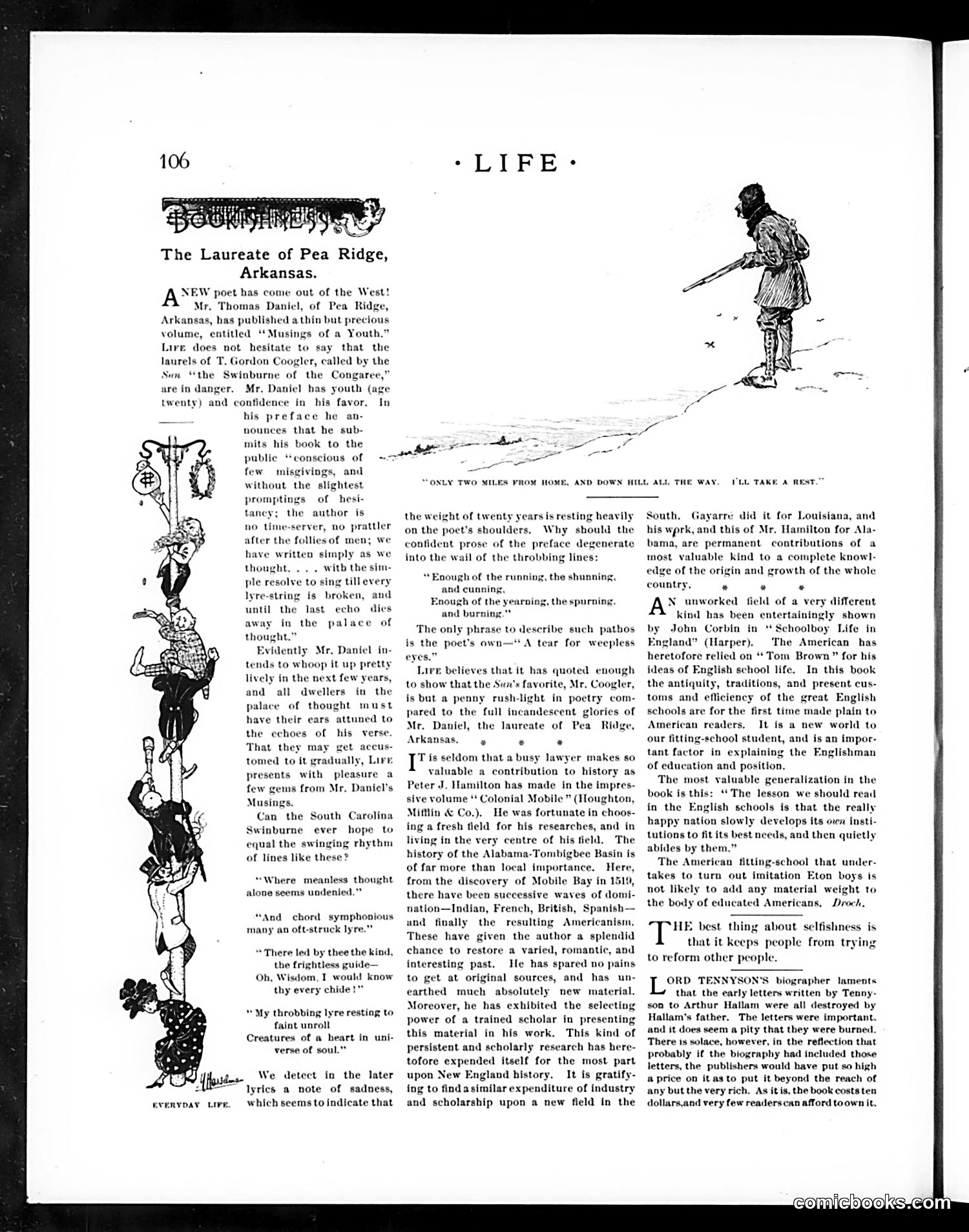
This page primarily features a literary review of Thomas Daniel's poetry collection from Pea Ridge, Arkansas, titled "The Swinburne of the Congaree." The accompanying illustration shows a man standing on a hillside with a rifle, captioned "Only two miles from home, and down hill all the way. I'll take a rest." The cartoon appears to be gentle rural humor rather than political satire—depicting a tired hunter taking a break during what seems an easy downhill walk home. The context suggests Life magazine is using this illustration to complement the literary discussion of Daniel's Southern poetry. The page includes several other short editorial items and quotes, including commentary on English schooling and Lord Tennyson's biography, but these are standard magazine content rather than satirical commentary.
📄 Transcribed text from this page (OCR, searchable)
Machine-transcribed from the original scan — historical spelling and the odd misread are preserved.
The Laureate of Pea Ridge, Arkansas. ANEW poet has come out of the West! Mr. Thomas Daniel, of Pea Rid Arkansas, has published a thin but precious volume, entitled ‘Musings of a Youth.” Lire does not hesitate to that the laurels of T. Gordon Coogler, called by the the Swinburne of the Congaree,” are in danger. Mr. Daniel has youth (age twenty) and confidence in his favor. In his preface he a nounces that he sub- mits his book to the public ‘conscious of few misgivings, and without the slightest promptings of tan the author is no time-server, no prattler after the follies of men; we have written simp thoug . witb the ple resolve to sing till eve! lyre-string is broken, and until the last echo dies away in the palace of thought.” Evidently Mr, Daniel in- tends to whoop it up pretty lively in the next few years, and all dwellers in the palace of thought must have their ears attuned to the echoes of his That they may get accus- tomed to it gradually, Li presents with pleasure a few gems from Mr. Daniel's Musings. Can the South Carolina Swinburne ever hope to equal the swinging rhythm of lines like these? Sun hesi- verse. “Where meantess thought alone seems undenie “And chord symphonious many an oft-struck lyre.” “There led by thee the kind, the frightless guide— Ob, Wisdom, I would know thy every chide!” “ My throbbing lyre resting to faint unroll Creatures of a heart in uni- verse of soul.” We detect in the later lyrics a note of sadness, evernvoay tre. which seems toindicate that “ONLY TWO MILES FROM HOME, AND DOWN the weight of twenty years is resting heavily on the poet’s shoulders. Why should the confident prose of the preface degenerate into the wail of the throbbing line: “Enough of the running, the shunning, and cunning, Enough of the yearning, the spurning. and burning.” The only phrase to describe such pathos is the poet's own—“ A tear for weepless Lire believes that it has quoted enough to show that the Sux's favorite, Mr. Coogler, is but a penny rush-light in poetry com- pared to the full incandescent glories of Mr. Daniel, the laureate of Pea Ridge, Arkansas. 9 * a T is seldom that a busy lawyer makes so valuable a contribution to history as Peter J. Hamilton has made in the impres- sive volume ‘ Colonial Mobile ” (Houghton, Mifflin & Co.). He was fortunate in choos- ing a fresh field for his researches, and in living in the very centre of his tield, The history of the Alabama-Tombigbee Basin is of far more than local importance. Hert from the discovery of Mobile Bay in 151! there have been successive waves of domi- nation—Indian, French, British, Spanish— and finally the resulting Americanism, These have given the author a splendid chance to restore a varied, romantic, and interesting past. He has spared no pains to get at original sources, and has un- earthed much absolutely new material. Moreover, he has exhibited the selecting power of a trained scholar in presenting this material in his work. This kind of persistent and scholarly research has bere- tofore expended itself for the most part upon New England history. It is gratify- ing to finda similar expenditure of industry and scholarship upon a new fleld in the ALL THE WAY. LL TARE A REST.” South. Gayarre did it for Louisiana, and his wprk, and this of Mr, Hamilton for Ala- bama, are permanent contributions of a most valuable kind to a complete knowl- edge of the origin and growth of the whole country, * * . AS, smorked field of a very different kind has been entertainingly shown John Corbin in “Schoolboy Life in England” (Harper). ‘The American has heretofore relied on “Tom Brown ” for his ideas of English school life. In this book the antiquity, traditions, and present cus- toms and efficiency of the great English schools are for the first time made plain to American readers, It is a new world to our fitting-*chool student, and is an impor- tant factor in explaining the Englishman of education and position. The most valuable generalization in the book is this: The lesson we should read in the English schools is that the really happy nation slowly develops its own insti- tutions to fit its best needs, and then quietly abides by them.” The American fitting-school that under- takes to turn out imitation Eton boys is not likely to add any material weight to the body of educated Americans, Droch, HE best thing about selfishness is that it keeps people from trying to reform other people. ORD TENNYSON'S biographer laments that the early letters written by Tenny- son to Arthur Hallam were all destroyed by Hallam's father. The letters were important. and it does seem a pity that they were burned. There is solace, however, in the reflection that probably if the biography had included those letters, the publishers would have put so high a price on it as to put it beyond the reach of any but the very rich. As it is, the book costs ten dollars.and very few readers can afford toown it.