
Life, 1898-02-10 · page 15 of 20
Life — February 10, 1898 — page 15: what you’re looking at
What you’re looking at
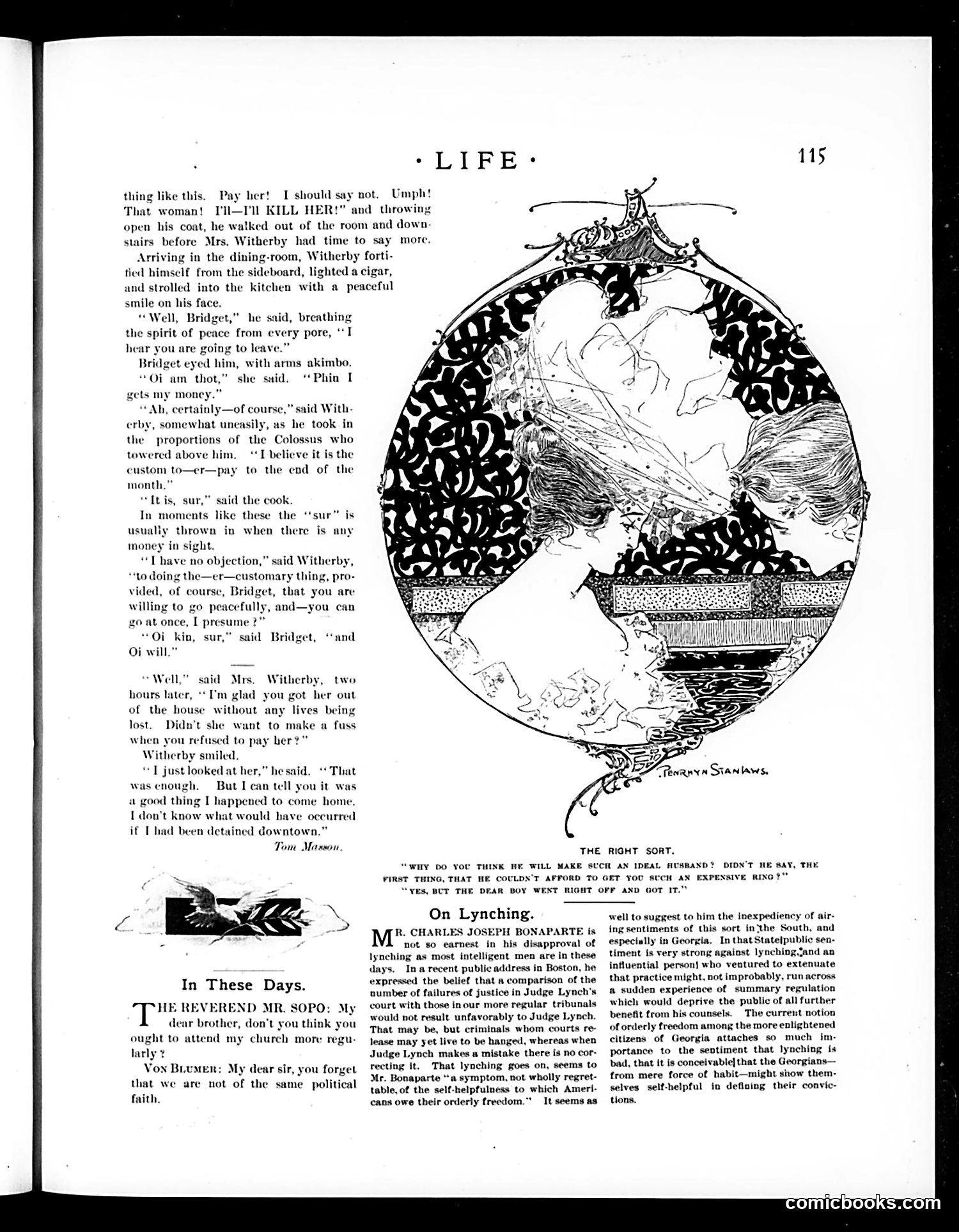
This *Life* magazine page contains three distinct pieces of satirical content: **"The Right Sort" cartoon** (top right): A couple discusses an engagement ring. The woman praises her fiancé for claiming he couldn't afford an expensive ring—then buying one anyway. The satire mocks both the couple's superficiality and the performative modesty of the wealthy. **"In These Days" dialogue**: A brief exchange where Reverend Sopo asks a parishioner to attend church more regularly, but the man refuses due to political differences. The title suggests this represents modern secular attitudes—people prioritizing politics over faith. **"On Lynching"**: A serious editorial attacking Charles Joseph Bonaparte (a real public figure—Roosevelt's Secretary of the Navy), who recently defended lynching as evidence of American self-reliance. *Life* sarcastically warns Bonaparte that expressing such views in Georgia could get him killed by a mob—essentially arguing that if he believes lynching represents "orderly freedom," he shouldn't be surprised if Georgians apply that logic to him.
📄 Transcribed text from this page (OCR, searchable)
Machine-transcribed from the original scan — historical spelling and the odd misread are preserved.
thing like this. Pay her! That woman! T'N—I'll KILL HER I should say not. and throwing Umph! open his coat, he watked out of the room and down stairs before Mrs. Witherby had time to say more. Arrivi x in the dining-room, Witherby forti- fied himself from the sideboard, lighted a cigar, and strolled into the smile on his face. “Well, Bridget,” he said, breathing the spirit of peace from every pore, ‘I hear you are going to leave.” Bridget eyed him, with arms akimbo. “Oi am thot,” she said. ‘Phin I gets my money “Ah, certainly crby, the tov of course,” said With- somewhat uneasily, as he took in proportions of the Colossus who red above him. ‘‘I believe it is the custom to—er—pay to the end of the month,” “Ttis, sur, id the cook. In moments like these usually thrown in money in sight. “T have no obje the ‘sur” is when there is any ion,” said Witherby, “to doing the—er—customary thing, pro- vided, of course, Bridget, that you are willing to go peacefully, and—you can goat once, I presume ?” “Oi kin, sur,” said Bridget, Oi will.” “and Well,” id Mrs. Witherby, two hours later, “I'm glad you got her out of the house without any lives being lost. Didn't she want to ma when you refused to pay he Witherby smiled. “T just looked at her,” was cnough. ke a fuss hesaid. ‘That But I can tell you it was a good thing I happened to come home. I don't know what would have occurred if I had been detained downtown.” Tom Masson In These Days. HE REVEREND MR. SOPO: dear brother, don't you thin ought to attend my church more regu- larly ¢ Vow Buumen: My dear sir, you forget that we are not of the same political faith. My itchen with a peaceful Ht Hl ini irae (i) HAWG THE RIGHT SORT. “WHY pO YOU THINK HF WILL MAKE SUCIL AN IDEAL HUSBAND! DIDN'T HE SAY, THE FIRST THING, THAT HE COULDN'T AFFORD TO GET YOU SUCH AN EXPENSIVE RING t** “YES, BUT THE DEAR BOY WENT RIGHT OFF AND GOT IT.” On Lynching. R. CHARLES JOSEPH BONAPARTE is not so earnest in his disapproval of lynching as most intelligent men are in these days. Ina recent public address in Boston, he expressed the belief that a comparison of the number of failures of justice in Judge Lynch's court with those inour more regular tribunals would not result unfavorably to Judge Lynch. That may be, but criminals whom courts re- lease may yet live to be hanged, whereas when Judge Lynch makes a mistake there is no cor- recting it. That lynching goes on, seems to Mr. Bonaparte “a symptom, not wholly regret- table, of the self-helpfulness to which Ameri- cans owe their orderly freedom.” It seems as. well to suggest to him the Inexpediency of air- ing sentiments of this sort inYhe South, and especially in Georgia. In thatStatelpublic sen- timent fs very strong against lynchingand an influential person} who ventured to extenuate that practice might, not improbably, run across a sudden experience of summary regulation which would deprive the public of all further benefit from his counsels. The curreut notion of orderly freedom among the more enlightened citizens of Georgia attaches so much im- portance to the sentiment that lynching is bad, that it is conceivable]that the Georgians— from mere force of habit—might show them- selves self-helpful in defloing their convic- tions.