
A complete issue · 26 pages · 1898
Life — January 20, 1898
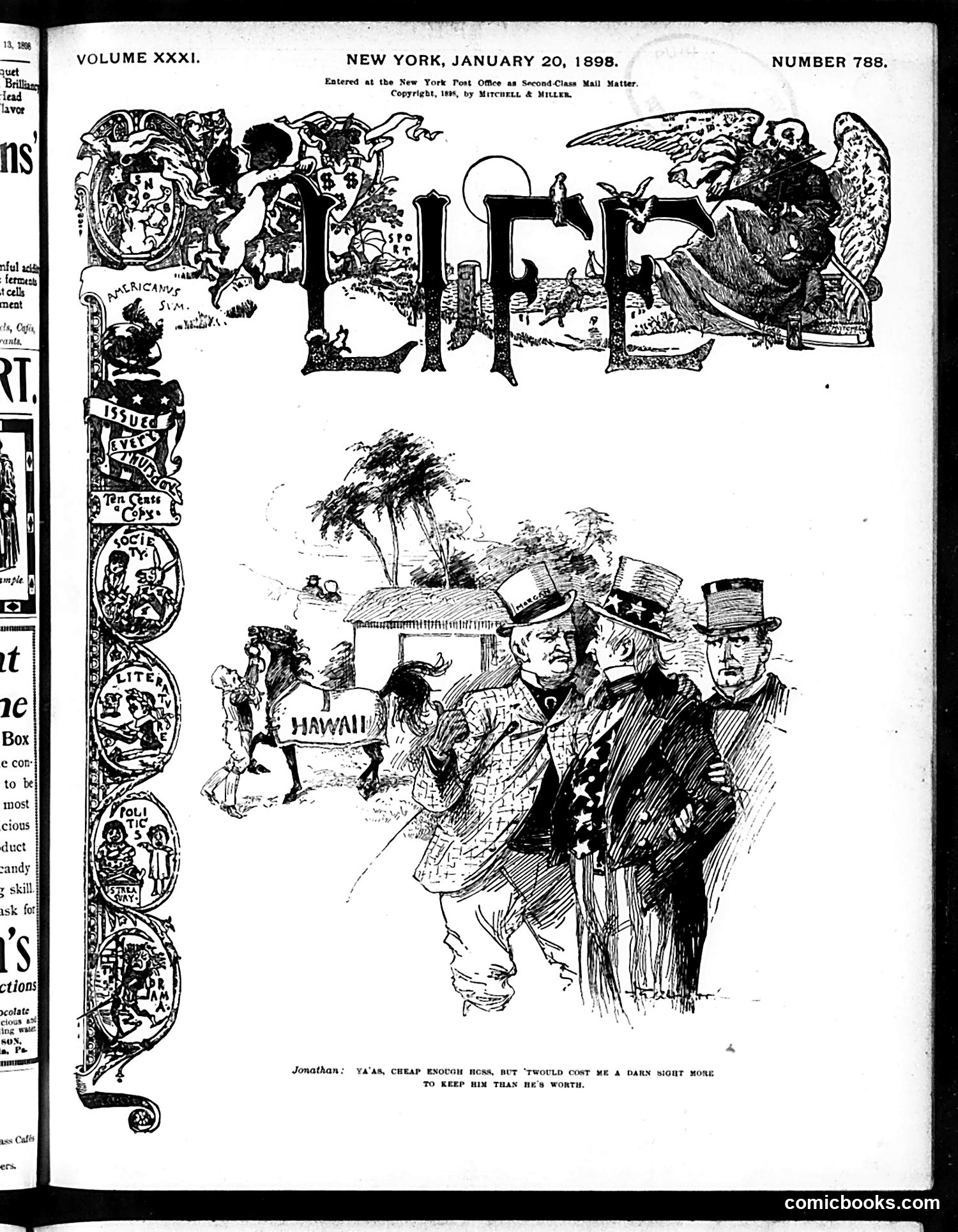
This page contains a political cartoon satirizing American imperial ambitions in Hawaii. The main illustration shows three well-dressed men in top hats standing on Hawaiian soil beside a "Hawaii" sign, with native figures in the background. The caption reads: "YA'AS, CHEAP ENOUGH HOSS, BUT 'TWOULD COST ME A DARN SIGHT MORE TO KEEP HIS THAN HE'S WORTH." The cartoon critiques the acquisition of Hawaii, likely following the 1898 annexation debate. The "cheap enough" reference suggests the initial purchase price seemed reasonable, but maintaining control—politically and militarily—would prove costly. The caricatured figures represent American political/business interests pursuing imperial expansion, while the native presence underscores the displacement of Hawaii's existing population and sovereignty.
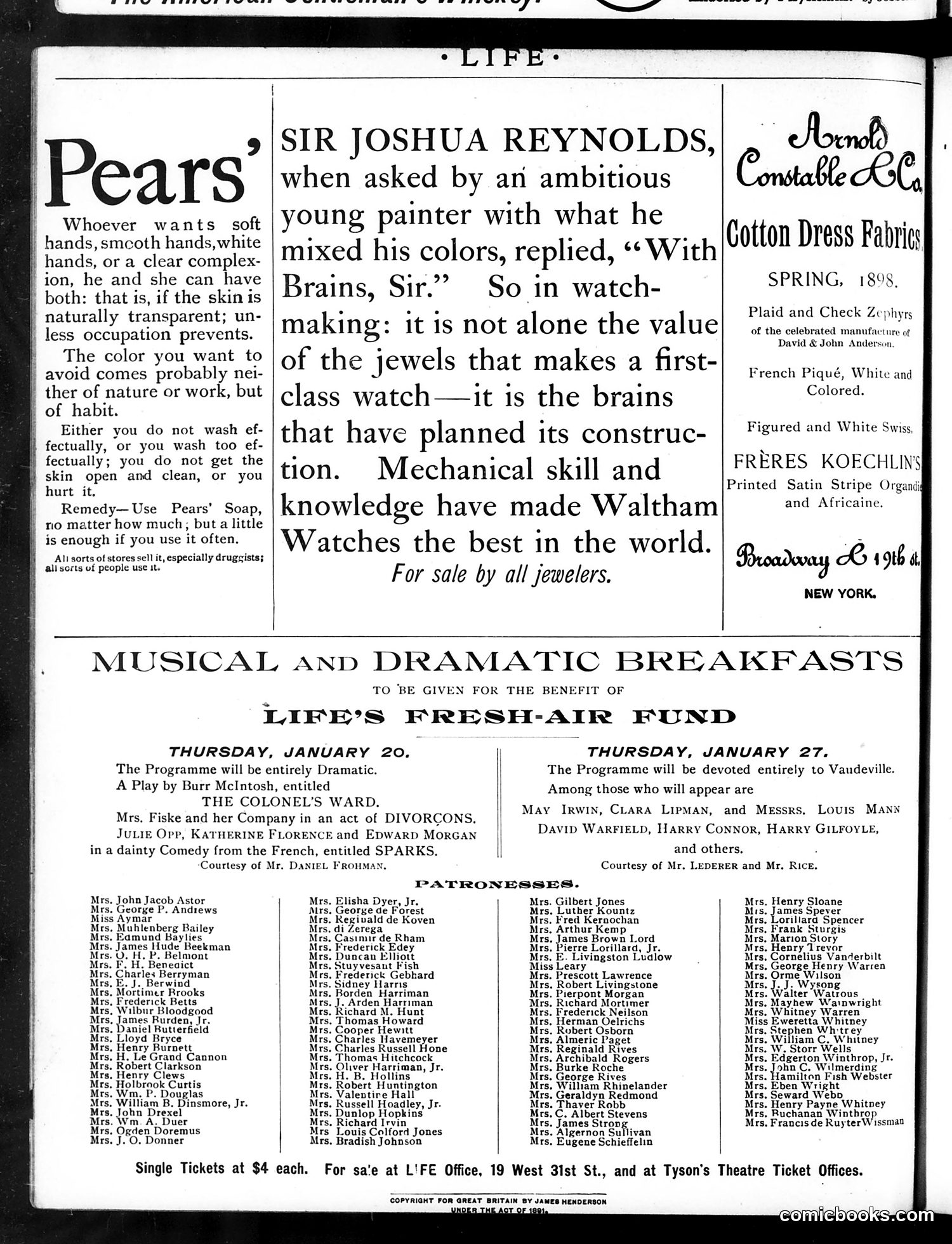
This page contains **no political cartoons or satirical illustrations**. Instead, it consists primarily of advertisements and event announcements: 1. **Pears' Soap ad** - Uses a quote attributed to Sir Joshua Reynolds about mixing colors "with brains" to advertise the soap's benefits for skin clarity. 2. **Waltham Watches ad** - Emphasizes that quality watches require both mechanical skill and intellectual planning ("brains"). 3. **Cotton Dress Fabrics ad** - Announces spring 1898 fabric collections. 4. **Musical and Dramatic Breakfasts** - Announces two charity events for Life's Fresh-Air Fund, featuring theatrical performances and listing numerous society patronesses. The page is essentially a **society/entertainment/commercial document** with no satirical content to decode.
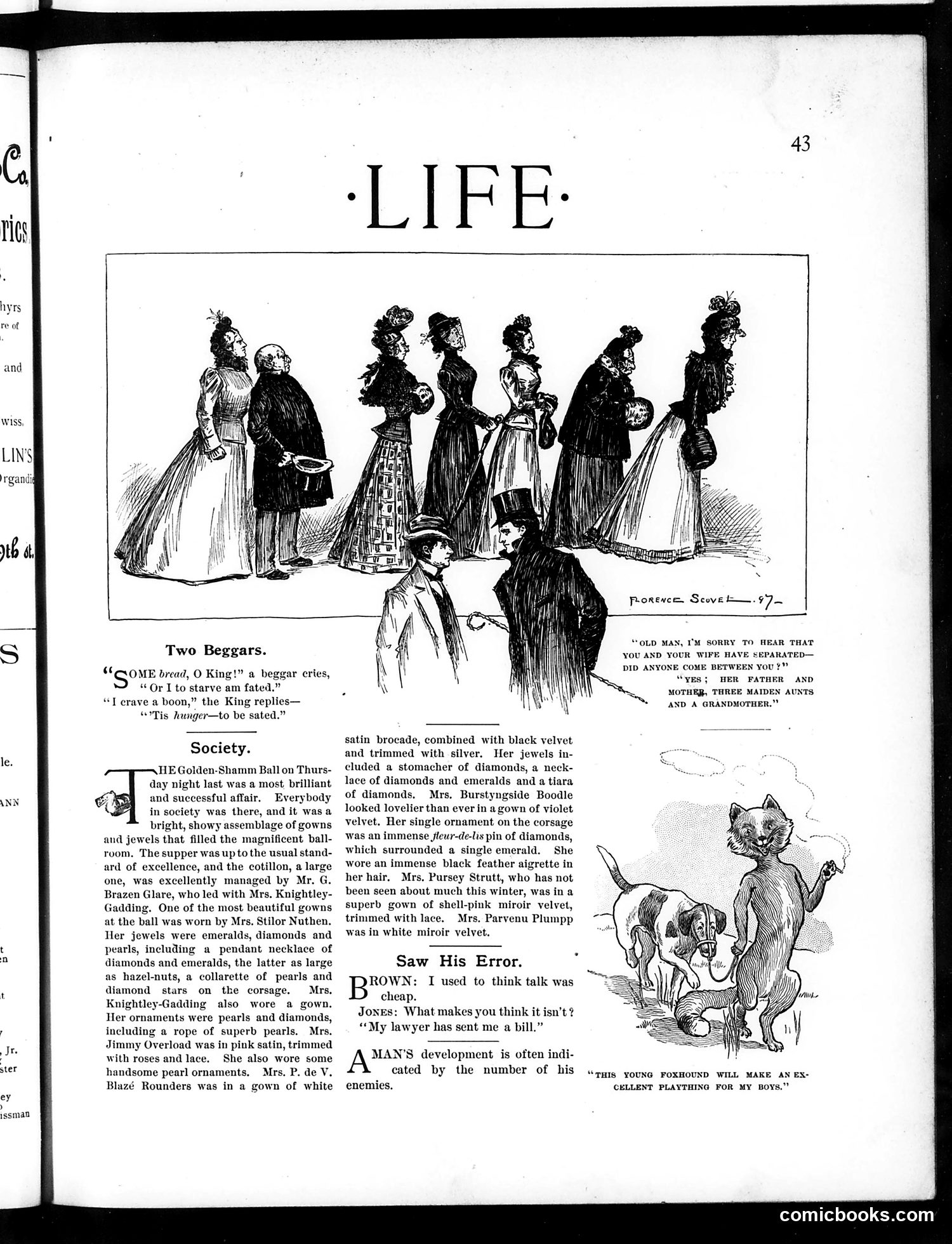
**"Two Beggars" (Top):** A crude joke where a beggar asks a king for bread or money to avoid starvation. The king replies "Tis hunger—to be sated," a sardonic dismissal suggesting the beggar's hunger is merely temporary appetite rather than genuine need. The satire mocks aristocratic indifference to poverty. **"Society" (Middle Section):** Describes a fashionable ball featuring elite women in elaborate gowns adorned with expensive jewels—diamonds, emeralds, pearls, and velvet. The detailed catalog of luxury items and designer names appears to mock the conspicuous consumption and vanity of high society. **"Saw His Error":** A brief comic dialogue where Jones's lawyer has sent him a bill, prompting Brown to reconsider his assumption that talk is cheap—implying lawyers' expensive advice contradicts the saying.
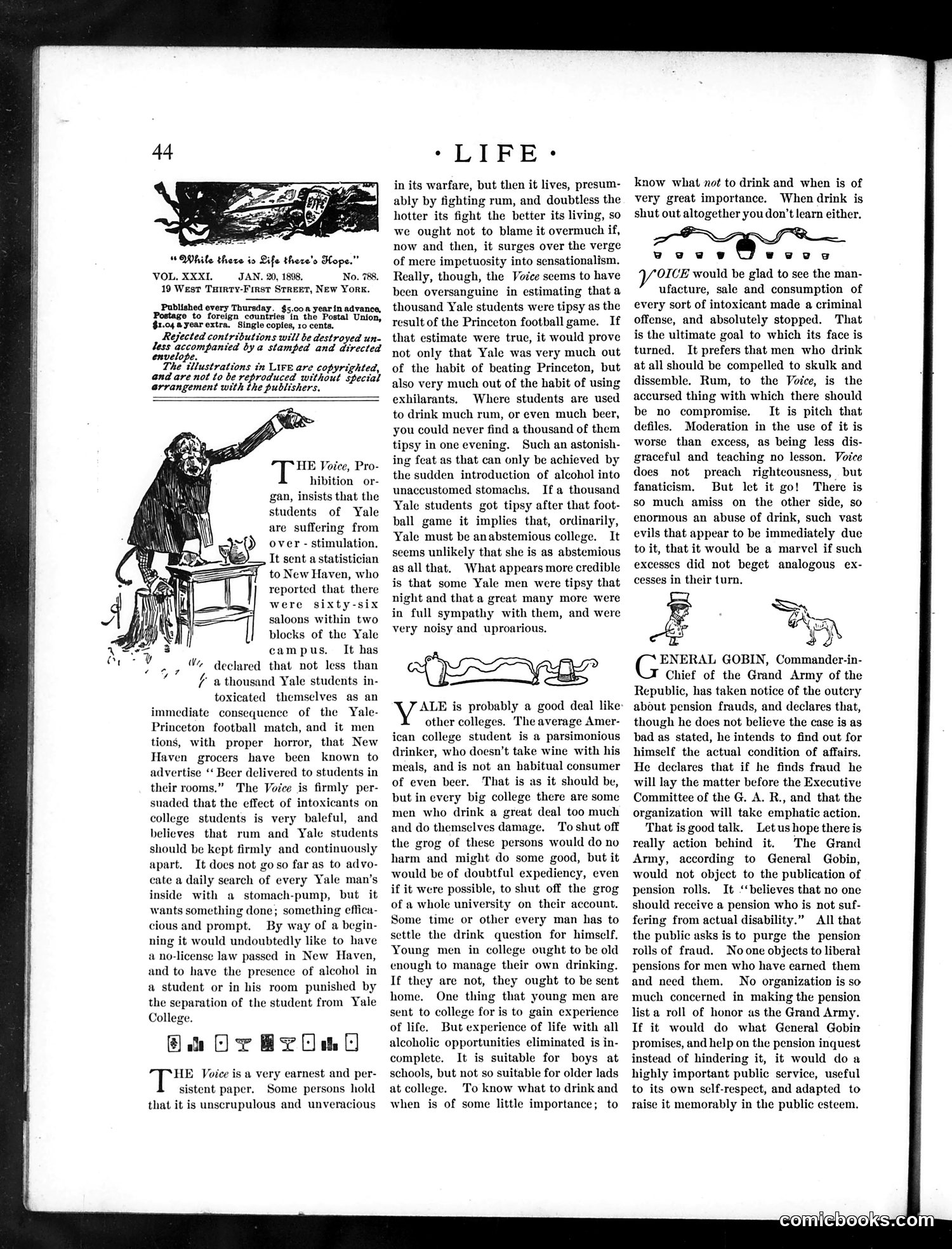
This page contains editorial commentary on college drinking, specifically addressing Yale University's alcohol consumption habits. The text criticizes excessive drinking among Yale students while defending moderate consumption. The left illustration depicts a figure (likely representing a Yale student) operating what appears to be a stomach pump—a visual metaphor for the serious consequences of overindulgence. The cartoon sardonically suggests that excessive drinking requires medical intervention. The editorial argues that Yale students are "tipsy" more often than students at other colleges, attributing this partly to the "sudden introduction of alcohol into unaccustomed stomachs." The author advocates for education about responsible drinking rather than total prohibition. The page also references General Gobin's concerns about pension fraud, but the primary focus remains college drinking culture and its social implications.
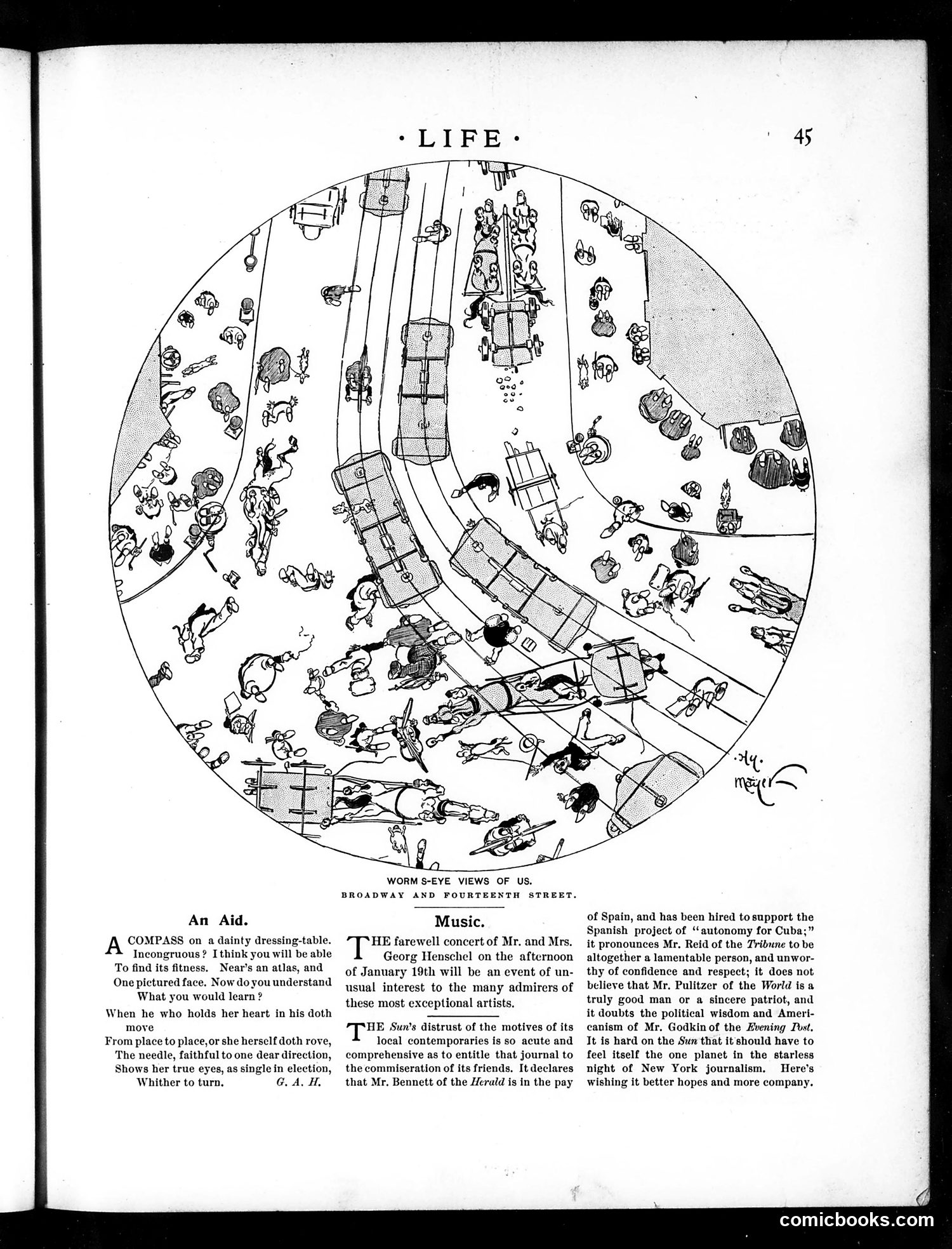
This is a bird's-eye satirical illustration of urban life in New York City, showing the chaos and density of pedestrian and vehicle traffic from above. The "worm's-eye view" title is ironic—we're looking down, not up. The cartoon depicts the crowded intersection of Broadway and Fourteenth Street with hundreds of tiny figures: pedestrians, carriages, street vendors, and urban activity rendered as a chaotic, interconnected mass. It satirizes modern city life's frenetic pace and overcrowding. The accompanying text discusses unrelated topics (a compass, dressing-table incongruities, and music criticism), suggesting this is a typical Life magazine page mixing illustration with miscellaneous commentary. The satire targets urban congestion and the absurdity of metropolitan existence.
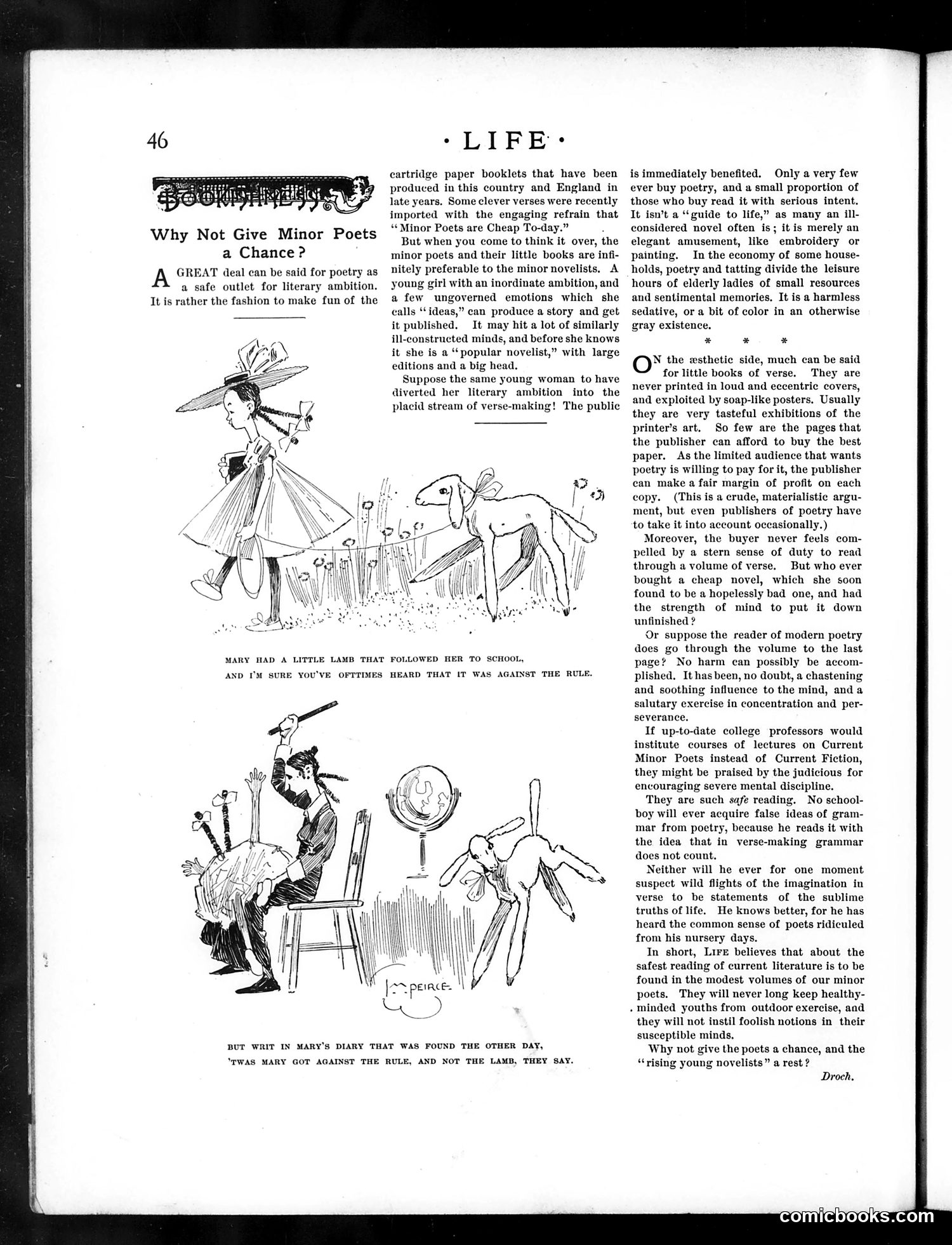
This page satirizes the publishing industry's dismissal of minor poetry. The article argues that young, ambitious poets deserve opportunities despite producing inferior work—suggesting this would benefit them more than reading novels. The cartoons mock the absurdity of this position through two scenes: 1. **Top cartoon**: A girl scattering pages labeled with nursery rhymes ("Mary Had a Little Lamb"), suggesting minor poetry is childish. 2. **Bottom cartoon**: Someone writing in a diary about breaking rules, with a lamb present, extending the nursery-rhyme mockery. The satire's point: Publishing minor poets isn't a kindness—their poorly-executed work wastes readers' time and won't develop young writers' talents. The author ("Droch") advocates instead for college courses on established minor poets and warns against promoting mediocre verse to impressionable youth.
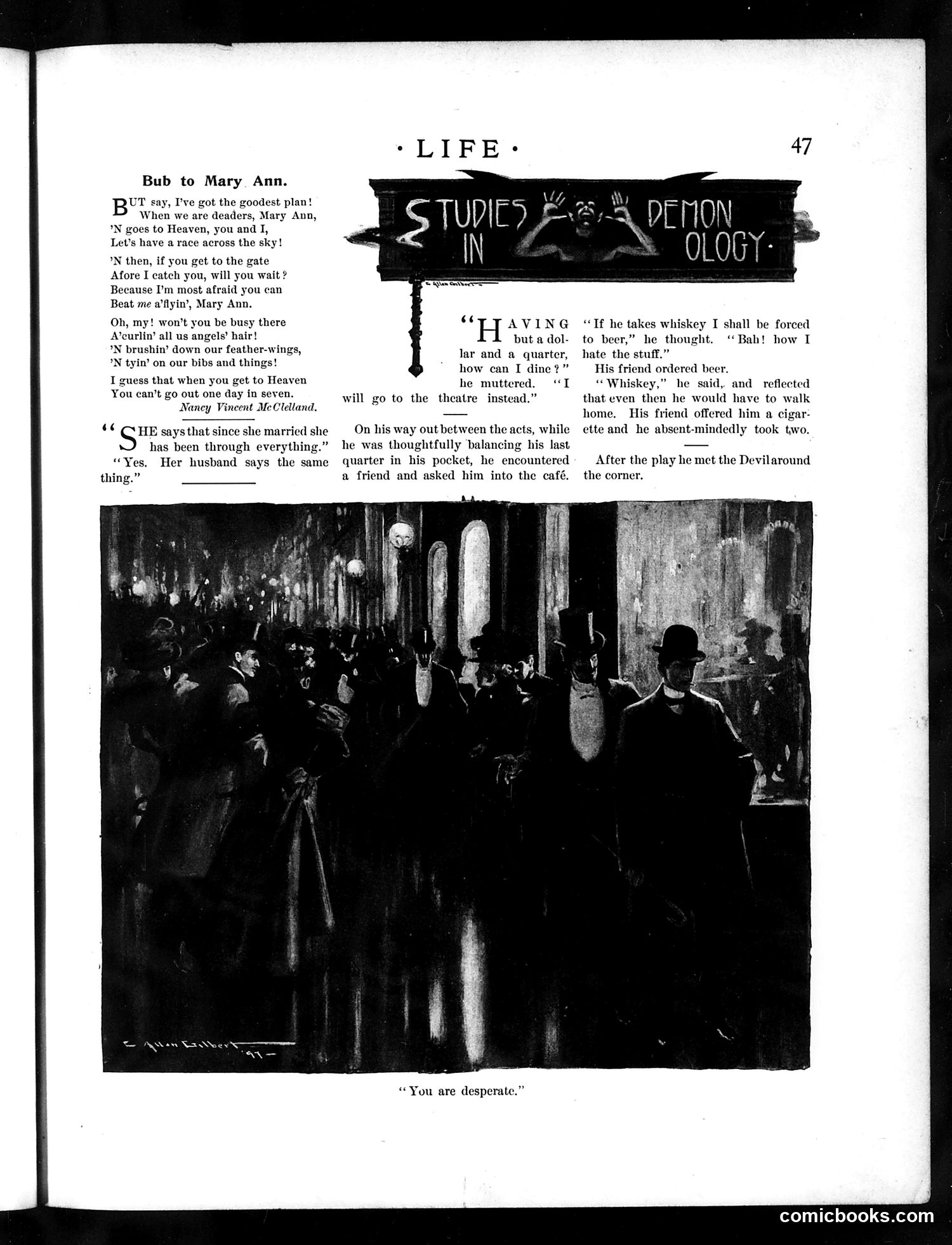
This page contains a humorous short story titled "Studies in Demonology" about a man who refuses alcohol at a theater intermission, choosing instead to attend a play. The narrative suggests this abstinence is unusual or noteworthy behavior. The accompanying illustration shows a crowded street scene with the caption "You are desperate," depicting what appears to be an urban nightlife setting, possibly a red-light district or entertainment area. The satire targets **Prohibition-era social attitudes**, mocking the idea that avoiding alcohol—or preferring theater to drinking—would be considered abnormal or even desperate behavior. The joke critiques how thoroughly drinking culture had permeated American social life that sobriety seemed remarkable or pitiable. The poem "Bub to Mary Ann" above reinforces themes of youthful mischief versus propriety.
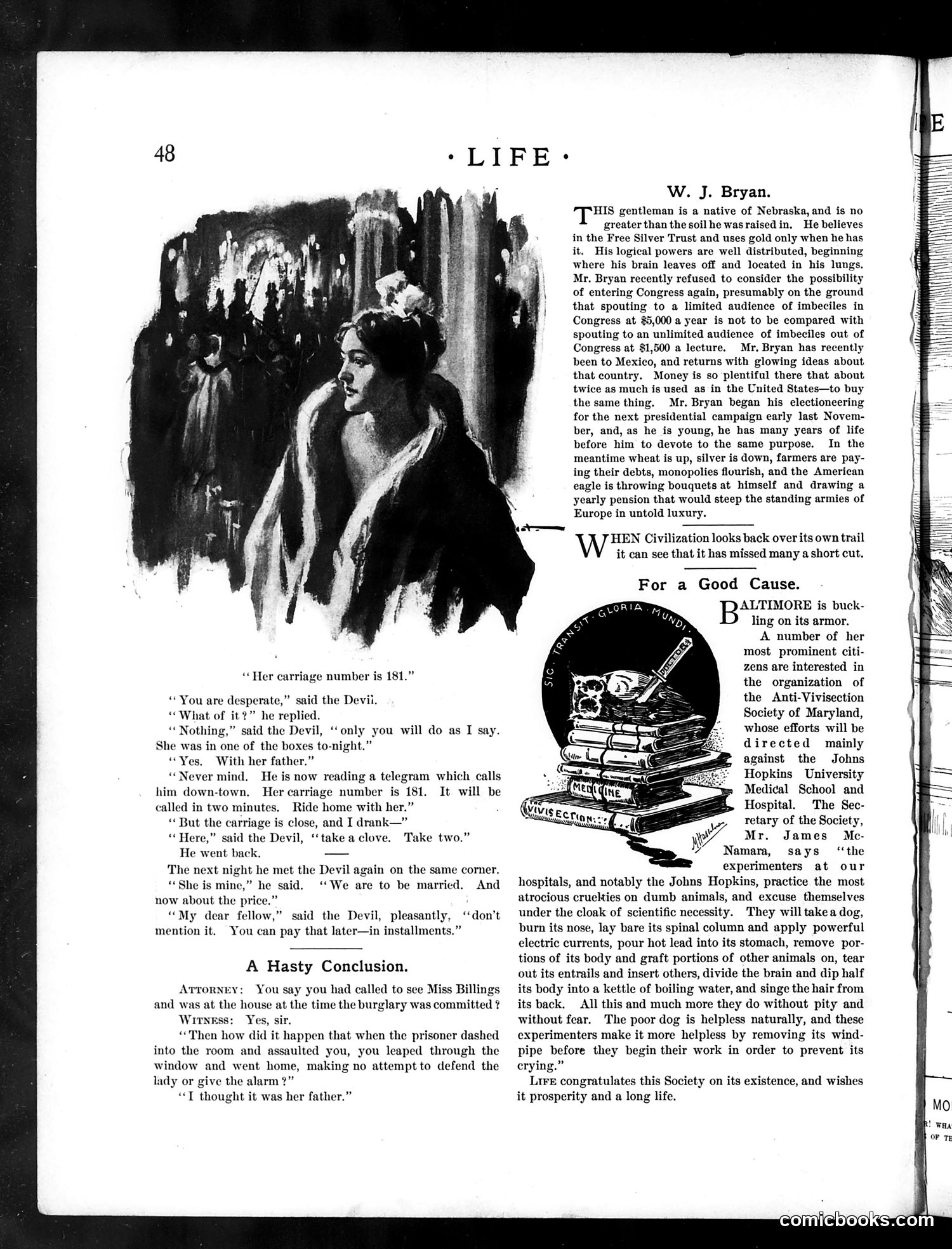
This page contains two distinct pieces: **Left side:** A sketch-illustrated story titled "A Hasty Conclusion" depicting a legal proceeding. An attorney cross-examines a witness about a burglary, asking how the prisoner escaped when the witness allegedly leaped through a window. The witness's reply—"I thought it was her father"—suggests mistaken identity as the punchline, playing on assumptions about who might be present during a crime. **Right side:** An article about W.J. Bryan (likely William Jennings Bryan, the prominent politician), followed by "For a Good Cause," which criticizes the Johns Hopkins University Medical School's vivisection practices. The Anti-Vivisection Society of Maryland opposes animal experimentation there, describing specific cruel procedures performed on dogs in the name of scientific research. Both pieces reflect early 20th-century concerns about legal procedures, political figures, and animal welfare activism.
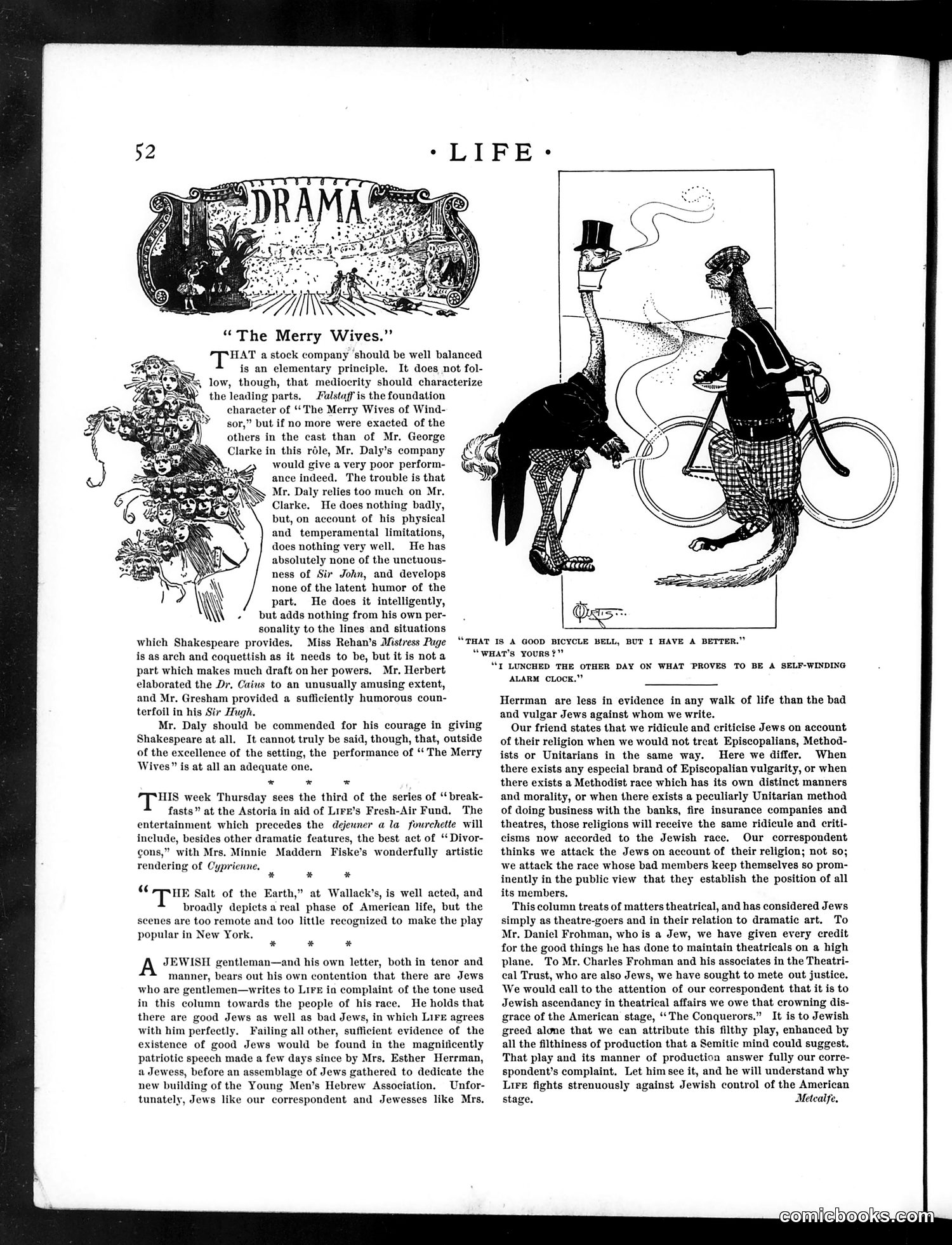
This page discusses theatrical productions, primarily reviewing "The Merry Wives of Windsor." The main illustration shows two figures on a bicycle—one wearing a top hat blowing a horn, the other in Victorian dress. The caption quotes: "That is a good bicycle bell, but I have a better. What's yours?" / "I lunched the other day on what proves to be a self-winding alarm clock." The joke appears to be a visual pun about noisemaking devices: the bicycle bell versus someone's stomach making noise (the "self-winding alarm clock"), likely referencing indigestion. The text below criticizes the theatrical production's performance quality and discusses antisemitic stereotypes in theater and press, defending Jewish involvement in theatrical enterprises. The satire targets prejudiced attitudes rather than a specific political figure.
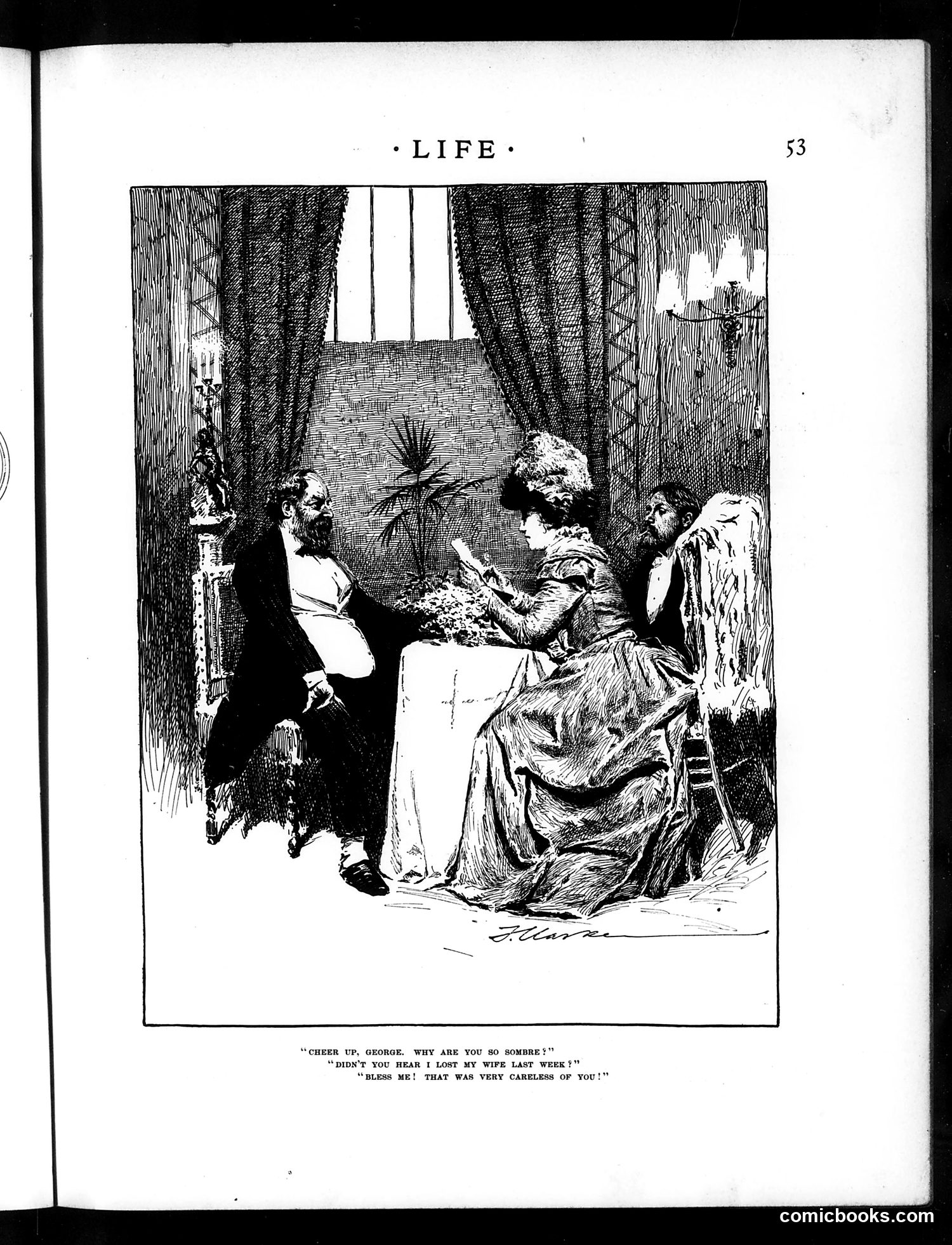
This illustration depicts a social comedy scene in an elegant interior. A well-dressed man appears somber while a woman seated nearby tries to cheer him up. The dialogue reads: "CHEER UP, GEORGE. WHY ARE YOU SO SOMBRE?" / "DIDN'T YOU HEAR I LOST MY WIFE LAST WEEK?" / "BLESS ME! THAT WAS VERY CARELESS OF YOU!" The satire mocks upper-class social pretense and marital indifference. The woman's response to George's "loss" of his wife—treating it as a matter of carelessness rather than tragedy—satirizes how wealthy society figures maintain superficial politeness while remaining emotionally detached and oblivious. The joke hinges on the absurd understatement, suggesting that among certain social circles, even losing one's spouse was treated with casual dismissal rather than genuine concern.
This page contains editorial commentary on drinking culture at Yale University. The text criticizes excessive alcohol consumption among Yale students, reporting that "not less than a thousand Yale students in two blocks of the Yale campus" had intoxicated themselves following a football game. The cartoon (left) depicts a skeletal "Death" or Grim Reaper figure serving drinks at what appears to be a bar or table, visualizing the danger of overconsumption. The editorial argues against both prohibition and moral fanaticism, instead advocating for responsible drinking habits among college men. It references General Goblin, Commander-in-Chief of the Grand Army of the Republic, regarding pension fraud concerns. The satire targets Yale's drinking problem as emblematic of broader college culture, mocking both student excess and institutional hypocrisy.
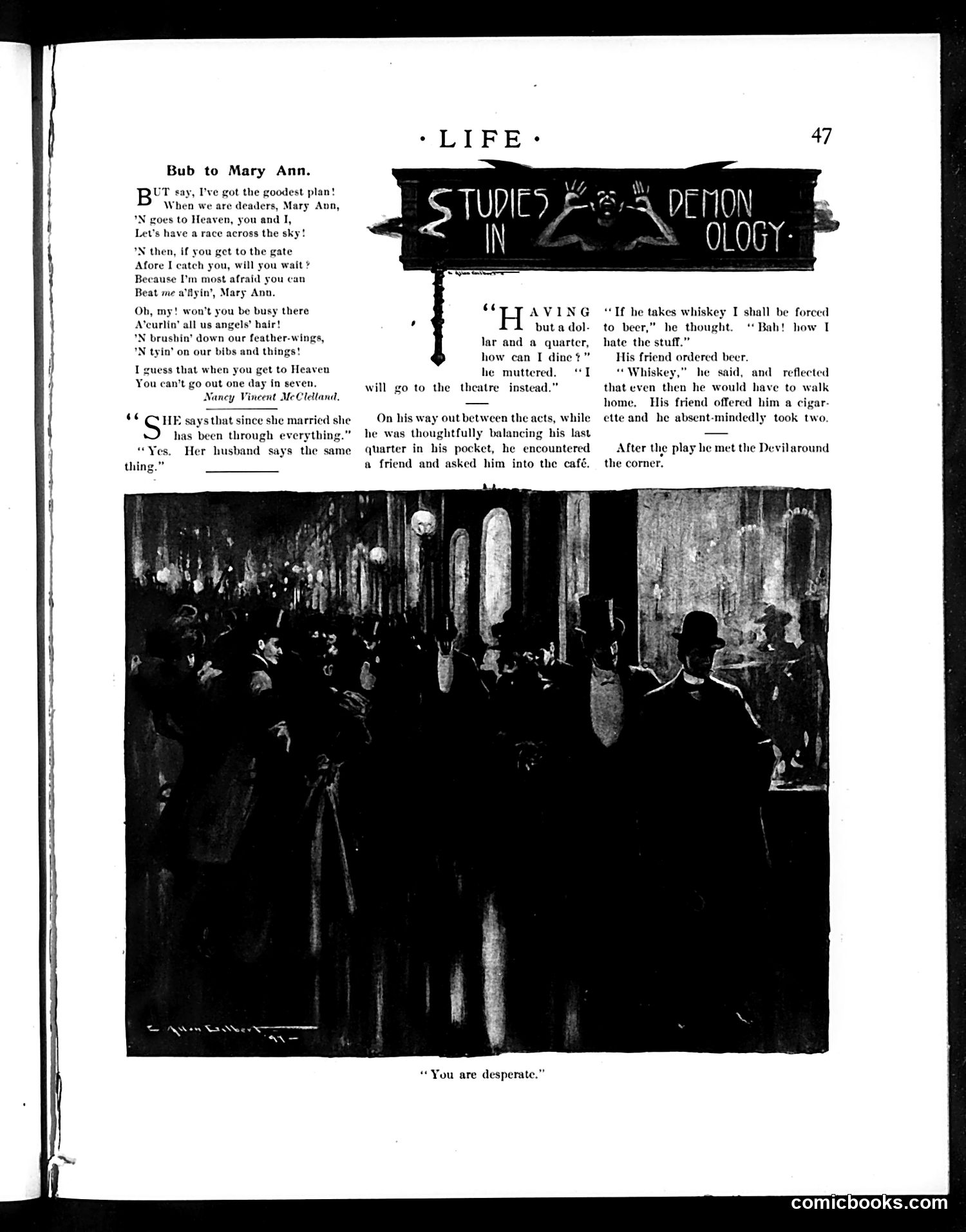
**Left: "Bub to Mary Ann"** (by Nancy Vincent McClelland) A sentimental children's dialogue imagining Heaven. A boy and girl plan to race across the sky after death, with the boy playfully worried the girl will beat him flying. The humor lies in the domestic, mundane details—Mary Ann will be busy curling angels' hair and tying bibs—deflating romantic notions of the afterlife into household drudgery. **Right: "Studies in Demonology"** A brief comic anecdote: A man with only a dollar and quarter debates whether to dine or see theatre. He chooses theatre, but encounters a friend who invites him to the café. Forced to choose between whiskey and beer (both expensive), he orders whiskey and walks home broke. The final line—"After the play he met the Devil around the corner"—suggests his financial desperation and moral compromise have infernal consequences. The satire targets urban poverty and the precarious economics of working-class leisure.
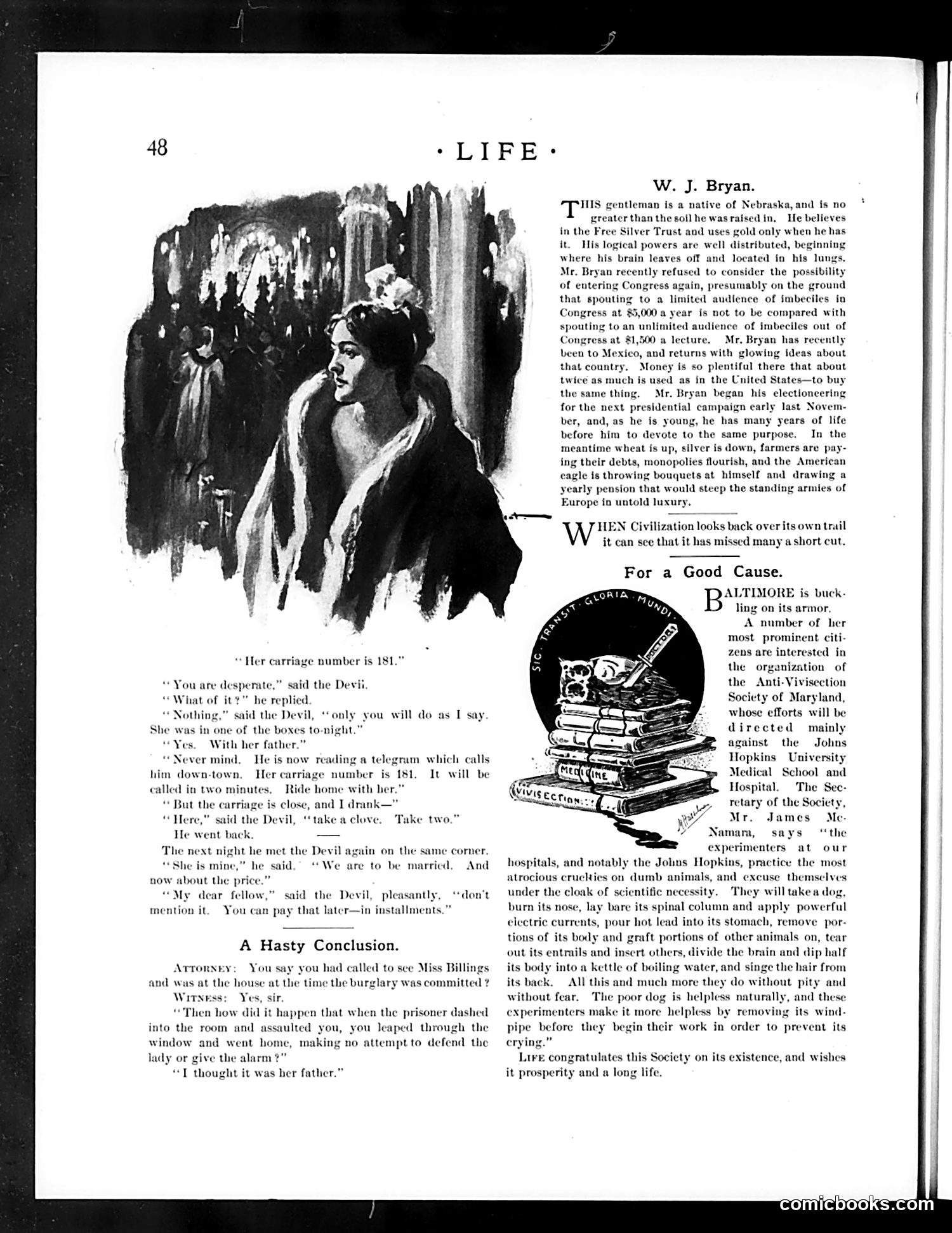
This Life magazine page contains three distinct pieces of satirical content: 1. **"A Hasty Conclusion"** (legal cartoon): A humorous courtroom exchange where a witness admits he leaped through a window during a burglary because he thought the assailant was the woman's father—implying he feared her father's disapproval more than actual danger. 2. **W.J. Bryan profile** (right column): A scathing political attack on William Jennings Bryan, the three-time presidential candidate. The satire mocks his "Free Silver" advocacy, his speaking career (suggesting he profits more lecturing outside Congress than serving in it), and his recent trip to Mexico. The piece suggests his policies help no one while criticizing his ongoing presidential ambitions. 3. **"For a Good Cause"** (lower right): An article supporting Baltimore's Anti-Vivisection Society, which opposed animal testing at Johns Hopkins Medical School. It describes graphic experimental procedures on animals, arguing they're unnecessarily cruel despite scientific justification. The page reflects Progressive Era debates: currency policy, political ambition, and animal welfare.
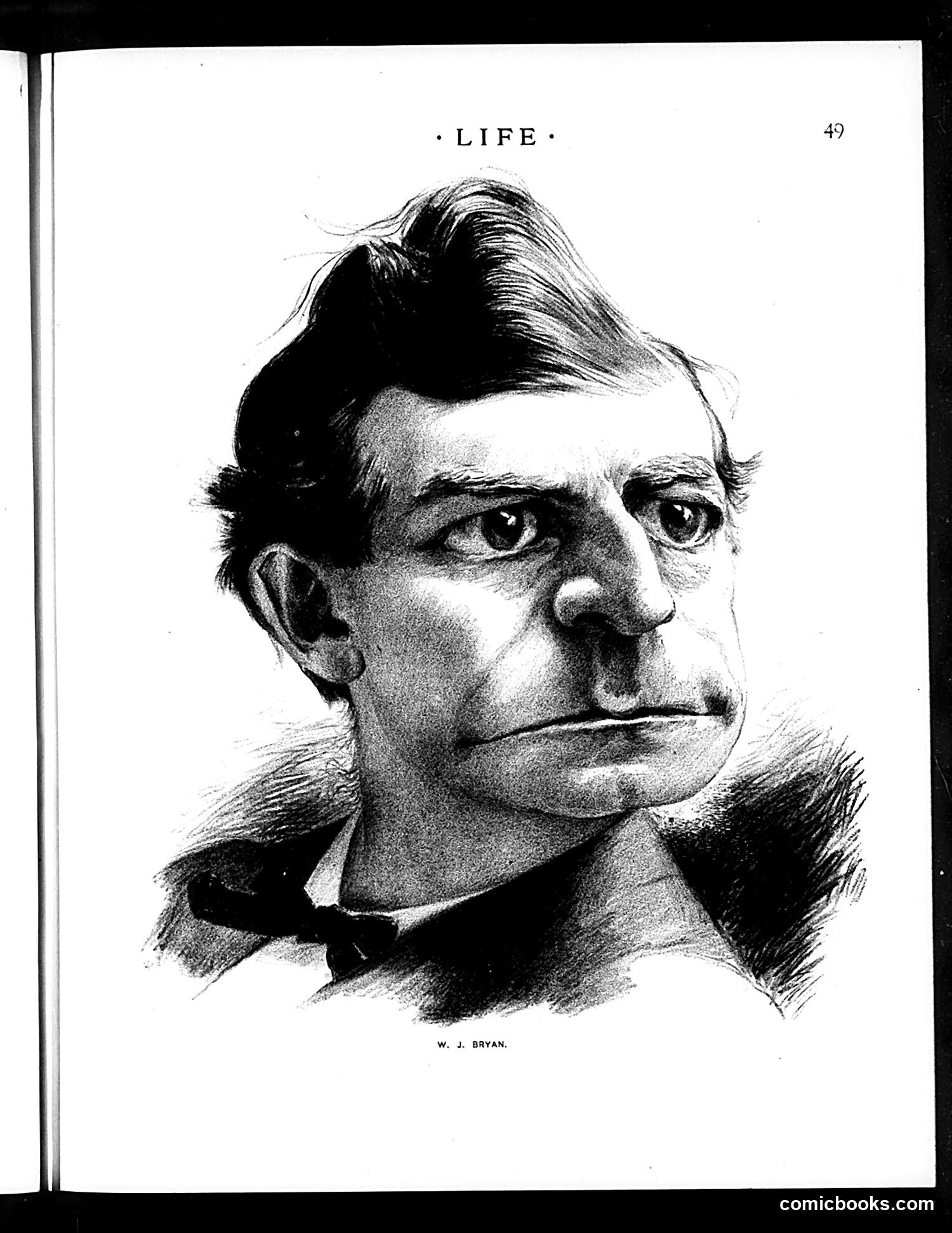
This page from *Life* magazine (page 49) features a portrait sketch labeled "W. J. Bryan"—William Jennings Bryan, the prominent American politician and three-time presidential candidate (1896, 1900, 1908). The sketch is a straightforward portrait rather than a satirical cartoon. Bryan was a major political figure known for his populist rhetoric, particularly his famous "Cross of Gold" speech. By the early 1900s when this appears to have been published, Bryan remained a significant (if controversial) Democratic Party figure. The portrait's inclusion in *Life*—a satirical magazine—suggests Bryan was newsworthy enough to warrant feature coverage, though without additional context or commentary visible here, the specific satirical intent is unclear.
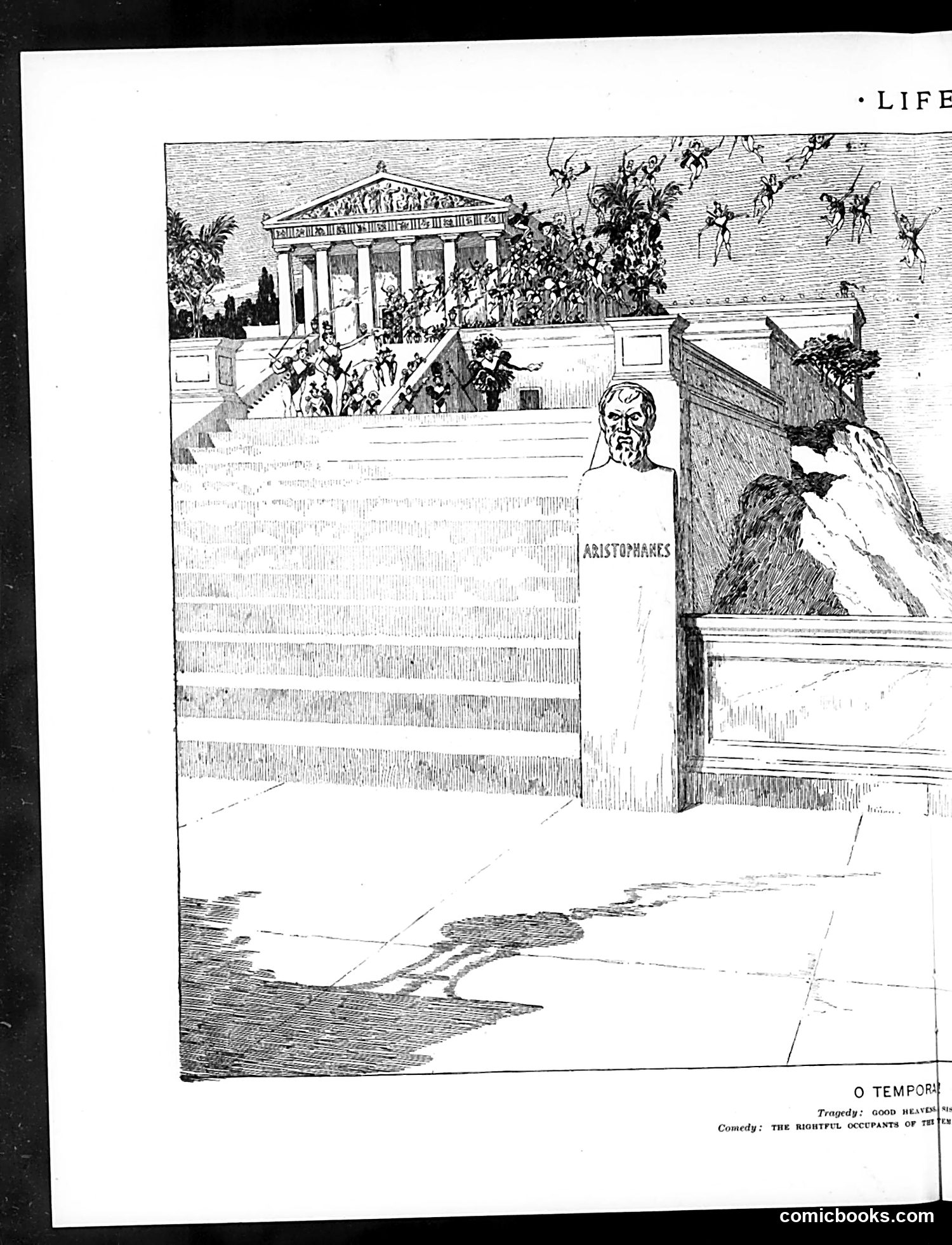
This appears to be a satirical illustration from Life magazine showing a classical Greek or Roman temple with a bust labeled "ARISTOPHANES" positioned prominently in the foreground. The temple in the background contains numerous figures, suggesting a gathering or assembly. The caption references both "Tragedy" and "Comedy," with mentions of "good heavens" and "the rightful occupants of the [temple]." Given Aristophanes was an ancient Greek comic playwright, this likely satirizes a contemporary debate about who legitimately deserves prominence or authority—possibly critiquing who holds cultural or political authority. The contrast between the solitary bust in front and the crowd within suggests commentary on individual versus collective power or representation. Without the complete OCR text or publication date, the specific political target remains unclear.
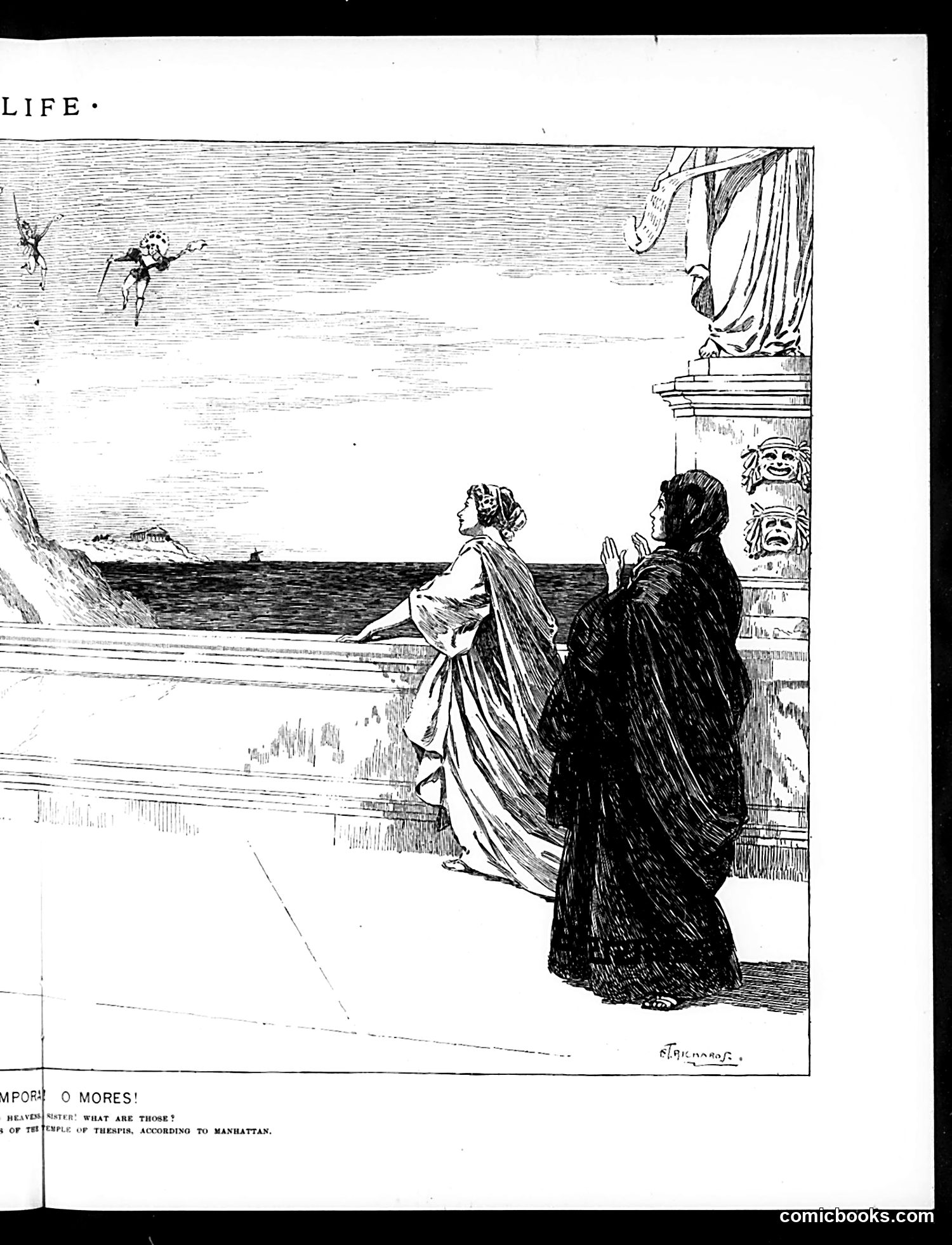
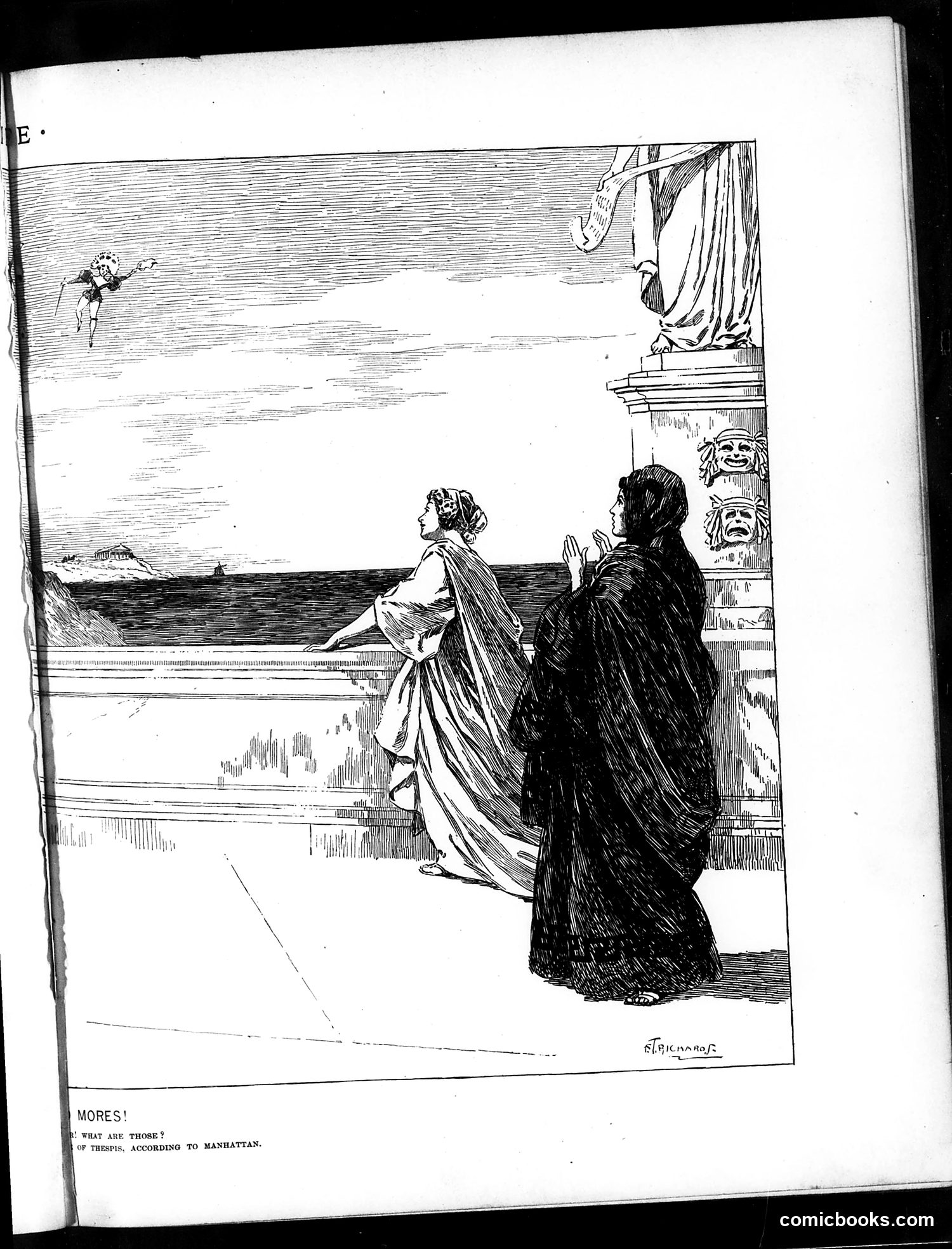
This satirical cartoon shows two women observing figures flying/leaping in the sky above Manhattan's skyline. The caption references the classical Latin phrase "O tempora, o mores!" ("Oh the times! Oh the customs!") — a traditional expression of moral outrage at societal decline. The joke appears to critique modern New York society by depicting scandalously dressed or behaving performers as if they were part of a "Temple of Thespis" (the legendary founder of Greek drama). One woman asks what these acrobatic figures are, implying shock at contemporary entertainment standards. The satire suggests that modern Manhattan theater and performance have become morally questionable compared to classical ideals — the cartoonist uses the Latin phrase ironically to mock both the performers' behavior and perhaps elite observers' hand-wringing about declining standards.
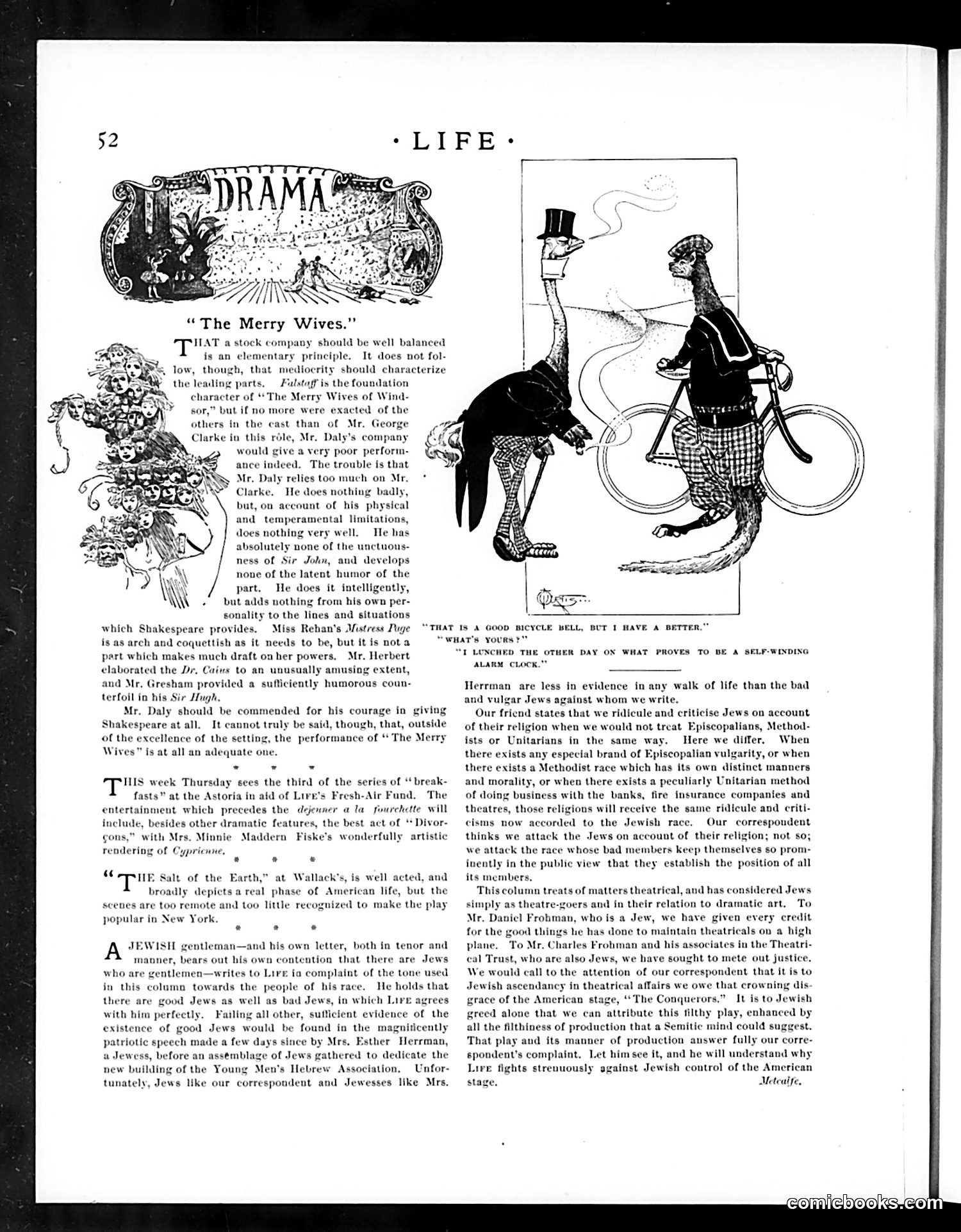
This page contains drama criticism and social commentary from early Life magazine (appears to be late 1800s based on style). **The Main Cartoon** shows two figures on a bicycle with exaggerated caricature features, exchanging dialogue about a bicycle bell and alarm clock—a visual pun about practical inventions. **The Drama Section** critiques a production of Shakespeare's "The Merry Wives of Windsor," faulting actor George Clarke's performance as lacking personality and depth, though praising the production's setting and some supporting actors. **The Controversial Section** addresses a complaint from a Jewish reader objecting to Life's negative portrayals of Jews. The editors defend their criticism, arguing they attack not the Jewish religion but rather the "race" and its "bad members" who behave vulgarly in business and public interactions. They claim they would similarly criticize vulgar Episcopalians or Methodists if such a distinct group existed. This passage reveals deeply offensive 19th-century racial attitudes presented as rational critique—Life distinguishes between religion (protected) and perceived ethnic/racial behavior (fair game for mockery).
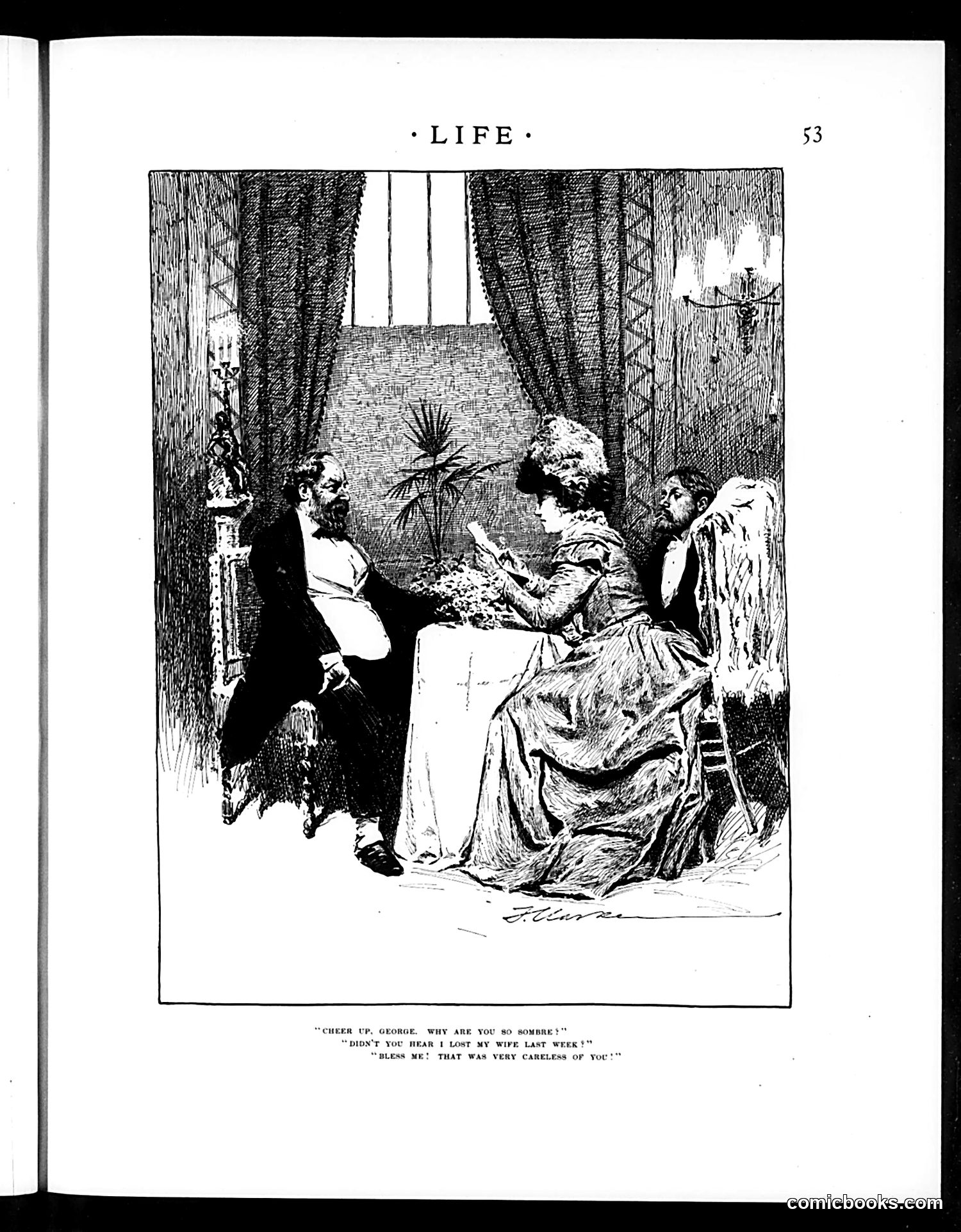
This is a satirical cartoon depicting a social scene in an elegant interior. A man named George stands dejected while conversing with seated women and another man. The dialogue reveals the joke: George claims he "lost" his wife last week, and a woman responds by calling this "careless." The humor relies on treating the loss of a wife—presumably through death or abandonment—with absurd casualness, as though she were a misplaced object like a hat or umbrella. This satirizes both upper-class emotional detachment and the trivialization of serious matters through polite society conversation. The ornate setting and formal dress emphasize the gap between the gravity of losing a spouse and the dismissive social response to it.
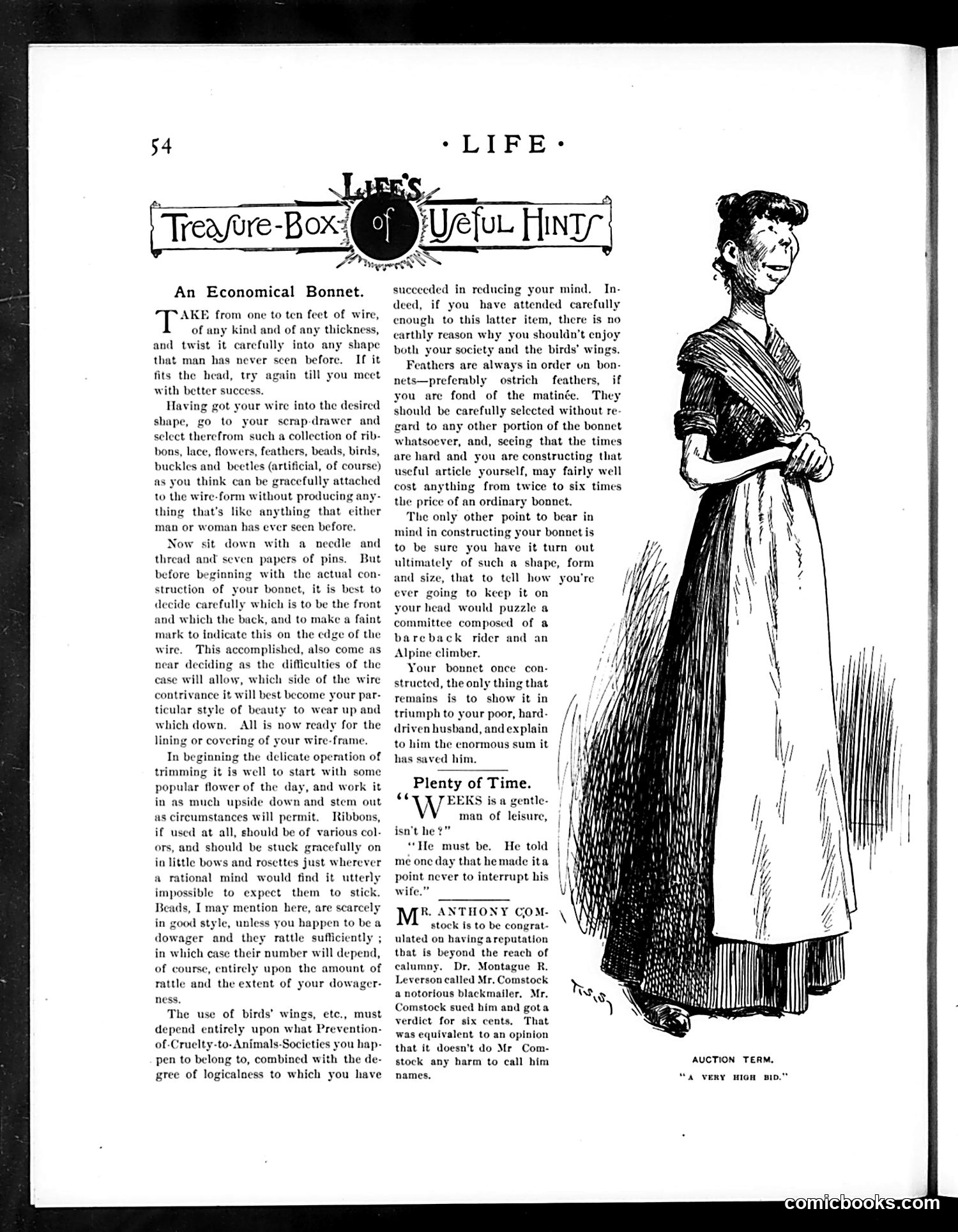
This page contains two distinct satirical pieces: **"An Economical Bonnet"** mocks the absurdity of women's hat fashions of the era. The tongue-in-cheek instructions ridicule the impractical, over-decorated bonnets women wore—advising readers to assemble wire frames with random ribbons, feathers, birds' wings, beads, and beetles in deliberately illogical arrangements. The satire targets both the wasteful expense of fashionable millinery and the sheer irrationality of the aesthetic choices, culminating in the joke that the final product will be so poorly balanced it would baffle a circus performer. **"Plenty of Time"** is a brief domestic joke about marital dynamics. A man is called a "gentleman of leisure" because he never interrupts his wife—implying wives talk so much that respecting their speech requires complete passivity. **"Auction Term"** concerns Anthony Comstock, the real historical figure who founded the Society for the Suppression of Vice. The joke references his lawsuit against Dr. Montague Leverson for defamation; winning only six cents damages effectively vindicated Leverson's criticism, making the verdict worthless.
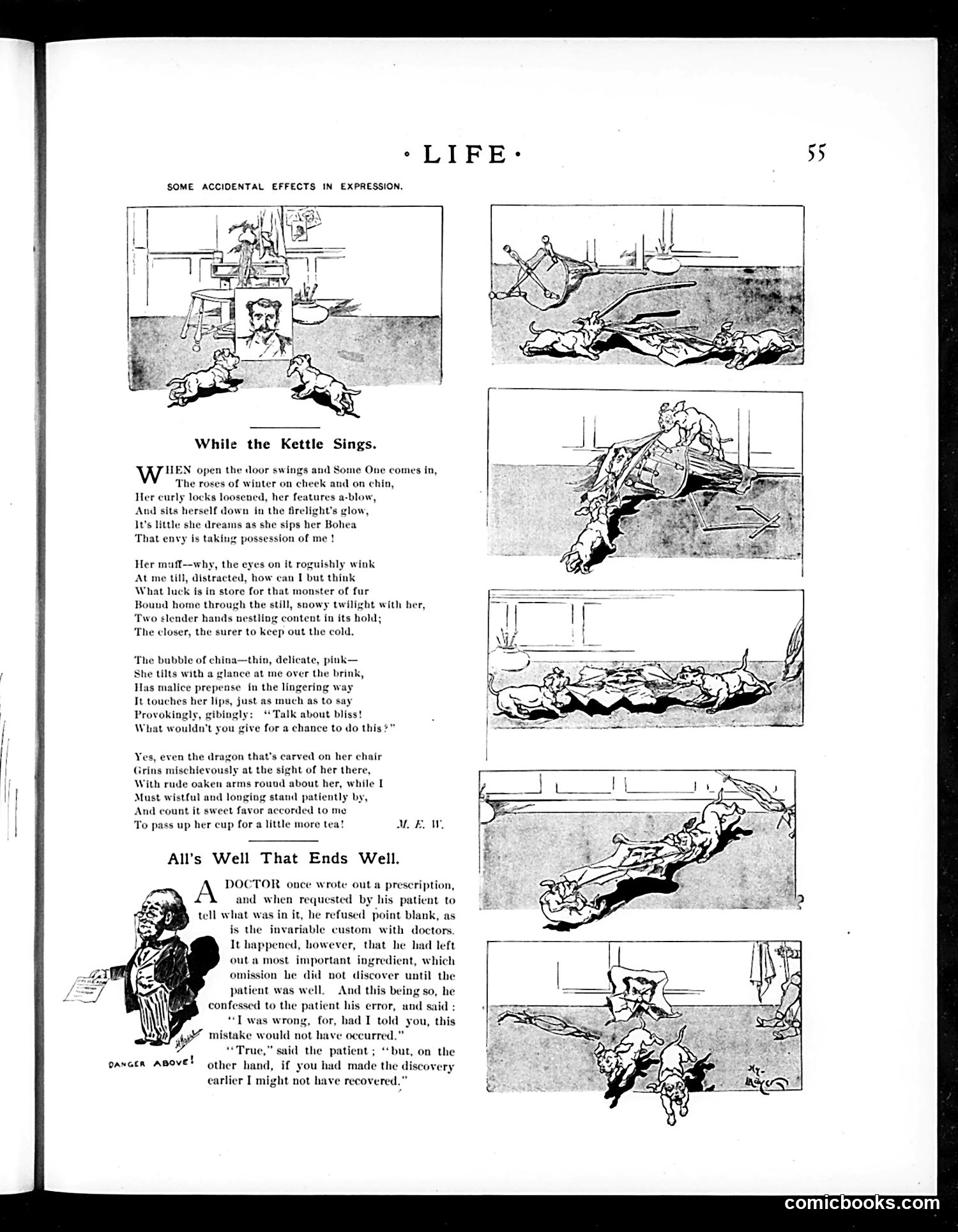
**"While the Kettle Sings"** depicts a lovelorn narrator's jealous observations of an attractive woman visiting on a winter evening. The humor lies in his envying inanimate objects near her—her muff, her teacup, the chair—that get to be close to her. The accompanying comic strip illustrations show the narrator's increasingly dramatic, physically comedic expressions of longing and despair as he watches her. **"All's Well That Ends Well"** is a brief humorous anecdote about a doctor who omits an important ingredient from a prescription. When the patient recovers anyway and confronts the doctor about his error, the doctor defends himself by noting that had the patient known about the mistake earlier, he might have psychosomatically failed to recover—implying a patient's belief in treatment affects its efficacy. Both pieces use exaggerated emotion and physical comedy typical of early-20th-century Life magazine humor.
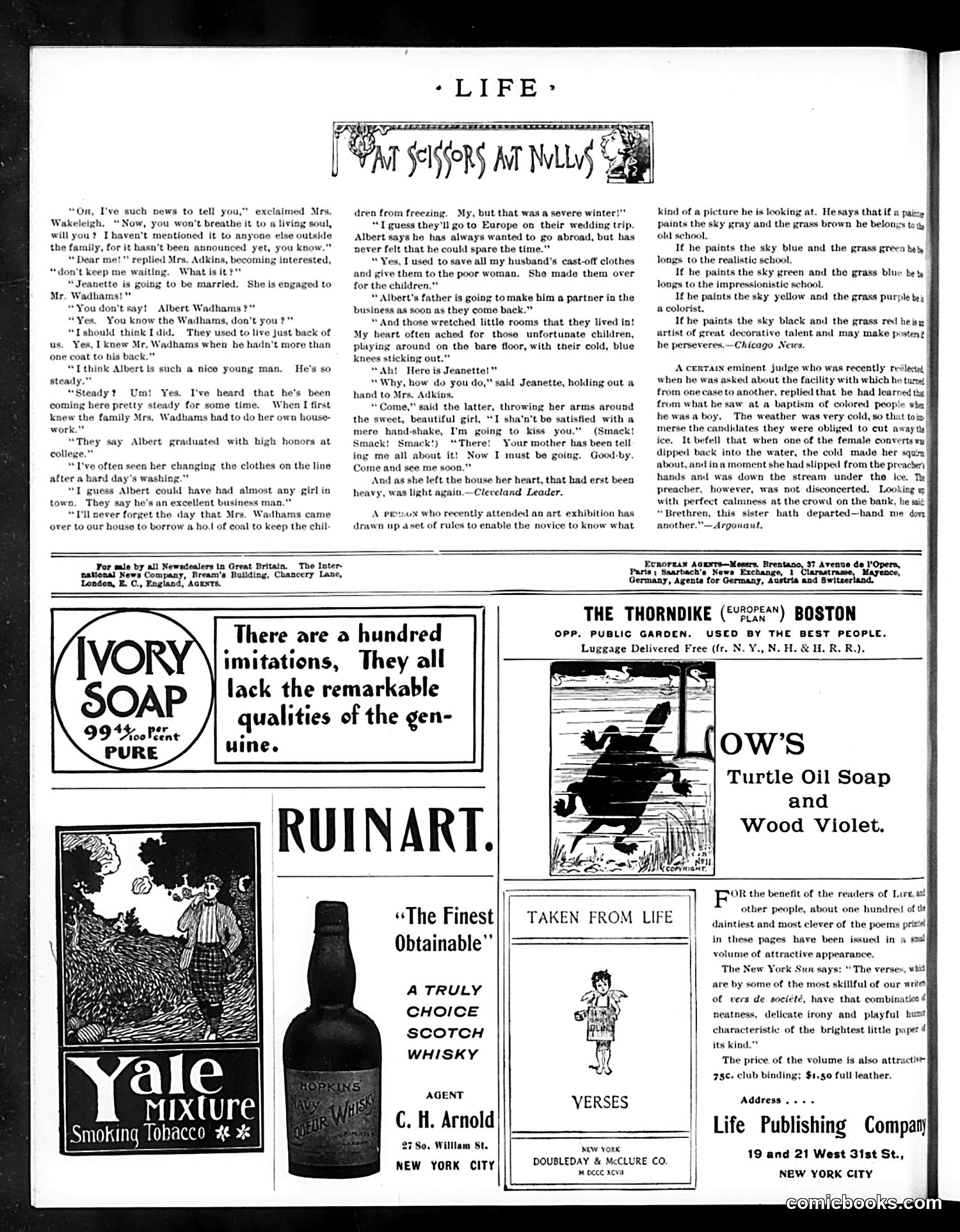
This page features a satirical short story (not a visual cartoon) that mocks social pretension and selective memory. Two women—Mrs. Wakeleigh and Mrs. Adkins—gossip about the engagement of "Jeanette" to "Albert Wadhams." **The satire's point**: Mrs. Wakeleigh boasts about Albert's accomplishments (graduated with honors, excellent businessman, plans European travel), while Mrs. Adkins keeps interjecting memories of Albert's family poverty—his mother borrowing coal, wearing hand-me-downs, living in "wretched little rooms," children with bare cold knees. **The joke**: The two women are describing the *same person's family* from opposite perspectives, revealing how people selectively emphasize facts to match their current social narrative. When Jeanette arrives, Mrs. Adkins instantly shifts from remembering poverty to fawning affection, demonstrating the hypocrisy of social-climbing and class consciousness in Victorian/Edwardian society. The page is primarily advertising otherwise (soap, tobacco, whiskey, etc.).
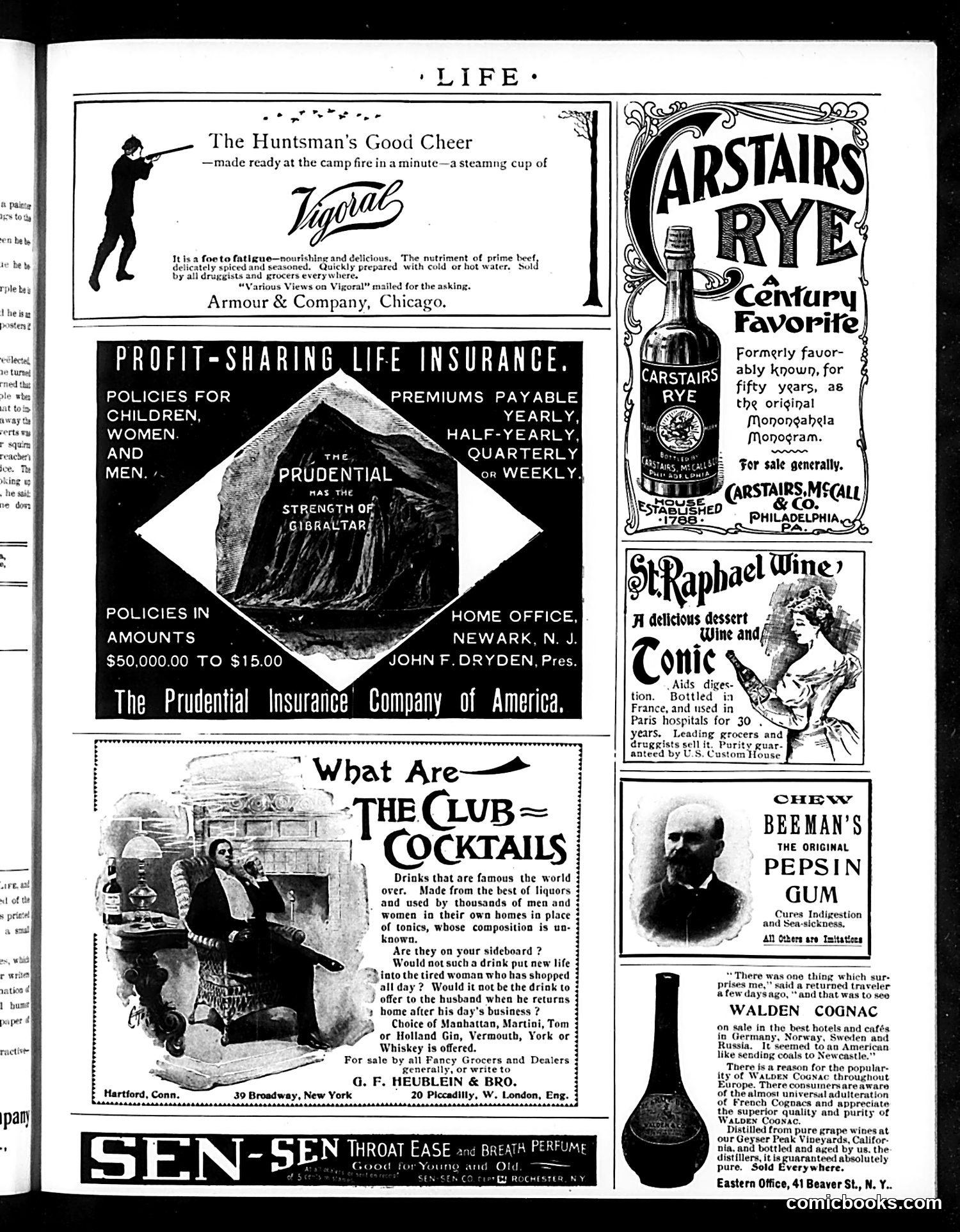
This is primarily an **advertising page** from an early 20th-century American magazine, containing no political cartoons or satire. The page features period product advertisements including: - **Vigoral** (beef extract/soup mix) marketed to hunters - **Prudential Insurance** promoting life policies for families - **Club Cocktails** by Heublein & Bros.—a striking ad depicting well-dressed men enjoying mixed drinks at home, appealing to domestic leisure and prosperity - **Carstairs Rye** whiskey - **St. Raphael Wine** (digestive aid) - **Beeman's Pepsin Gum** (digestive remedy) - **Walden Cognac** (California brandy marketed as superior to French imports) - **Sen-Sen** breath perfume The ads reflect **early 1900s consumer culture**: emphasis on convenience foods, life insurance as status symbol, alcohol as everyday home beverage, and patent medicines for digestive complaints. The imagery and messaging target middle/upper-class readers with disposable income. No satire or political commentary is present.
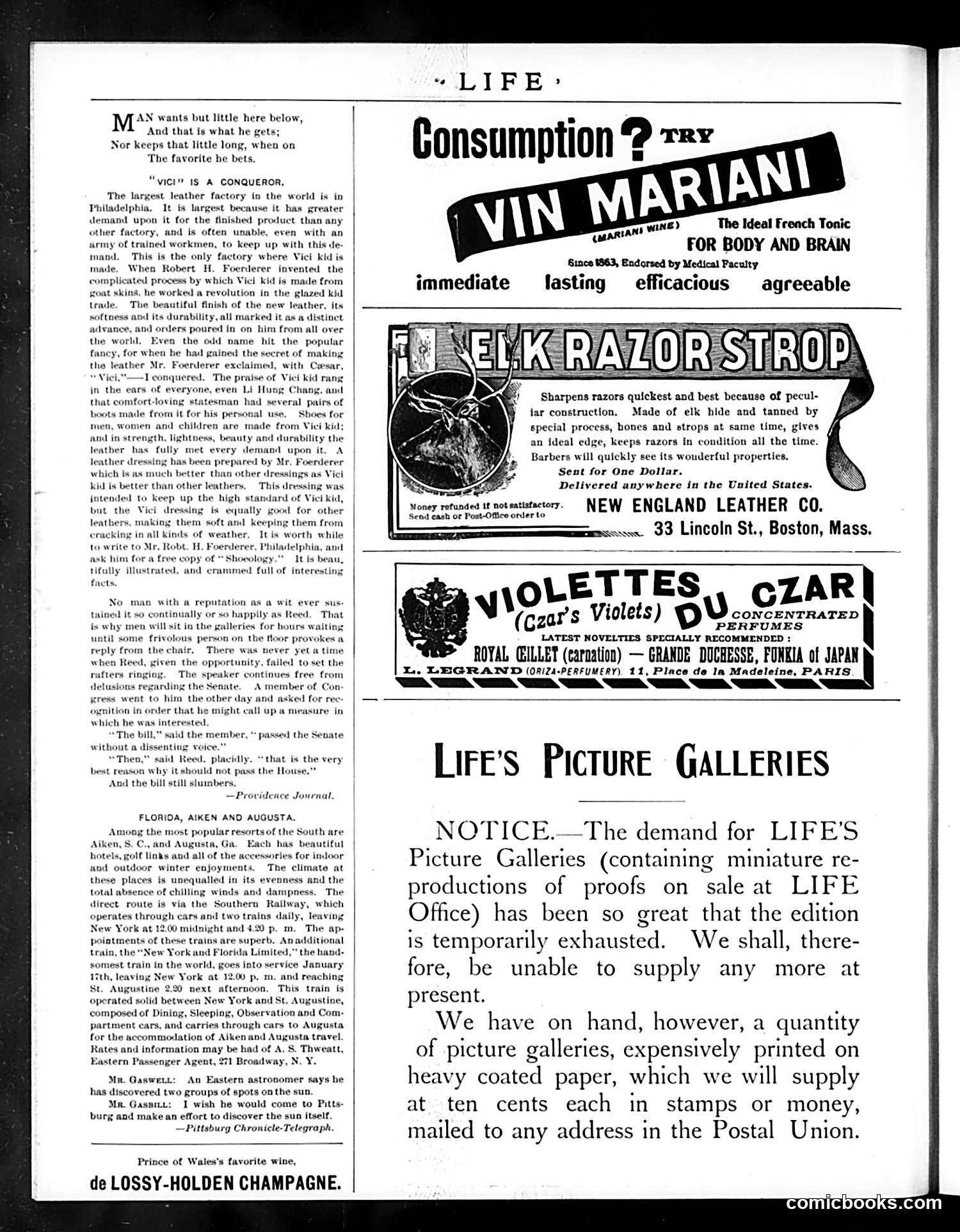
This page is primarily **advertising and travel promotion**, not political satire. The main content includes: **Advertisement for Vici Kid leather** (Philadelphia factory): Promotes a revolutionary glazed leather manufacturing process invented by Robert H. Foerderer. The copy notes even Li Hung Chang (Chinese statesman) ordered boots made from it—a reference to his prominence in late 19th-century international affairs, used to establish the product's prestige. **Minor anecdote about Speaker Reed**: A brief humorous exchange where Speaker of the House Thomas B. Reed quips that a bill passing the Senate unanimously is "the very best reason why it should not pass the House"—satirizing partisan gridlock. **Travel promotions** for Florida resorts and Southern Railway service. **Product advertisements**: Elk Razor Strop, Violettes du Czar perfume, and notice about exhausted "Life's Picture Galleries." The page reflects **turn-of-century consumer culture** and commercial interests rather than sustained political commentary.
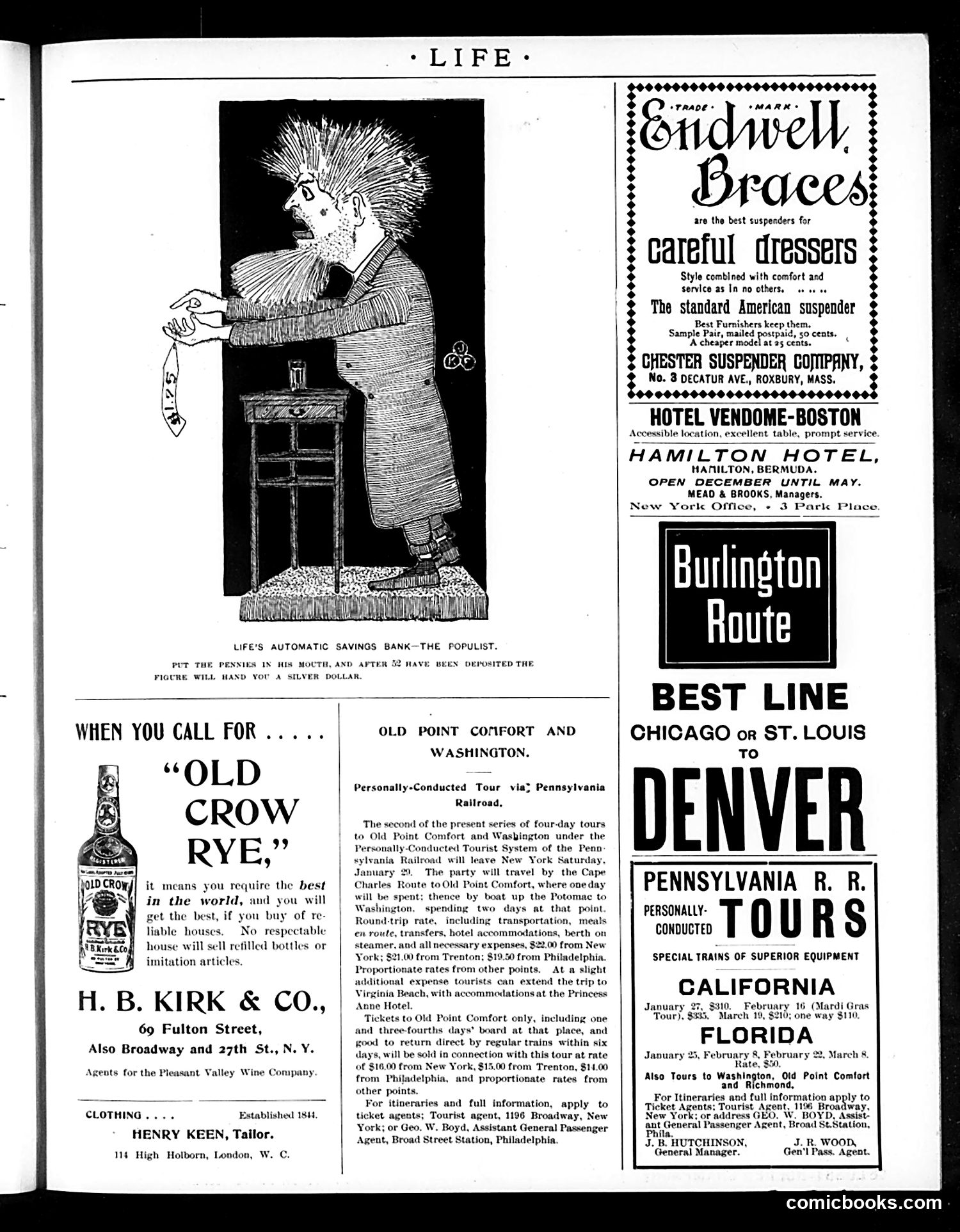
This cartoon satirizes the **Populist movement** of the late 1800s. The figure depicts a Populist as a mechanical "savings bank"—a child's novelty toy where inserting coins causes a mechanical figure to hand back payment. The satire's point: **Populists promise ordinary people (represented by pennies) that they'll receive silver dollars in return**—a reference to the Populist Party's central demand for unlimited silver coinage, which they believed would benefit common workers and farmers against wealthy interests. The joke suggests Populism is essentially a con: put in small change, get promised grand returns. By labeling it an "automatic" bank, the cartoonist implies the movement operates mechanically without genuine substance—just gimmicks designed to attract the desperate poor through false promises of financial transformation. This mocks a core Populist platform argument with visual mockery rather than direct political debate.
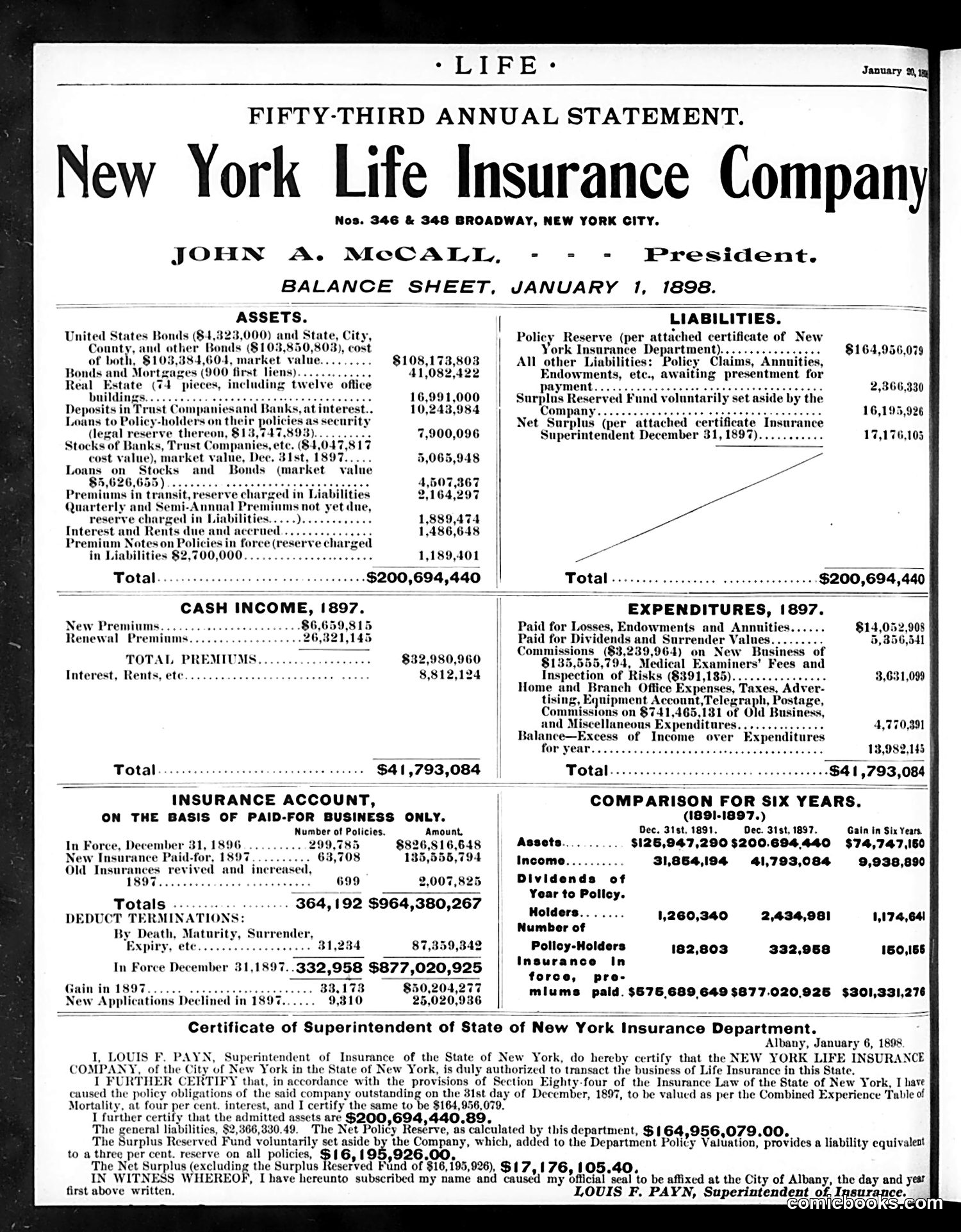
This page contains **no cartoon or satirical content**. It is a straightforward **corporate financial document**—the fifty-third annual statement of the New York Life Insurance Company, dated January 1, 1898, signed by President John A. McCall. The page presents balance sheets, asset/liability accounts, cash income and expenditures for 1897, and a six-year comparison (1891-1897). It concludes with an official certification from Louis F. Payn, Superintendent of Insurance for New York State, validating the company's financial position and policy reserves. This appears in *Life* magazine likely because the publication served educated, financially-literate readers interested in major corporations' fiscal health. The document demonstrates the company's substantial growth—assets increased from $126.9 million (1891) to $200.7 million (1897)—reassuring policyholders of institutional stability during the economically volatile 1890s.