
Life, 1898-01-20 · page 6 of 26
Life — January 20, 1898 — page 6: what you’re looking at
What you’re looking at
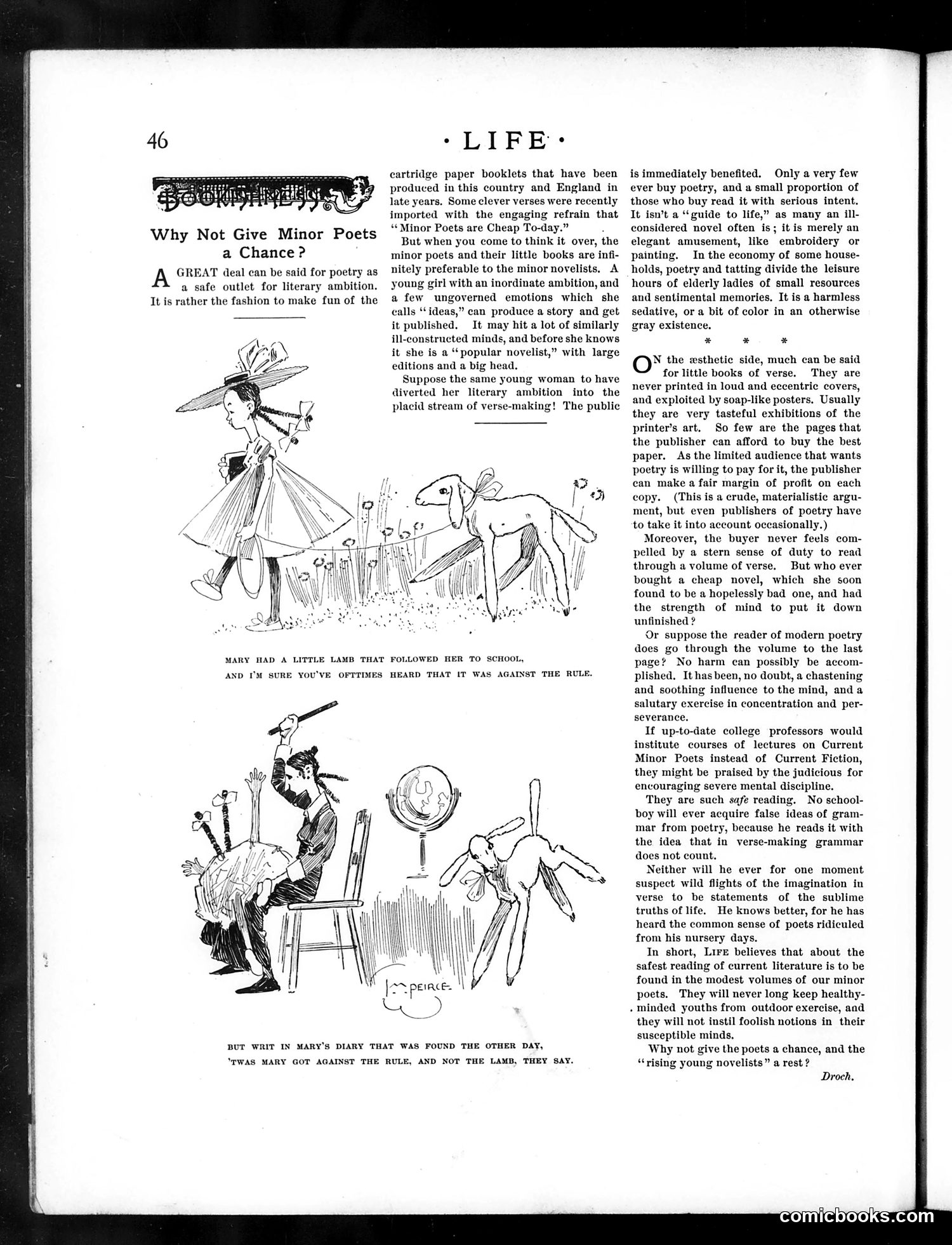
This page satirizes the publishing industry's dismissal of minor poetry. The article argues that young, ambitious poets deserve opportunities despite producing inferior work—suggesting this would benefit them more than reading novels. The cartoons mock the absurdity of this position through two scenes: 1. **Top cartoon**: A girl scattering pages labeled with nursery rhymes ("Mary Had a Little Lamb"), suggesting minor poetry is childish. 2. **Bottom cartoon**: Someone writing in a diary about breaking rules, with a lamb present, extending the nursery-rhyme mockery. The satire's point: Publishing minor poets isn't a kindness—their poorly-executed work wastes readers' time and won't develop young writers' talents. The author ("Droch") advocates instead for college courses on established minor poets and warns against promoting mediocre verse to impressionable youth.
📄 Transcribed text from this page (OCR, searchable)
Machine-transcribed from the original scan — historical spelling and the odd misread are preserved.
Why Not Give Minor Poets a Chance? GREAT deal can be said for poetry as a safe outlet for literary ambition. It is rather the fashion to make fun of the -LIFE: cartridge paper booklets that have been produced in this country and England in late years. Some clever verses were recently imported with the engaging refrain that “Minor Poets are Cheap To-day.” . But when you come to think it over, the minor poets and their little books are infi- nitely preferable to the minor novelists, A young girl with an inordinate ambition, and a few ungoverned emotions which she calls “ideas,” can produce a story and get it published. It may hit a lot of similarly ill-constructed minds, and before she knows it she is a “popular novelist,” with large editions and a big head. Suppose the same young woman to have diverted her literary ambition into the placid stream of verse-making! The public Mit BUT WRIT IN MARY'S DIARY THAT WAS FOUND THE OTHER DAY, ‘TWAS MARY GOT AGAINST THE RULE, AND NOT THE LAMB, THEY SAY. is immediately benefited. Only a very few ever buy poetry, and a small proportion of those who buy read it with serious intent. It isn’t a “guide to life,” as many an ill- considered novel often is; it is merely an elegant amusement, like embroidery or painting. In the economy of some house- holds, poetry and tatting divide the leisure hours of elderly ladies of small resources and sentimental memories. It is a harmless sedative, or a bit of color in an otherwise gray existence. * * * N the wsthetic side, much can be said for little books of verse. They are never printed in loud and eccentrie covers, and exploited by soap-like posters. Usually they are very tasteful exhibitions of the printer's art, So few are the pages that the publisher can afford to buy the best paper. As the limited audience that wants poetry is willing to pay for it, the publisher can make a fair margin of profit on each copy. (This is a crude, materialistic argu- ment, but even publishers of poetry have to take it into account occasionally.) Moreover, the buyer never feels com- pelled by a stern sense of duty to read through a volume of verse. But who ever bought a cheap novel, which she soon found to be a hopelessly bad one, and had the strength of mind to put it down unfinished ? Or suppose the reader of modern poetry does go through the volume to the last page? No harm can possibly be accom- plished, Ithas been, no doubt, a chastening and soothing influence to the mind, anda salutary exercise in concentration and per- severance. If up-to-date college professors would institute courses of lectures on Current Minor Poets instead of Current Fiction, they might be praised by the judicious for encouraging severe mental discipline. They are such safe reading. No school- boy will ever acquire false ideas of gram- mar from poetry, because he reads it with the idea that in verse-making grammar does not count, Neither will he ever for one moment suspect wild flights of the imagination in verse to be statements of the sublime truths of life, He knows better, for he has heard the common sense of poets ridiculed from his nursery days. In short, Lire believes that about the safest reading of current literature is to be found in the modest volumes of our minor poets. They will never long keep healthy- . minded youths from outdoor exercise, and they will not instil foolish notions in their susceptible minds, Why not give the poets a chance, and the “rising young novelists” a rest ? Droch,