
Life, 1898-01-20 · page 18 of 26
Life — January 20, 1898 — page 18: what you’re looking at
What you’re looking at
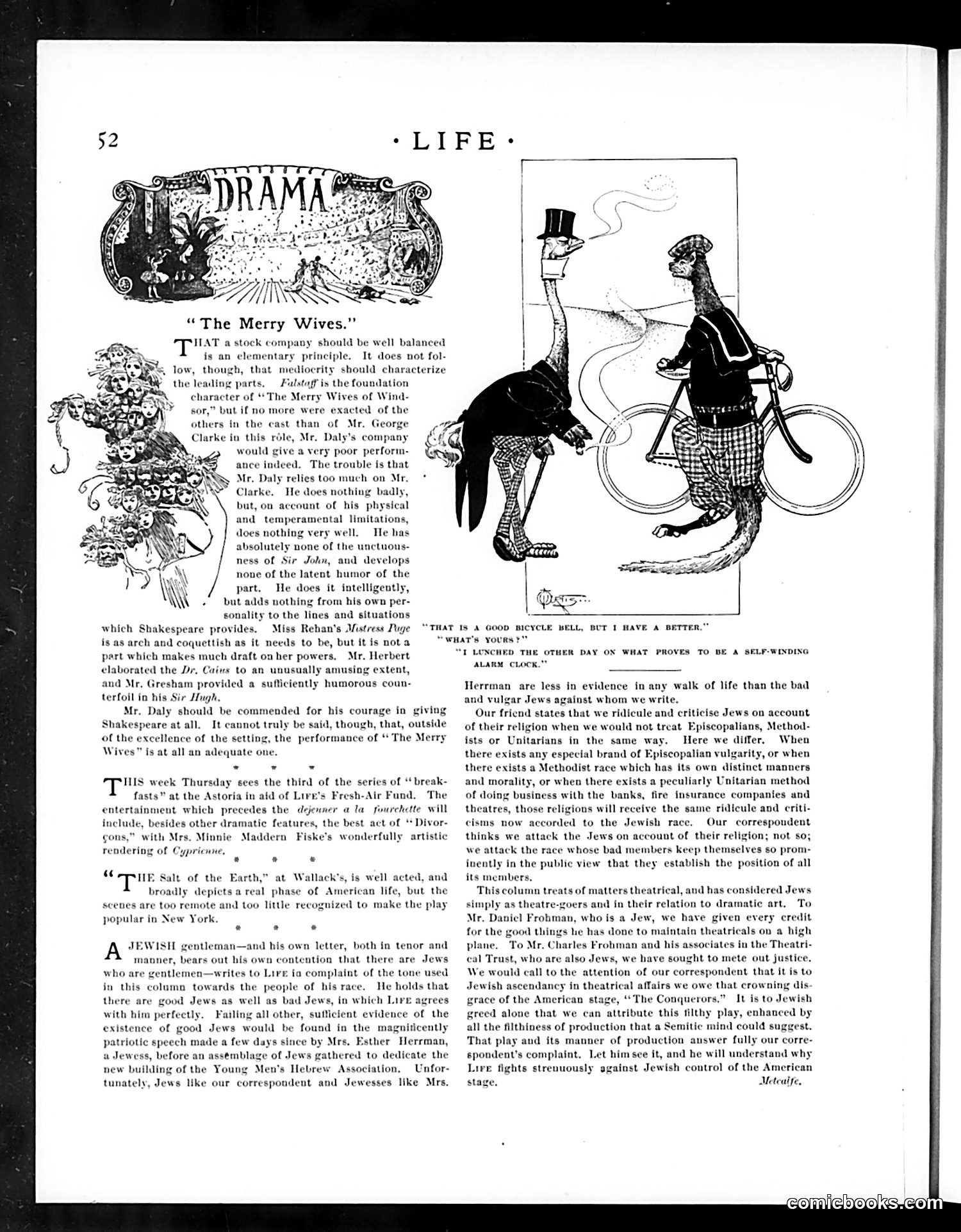
This page contains drama criticism and social commentary from early Life magazine (appears to be late 1800s based on style). **The Main Cartoon** shows two figures on a bicycle with exaggerated caricature features, exchanging dialogue about a bicycle bell and alarm clock—a visual pun about practical inventions. **The Drama Section** critiques a production of Shakespeare's "The Merry Wives of Windsor," faulting actor George Clarke's performance as lacking personality and depth, though praising the production's setting and some supporting actors. **The Controversial Section** addresses a complaint from a Jewish reader objecting to Life's negative portrayals of Jews. The editors defend their criticism, arguing they attack not the Jewish religion but rather the "race" and its "bad members" who behave vulgarly in business and public interactions. They claim they would similarly criticize vulgar Episcopalians or Methodists if such a distinct group existed. This passage reveals deeply offensive 19th-century racial attitudes presented as rational critique—Life distinguishes between religion (protected) and perceived ethnic/racial behavior (fair game for mockery).
📄 Transcribed text from this page (OCR, searchable)
Machine-transcribed from the original scan — historical spelling and the odd misread are preserved.
IIKSS “The Merry Wives.” IIAT a stock company should be well balanced ntary principle. It does not fol- y should characterize the leading parts, Fulst the foundation character of “The Merry Wives of W - but if no more were exacted of the others in the cast than of Mr. George Clarke in this réle, Mr. Daly’s company would give a very poor perform- ance indeed. The trouble is that Mr, Daly relies too much on Mr. Clarke. He does nothing badly, but, on account of his physical and temperamental limitations, does nothing very well, He has absolutely none of the unctuous ness of Sir John, and develops none of the latent humor of the part. He does it intelligently, + but adds nothing from his own per- sonality to the lines and situations which Shakespeare provides. Miss Rehan's Mistress Duge isas arch and coquettish as it needs to be, but it is nota pert which makes much draft on her powers. Mr. Herbert elaborated the Jr, Caivs to an unusually amusing extent, and Mr. Gresham provided a sufficiently humorous coun- terfoil in his Sir Hugh, Mr. Daly should be commended for his courage in giving Shakespeare at all. It cannot truly be said, though, that, outside of the excellence of the setting, the performance of “ The Merry Wi is at all an adequate one. 6 week Thursday sees the third of the series of ‘break- fasts” at the Astoria in aid of Lire’s Fresh-Air Fund, The entertainment which precedes the dejenner a la fuurchette will include, besides other dramatic features, the best act of ‘ Divor- with Mrs. Minnie Maddern Fiske’s wonderfully artistic rendering of C; cons, * . . SCHITE Salt of the Earth,” at Wallack’s, is well acted, and broadly depicts a real phase of American life, but the es are too remote and too little recognized to make the play popular in New York. . * . A semi n—and his own letter, both in tenor and manner, bears out his own contention that there are Jews who are gentlemen—writes to Live ia complaint of the tone used in this column towards the people of his race, He holds that there are good Jews as well as bad Jews, in which Lire agrees with him perfectly. Failing all other, sufficient evidence of the existence of good Jews would be found in the magniticently patriotic speech made a few days since by Mrs. Esther Herrman, a Jewess, before an ass¢mblage of Jews gathered to dedicate the new building of the Young Men's Hebrew Association, Unfor- tunately, Jews like our correspondent and Jewesses like Mrs. “THAT IS A GOOD BICYCLE BELL, BUT 1 HAVE A BETTER.” “wHat'’s yours?” “I LUNCHED THE OTHER DAY ON WHAT PROVES TO BE A SEL! ALARM CLOCK." Herrman are less in evidence in any walk of life than the bad and vulgar Jews against whom we write. Our friend states that we ridicule and criticise Jews on account of their religion when we would not treat Episcopalians, Method- ists or Unitarians in the same w Here we differ, When there exists any especial brand of Episcopalian vulgarity, or when there exists a Methodist race which has its own distinct manners and morality, or when there exists a peculiarly Unitarian method of doing business with the banks, fire insurance companies and theatres, those religions will receive the same ridicule and criti- cisms now accorded to the Jewish race. Our correspondent thinks we attack the Jews on account of their religion; not so; we attack the race whose bad members keep themselves so prom- inently in the public view that they establish the position of all its members, This column treats of matters theatrical, and has considered Jews simply as theatre-goers and in their relation to dramatic art. To Mr. Danicl Frohman, who is a Jew, we have given every credit for the good things he has done to maintain theatricals on a high ph To Mr. Charles Frohman and his associates in the Theatri- cal Trust, who are also Jews, we have sought to mete out justice. We would call to the attention of our correspondent that it is to Jewish ascendancy in theatrical affairs we owe that crowning dis grace of the American stage, ‘The Conquerors,” It is to Jewish greed alone that we can attribute this filthy play, enhanced by all the filthiness of production that a Semitic mind could sug, That play and its manner of production auswer fully our corre spondent’s complaint, Let him sce it, and he will understand why Lire fights strenuously against Jewish coutrol of the Ameri stage. Meteuife.