
Life, 1898-01-20 · page 12 of 26
Life — January 20, 1898 — page 12: what you’re looking at
What you’re looking at
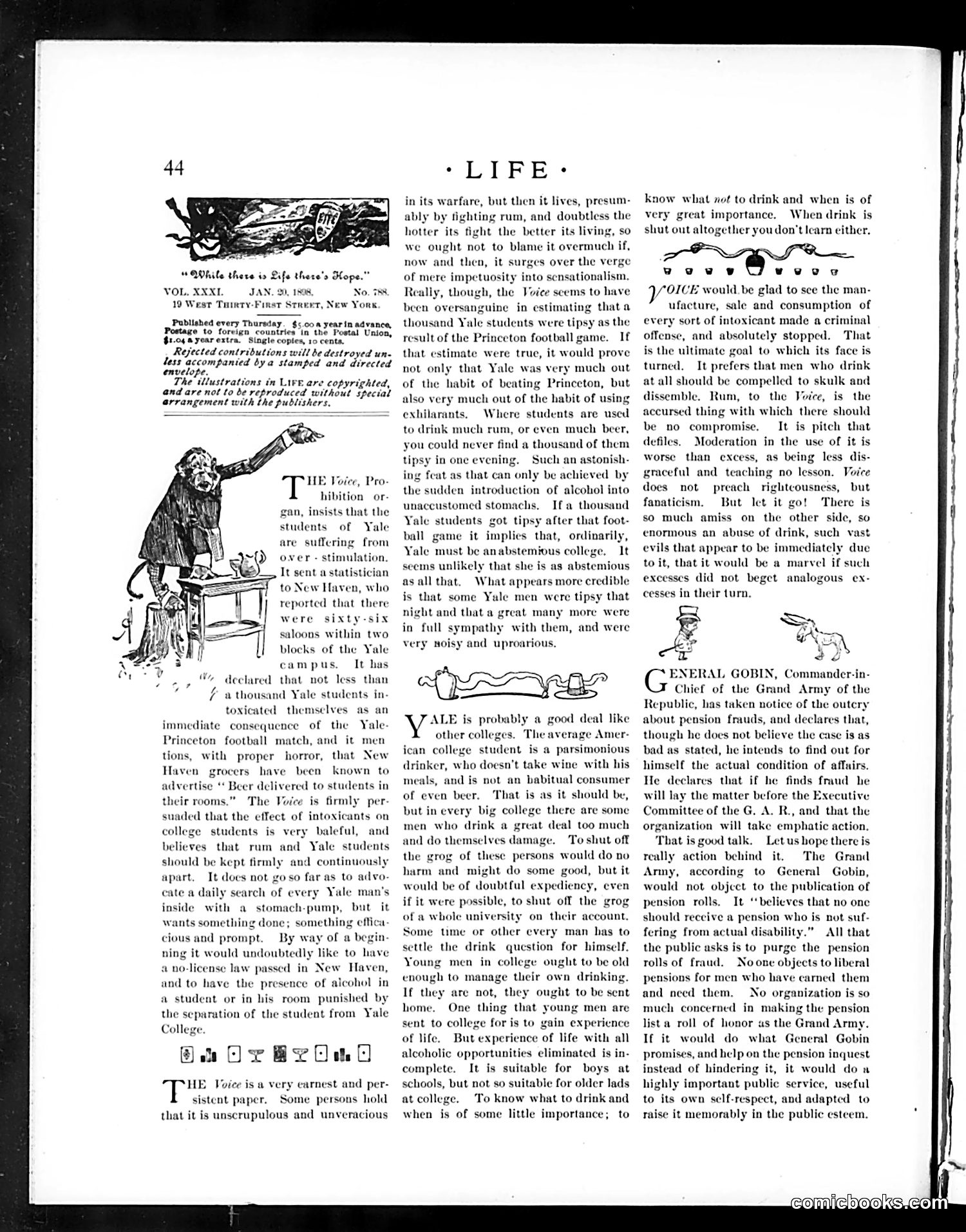
This page contains editorial commentary on drinking culture at Yale University. The text criticizes excessive alcohol consumption among Yale students, reporting that "not less than a thousand Yale students in two blocks of the Yale campus" had intoxicated themselves following a football game. The cartoon (left) depicts a skeletal "Death" or Grim Reaper figure serving drinks at what appears to be a bar or table, visualizing the danger of overconsumption. The editorial argues against both prohibition and moral fanaticism, instead advocating for responsible drinking habits among college men. It references General Goblin, Commander-in-Chief of the Grand Army of the Republic, regarding pension fraud concerns. The satire targets Yale's drinking problem as emblematic of broader college culture, mocking both student excess and institutional hypocrisy.
📄 Transcribed text from this page (OCR, searchable)
Machine-transcribed from the original scan — historical spelling and the odd misread are preserved.
“While there io Life there's Hope.” vol 1. JAN. 20, 1808, 0. TSS. 19 West Tuiety-Finst Street, New Yor. Published every Thursday. $:.0on yearin advance, to foreign countries in the Postal Union, $1.04 a year extra. Single copies, 10 cents. Rejected contributions will be destroyed un- des accompanied bya stamped and directed envelope. The illustrations in Live. are copyrighted, and are not to be reproduced without special arrangement with the publishe ‘bice, Pro- hibition or- gan, insists that the students of Yale are suffering from over - stimulation. It sent a statistician to New Haven, who reported that there were sixty-six saloons within two blocks of the Yale campus. It has declared that not less than a thousand Yale students in- toxicated themselves as an immediate consequence of the Yale- Princeton football match, and it men tions, with proper horror, that New Haven grocers have been known to advertise ‘* Beer delivered to students in their rooms,” The Voice is firmly pe suaded that the effect of intoxicants on college students is very eful, and believes that rum and Yale students should be kept firmly and continuously apart, It does not go so far as to advo cate a daily search of every Yale man’s inside with a stomach-pump, but it wants something done; something effica- cious and prompt. By way of a begin- ning it would undoubtedly like to have a no-license law passed in New Haven, nd to have the presence of alcohol in a student or in his room punished by the separation of the student from Yale College. a HE Voice is a very earnest and per- Some persons hold un Ove 82 sistent paper. that it is unscrupulous and unveracious *LIFE-: in its warfare, but then it lives, presum- ably by fighting rum, and doubtless the hotter its fight the better its living, so we ought not to blame it overmuch if, now and then, it surges over the verge of mere impetuosity into sensationalism. Really, though, the Voice scems to have been oversanguine in estimating that a thousand Yale students were tipsy as the result of the Princeton football game. If that estimate were true, it would prove not only that Yale was very much out of the habit of beating Princeton, but also very much out of the habit of using exhilarants, Where students are used to drink much rum, or even much beer, you could never find a thousand of them tipsy in one evening. Such an astonish- ing feat as that can only be achieved by the sudden introduction of alcohol into unaccustomed stomachs. Ifa thousand Yale students got tipsy after that foot- ball game it implies that, ordinarily, Yale must be anabstemious college. It seems unlikely that she is as abstemious asallthat. W appears more credible is that some Yule men were tipsy that night and that a great many more were in full sympathy with them, and were very soisy and uproarious. (Pane ALE is probably a good deal like other colleges. The average Amer- ican college student is a parsimonious drinker, who doesn't take wine with his meals, and is not an babitual consumer of even beer, That is as it should be, but in every bi there are some men who drink a great deal too much and do themselves damage. To shut off the grog of these persons would do no harm and might do some good, but it would be of doubtful expediency, even if it were possible, to shut off the grog of a whole university on their account, Some time or other every man has to settle the drink question for himself. Young men in college ought to be old enough to manage their own drinking. If they are not, th ought to be sent home. One thing that young men are sent to college for is to gain experience of life. But experience of life with all alcoholic opportunities eliminated is in- complete, It is suitable for boys at schools, but not so suitable for older lads at college. To know what to drink and when is of some little importance; to know what not to drink and when is of very great importance. When drink is shut out altogether you don't learn either, Vf OE would. be glad to sce the man- ufacture, sale and consumption of every sort of intoxicant made a criminal offense, and absolutely stopped. That is the ultimate goal to which its face is turned, It prefers that men who drink at all should be compelled to skulk and dissemble. Rum, to the Voice, is the accursed thing with which there should be no comprom It is pitch that defil Moderation in the use of it is worse than excess, as being less dis- graceful and teaching no lesson. Voice does not preach rightcousness, but fanaticism. But let it got There is so much amiss on the other side, so enormous an abuse of drink, such vast evils that appear to be immediately due to it, that it would be a marvel if such excesses did not beget analogous ex- cesses in their turn, SNERAL GOBIN, Commander-in- Chief of the Grand Army of the Republic, has taken notice of the outery about pension frauds, and declares that, though he does not believe the case is as bad as stated, he intends to find out for himself the actual condition of affairs. He deelarcs that if he finds fraud he will lay the matter before the Executive Committee of the G. A. R., and that the organization will take emphatic action. That is good talk. Letus hope there is really action behind it. The Grand Amny, according to General Gobin, would not objcct to the publication of pension rolls. It ‘believes that no one should receive a pension who is not suf- fering from actual disability.” All that the public asks is to purge the pension rolls of fraud. Noone objects to liberal pensions for men who have carned them and need them. No organization is so much concerned in making the pension list a roll of honor as the Grand Army. If it would do what General Gobin promises, and help on the pension inquest instead of hindering it, it would do a mportant public service, useful own sclf-respect, and adapted to raise it memorably in the public esteem.