
A complete issue · 20 pages · 1897
Life — October 21, 1897
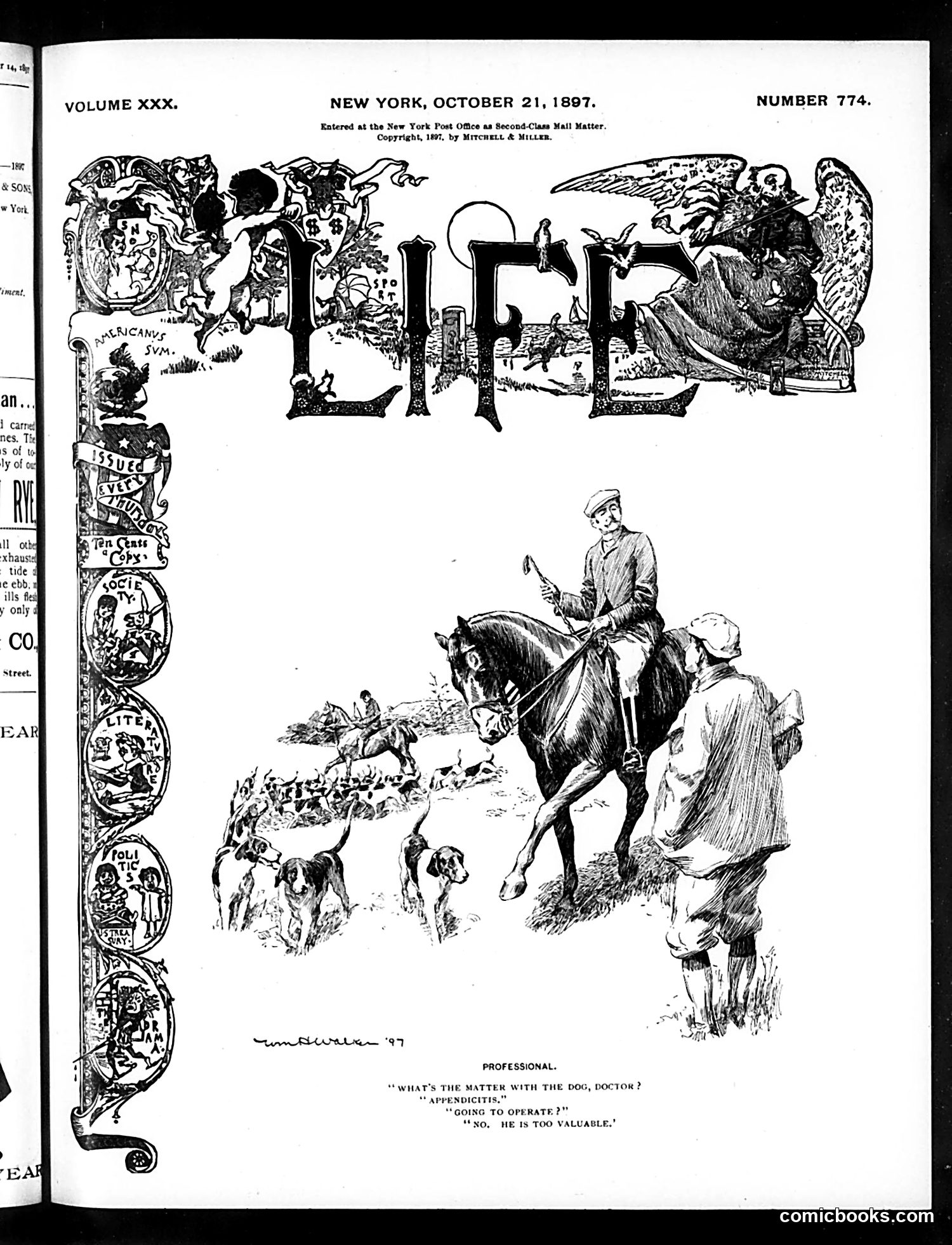
This cartoon satirizes a veterinarian's assessment of a valuable hunting dog. A well-dressed man on horseback and another figure consult a doctor about a sick dog with visible hunting dogs in the background. The dialogue reveals the joke: when asked what's wrong with the dog and whether surgery ("going to operate") is needed, the doctor replies "No, he is too valuable"—suggesting that the dog's high monetary worth paradoxically prevents proper medical treatment. The satire targets professional ethics and class-based decision-making: a valuable animal receives *worse* care precisely because owners fear losing their investment through risky procedures. The cartoon mocks how economic considerations override proper professional judgment, even in animal care.
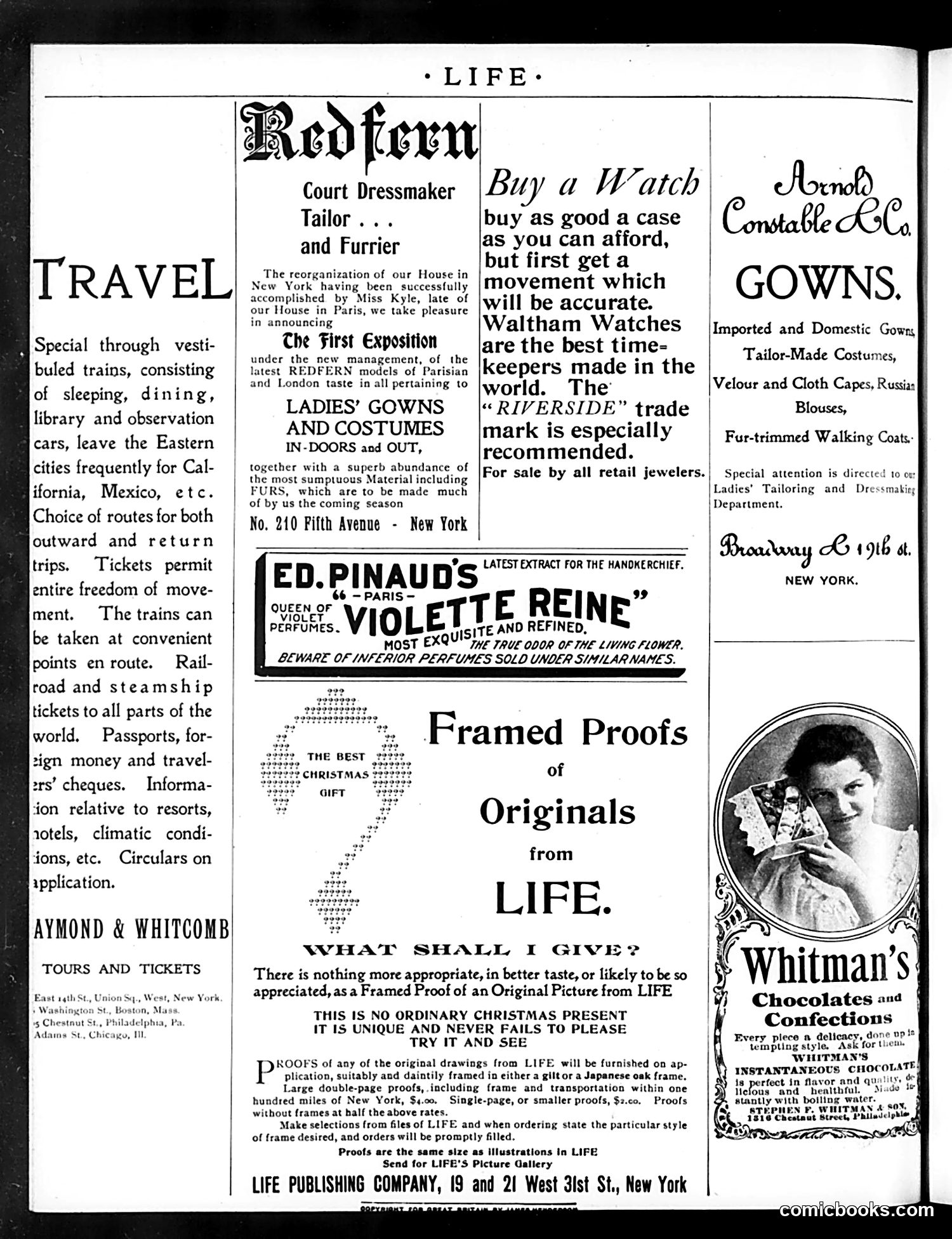
This page is primarily **advertising and commercial content**, not political satire. It contains: - Travel advertisements (Aymond & Whitcomb tours) - Fashion ads (Redfern dressmaker, Arnold Constable gowns) - Luxury goods promotions (Waltham watches, Ed. Pinaud perfume, Whitman's chocolates) - A service offering framed proofs of original artwork from Life magazine itself The single non-commercial element is a decorative Christmas gift illustration (a question mark made of asterisks), accompanying text promoting framed proofs as holiday presents. There are **no political cartoons or satirical commentary** visible on this page. It represents Life magazine's revenue model: combining editorial content with high-end advertising targeting wealthy, fashionable readers circa 1916.
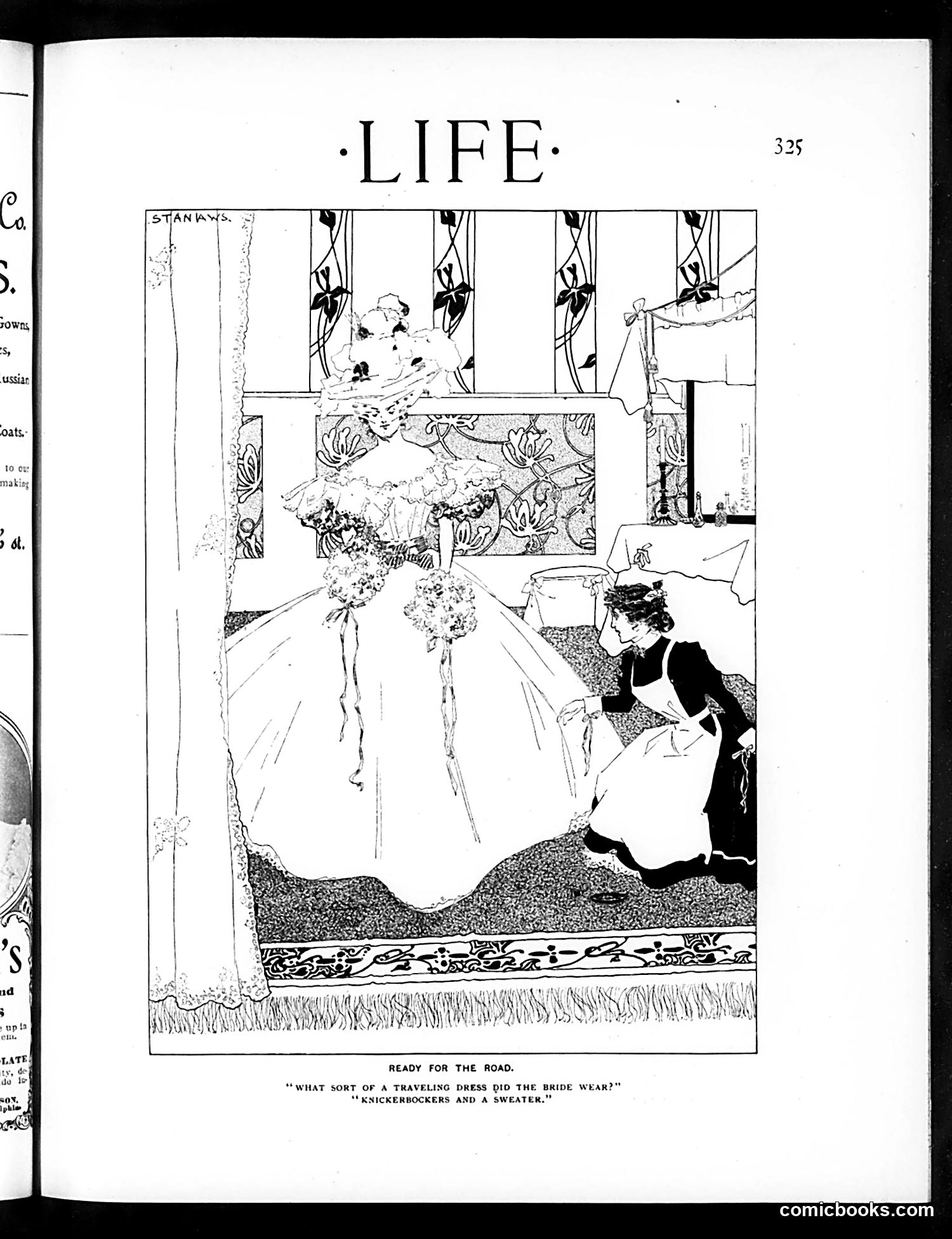
This illustration depicts a domestic scene titled "Ready for the Road," accompanied by dialogue: "What sort of a traveling dress did the bride wear?" "Knickerbockers and a sweater." The cartoon satirizes changing women's fashion and attitudes toward marriage in the early 20th century. A woman in practical traveling clothes (knickerbockers—loose-fitting trousers—and a sweater) contrasts sharply with the elaborate bride visible in the upper window wearing a traditional white wedding dress. The joke mocks the bride's immediate rejection of formal bridal attire in favor of comfortable, unconventional clothing for travel, suggesting modern women prioritize practicality over tradition. This reflects contemporary debates about women's independence and the loosening of rigid social conventions regarding female dress and behavior.
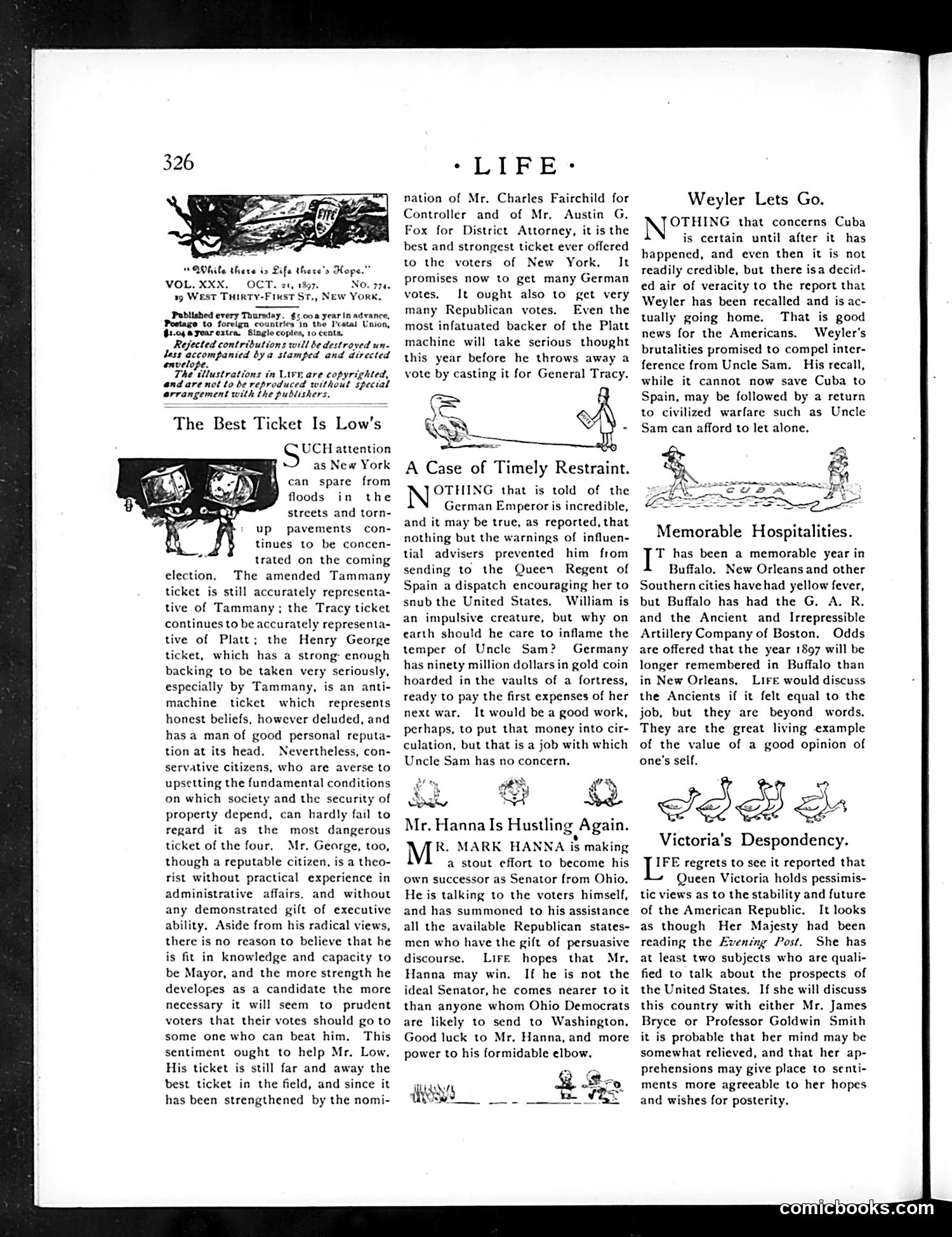
This October 1892 page contains political commentary rather than comics. The main articles critique the Republican presidential ticket of Benjamin Harrison and Whitelaw Reid ("The Best Ticket Is Low's"), suggesting it lacks strength despite Reid's reputation. Another section mocks the German Emperor's rumored interference in American affairs—reportedly encouraging Spain's Queen Regent to attack the United States, which the piece treats as absurdly implausible given Germany's financial interests in peace. A third piece humorously discusses Mark Hanna's effort to become Ohio's next Senator, characterizing him as a "stout effort" candidate. The final section comments on Queen Victoria's pessimistic views about American stability, suggesting her apprehensions lack merit. The satire employs irony and skepticism toward political claims and international rumors rather than visual caricature.
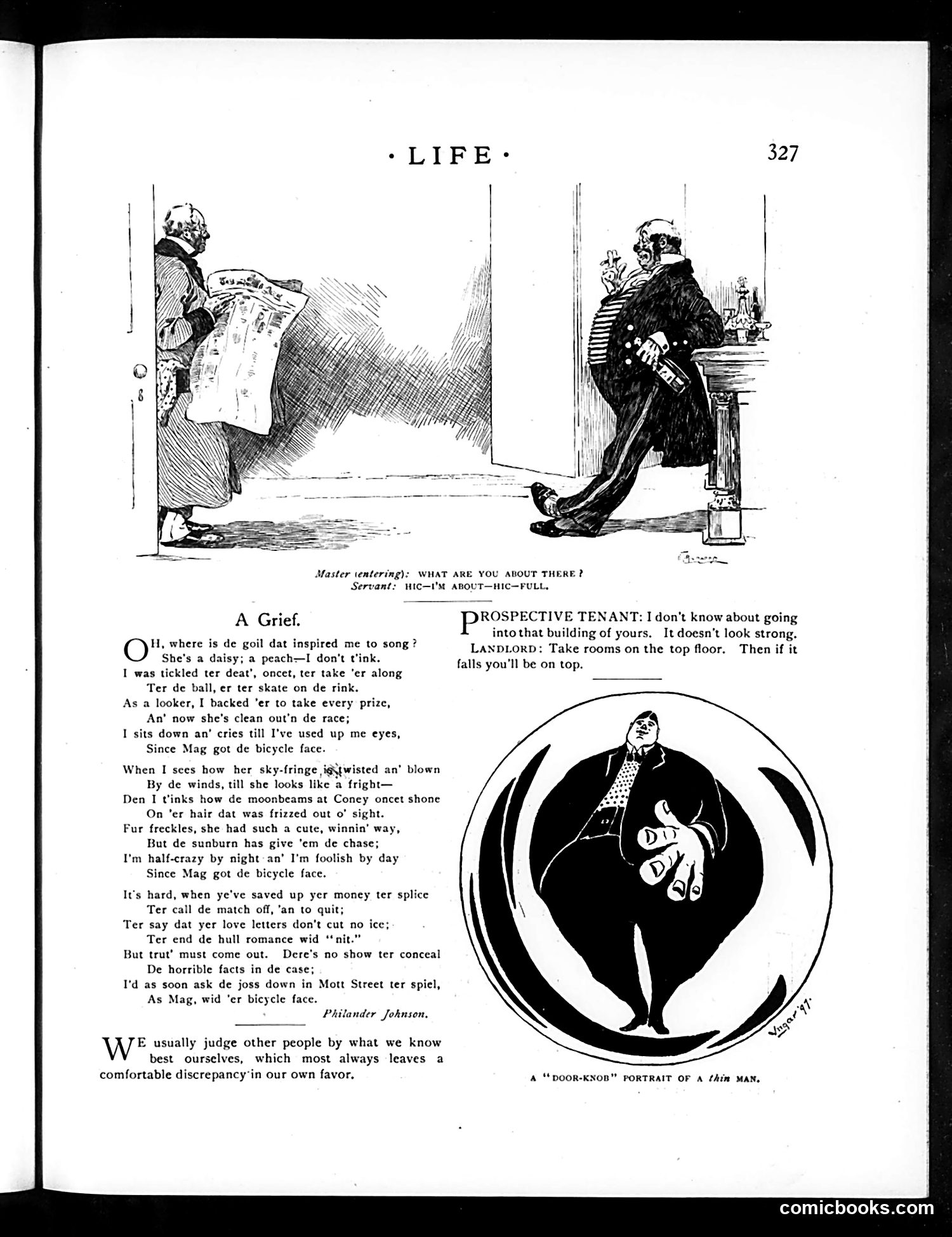
The top cartoon shows a master confronting a servant about scattered papers—a visual gag about domestic chaos. The servant's response ("I'm about—hic—full") suggests drunkenness, explaining the mess. Below, "A Grief" is a poem by Philander Johnson lamenting a woman named Mag who had an attractive face until getting a "bicycle face"—a real period concern (1890s-1900s) that cycling supposedly caused facial sagging and strain. The circular "door-knob portrait" caricature on the right depicts a thin man with exaggerated features, though the specific identity is unclear from the image alone. The final quote about judging others reflects on human bias and self-deception—a common satirical theme in Life's editorial commentary.
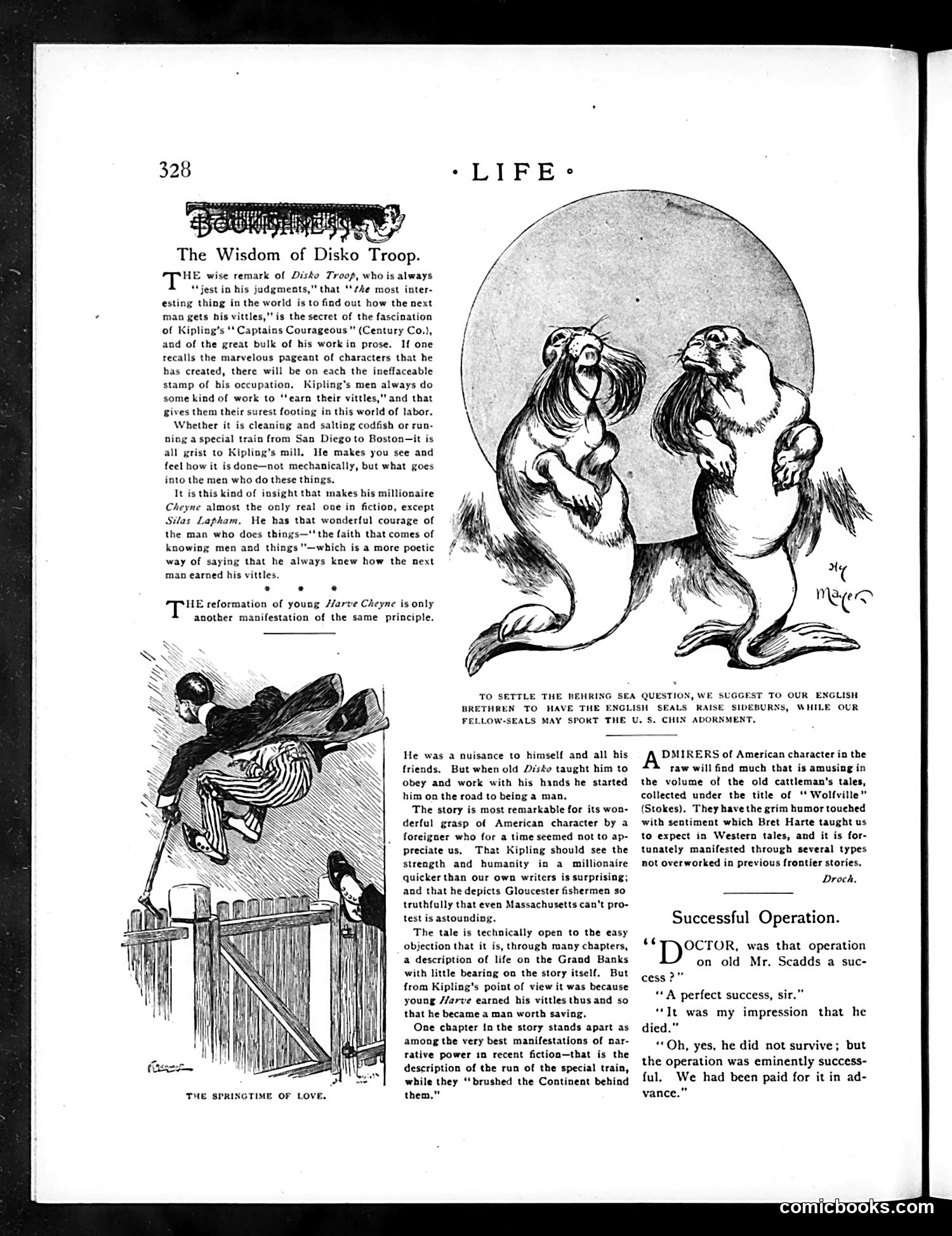
This page discusses Rudyard Kipling's literary character Disko Troop from the novel *Captains Courageous*. The upper illustration depicts an anthropomorphic dog or seal-like creature, likely referencing Kipling's "Disko Troop" character—the wise, tough ship captain who teaches young men work ethic through labor. The lower cartoon titled "The Springtime of Love" shows a man proposing to a woman at a fence, a sentimental domestic scene typical of early 1900s humor. The right column discusses American character types, referencing "Wollville" stories and praising Kipling's ability to capture authentic American frontier figures with humor and sentiment. The "Successful Operation" dialogue at bottom appears unrelated—a brief medical exchange suggesting a patient died but the surgery itself succeeded, likely satirizing physicians' priorities.
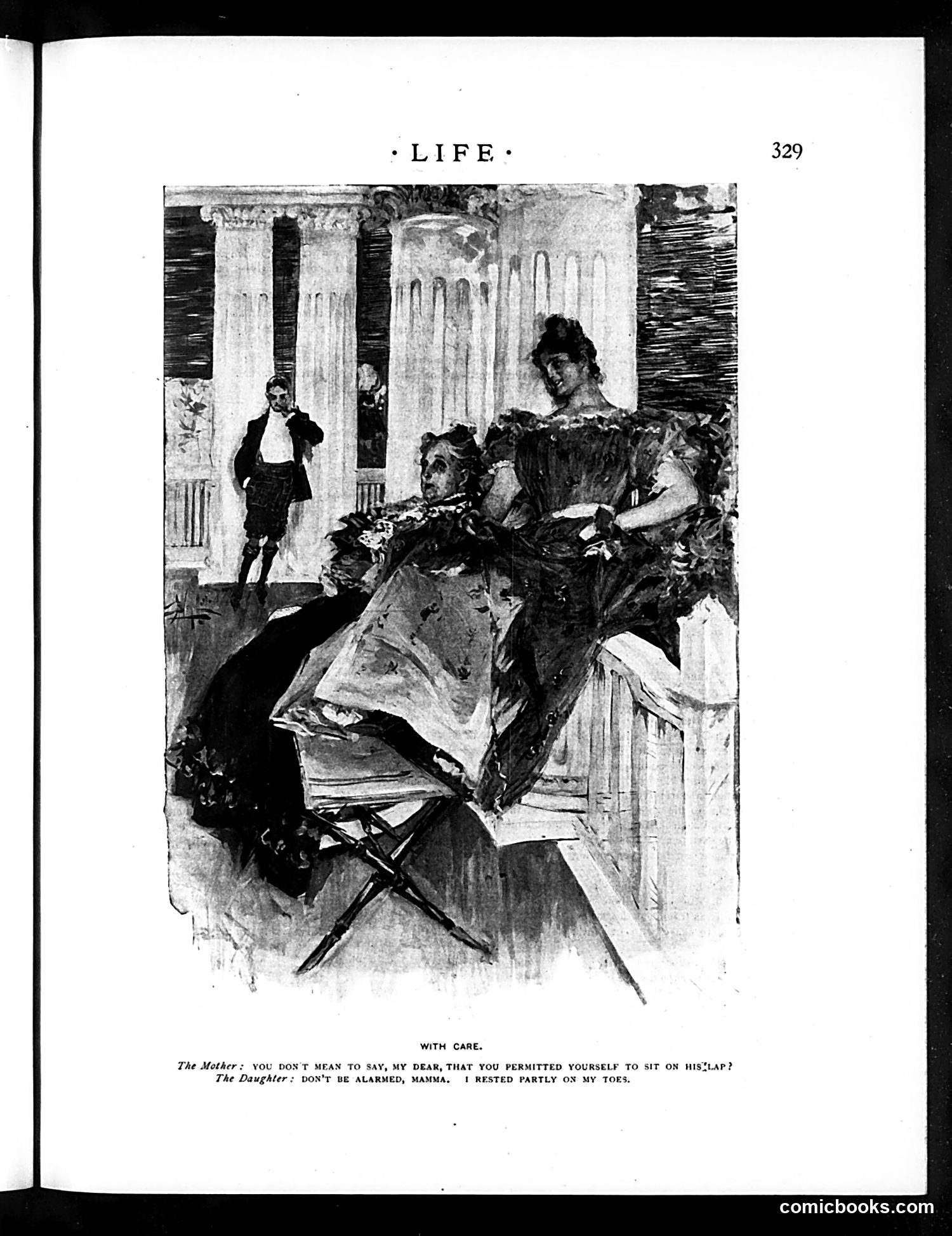
This illustration depicts a domestic social scene satirizing Victorian-era propriety and gender relations. A mother and daughter sit with guests in an elegant parlor (indicated by classical columns). The daughter appears to have permitted a male visitor to sit on her lap—a scandalous breach of Victorian etiquette. The mother's reproachful dialogue ("You don't mean to say, my dear, that you permitted yourself to sit on his lap?") contrasts sharply with the daughter's casual excuse ("I rested partly on my toes"), suggesting she's attempting to maintain plausible deniability about improper physical contact. The satire mocks the absurd social conventions governing interaction between unmarried young women and men, and the polite pretenses used to navigate them.
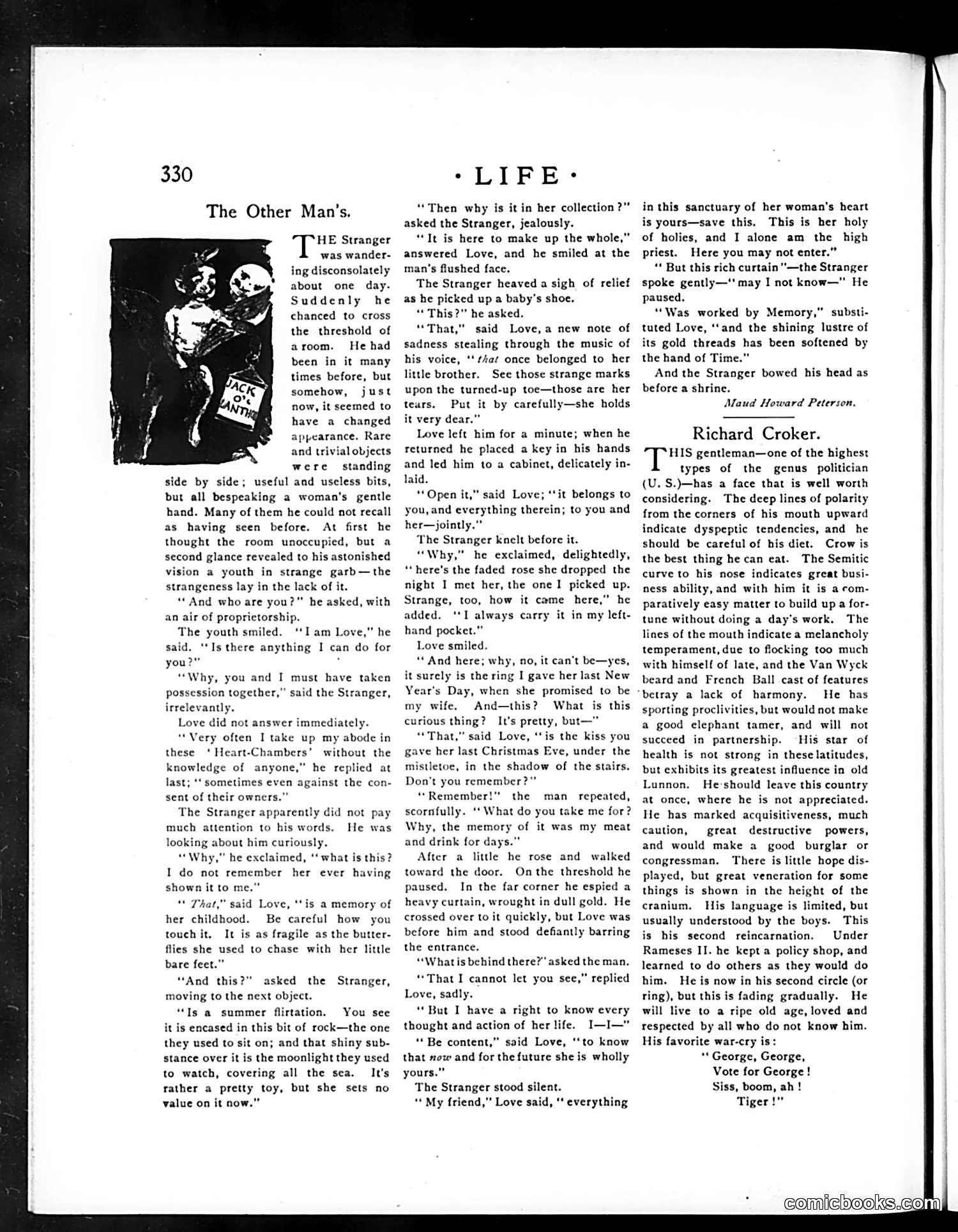
This page contains two distinct pieces: **"The Other Man's"** — A short story illustrated with a woodcut-style image showing a couple embracing. The narrative involves a Stranger discovering intimate objects (a baby's shoe, rose) belonging to a woman named Love, leading to philosophical discussion about memory, possession, and relationships. **"Richard Croker"** — A satirical character sketch of Richard Croker, identified as "one of the highest types of the genus politician (U.S.)." The piece mockingly catalogs his physical features and personality traits, suggesting he's a corrupt political figure with destructive influence. References to his "acquisitiveness," potential as a "burglar or congressman," and his nickname "George" indicate this targets a real Gilded Age political boss, likely the Tammany Hall leader.
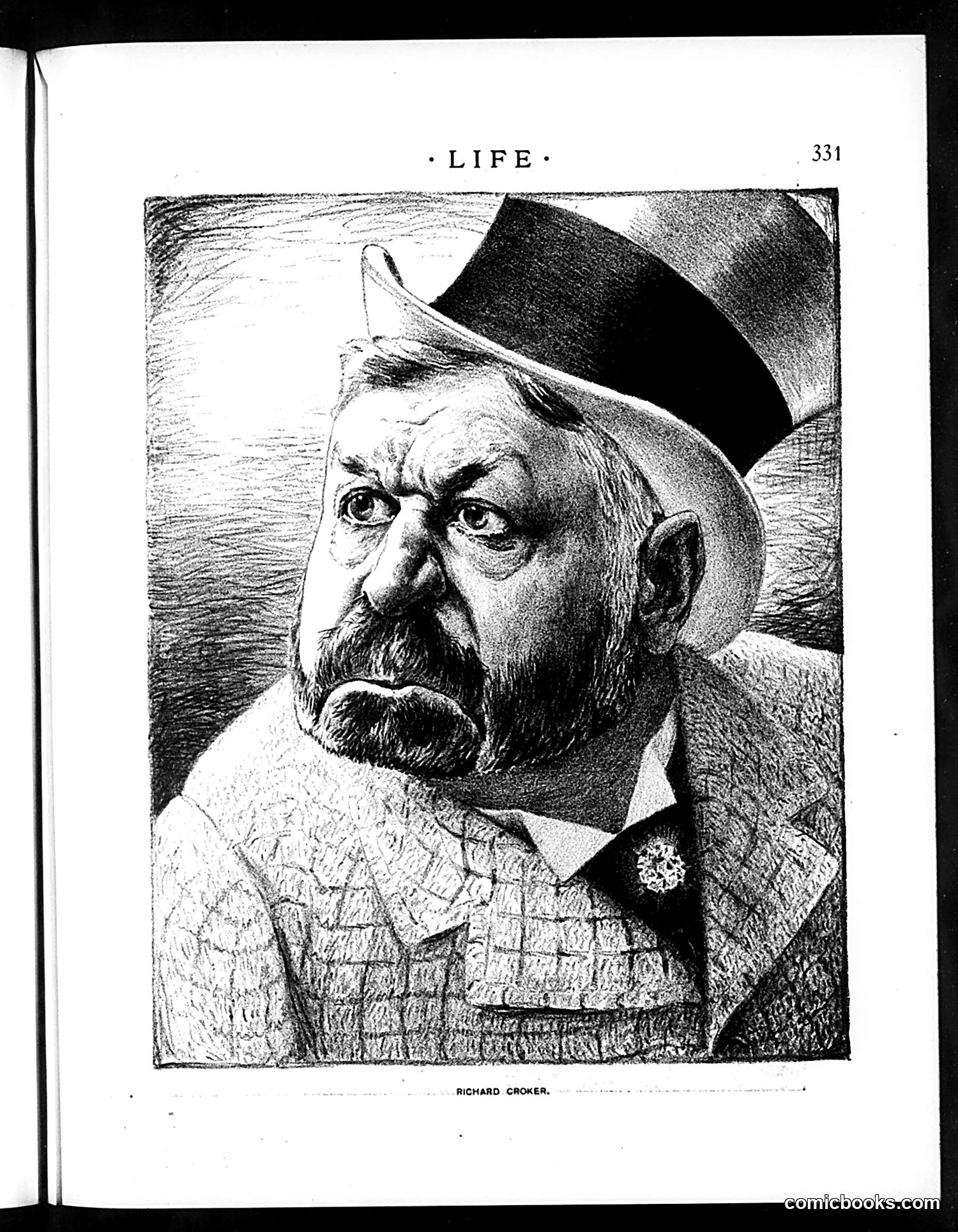
This page from *Life* magazine features a portrait labeled "Richard Croker," a prominent political figure of the late 19th/early 20th century. Croker was the boss of Tammany Hall, New York's influential Democratic political machine, known for corruption and patronage. The engraved portrait emphasizes his stern, commanding expression and heavy facial hair—likely exaggerating features to suggest ruthlessness or menace. His formal attire (vest, tie pin, cowboy hat) reflects his power and status. The satirical intent appears critical: portraying him as a domineering political boss whose influence shaped New York politics through backroom deals rather than democratic principle. This aligns with *Life*'s tradition of mocking corrupt political machines and their leaders.
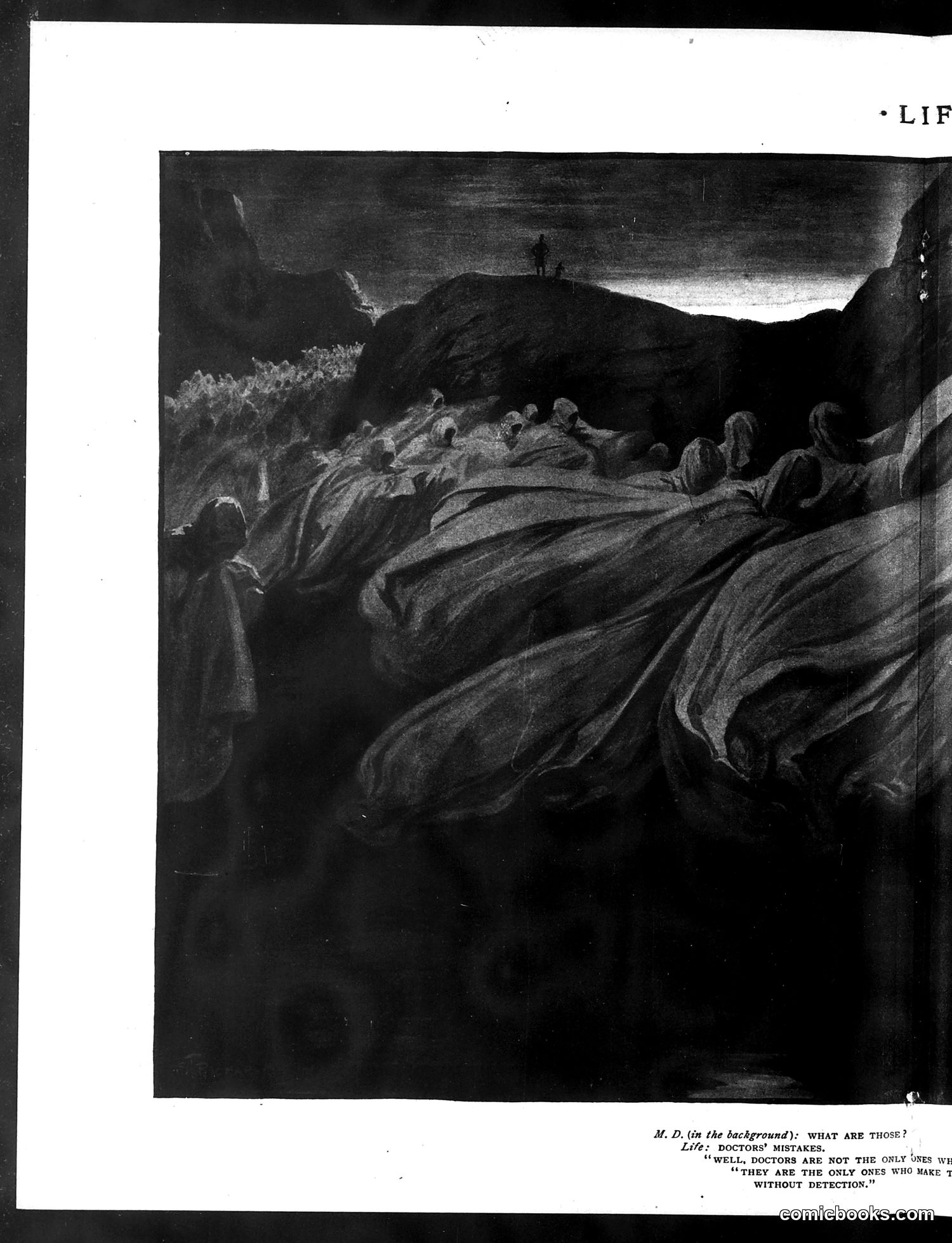
This appears to be a dramatic illustration from *Life* magazine depicting a scene in what looks like a cave or underground setting, with robed figures and an ominous atmosphere. The caption reads: "M.D. (in the background): 'WHAT ARE THOSE?' / Life: 'DOCTORS' MISTAKES.' / 'WELL, DOCTORS ARE NOT THE ONLY ONES WHO MAKE THEM—THERE ARE LOTS OF PEOPLE WHO MAKE MISTAKES WITHOUT DETECTION.'" This is satirical commentary on medical malpractice and professional accountability. The cartoon suggests that while doctors' errors are visible and discussed, ordinary people make mistakes constantly without public scrutiny or consequences. The dark, dramatic imagery emphasizes the gravity of medical errors, while the punchline critiques the disproportionate attention paid to doctors' mistakes versus those of the general population.
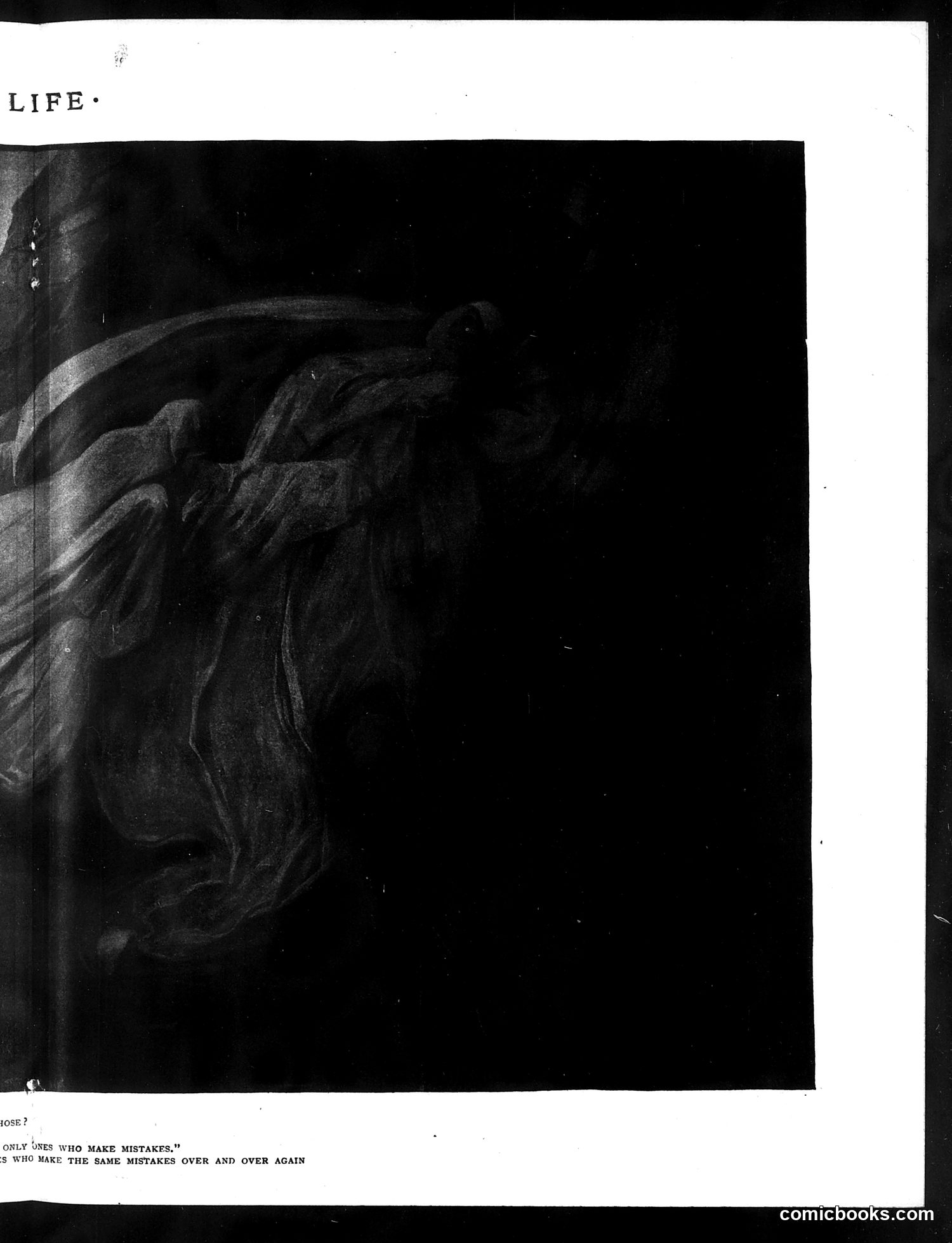
This appears to be a page from Life magazine featuring what the visible text describes as commentary about mistakes: "ONLY ONES WHO MAKE MISTAKES" and "WHO MAKE THE SAME MISTAKES OVER AND OVER AGAIN." The image itself is quite dark and difficult to discern clearly, showing what appears to be an ornamental architectural detail or sculptural element on the left side against a predominantly black background. Without clearer visibility of the cartoon's central figures or more complete text, I cannot definitively identify the specific political or social references intended. The partial caption suggests the content concerns repeated errors or foolish behavior, likely satirizing public figures or institutions of the era, but the specific targets and context remain unclear from this reproduction.
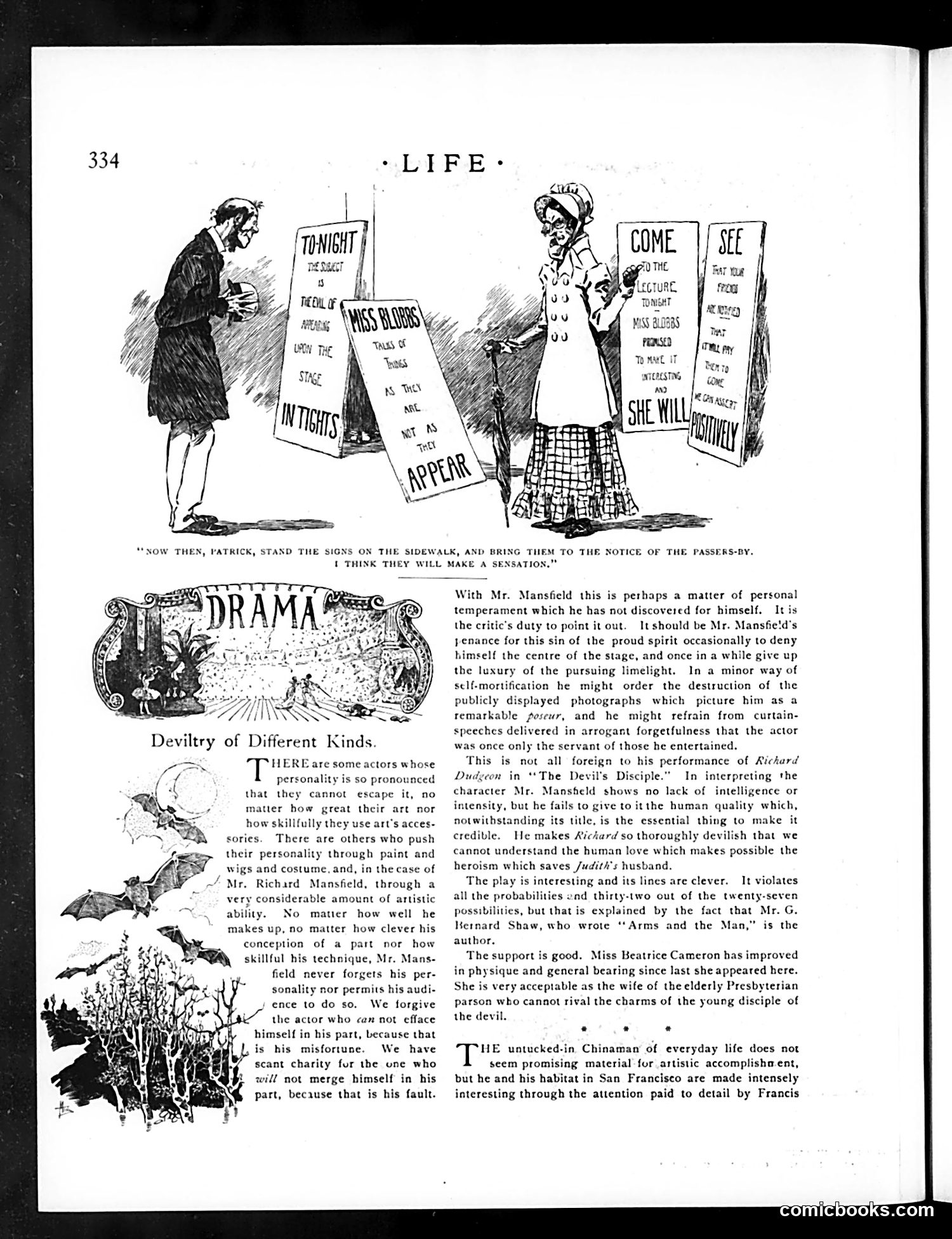
This page from *Life* magazine satirizes theatrical promotion and actor ego. The top cartoon shows a theater manager instructing an assistant to place sensational sandwich-board signs on sidewalks advertising a production featuring "Miss Globbs." The caption mocks the absurdity of using outrageous publicity stunts to draw audiences. The lower section, titled "Delivery of Different Kinds," critiques actor Richard Mansfield's theatrical style. The text accuses him of excessive self-aggrandizement and argues that while technically skilled, he fails to convey genuine human emotion in roles like *Richard the Third*. The satire suggests Mansfield prioritizes personal star power and artistic display over authentic character portrayal—a common complaint about early twentieth-century stage acting emphasizing spectacle over substance.
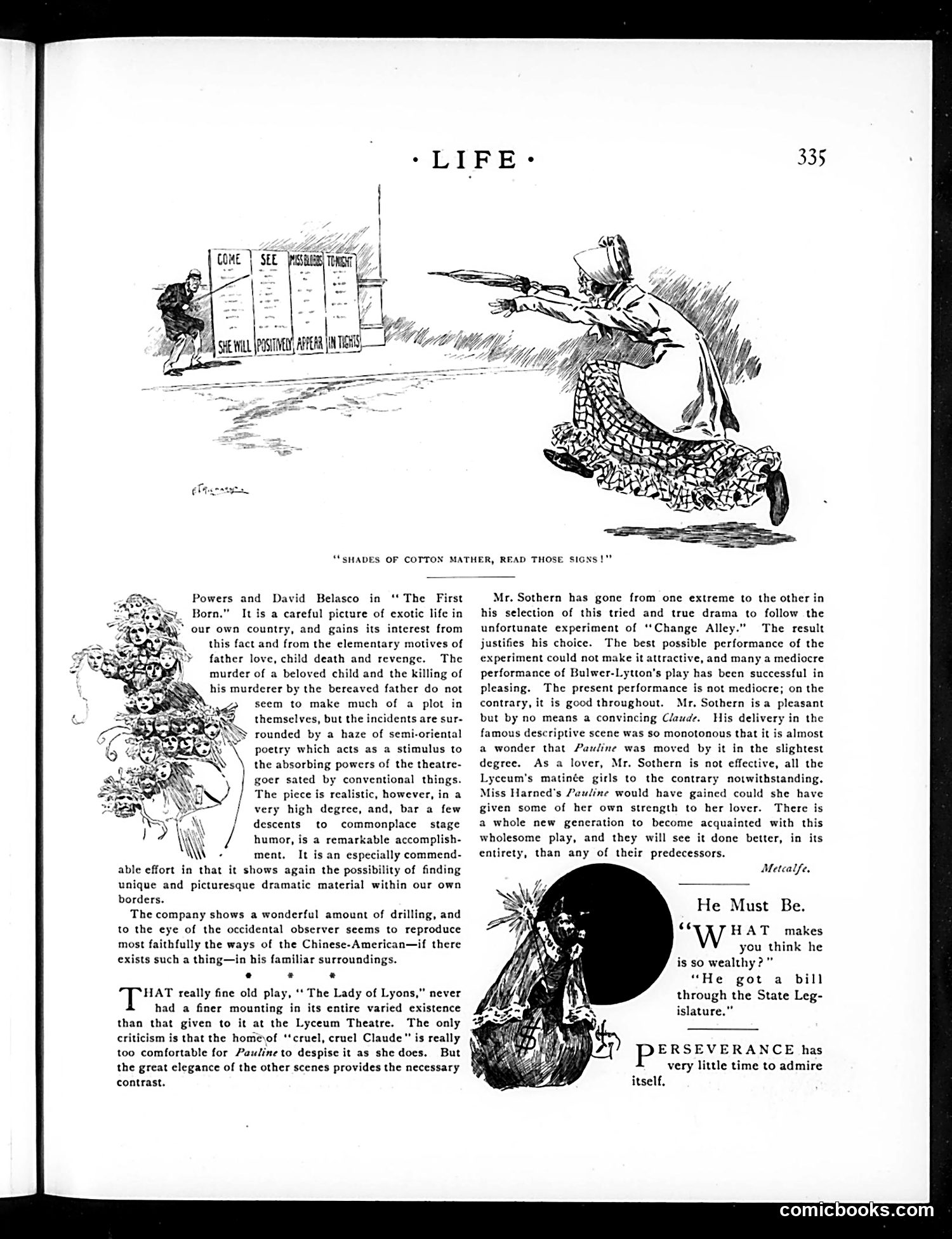
The main cartoon depicts a woman in period dress pointing accusingly at a man reading signs outside what appears to be a fortune teller's establishment. The caption "Shades of Cotton Mather, read those signs!" references the Puritan witchcraft judge, sardonically comparing the fortune-teller's signage to superstitious witch-hunting. The page reviews theatrical productions, including "The First Born" (featuring Powers and David Belasco), praised for using exotic Chinese-American subject matter—murder, child death, and revenge—within American borders rather than distant settings. The bottom includes two brief humor items: one mocking wealth obtained through legislative bills (political corruption satire), and another on perseverance lacking self-awareness. The cartoons and commentary reflect early 20th-century American anxieties about superstition, theatrical authenticity, and political graft, while the Mather reference invokes historical Puritan extremism as comparison.
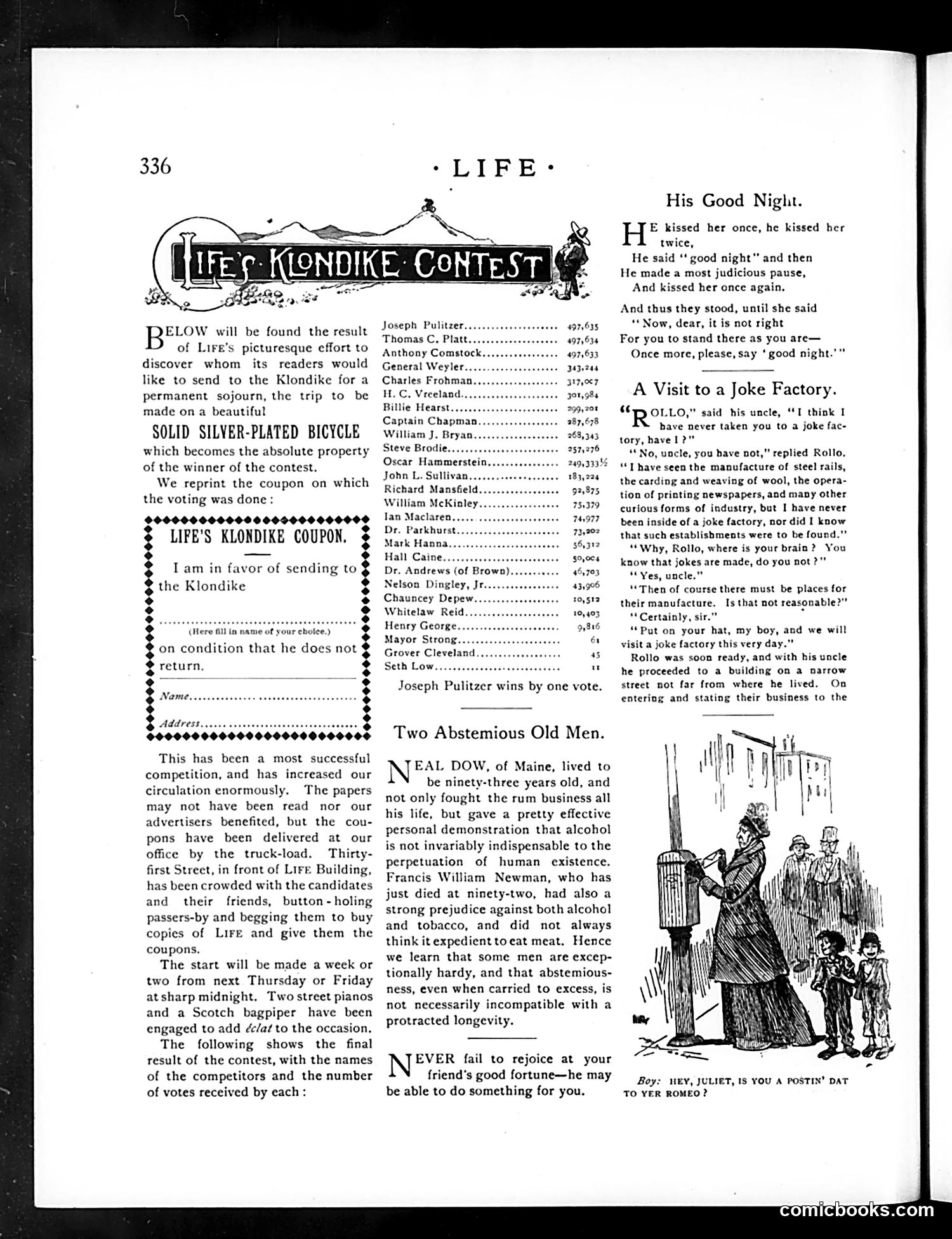
This page documents *Life* magazine's humorous contest asking readers to vote on which public figure they'd most like to send to the Klondike (the Yukon gold-rush region) for permanent exile. The winner receives a silver-plated bicycle. The results reveal contemporary public sentiment: **Joseph Pulitzer** (newspaper publisher) wins by one vote, followed by politicians Thomas C. Platt and Anthony Comstock. The list includes figures Life's readers apparently disliked—William McKinley, William Jennings Bryan, newspaper magnate James Gordon Bennett's son ("Billie Hearst"), and General Weyler (Spanish military figure). This is satirical voting on unpopular public figures of the 1890s. The contest's success (truck-loads of coupons) shows it capitalized on readers' desire to humorously "banish" controversial politicians, businessmen, and public figures. The page also includes unrelated humorous sketches about elderly teetotalers and a joke factory.
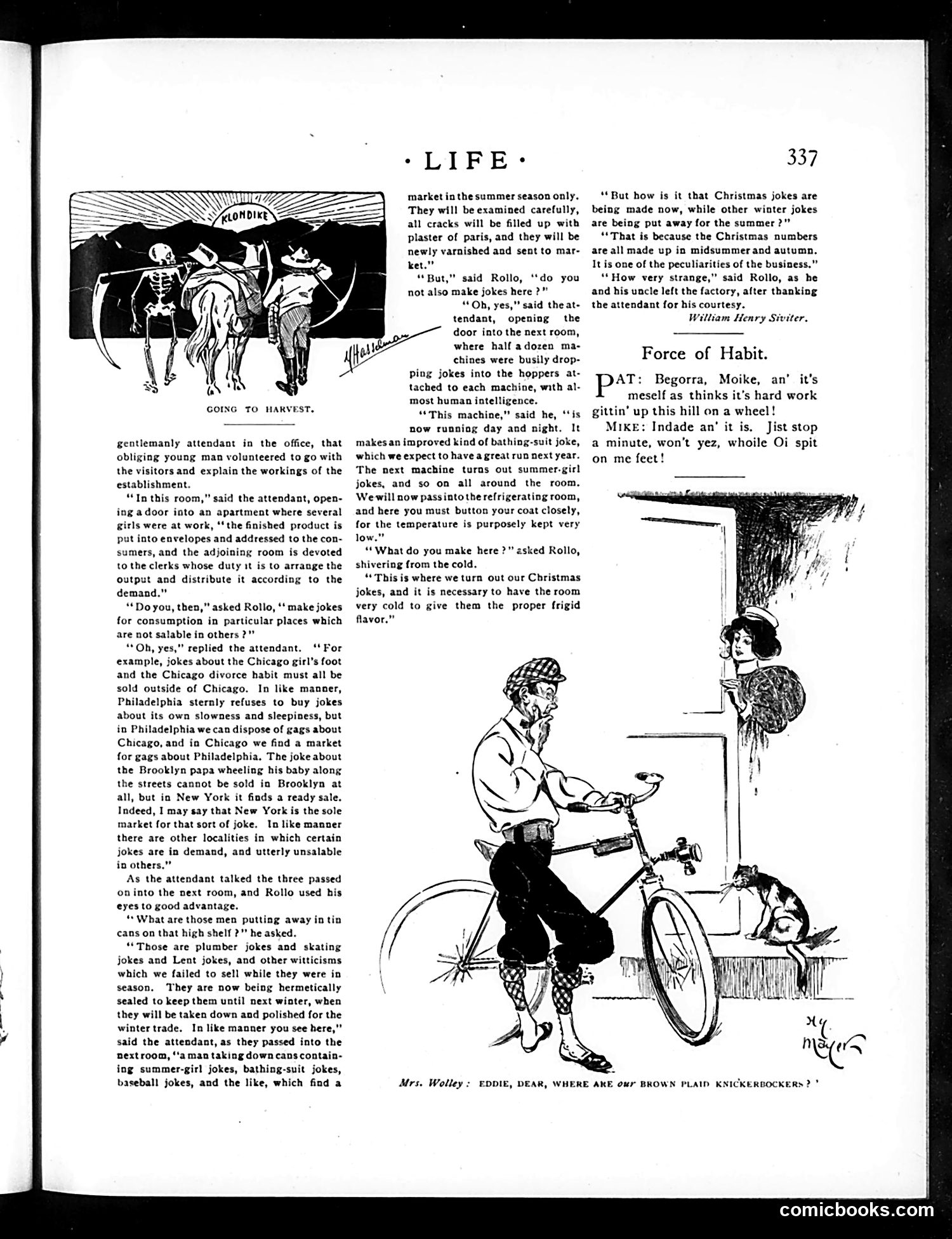
This page satirizes the **seasonal nature of topical humor** in early 20th-century America. The main story follows a character named Rollo touring a fictional "joke factory" that manufactures jokes like industrial products. The satire mocks how jokes are location-specific and season-dependent: Chicago divorce jokes won't sell in Chicago itself; Brooklyn baby-carriage jokes only sell in New York; Christmas jokes must be written in summer for holiday publications. The factory literally stores jokes in cans during off-season, then "polishes" them for resale—treating humor as mass-produced inventory rather than creative expression. The cartoon below shows two Irish laborers struggling uphill on a bicycle, one saying the climb is hard work. This appears to be a separate humor piece playing on Irish dialect stereotypes common to the era. Together, the page satirizes both the commercialization of humor and publishing's rigid seasonal cycles.
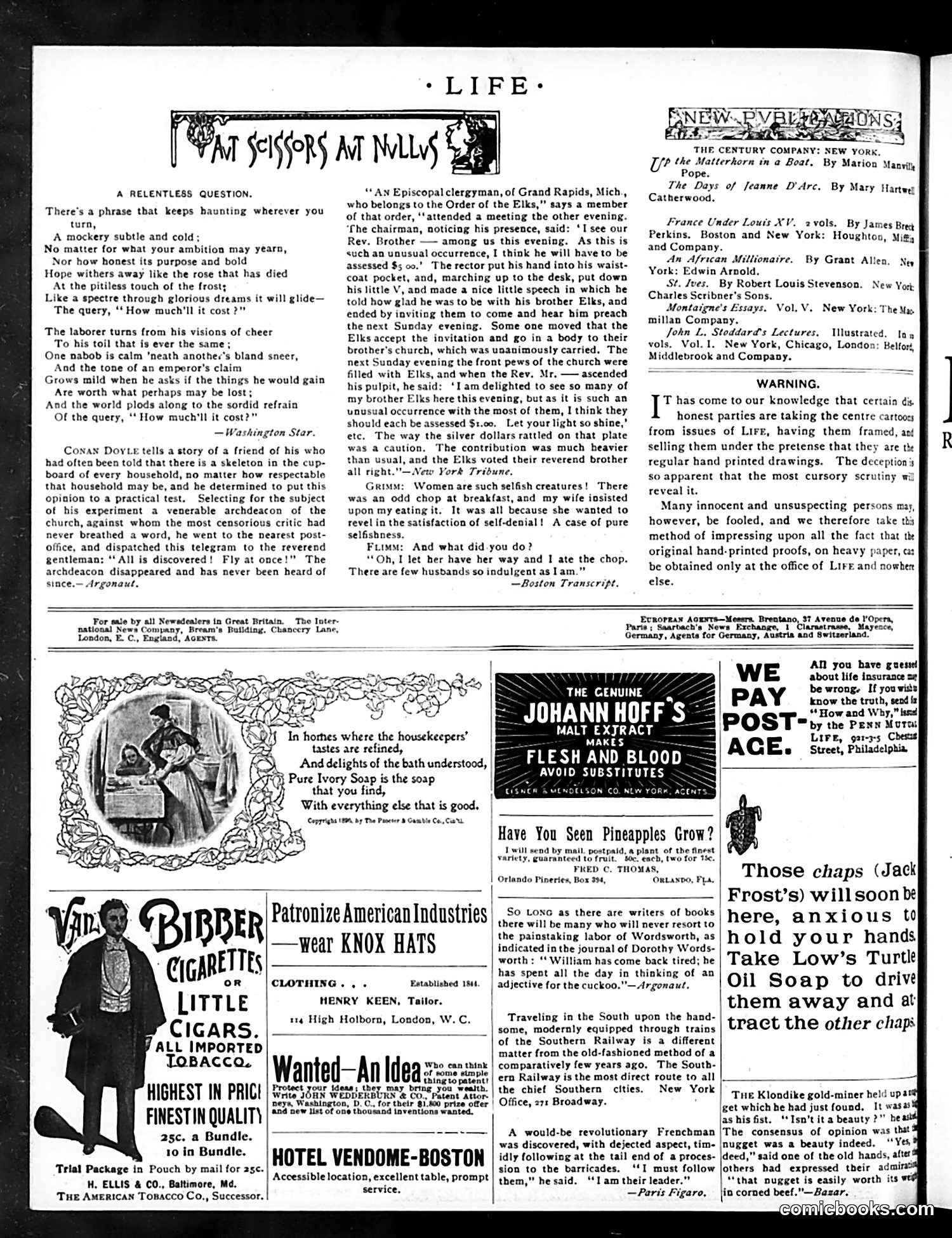
This page is primarily **advertising and miscellaneous content** rather than political satire. The main elements are: **Poems/Humor Pieces:** - "A Relentless Question" — a melancholic poem about how cost considerations ("How much'll it cost?") dampen human ambition and joy across all social classes - Two brief anecdotes mocking human nature: one about an archdeacon who flees upon receiving a mysterious telegram, another about a clergyman who turns the tables on the Elks lodge by assessing them donations **Advertisements:** The page is dominated by ads for Knox Hats, Van Bibber Cigarettes, Johann Hoff's Malt Extract, and other period products, along with book announcements. **Overall Character:** This appears to be a typical **Life magazine filler page** from the early 1900s—mixing light satirical verse about everyday frustrations with commercial advertising. The humor is gentle social commentary rather than sharp political critique.
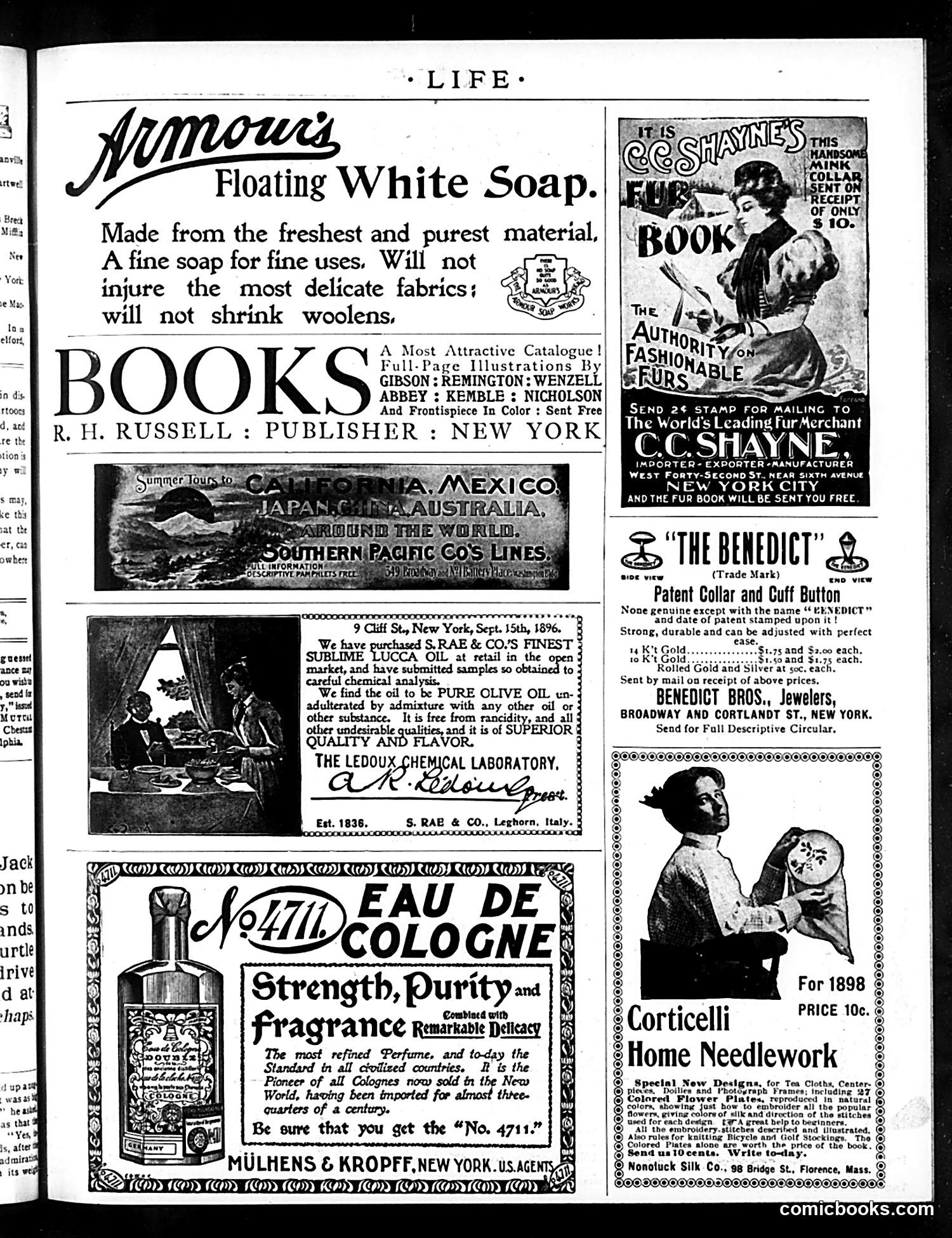
This is primarily a **advertisements page**, not a political cartoon. It contains multiple product ads typical of the 1890s: **Key advertisements:** - **Armour's Floating White Soap** - emphasizing purity and gentleness on fabrics - **R.H. Russell Publisher** - promoting illustrated books by famous artists (Gibson, Remington, etc.) - **Travel tours** to California, Mexico, Japan, and Australia - **S. Rae & Co. Lucca Oil** - olive oil certified pure by chemical analysis (addressing contemporary food adulteration concerns) - **No. 4711 Eau de Cologne** - a century-old perfume brand - **Shayne Fur Company** - fur merchant with fashion book - **Benedict Bros.** - patent collar buttons in gold and silver - **Corticelli Home Needlework** - embroidery instruction book for 1898 The page reflects **Gilded Age consumer culture**: emphasis on purity/quality (responding to food safety scandals), luxury goods, travel aspirations, and domestic crafts for women. No satire is evident—this appears to be standard Life magazine revenue content.
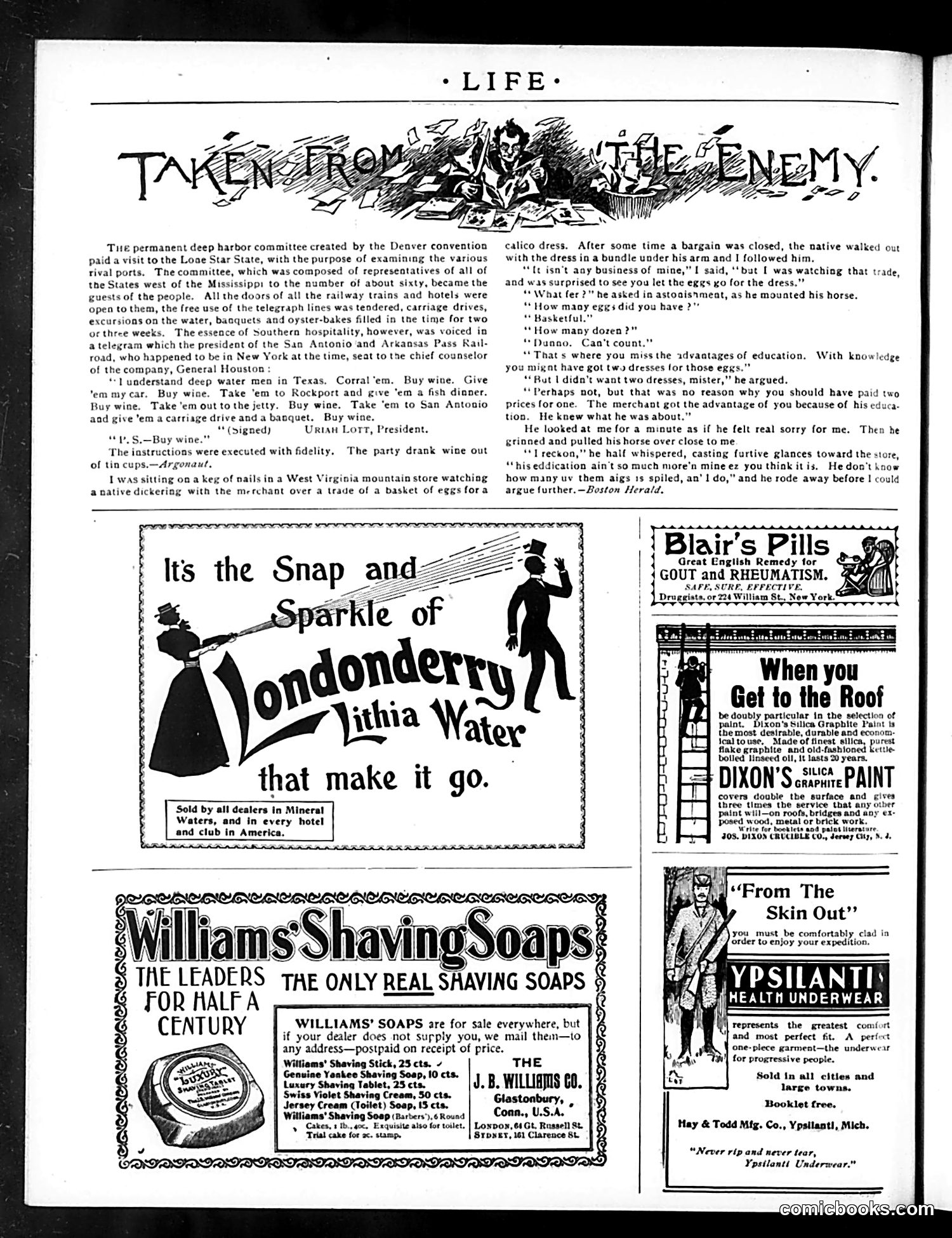
This page contains two satirical anecdotes about cunning and education: 1. **The Harbor Committee Story**: A railroad president instructs his subordinate to entertain visiting businessmen through lavish hospitality—repeatedly buying wine and arranging banquets. The satire mocks how Southern businessmen used excessive entertainment to influence commercial decisions, with the repeated phrase "Buy wine" highlighting both the strategy's simplicity and its dependence on alcohol. 2. **The Uneducated Man Outwits the Educated Merchant**: A backwoods trader exchanges eggs for a calico dress. When a bystander lectures him about education and fair pricing, the man reveals he actually got the better deal—he knew some eggs were spoiled (information the "educated" merchant lacked). The joke inverts the superiority of formal education, suggesting practical knowledge and cunning matter more than book-learning. Both stories celebrate cleverness over conventional wisdom—whether through shameless manipulation or street smarts.
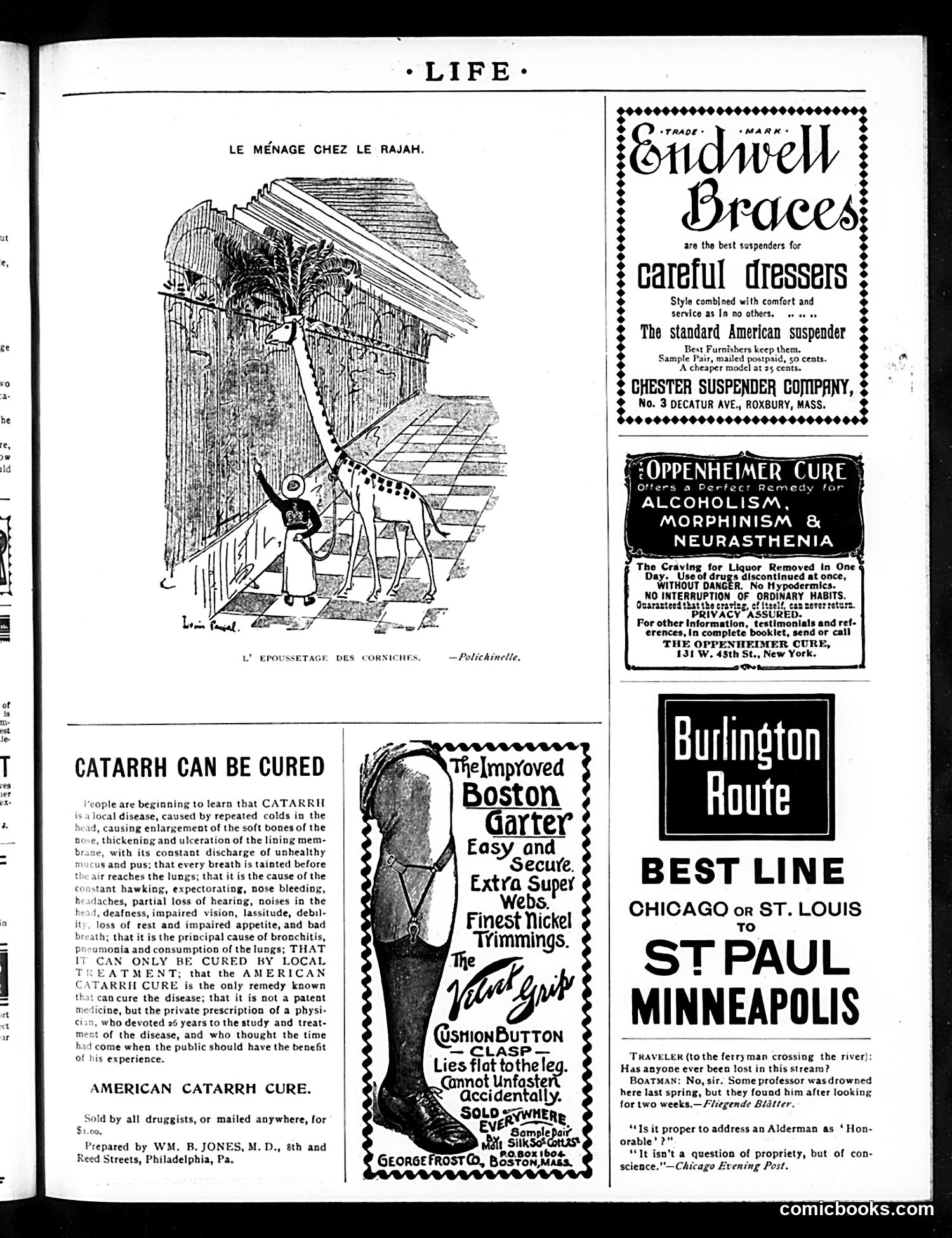
This page combines satirical cartoons with period advertisements, typical of Life's format. **The Cartoons:** Two French-captioned illustrations appear at top: "Le Ménage Chez le Rajah" (Housekeeping at the Rajah's) depicts a colonial scene with a servant sweeping, likely satirizing British imperial household dynamics. Below, "L'Époussetage des Corniches" shows similar domestic servitude, signed by Polichinelle (a commedia dell'arte character used as a running byline). These mock European attitudes toward colonial labor. **The Advertisements:** The page is largely filled with period patent medicines and products—catarrh cures, suspenders, the "Oppenheimer Cure" for alcoholism—reflecting early 1900s medicine's questionable remedies. The railroad advertisement for Burlington Route represents legitimate commercial content. **The Jokes:** A brief dialogue at bottom mocks municipal corruption: an alderman being called "honorable" is presented as a matter of conscience rather than propriety—dark humor about political dishonesty.
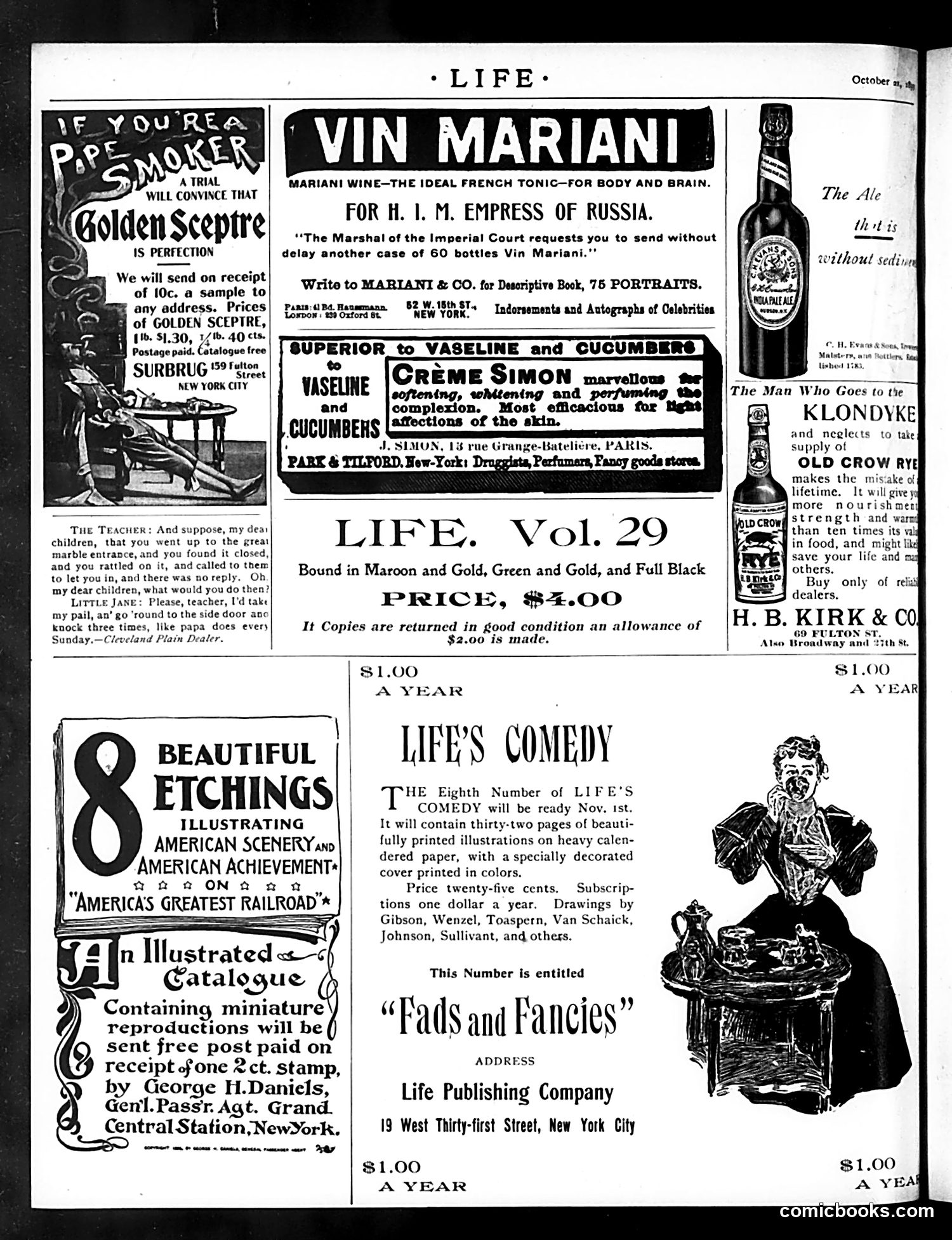
This page is primarily advertising and promotional content rather than satirical cartoons. The main elements are: **Advertisements:** The page features luxury products marketed to affluent readers—Vin Mariani wine (a French tonic claiming health benefits), Crème Simon skincare, and Golden Sceptre pipe tobacco. These ads use celebrity endorsements and pseudo-scientific claims typical of early 20th-century marketing. **One Humor Piece:** A brief joke titled "The Teacher" depicts a schoolchild (Little Jane) who, when asked what she'd do if locked out of a marble building, says she'd sneak around to the side door "like papa does every Sunday"—implying her father regularly enters buildings illicitly. The humor assumes readers will recognize this as commentary on working-class or immigrant behavior. **Life Magazine Promotions:** The page advertises Life's own publications, including an upcoming "Comedy" issue and a railroad-themed etchings catalog. The page reflects Gilded Age consumer culture and contains casual period stereotyping, but lacks substantial political or social satire.