
Life, 1897-10-21 · page 12 of 20
Life — October 21, 1897 — page 12: what you’re looking at
What you’re looking at
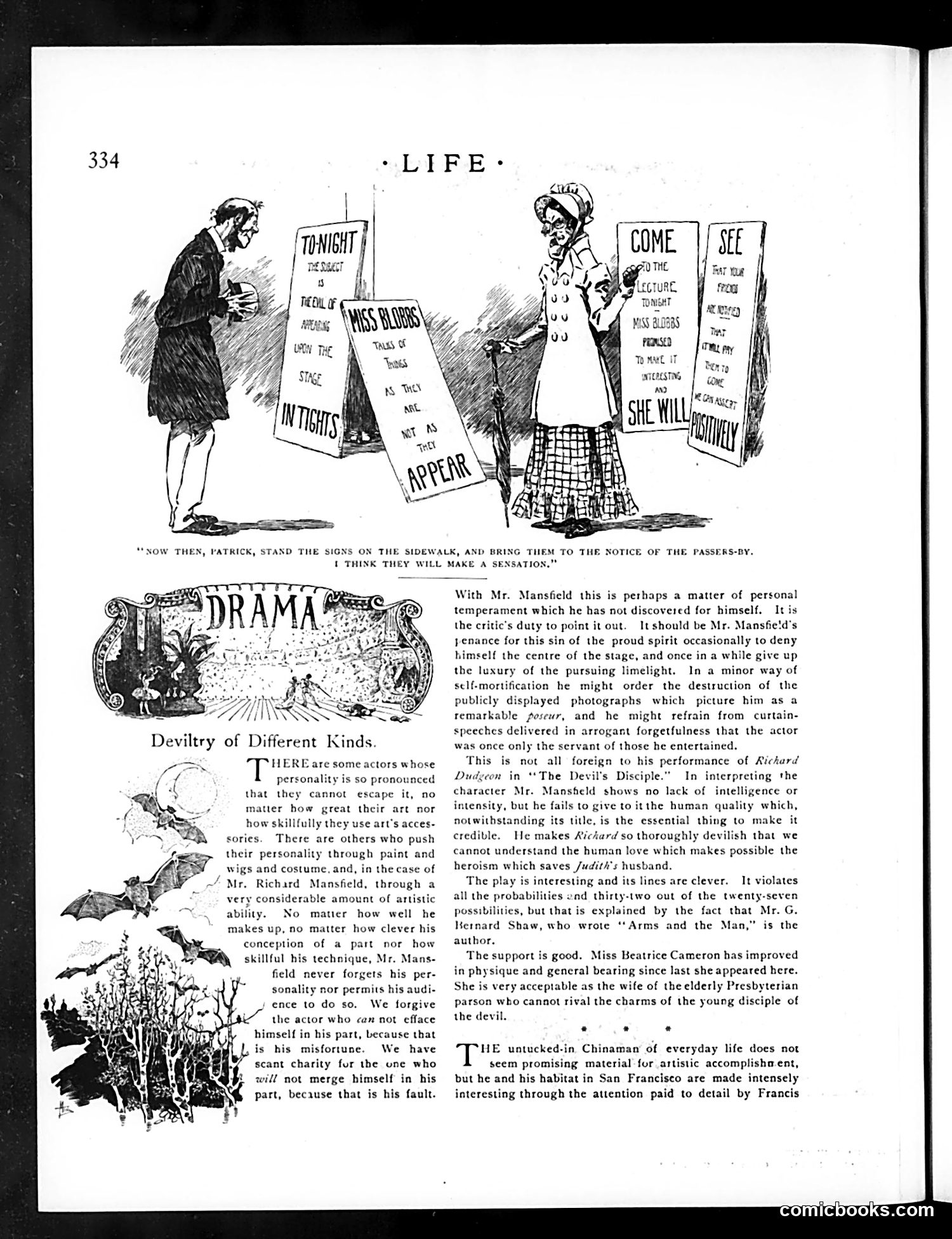
This page from *Life* magazine satirizes theatrical promotion and actor ego. The top cartoon shows a theater manager instructing an assistant to place sensational sandwich-board signs on sidewalks advertising a production featuring "Miss Globbs." The caption mocks the absurdity of using outrageous publicity stunts to draw audiences. The lower section, titled "Delivery of Different Kinds," critiques actor Richard Mansfield's theatrical style. The text accuses him of excessive self-aggrandizement and argues that while technically skilled, he fails to convey genuine human emotion in roles like *Richard the Third*. The satire suggests Mansfield prioritizes personal star power and artistic display over authentic character portrayal—a common complaint about early twentieth-century stage acting emphasizing spectacle over substance.
📄 Transcribed text from this page (OCR, searchable)
Machine-transcribed from the original scan — historical spelling and the odd misread are preserved.
‘awtr} | TE RBET Mass BL0885 PURSED Te nut iT INTERESTING rs) Y SHE ILL “NOW THEN, PATRICK, STAND THE SIGNS ON THE SIDEWALK, AND BRING THEM TO THE NOTICE OF THE PASSERS-BY. 1 THINK THEY WILL MAKE A SENSATION.” Deviltry of Different Kinds. 7 f (od HERE are some actors whose personality is so pronounced that they cannot escape it, no matter how great their art nor how skillfully they use art's acces- sories. There are others who push their personality through paint and wigs and costume. and, in the case of Mr. Richard Mansfield, through a very considerable amount of artistic ability. No matier how well he makes up, no matter how clever his conception of a part nor how skillful his technique, Mr. Mans- field never forgets his per- sonality nor permits his audi- ence to do so, We forgive the actor who can not efface himself in his part, because that is his misfortune. We have scant charity fur the une who will not merge himself in his part, because that is his fault. With Mr. Mansfeld this is perhaps a matter of personal temperament which he has not discovered for himself. It is the critic's duty to point it out. It should be Mr. Mansfie!d’s penance for this sin of the proud spirit occasionally to deny himself the centre of the stage, and once in a while give up the luxury of the pursuing limelight. In a minor way of self-mortification he might order the destruction of the publicly displayed photographs which picture him as a remarkable foseur, and he might refrain from curtain- speeches delivered in arrogant forgetfulness that the actor was once only the servant of those he entertained, This is not all foreign to his performance of Richard Dudgeon in “The Devil's Disciple.” In interpreting the character Mr. Mansheld shows no lack of intelligence or intensity, but he fails to give to itthe human quality which, notwithstanding its tide, is the essential thing to make it credible. He makes Aickard so thoroughly devilish that we cannot under: d the human love which makes possible the heroism which saves /udith’s husband. The play is interesting and its lines are clever. It violates all the probabilities end thirty-two out of the twenty-seven possibilities, but that is explained by the fact that Mr. G. Bernard Shaw, who wrote ‘Arms and the Man,” is the author, The support is good. Miss Beatrice Cameron bas improved in physique and gencral bearing since last she appeared here. She is very acceptable as the wife of the elderly Presbyterian parson who cannot rival the charms of the young disciple of the devil. * * * HE untucked-in Chinaman of everyday life does not seem promising material fur artistic accomplisha-ent, but he and his habitat in San Francisco are made intensely interesting through the attention paid to detail by Francis