
A complete issue · 20 pages · 1897
Life — September 30, 1897
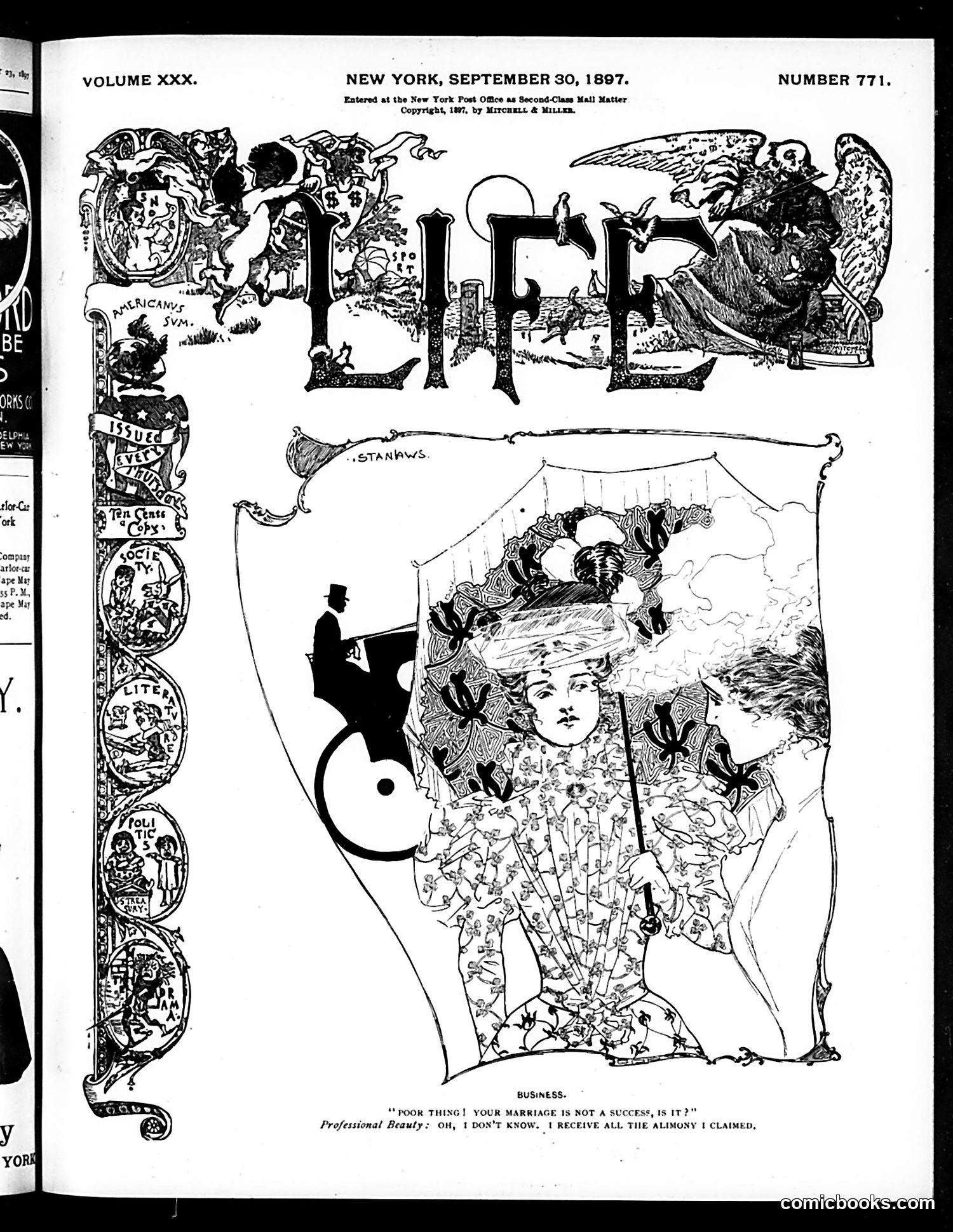
This page features a satirical cartoon about marriage and alimony. The central image shows an elaborately dressed woman under a parasol, with a small figure of a man in a top hat sitting on the parasol's curve—a visual metaphor suggesting he's being weighed down or controlled by her. The caption reads: "Poor thing! Your marriage is not a success, is it?" with a response about receiving "all the alimony I claimed." The satire targets the financial burden of divorce settlements on men, particularly wealthy ones. This reflects late-19th-century anxieties about women's legal rights to spousal support. The woman's elaborate, expensive dress emphasizes the joke—that alimony allows ex-wives to maintain lavish lifestyles at their former husbands' expense. The cartoon mocks both the legal system and women's "gold-digging" motivations.
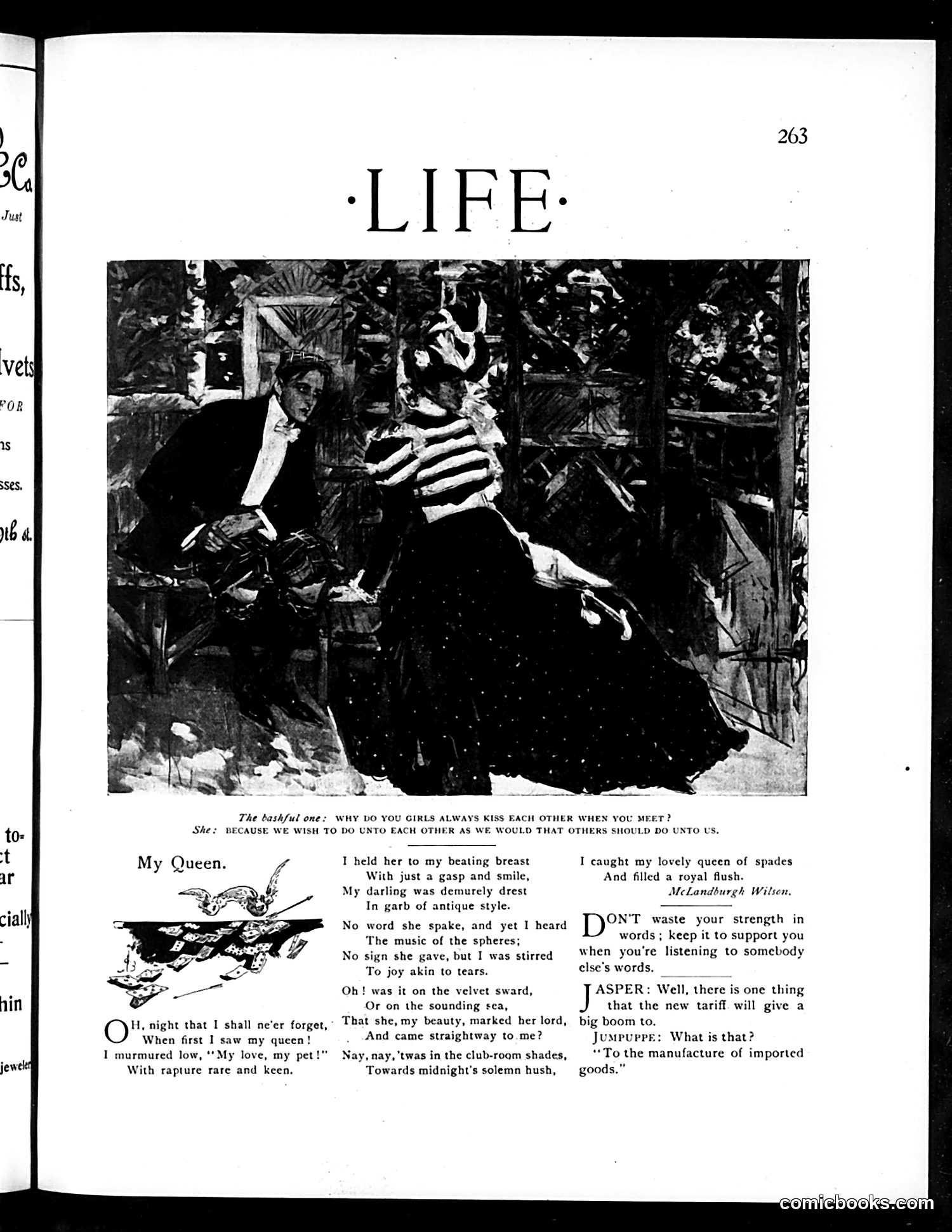
This page from *Life* magazine features "My Queen," a romantic poem with accompanying illustration. The main image shows a couple in an intimate embrace at what appears to be a social gathering, rendered in dramatic black and white. The poem is sentimental Victorian-era romance, describing the speaker's infatuation with his beloved. The illustration style—with its bold contrasts and theatrical composition—suits the passionate tone. Below, a brief humorous dialogue between characters named Jasper and Jumpiffer discusses tariff policy and manufactured goods, suggesting this was typical of *Life's* mix of romantic content and light political/economic commentary. This page reflects early 20th-century magazine conventions: mixing sentimental literature with satirical commentary on contemporary economic debates.
This page contains three political commentary pieces satirizing New York City politics of the 1890s: **"No Nonsense About Low"** criticizes Seth Low's mayoral candidacy, praising his straightforward character and suggesting he represents genuine reform—contrasting with typical corrupt politicians. **"Stick to the Pick, General"** mocks Commissioner Collis's efforts to nominate a Republican rival to Low, arguing such infighting undermines reform efforts and that Collis should focus on proving reform administrations work. **"The Newest Balloon Story"** appears to reference newspaper correspondents' exaggerated reporting about a balloon sighting in the American West, satirizing sensationalist journalism and the unreliability of frontier news reports. The illustrations (not fully visible) likely accompany these satirical attacks on city politics and press practices.
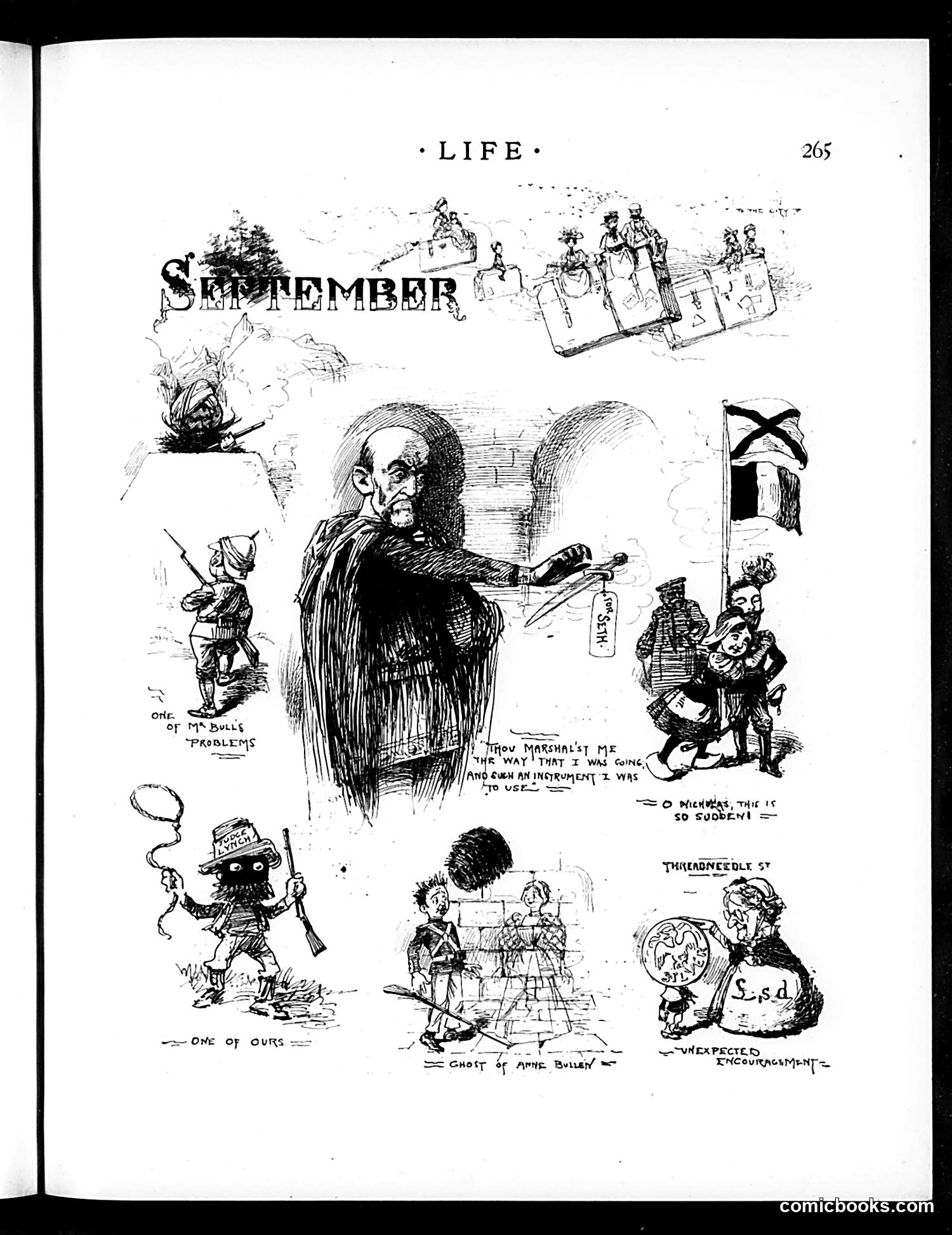
This page presents satirical sketches commenting on September events and figures. The central image shows a gaunt, angry military or political figure confronting someone, with caption references to "Marshal" and an "instrument" — likely alluding to a contemporary military or political conflict, though the specific reference is unclear without additional context. The surrounding vignettes mock various September occurrences: "One of Ours," "Ghost of Anne Boleyn," "Threadneedle St" (London's financial district), and "Unexpected Encouragement" suggest commentary on American soldiers, historical references, financial matters, and political developments. The style is typical of Life's satirical approach to current events, using caricature and visual metaphor to critique political and social situations of the period, though specific identifications require additional historical context.
This page contains **no political cartoon or satire**. Instead, it presents a serialized short story titled "As Told by the Girl" with sections including "Journalistic" and "Our Fresh Air Fund." The narrative appears to be a romantic drama involving characters named Miss Townsend, Kitty, and Mr. Appleton, depicting an emotional conversation between young people. The story deals with personal relationships and feelings rather than political or social commentary. The page also includes a financial notation for "Our Fresh Air Fund" acknowledging previous charitable contributions to institutions like Greek Island Sunday School and the H.A.P. This is **literary content, not satirical illustration**.
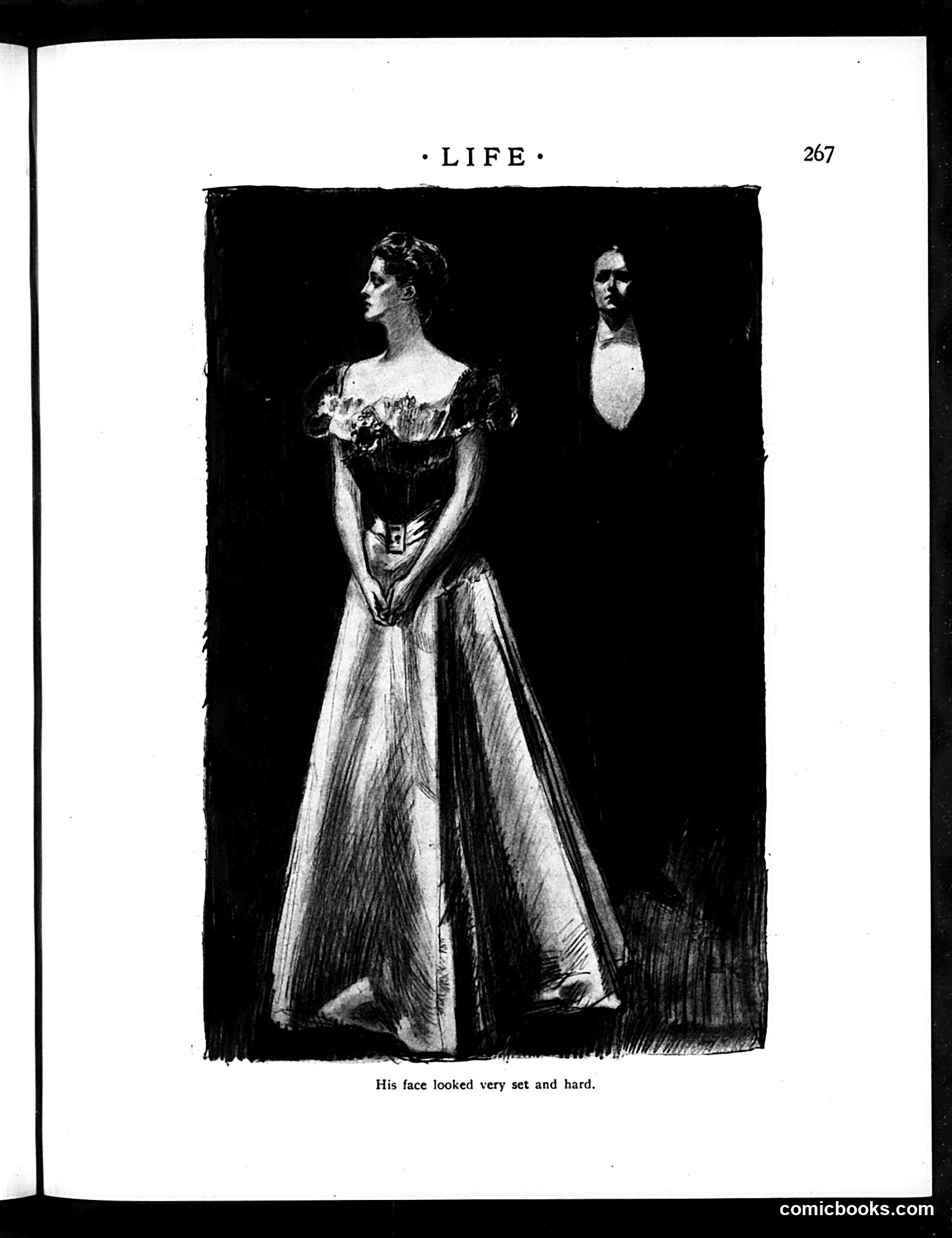
This page from *Life* magazine (page 267) shows an illustration of a woman in formal evening wear alongside a man's head in profile. The caption reads: "His face looked very set and hard." The sketch appears to be from a narrative or serialized story rather than a standalone political cartoon. Without additional context from surrounding pages, the specific dramatic situation is unclear. The artistic style—a dramatic black-and-white illustration with theatrical lighting—suggests this depicts a tense moment between two characters, possibly from a romance or drama being serialized in the magazine. The formal attire and emotional tension suggest upper-class social drama, typical of *Life's* satirical fiction content from the early 20th century, but the specific characters, plot, and satirical point cannot be definitively identified from this page alone.
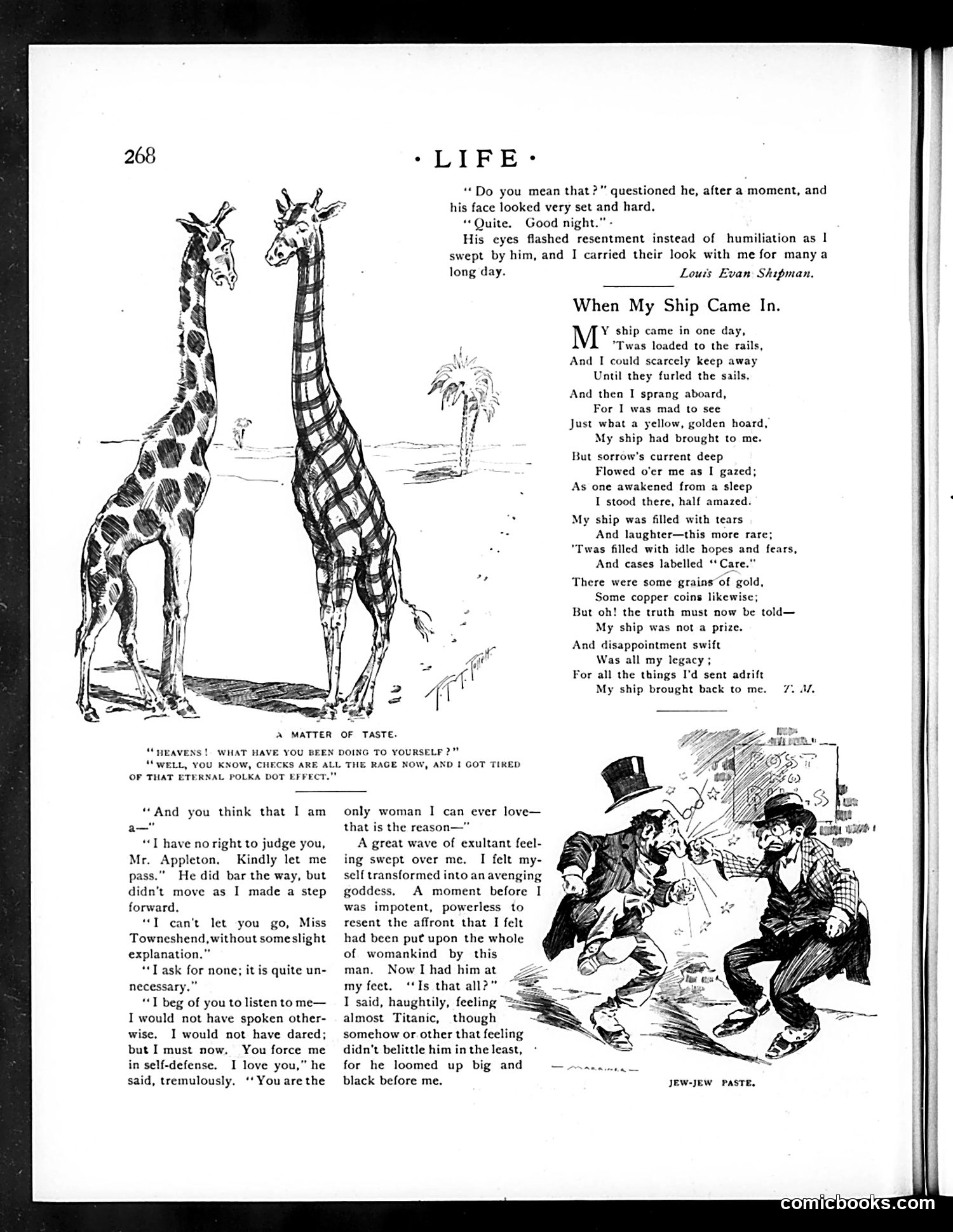
**Upper Illustration: "A Matter of Taste"** Two giraffes are depicted with contrasting patterns—one natural-spotted, one wearing a checkered suit. The caption shows one giraffe criticizing the other's fashion choices, joking about "eternal polka dot effect." This appears to be gentle satirical commentary on fashion trends and personal taste preferences of the era. **Lower Illustration: "Jew-Jew Paste"** Three figures in formal dress appear to be engaged in a confrontational scene. This cartoon's title and imagery suggest antisemitic content typical of early-20th-century American satirical publications. The specifics of the satirical "point" are unclear from context alone, but it reflects the unfortunately common prejudiced stereotyping found in period publications.
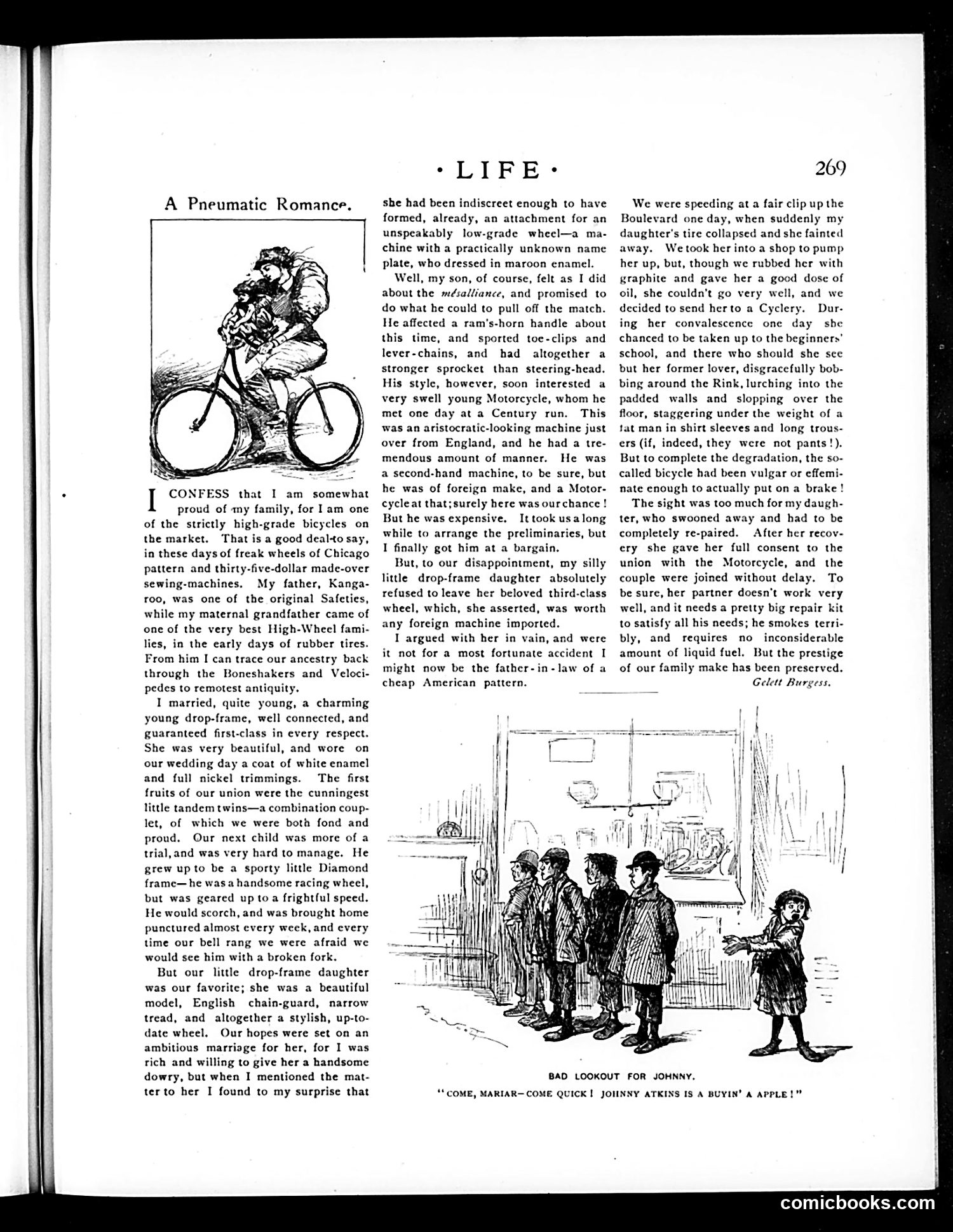
This page satirizes the era's fascination with bicycles and motorcycles as status symbols among the wealthy. The main article mocks a narrator's family pride in owning "high-grade bicycles"—presenting them as markers of social standing equivalent to fine furniture or jewelry. The humor targets how bicycles were marketed as luxurious goods, while the story depicts the awkwardness when the narrator's "drop-frame daughter" refuses to marry a wealthy suitor because his motorcycle (though expensive and "aristocratic-looking") lacks the proper class credentials. The illustration "Bad Lookout for Johnny" depicts street children gazing at shop windows, contrasting sharply with the wealthy cyclists above—pointing out how this bicycle obsession among the rich ignored urban poverty and working-class children's deprivation.
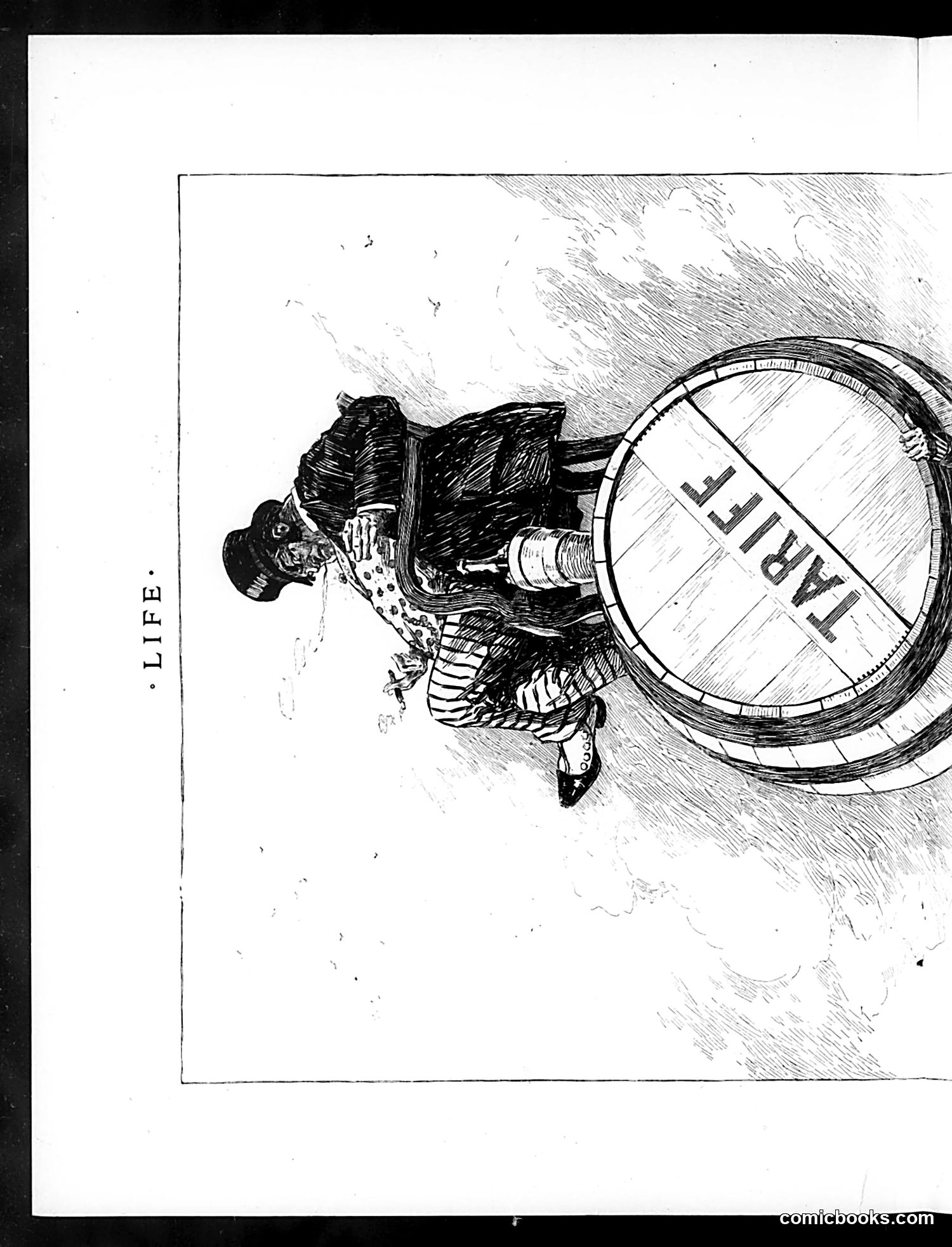
This appears to be a title page or section divider from *Life* magazine featuring a single illustration labeled "LIFE" on the left margin. The image shows a caricatured figure in Victorian-era clothing carrying a large barrel or container marked "LIFE." The figure is drawn in black ink with exaggerated features typical of period satirical illustration. The cross-hatching and line work are characteristic of late 19th or early 20th-century engraving. Without additional context or visible text explaining the specific reference, the exact political or social commentary remains unclear. The barrel may represent something the figure "carries" metaphorically—perhaps burden, responsibility, or a commentary on how society views existence itself—but the specific target of satire cannot be definitively determined from the image alone.
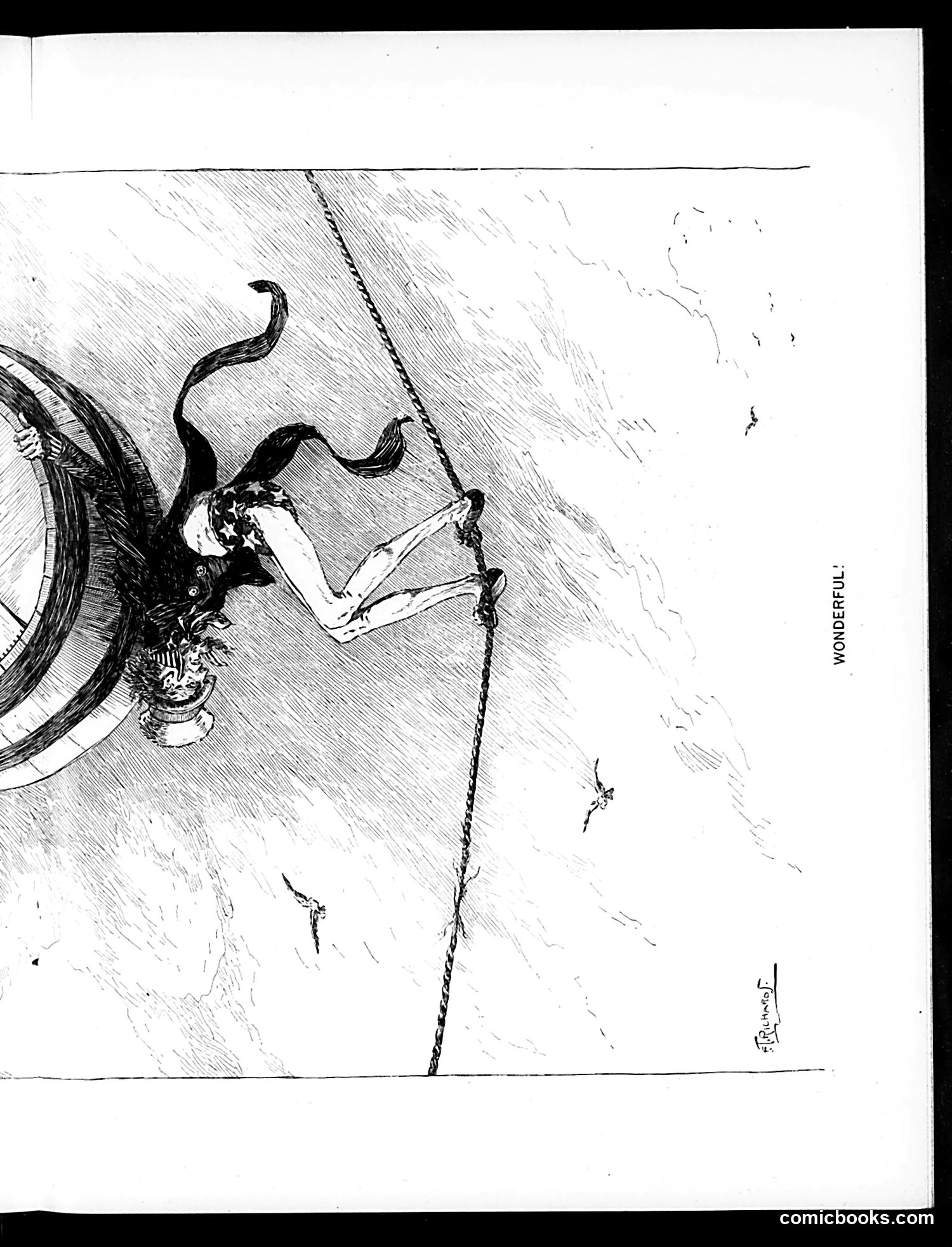
This page from *Life* magazine contains a single satirical ink drawing titled "WONDERFUL!" The cartoon depicts a figure (appearing to be a wealthy or aristocratic person, suggested by the ornate vessel/decorative object on the left) suspended by a rope over what seems to be a vast, empty expanse with scattered small figures below. The composition uses heavy cross-hatching to create atmosphere and drama. The satire likely comments on someone being elevated or promoted to an absurdly high position, or suspended precariously above common people—a visual metaphor for social hierarchy, hubris, or the precariousness of status. Without additional context about the specific date and political events, the exact target remains unclear, though the ironic title "WONDERFUL!" suggests mockery of a situation presented as desirable but actually dangerous or ridiculous.
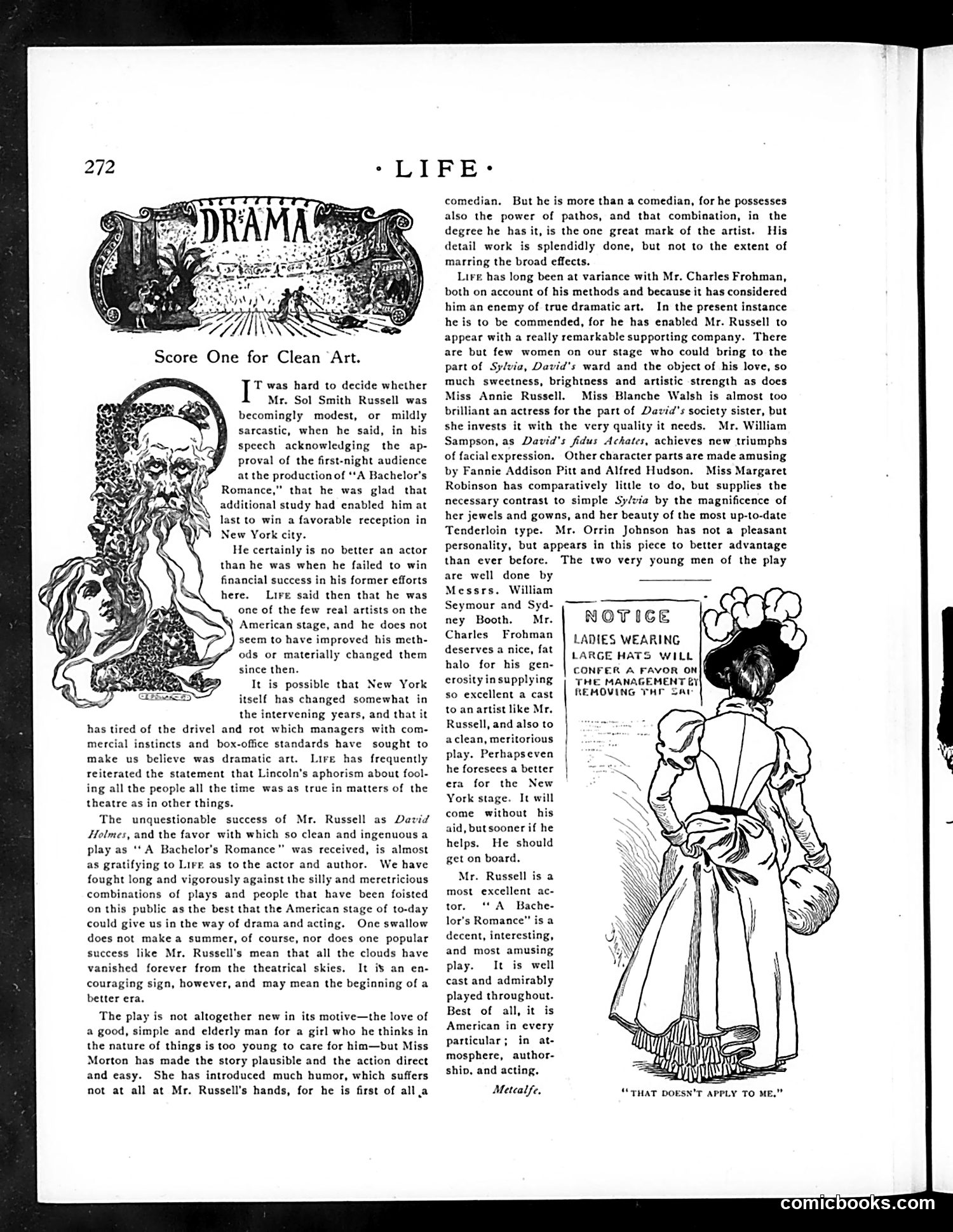
This page reviews Sol Smith Russell's performance in "A Bachelor's Romance." The article praises Russell as both comedian and serious actor, noting his success in combining pathos with humor—a rare achievement the writer credits to his talent rather than changed methods. The illustration shows a woman from behind wearing a large hat—likely referencing the notice about ladies removing large hats during performances. This was a genuine theater etiquette issue of the era: women's enormous fashionable hats obstructed other audience members' views. The cartoon's caption "THAT DOESN'T APPLY TO ME" suggests ironic commentary on this widespread problem, humorously implying the wearer won't comply with the management's request.
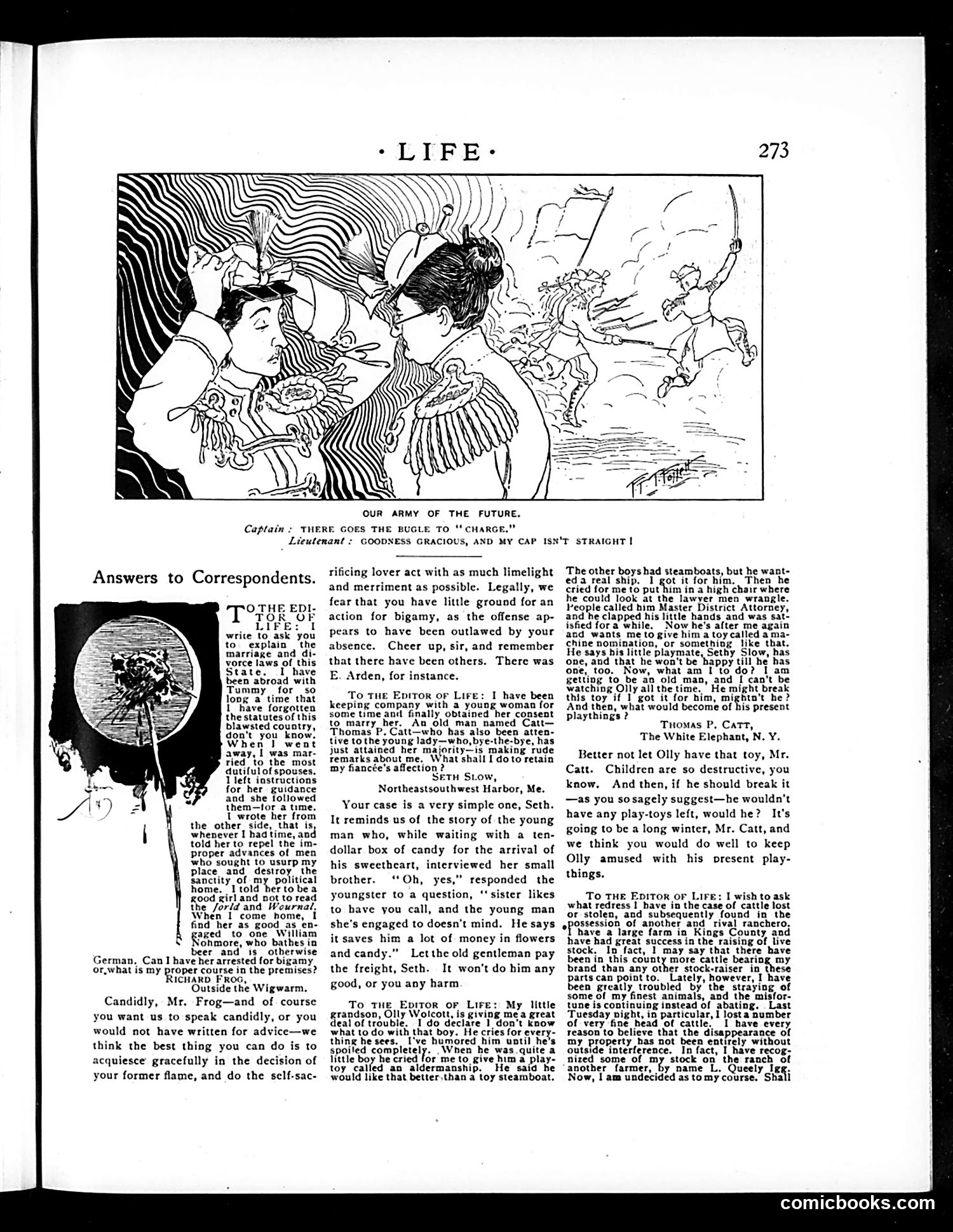
The top cartoon satirizes military preparedness, showing elaborately uniformed officers discussing a bugle call to "charge" while appearing disconnected from actual warfare—a jab at pompous, ineffectual military leadership. The "Answers to Correspondents" section is satirical advice columns mocking contemporary politics. The letter from "Richard Frog" about bigamy appears to reference political infidelity or broken promises. More pointedly, "Seth Stow's" letter about competing suitors seems to lampoon political rivalry, while "Thomas P. Catt's" lengthy complaint about his grandson "Olly" craving toys like "aldermanship," "District Attorney," and "machine nomination" is heavy political satire—the child's toys represent coveted political offices and patronage positions. The grandfather's frustration humorously mirrors real anxieties about political ambition and corruption, suggesting that such offices are mere playthings sought by greedy politicians.
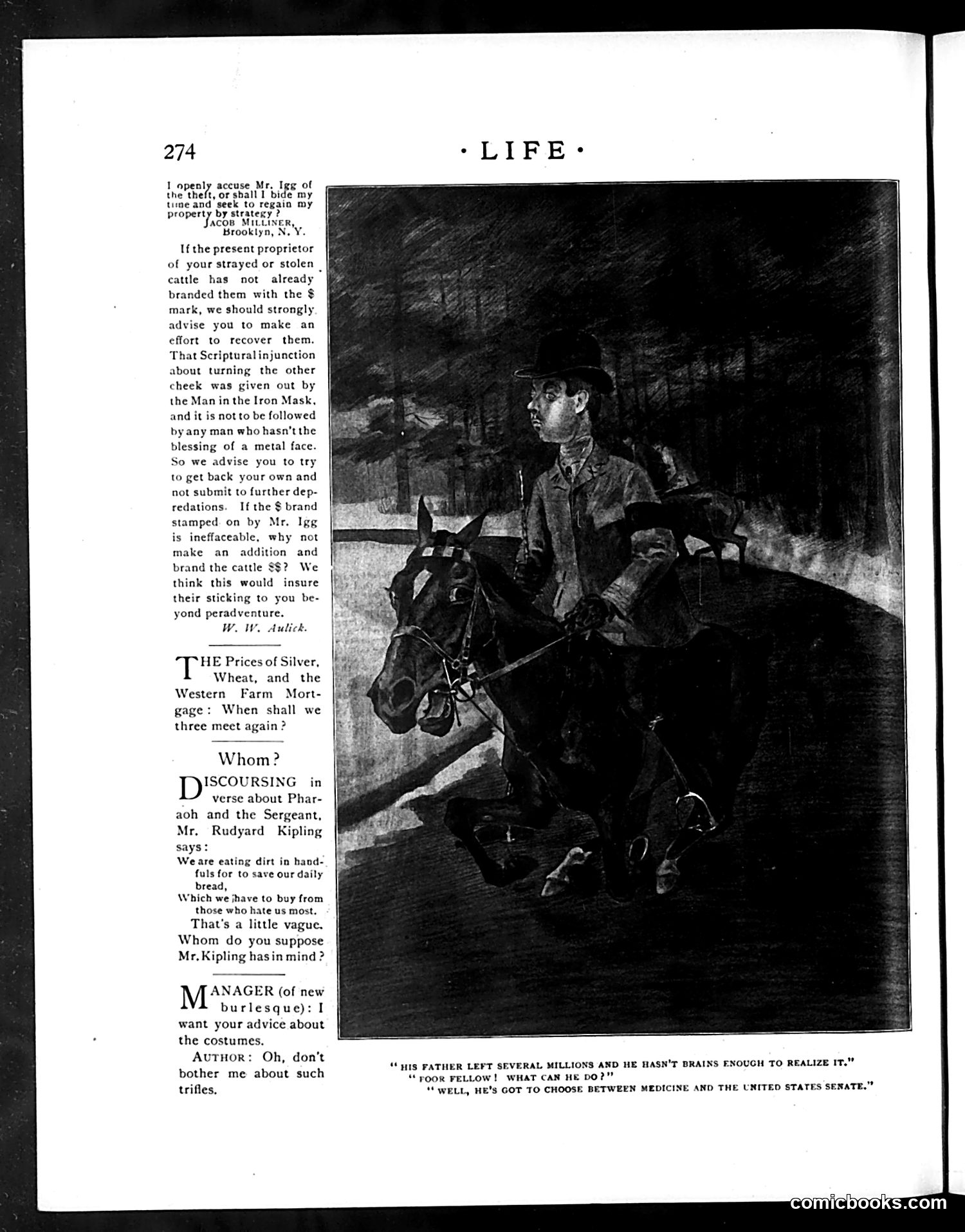
This page contains multiple brief satirical pieces typical of Life's format: **Main illustration**: Shows a wealthy young man on horseback, accompanying a caption mocking inherited wealth. The satire suggests that a man who inherited millions lacks the intelligence to manage it, and his only viable career options are medicine or becoming a U.S. Senator—implying that the Senate requires no particular competence, merely money and family connections. **Text sections** include: - A dispute-advice column about cattle theft and branding - Commentary on Rudyard Kipling's poetry about poverty and those "who hate us most," with Life questioning his vagueness - A brief joke about a theater manager and costume designer The overall tone is cynical about wealth, political incompetence, and class divisions. The Senate reference is particularly sharp political satire, suggesting senators were seen as placeholders for rich mediocrities rather than capable legislators.
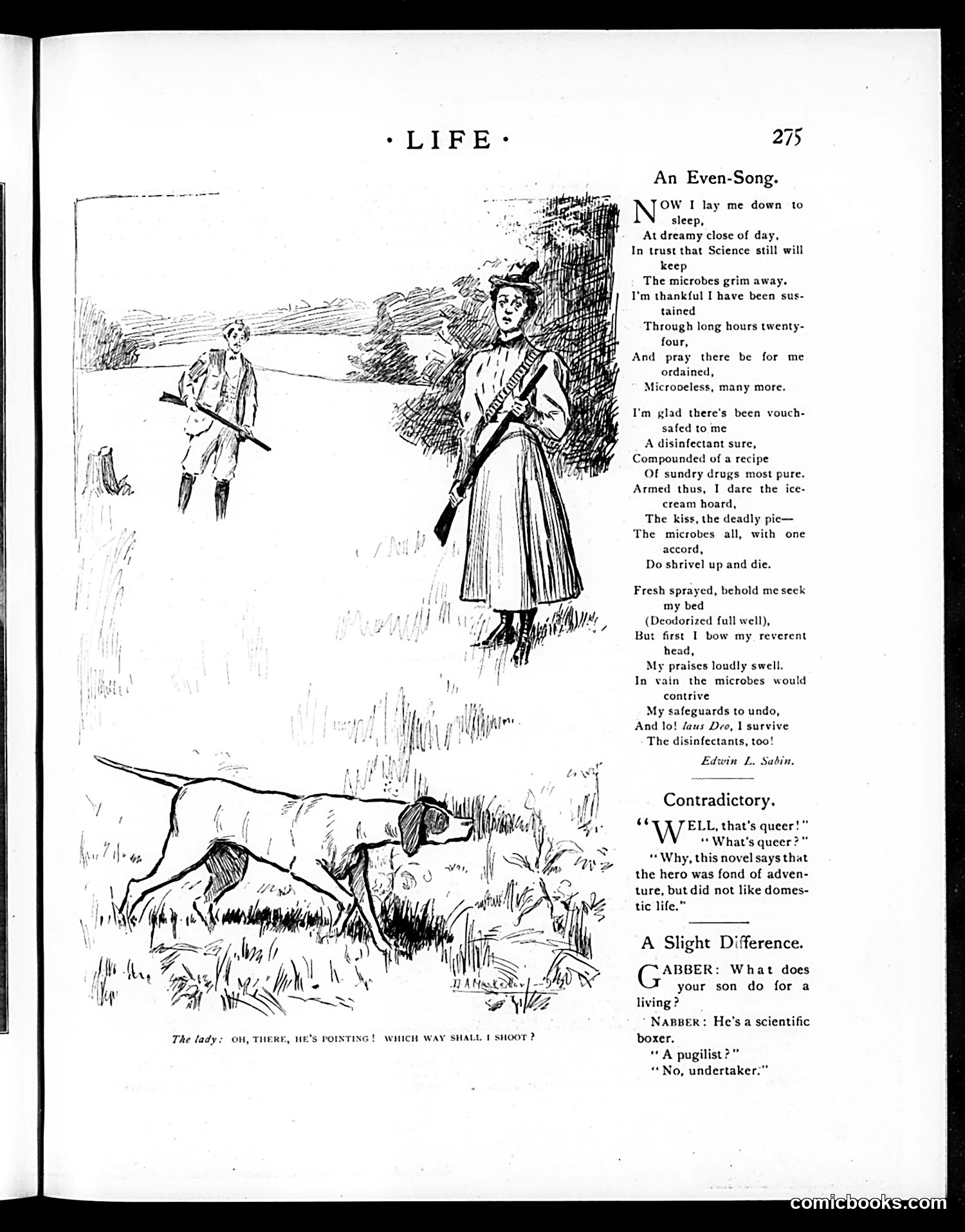
The main cartoon depicts a hunting scene with satirical commentary on gender roles. A woman with a gun stands confused while a man points, asking "Which way shall I shoot?" The humor targets the absurdity of women being unprepared or indecisive hunters—a social commentary on women's participation in traditionally male activities. "An Even-Song" is a humorous poem mocking the era's obsession with germ theory and disinfectants. It depicts someone going through elaborate anti-bacterial rituals before sleep, treating microbes like demons to be fought off with "sundry drugs." The satire suggests people were becoming irrationally fearful about invisible germs and over-reliant on commercial disinfectant products—reflecting early-20th-century marketing of "scientific" hygiene products. The bottom jokes use wordplay about occupations: a "scientific boxer" who's actually an "undertaker" (because boxers cause deaths/injuries). All pieces mock contemporary anxieties about science, modernity, and changing social norms.
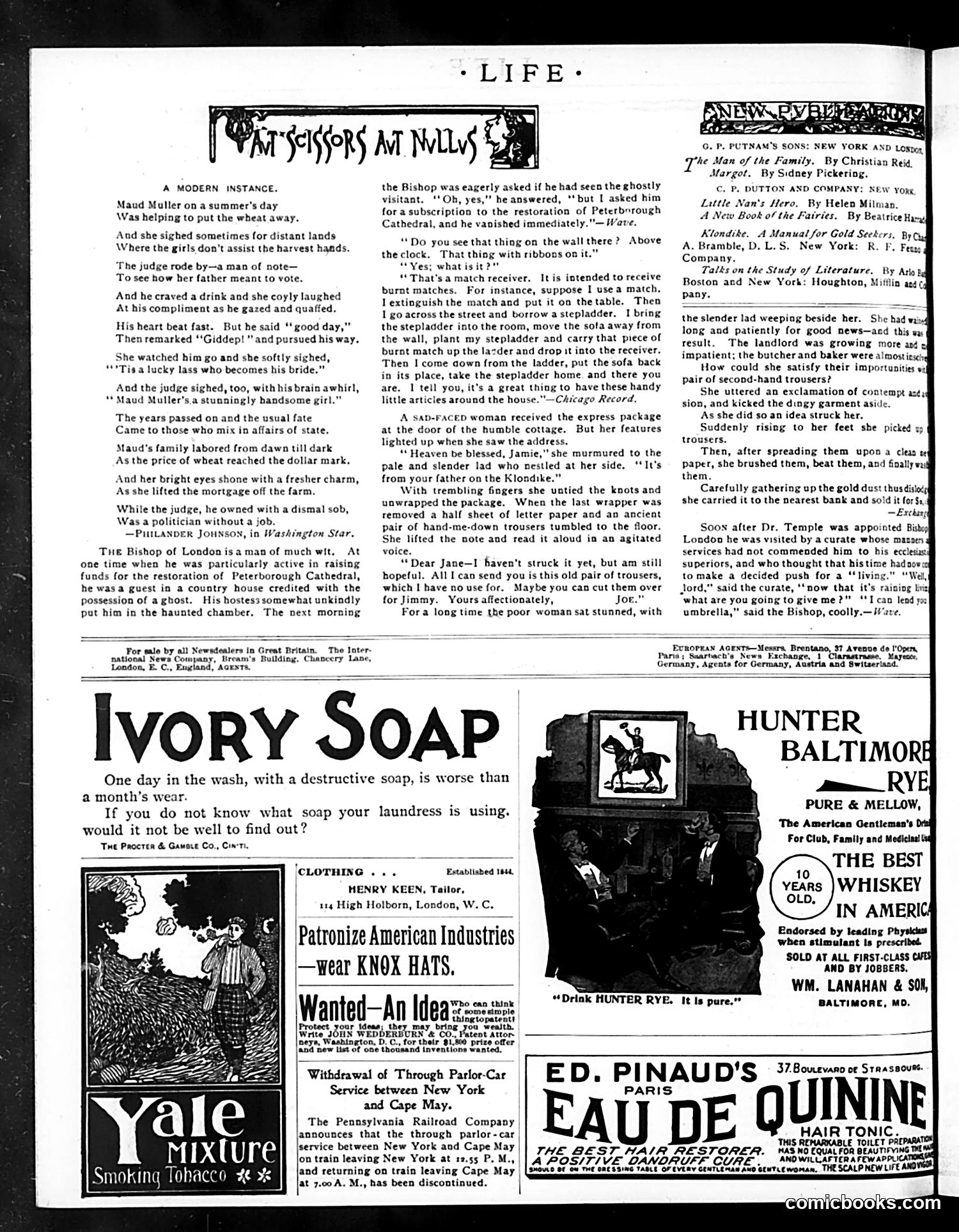
This page contains three satirical anecdotes mocking contemporary social pretensions and economic realities of the 1890s. **"A Modern Instance"** parodies Whittier's "Maud Muller" poem. A rural judge courts a farmer's daughter Maud, but she becomes prosperous (wheat prices rise; she pays off the farm mortgage) while he loses his political position and becomes jobless. The satire inverts the romantic outcome: the working-class woman succeeds while the politician fails—a pointed commentary on unstable political careers versus agricultural wealth. **The Bishop anecdote** jokes about aggressive fundraising: even a ghost flees when asked to donate to cathedral restoration. **The Klondike story** satirizes Yukon gold-rush fever. A man sends his struggling family only hand-me-down trousers instead of promised riches—exposing the gap between Klondike dreams and actual returns. The page's title alludes to "Scissors at Nullys" (unclear reference), and overall mocks Victorian sentimentality, political ambition, and get-rich-quick schemes.
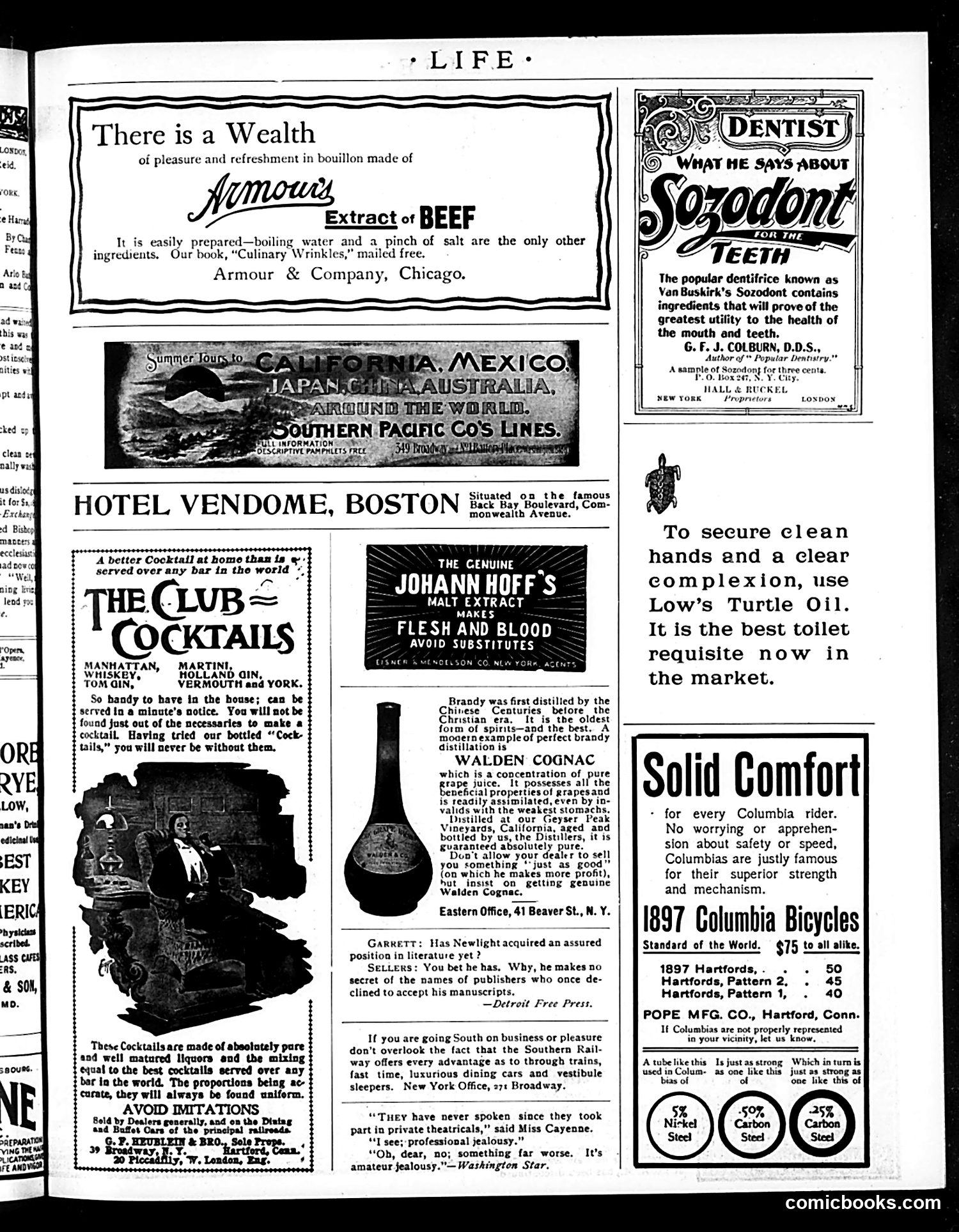
This is primarily an **advertising page** from *Life* magazine (circa 1897, based on bicycle models). The dominant content consists of product advertisements rather than satirical cartoons. The only clear **satirical content** is a brief joke at the bottom: **The Joke:** A woman mentions that two people "have never spoken since they took part in private theatricals." When a listener assumes "professional jealousy," she corrects him—it's "amateur jealousy" instead. **The Point:** This mocks amateur theatrical performers as more petty and quarrelsome than professionals. It satirizes the vanity and thin-skinned nature of amateur actors who take themselves too seriously. The rest of the page advertises beverages (Armour beef extract, cognac, cocktails, malt extract), patent medicines (Sozodont toothpaste), personal care products (Turtle Oil), bicycles (Columbia and Hartford brands), and travel services. These ads reflect late-19th-century consumer culture and include health claims now considered dubious or fraudulent.
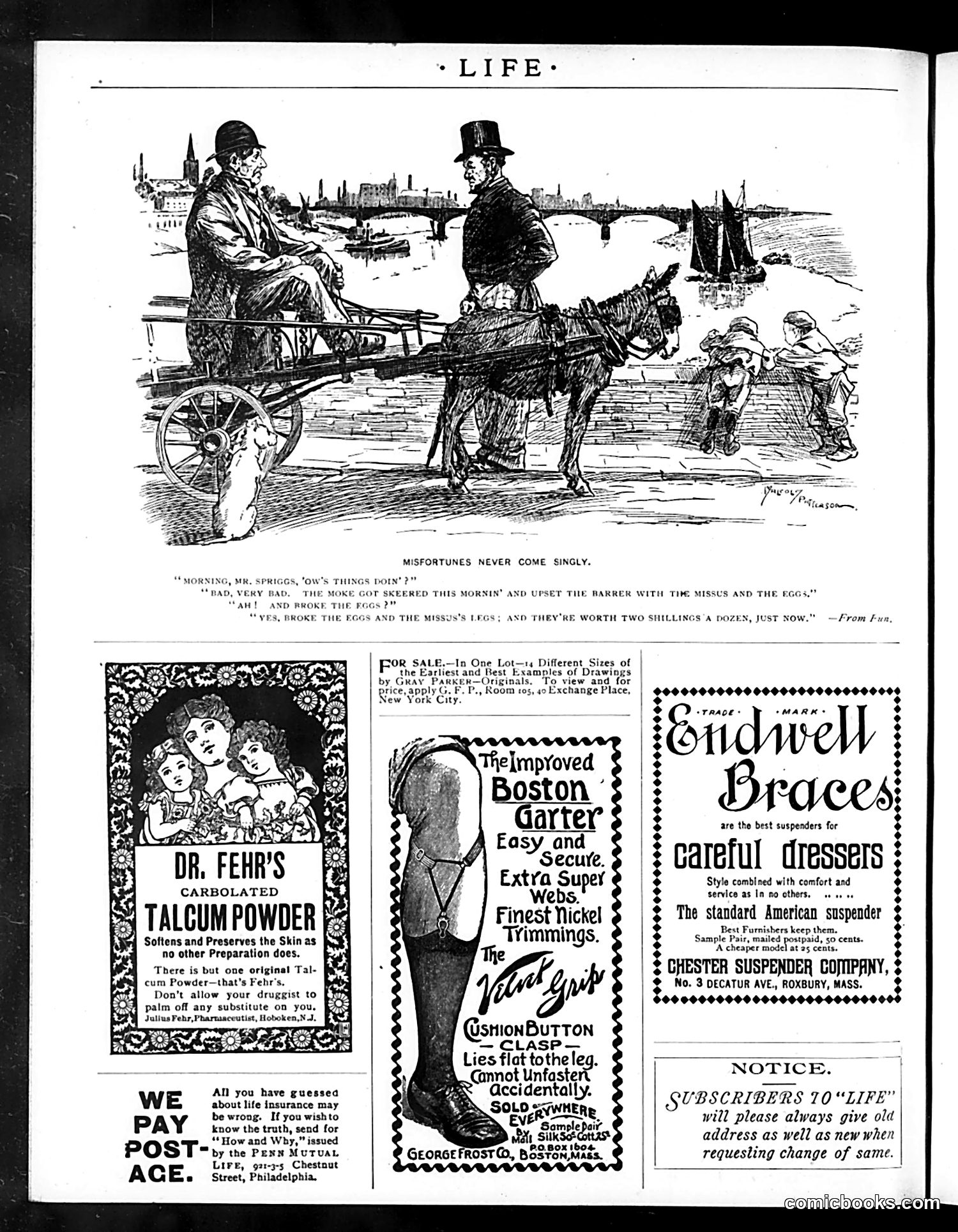
The main cartoon depicts two working-class men in conversation on a London dock (indicated by the Thames riverscape and boats). Mr. Spriggs is recounting a series of domestic disasters: his donkey kicked the barber, upsetting him so he struck Spriggs's wife and broke her eggs. The caption jokes that the broken eggs are worth "two shillings a dozen, just now"—suggesting eggs were expensive or scarce at this moment. The satire plays on the phrase "misfortunes never come singly," illustrating how one accident (the donkey kick) cascades into multiple mishaps. The humor is slapstick and working-class in character. The page includes the cartoon's source attribution to *Fun* magazine. The rest of the page consists of period advertisements (talcum powder, garters, suspenders) and a notice to subscribers—typical magazine filler of the era.
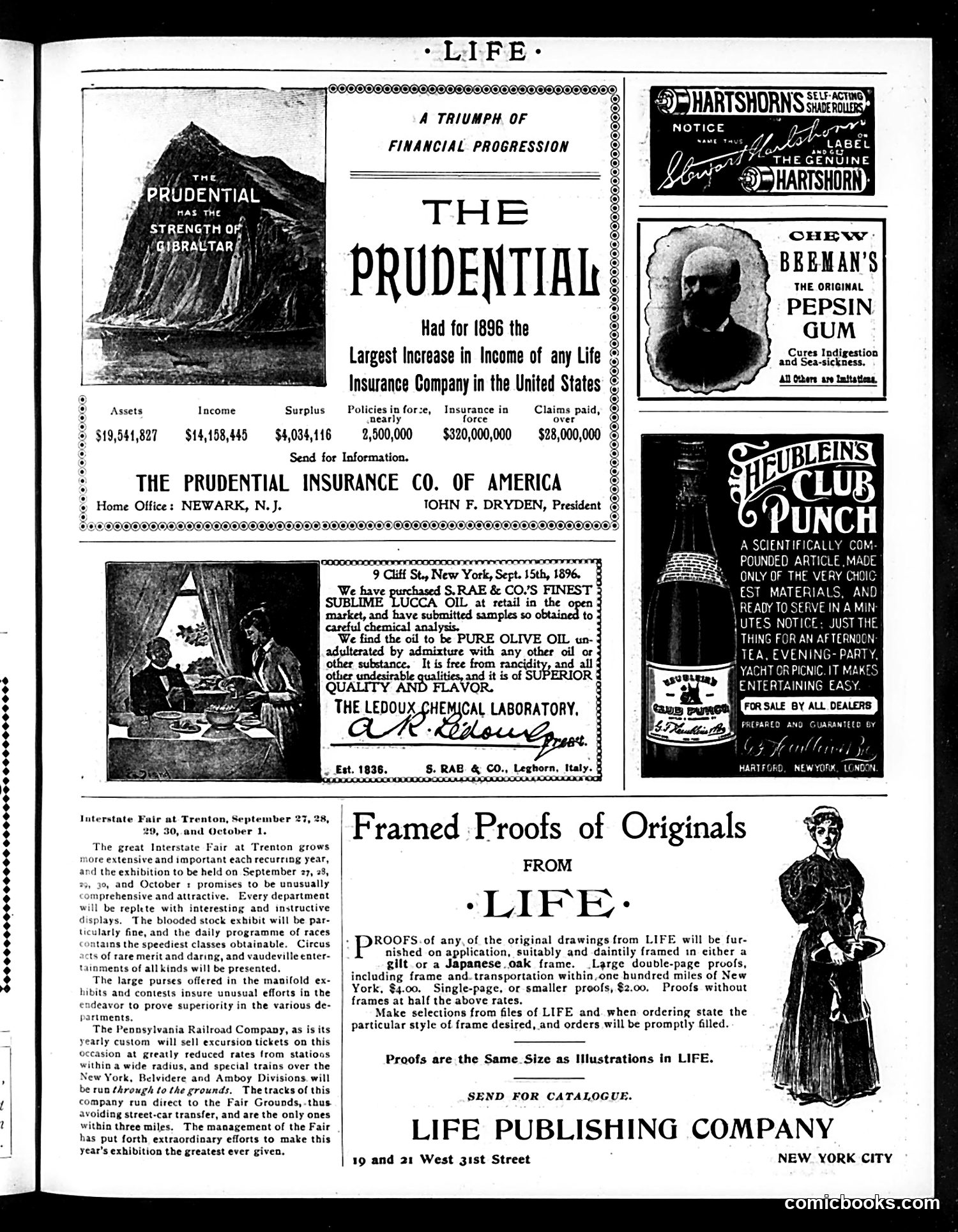
This is primarily an **advertising page** with no political cartoons. The content consists of commercial advertisements typical of the 1890s: **Major Ads:** - **The Prudential Insurance Company** promotes record financial growth in 1896, emphasizing corporate stability through statistics (assets, income, surplus). - **S. Rae & Co.** advertises "pure olive oil," featuring a chemical laboratory certification to assure consumers of product authenticity—a sales strategy addressing emerging concerns about food adulteration. - **Beeman's Pepsin Gum**, **Hartshorn**, and **Heublein's Club Punch** are consumer products. **Context for Modern Readers:** The repeated emphasis on "purity" and third-party verification reflects late-19th-century consumer anxiety: without FDA regulation (established 1906), food and medicine fraud was rampant. Companies competed by claiming scientific proof of quality. The insurance ad's focus on financial data represents the era's fascination with quantifying corporate credibility. The page also includes notices about the **Interstate Fair at Trenton** and **Life Publishing Company's framed artwork service**—evidence of Life's dual role as both satirical publication and commercial enterprise.
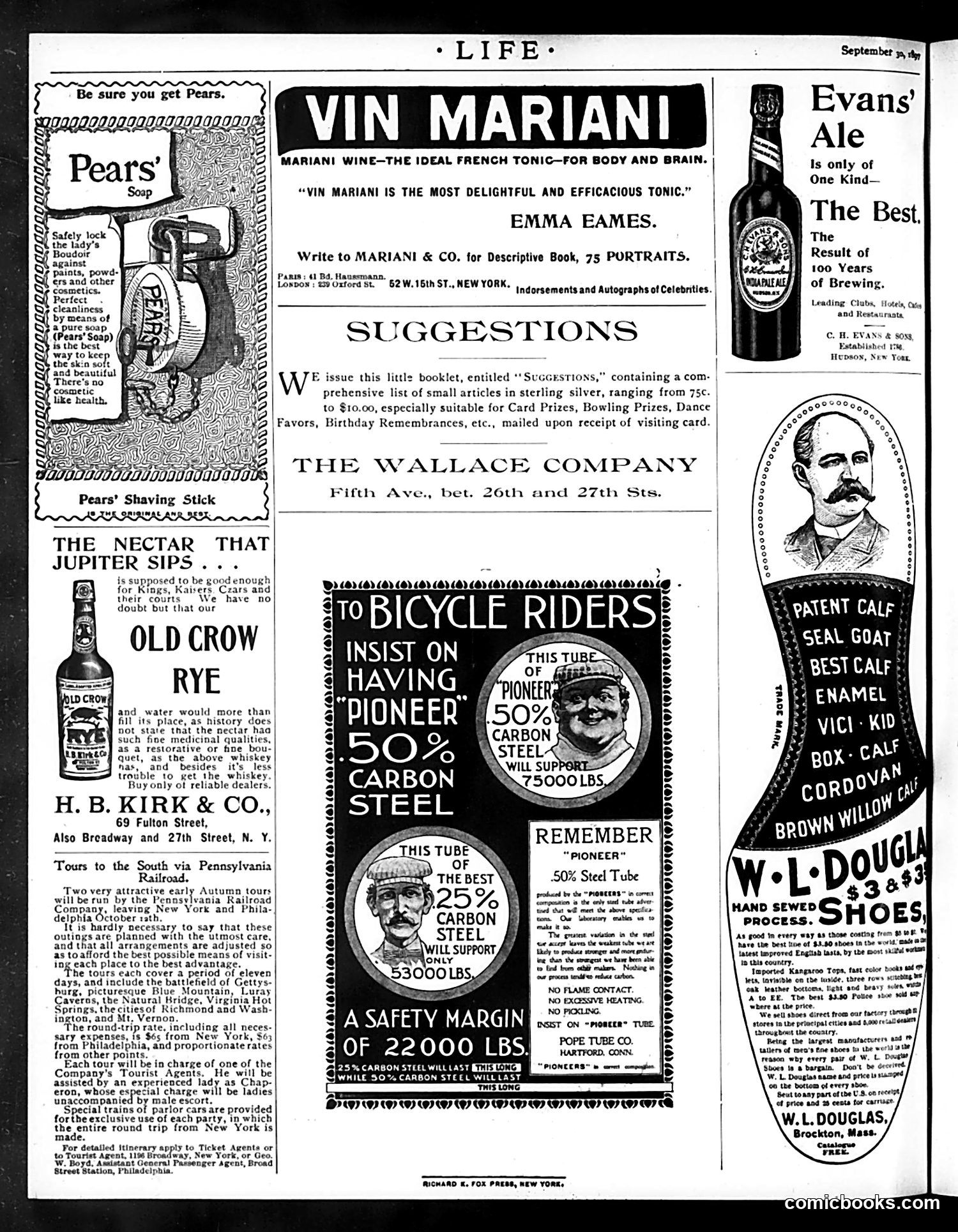
This page is primarily **advertising**, typical of Life's revenue model. The content includes: **Main advertisements:** - **Vin Mariani**: A French wine tonic endorsed by opera singer Emma Eames, marketed as beneficial "for body and brain"—reflecting the era's acceptance of alcohol-based patent medicines - **Pioneer bicycle tubes**: Emphasizing safety with "50% carbon steel" and load-bearing capacity - **W.L. Douglas shoes**: Direct-factory sales claiming quality at lower prices than competitors - **Old Crow Rye whiskey**, **Pears soap**, **Evans' Ale**, and Pennsylvania Railroad tours **Historical context for modern readers:** These ads reveal 1890s consumer culture: wine tonics were legitimate medical products; bicycle safety was a selling point (bikes were relatively new); and direct factory sales represented marketing innovation. The endorsements by celebrities (Eames) parallel modern advertising. No political satire is evident—this is a straightforward advertising page typical of Life's content during this period.