
Life, 1897-09-30 · page 4 of 20
Life — September 30, 1897 — page 4: what you’re looking at
What you’re looking at
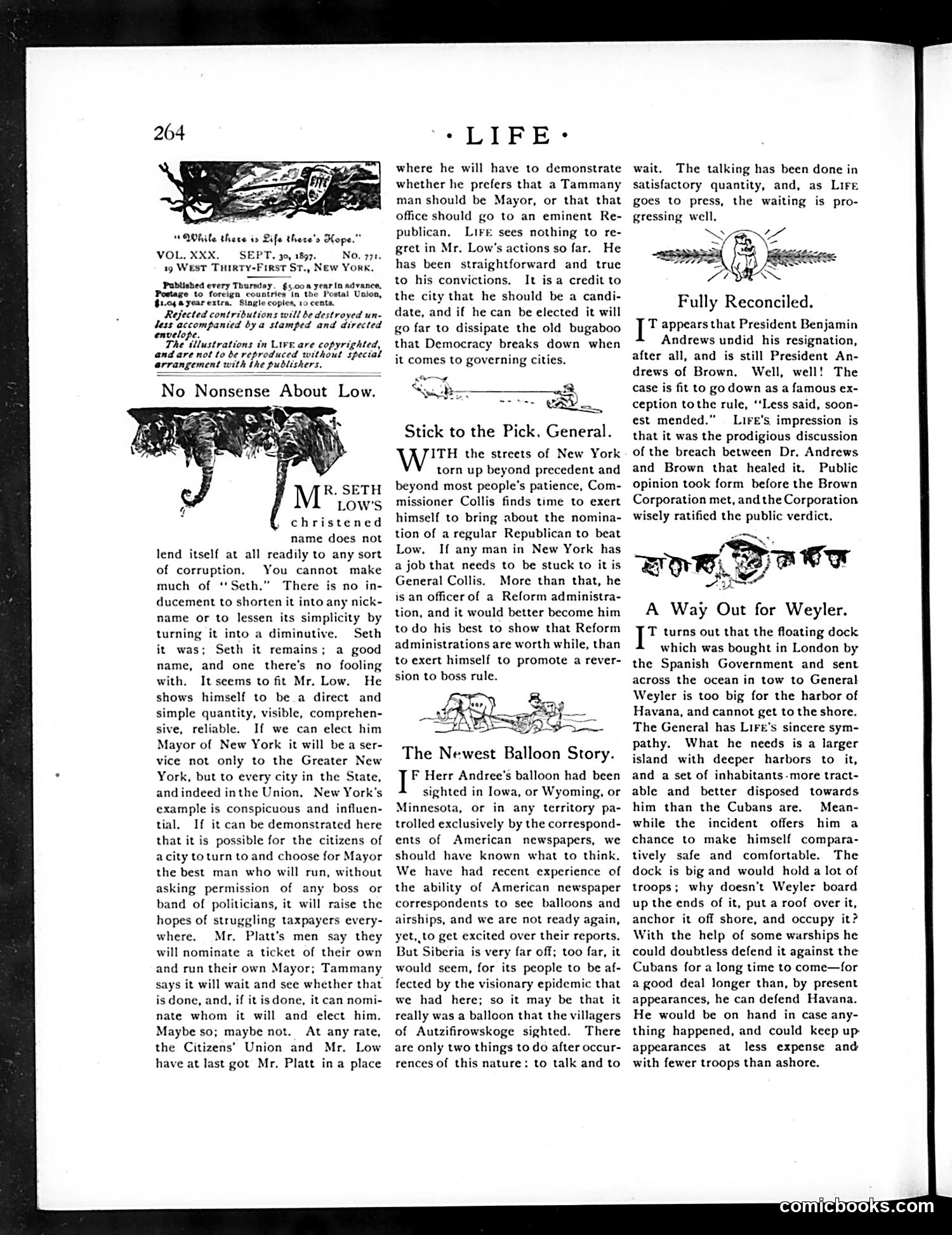
This page contains three political commentary pieces satirizing New York City politics of the 1890s: **"No Nonsense About Low"** criticizes Seth Low's mayoral candidacy, praising his straightforward character and suggesting he represents genuine reform—contrasting with typical corrupt politicians. **"Stick to the Pick, General"** mocks Commissioner Collis's efforts to nominate a Republican rival to Low, arguing such infighting undermines reform efforts and that Collis should focus on proving reform administrations work. **"The Newest Balloon Story"** appears to reference newspaper correspondents' exaggerated reporting about a balloon sighting in the American West, satirizing sensationalist journalism and the unreliability of frontier news reports. The illustrations (not fully visible) likely accompany these satirical attacks on city politics and press practices.
📄 Transcribed text from this page (OCR, searchable)
Machine-transcribed from the original scan — historical spelling and the odd misread are preserved.
“While there is Life there's Hope.” VOL. XXX. SEPT. 30, 1897. No. 771. ag West THIRTY-First St., New York. Published every Thursday. 5.00 yearin advance, Postage to foreign countries in the Postal Union, $1.04 a year extra, Single copies, 10 cents, Rejected contributions will be destroyed un- dess accompanied bya stamped and directed envelope. The illustrations in Live are copyrighted, and are not to be reproduced without special @rrangement with the publishers. No Nonsense About Low. R. SETH LOW'S christened name does not lend itself at all readily to any sort of corruption, You cannot make much of “Seth.” There is no in- ducement to shorten it into any nick- name or to lessen its simplicity by turning it into a diminutive. Seth it was; Seth it remains; a good name, and one there's no fooling with. It seems to fit Mr. Low. He shows himself to be a direct and simple quantity, visible, comprehen- sive, reliable. If we can elect him Mayor of New York it will be a ser- vice not only to the Greater New York, but to every city in the State, and indeed inthe Union, New York's example is conspicuous and influen- tial. If it can be demonstrated here that it is possible for the citizens of acity toturn to and choose for Mayor the best man who will run, without asking permission of any boss or band of politicians, it will raise the hopes of struggling taxpayers every- where. Mr. Platt’s men say they will nominate a ticket of their own and run their own Mayor; Tammany says it will wait and see whether that is done, and, if it isdone, it can nomi- nate whom it will and elect him. Maybe so; maybe not. At any rate, the Citizens’ Union and Mr. Low have at last got Mr. Platt ina place ‘LIFE: where he will have to demonstrate whether he prefers that a Tammany man should be Mayor, or that that office should go to an eminent Re- publican. Lire sees nothing to re- gret in Mr. Low's actions so far. He has been straightforward and true to his convictions. It isa credit to the city that he should be a candi- date, and if he can be elected it will go far to dissipate the old bugaboo that Democracy breaks down when it comes to governing cities. <d Stick to the Pick, General. ITH the streets of New York torn up beyond precedent and beyond most people's patience, Com- missioner Collis finds time to exert himself to bring about the nomina- tion of a regular Republican to beat Low. If any man in New York has a job that needs to be stuck to it is General Collis. More than that, he is an officer of a Reform administra- tion, and it would better become him todo his best to show that Reform administrations are worth while, than to exert himself to promote a rever- sion to boss rule. The Newest Balloon Story. F Herr Andree’s balloon had been sighted in Iowa, or Wyoming, or Minnesota, or in any territory pa- trolled exclusively by the correspond- ents of American newspapers, we should have known what to think. We have had recent experience of the ability of American newspaper correspondents to see balloons and airships, and we are not ready again, yet, to get excited over their reports. But Siberia is very far off; too far, it would seem, for its people to be af- fected by the visionary epidemic that we had here; so it may be that it really was a balloon that the villagers of Autzifirowskoge sighted. There are only two things to do after occur- rences of this nature: to talk and to wait. The talking has been done in satisfactory quantity, and, as Lire goes to press, the waiting is pro- gressing well, SYRNE Fully Reconciled. T appears that President Benjamin Andrews undid his resignation, after all, and is still President An- drews of Brown, Well, well! The case is fit to go down as a famous ex- ception tothe rule, ‘‘Less said, soon- est mended.” Lire’s impression is that it was the prodigious discussion of the breach between Dr, Andrews and Brown that healed it. Public opinion took form before the Brown Corporation met, and the Corporation wisely ratified the public verdict. A Way Out for Weyler. T turns out that the floating dock which was bought in London by the Spanish Government and sent across the ocean in tow to General Weyler is too big for the harbor of Havana, and cannot get to the shore. The General has Lire's sincere sym- pathy. What he needs is a larger island with deeper harbors to it, and a set of inhabitants -more tract- able and better disposed towards him than the Cubans are. Mean- while the incident offers him a chance to make himself compara- tively safe and comfortable. The dock is big and would hold a lot of troops; why doesn’t Weyler board up the ends of it, put a roof over it, anchor it off shore, and occupy it? With the help of some warships he could doubtless defend it against the Cubans for a long time to come—for a good deal longer than, by present appearances, he can defend Havana. He would be on hand in case any- thing happened, and could keep up appearances at less expense and with fewer troops than ashore,