
A complete issue · 20 pages · 1897
Life — September 23, 1897
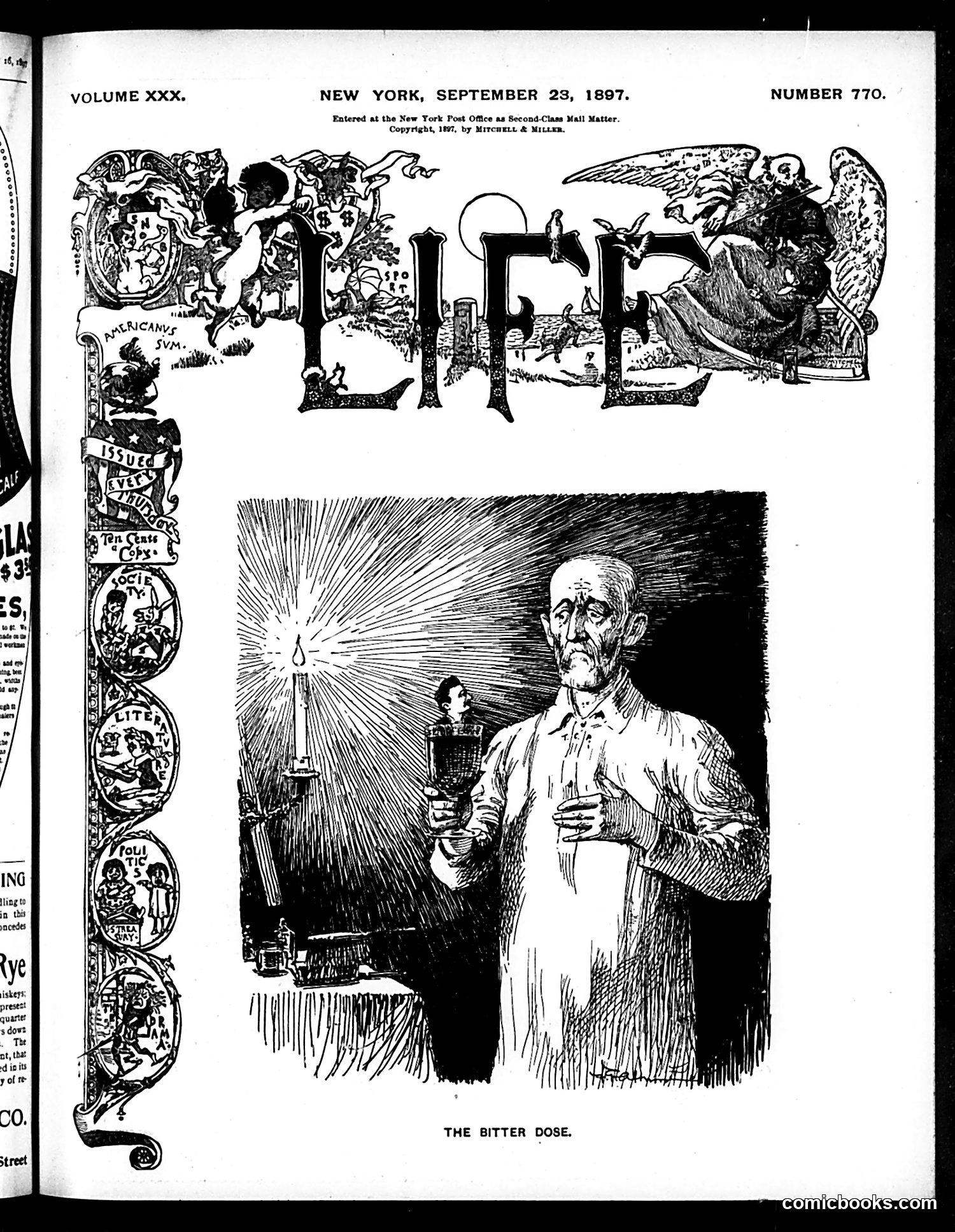
This cartoon depicts an elderly man in white robes holding a glowing chalice or lamp, with a smaller figure visible in the background. The title "The Bitter Dose" suggests forced consumption of something unpleasant. The religious imagery—the glowing vessel, the white garments, the halo-like radiance—indicates this is likely religious or moral commentary. Without additional context visible on this page, the specific political reference remains unclear. The 1897 date and satirical style suggest it comments on a contemporary event or policy, but the exact target cannot be definitively identified from the image alone. The ornate decorative border features various emblems typical of Life magazine's design.
This page is primarily **advertising and book announcements** rather than political satire. The left side promotes The Evening Post newspaper and describes tourist destinations (Adirondack Mountains). The right side advertises forthcoming magazine issues and new fiction titles. The only illustrated content shows figures for "The Golfer's Conquest of America" by Caspar Whitney and "Spanish John" by William McLennan. These appear to be **humorous sporting and adventure narratives** rather than political commentary—the golfer illustration depicts comedic bad form in golf technique, while Spanish John shows historical adventure fiction. The page reflects early 20th-century publishing and leisure interests, with no apparent political satire or social critique present.
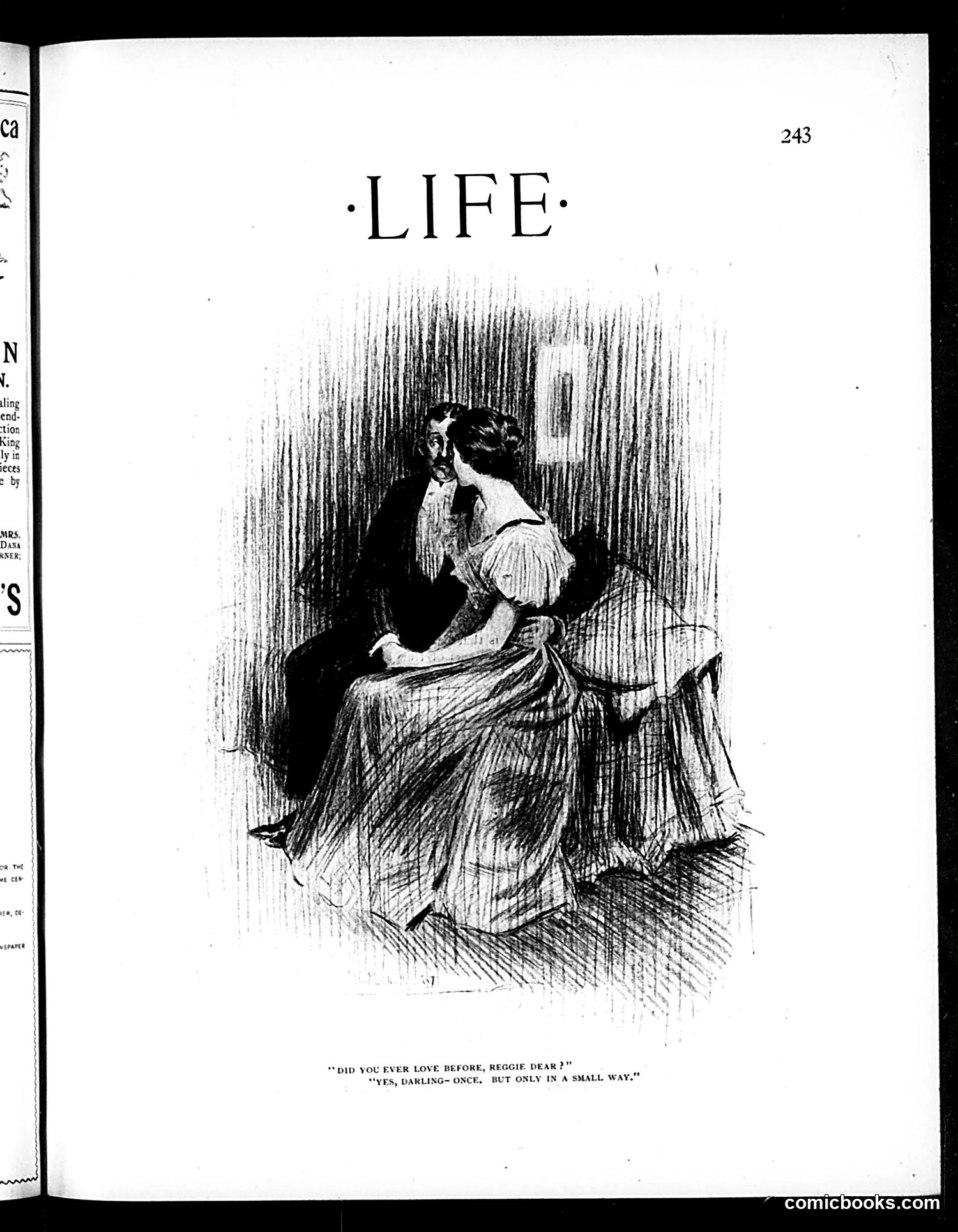
This page features a romantic illustration titled "LIFE" showing two figures in an intimate embrace. The caption reads: "DID YOU EVER LOVE BEFORE, REGGIE DEAR?" / "YES, DARLING—ONCE. BUT ONLY IN A SMALL WAY." The cartoon appears to be satirizing romantic conventions of the early 20th century. "Reggie" suggests an upper-class or affected male character, while the woman's question invites a confession. The punchline—that his previous love was minor or insignificant—creates gentle humor about romantic pretension and the tendency of wealthy characters to minimize past relationships. This represents Life magazine's typical blend of social satire targeting manners, courtship rituals, and class-conscious dialogue among the wealthy. The sketch style and subject matter are characteristic of the magazine's humor from roughly the 1910s-1920s era.
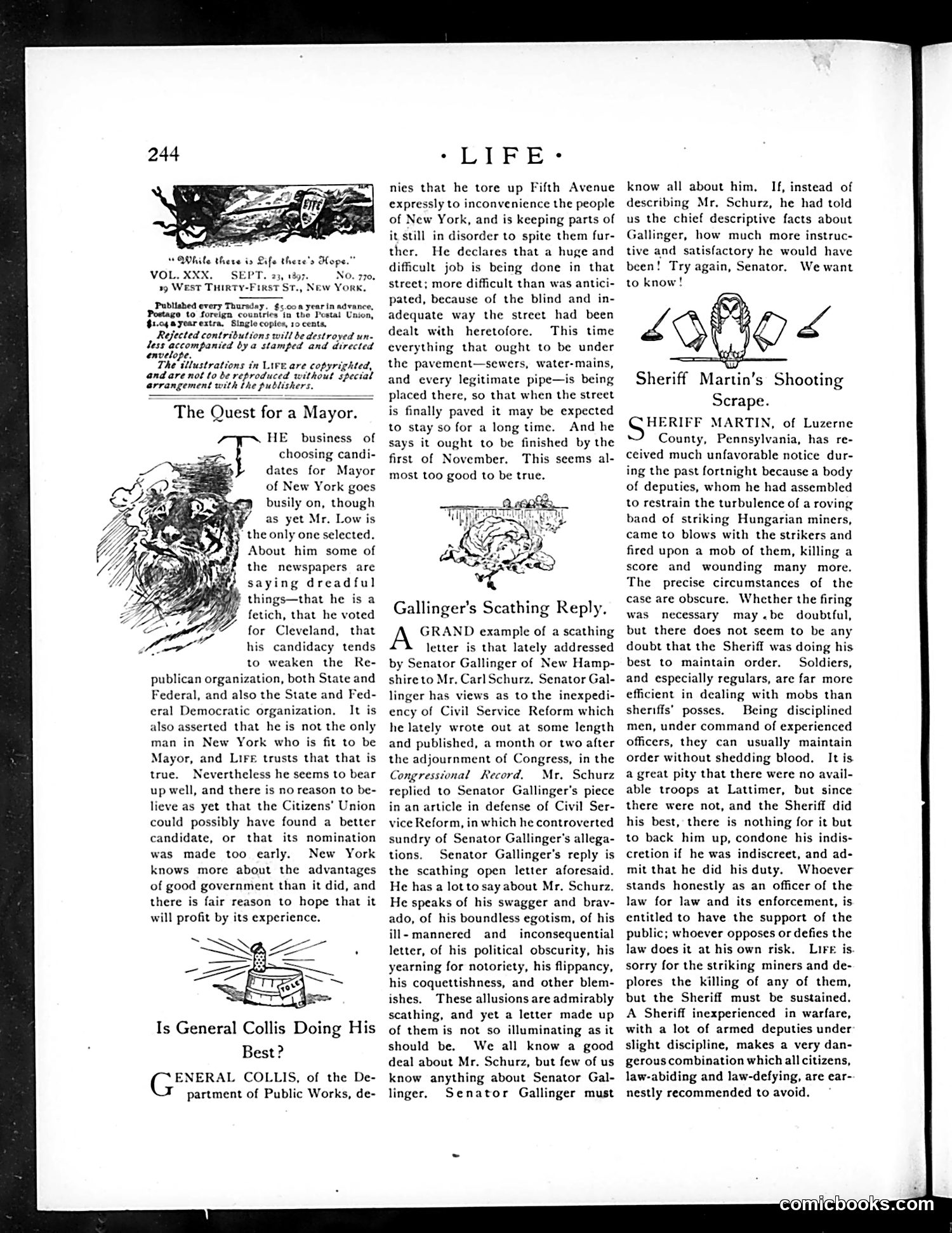
This page contains three separate political commentaries from early 20th-century New York politics: 1. **"The Quest for a Mayor"**: Criticizes the mayoral selection process, suggesting the Citizens' Union nominated an inadequate candidate and that Cleveland received the "fetish" of their vote instead. 2. **"Gallinger's Scathing Reply"**: References Senator Gallinger's published response to Mr. Carl Schurz's Civil Service Reform critique. The piece defends Schurz against Gallinger's personal attacks, praising his character while criticizing Gallinger's "swagger," "boundless egotism," and "ill-mannered" conduct. 3. **"Is General Collis Doing His Best?"**: Questions General Collis of the Department of Public Works' effectiveness. The cartoons use satirical commentary to critique political figures and administrative competence during this reform-era period.
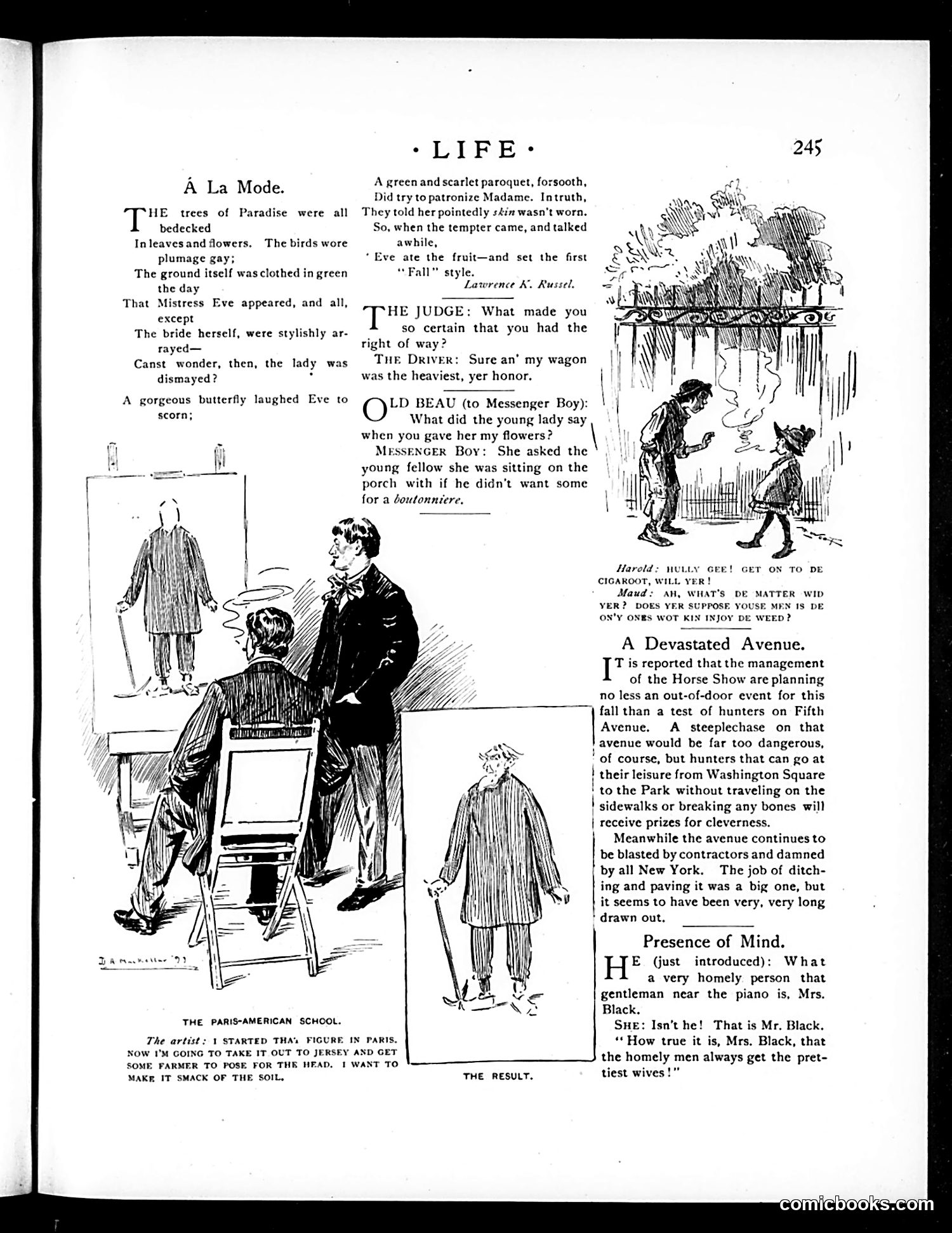
This page contains three separate humorous pieces: 1. **"À La Mode"**: A poem mocking fashionable society, particularly critiquing a bride's unstylish appearance despite wearing expensive garments. 2. **"The Paris-American School"**: A cartoon showing an art instructor and student. The artist claims he'll take a figure to Jersey to have a farmer pose for the head, wanting to "make it smack of the soil"—satirizing pretentious artistic affectation and the gap between European artistic tradition and American attempts to replicate it. 3. **"A Devastated Avenue"** and **"Presence of Mind"**: Brief anecdotes about Fifth Avenue construction and homely men with attractive wives—typical light humor about contemporary urban life and social observation. The page exemplifies *Life*'s satirical approach to American society, fashion, and cultural pretension.
This page contains no political cartoon. Instead, it presents "As Told by the Girl," a serialized short story in three conversations. The narrative follows a young woman named Sally recounting romantic complications to an unnamed listener. The story involves Sally's conflicted feelings about a man (apparently blind or unaware of her affection) and features dialogue with a character named Kitty. The text emphasizes emotional turmoil—Sally struggles with unrequited love and questions about honesty in relationships. This appears to be typical serialized fiction content from Life magazine's literary section, not satirical commentary. Without seeing accompanying illustrations, the social or political satire, if any exists, remains unclear from this text alone.
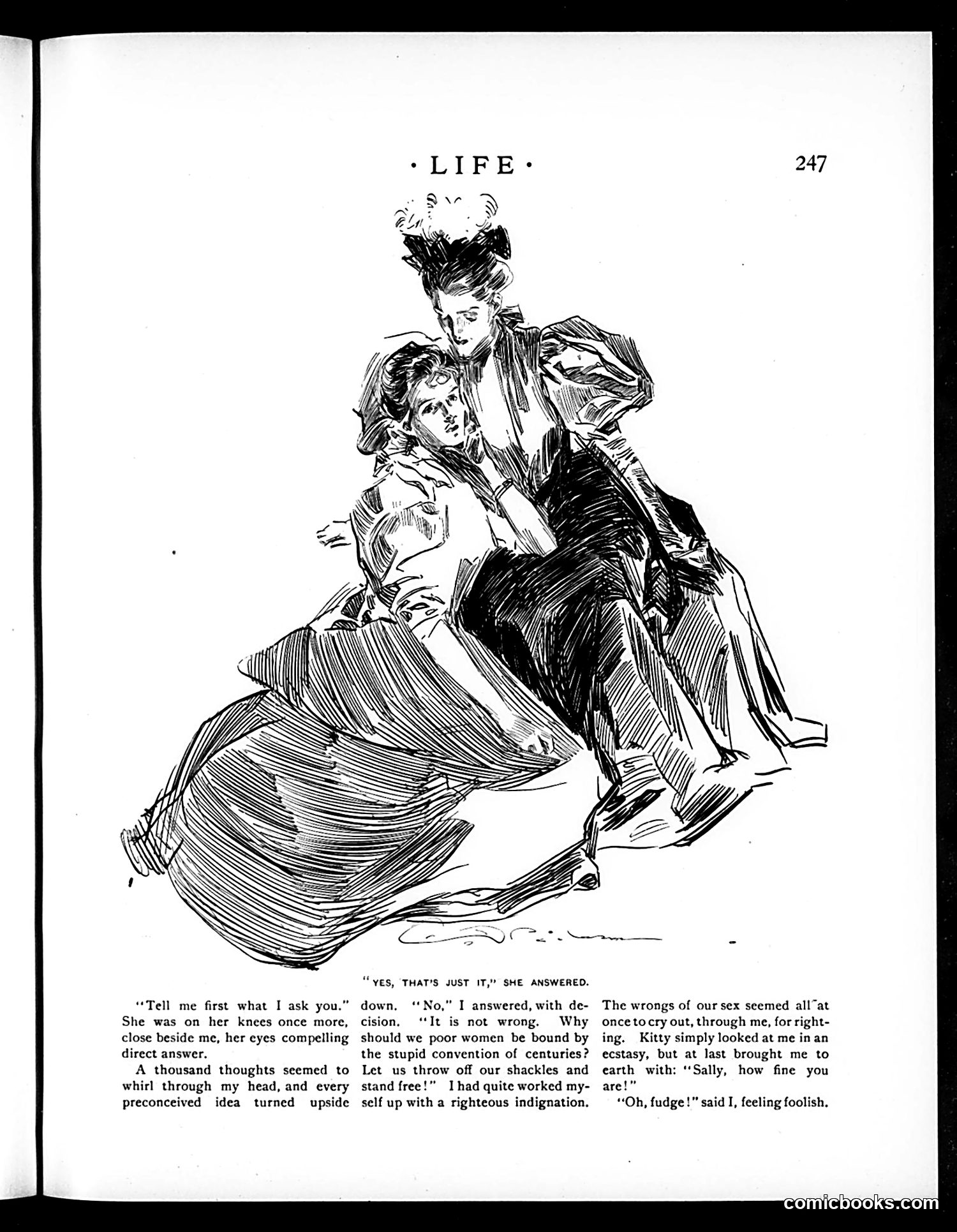
This page from *Life* magazine presents a satirical illustration and dialogue about gender relations and women's autonomy. The sketch depicts a woman in fashionable 1890s-1900s dress sitting with a man, illustrating a romantic or intimate conversation. The dialogue addresses women's rights and social constraints—specifically critiquing the "stupid convention of centuries" that binds women through societal expectations. The woman's character advocates for women throwing off social restrictions and standing "free," while the man responds with dismissal ("fudge!"). The satire mocks conventional attitudes about proper female behavior and romantic relationships, suggesting that traditional gender norms are outdated and restrictive. This reflects the early feminist discourse of the era, when *Life* used humor to comment on evolving gender dynamics and women's growing demands for social equality.
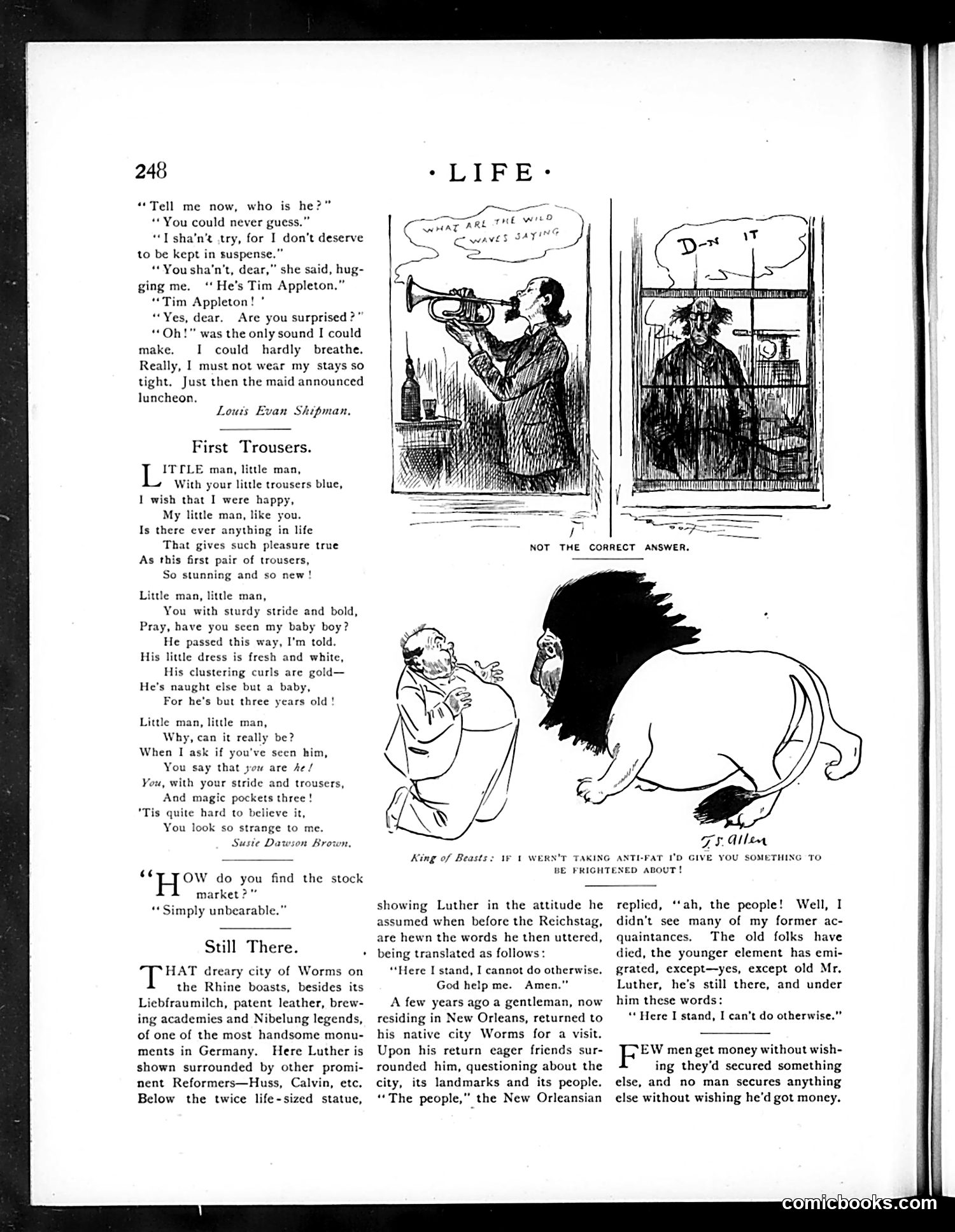
The page contains several distinct items: **Top cartoons:** Two panels labeled "NOT THE CORRECT ANSWER" show a man with a trumpet and someone at a window. The joke appears to involve someone giving an incorrect response to a question, though the specific reference is unclear from the image alone. **Bottom cartoon:** Titled "King of Beasts: If I Weren't Taking Anti-Fat to Give You Something to Be Frightened About!" shows a thin lion speaking to a smaller animal. This satirizes health anxiety and commercial health products—likely mocking how manufacturers exaggerate dangers to sell remedies. **Text sections:** Include poems titled "First Trousers" and "Still There," plus a brief anecdote about a gentleman returning to Worms, Germany, and a quote attributed to Luther. The page appears to mix humor, verse, and cultural commentary typical of Life magazine's satirical format.
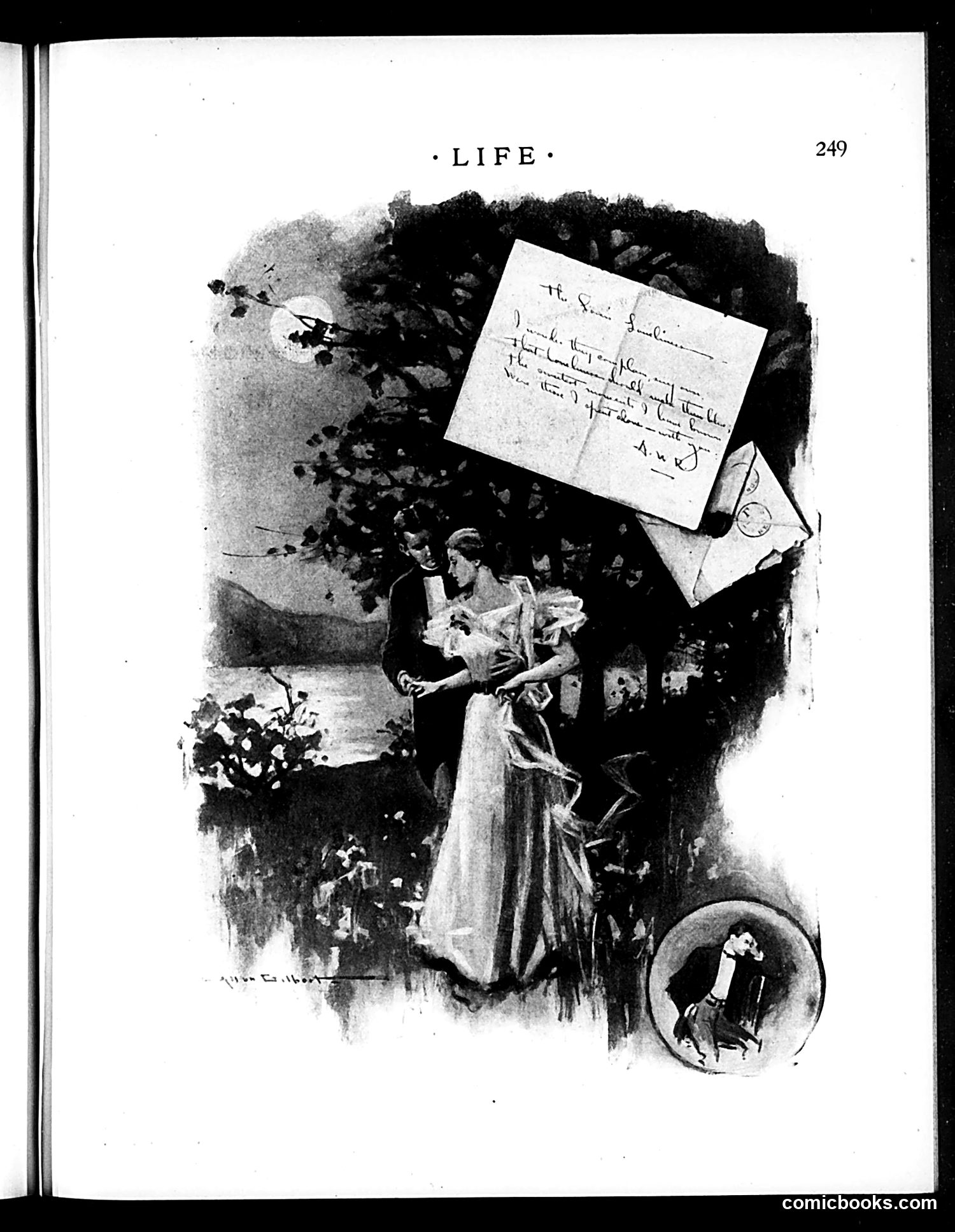
This appears to be a romantic or sentimental illustration rather than political satire. The image shows a silhouetted profile of a woman's head containing an interior scene: a woman in classical dress holding flowers, standing in a romantic landscape with trees and water. A handwritten letter or note is overlaid on the upper portion, though the specific text is illegible in this reproduction. A circular inset in the lower right shows what appears to be a cherub or cupid figure. The overall composition—a "head full of thoughts" format—was a common early-20th-century visual metaphor for depicting someone's inner romantic fantasies or daydreams. This appears to be an illustration about love, correspondence, or romantic sentiment rather than political commentary.
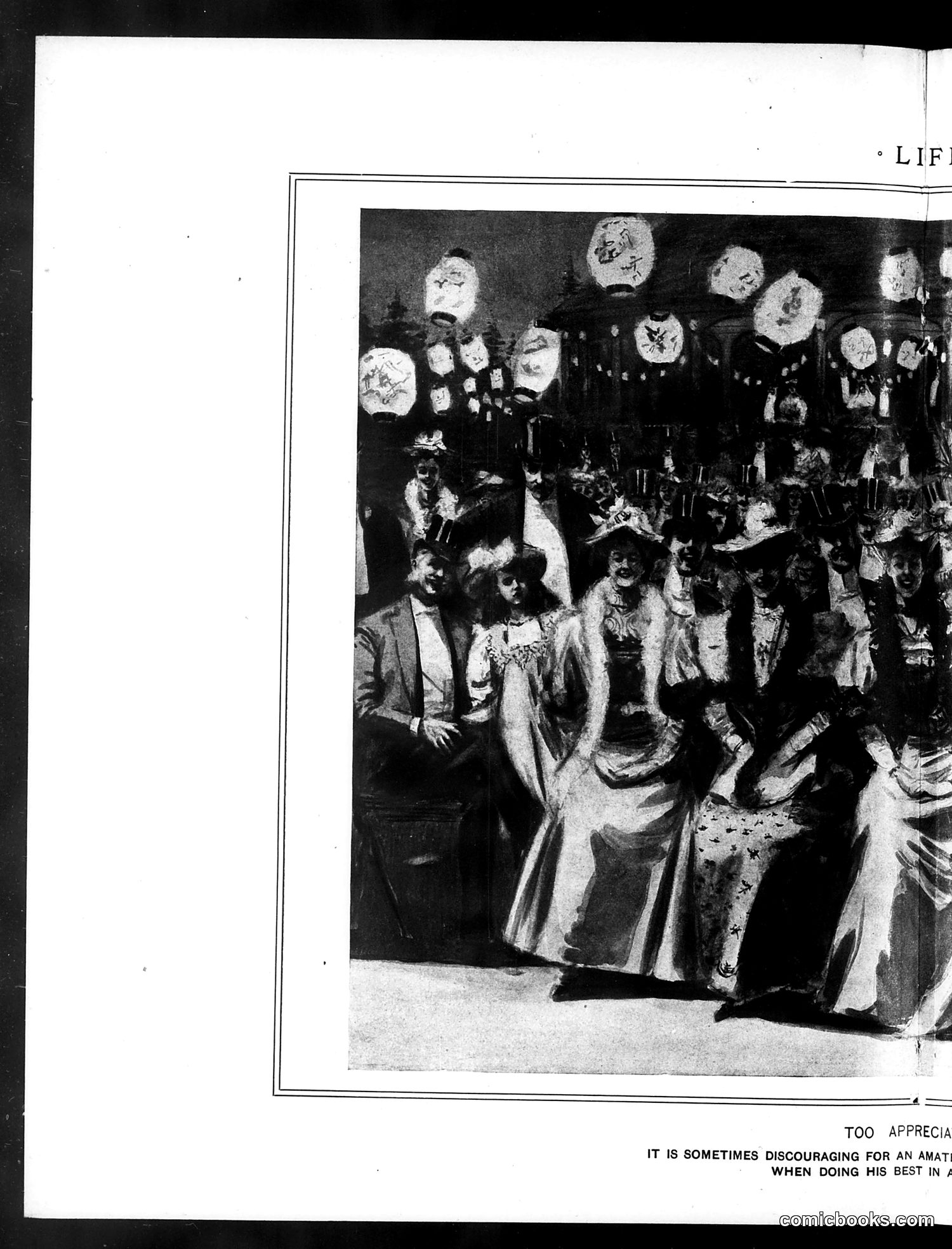
This page from *Life* magazine shows a theatrical or masquerade ball scene with costumed figures wearing elaborate masks and formal attire. The visible caption text reads: "TOO APPRECIA[TED]... IT IS SOMETIMES DISCOURAGING FOR AN AMATEUR... WHEN DOING HIS BEST IN A..." The satire appears to target amateur performers or participants who receive excessive appreciation or praise despite mediocre efforts. The masked ball setting suggests pretense or hidden identities—likely satirizing social climbers or amateurs in theatrical/artistic circles who are overrated by audiences. The specific identities of the figures and the complete caption are unclear from this partial view, limiting precise interpretation of which individuals or events are being mocked.
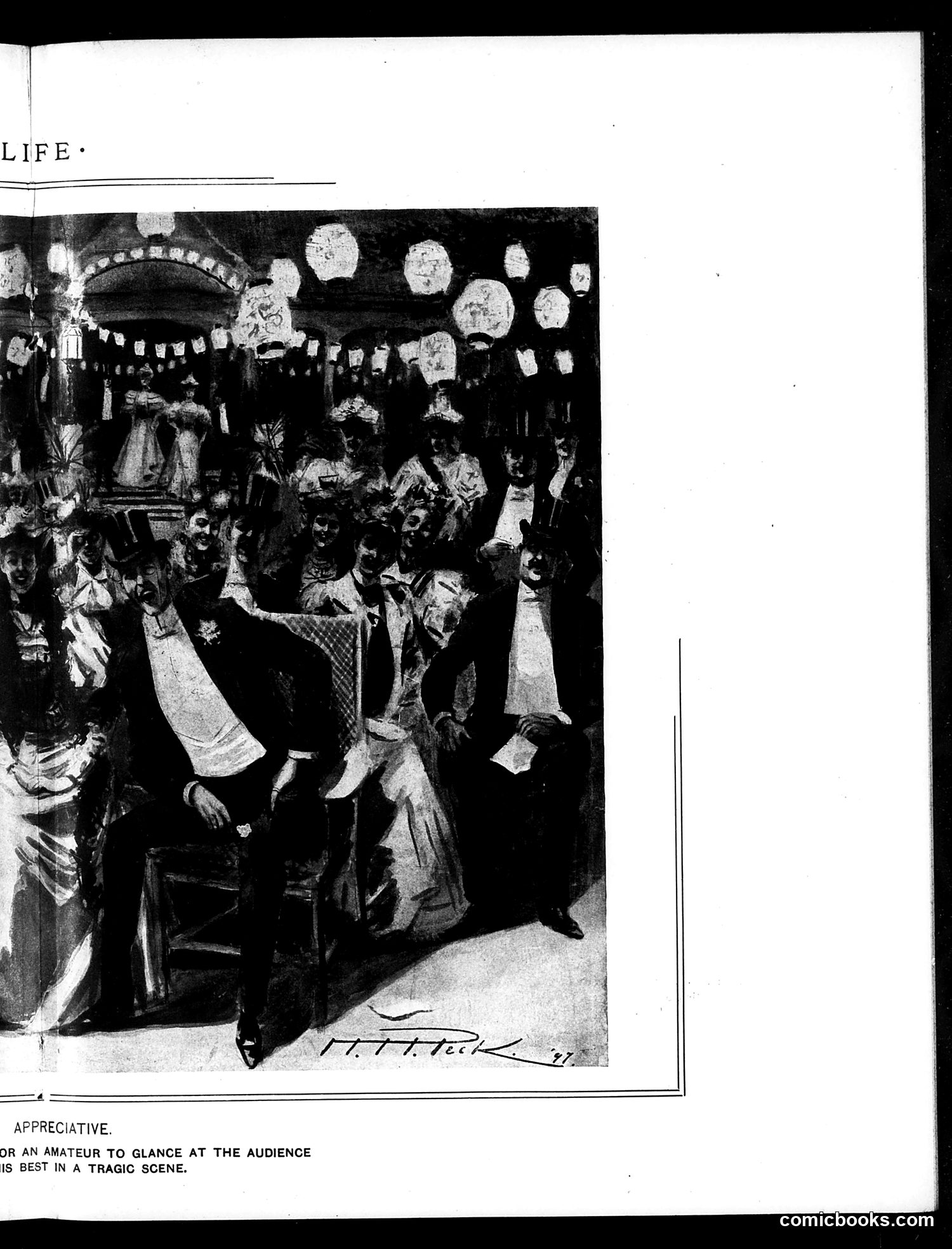
This is a satirical illustration from *Life* magazine titled "Appreciative" with the subtitle: "For an amateur to glance at the audience is best in a tragic scene." The image depicts a theatrical performance, showing actors on stage in what appears to be a dramatic scene. The satire targets amateur theatrical performers who, despite supposedly performing in a "tragic scene," break character by glancing toward the audience—a fundamental acting error that undermines the emotional authenticity required for serious drama. The joke criticizes inexperienced actors for failing to maintain the fourth wall and emotional commitment to their roles. By looking at the audience during a tragic moment, they demonstrate amateurism and self-consciousness rather than genuine dramatic engagement, which the magazine mocks as absurdly inappropriate to the scene's supposed gravity.
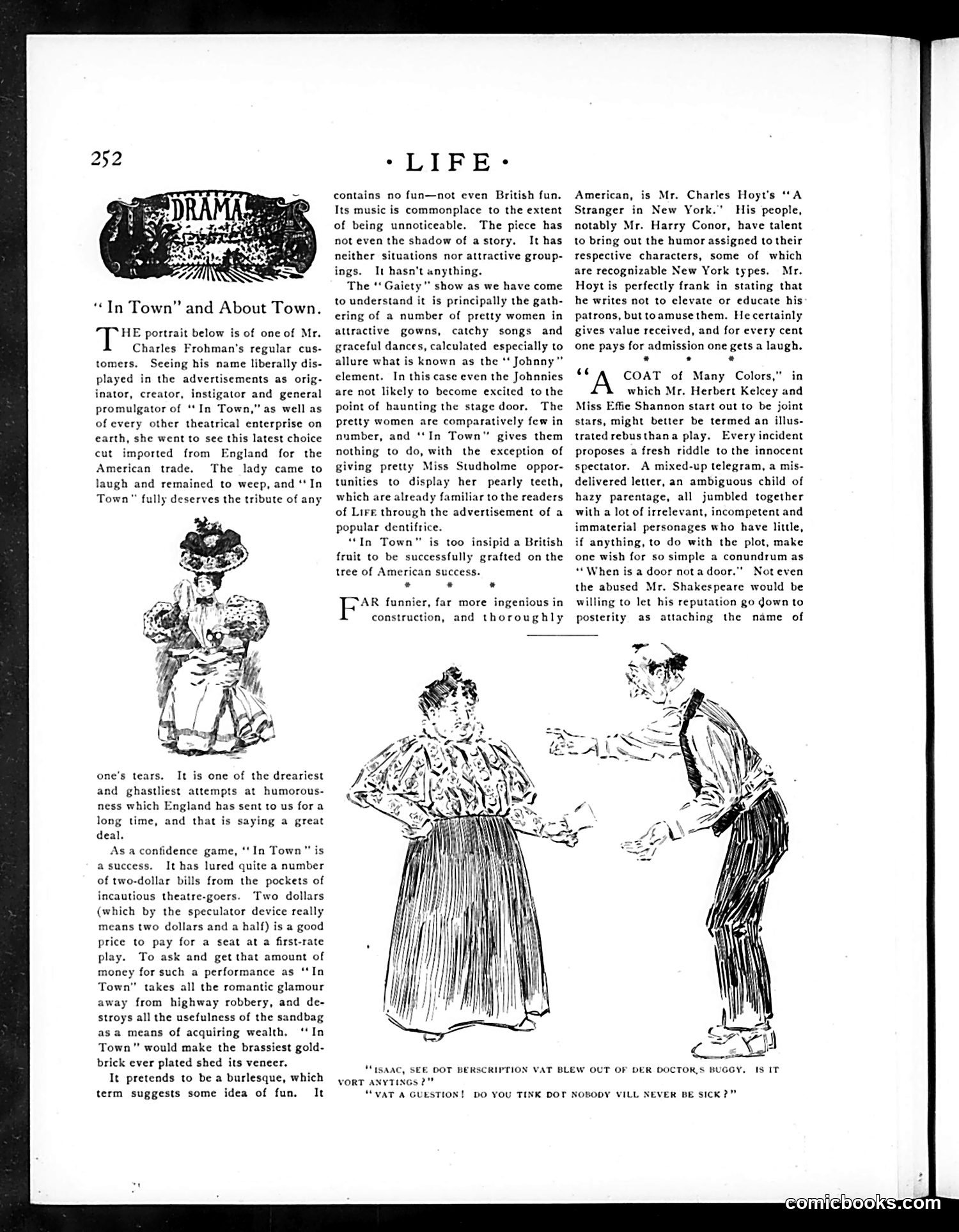
This page critiques a theatrical production called "In Town," a British play imported to America. The critic dismisses it as bland and unoriginal—it contains "no fun, not even British fun" and lacks genuine humor or compelling situations. The illustrations show two characters in conversation, likely depicting a scene from the play. The caption quotes dialogue about a doctor's buggy, suggesting the play relies on trivial, contrived situations for comedy. The review's broader point: American audiences paid good money ($2.50—expensive for the era) to see imported British theater that fails to entertain. The critic argues it's essentially a con game, relying on spectacle and pretty actresses rather than actual wit or substance.
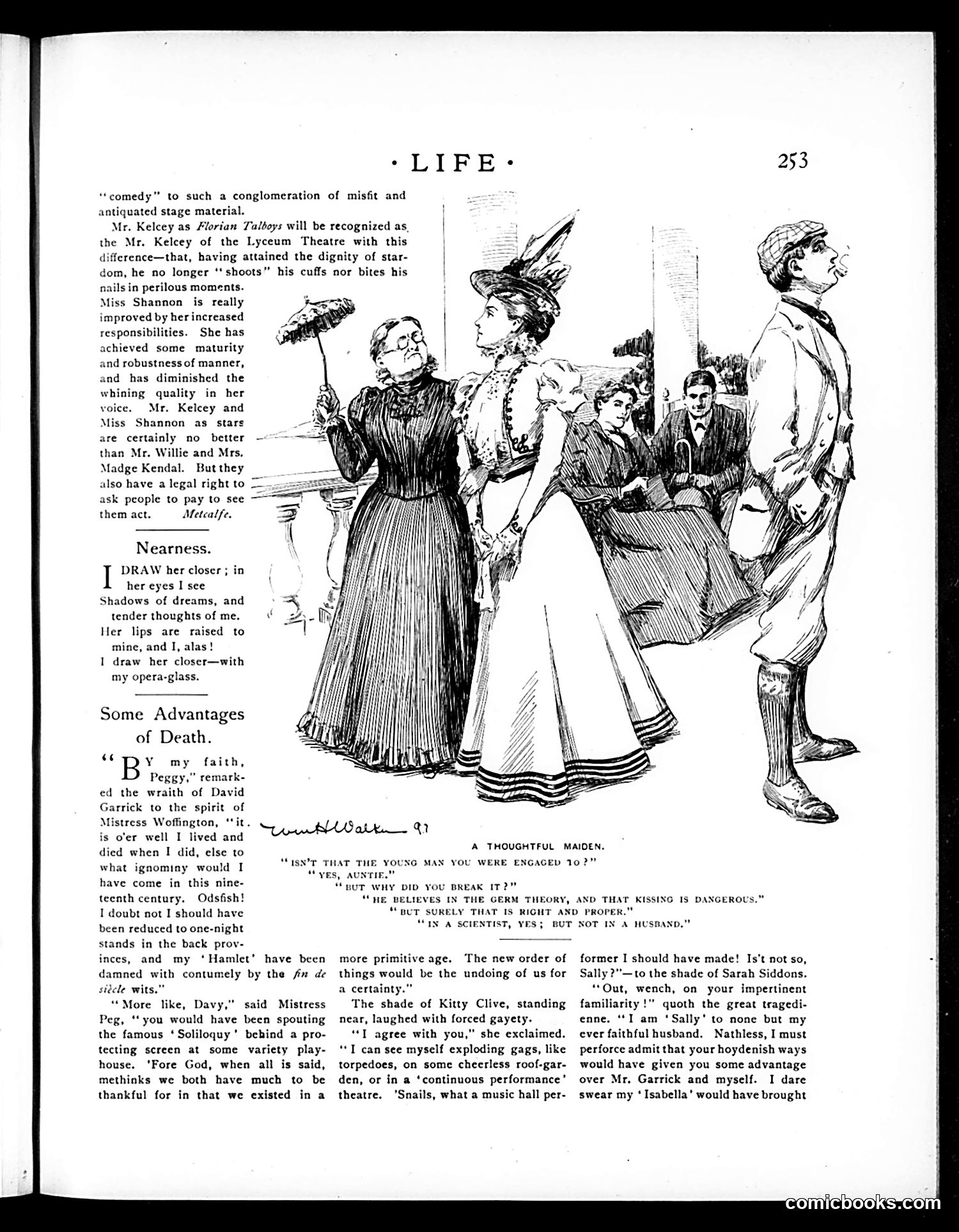
This page contains theater criticism and satirical commentary on 19th-century theatrical life. The main cartoon depicts a young woman who has broken her engagement because her fiancé believes kissing spreads germs (referencing germ theory, a contemporary scientific concern). She finds this scientifically correct but impractical in a husband—satirizing the tension between modern scientific rationalism and romantic expectation. The accompanying text mocks theatrical culture: it praises actors Kelcey and Shannon's improved performances while noting they're no better than established stars Willie and Madge Kendal—yet audiences still pay to see them. A humorous poem about using opera glasses to view a woman at distance, and a dialogue between dead famous actors (Garrick, Woffington, Kitty Clive, Sarah Siddons) lamenting how modern theater—with its "continuous performances" and vaudeville circuits—would have destroyed their legacies, complete the satirical commentary on theater's decline.
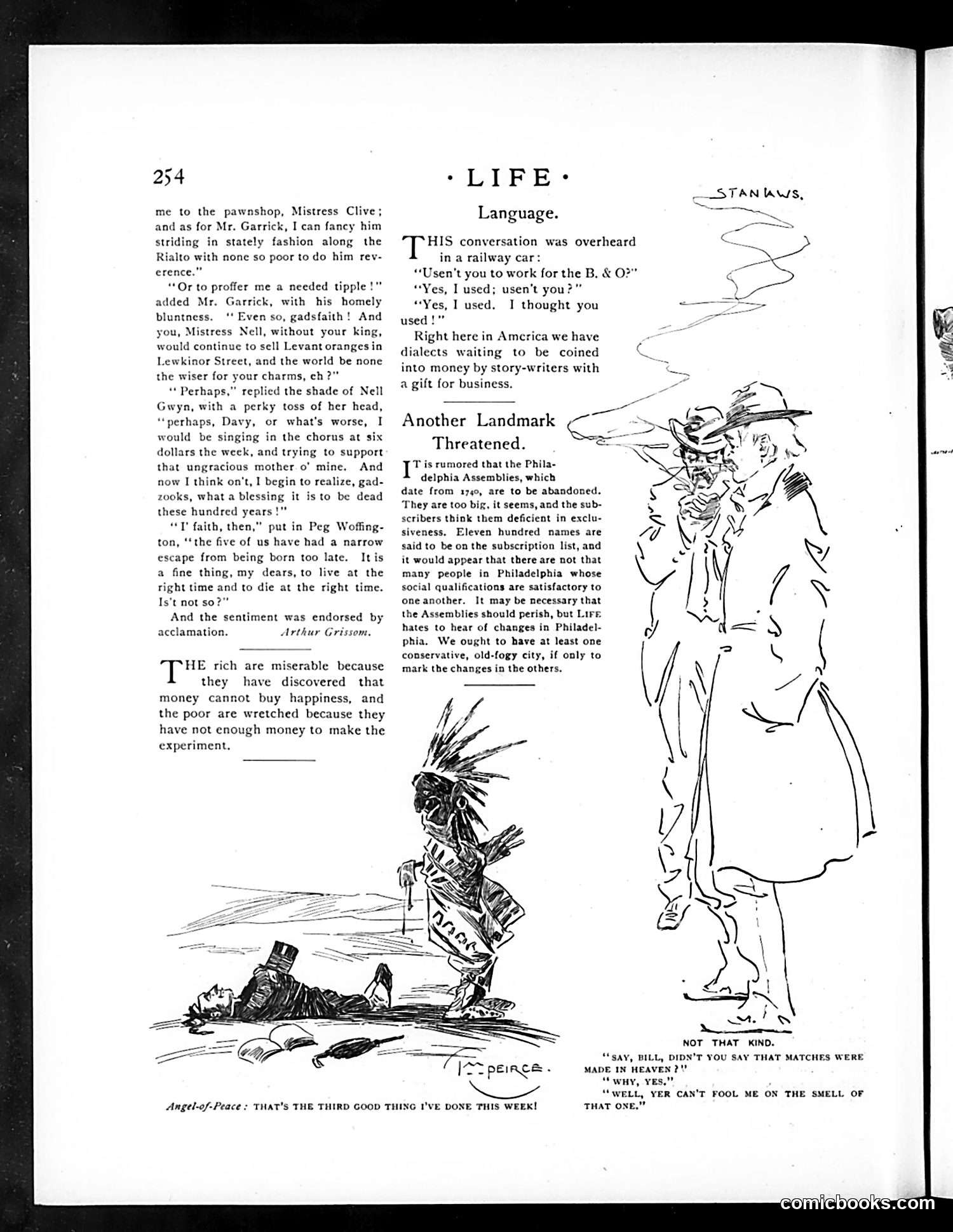
This page contains three distinct satirical pieces: **"Language"** mocks American dialect diversity. A overheard railway conversation between two men using non-standard grammar ("usen't") prompts commentary that American dialects are commercial gold mines waiting to be exploited by story-writers—satirizing both the proliferation of regional speech and commercial opportunism in literature. **"Another Landmark Threatened"** laments the potential closure of Philadelphia's Assemblies (an exclusive social organization dating to 1740). Life ironically suggests Philadelphia should remain conservative and old-fashioned as a counterpoint to America's rapid modernization elsewhere—poking fun at social exclusivity while simultaneously treating outdated institutions as culturally valuable. **"Not That Kind"** is a cartoon joke about matches in heaven. Two men debate whether matches exist in heaven; one produces a match, and the other dismisses it by its smell, implying it's a devilish (hellish) match instead—a simple pun on "matches" as both fire-starting objects and potential romantic pairings. The page reflects early 20th-century American anxieties about social change, class distinction, and commercialization.
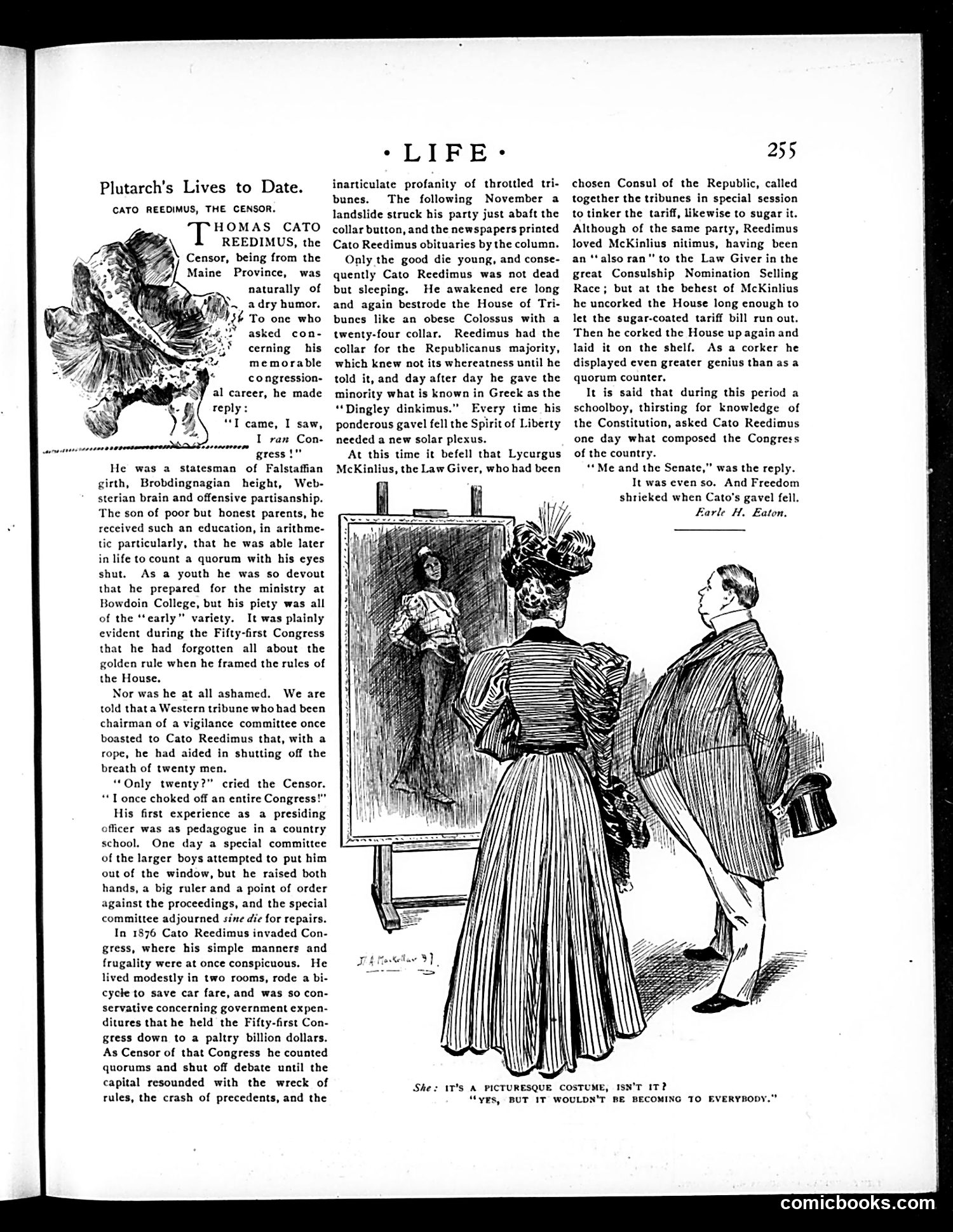
This is a satirical biographical sketch from Life magazine mocking **Thomas Brackett Reed**, Speaker of the House during the 51st Congress (1889-1891). The text uses classical allusions ("Plutarch's Lives") to parody Reed's authoritarian control of parliamentary procedure. The satire targets Reed's: - **Physical appearance** ("Falstaffian girth," "Brobdingnagian height") - **Heavy-handed rule enforcement**, including counting absent members present to maintain quorums and silencing debate through strict application of House rules - **Political ruthlessness** (the joke about "choking off an entire Congress") - **Arrogance** (claiming "Me and the Senate" compose Congress) The accompanying cartoon shows two figures examining what appears to be period costume, likely commenting on the artificial or performative nature of Reed's authoritarian style. The satire reflects contemporary Republican criticism of Reed's controversial but effective methods for modernizing House procedures during the McKinley era.
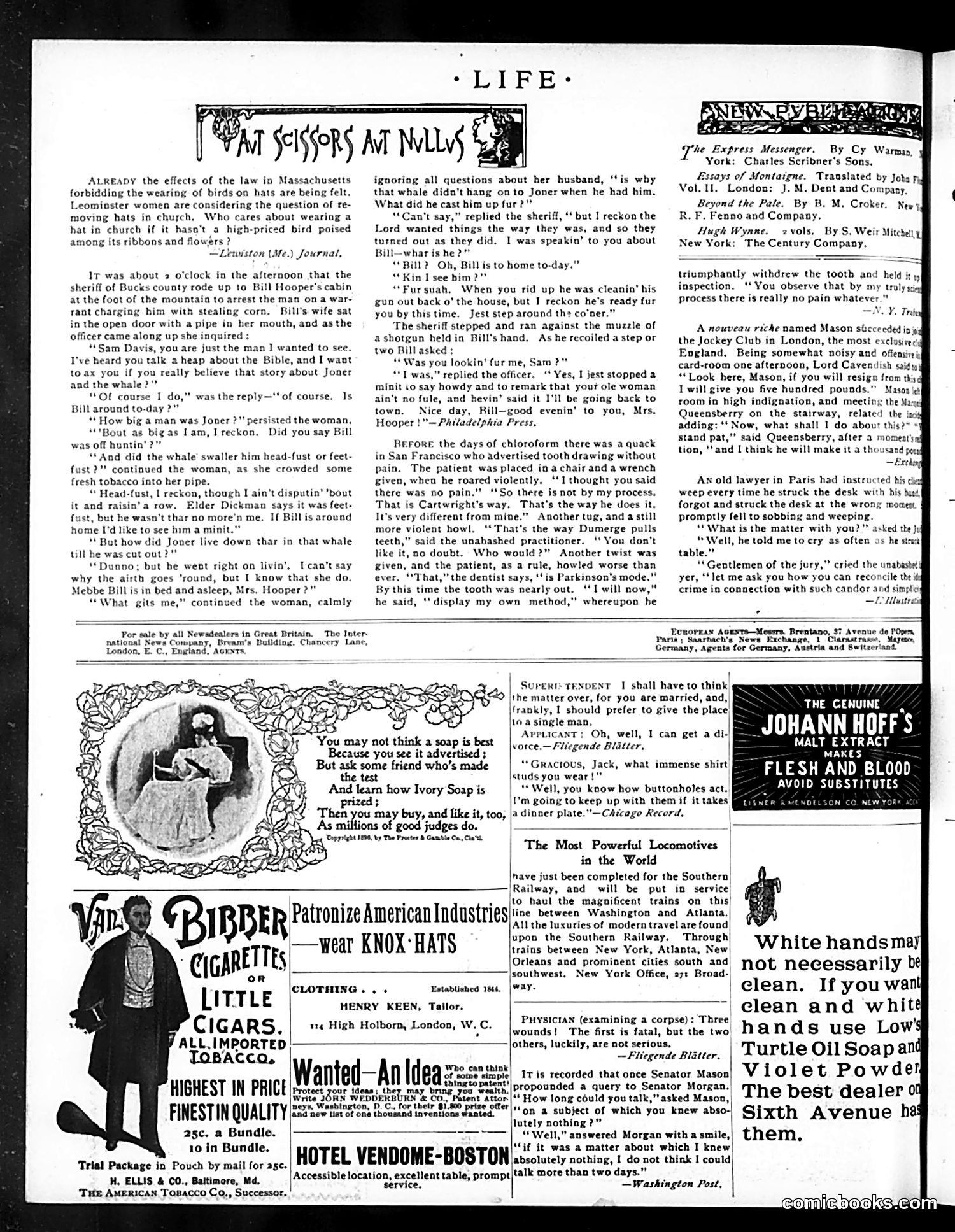
This page contains three satirical anecdotes rather than a traditional political cartoon. The main featured story mocks a Massachusetts law banning feathered hats. Women are so attached to their ornamental bird-laden bonnets that they're considering removing hats from church entirely rather than obey the ban—satirizing both female vanity and the impracticality of sumptuary laws. The other anecdotes employ rural/frontier humor: a sheriff's wife deliberately delays answering about her husband's whereabouts by asking theological questions about Jonah and the whale, only to have the suspect confront the officer with a shotgun. A second story ridicules a quack dentist who claims painless tooth extraction while clearly causing agony. These pieces reflect early 1900s satirical humor—poking fun at fashion obsession, clever rustic characters outwitting authority, and medical fraud. The page is primarily satirical journalism rather than visual cartooning.
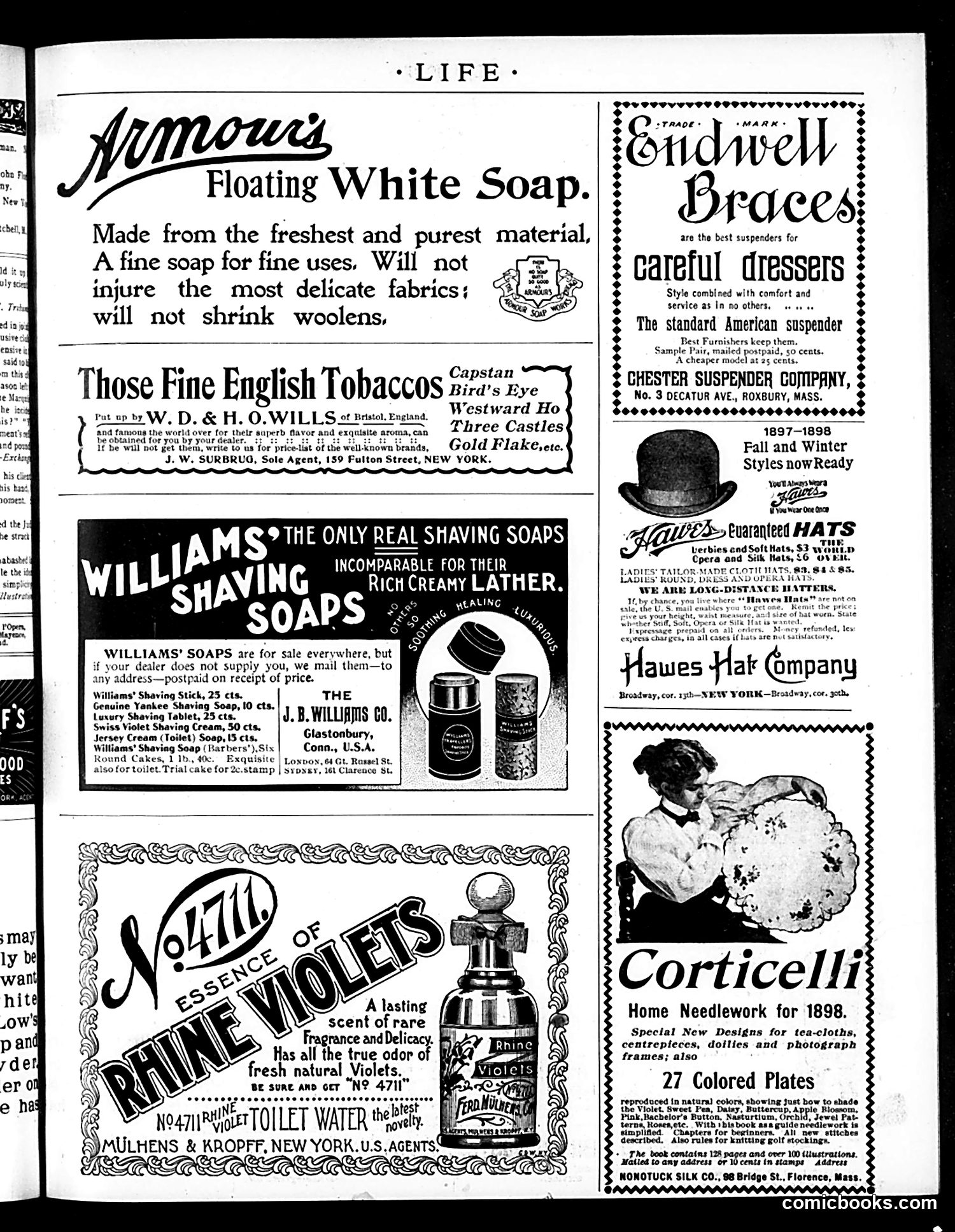
This is **not a cartoon page** but rather a **full advertising section** from Life magazine (1897-1898). The page contains commercial advertisements for consumer products popular in the late Victorian era, with no satire or political commentary. The ads promote: - **Armour's Floating White Soap** and competing shaving soaps (Williams', Noleil) - **English tobacco products** (Capstan, Bird's Eye, Westward Ho) - **Men's accessories**: Endwell Braces (suspenders) and Hawes Hats - **Women's crafts**: Corticelli needlework instruction book with colored plates Each advertisement emphasizes quality, purity, and genteel refinement—typical marketing language for the period. The decorative borders and typography reflect Belle Époque design aesthetics. This page represents Life's revenue model: a satirical magazine supplementing editorial content with paid advertisements targeting middle and upper-class readers.
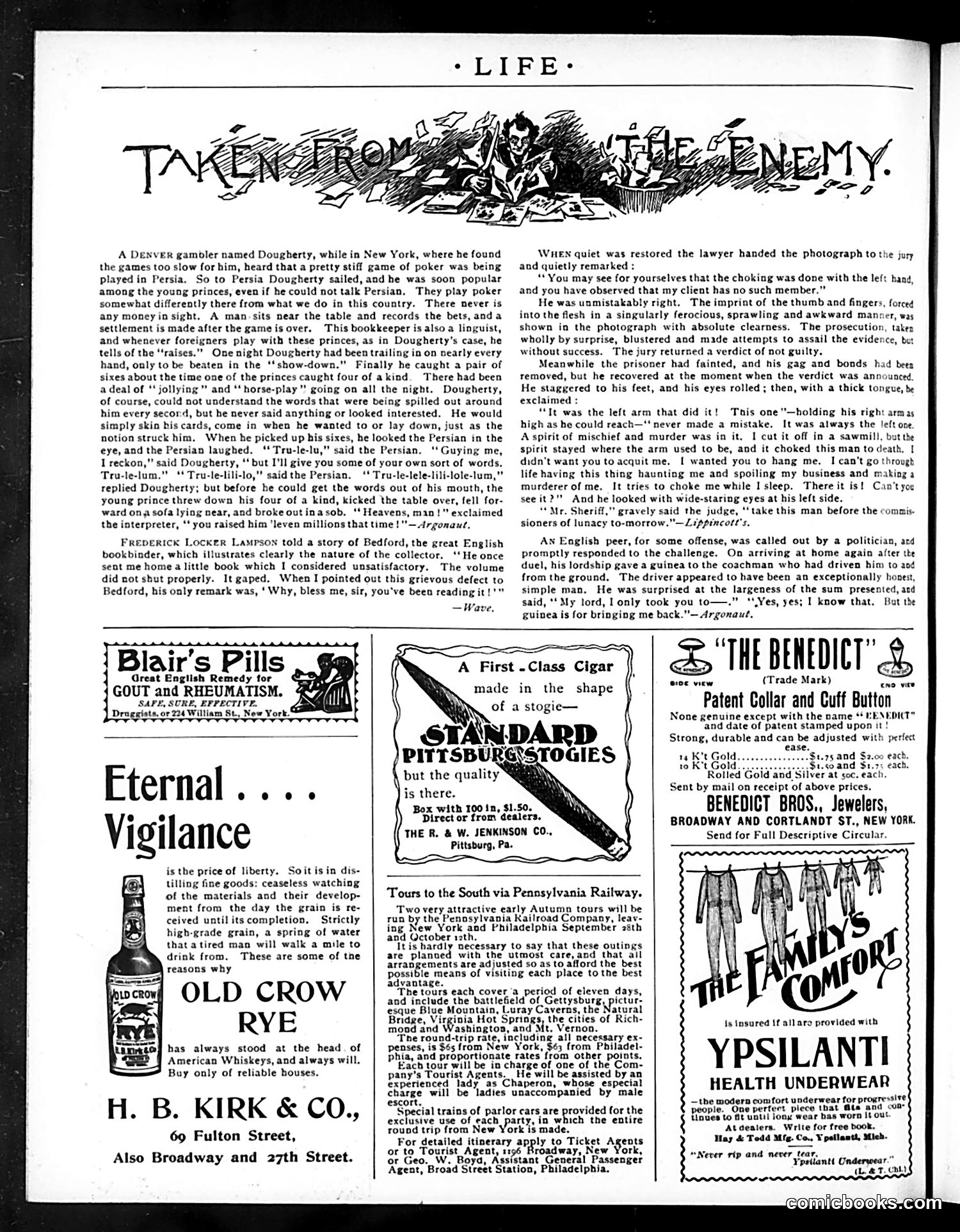
This page contains two humorous anecdotes rather than political cartoons: 1. **"The Persian Poker Game"**: An American gambler named Dougherty travels to Persia to play high-stakes poker with young princes. Unable to understand Persian, he mimics their nonsense words ("Tru-le-lu") during betting. When he repeats their gibberish back at them, the young prince believes Dougherty has made an enormous raise worth "leven millions" and dramatically concedes in embarrassment. The joke satirizes the absurdity of international misunderstandings and the stakes of gambling culture. 2. **"The Left Arm Defense"**: A lawyer proves his client innocent of strangulation by showing the jury a photograph revealing the killer's left-handed attack—while his client has no left arm. However, the "guilty" client then claims his severed arm's *spirit* committed the murder and haunts him, expressing disappointment at acquittal. Both stories mock pretension, exaggeration, and the contradictions of human behavior through tall tales typical of *Life* magazine's satirical humor.
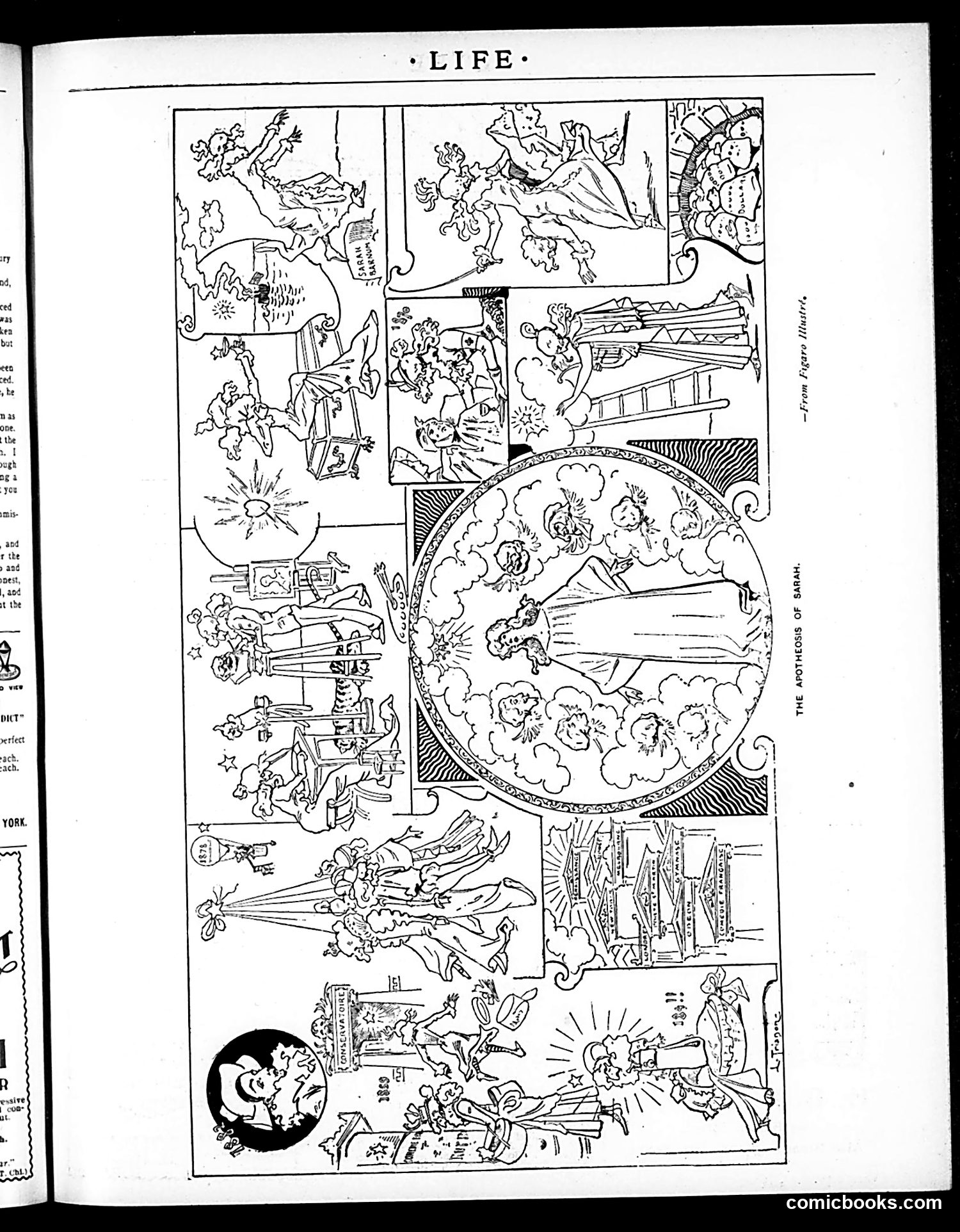
This page depicts the deification of **Sarah Bernhardt**, the renowned French actress. The central circular composition shows her ascending to heaven surrounded by cherubs and clouds—a classical "apotheosis" (elevation to divine status). The surrounding smaller panels appear to illustrate scenes from her theatrical career and dramatic life, rendered in a playful, reverent style. The title's ironic tone suggests Life magazine is satirizing the excessive adulation Bernhardt received, particularly in America where she toured frequently. The comic treatment elevates her from mere performer to goddess-like status, poking fun at both her celebrity worship and the grandiose way European theatrical culture was regarded by American audiences. This likely dates to the late 19th or early 20th century when Bernhardt was at peak fame.
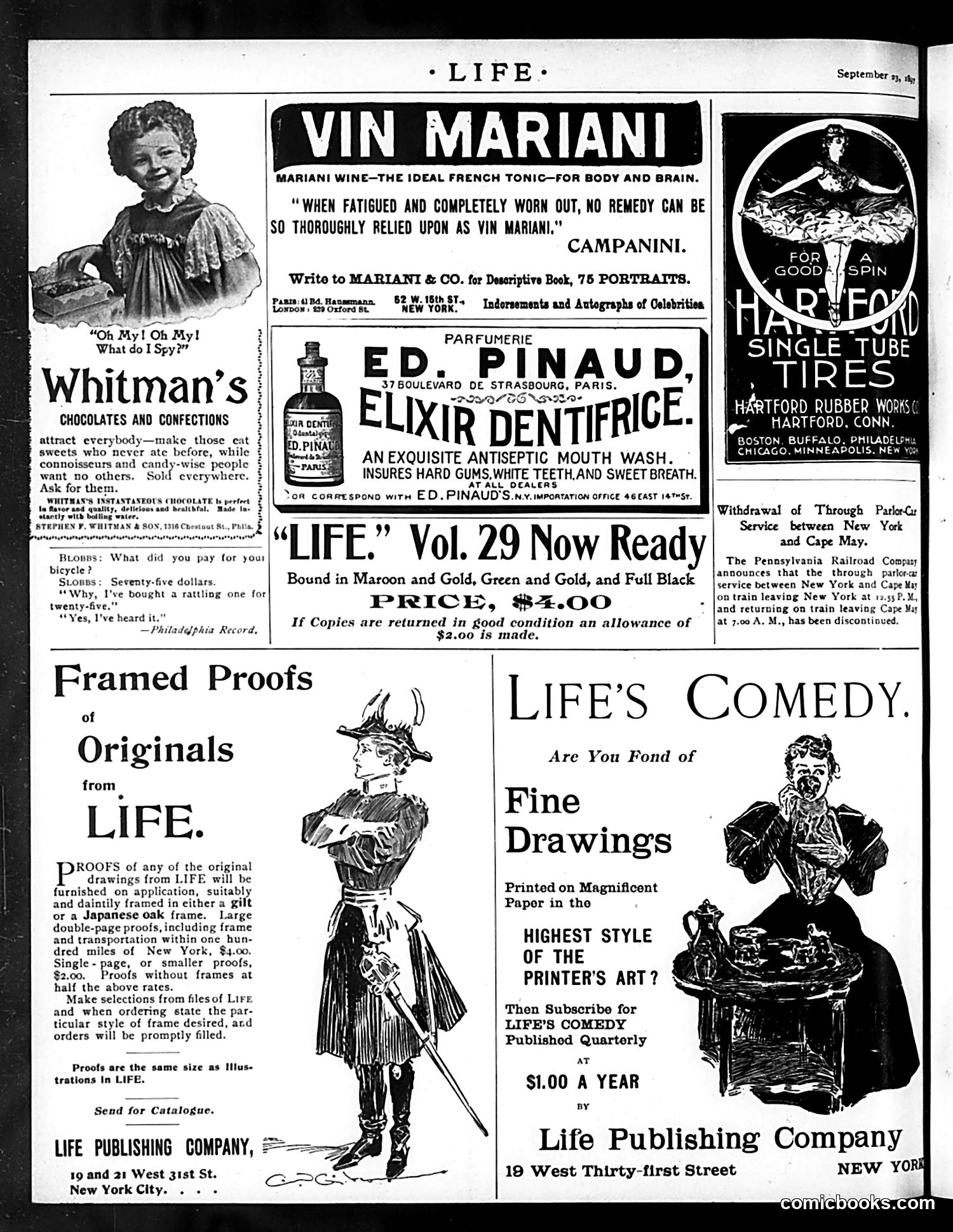
This page is primarily **advertising and promotional content**, not political cartoons. It showcases products and services popular in the early 20th century: **Notable Advertisements:** - **Vin Mariani**: A wine-based tonic marketed as a cure for fatigue, endorsed by opera singer Campanini. Such patent medicines were common before FDA regulation. - **Whitman's Chocolates** and **ED. Pinaud's Elixir Dentifrice** (toothwash): Standard consumer products. - **Hartford Rubber Works tires**: Automotive advertising. **Publishing Content:** The page promotes *Life* magazine's own products—bound volumes ($4.00), framed original artwork proofs, and *Life's Comedy*, a quarterly publication of fine drawings ($1.00/year). **The Joke/Dialog:** A brief exchange about bicycle prices satirizes inflation or buyer's remorse—someone paid $75 for a bicycle, another bought one for $25; the first dismisses the second's claim as implausible. This is a typical magazine page mixing editorial advertisements with house promotions, offering little satirical or political content beyond the brief humor snippet.