
Life, 1897-09-23 · page 13 of 20
Life — September 23, 1897 — page 13: what you’re looking at
What you’re looking at
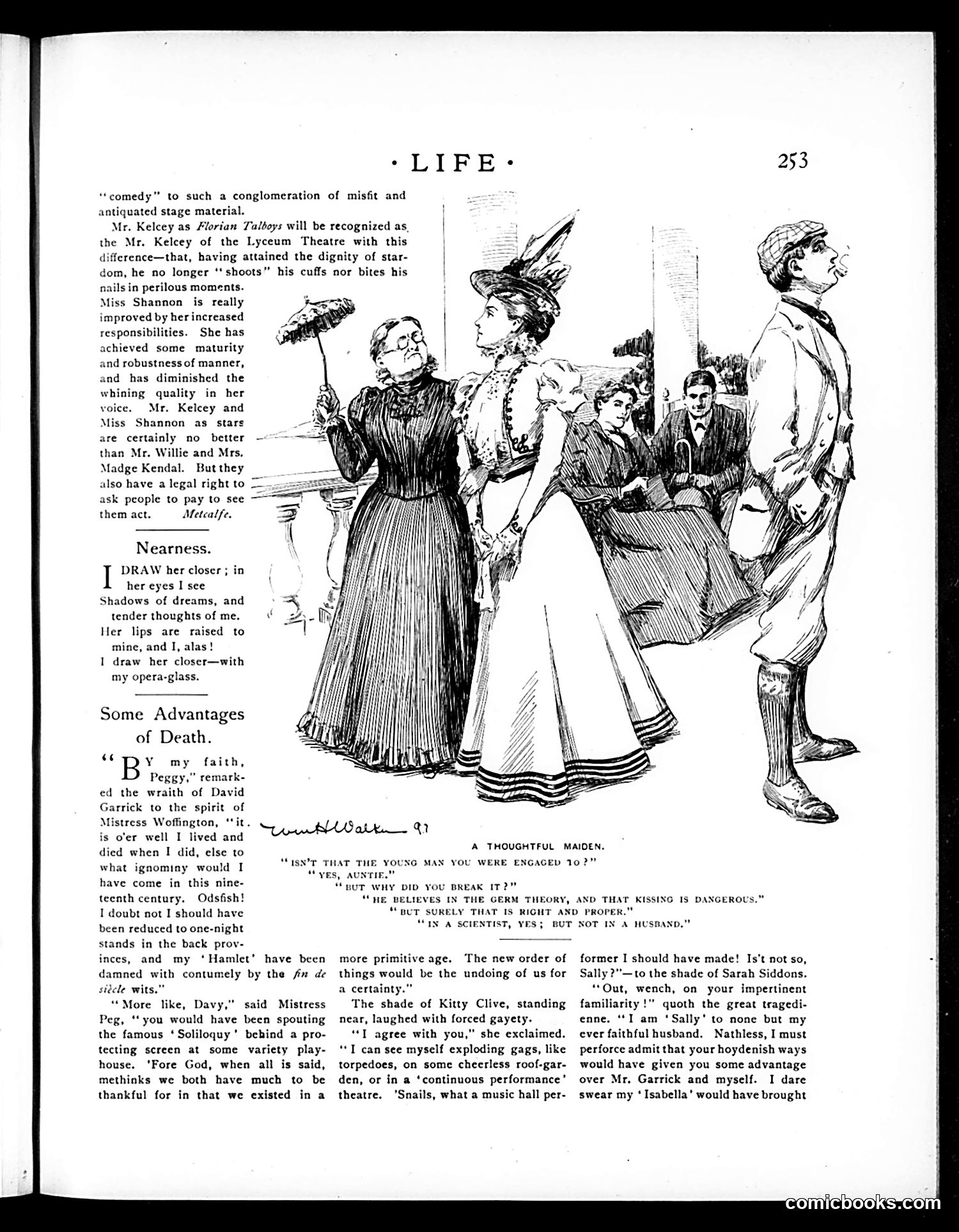
This page contains theater criticism and satirical commentary on 19th-century theatrical life. The main cartoon depicts a young woman who has broken her engagement because her fiancé believes kissing spreads germs (referencing germ theory, a contemporary scientific concern). She finds this scientifically correct but impractical in a husband—satirizing the tension between modern scientific rationalism and romantic expectation. The accompanying text mocks theatrical culture: it praises actors Kelcey and Shannon's improved performances while noting they're no better than established stars Willie and Madge Kendal—yet audiences still pay to see them. A humorous poem about using opera glasses to view a woman at distance, and a dialogue between dead famous actors (Garrick, Woffington, Kitty Clive, Sarah Siddons) lamenting how modern theater—with its "continuous performances" and vaudeville circuits—would have destroyed their legacies, complete the satirical commentary on theater's decline.
📄 Transcribed text from this page (OCR, searchable)
Machine-transcribed from the original scan — historical spelling and the odd misread are preserved.
*LIFE-: “comedy” to such a conglomeration of misfit and antiquated stage material. Mr. Kelcey as Horian Talboys will be recognized as, the Mr. Kelcey of the Lyceum Theatre with this difference—that, having attained the dignity of star- dom, he no longer ‘* shoots” his cuffs nor bites his nails in perilous moments. Miss Shannon is really improved by her increased responsibilities. She has achieved some maturity and robustness of manner, and has diminished the whining quality in her voice. Mr. Kelcey and Miss Shannon as stars are certainly no better than Mr. Willie and Mrs. Madge Kendal. But they also have a legal right to — ask people to pay to see — them act. Metcalfe. Nearness. DRAW her closer ; in her eyes I sce Shadows of dreams, and tender thoughts of me, Her lips are raised to mine, and I, alas! I draw her closer—with my opera-glass. Some Advantages of Death. “ec Y omy faith, Peggy,” remark- ed the wraith of David Garrick to the spirit of Mistress Woffington, ‘it. is o'er well I lived and died when I did, else to what ignominy would I have come in this nine- teenth century. Odsfish! I doubt not I should have been reduced to one-night stands in the back prov- inces, and my ‘Hamlet’ have been damned with contumely by the fix de sidcle wits.” “More like, Davy,” said Mistress Peg, ‘you would have been spouting the famous ‘Soliloquy’ bebind a pro- tecting screen at some variety play- house. ‘Fore God, when all is said, methinks we both have much to be thankful for in that we existed in a SrA atk 91 A THOUGHTFUL MAIDEN. “BUT WHY DID YOU BREAK IT?’ ‘Isx’? THAT THE YOUNG MAN YOU WERE ENGAGED 10?” “HE BELIEVES IN THE GERM THEORY, AND THAT KISSING IS DANGEROUS.” “BUT SURI THAT IS RIGHT AND PROPER.” “IN A SCIENTIST, YES; BUT NOT IN A HUSBAND,” more primitive age. The new order of things would be the undoing of us for a certainty.” The shade of Kitty Clive, standing near, laughed with forced gayety. ‘I agree with you,” she exclaimed. “TI can see myself exploding gags, like torpedoes, on some cheerless roof-gar- den, or in a ‘continuous performance’ theatre. ‘Snails, what a music hall per- former I should have made! Is’t not so, Sally ?"—to the shade of Sarah Siddons. **Out, wench, on your impertinent familiarity!" quoth the great tragedi- enne. ‘*I am ‘Sally’ to none but my ever faithful husband, Nathless, I must perforce admit that your hoydenish ways would have given you some advantage over Mr. Garrick and myself. I dare swear my ‘Isabella’ would have brought