
Life, 1897-09-23 · page 12 of 20
Life — September 23, 1897 — page 12: what you’re looking at
What you’re looking at
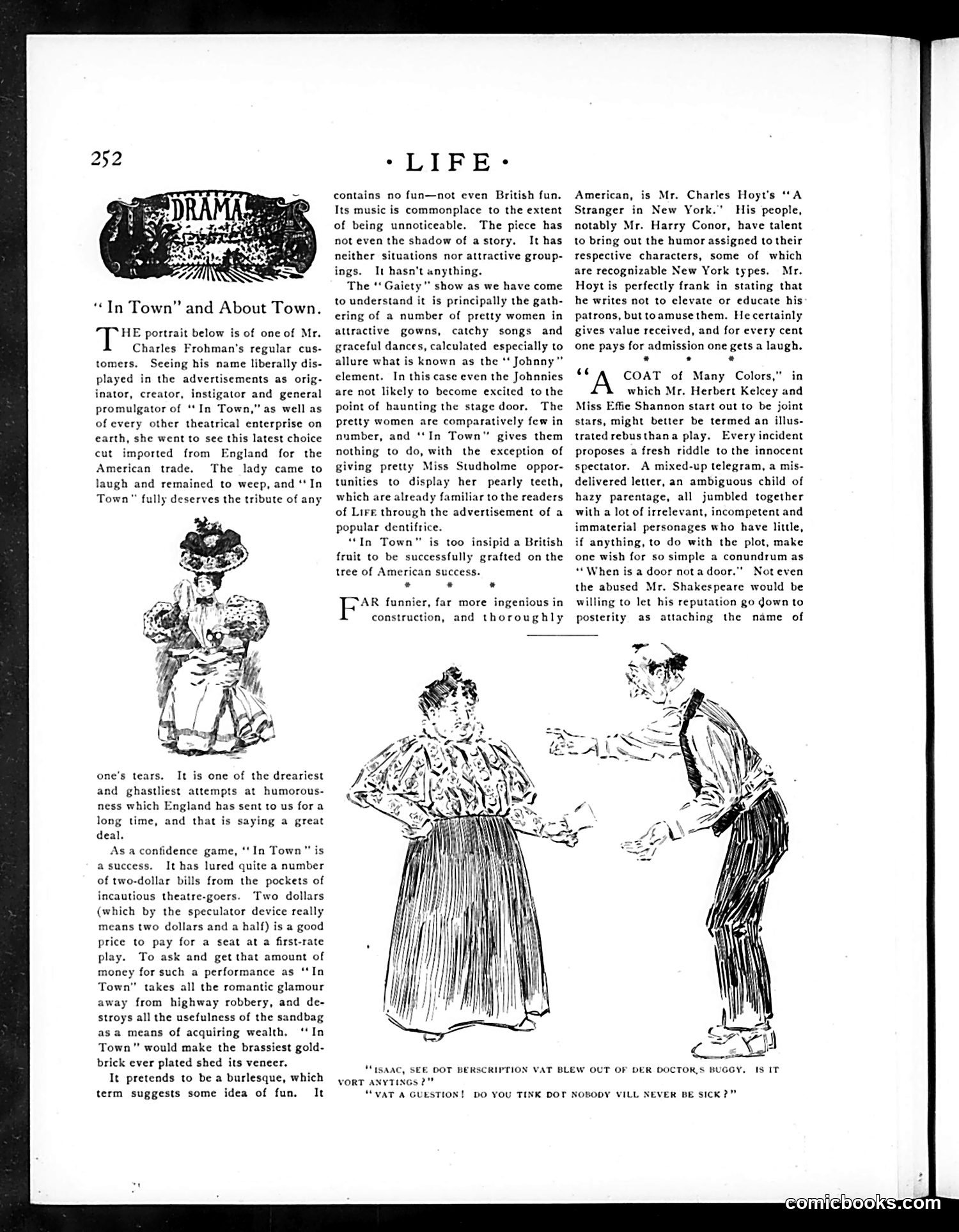
This page critiques a theatrical production called "In Town," a British play imported to America. The critic dismisses it as bland and unoriginal—it contains "no fun, not even British fun" and lacks genuine humor or compelling situations. The illustrations show two characters in conversation, likely depicting a scene from the play. The caption quotes dialogue about a doctor's buggy, suggesting the play relies on trivial, contrived situations for comedy. The review's broader point: American audiences paid good money ($2.50—expensive for the era) to see imported British theater that fails to entertain. The critic argues it's essentially a con game, relying on spectacle and pretty actresses rather than actual wit or substance.
📄 Transcribed text from this page (OCR, searchable)
Machine-transcribed from the original scan — historical spelling and the odd misread are preserved.
“In Town” and About Town. HE portrait below is of one of Mr. Charles Frohman’s regular cus- tomers. Seeing his name liberally dis- played in the advertisements as orig- inator, creator, instigator and general promulgator of “In Town,” as well as of every other theatrical enterprise on earth, she went to see this latest choice cut imported from England for the American trade. The lady came to laugh and remained to weep, and “In Town" fully deserves the tribute of any one’s tears, It is one of the dreariest and ghastliest attempts at humorous- ness which England has sent to us fora long time, and that is saying a great deal. As a confidence game, ‘In Town” is a success. It has lured quite a number of two-dollar bills from the pockets of incautious theatre-goers. Two dollars (which by the speculator device really means two dollars and a half) is a good price to pay for a seat at a first-rate play. To ask and get that amount of money for such a performance as “In Town” takes all the romantic glamour away from highway robbery, and de- stroys all the usefulness of the sandbag asa means of acquiring wealth, ‘‘In Town” would make the brassiest gold- brick ever plated shed its veneer. It pretends to be a burlesque, which term suggests some idea of fun, It * LIFE: contains no fun—not even British fun. Its music is commonplace to the extent of being unnoticeable. The piece has not even the shadow of astory. It has neither situations nor attractive group- ings. It hasn't anything. The “Gaiety” show as we have come to understand it is principally the gath- ering of a number of pretty women in altractive gowns, catchy songs and graceful dances, calculated especially to allure what is known as the ** Johnny” element. In this case even the Johnnies are not likely to become excited tothe point of haunting the stage door. The pretty women are comparatively few in number, and ‘‘In Town” gives them nothing to do, with the exception of giving pretty Miss Studholme oppor- tunities to display her pearly teeth, which are already familiar to the readers of Lire through the advertisement of a popular dentifrice. “In Town" is too insipid a British fruit to be successfully grafted on the tree of American success. * * . AR funnier, far more ingenious in construction, and thoroughly ‘ISAAC, SEE DOT BERSCRIPTION VAT BLEW OUT OF DER DOCTOR,S BUGGY, VORT ANYTINGS 2" “VAT A GUESTION! American, is Mr. Charles Hoyt's ‘A Stranger in New York.’ His people, notably Mr. Harry Conor, have talent to bring out the humor assigned to their respective characters, some of which are recognizable New York types. Mr. Hoyt is perfectly frank in stating that he writes not to elevate or educate his patrons, but toamusethem. Hecertainly gives value received, and for every cent one pays for admission one gets a laugh. * . * at COAT of Many Colors,” in which Mr. Herbert Kelcey and Miss Effie Shannon start out to be joint stars, might better be termed an illus- trated rebusthana play. Every incident proposes a fresh riddle to the innocent spectator. A mixed-up telegram, a mis- delivered letter, an ambiguous child of hazy parentage, all jumbled together with a lot of irrelevant, incompetent and immaterial personages who have little, if anything, to do with the plot, make one wish for so simple a conundrum as **When is a door nota door.” Noteven the abused Mr. Shakespeare would be willing to let his reputation go gown to posterity as attaching the name of Is iT DO YOU TINK DOT NOBODY VILL NEVER BE SICK?”