
A complete issue · 20 pages · 1897
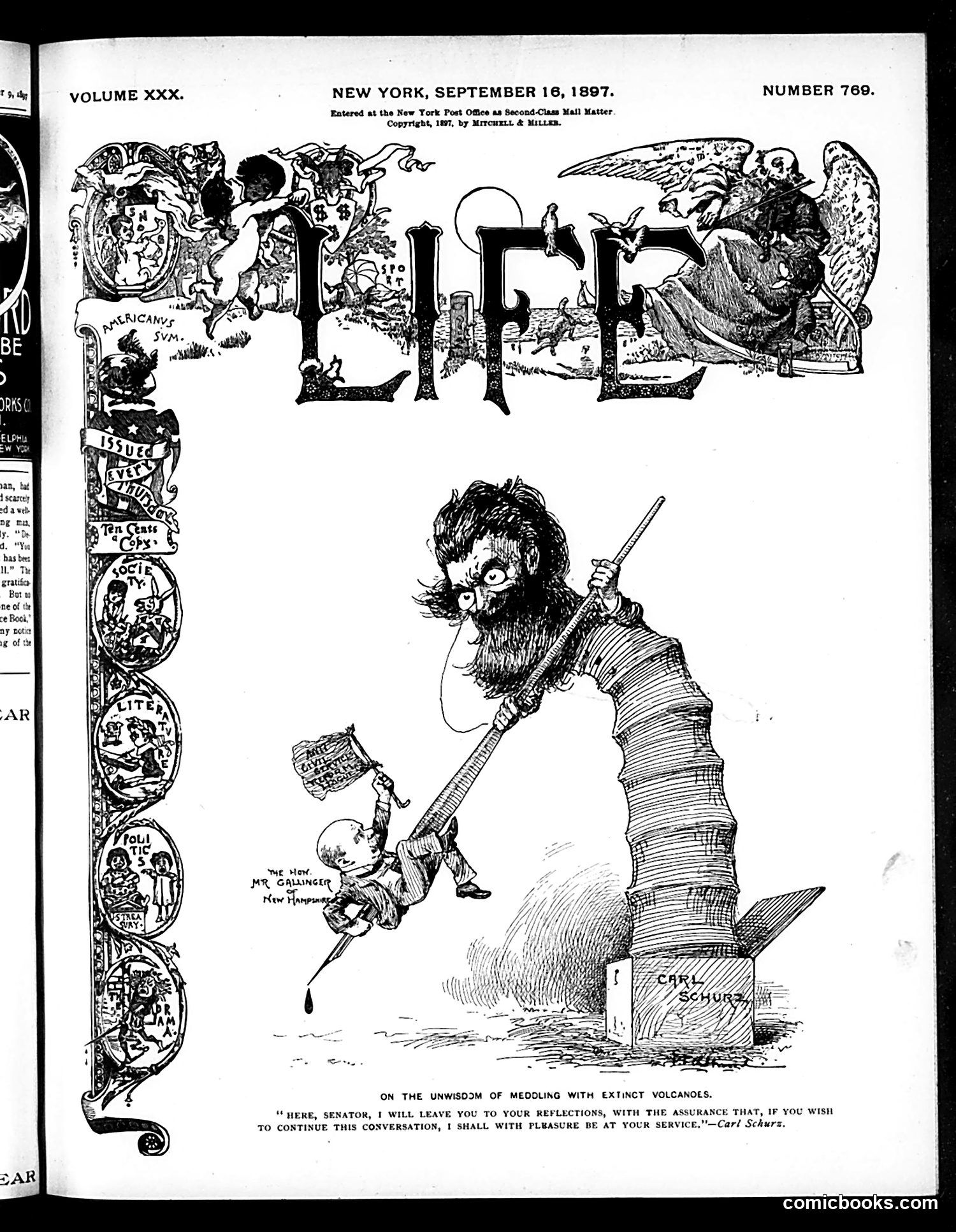
Life — September 16, 1897
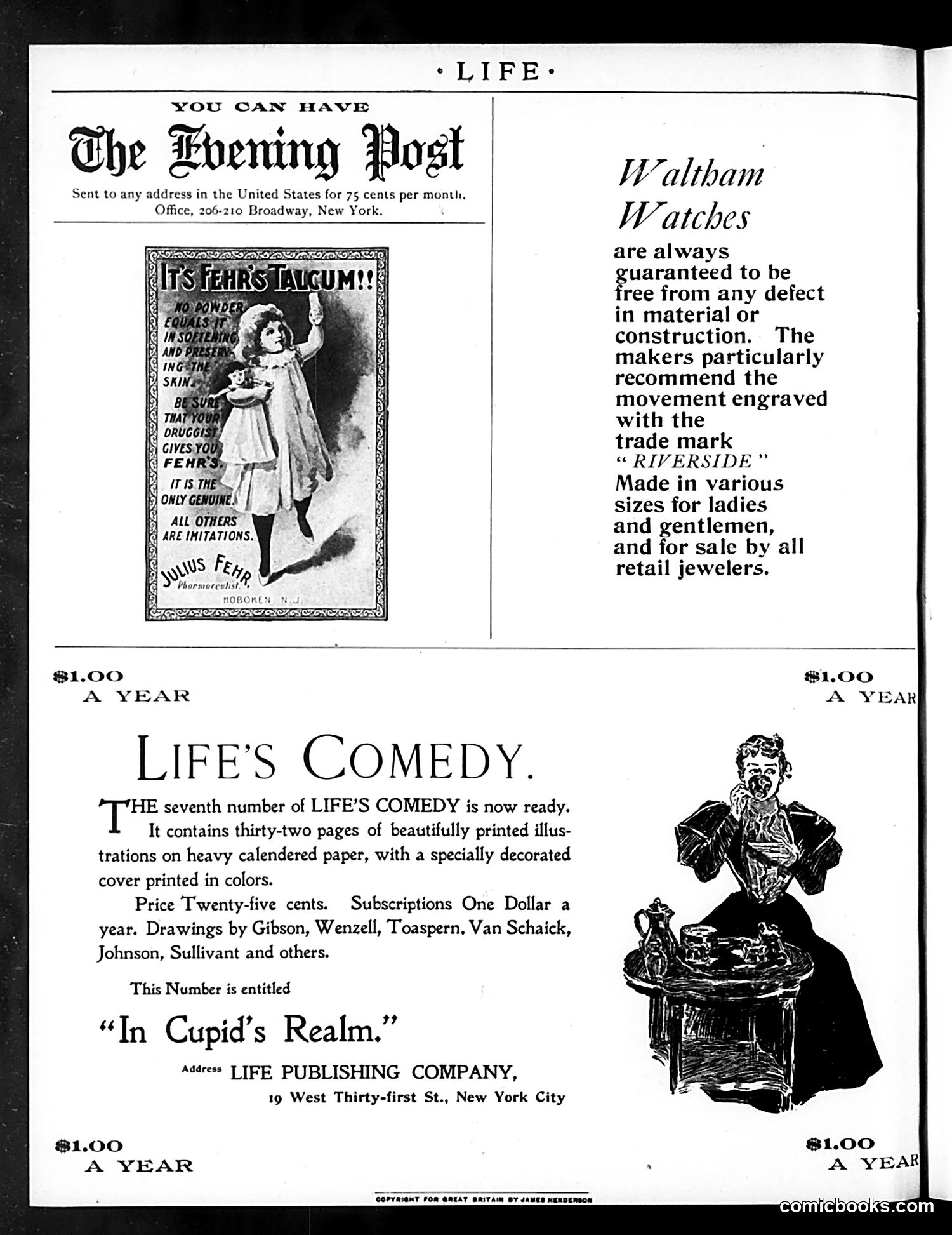
This page is primarily **advertising and promotional content** rather than political satire. It contains: 1. **Fehr's Talcum advertisement**: Shows a young child using talcum powder, claiming it's the "only genuine" product and that "all others are imitations." This reflects early 20th-century advertising practices making dubious quality claims. 2. **Waltham Watches ad**: Promotes their "Riverside" movement as defect-free, marketed to both ladies and gentlemen through retail jewelers. 3. **Life's Comedy promotion**: Announces the seventh issue of *Life* magazine's comedy section, priced at 25 cents, featuring illustrations by prominent artists of the era (Gibson, Wentzell, Toaspern, Van Schaick, Johnson, Sullivant). The page demonstrates typical magazine monetization through advertising rather than containing satirical content.
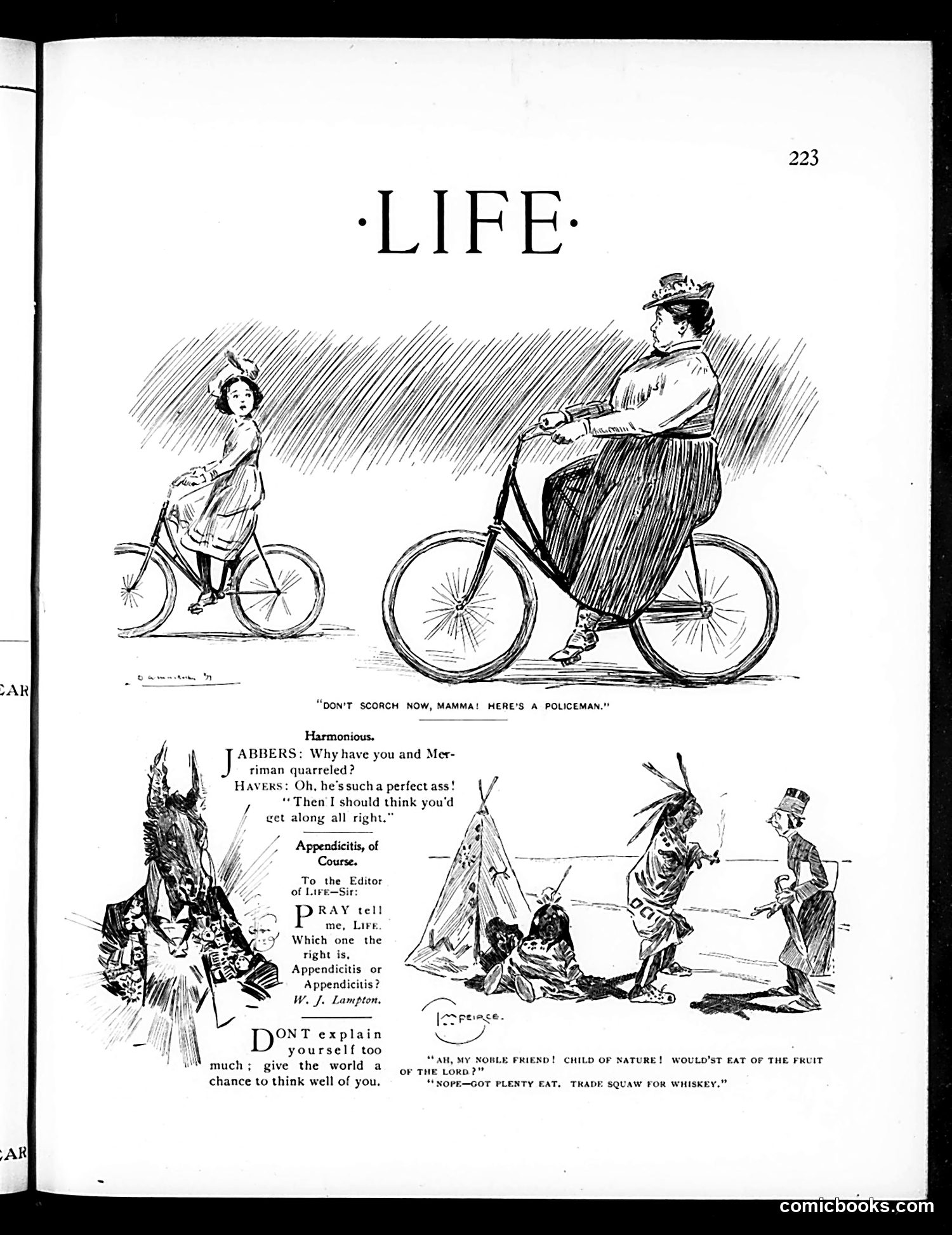
This page contains humor about bicycling—a popular leisure activity in the late 19th/early 20th century. The top cartoon shows a woman riding alongside a man on a bicycle, with the caption "Don't scorch now, mamma! Here's a policeman," referencing "scorching" (reckless fast riding) and police enforcement. Below are lighter sketches with dialogue about appendicitis versus appendicitis (likely a pun on a medical dispute), and a "Lorence" cartoon mocking overly romantic or affected behavior among bicyclists ("Ah, my noble friend! Child of nature! Would'st eat of the fruit of the lord?"). The humor trades on bicycles as both fashionable leisure items and subjects of social commentary about propriety, class, and modern behavior.
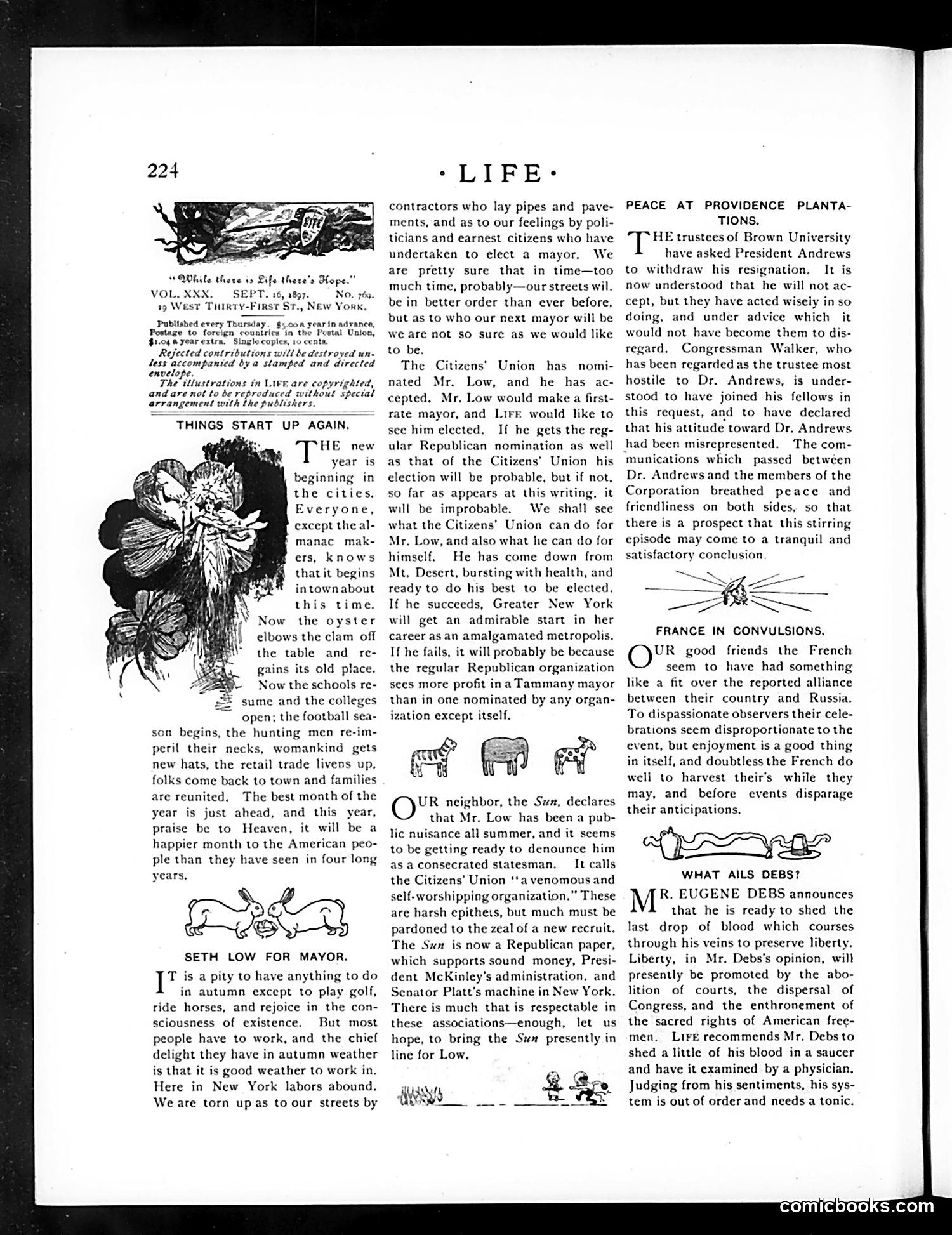
This page contains three satirical sections about New York politics and current events: **"Seth Low for Mayor"** discusses the mayoral election. Seth Low, nominated by the Citizens' Union, is portrayed as an outsider—someone who "doesn't play golf" but works hard. The satire mocks that New York's establishment prefers their politicians idle while ordinary people labor. **"Things Start Up Again"** celebrates autumn's return, when oyster season begins and hunting resumes—coded language for the leisure activities of wealthy New Yorkers. **"France in Convulsions"** references Franco-Russian alliance anxieties (likely related to the 1890s Dreyfus Affair tensions). **"What Ails Debs?"** critiques Eugene Debs's radical political platform, dismissing his calls for congressional reform and workers' rights as excessive radicalism requiring "a tonic." The cartoons use animals and crude illustrations typical of 1890s satirical journalism.
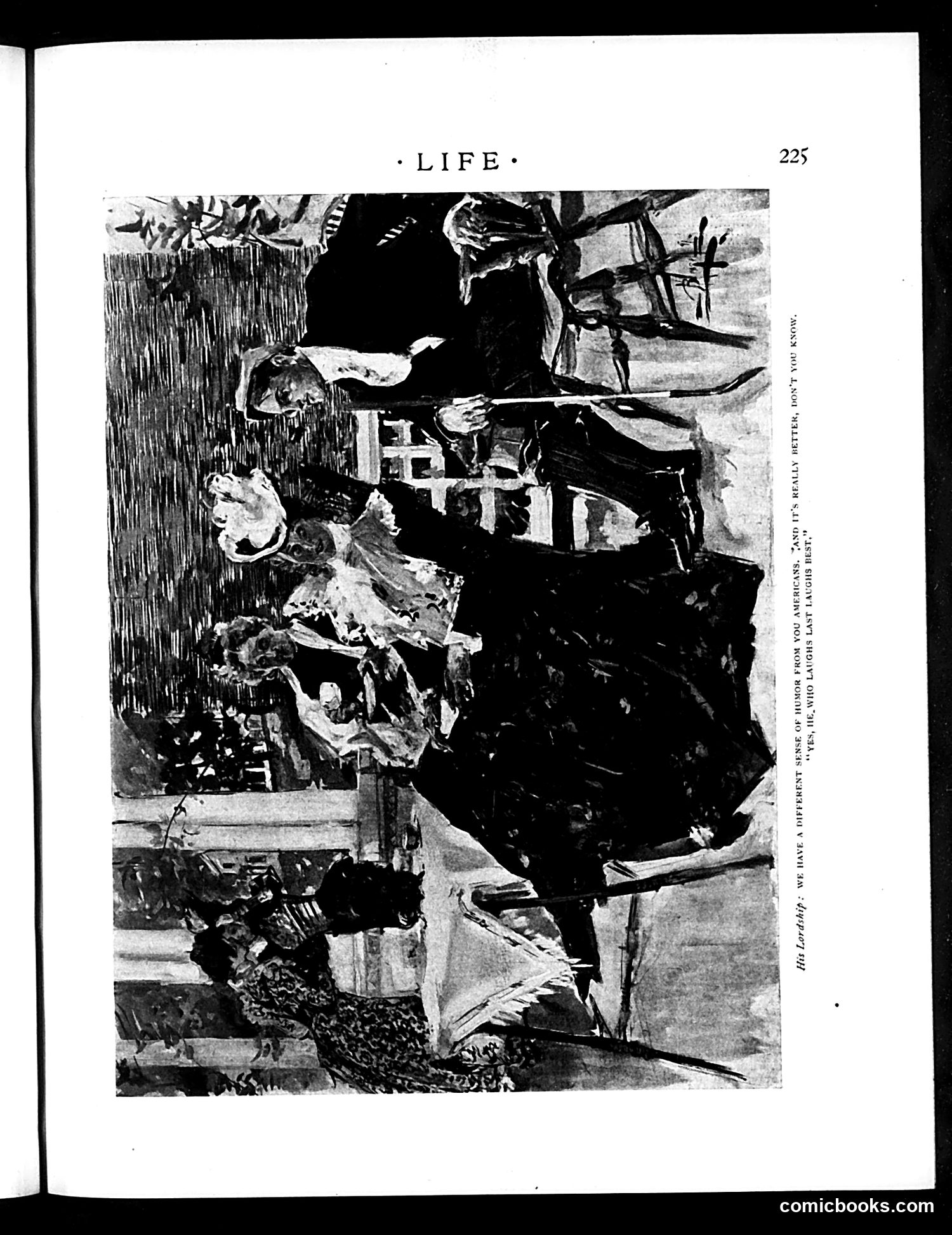
This page from *Life* magazine (page 225) contains a black-and-white illustration that appears to be rotated 90 degrees. The caption along the right margin reads: "BE EARLY — WE HAVE IMPORTANT NEWS. 'SMITH' IS READY AND WAITING." The image shows what appears to be a domestic or social scene with multiple figures, though the rotation and image quality make specific details difficult to discern with certainty. The reference to "Smith" and the emphasis on being "early" for "important news" suggests this is political or social satire, likely mocking a public figure or event, but without clearer visibility of the illustration or additional context, I cannot definitively identify which specific person or incident is being satirized.
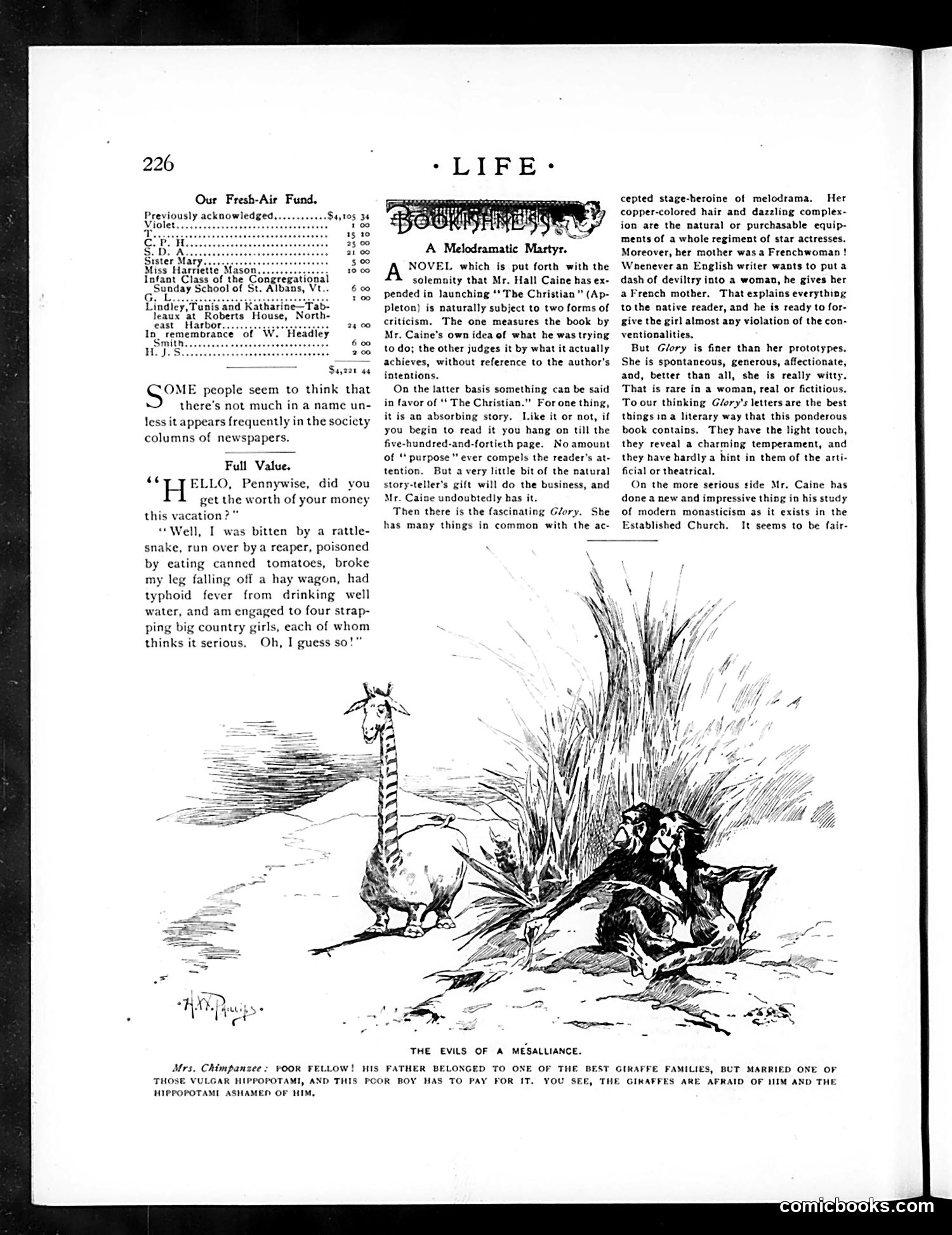
This cartoon satirizes interspecies marriage through a visual pun. A giraffe and a chimpanzee are depicted together, with the caption explaining that a giraffe from a "best" family married a chimp from "vulgar hippopotami," producing offspring feared by both species. The satire appears to target anxieties about **mismatched social unions**—a common theme in early 20th-century satirical magazines. The joke plays on Victorian-era concerns about "proper" marriages between families of different social standing. By using animals of different species, *Life* makes the concern about such unions absurd and ridiculous, mocking the snobbery that fueled these social prejudices. The caption's mock-serious tone reinforces this mockery of class-conscious attitudes.
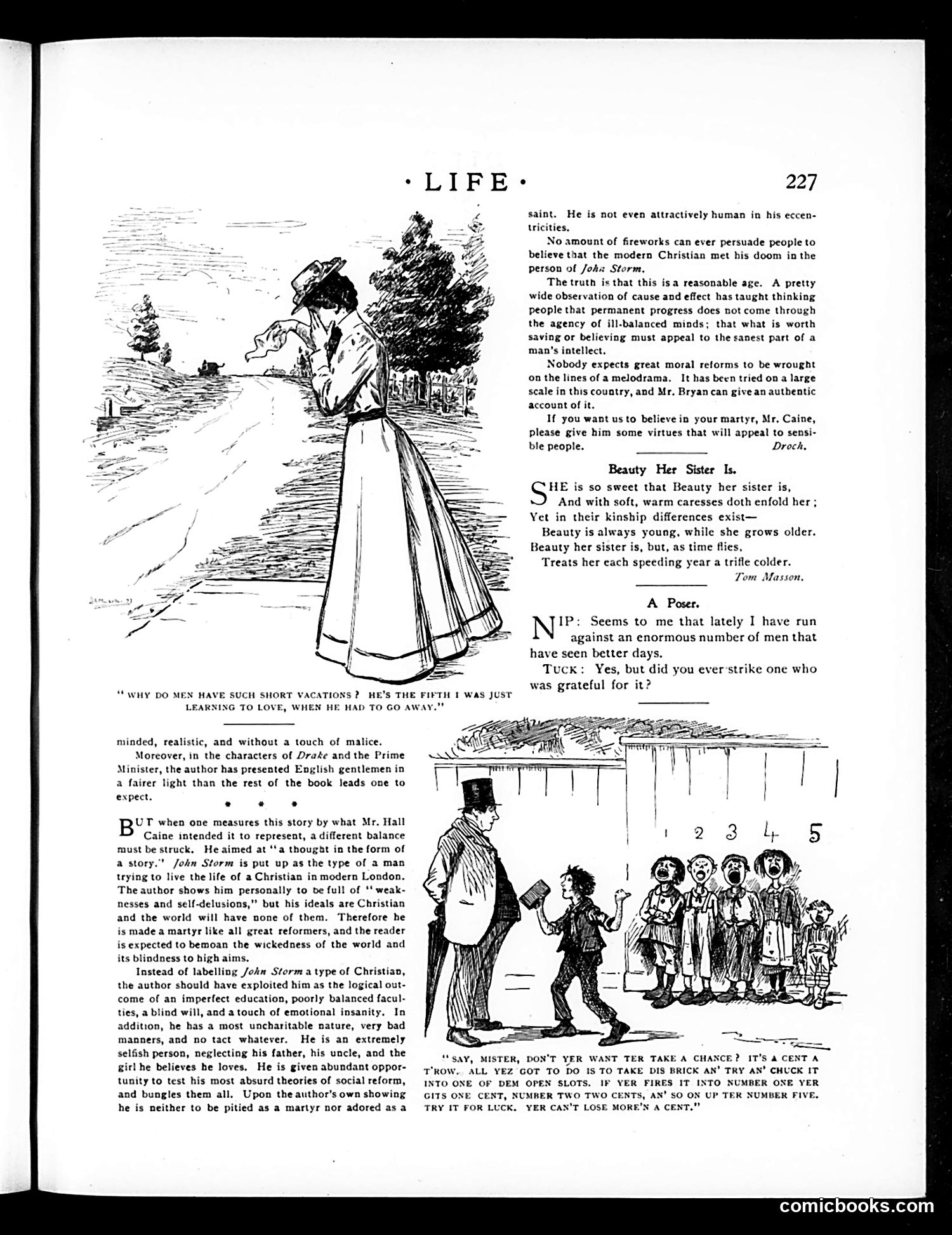
This page critiques a novel by Hall Caine titled *John Storm*. The text argues that Caine intended to depict a Christian living authentically in modern London, but instead created a character with "weaknesses and self-delusions" who lacks genuine Christian ideals. The reviewer criticizes the protagonist as poorly mannered, emotionally unstable, and self-righteous—hardly an inspiring moral example. The cartoon below satirizes working-class gambling, showing a man explaining a numbers-betting scheme to children, using crude probability language ("one cent, number two two cents"). The caption mocks the desperation of poor people seeking quick wealth through gambling rather than honest work—a common Progressive-era social criticism about urban vice and poverty.
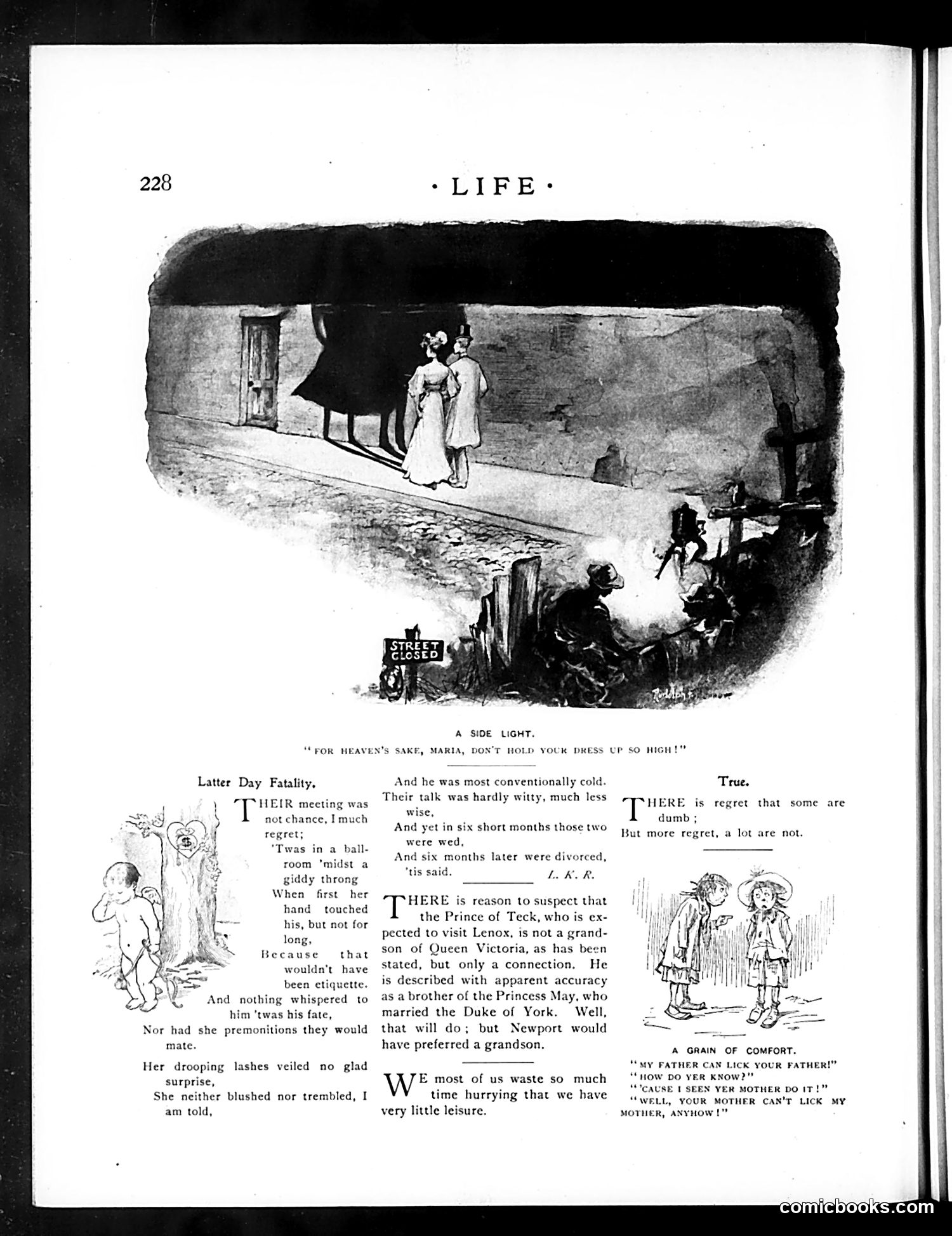
This page contains three separate satirical pieces: **Top cartoon ("A Side Light"):** A street scene where women in long dresses are warned about holding their skirts too high—likely mocking the ongoing debate about women's hemlines and propriety in early 20th-century fashion. **"Latter Day Fatality":** A poem about a couple who met by chance, married within six months, then divorced six months later. The satire targets the growing divorce rate and hasty marriages of the era, presented as a modern cautionary tale. **"True":** Brief text mocking the Prince of Teck's rumored visit to England, sarcastically noting he's merely a "connection" rather than grandson to Queen Victoria—poking fun at royal genealogy and social pretension. **"A Grain of Comfort":** A cartoon of children discussing whether their fathers can lick their fathers—crude humor typical of Life's comedic style.
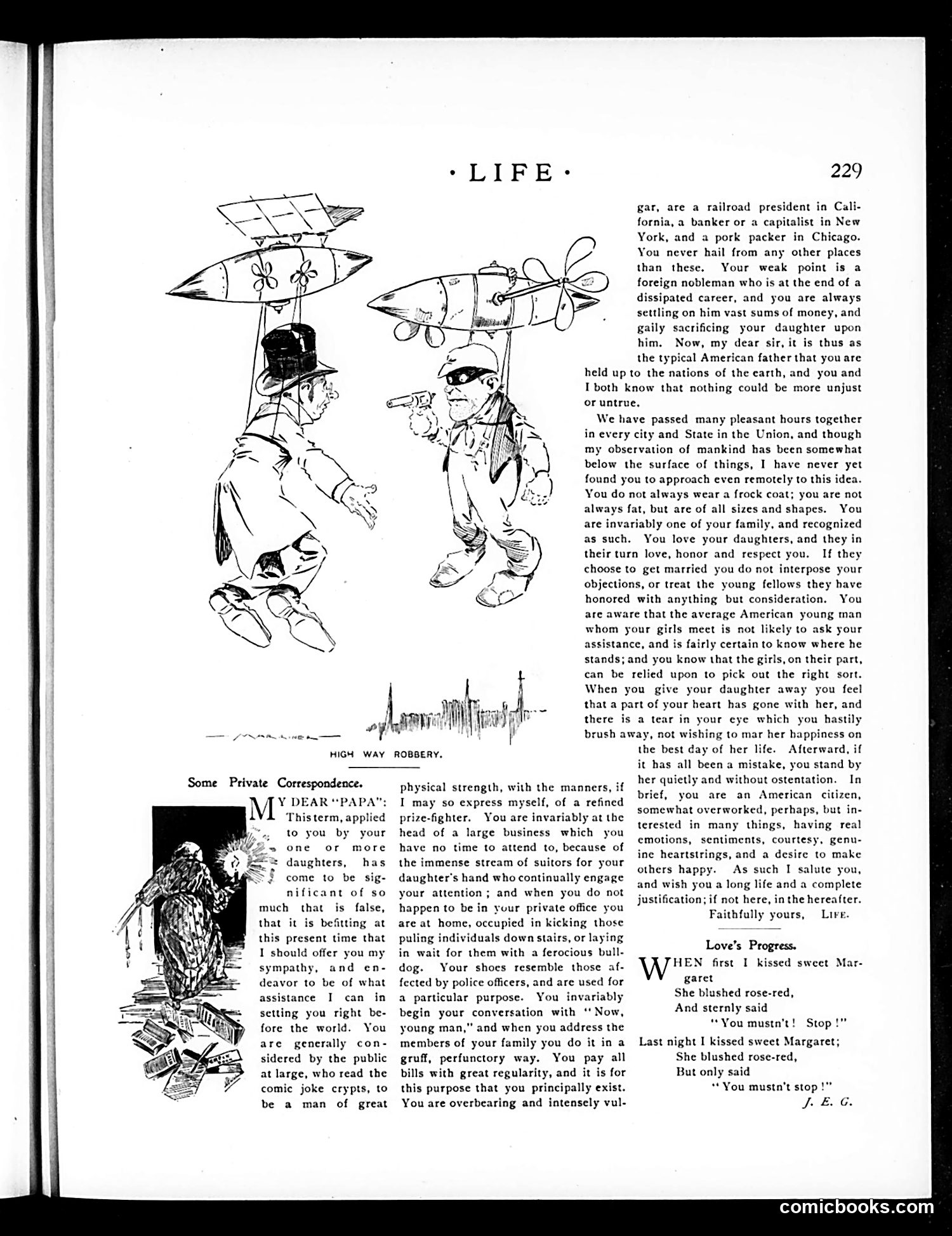
This cartoon depicts two figures suspended by mechanical flying contraptions labeled as "airships," dropping money into a collection basket below. The caption "HIGH WAY ROBBERY" is a pun—literally "high" way (in the sky) rather than traditional highway robbery. The satire criticizes wealthy American businessmen (likely railroad presidents, bankers, and capitalists mentioned in the adjacent text) as thieves who extract money from the public while appearing respectable. The absurd flying machines suggest the audacity and implausibility of their schemes. The accompanying text mocks these men's pretensions to respectability despite their predatory financial practices, critiquing how American industrial magnates of this era accumulated wealth through questionable means while maintaining public respectability.
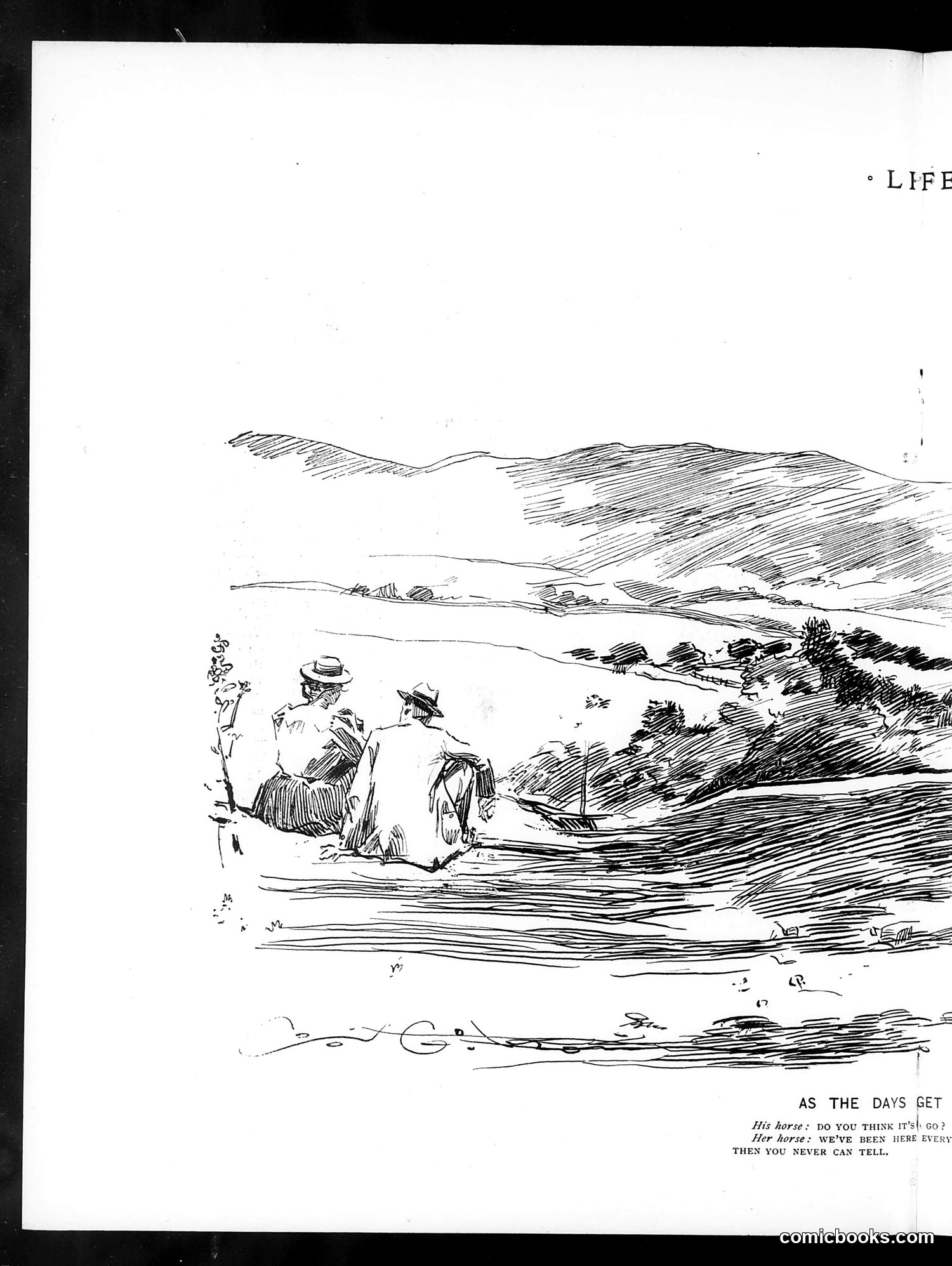
This is a sketch from Life magazine titled "As the Days Get" showing two figures in period dress (appearing to be late 19th/early 20th century based on clothing) standing in a rural landscape. The dialogue reads: **His horse:** "Do you think it's all go?" **Her horse:** "We've been here every day. Then you never can tell." The satire appears to target romantic courtship rituals—specifically the predictability of young couples' behavior. The joke suggests that despite the couple's apparent routine meetings in the same pastoral location, there's uncertainty about whether their relationship will progress ("it's all go"). By attributing the commentary to the horses rather than the couple, the cartoonist creates ironic distance, implying that even the animals recognize the stagnant repetitiveness of their romantic endeavors. The humor mocks both courtship conventions and the couple's lack of spontaneity.
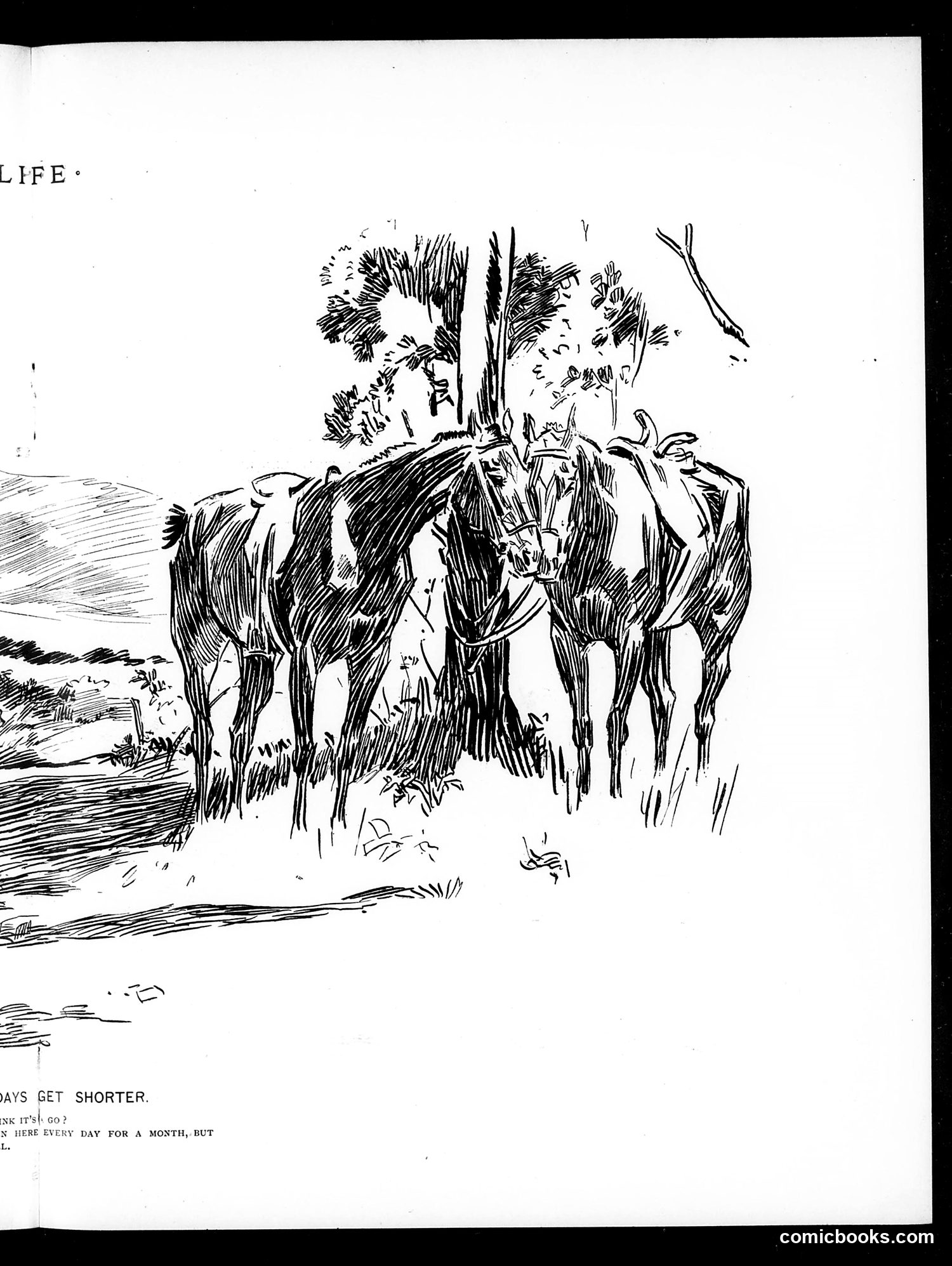
This page features a sketch-style illustration of three horses standing together, with trees in the background. The heading "LIFE" appears at top left. The visible text at bottom reads: "DAYS GET SHORTER" followed by partial text mentioning "ASK IT'S GO?" and "N HERE EVERY DAY FOR A MONTH, BUT" The incomplete OCR text makes the specific satirical point unclear. However, this appears to be a humorous observation about seasonal change (days getting shorter in autumn/winter) connected to some recurring activity or habit. The three horses may be symbolic figures or characters, but without complete text or additional context, I cannot definitively identify what social or political situation is being satirized. The fragmentary nature of the visible text limits interpretation.
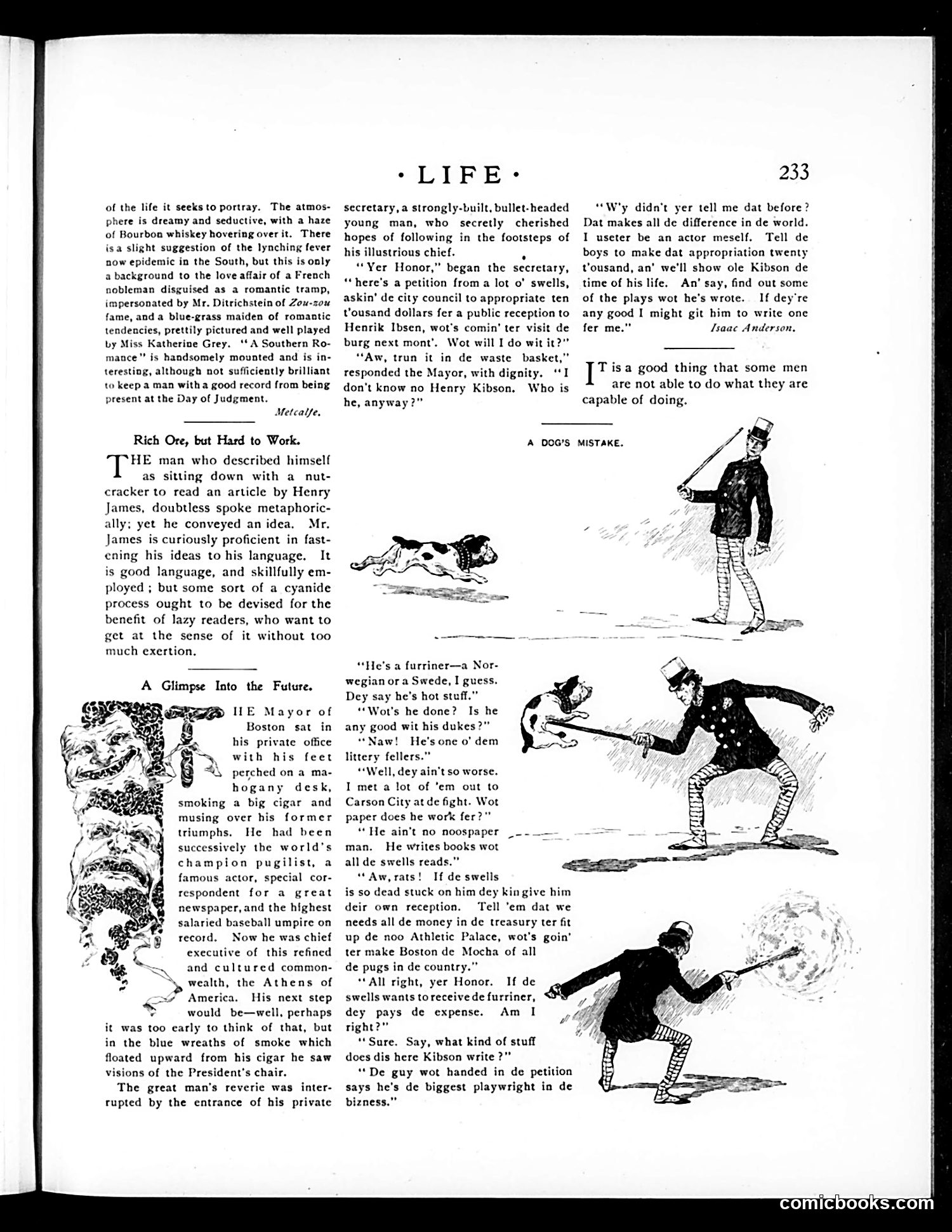
This page satirizes Boston's Mayor, imagined as a self-made man (former boxer, actor, journalist, baseball umpire) now wielding political power. The humor hinges on a deliberate name-confusion. **The Main Satire:** When the secretary requests funds to honor visiting playwright **Henrik Ibsen**, the Mayor dismissively refuses—claiming he doesn't know "Henry Kibson." Only when told Ibsen is a famous writer do the Mayor's interests spike; he now wants to fund the reception and potentially hire Ibsen as a playwright. **The Point:** The Mayor's sudden reversal mocks political opportunism and cultural snobbery. He initially dismisses Ibsen as nobody, then lavishes attention once learning he's celebrated by "swells" (wealthy elites). The comic misnaming—"Kibson" instead of Ibsen—emphasizes the Mayor's ignorance of the famous Norwegian dramatist. The surrounding text critiques Henry James's impenetrable prose style and reviews a theatrical production, fitting Life's focus on arts and culture commentary.
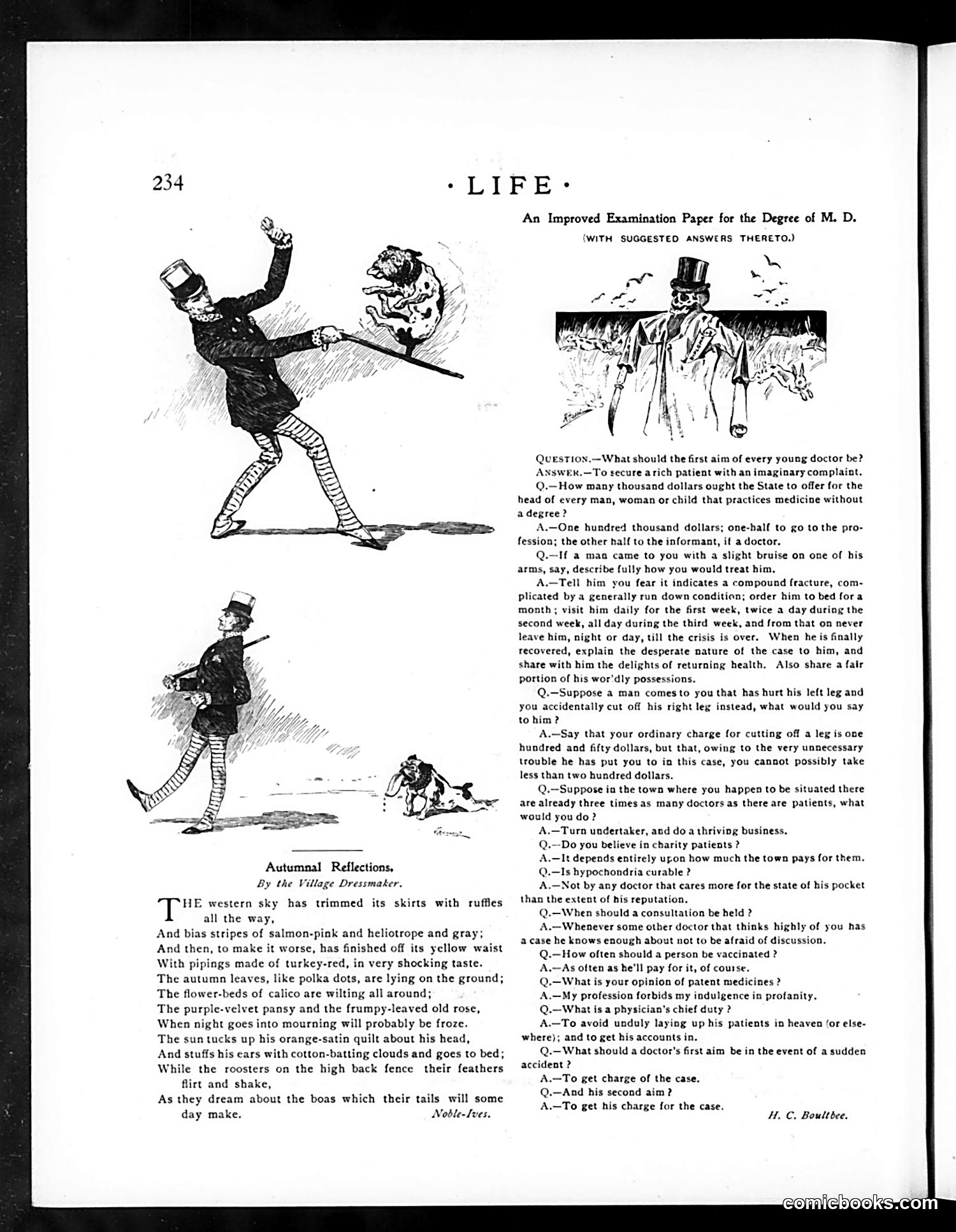
This 1890s Life magazine page contains two satirical pieces mocking American society. **"Autumnal Reflections"** is humorous verse by a village dressmaker who describes autumn using fashion terminology—the sky's "ruffles," "bias stripes," and "shocking taste" in color coordination. It's gentle humor treating nature as if it were a poorly coordinated outfit. **"An Improved Examination Paper for the Degree of M.D."** is sharp social satire attacking medical doctors as greedy fraudsters. The "exam questions with answers" mock physicians for: fabricating serious diagnoses for minor injuries to justify expensive house calls; overcharging patients; pursuing wealthy clients; practicing unnecessary medicine; and prioritizing profit over patient welfare. The darkest joke: if there are too many doctors competing, become an undertaker instead—implying doctors cause deaths. The cartoon figures appear to be doctors or medical practitioners engaged in exaggerated, undignified behavior, reinforcing the text's critique of medical ethics and greed in the profession.
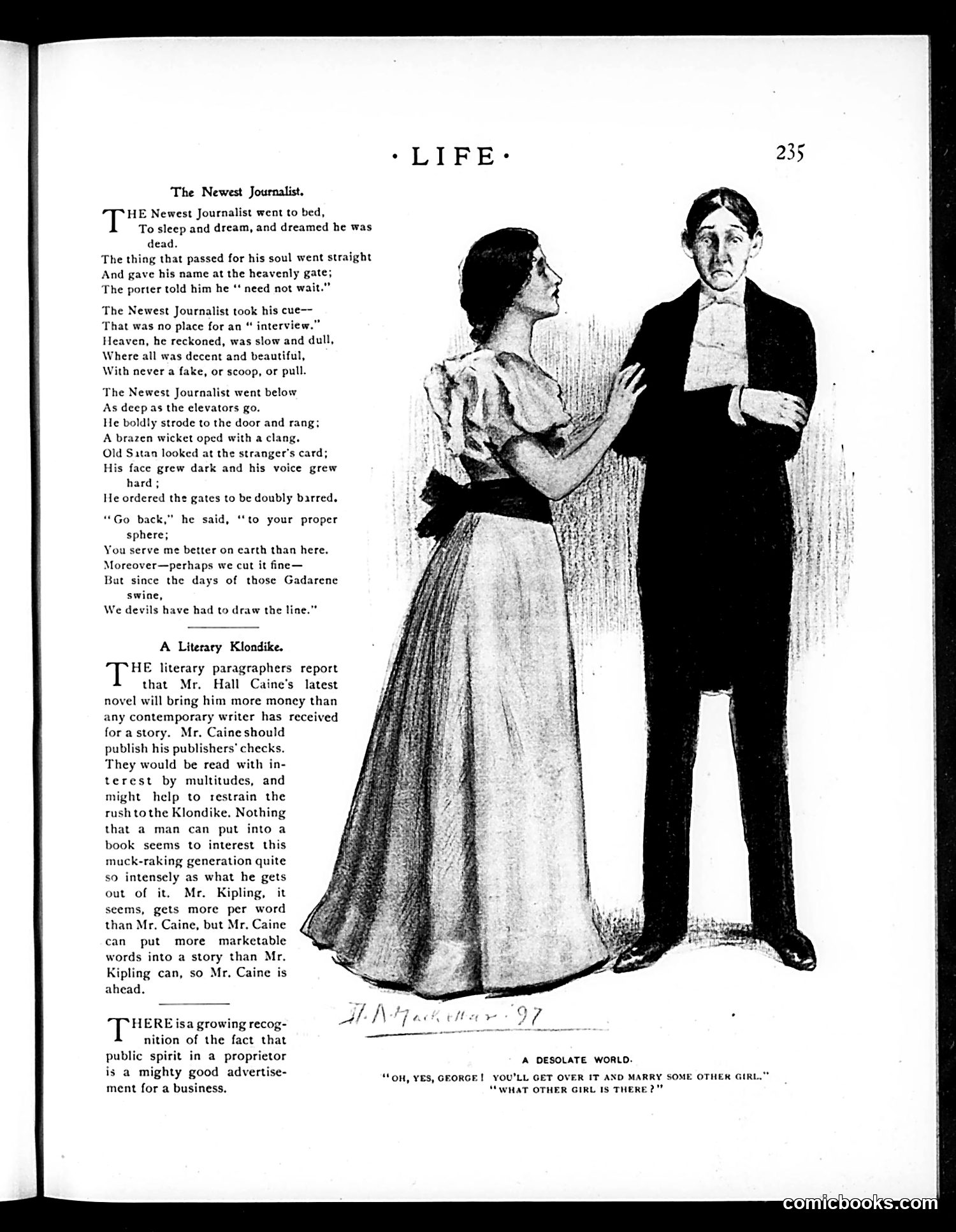
This page contains three satirical pieces mocking contemporary attitudes: **"The Newest Journalist"** (poem with illustration): A journalist dreams he's rejected from both Heaven and Hell. Satan himself bars the gates, saying the journalist serves evil better on Earth. The satire targets "yellow journalism"—the sensationalistic, unethical reporting practices of the era. Journalists are portrayed as so morally corrupt that even the Devil doesn't want them, preferring they remain on Earth spreading fakery and manipulation. **"A Literary Klondike"** (prose commentary): Mocks the public's obsession with money. It notes that Hall Caine's novel earnings generate more interest than the literary merit itself, comparing this to the Klondike gold rush mentality. The joke: people care only about authors' profits, not their art. **"A Desolate World"** (cartoon): Shows a woman and man in conversation; she dismisses his heartbreak cavalierly. The satire appears to target either romantic superficiality or changing social attitudes toward relationships—though the exact context is unclear from this page alone. All three pieces reflect fin-de-siècle cynicism about journalism ethics, commercial culture, and social values.
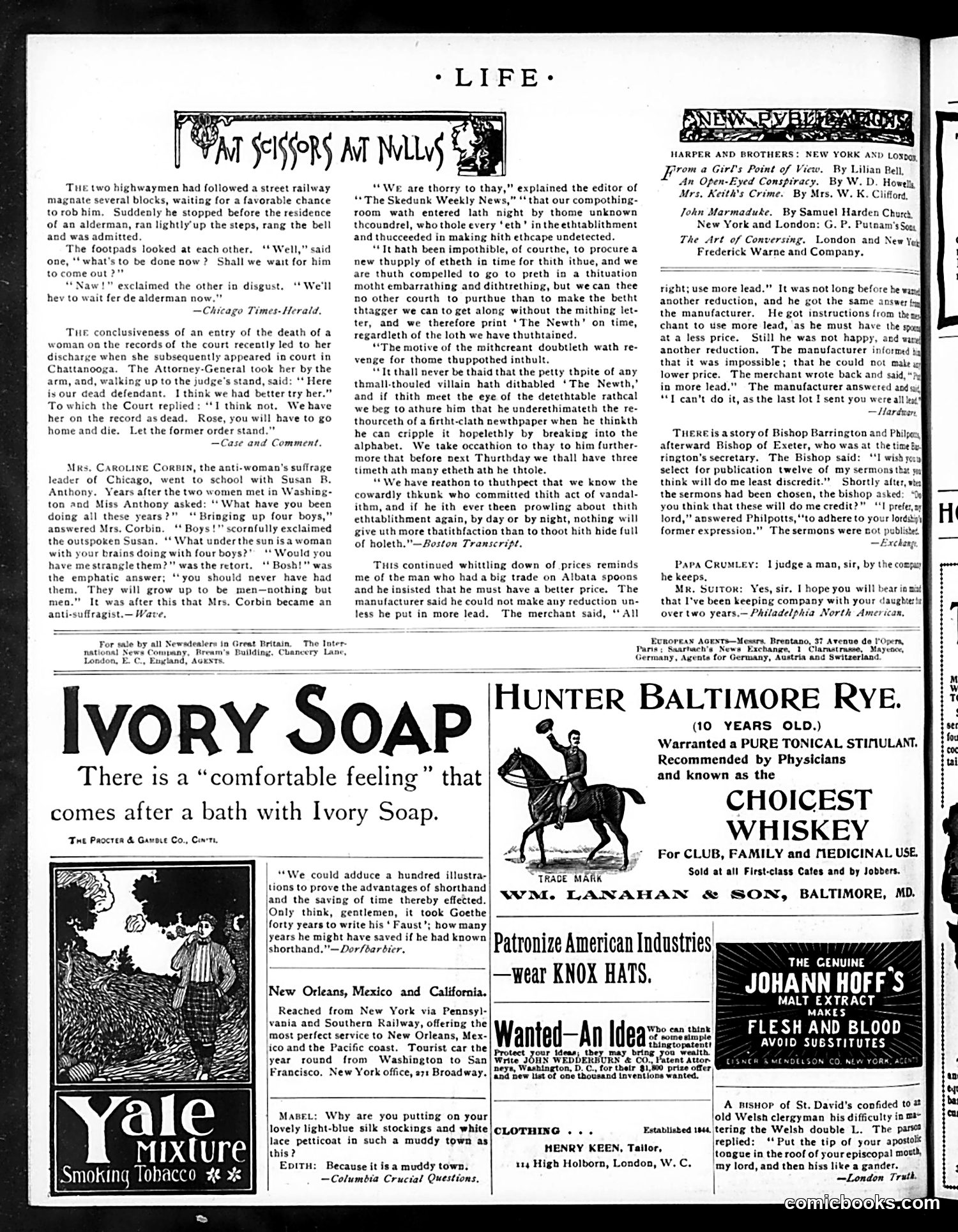
This page contains three satirical pieces typical of early 20th-century American humor: **"Scissors at Nullys"** (top): A joke about municipal corruption. Two highwaymen planning to rob a wealthy street railway magnate abandon the scheme after seeing him enter an alderman's residence, reasoning he'll be stripped of his valuables inside—implying aldermen were notorious for extorting bribes from businessmen. **The "Skedunk Weekly News" piece** (center): A printer's joke where thieves steal all the letter "S" from a newspaper's typeface, forcing them to print without it. The editor's entire response is written phonetically without S's ("thay" for "say"), creating comic chaos. This satirizes small-town newspapers and printer troubles. **The Susan B. Anthony anecdote** (bottom): Anti-suffragist Caroline Corbin's dismissal of women's rights, contrasted with Anthony's earlier witty retort about her domestic focus over intellectual pursuits. The page also contains period advertisements for Ivory Soap, tobacco, whiskey, and other products typical of the era's magazines.
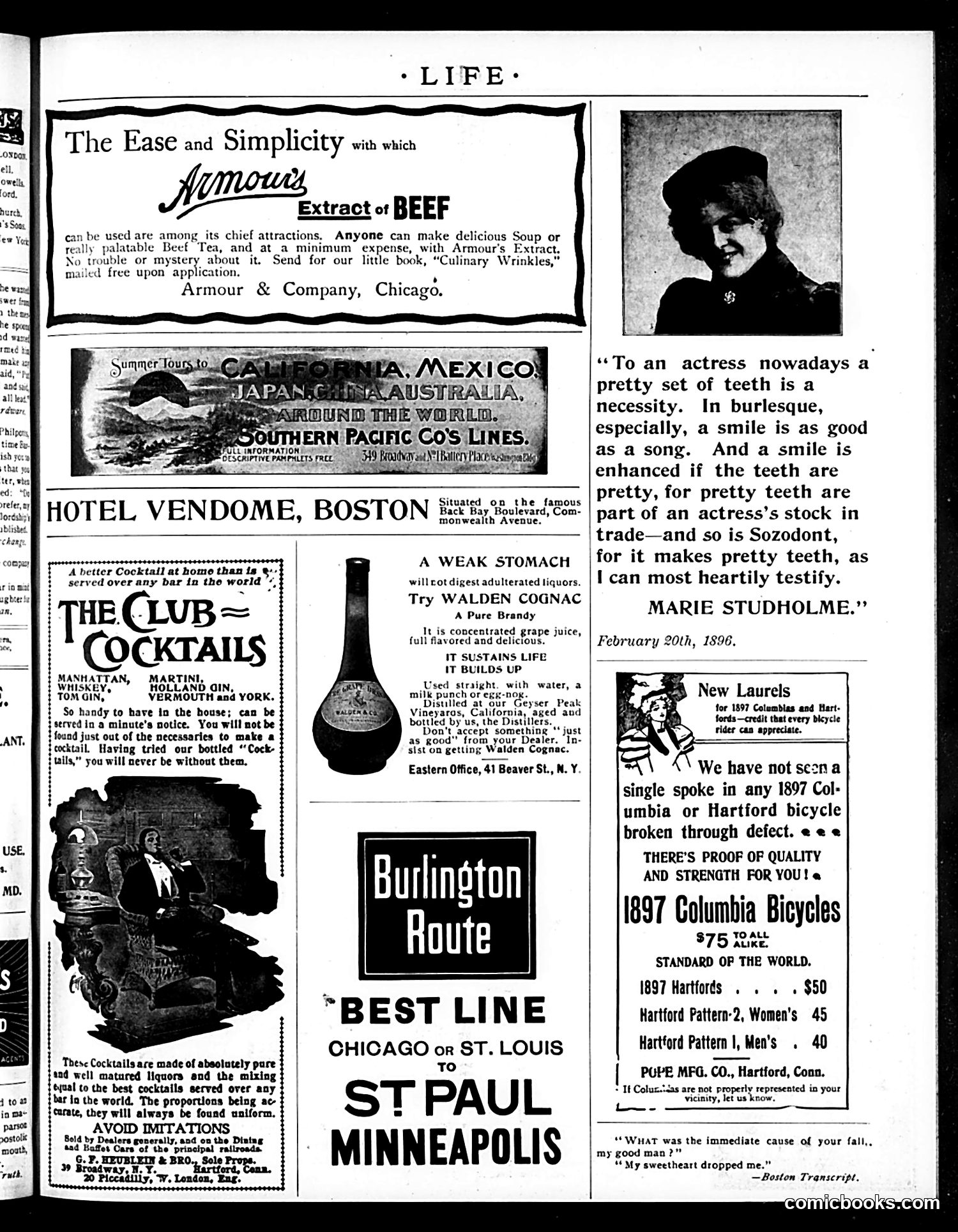
This page is primarily **advertising**, not satirical content. It showcases late-19th-century consumer products targeting middle and upper-class readers. Notable advertisements include: - **Armour's Beef Extract**: Promoted for easy soup-making at minimal cost - **Club Cocktails**: Pre-mixed spirits sold in bottles, marketed as convenient for home entertaining - **Walden Cognac**: Brandy advertised for digestive health - **Burlington Route**: Railroad service to St. Paul/Minneapolis - **1897 Columbia and Hartford Bicycles**: Boasting durability ("not a single spoke broken") The page includes a **testimonial** from actress **Marie Studholme** (dated February 20, 1896) endorsing Sozodont toothpaste, emphasizing that actresses need attractive teeth for professional success—reflecting period attitudes about women's appearance in entertainment. A small **joke** at bottom (Boston Transcript attribution) plays on "dropped" (romantic rejection versus physical falling). The content reflects Gilded Age consumer culture and emerging advertising techniques using celebrity endorsements.
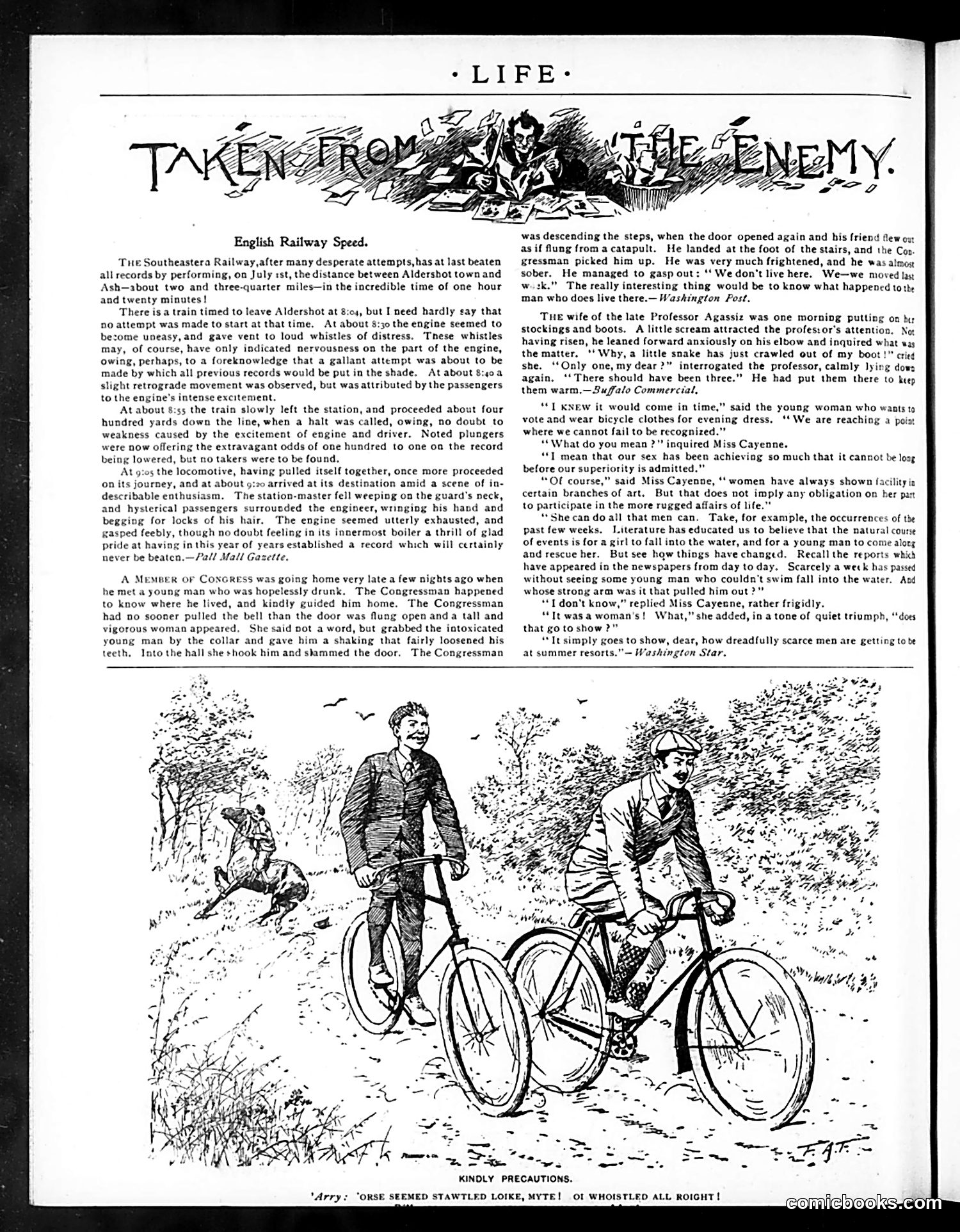
This page contains three satirical pieces mocking contemporary absurdities: **English Railway Speed**: The Southeastern Railway's supposed record—covering 2.75 miles in 80 minutes—is ridiculed. The satire describes the train's nervous "excitement," false starts, and eventual arrival as if it were a heroic achievement, when the speed is comically glacial. This mocks both railroad inefficiency and the tendency to celebrate mediocre progress. **Congressional Anecdote**: A congressman escorts a drunk man home, only to have the man violently ejected by a woman (presumably his wife). The joke turns when the man reveals they don't even live there—the congressman assisted the wrong person entirely, adding physical comedy to the congressman's misguided good deed. **Professor Agassiz Story**: A naturalist deliberately places snakes in his wife's boot "to keep them warm," treating this disturbing prank as casually scientific. The humor relies on absurdist domestic behavior and intellectual eccentricity. The bottom illustration shows cyclists on a rural path, captioned with a humorous dialogue about a startled horse.
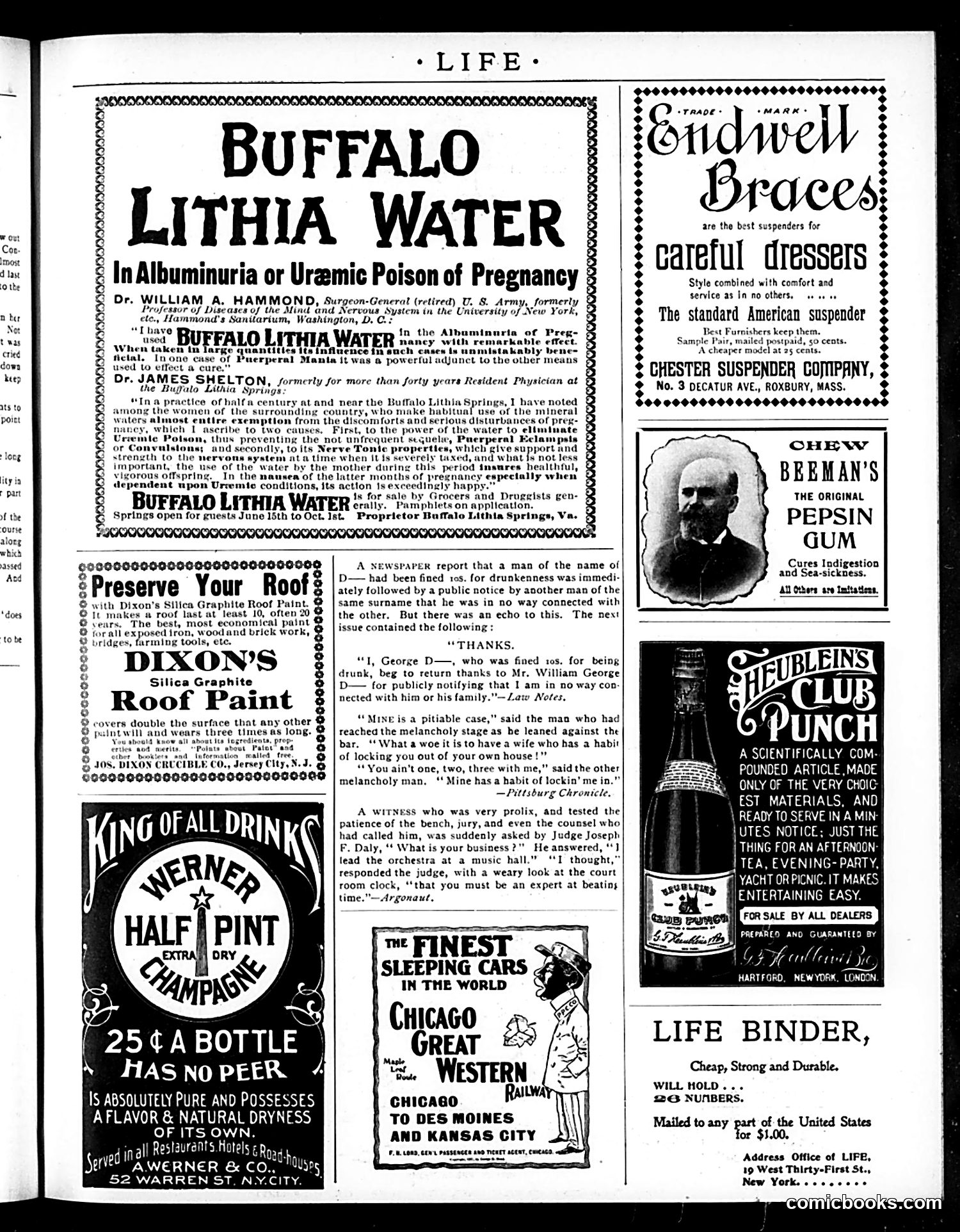
This page is almost entirely **advertisements**, not editorial content or cartoons. The dominant advertisers are: 1. **Buffalo Lithia Water** (top-left): A medical nostrum claiming to cure pregnancy complications ("Albuminuria or Uremic Poison of Pregnancy"). It cites testimonials from actual doctors and positions mineral water as a cure-all. 2. **Various consumer products**: Endwell Braces, Beeman's Pepsin Gum, Werner Half-Pint Champagne, Dixon's Roof Paint, Life Binder, and Heubleins Club Punch. 3. **Small anecdotal humor sections** (center): Brief, unrelated comic stories about cases of mistaken identity and complaints from henpecked husbands—typical Life magazine filler content. The page represents early-1900s advertising's credulous promotion of patent medicines and dubious health remedies. The Buffalo Lithia Water ad is particularly notable for its pseudoscientific claims backed by medical authority.
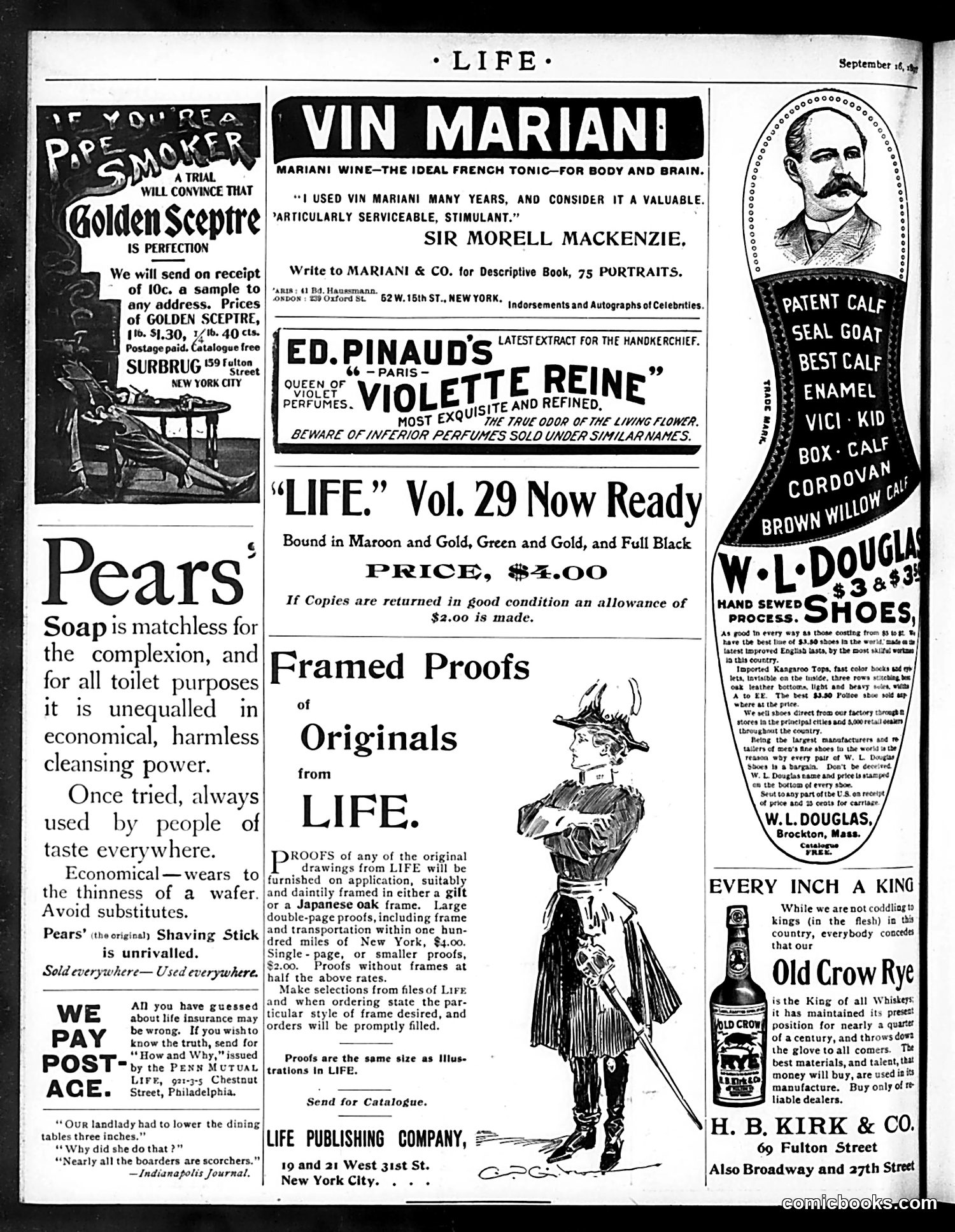
This is primarily an **advertising page** from Life magazine, Volume 29. The central content is a framed illustration of a fashionable woman in Victorian dress, used to advertise framed proofs of Life's original artwork. The page contains **no political cartoon or satire**—it's a commercial layout featuring advertisements for: - **Consumer products**: Pears' Soap, Golden Sceptre tobacco, Vin Mariani (a wine-based tonic), and Ed. Pinaud's perfume - **Life magazine subscriptions** ($4.00, bound in decorative covers) - **W.L. Douglas shoes**, Old Crow Rye whiskey, and H.B. Kirk & Company The single **joke** appears in a small sidebar: "Nearly all the boarders are scorchers"—a period reference to cyclists who rode recklessly, humorously explaining why a landlady lowered her dining tables. The page reflects **turn-of-century consumer culture** and advertising practices, with celebrity endorsements (Sir Morell Mackenzie for Vin Mariani) and emphasis on quality and style.