
Life, 1897-09-16 · page 14 of 20
Life — September 16, 1897 — page 14: what you’re looking at
What you’re looking at
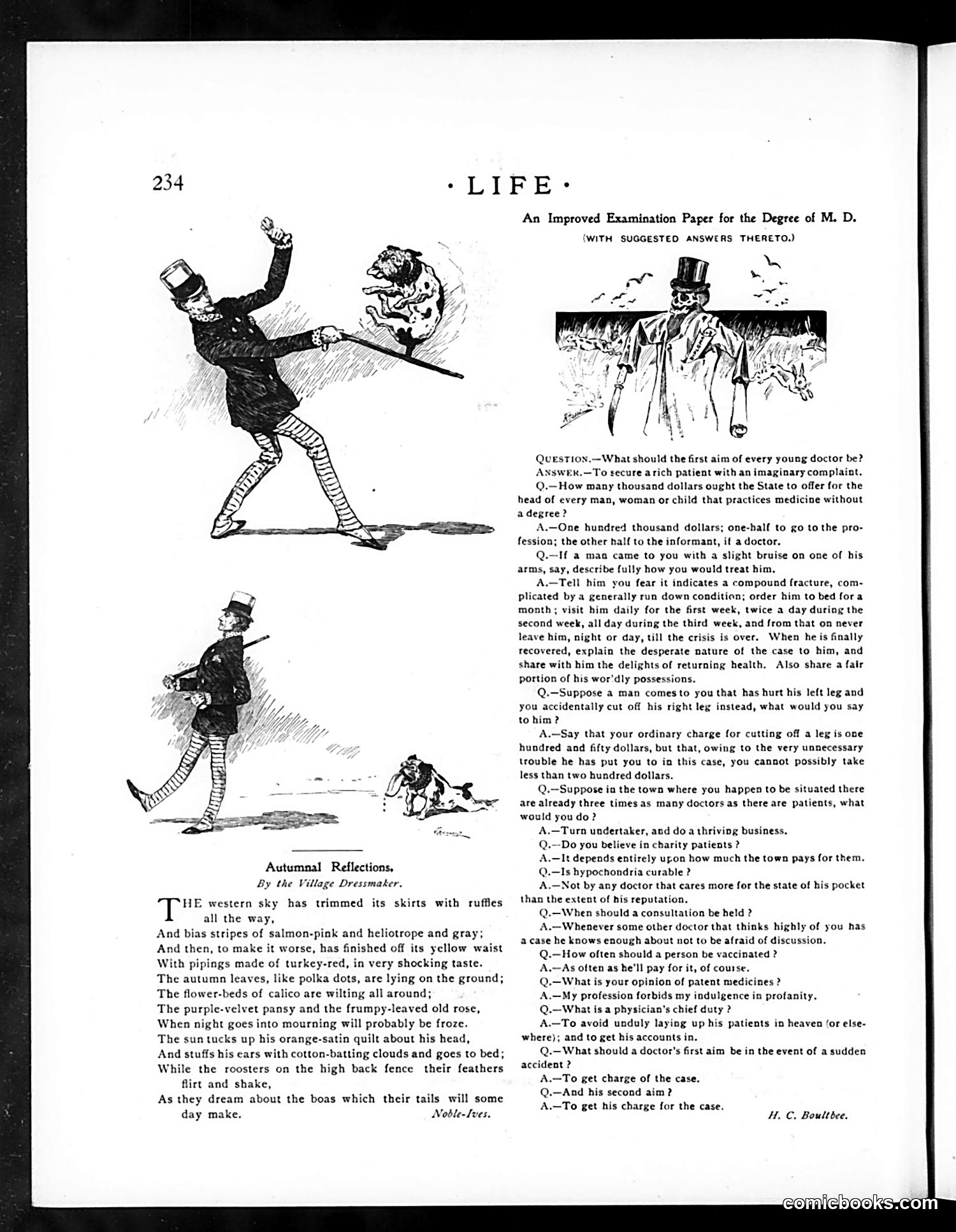
This 1890s Life magazine page contains two satirical pieces mocking American society. **"Autumnal Reflections"** is humorous verse by a village dressmaker who describes autumn using fashion terminology—the sky's "ruffles," "bias stripes," and "shocking taste" in color coordination. It's gentle humor treating nature as if it were a poorly coordinated outfit. **"An Improved Examination Paper for the Degree of M.D."** is sharp social satire attacking medical doctors as greedy fraudsters. The "exam questions with answers" mock physicians for: fabricating serious diagnoses for minor injuries to justify expensive house calls; overcharging patients; pursuing wealthy clients; practicing unnecessary medicine; and prioritizing profit over patient welfare. The darkest joke: if there are too many doctors competing, become an undertaker instead—implying doctors cause deaths. The cartoon figures appear to be doctors or medical practitioners engaged in exaggerated, undignified behavior, reinforcing the text's critique of medical ethics and greed in the profession.
📄 Transcribed text from this page (OCR, searchable)
Machine-transcribed from the original scan — historical spelling and the odd misread are preserved.
* LIFE: Autumnal Reflections, By the Village Dressmaker. TT" western sky has trimmed its skirts with ruffles all the way, And bias stripes of salmon-pink and heliotrope and gray; And then, to make it worse, has finished off its yellow waist With pipings made of turkey-red, in very shocking taste. The autumn leaves, like polka dots, are lying on the ground; The flower-beds of calico are wilting all around; The purple-velvet pansy and the frumpy-leaved old rose, When night goes into mourning will probably be froze. The sun tucks up his orange-satin quilt about his head, And stuffs his ears with cotton-batting clouds and goes to bed; While the roosters on the high back fence their feathers flirt and shake, As they dream about the boas which their tails will some day make. Noble-Tves. An Improved Examination Paper for the Degree of M. D. (WITH SUGGESTED ANSWERS THERETO.) Quvuestion.—What should the first aim of every young doctor be? ANsWEk.—To secure arich patient with an imaginary complaint. Q.—How many thousand dollars ought the State to offer for the head of every man, woman or child that practices medicine without a degree? A.—One hundred thousand dollars; one-half to go to the pro- fession; the other half to the informant, if a doctor. Q.—If a maa came to you with a slight bruise on one of his arms, say, describe fully how you would treat him, A.—Tell him you fear it indicates a compound fracture, com- plicated by a generally run down condition; order him to bed fora month ; visit him daily for the first week, twice a day during the second week, all day during the third week, and from that on never leave him, night or day, till the crisis is over. When hi finally recovered, explain the desperate nature of the case to him, and share with him the delights of returning health. Also share a fair portion of his wor'dly possessions. Q.—Suppose a man comes to you that has hurt his left leg and you accidentally cut off his right leg instead, what would you say to him? A.—Say that your ordinary charge for cutting off a leg is one hundred and fifty dollars, but that, owing to the very unnecessary trouble he has put you to in this case, you cannot possibly take less than two hundred dollars. Q.—Suppose ia the town where you happen to be situated there are already three times as many doctors as there are patients, what would you do? A.—Turn undertaker, and do a thriving business. Q.—Do you believe in charity patients ? A.—It depends entirely upon how much the town pays for them. Q.—Is hypochondria curable ? A.—Not by any doctor that cares more for the state of his pocket than the extent of his reputation, Q.—When should a consultation be held ? A.—Whenever some other doctor that thinks highly of you has a case he knows enough about not to be afraid of discussion. Q.—How often should a person be vaccinated ? A.—As often as he'll pay for it, of course. Q.—What is your opinion of patent medicines ? A.—My profession forbids my indulgence in profanity. Q.—What isa physician's chief duty ? A.—To avoid unduly laying up his patients in heaven for else- where); and to get his accounts in. Q.—What should a doctor's first aim be in the event of a sudden accident ? A.—To get charge of the case. Q.—And his second aim? A.—To get his charge for the case. H. C. Boultbee.