
A complete issue · 20 pages · 1897
Life — September 2, 1897
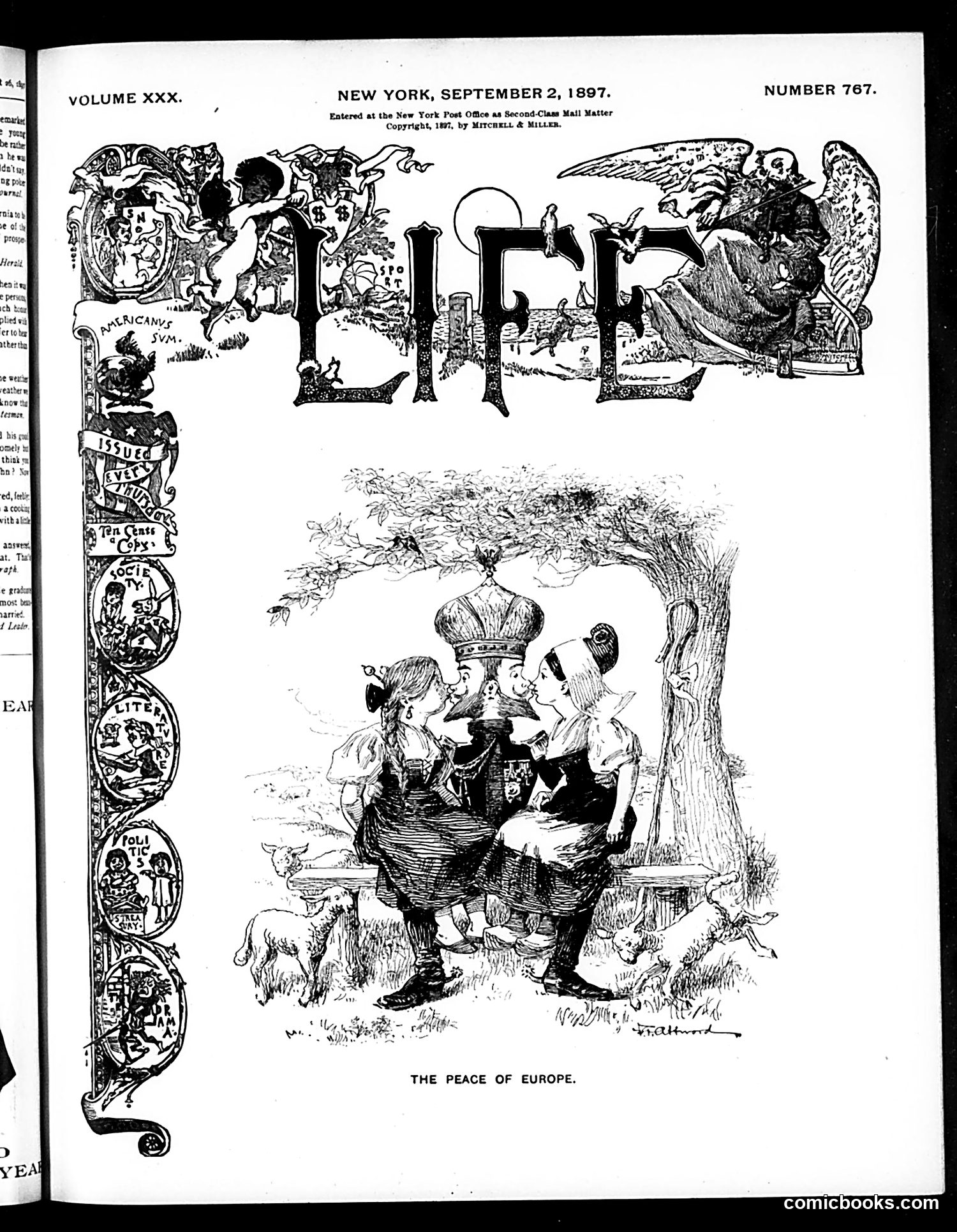
This cartoon satirizes European political tensions through an allegorical scene. Two figures in traditional dress (likely representing European nations or powers) sit beneath a tree, appearing to negotiate or share an urn labeled with a crown—possibly representing territorial disputes or power-sharing agreements. A small dog or animal sits nearby. The title "The Peace of Europe" is ironic; the cramped positioning and need for a mediating vessel suggests fragile, uncomfortable coexistence rather than genuine harmony. The ornate left border, typical of Life's decorative style, contains small emblematic scenes. The cartoon reflects late-19th-century anxieties about European geopolitical instability—a period of imperial competition and alliance-building that would eventually lead to World War I.
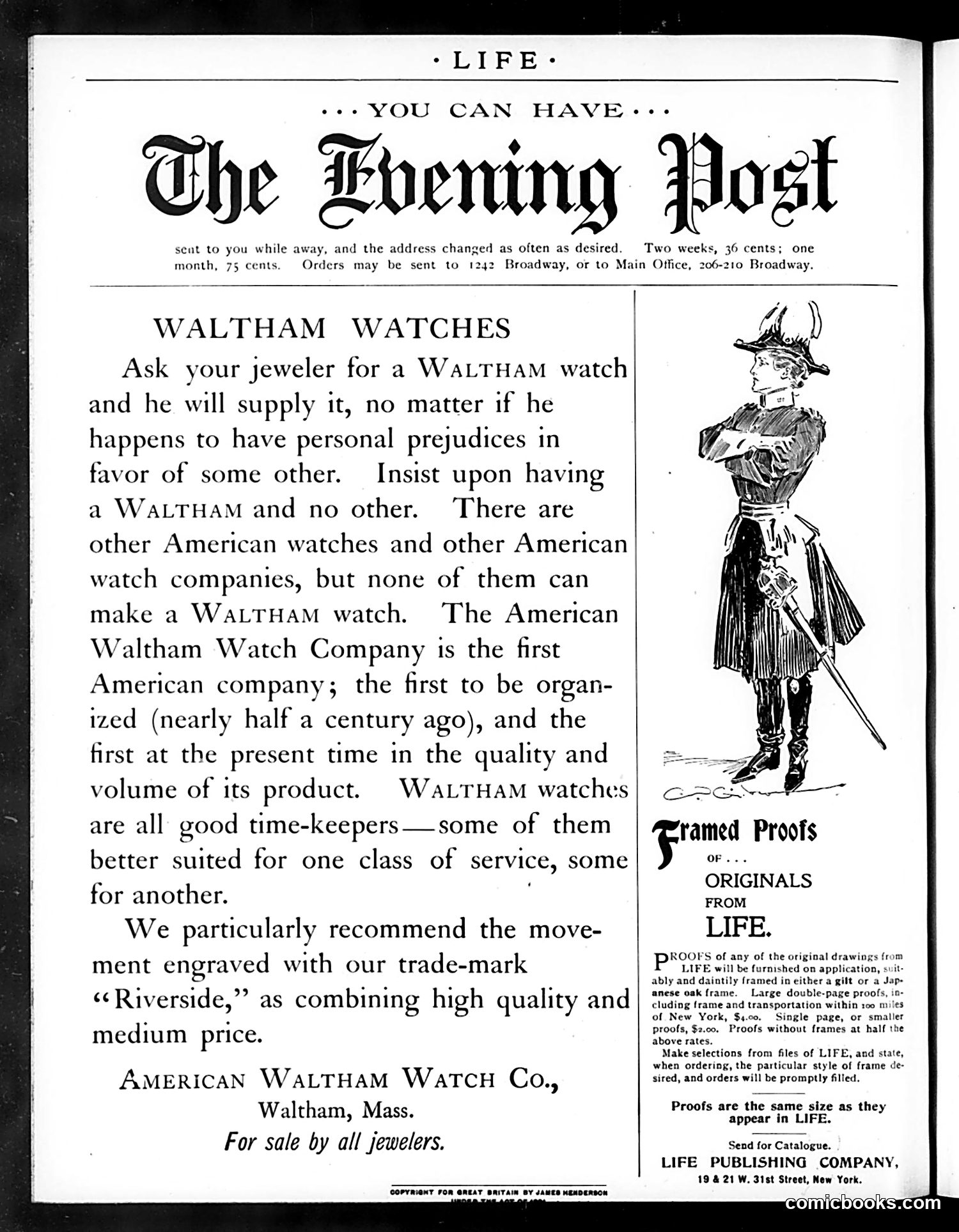
This page is **primarily advertising**, not satire or political commentary. The left side contains a Waltham Watch Company advertisement promoting their timepieces, emphasizing they're "the first American company" organized for watch production and recommending their "Riverside" model as combining quality with affordability. The right side features an illustration of a figure in ornate military dress with a plumed hat and sword, labeled "Framed Proofs of Originals from Life." This appears to be promotional material offering readers the ability to purchase framed reproductions of drawings published in Life magazine, available through the Life Publishing Company in New York. The page represents typical early 20th-century magazine content: commercial advertisements interspersed with house promotion of the publication's merchandise.
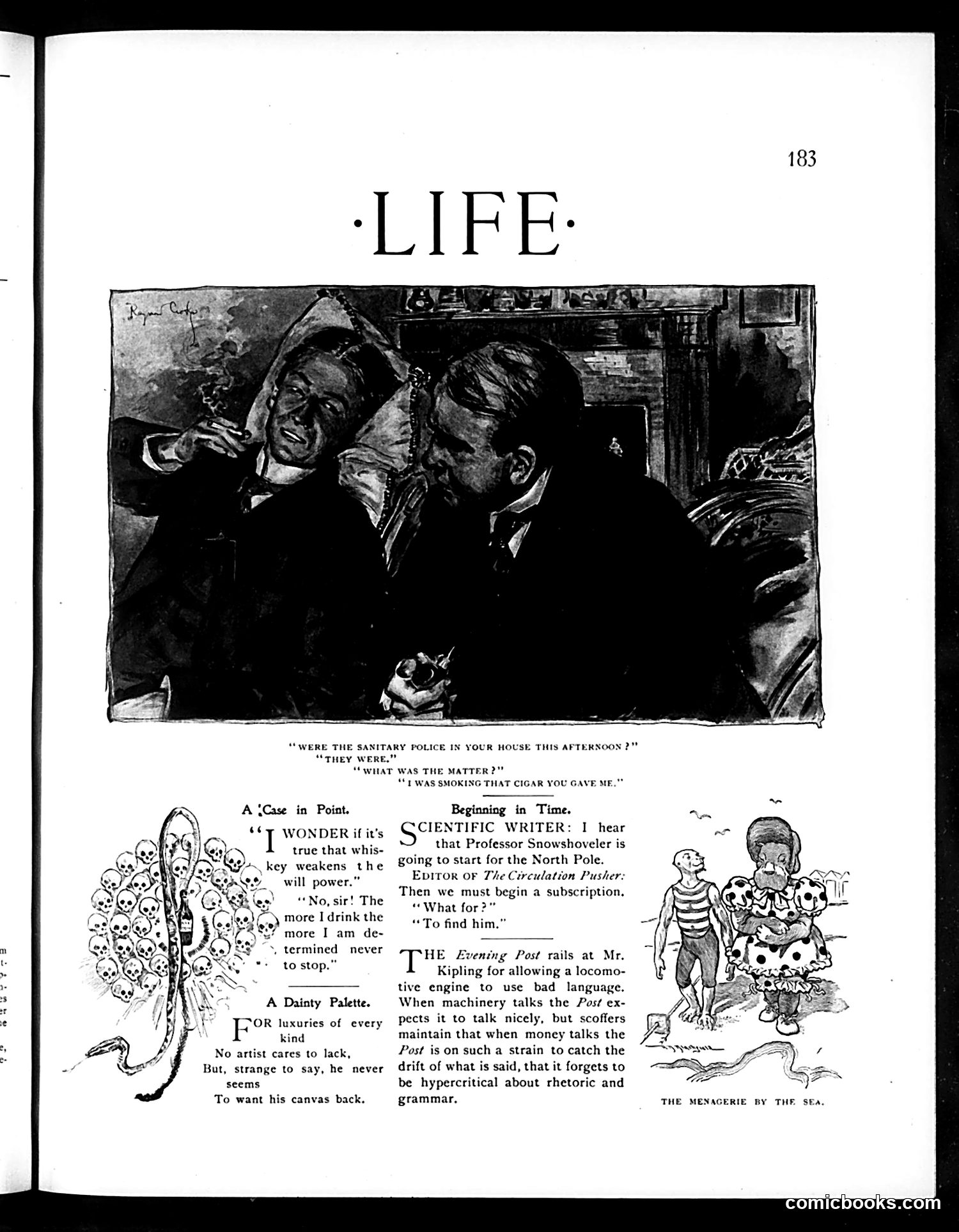
**Main Cartoon (top):** Shows two men confronting a third about smoking a cigar indoors. The caption reveals social friction over personal habits—one man claims the sanitary police visited due to the cigar smoke, suggesting early 20th-century public health concerns about indoor smoking and ventilation. **"A Case in Point":** A brief joke about whiskey weakening willpower, playing on temperance movement anxieties of the era. **"A Dainty Palette":** Satirizes artists' complaints about lacking luxuries while paradoxically needing expensive canvas—poking fun at bohemian pretensions. **"Beginning in Time":** References Professor Snowshoveler's Arctic expedition and the *Evening Post*'s locomotive engine using "bad language"—whimsical social commentary typical of Life's satirical humor targeting contemporary institutions and behaviors.
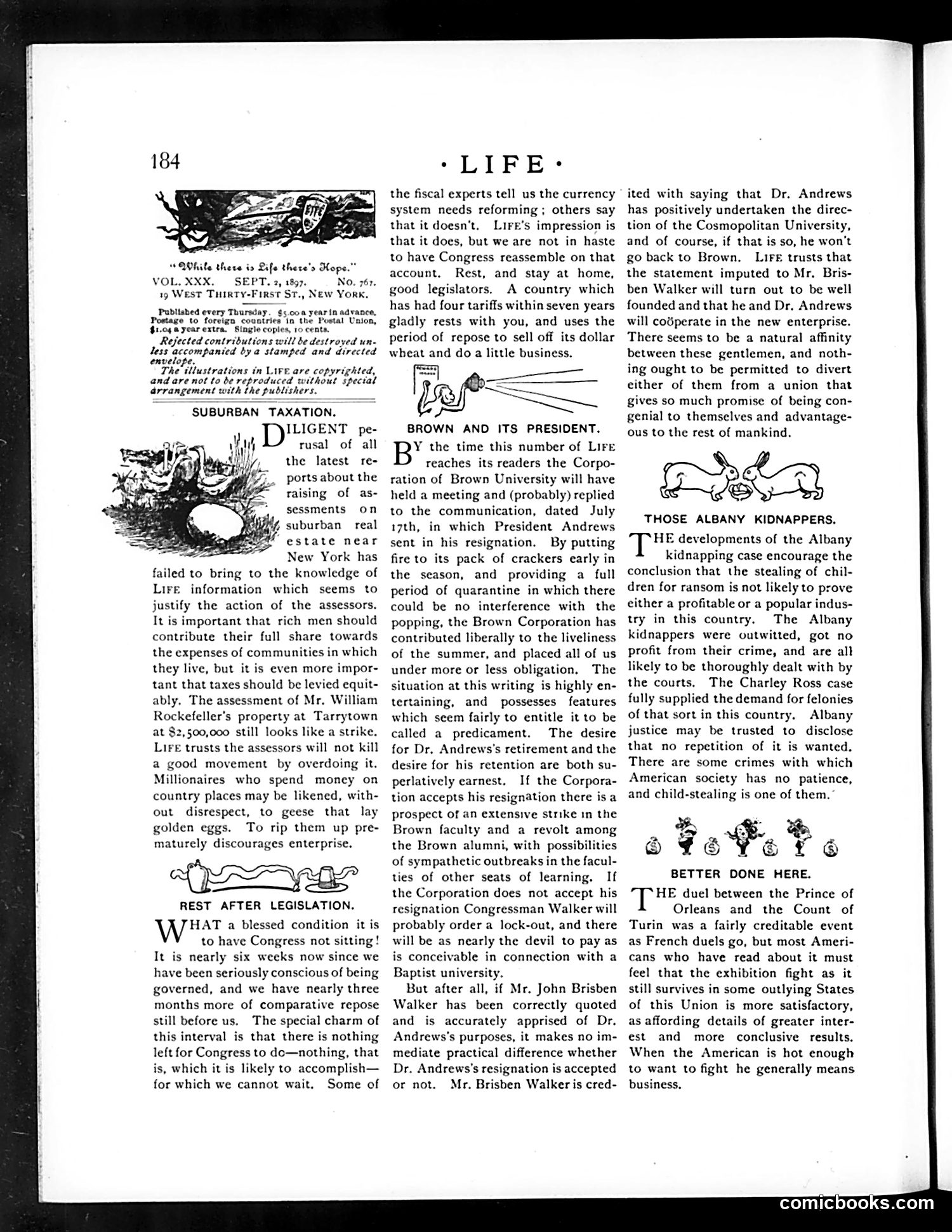
This page contains three editorial sections with accompanying illustrations: 1. **"Rest After Legislation"**: Celebrates Congress's recess, praising the break from governance as beneficial for the nation and enterprise. 2. **"Brown and Its President"**: Discusses Brown University's president Dr. Andrews and anticipated resignation. The text suggests internal conflict, possibly regarding faculty strikes or administrative disputes, with reference to Congressman Brisben Walker. 3. **"Those Albany Kidnappers"** and **"Better Done Here"**: Comment on kidnapping cases in Albany and a duel between the Prince of Orleans and the Count of Turin, suggesting American justice systems handle crime better than European aristocratic violence. The cartoons appear decorative rather than sharply satirical, using animal illustrations as section dividers typical of *Life*'s visual style.
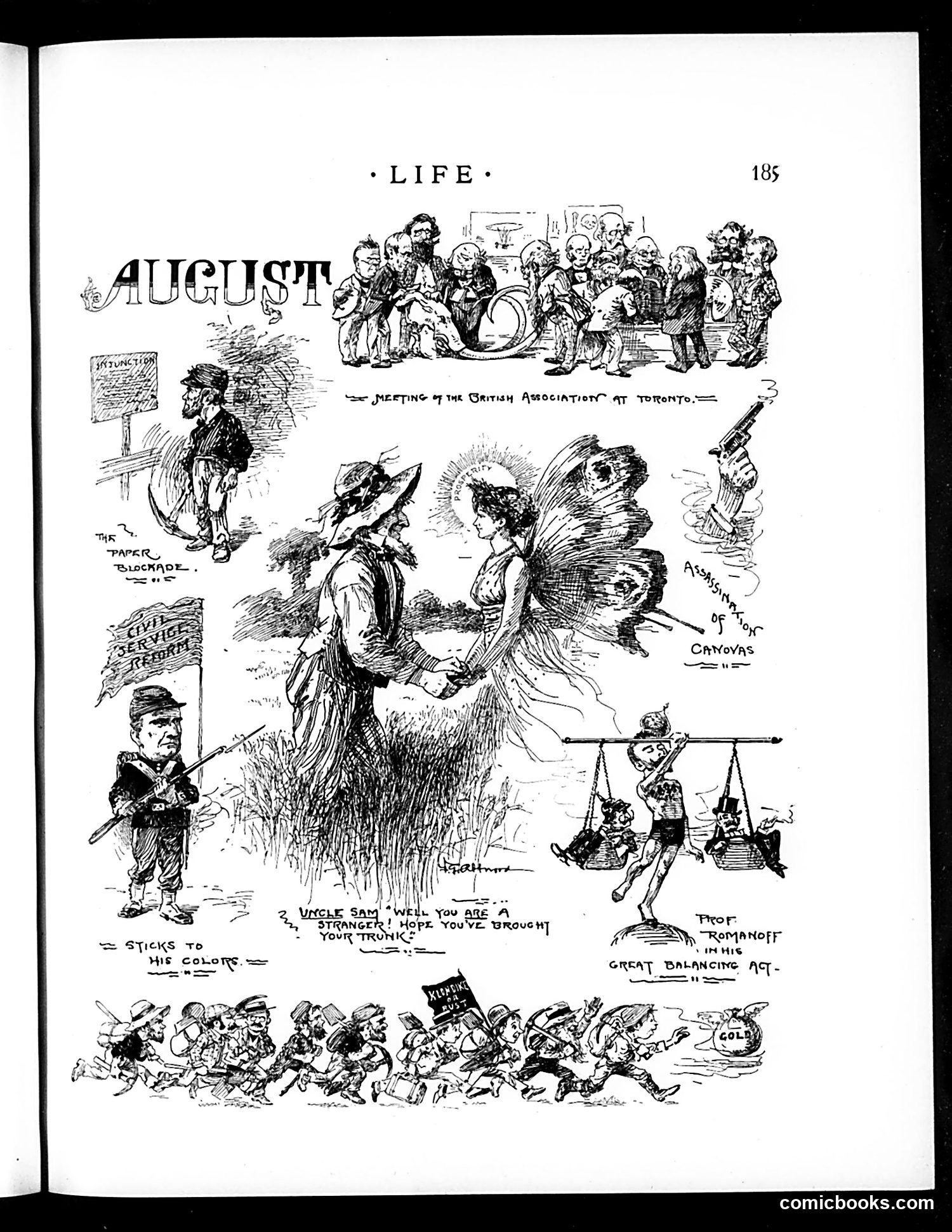
This page satirizes a **Meeting of the British Association at Toronto** (visible in the header illustration). The cartoons mock various political and social figures of the era through exaggerated caricature. Key scenes include: - **"The Paper Blockade"** - appears to reference trade or political disputes - **"Civil Service Reform"** - critiques government bureaucracy - **"Uncle Sam"** speaking to a stranger about bringing "your tronics" - likely American political commentary - **"Prof. Romanoff in his Great Balancing Act"** - mocks a performer or politician attempting precarious political balance - **"Assassination of Cannibal"** - unclear reference requiring additional context The bottom panel shows chaotic crowd scenes, typical of Life's satirical style. The exact political context and identified figures would require knowledge of late 19th-century Canadian and American politics.
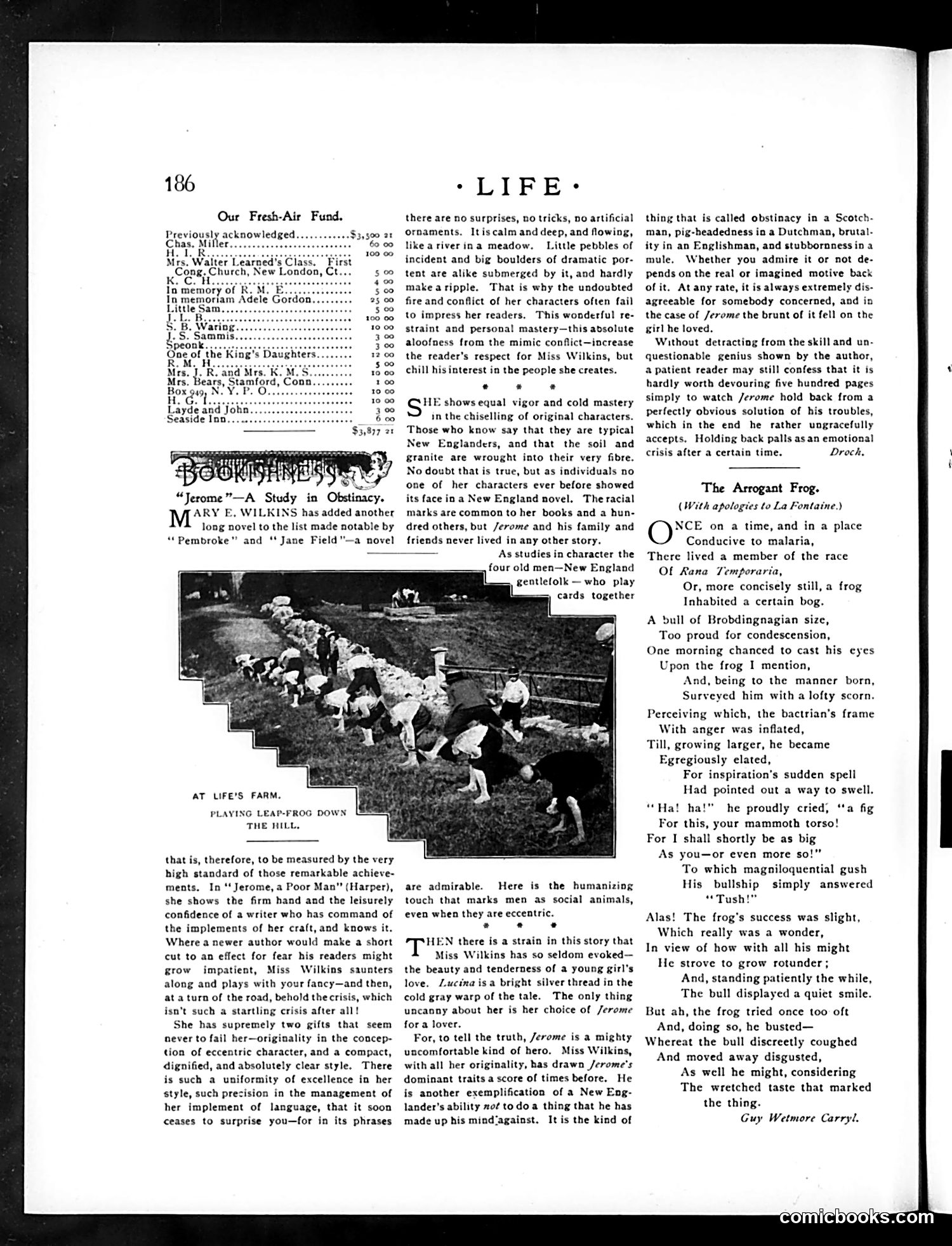
This page from *Life* magazine contains two distinct sections: **Left side**: A book review of Mary E. Wilkins's novel *Jerome*, praising her skill at characterization. The accompanying photograph shows children playing "leap-frog down the hill" at Life's Farm—a rural retreat, not political content. **Right side**: "The Arrogant Frog," a poem with La Fontaine attribution, depicting an inflated bull-frog attempting to match a bull's size and becoming comically deflated when the bull coughs. This is a satirical fable about overreaching ambition and pretension being exposed and humbled—a timeless moral tale rather than specific political commentary. The page is primarily literary rather than political satire.
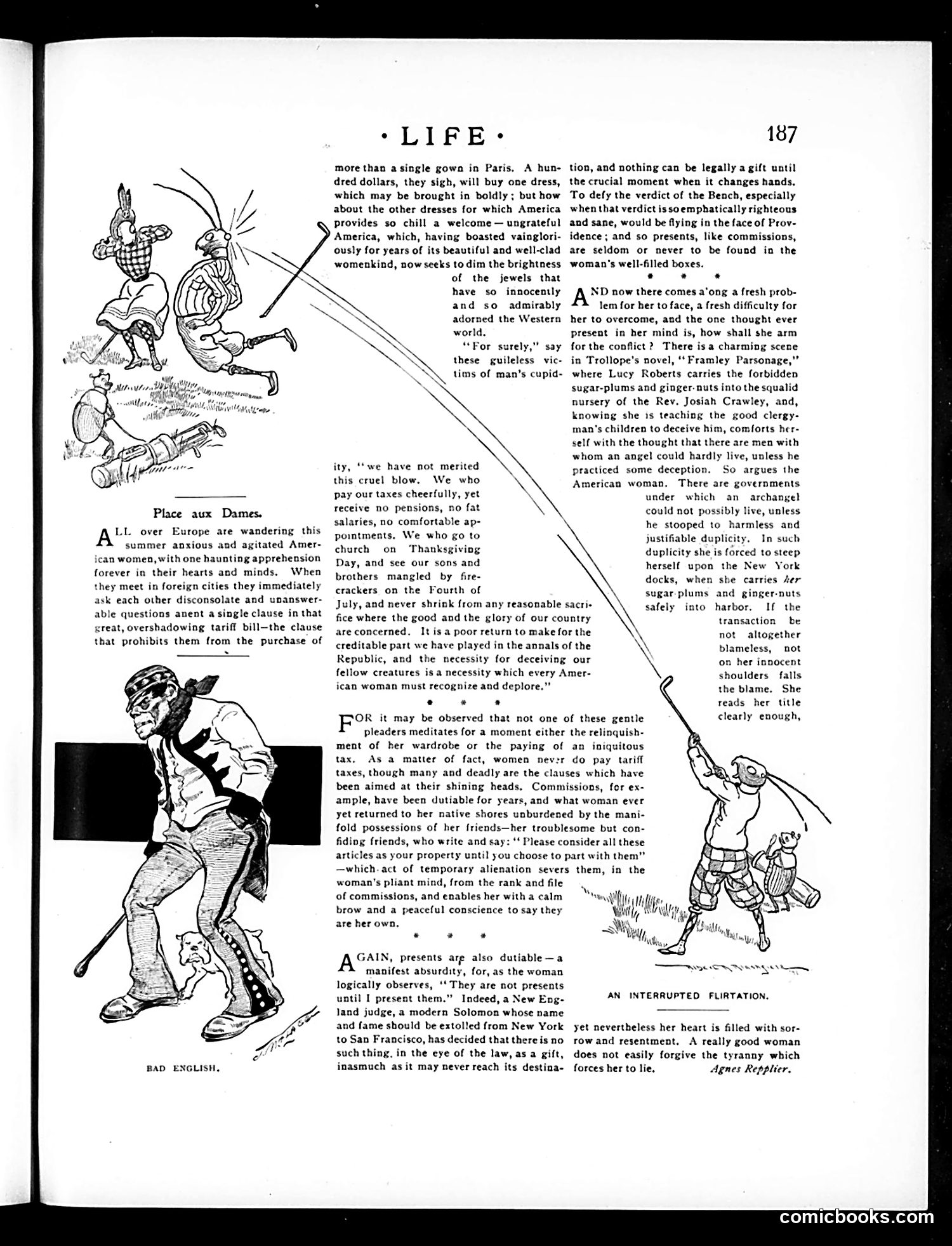
This page satirizes American women's spending habits and European fashion obsession. The left cartoon labeled "BAD ENGLISH" depicts a caricatured British figure, likely mocking English attitudes toward American women's consumption. The main text criticizes wealthy American women traveling Europe who spend lavishly on Parisian gowns while claiming financial constraints. The satire argues this conspicuous consumption is hypocritical—these women receive no salaries yet somehow afford expensive wardrobes, then return to America to "dim the brightness of the jewels that have so innocently adorned the Western world." The right cartoon "AN INTERRUPTED FLIRTATION" appears unrelated, showing children at play. The page concludes with commentary on "gains" (gifts/presents) and legal disputes over women's property rights, suggesting contemporary debates about female financial autonomy and marital law.
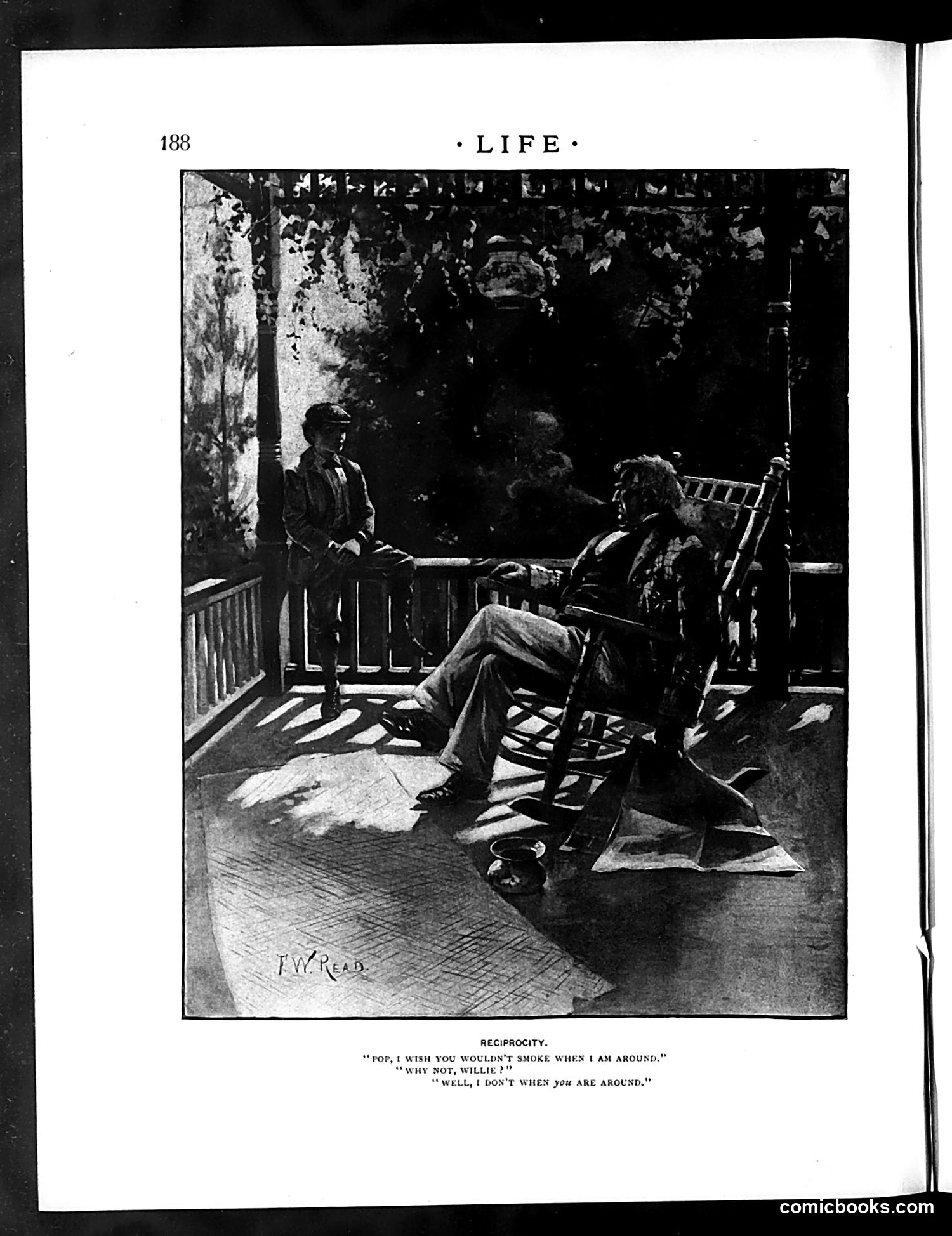
This cartoon depicts a porch scene with two figures in rocking chairs and a standing man. The title "Reciprocity" and dialogue suggest a social commentary on mutual obligation or fairness. The exchange—"Pop, I wish you wouldn't smoke when I am around" / "Why not, Willie?" / "Well, I don't when you are around"—illustrates reciprocal behavior through domestic conflict. The young man (Willie) demands his father stop smoking but admits he doesn't reciprocate the courtesy when his father is present. This appears to be satirizing hypocrisy or double standards in personal relationships—pointing out that people often demand consideration they themselves refuse to offer. The "reciprocity" concept critiques selective morality in everyday family dynamics. The artist signature appears to read "F.W. Read."
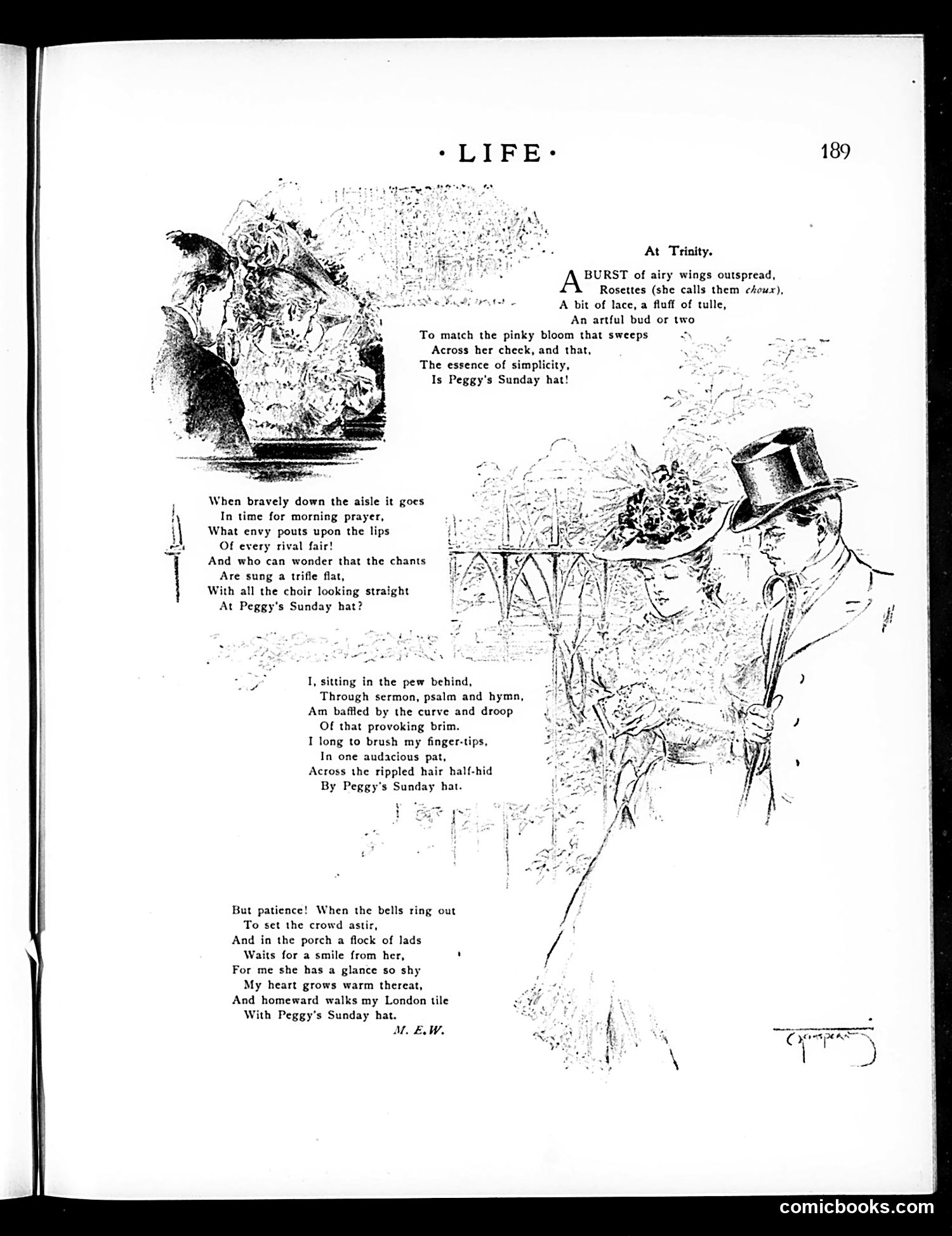
This page presents a poem (signed "M.L.W.") celebrating a woman's fashionable hat worn to church at Trinity. The illustrated vignettes show church scenes: worshippers in a pew, a gentleman admiring a woman, and church architecture with bells. The satire is gentle social commentary on Victorian/Edwardian fashion obsession. The poem jokes that "Peggy's Sunday hat" — with its "airy wings outspread" and "Rosettes" — is so eye-catching it distracts from religious observance. Men lose focus during services; the narrator's "heart grows warm" seeing the wearer. The hat matters more than piety. This reflects *Life* magazine's recurring theme mocking how ornate women's hats dominated public attention and church etiquette of the era.
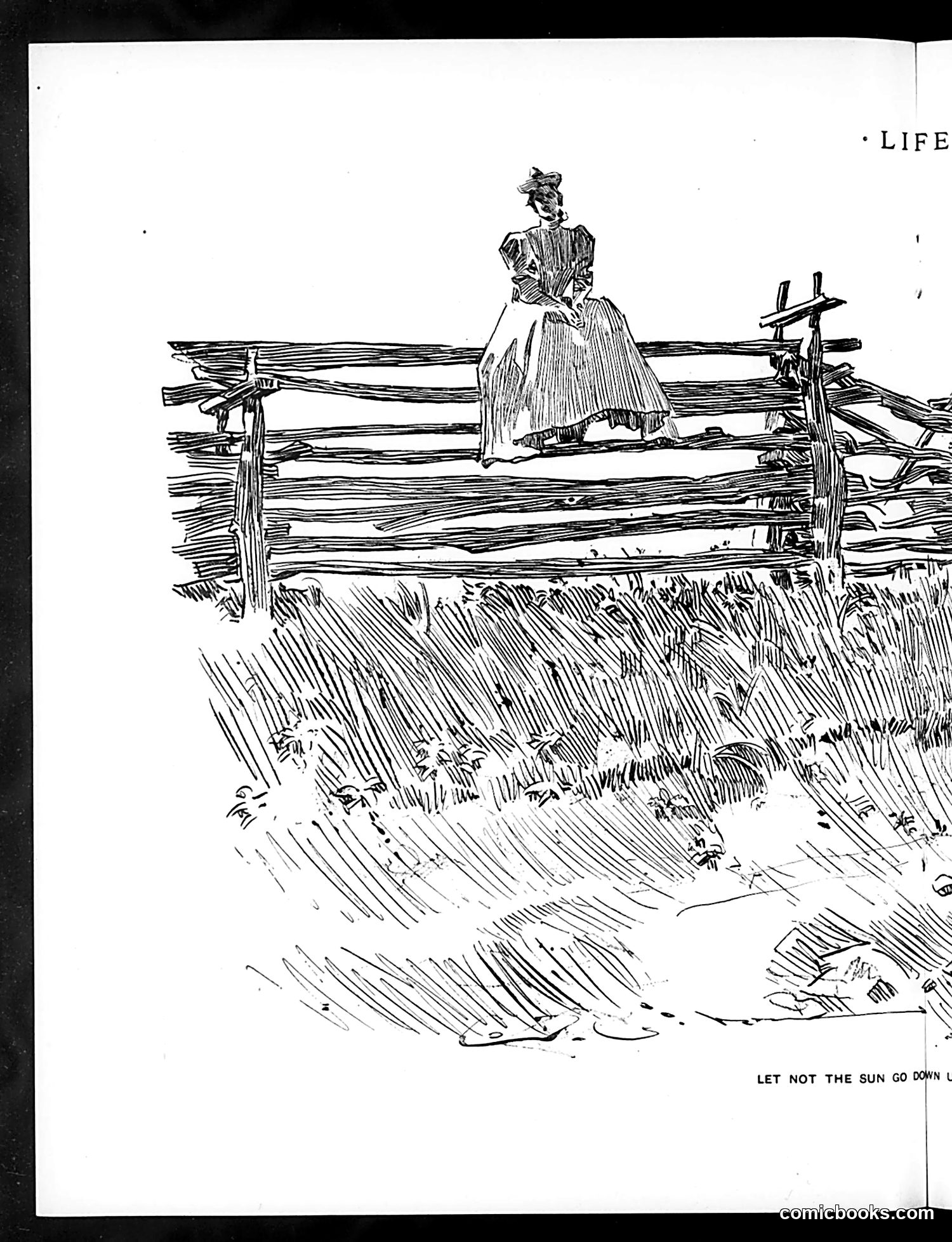
This is an illustration from *Life* magazine showing a woman in Victorian-era dress standing on a wooden fence, gazing into the distance. The caption reads "LET NOT THE SUN GO DOWN U[PON]..." (text cut off). The image appears to reference a biblical phrase—likely "Let not the sun go down upon your wrath" (Ephesians 4:26), a verse about resolving anger before nightfall. The woman's contemplative pose and romantic setting suggest this is satirizing sentimental Victorian ideals about reconciliation, probably in a romantic or domestic context. Without seeing the full caption or surrounding text, the specific satirical target remains unclear—it could mock overly romantic notions, marital discord, or period sentimentality generally.
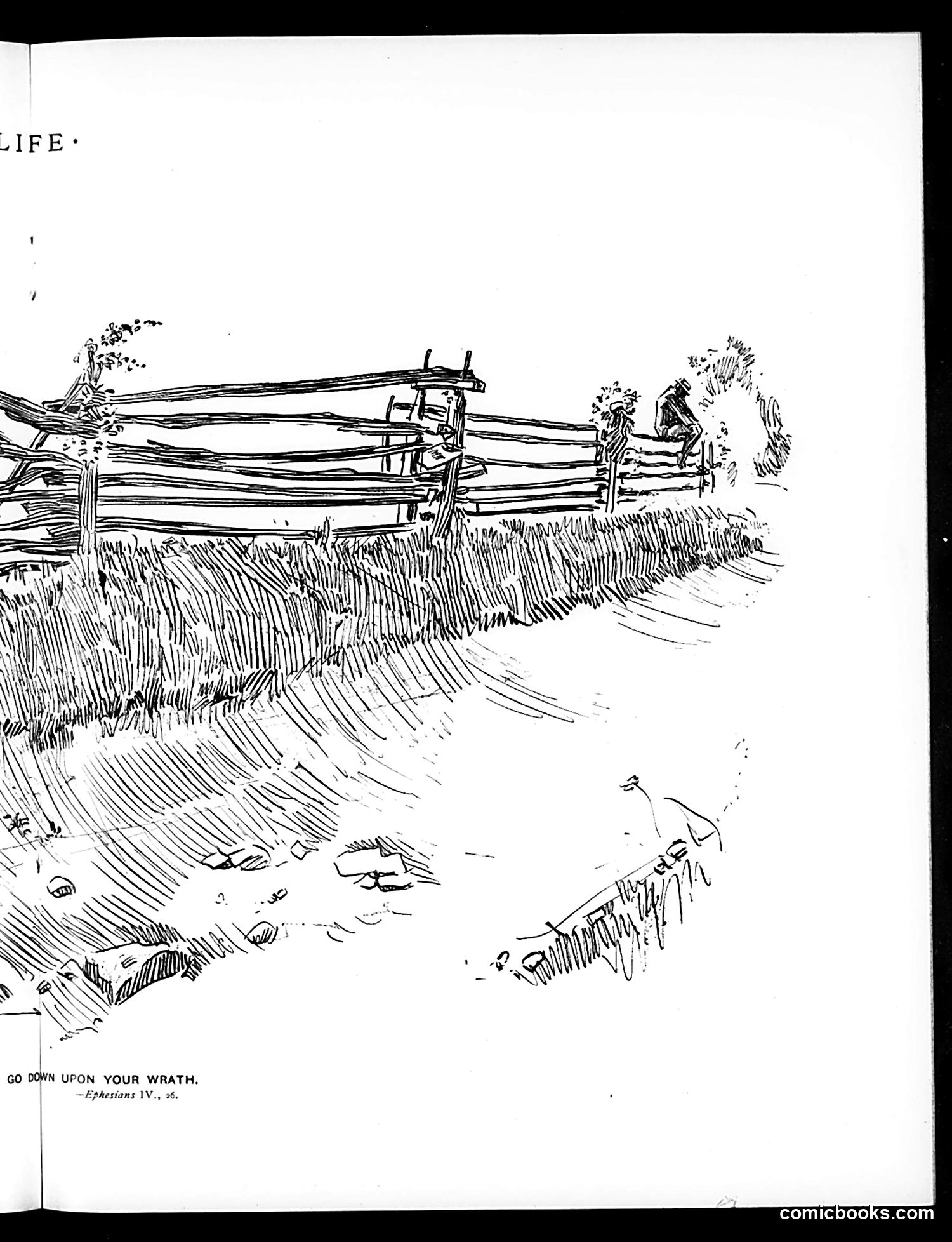
This is a pen-and-ink illustration depicting a rural landscape with a split-rail fence and overgrown grassland. The artistic style uses cross-hatching for texture and depth. The caption reads "GO DOWN UPON YOUR WRATH" with a citation to "Ephesians IV., 26" — a biblical reference to the passage about anger and sin. The cartoon appears to be a visual meditation on the biblical concept rather than a specific political satire. The desolate rural scene—with its weathered fence and wild, unkempt vegetation—suggests spiritual desolation or the aftermath of destructive emotion. The artistic technique emphasizes decay and disorder, reinforcing the moral lesson about controlling wrath. Without additional context or identifying figures, this reads as a general moral/religious commentary rather than commentary on specific contemporary events or figures.
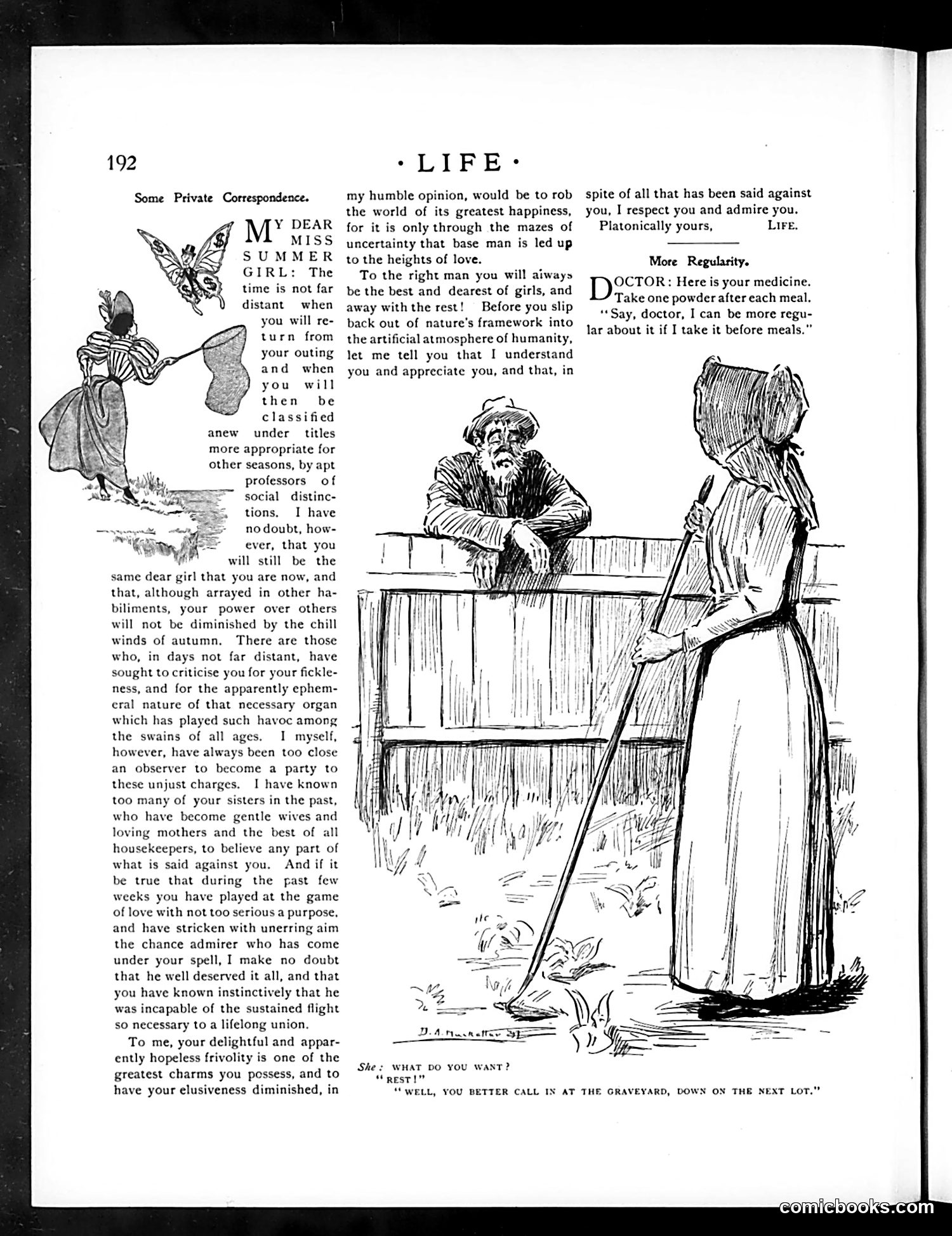
This page contains two distinct sections: a romantic letter to "My Dear Miss Summer Girl" on the left, and a medical cartoon on the right. The letter satirizes romantic idealization of women, praising the correspondent's constancy despite criticisms of her "fickleness" and "ephemeral nature." It's courtship-era satire. The cartoon below depicts a doctor and patient at a fence. The patient asks "What do you want?" The doctor replies: "Well, you better call in at the graveyard, down on the next lot." This is gallows humor about medicine—suggesting the patient is so ill that the doctor is essentially directing them toward death. It satirizes the limitations (or incompetence) of early medical practice, a common theme in satirical magazines of this era.
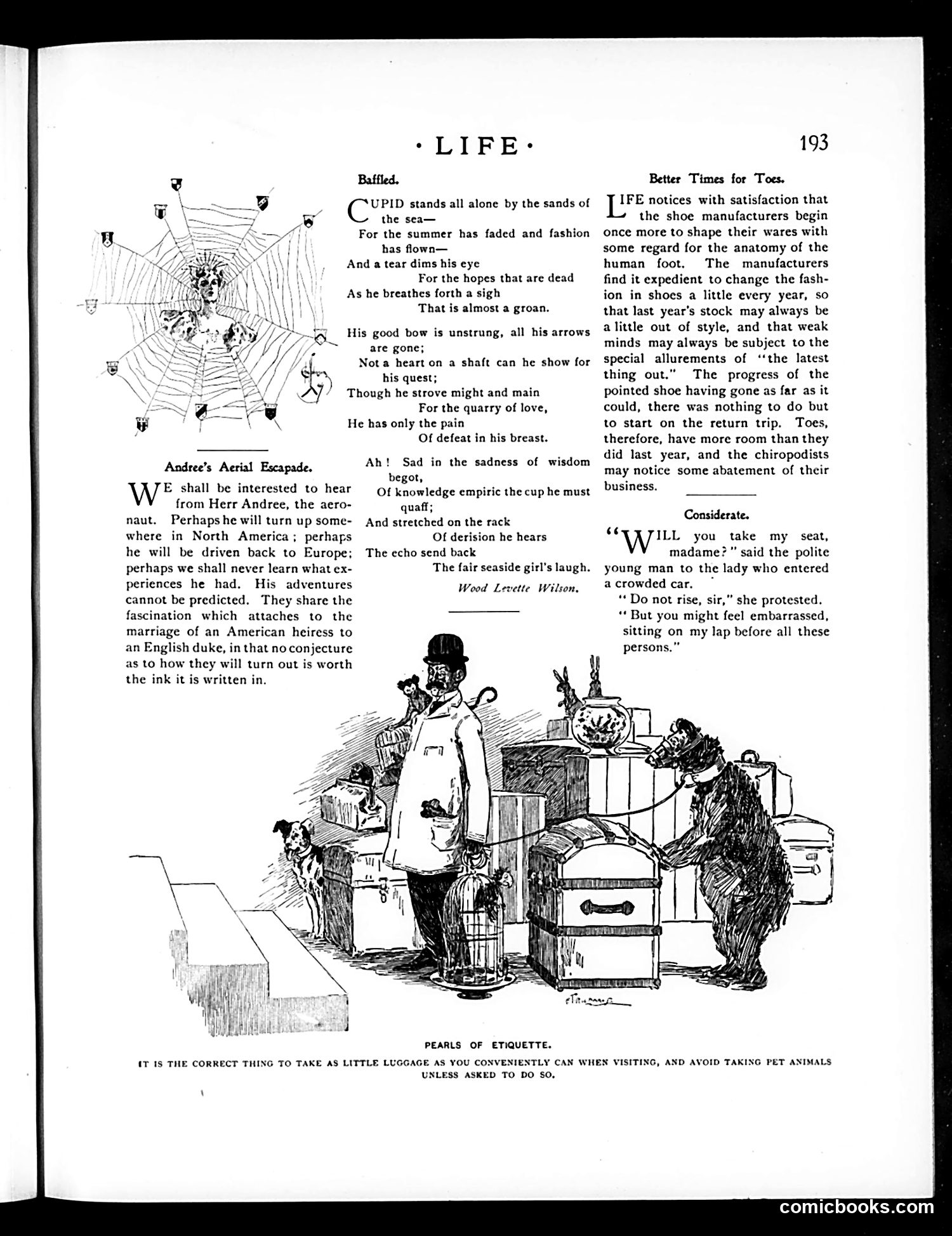
This page contains three distinct pieces of satirical content: 1. **"Baffled"** (top): A poem illustrated with Cupid abandoned by the seashore after summer ends. The satire mocks romantic disappointment—Cupid's arrows are gone, his efforts at love have failed, leaving only pain. It's a melancholic commentary on love's futility. 2. **"Andree's Aerial Escapade"** (left): References explorer S.A. Andrée's 1897 polar balloon expedition (outcome then unknown). Life sarcastically compares the unpredictability of his fate to the marriage of an American heiress to an English duke—both equally speculative and ink-wasting to predict. 3. **"Better Times for Toes"** (right): Satirizes shoe fashion cycles. Manufacturers deliberately change styles yearly to render last year's shoes "out of style," manipulating consumers with "latest thing" marketing. The piece notes the pointed-toe trend has finally reversed, giving feet relief. 4. **"Considerate"** (bottom): A crude joke where a woman rejects a man's offered seat, suggesting his lap is an inappropriate alternative. 5. **"Pearls of Etiquette"** (footer): Practical advice about travel luggage and pet animals.
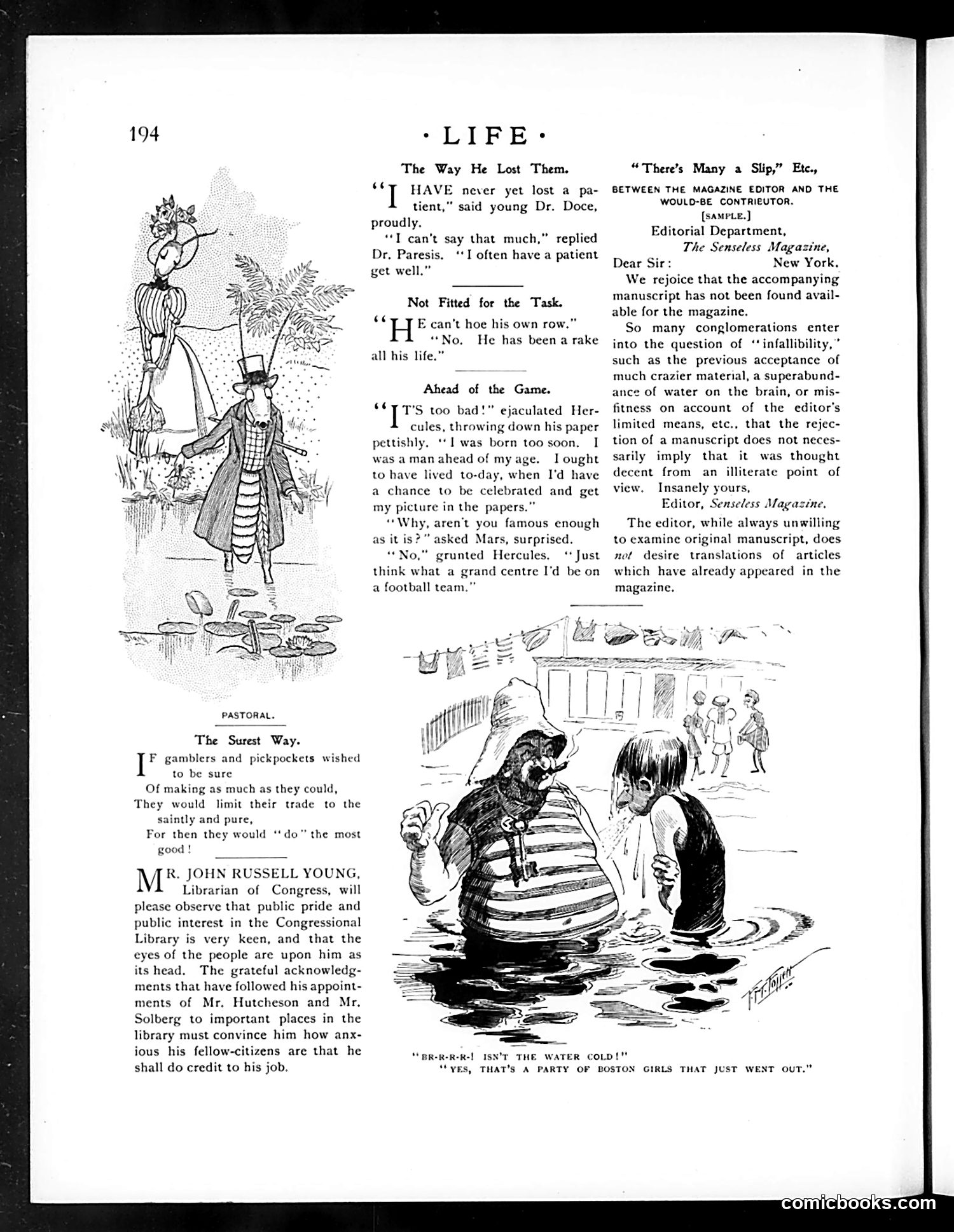
This page contains several brief humorous pieces mocking contemporary figures and situations: **"The Way He Lost Them"** satirizes a young doctor's false boasting—he claims never losing a patient, but his colleague replies he often has patients *recover*, implying incompetence. **"Ahead of the Game"** ridicules the classical hero Hercules for lamenting he was "born too soon," wishing he'd lived today to become a football star instead—mocking the era's sports obsession over genuine accomplishment. **Magazine Editor's Letter** parodies rejection letters' absurd logic, suggesting editors reject work for arbitrary reasons while accepting worse material. **The cartoon bottom-right** shows a man in water with Boston girls, playing on stereotypes about Boston women and cold water, likely a social/regional joke. **John Russell Young section** appears to be commentary about the Library of Congress Librarian's recent staff appointments, suggesting political patronage concerns. The overall tone is genteel mockery of professional pretension, changing values, and bureaucratic absurdity typical of *Life*'s satirical approach.
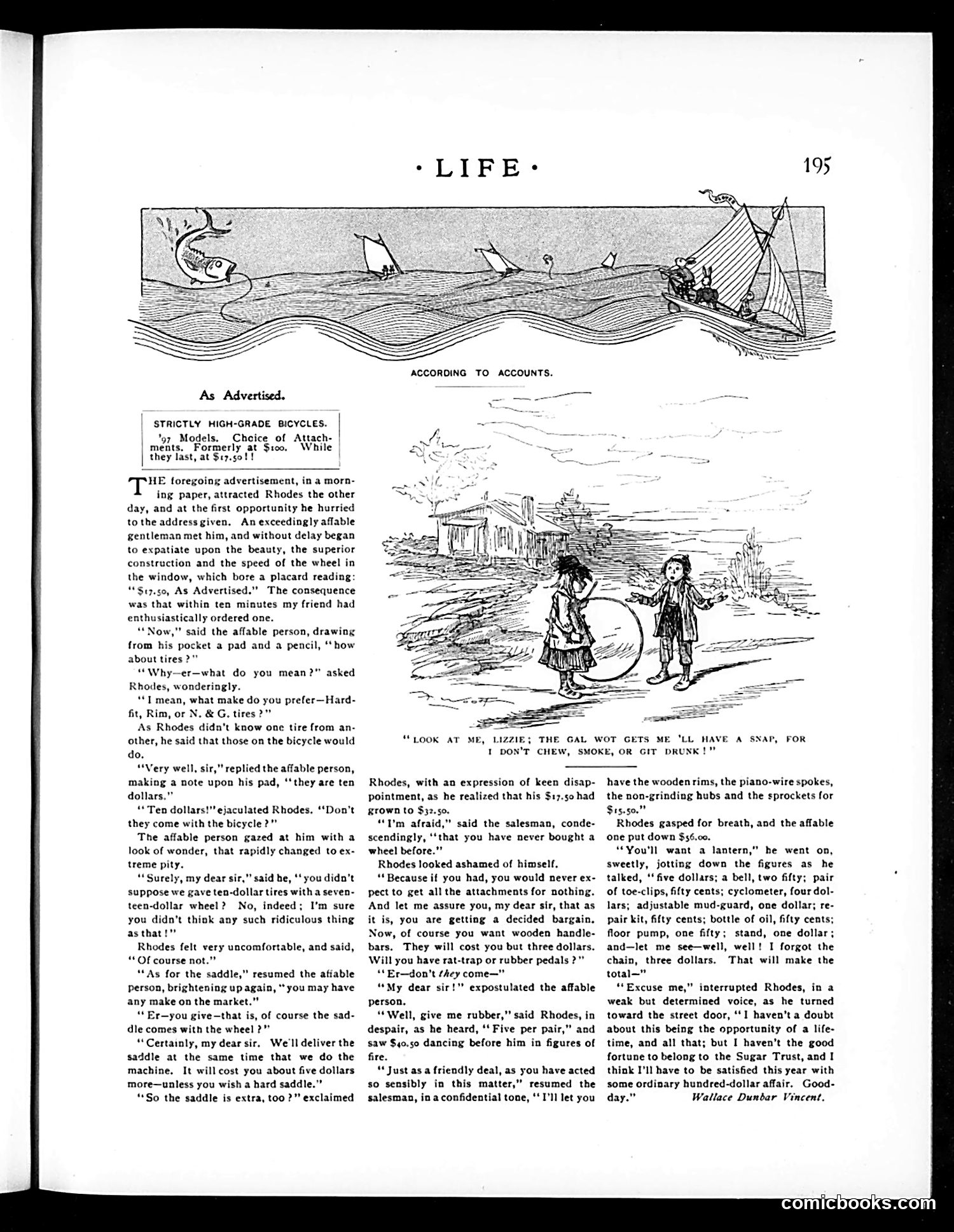
This page satirizes deceptive advertising and aggressive sales tactics in the bicycle boom of the 1890s. A man named Rhodes responds to a newspaper ad for "$17.50" bicycles, only to be systematically upsold by an "affable" salesman who reveals that nearly every component—tires, saddle, handlebars, pedals, rims, spokes, lantern, bell, and tools—costs extra. The satire targets the gap between advertised prices and actual costs. The salesman's condescending manner ("you didn't suppose we gave ten-dollar tires...?") mocks both the deceptive merchant and Rhodes's naïveté. By story's end, the "$17.50" bicycle totals approximately $56, at which point Rhodes flees. The secondary cartoon below depicts a street character, likely satirizing another contemporary social type. The piece critiques consumer fraud and exploitative retail practices common in the gilded age.
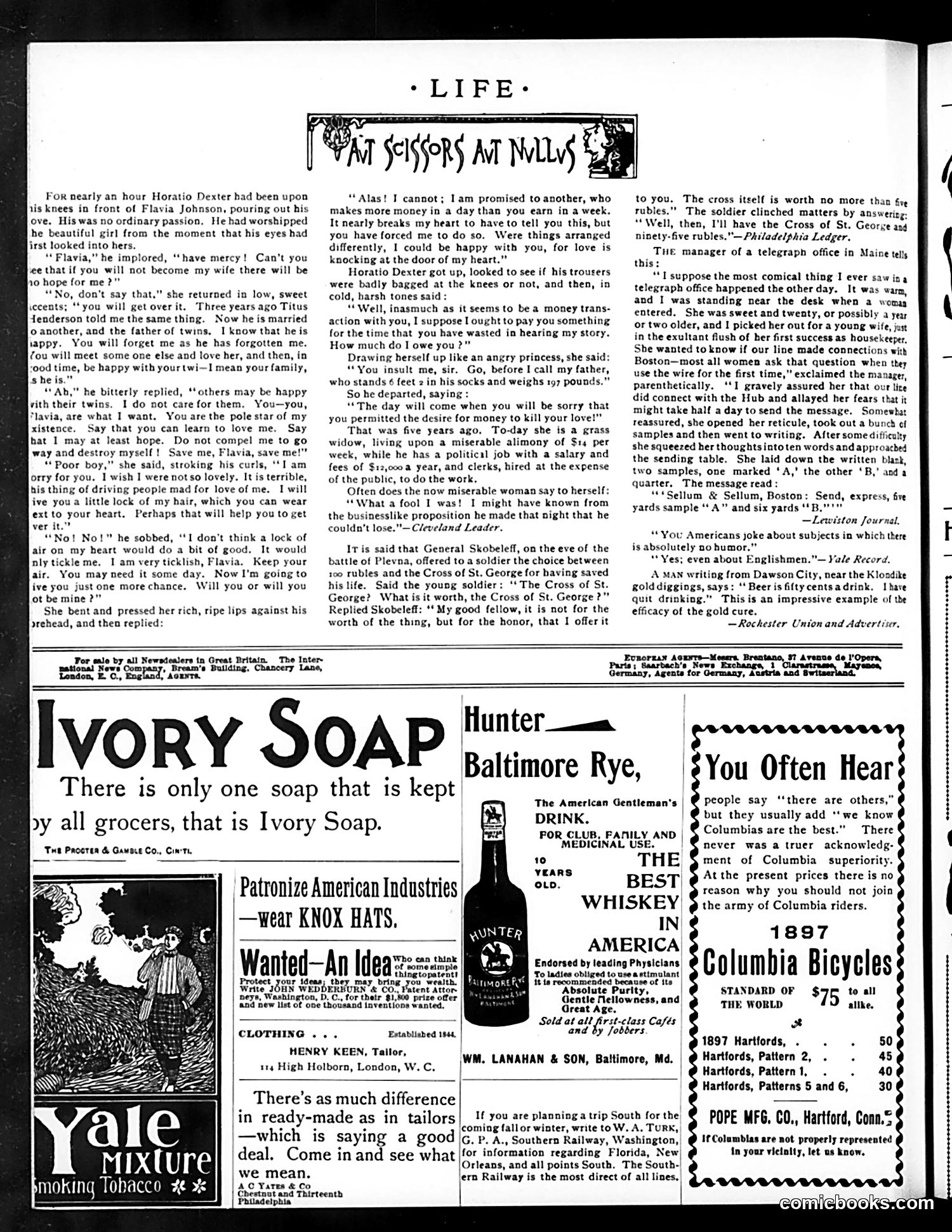
This page contains two satirical stories illustrating materialist values in late 19th-century America. **The main narrative** follows Horatio Dexter's rejected marriage proposal to Flavia Johnson. She chooses a wealthier suitor, dismissing Dexter's romantic appeals. Five years later, the tables turn: Flavia becomes a "grass widow" (likely separated/divorced) surviving on meager alimony ($14/week), while Dexter prospers with a cushy political job ($12,000 salary). The satire mocks her mercenary choice and suggests that marrying for money was ultimately foolish. **The secondary anecdote** about General Skobeleff and a Russian soldier makes a similar point: even when offered an honorable military decoration, the soldier negotiates to keep 95 rubles, choosing cash over prestige. Together, these stories critique the era's obsession with material wealth over virtue, honor, and love—positioning greed as ultimately self-defeating. The humor relies on the protagonist's comeuppance and ironic reversals typical of moralistic 19th-century journalism.
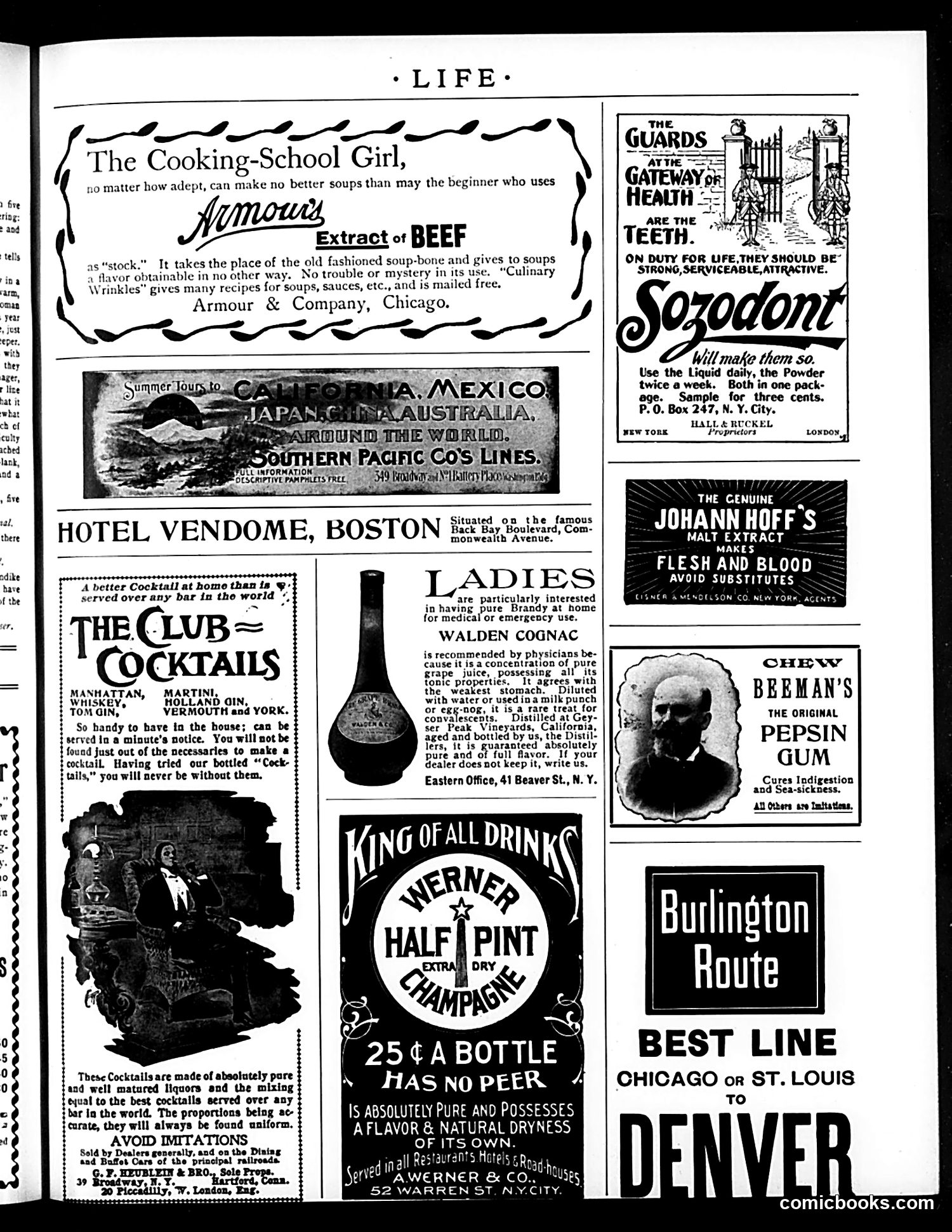
This is **primarily a collection of advertisements**, not satirical cartoons. The page showcases consumer products from the early 20th century, revealing period attitudes about health and propriety. **Key advertised products include:** - **Armour's Beef Extract**: Positioned as a cooking shortcut for "adept" home cooks, reflecting emerging convenience culture - **Club Cocktails**: Marketed for home consumption with assurances of quality—notable given Prohibition's imminence - **Walden Cognac**: Explicitly marketed to ladies "for medical or emergency use"—a transparent euphemism masking recreational alcohol consumption under medical pretense - **Johann Hoff's Malt Extract**: Promises to build "flesh and blood," typical of patent medicine claims - **Beeman's Pepsin Gum**: Claims to cure indigestion and seasickness **The satirical subtext**: These advertisements reveal how early 1900s companies exploited health anxieties and gender norms (women needed "medical" brandy; girls needed cooking shortcuts) to sell products with dubious benefits. The overall message reflects commercialization of domestic life and health concerns.
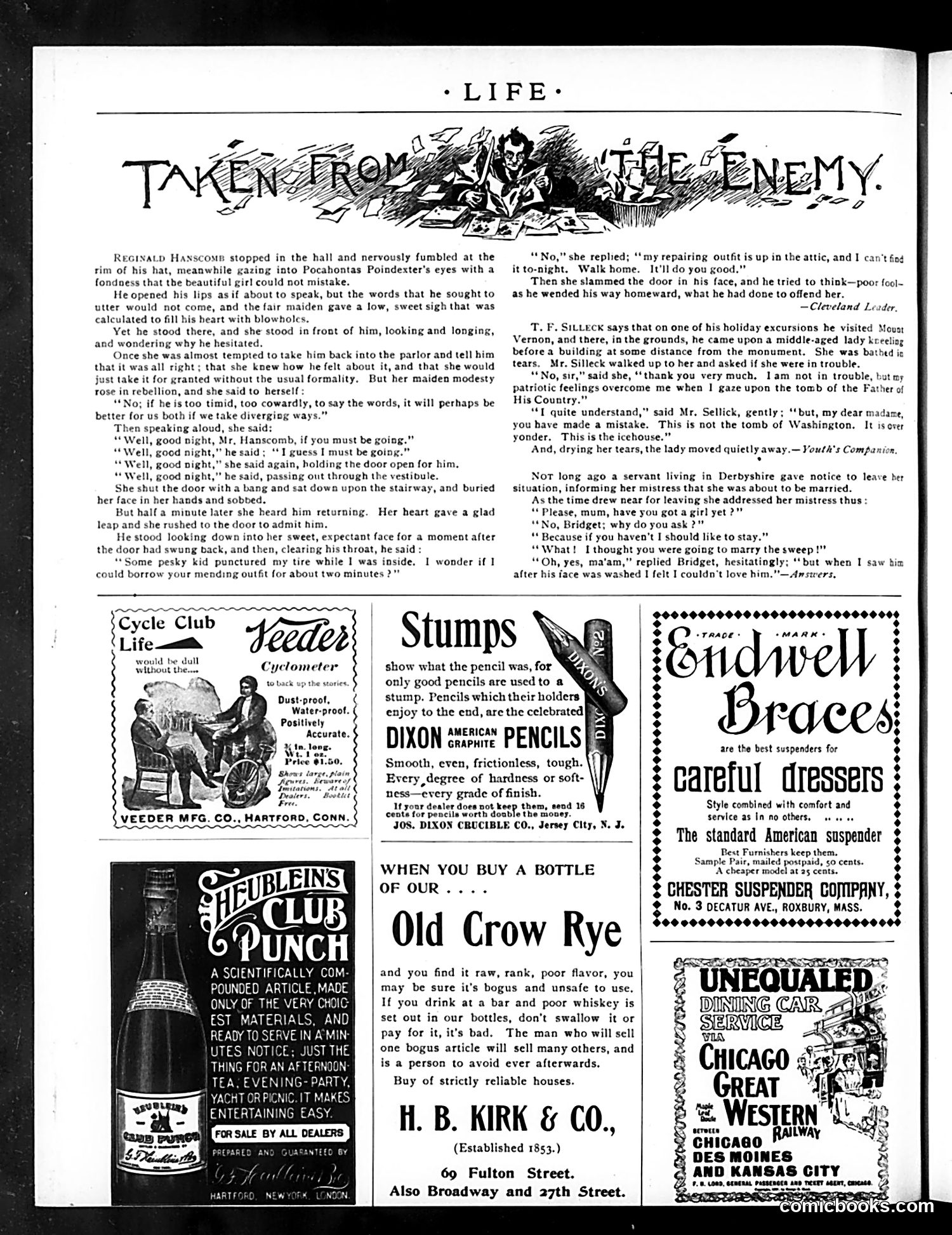
This page contains **three humor pieces** rather than political cartoons: 1. **"Taken from the Enemy"** – A romantic comedy about Reginald Hanscome's failed marriage proposal. He leaves Pocahontas Poindexter's house, then returns—but only to ask to borrow her sewing kit after puncturing his bicycle tire. She, offended at his trivial return, slams the door. 2. **Mount Vernon anecdote** – A woman weeps before what she believes is George Washington's tomb; she's actually at the icehouse. The humor relies on her mistaken patriotic emotion. 3. **Servant's engagement story** – A maid plans to marry a chimney sweep, but changes her mind after seeing his face washed clean. The page is primarily **advertising-heavy** (Cycle Club Life, Dixon Pencils, Shebleins Punch, Endwell Braces, Old Crow Rye, and railroad services). The humor pieces are sentimental, domestic comedy typical of early 20th-century Life magazine—focusing on romantic mishaps and class-based situations rather than political satire.
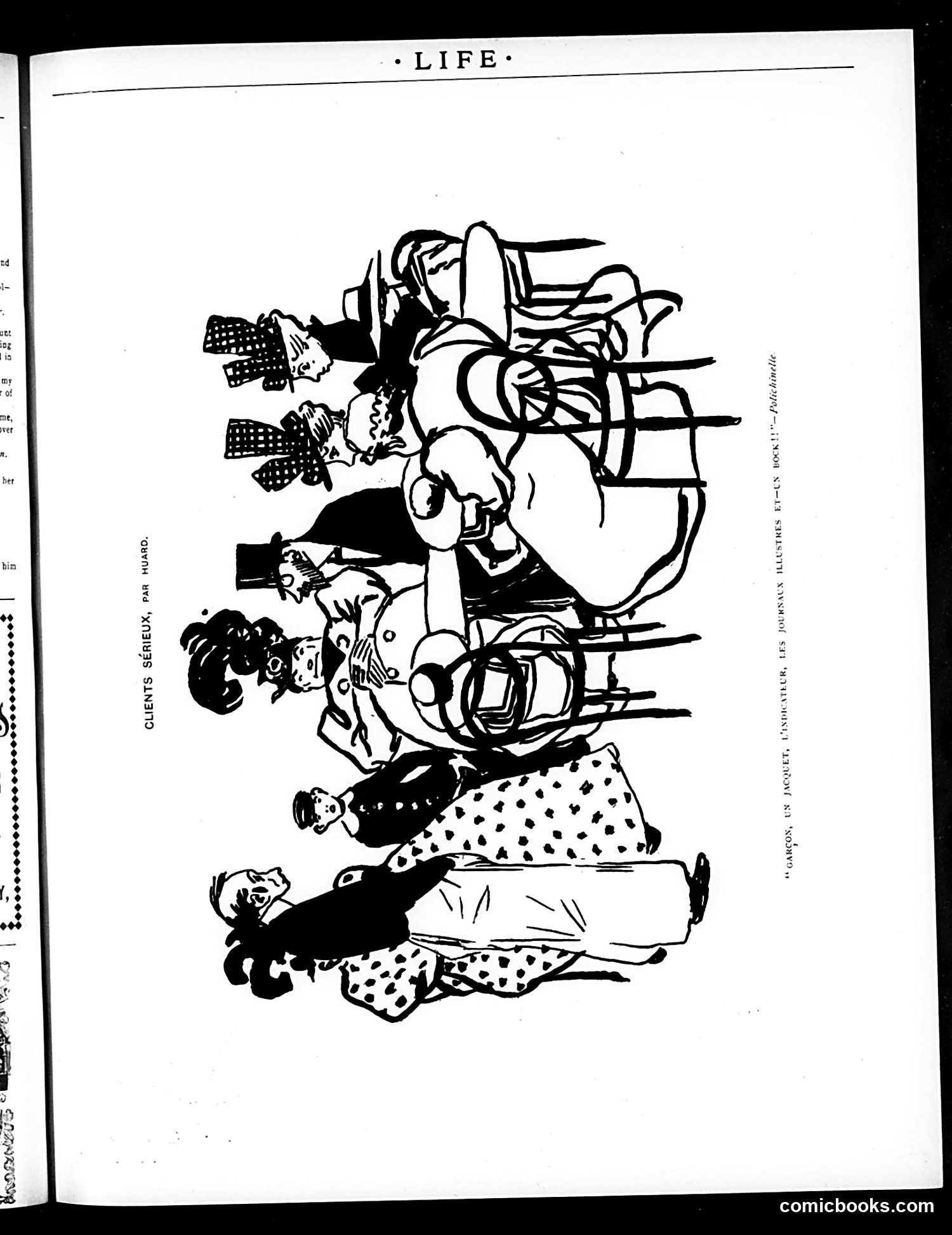
This cartoon, credited to "Polichinelle" (a traditional French comedic character), uses French text to satirize what appears to be a group of pompous or self-important figures. The composition shows several characters arranged vertically—some in formal dress with polka-dot patterns, others in black formal wear—suggesting people of supposed distinction or status. The title "Clients Sérieux" (Serious Clients) implies mockery: these figures present themselves as serious, respectable clients or patrons, yet their exaggerated poses and artistic style suggest pretension. The cartoon likely ridicules French bourgeois society's affected sophistication or the absurdity of those claiming social importance. Without a specific date visible, the exact political context remains unclear, though the satirical tone is unmistakable.
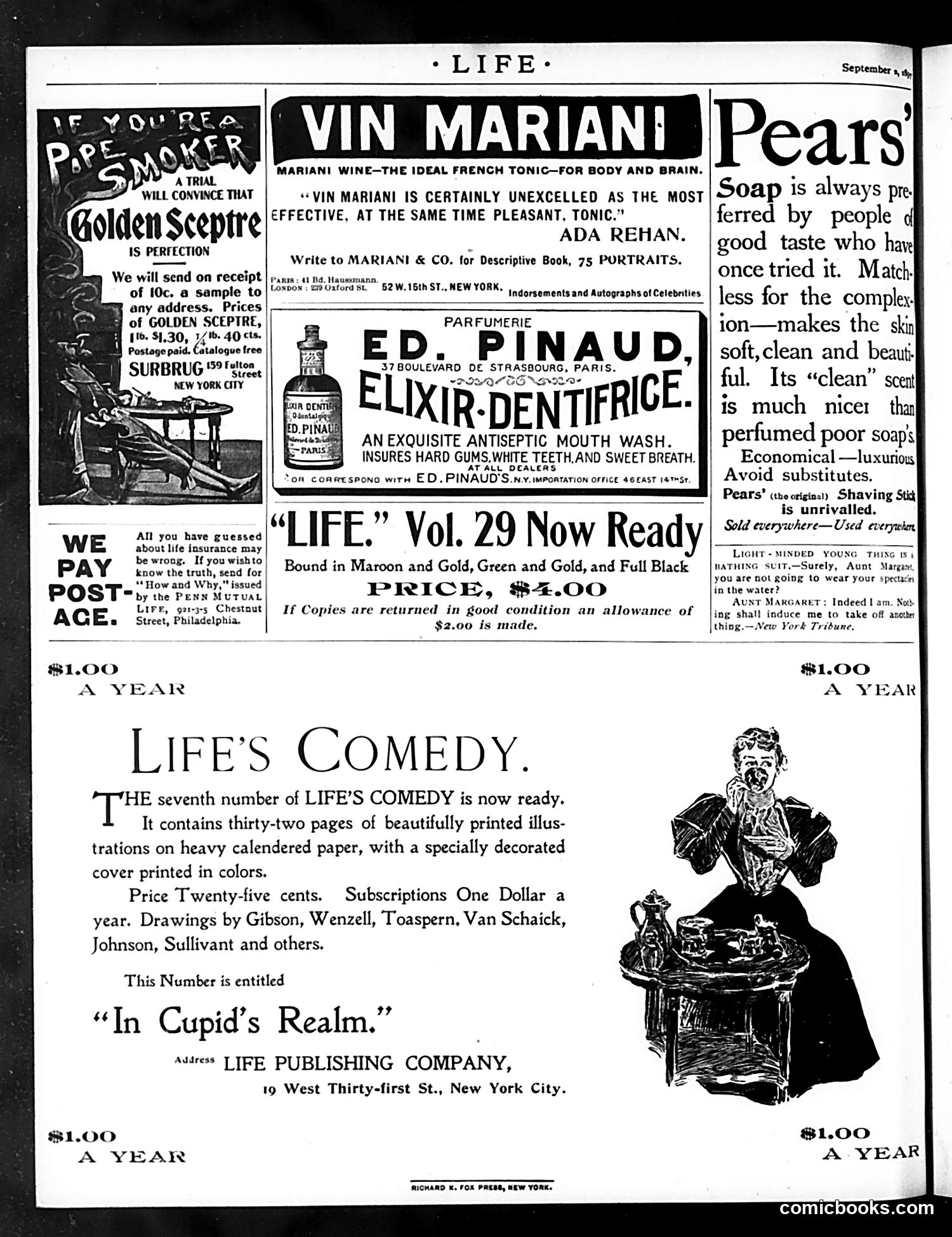
This is primarily an **advertisement and promotional page** from Life magazine (Vol. 29), circa early 1900s, rather than political satire. The page promotes: 1. **Life magazine itself** ($4.00 bound volume) and its comedy series "In Cupid's Realm" 2. **Patent medicines and toiletries** common to the era: - Golden Sceptre pipe tobacco - Vin Mariani (a wine-based "tonic" endorsed by actress Ada Rehan) - Ed. Pinaud's antiseptic mouthwash - Pears' soap 3. **A brief cartoon joke** (lower right): An aunt wearing spectacles while bathing, refusing to remove them—likely mocking Victorian prudishness or vanity. The page reflects **turn-of-century advertising practices**: celebrity endorsements, dubious health claims for alcohol-based products marketed as medicinal tonics, and genteel humor. There's no significant political content—this is a **commercial page showing what Life's readers encountered alongside editorial content**.