
Life, 1897-09-02 · page 7 of 20
Life — September 2, 1897 — page 7: what you’re looking at
What you’re looking at
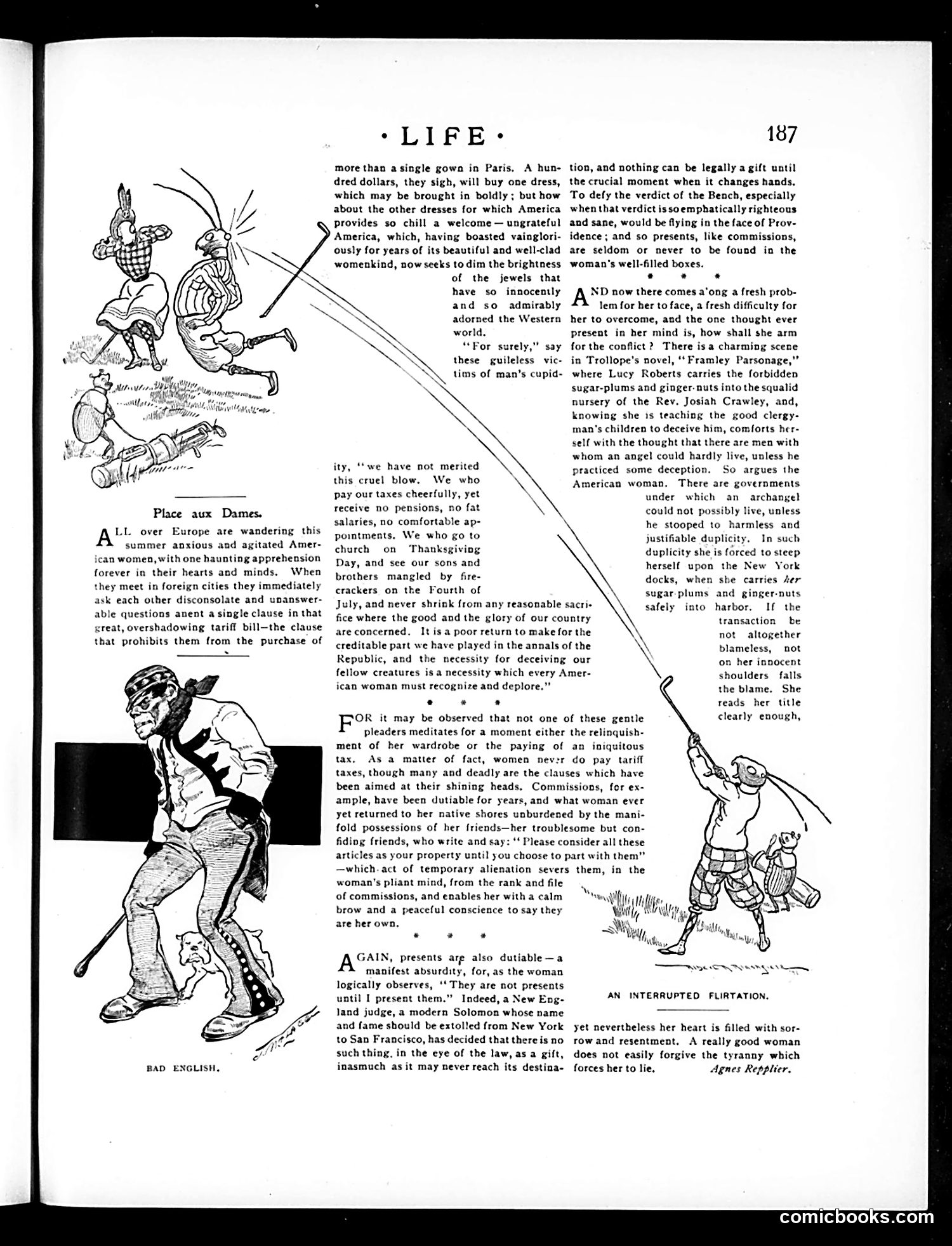
This page satirizes American women's spending habits and European fashion obsession. The left cartoon labeled "BAD ENGLISH" depicts a caricatured British figure, likely mocking English attitudes toward American women's consumption. The main text criticizes wealthy American women traveling Europe who spend lavishly on Parisian gowns while claiming financial constraints. The satire argues this conspicuous consumption is hypocritical—these women receive no salaries yet somehow afford expensive wardrobes, then return to America to "dim the brightness of the jewels that have so innocently adorned the Western world." The right cartoon "AN INTERRUPTED FLIRTATION" appears unrelated, showing children at play. The page concludes with commentary on "gains" (gifts/presents) and legal disputes over women's property rights, suggesting contemporary debates about female financial autonomy and marital law.
📄 Transcribed text from this page (OCR, searchable)
Machine-transcribed from the original scan — historical spelling and the odd misread are preserved.
Place aux Dames. LL over Europe are wandering this summer anxious and agitated Amer- ican women, with one haunting apprehension forever in their hearts and minds. When they meet in foreign cities they immediately ask each other disconsolate and unanswer- able questions anent a single clause in that great, overshadowing tariff bill—-the clause that prohibits them from the purchase of BAD ENGLISH, “LIFE: more than a single gown in Paris, A hun- dred dollars, they sigh, will buy one dress, which may be brought in boldly; but how about the other dresses for which America provides so chill a welcome — ungrateful America, which, having boasted vainglori- ously for years of its beautiful and well-clad womenkind, now seeks to dim the brightness of the jewels that have so innocently and so admirably adorned the Western world, “For surely,” say these guileless vic- tims of man’s cupid- ity, “we have not merited this cruel blow. We who pay our taxes cheerfully, yet receive no pensions, no fat salaries, no comfortable ap- pointments. We who go to church on Thanksgiving Day, and see our sons and brothers mangled by fire- crackers on the Fourth of July, and never shrink from any reasonable sacri- fice where the good and the glory of our country It is a poor return to make for the creditable part we have played in the annals of the are concerned, Republic, and the necessity for deceiving fellow creatures ican woman must recognize and deplore.” . + * OR it may be observed that not one of these gentle pleaders meditates for a moment either ment of her wardrobe or the paying of tax, As a matter of fact, women never a necessity which every Amer- 187 tion, and nothing can be legally a gift until the crucial moment when it changes hands. To defy the verdict of the Bench, especially when that verdict issoemphatically righteous and sane, would be flying in the face of Prov- idence; and so presents, like commissions, are seldom or never to be found in the woman's well-filled boxes. . * * ND now there comes a‘ong a fresh prob- lem for her to face, a fresh difficulty for her to overcome, and the one thought ever Present in her mind is, how shall she arm forthe conflict ?. There isa charming scene in Trollope's novel, ‘Framley Parsonage,” where Lucy Roberts carries the forbidden sugar-plums and ginger-nuts into the squalid nursery of the Rev. Josiah Crawley, and, knowing she 1s teaching the good clergy- man’s children to deceive him, comforts her- self with the thought that there are men with whom an angel could hardly live, unless he practiced some deception. So argues the American woman, There are governments under which archangel could not possibly live, unless he stooped to harmless and justifiable duplicity. In such duplicity she is forced to steep herself upon the New York docks, when she carries Aer sugar-plums and ginger-nuts safely into harbor. If the transaction be not altogether blameless, not on her innocent shoulders falls the blame, She reads her title clearly enough, an our the relinquish- an iniquitous do pay tariff taxes, though many and deadly are the clauses which have been aimed at their shining heads. Commissions, for ex- ample, have been dutiable for years, and what woman ever yet returned to her native shores unburdened by the mani- fold possessions of her friends—her troublesome but con- fiding friends, who write and say: ‘* Please consider all these articles as your property until you choose to part with them” —which. act of temporary alienation severs them, in the woman's pliant mind, from the rank and file of commissions, and enables her with a calm brow and a peaceful conscience to say they are her own, . * * presents arg also dutiable—a manifest absurdity, for, as the woman logically observes, ‘‘ They are not presents until I present them.” Indeed, a New Eng- Jand judge, a modern Solomon whose name and fame should be extolled from New York to San Francisco, has decided that there is no such thing, in the eye of the law, as a gift, inasmuch as it may never reach its destina- “swiliy intl, i gn AN INTERRUPTED FLIRTATION. yet nevertheless her heart is filled with sor- row and resentment. A really good woman does not easily forgive the tyranny which forces her to lie. Agnes Repplier. comicbooks.com