
Life, 1897-09-02 · page 6 of 20
Life — September 2, 1897 — page 6: what you’re looking at
What you’re looking at
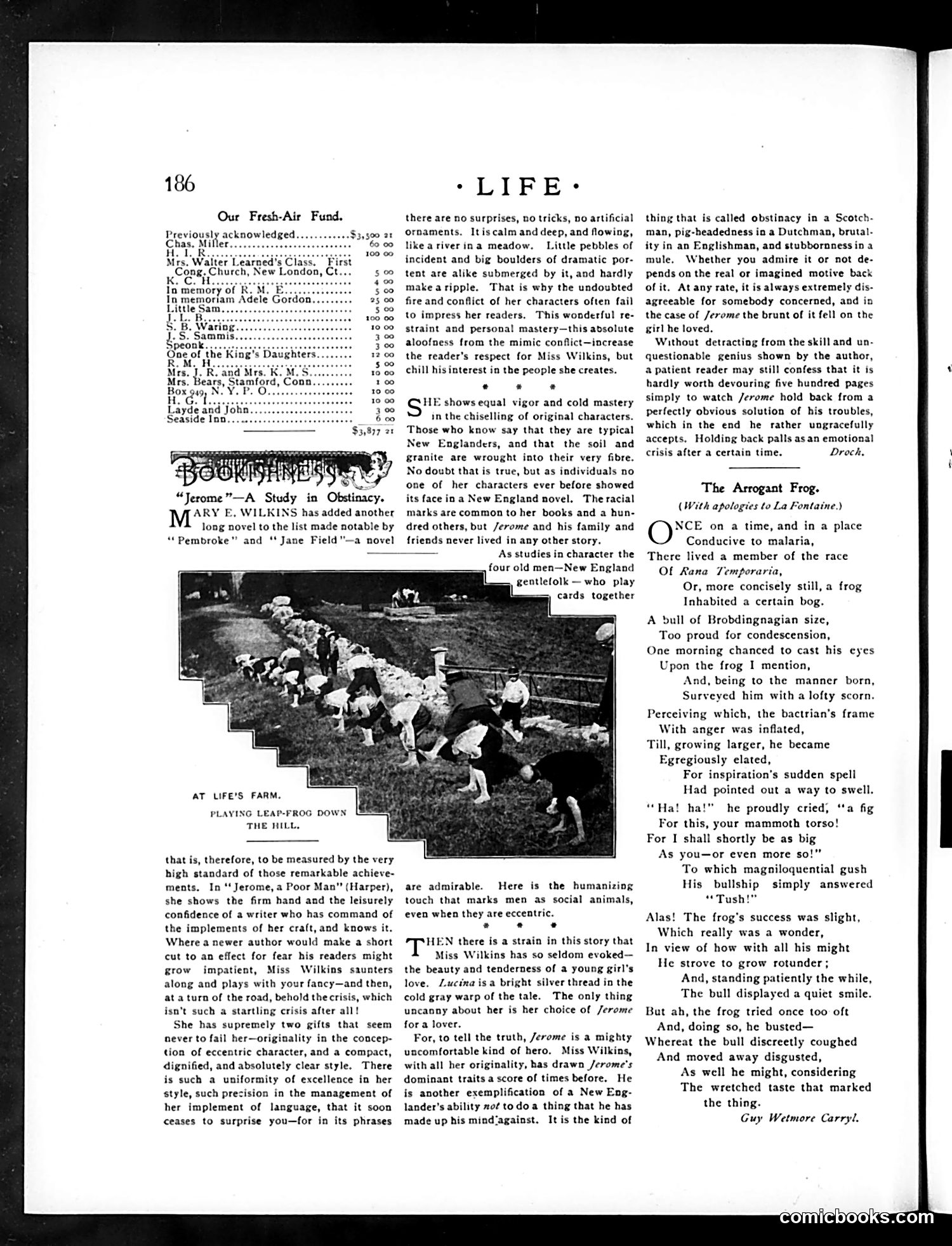
This page from *Life* magazine contains two distinct sections: **Left side**: A book review of Mary E. Wilkins's novel *Jerome*, praising her skill at characterization. The accompanying photograph shows children playing "leap-frog down the hill" at Life's Farm—a rural retreat, not political content. **Right side**: "The Arrogant Frog," a poem with La Fontaine attribution, depicting an inflated bull-frog attempting to match a bull's size and becoming comically deflated when the bull coughs. This is a satirical fable about overreaching ambition and pretension being exposed and humbled—a timeless moral tale rather than specific political commentary. The page is primarily literary rather than political satire.
📄 Transcribed text from this page (OCR, searchable)
Machine-transcribed from the original scan — historical spelling and the odd misread are preserved.
186 Our Fresh-Air Fund. Prev ao acknowledged Chas, $3, seo at 60 00 109 09 500 te memory of Ry ii. In memoriam Adele Gordon... Little Sam B, Waring. ac sammis. Sg ot ike King's Daughters Mrs, J. Roand Sirs. K. Mrs. Bea: giamford, Conn. Box gay, N.Y.P. 0 Layde and John Seaside Inn. ARY E, WILKINS has added another long novel to the list made notable by “Pembroke” and ‘* Jane Field"—a novel AT LIFE’S FARM. PLAYING LEAP-FROG DOWN THE HILL, that is, therefore, to be measured by the very high standard of those remarkable achieve- ments. In ‘Jerome, a Poor Man" (Harper), she shows the firm hand and the leisurely confidence of a writer who has command of the implements of her craft, and knows it. Where a newer author would make a short cut to an effect for fear his readers might grow impatient, Miss Wilkins saunters along and plays with your fancy—and then, at a turn of the road, behold thecrisis, which isn’t such a startling crisis after all! She has supremely two gifts that seem never to fail her—originality in the concep- tion of eccentric character, and a compact, dignified, and absolutely clear style. There is such a uniformity of excellence in her style, such precision in the management of her implement of language, that it soon ceases to surprise you—for in its phrases LIFE there are no surprises, no tricks, no artificial ornaments. Itiscalm and deep, and flowing, like a river ina meadow. Little pebbles of incident and big boulders of dramatic por- tent are alike submerged by it, and hardly make aripple. That is why the undoubted fire and conflict of her characters often fail to impress her readers, This wonderful re- straint and personal mastery—this absolute aloofness from the mimic conflict—increase the reader's respect for Miss Wilkins, but chill his interest in the people she creates. ° * * She shows equal vigor and cold mastery in the chiselling of original characters. Those who know say that they are typical New Englanders, and that the soil and granite are wrought into their very fibre. No doubt that is true, but as individuals no one of her characters ever before showed its face in a New England novel. The racial marks are common to her books and a hun- dred others, but Jerome and his family and friends never lived in any other story. As studies in character the four old men—New England gentlefolk — who play cards together are admirable. Here is the humanizing touch that marks men as social animals, even when they are eccentric. * * * HEN there is a strain in this story that Miss Wilkins has so seldom evoked— the beauty and tenderness of a young girl's love. Lucina isa bright silver thread in the cold gray warp of the tale. The only thing uncanny about her is her choice of Jerome fora lover. For, to tell the truth, Jerome is a mighty uncomfortable kind of hero. Miss Wilkins, with all her originality, has drawn Jerome's dominant traits a score of times before. He is another exemplification of a New Eng- lander's ability zo¢ todo a thing that he has made up his mind‘against. It is the kind of thing that is called obstinacy in a Scotch- man, pig-headedness in a Dutchman, brutal- ity in an Englishman, and stubbornness in a mule, Whether you admire it or not de- pends on the real or imagined motive back of it. At any rate, it is always extremely dis- agreeable for somebody concerned, and in the case of Jerome the brunt of it fell on the girl he loved, Without detracting from the skill and un- questionable genius shown by the author, a patient reader may still confess that it is hardly worth devouring five hundred pages simply to watch Jerome hold back from a perfectly obvious solution of his troubles, which in the end he rather ungracefully accepts. Holding back palls asan emotional crisis after a certain time. Droch, The Arrogant Frog. (With apologies to La Fontaine.) NCE on a time, and in a place Conducive to malaria, There lived a member of the race Of Rana Temporaria, Or, more concisely still, a frog Inhabited a certain bog. A bull of Brobdingnagian size, Too proud for condescension, One morning chanced to cast his eyes Upon the frog I mention, And, being to the manner born, Surveyed him with a lofty scorn. Perceiving which, the bactrian’s frame With anger was inflated, Till, growing larger, he became Egregiously elated, For inspiration’s sudden spell Had pointed out a way to swell. “Hal ha!" he proudly cried, “a fig For this, your mammoth torso! For I shall shortly be as big As you—or even more so!” To which magniloquential gush His bullship simply answered “Tush!” Alas! The frog's success was slight, Which really was a wonder, In view of how with all his might He strove to grow rotunder; And, standing patiently the while, The bull displayed a quiet smile. But ah, the frog tried once too oft And, doing so, he busted— Whereat the bull discreetly coughed And moved away disgusted, As well he might, considering The wretched taste that marked the thing. Guy Wetmore Carryl.