
A complete issue · 26 pages · 1897
Life — August 5, 1897
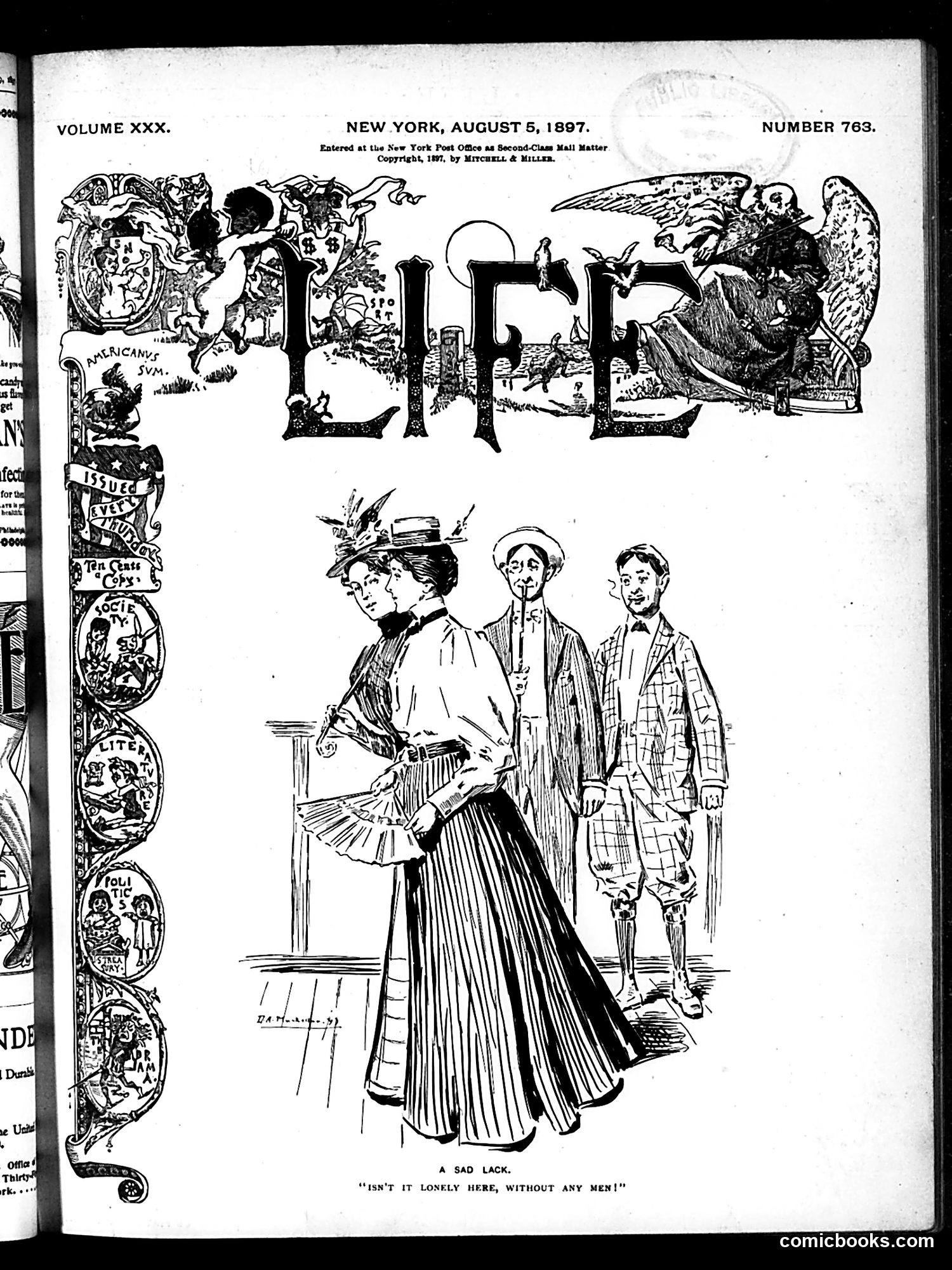
This cartoon satirizes the social predicament of an unattached woman in 1890s America. The illustration shows a woman with a fashionable hat standing alone while two men in suits observe her from behind. The caption reads: "ISN'T IT LONELY HERE, WITHOUT ANY MEN?" The satire mocks the era's assumption that a woman's happiness and social value depended entirely on male companionship. The woman's predicament—being surrounded by potential suitors yet apparently unpartnered—was treated as inherently tragic. The cartoon likely critiques both the shallow male-centered worldview of the period and society's narrow expectations for women, whose status was largely defined by romantic or marital attachment rather than independence or other pursuits.
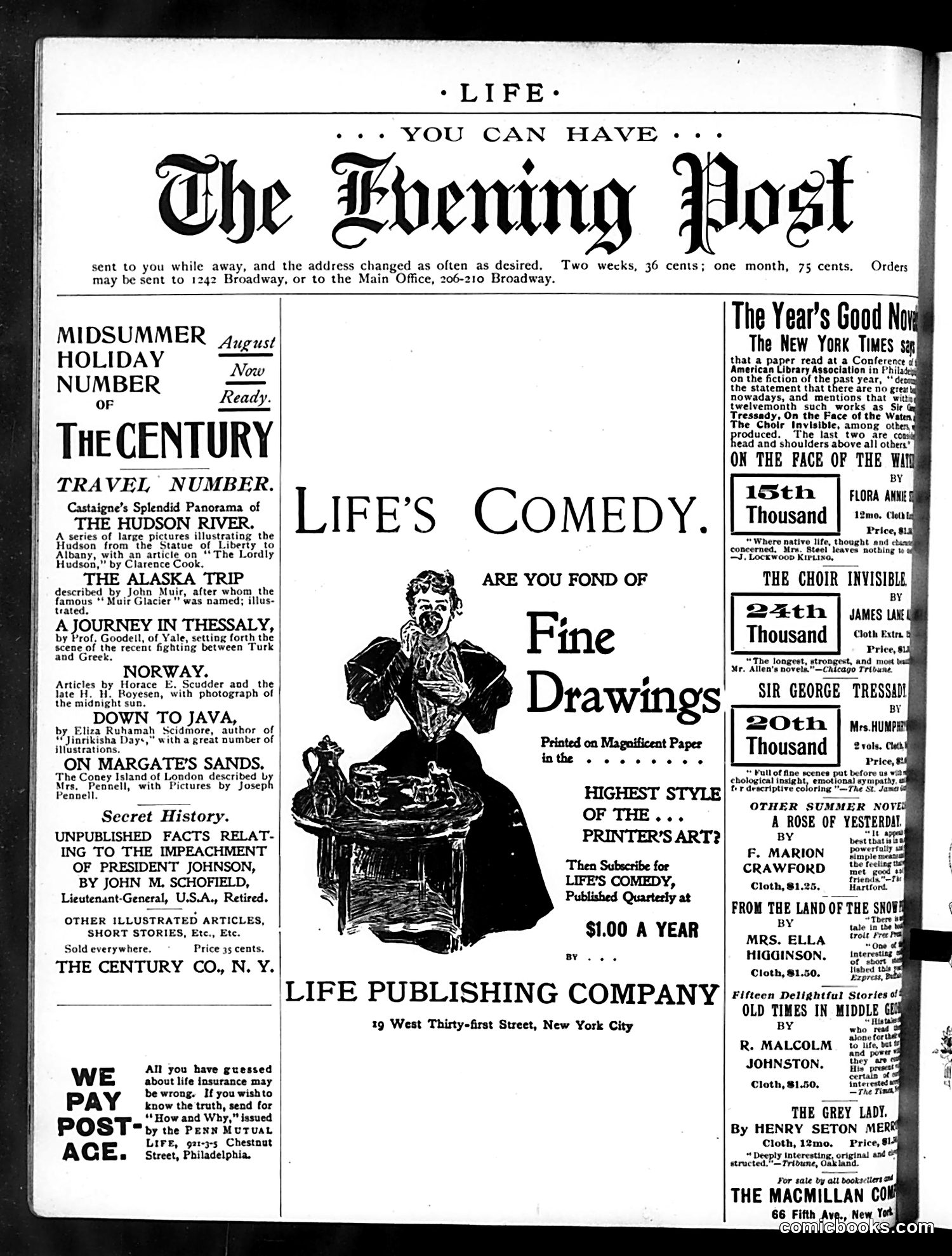
This page is primarily **advertising material** for Life Publishing Company and The Century magazine, not political satire. The central image shows a caricatured figure with exaggerated features at a drawing table—likely representing a cartoonist or artist—advertising "Life's Comedy" fine drawings. The figure appears to be a stock comedic character type common to early 20th-century magazines, used generically to represent artistic endeavor rather than to lampoon a specific political figure or contemporary person. The surrounding text advertises The Century's midsummer holiday travel number, various books, and Life's subscription rates. A small political note mentions President Johnson, but the page's primary purpose is magazine promotion, not satirical commentary.
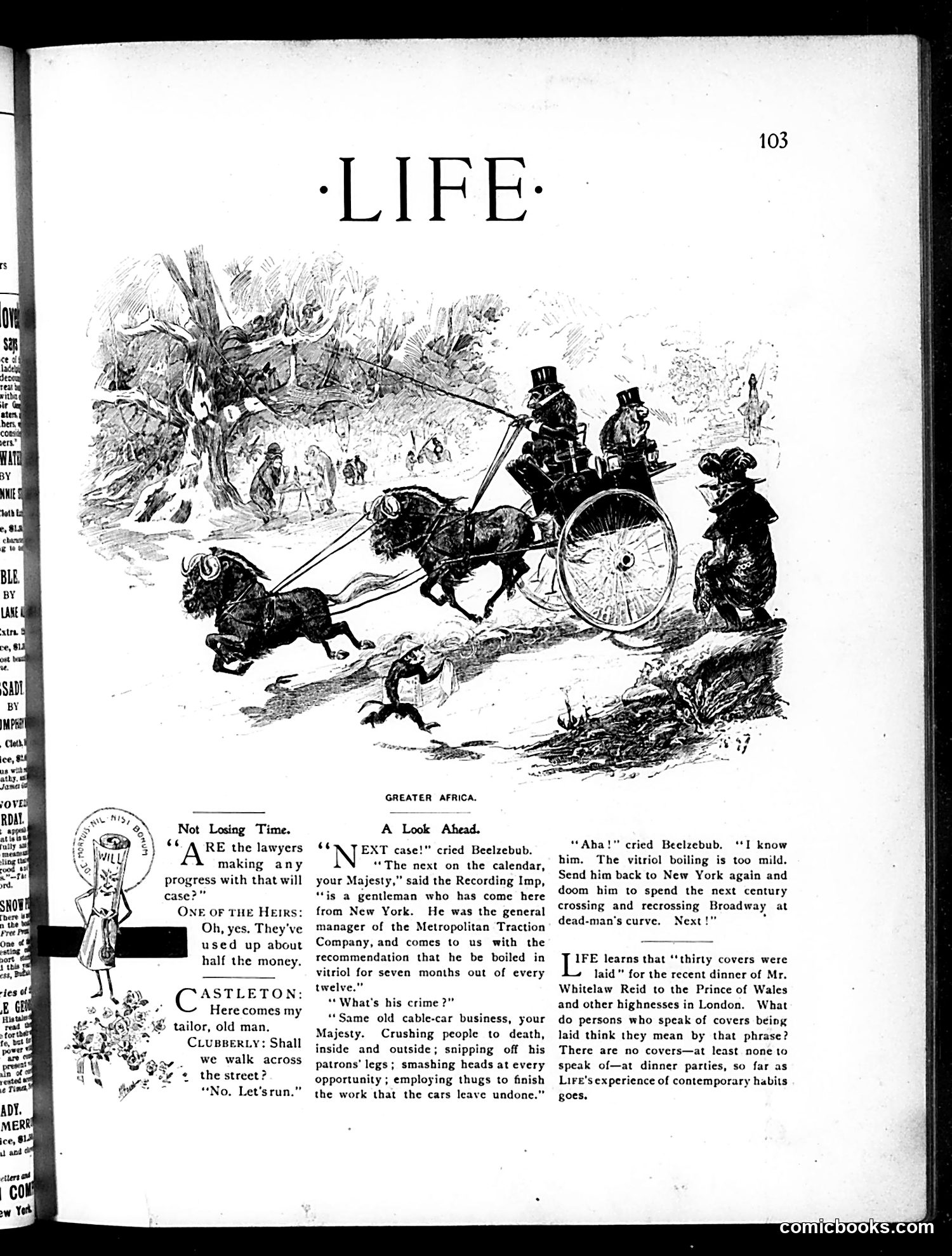
This page contains satirical dialogue about lawyers and legal progress. The main cartoon depicts a fantastical scene set in "Greater Africa" with two figures in top hats riding in an unusual contraption pulled by what appears to be a large animal. The dialogue jokes about lawyers making slow progress ("not losing time") while handling cases involving inheritance and money disputes. One character, Castleton, describes a chaotic street scene of cable-car accidents and violence, while another (Crubberly) suggests they "run" from the danger. The satire critiques both the legal profession's inefficiency and the hazards of contemporary urban transportation (cable cars), suggesting lawyers exploit disorder rather than resolve it. The exotic African setting appears purely whimsical, typical of early 20th-century Life magazine's absurdist humor style.
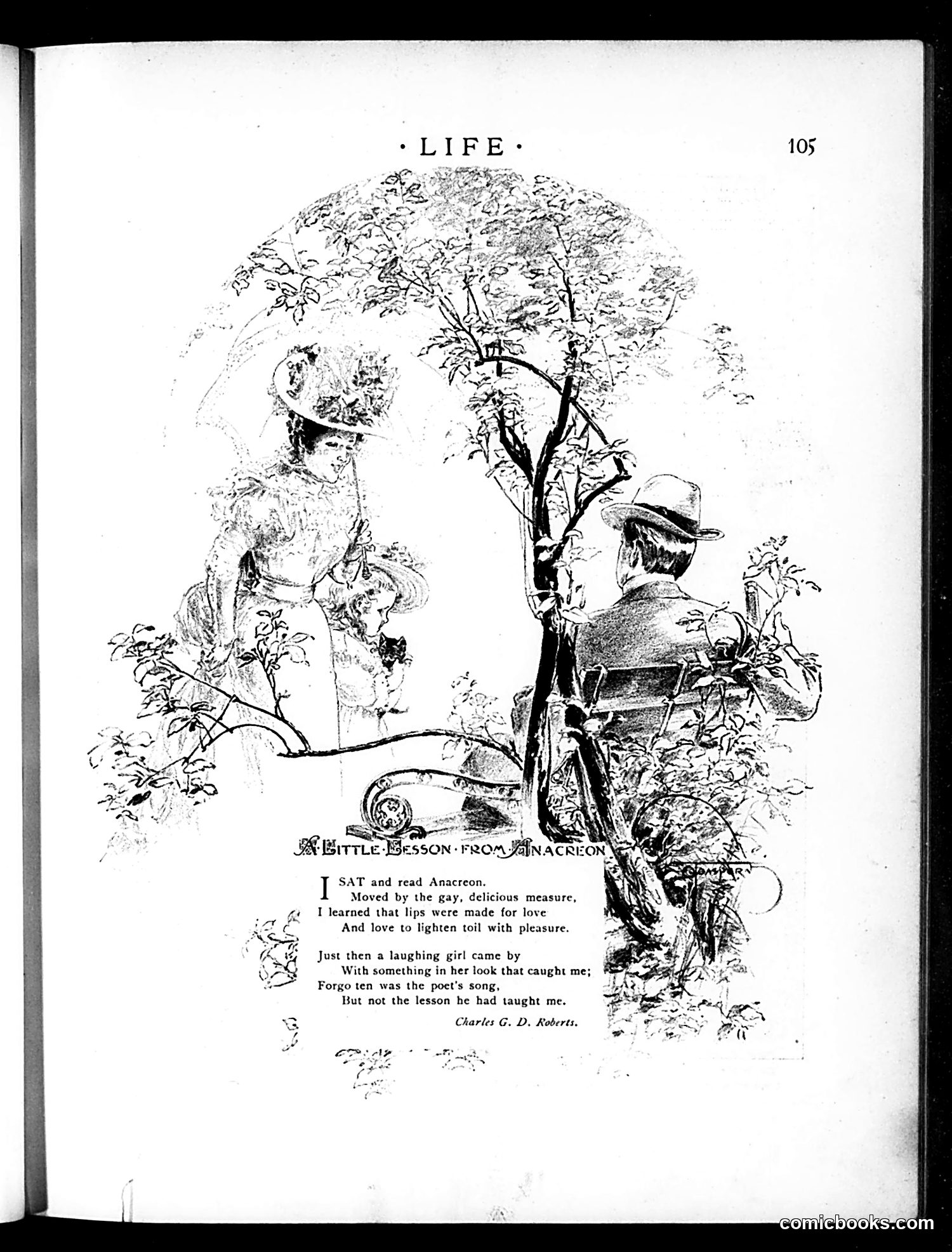
This page illustrates a poem by Charles G.D. Roberts titled "A Little Lesson from Anacreon." The image shows two figures in a garden setting beneath a tree—a woman on the left and a man on the right, both dressed in late 19th or early 20th-century clothing. The poem's narrative concerns romantic instruction: the speaker learns about love's pleasures from reading the ancient Greek poet Anacreon, but gains his true education from encountering "a laughing girl" in person. The satire gently mocks the contrast between literary romanticism and lived experience—books teach theory, but actual human interaction teaches genuine lessons about love and desire. The illustration romanticizes this encounter through pastoral imagery.
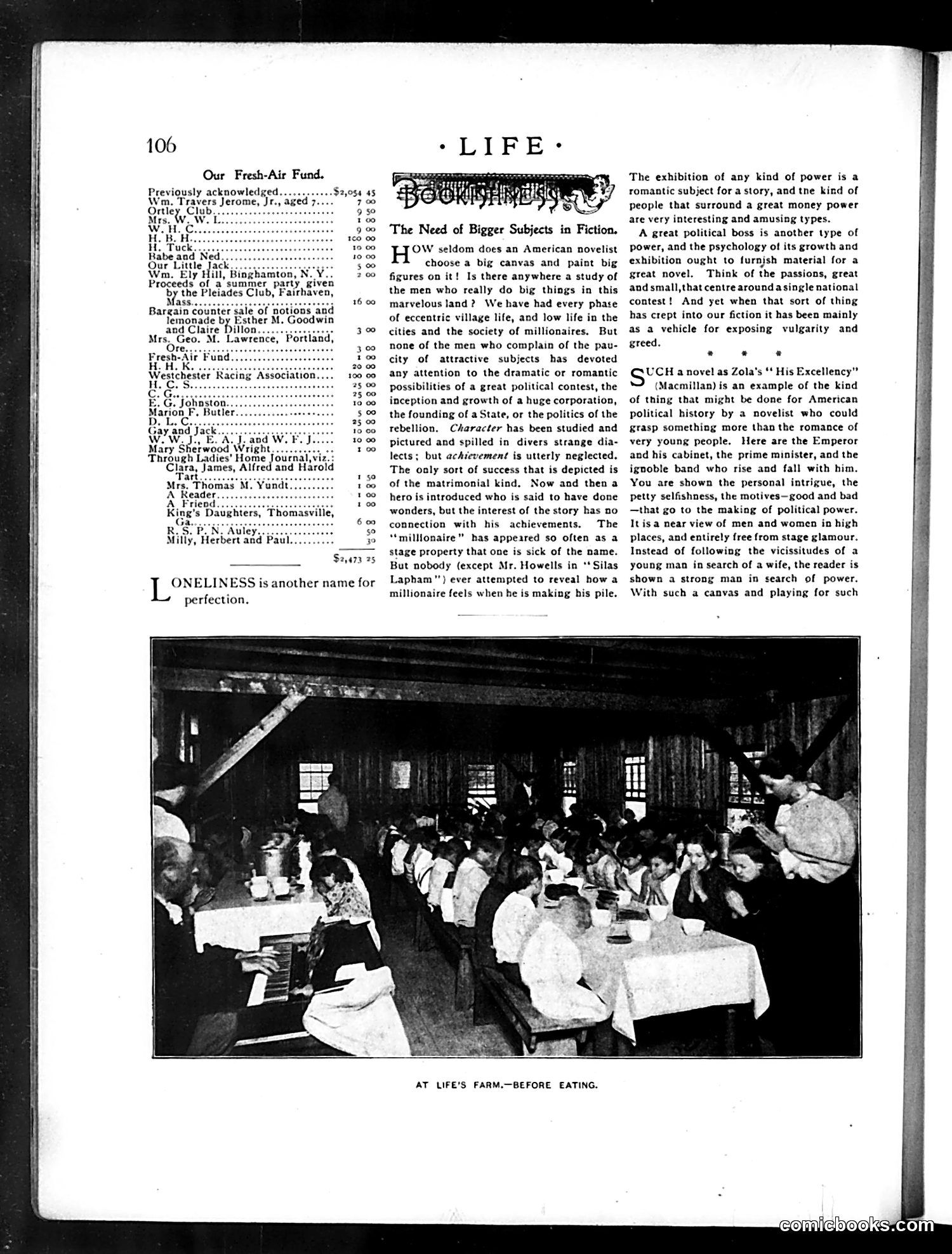
This page contains no political cartoon. Instead, it features: 1. **"Our Fresh-Air Fund"** – A charitable donation list showing contributions to what appears to be a children's welfare organization, listing names and amounts ($7.00, $3.00, etc.). 2. **"The Need of Bigger Subjects in Fiction"** – An essay arguing that American novelists should tackle grander themes like politics and power, rather than focusing narrowly on village life or romance. The author criticizes fiction's neglect of how political leaders actually operate. 3. **A photograph captioned "At Life's Farm—Before Eating"** showing what appears to be a dining hall or common area with many people at tables, likely documenting the Fresh-Air Fund's charitable work. This is primarily a charitable appeal and literary criticism page, not satirical content.
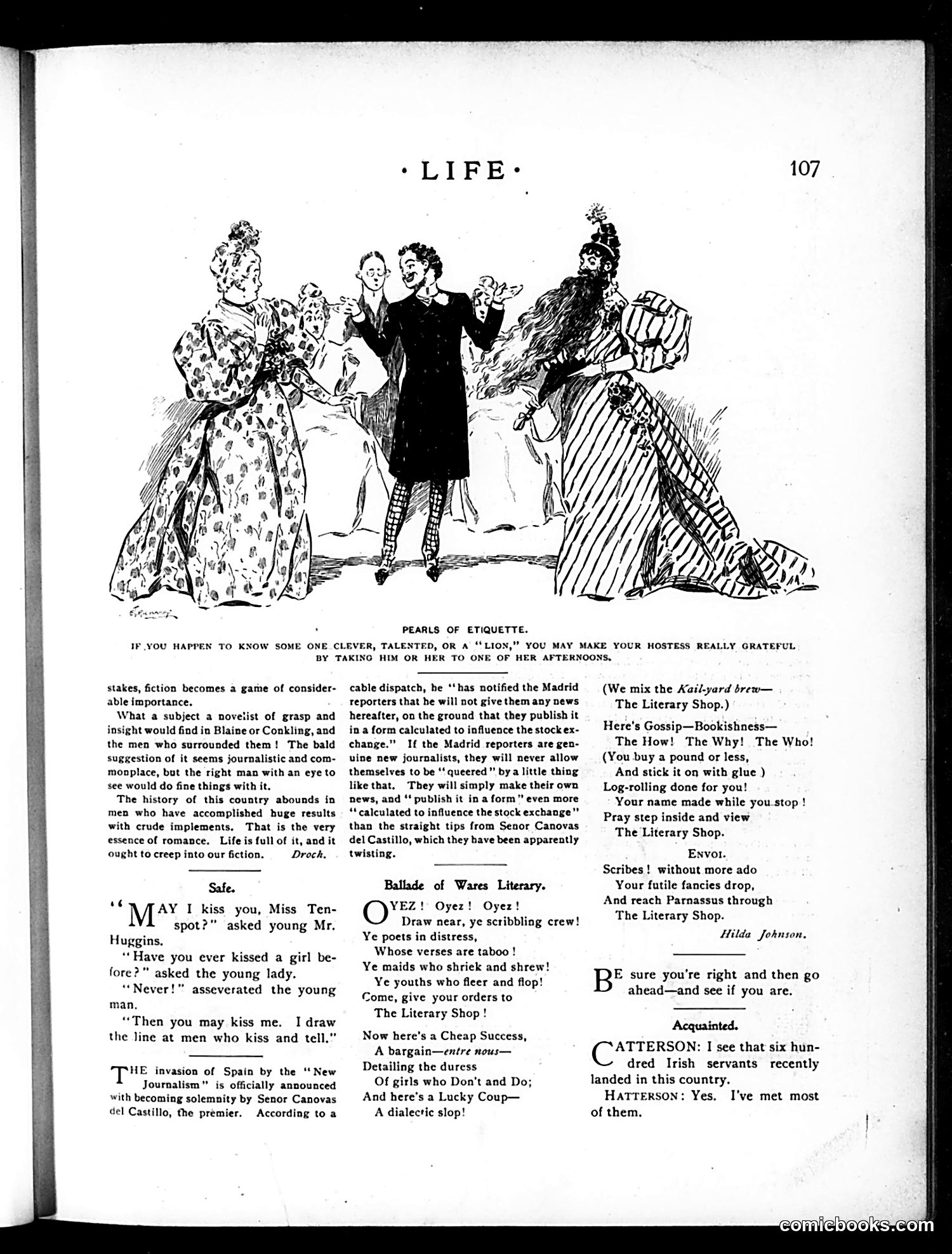
The top illustration titled "Pearls of Etiquette" depicts a social scene where a man in dark formal wear stands among elaborately dressed women, appearing to entertain them. The caption advises that if you know "some one clever, talented, or a 'lion,'" you may make your hostess grateful by bringing them to an afternoon gathering. This satirizes upper-class social climbing and the practice of using notable or famous individuals as social props to elevate a hostess's standing. The exaggerated dress of the women and the central male figure's prominent positioning mock Victorian-era social pretension and the commodification of celebrity or talent for entertainment purposes. The page also contains humorous short pieces about literature and Irish servants, typical of Life's satirical content from this era.
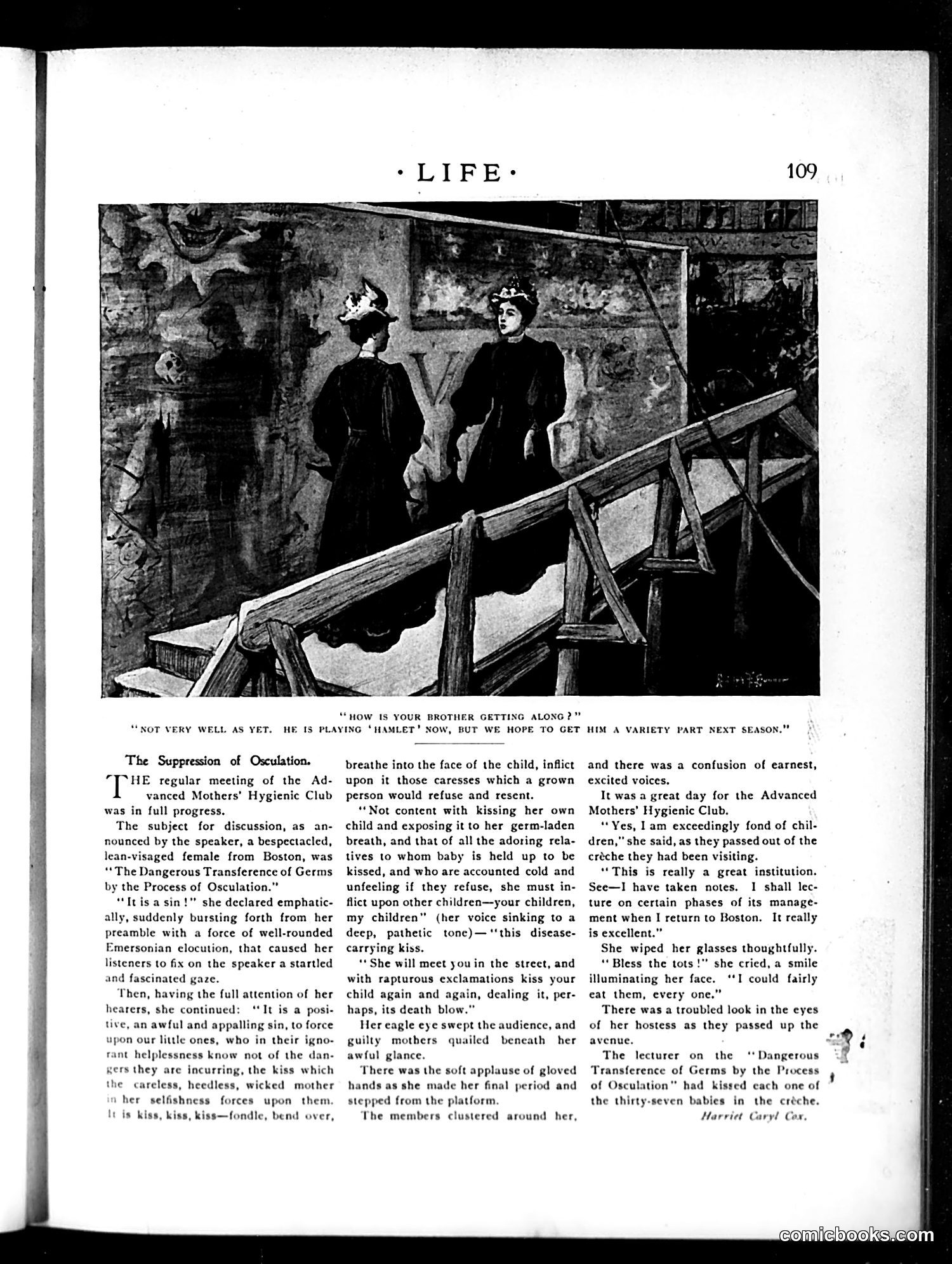
This page satirizes the "Advanced Mothers' Hygiene Club," which advocates against kissing children due to germ transmission concerns. The photograph shows two women at what appears to be a lecture or meeting about hygiene. The text mocks the speaker's emphatic warnings that mothers' kisses spread disease to children. The satire targets the tension between modern scientific hygiene concerns and traditional maternal affection—suggesting the hygiene movement has become absurdly extreme in asking mothers to suppress natural physical displays of love. The caption's dialogue about a brother playing "Hamlet" appears to reference theatrical performance, possibly contrasting dramatic artificiality with genuine maternal behavior. The overall joke ridicules the tension between contemporary public-health messaging and common parenting practices that audiences would find emotionally absurd to abandon.
This page contains three editorial cartoons addressing contemporary economic and political issues: 1. **"Anxiety Allayed"** depicts anxieties about the Sugar Trust's monopoly power, referencing the Wilson tariff controversy. The cartoon satirizes trust supporters who claim prosperity has arrived. 2. **"Aurora Borealis Gold Mines"** shows two rabbits or hares—likely representing miners or prospectors—in a humorous take on the Klondike gold rush, which was attracting fortune-seekers to Canada. 3. **"Too Bad!"** concerns Lehigh University's financial difficulties. The text criticizes the university's trustees for mismanagement and inability to properly maintain their property, appealing for charitable donations to prevent institutional collapse. The page reflects 1890s concerns about monopolies, resource rushes, and institutional stability.
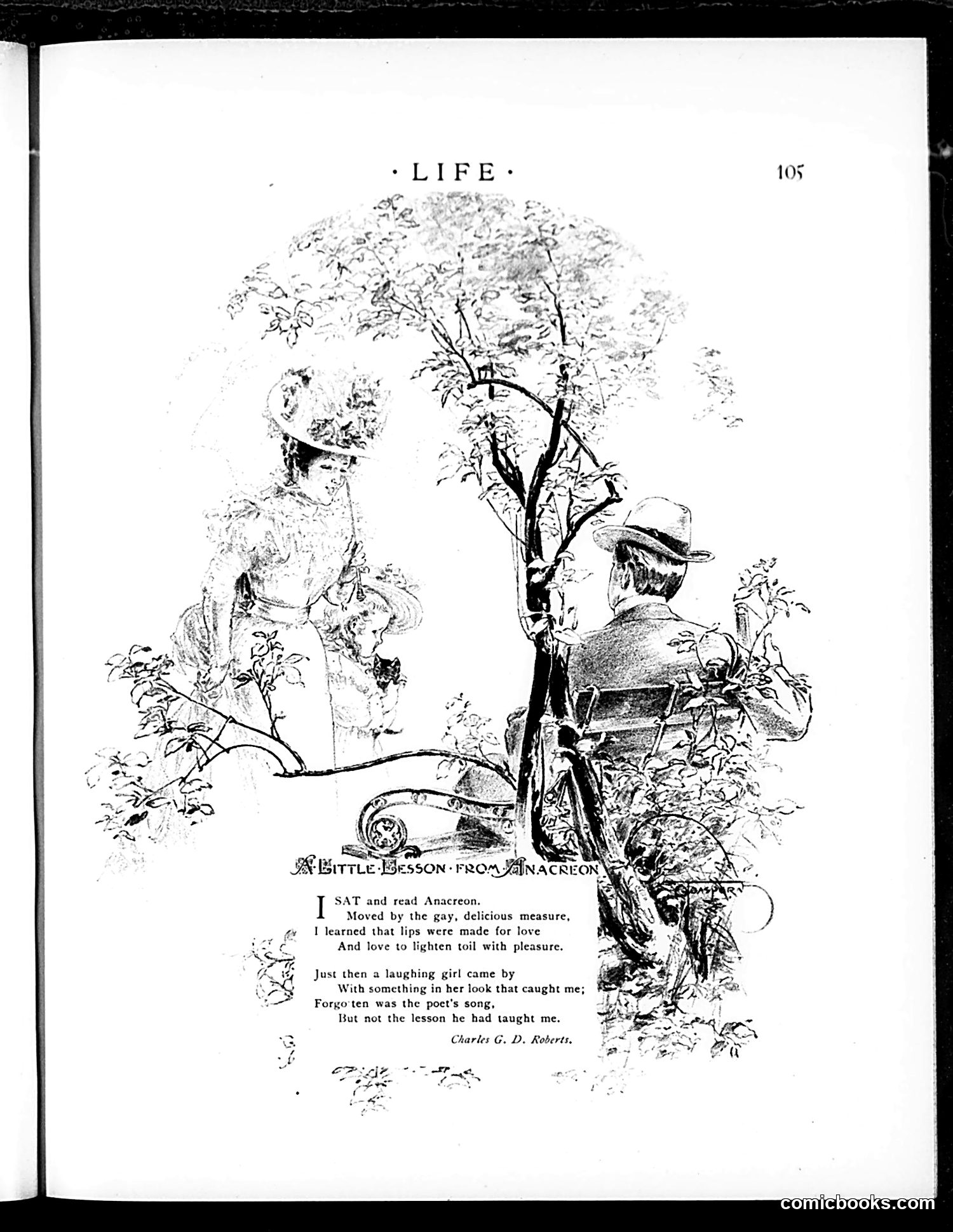
This page presents a romantic illustration with an accompanying poem by Charles G. D. Roberts. The image shows two figures in period dress near a tree in a garden setting—one seated, one standing—suggesting a moment of courtship or romantic encounter. The title references Anacreon, an ancient Greek poet famous for love poetry. The poem's narrative describes the speaker learning about love's pleasures from observing lips, only to be distracted when "a laughing girl came by." The final lines suggest the girl's appearance taught him something more important than the philosophical lesson—implying practical romantic experience supersedes theoretical knowledge. This appears to be sentimental, lighthearted content rather than political satire, typical of *Life* magazine's mixed editorial and literary material.
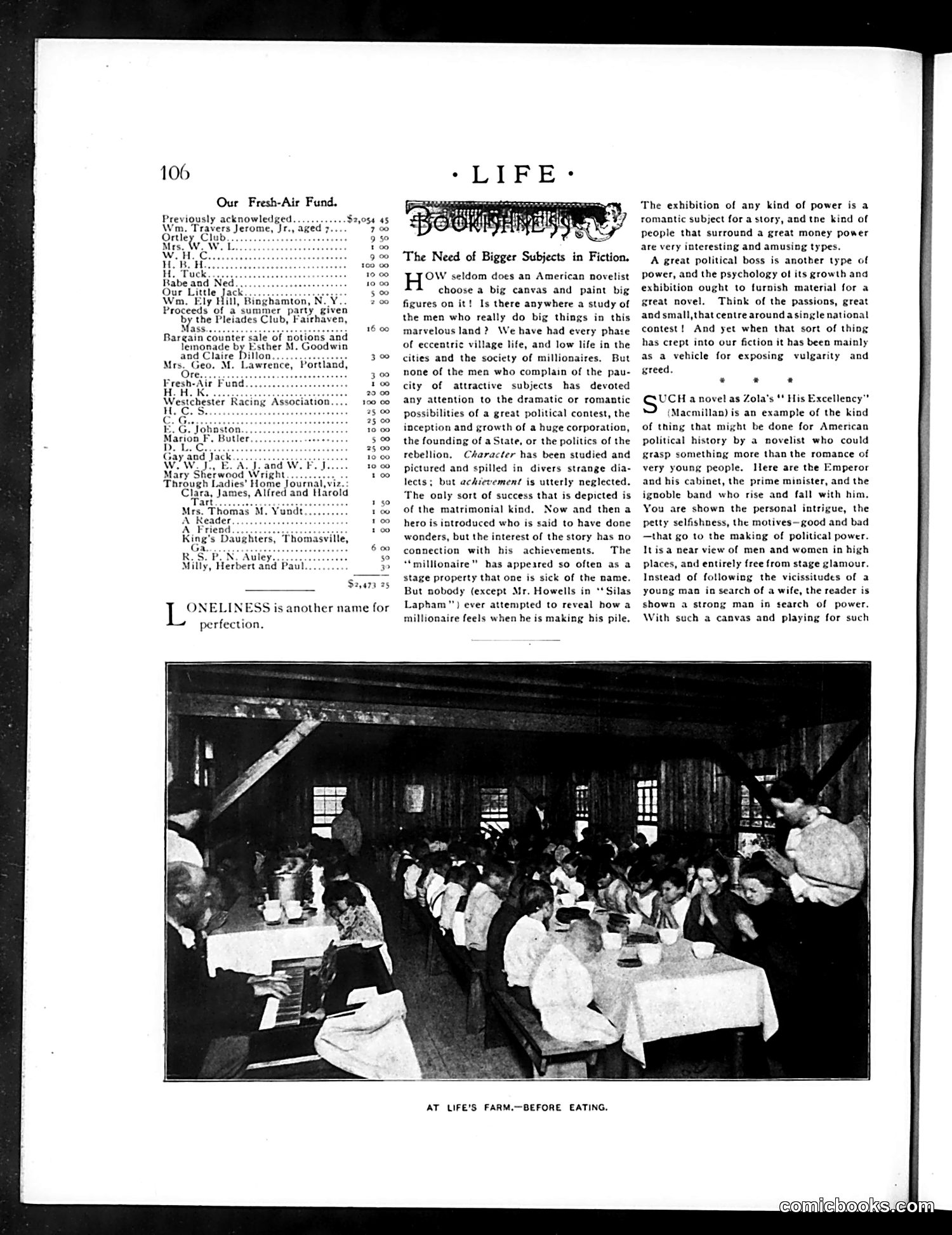
This page contains a fundraising appeal ("Our Fresh-Air Fund") listing donors, plus an article titled "The Need of Bigger Subjects in Fiction." The article critiques American novels for ignoring dramatic real-world subjects—political power, corporate growth, state politics, rebellion—in favor of romantic plotlines and "matrimonial" concerns. It specifically praises Zola's work and argues that American fiction should engage with larger political and social themes rather than personal intrigue. The photograph captioned "AT LIFE'S FARM—BEFORE EATING" shows what appears to be a charitable dining facility, likely the Fresh-Air Fund's operation providing meals to underprivileged urban residents. The image supports the fundraising appeal on the same page. The magazine thus combines social advocacy with cultural criticism about literature's proper scope.
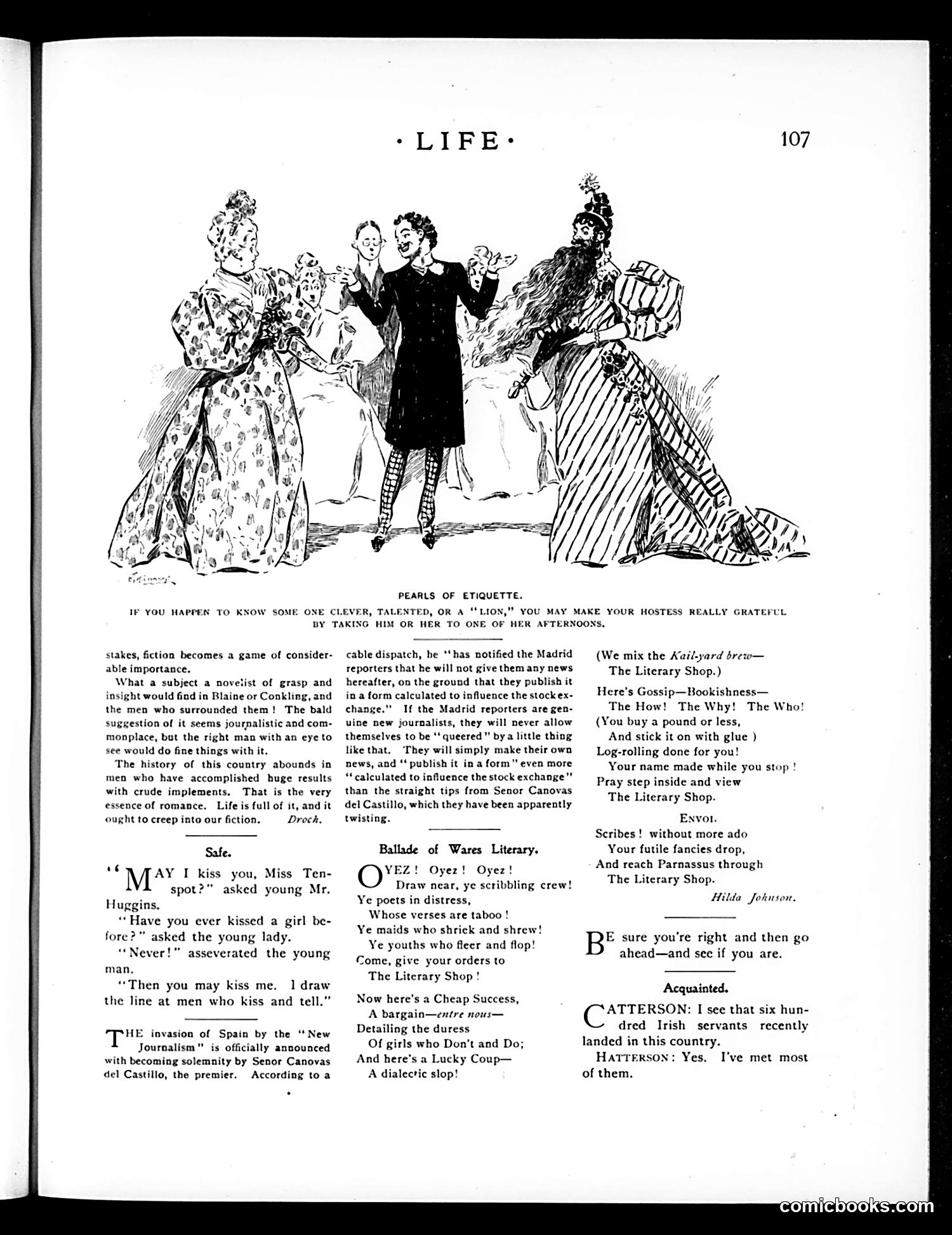
This page contains three satirical pieces about late-19th-century American society and journalism. **"Pearls of Etiquette"** offers tongue-in-cheek social advice, with the main cartoon depicting a hostess introducing a "clever" or famous person ("lion") to her guests—satirizing the social ambition of the era's aspiring upper class who sought prestige through association with notable figures. **"Safe"** is a brief romantic dialogue mocking courtship conventions, where a young man asks permission to kiss only after the woman establishes he won't "kiss and tell"—poking fun at Victorian propriety and gossip culture. **"Ballade of Wares Literary"** and the Spanish journalism dispatch together mock the commercialization of literature and the rise of "New Journalism" (sensationalist reporting). The piece critiques hack writers, derivative works, and newspapers willing to manufacture news to influence markets—suggesting journalism had become just another commercial commodity rather than a serious enterprise.
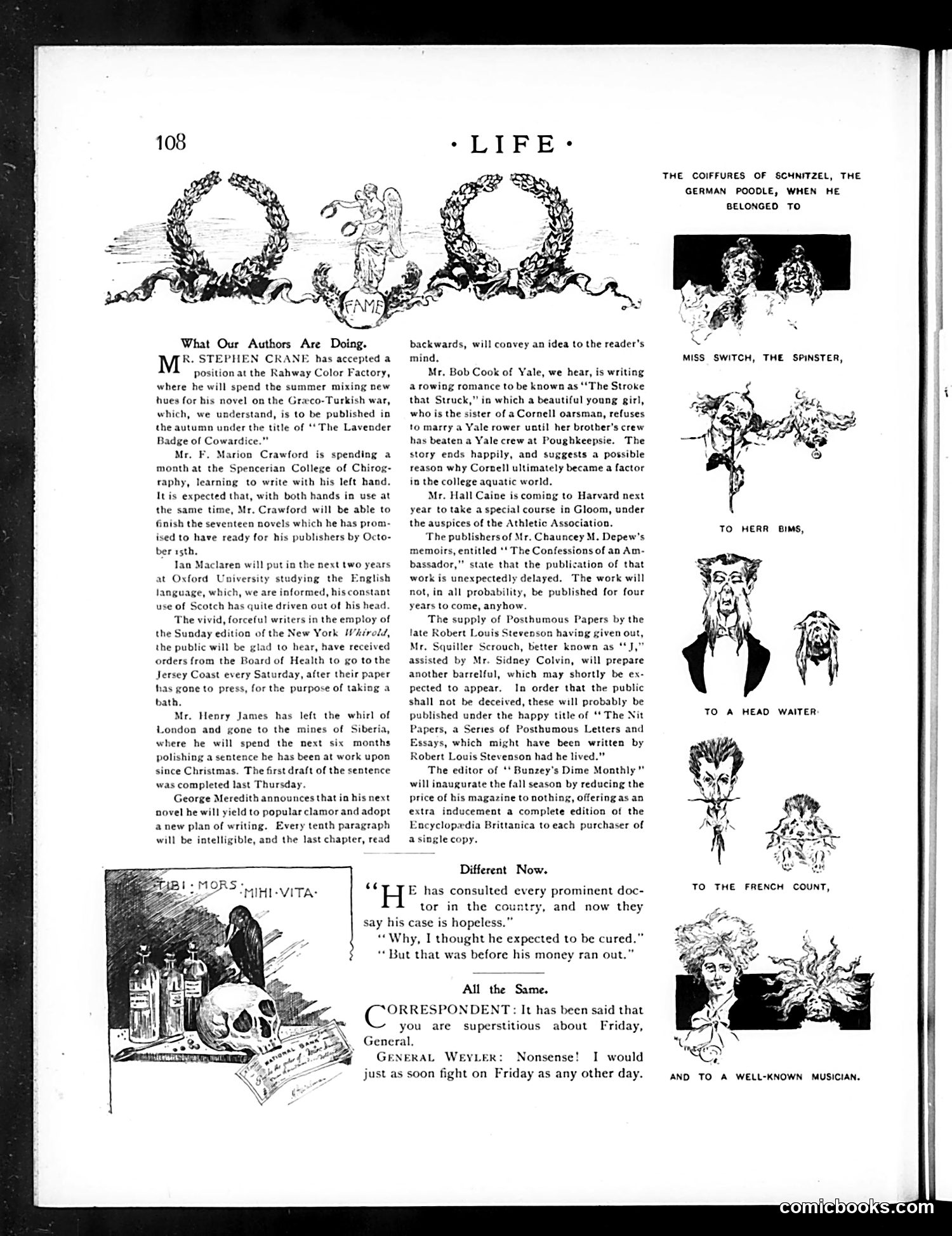
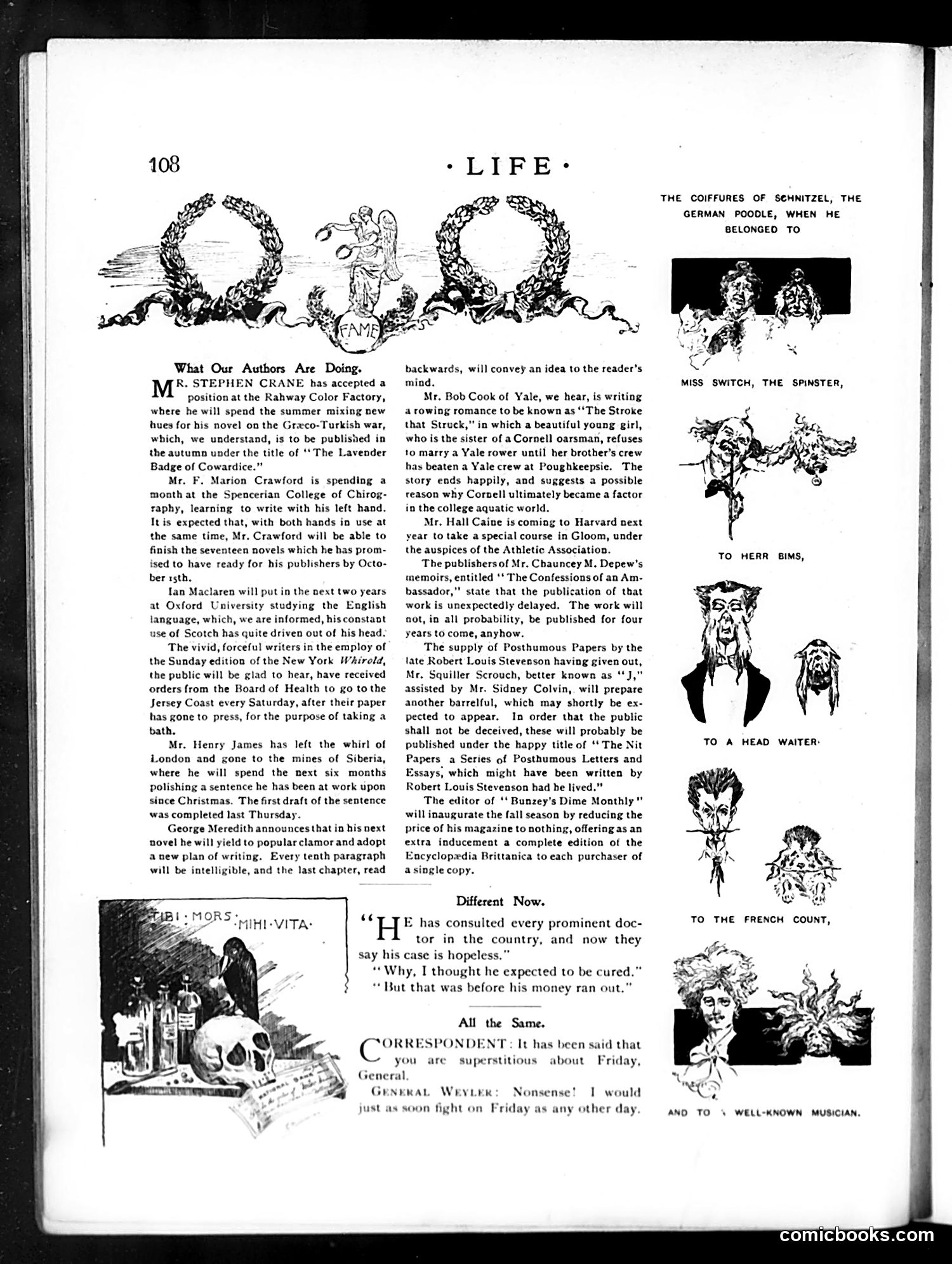
This page mocks prominent late-19th-century writers through absurdist humor. Stephen Crane is caricatured as mixing "lavender" paint while writing about war—a jab at his artistic pretension. F. Marion Crawford, a prolific novelist, is satirized for needing both hands to write seventeen novels by October. Jan Maclaren's Scots dialect is mocked as having "driven out" English entirely. The jokes target literary excess: George Meredith's deliberately obscure prose (every tenth paragraph intelligible), Henry James's notorious sentence-polishing (six months on one sentence), and Hall Caine studying "Gloom" at Harvard. Robert Louis Stevenson's posthumous papers are so exhausted that new ones must be fabricated under false titles. The satire assumes readers recognize these authors and their reputations—Crane's war novels, Crawford's output, James's complexity. The jokes work through exaggeration of each writer's known stylistic quirks.
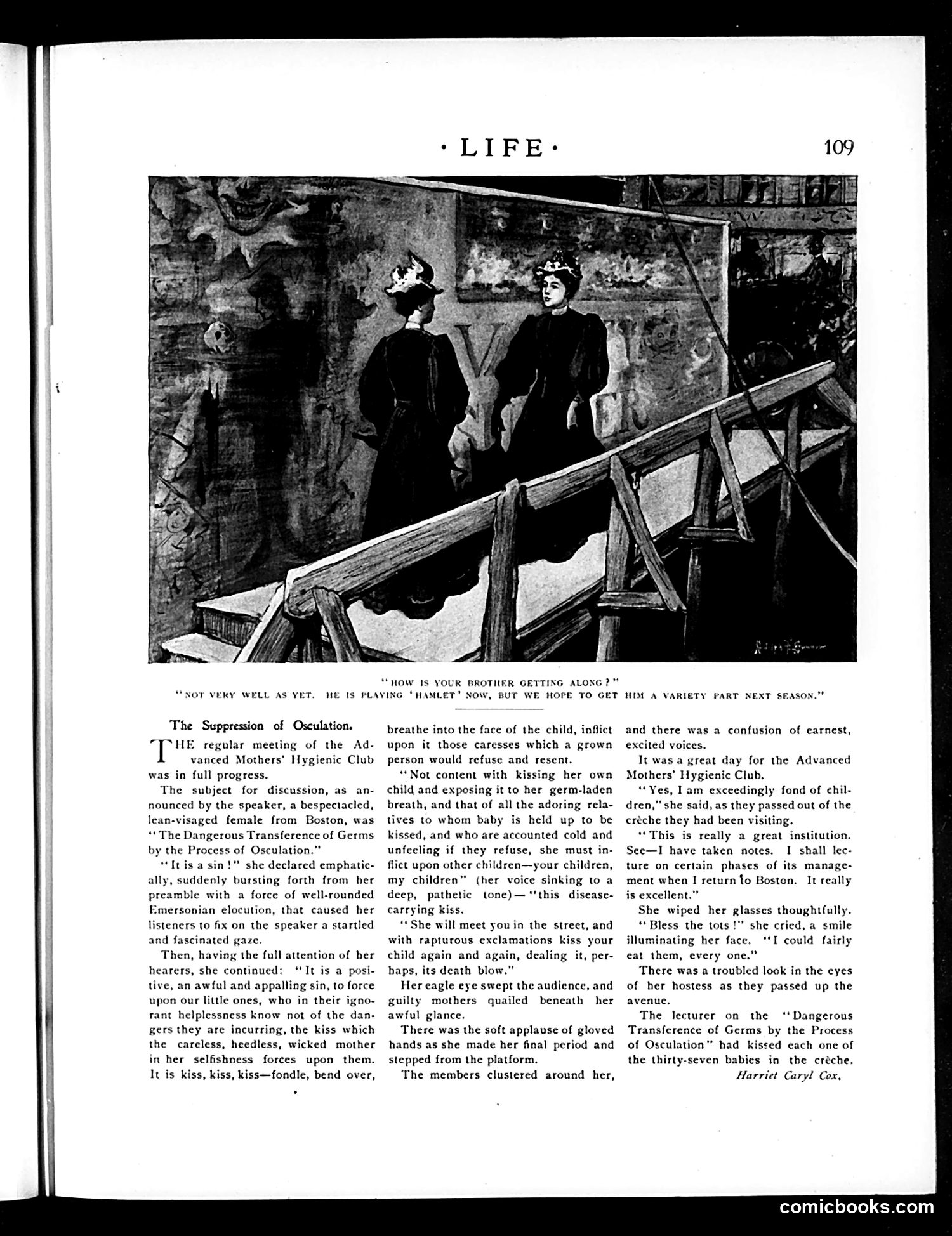
This page satirizes the "Advanced Mothers' Hygienic Club," a Boston organization of progressive women concerned with germ transmission via kissing. A severe, bespectacled lecturer delivers an impassioned sermon warning mothers that kissing children spreads disease—calling it a "sin" and "awful" practice. The satire's target is the *hypocrisy* of the speaker: after her lengthy condemnation of indiscriminate child-kissing, she visits a creche (orphanage) and kisses all thirty-seven babies there, remarking she could "fairly eat them, every one." Her hostess appears troubled by this contradiction. The joke mocks overzealous hygiene crusaders and "advanced" reform movements of the early 1900s—specifically their sanctimonious rhetoric that contradicts their actual behavior. The small inset image shows two fashionably-dressed women; the caption jokes about casting an actor in "Hamlet," establishing this as a comment on theatrical pretension alongside the hypocrisy theme.
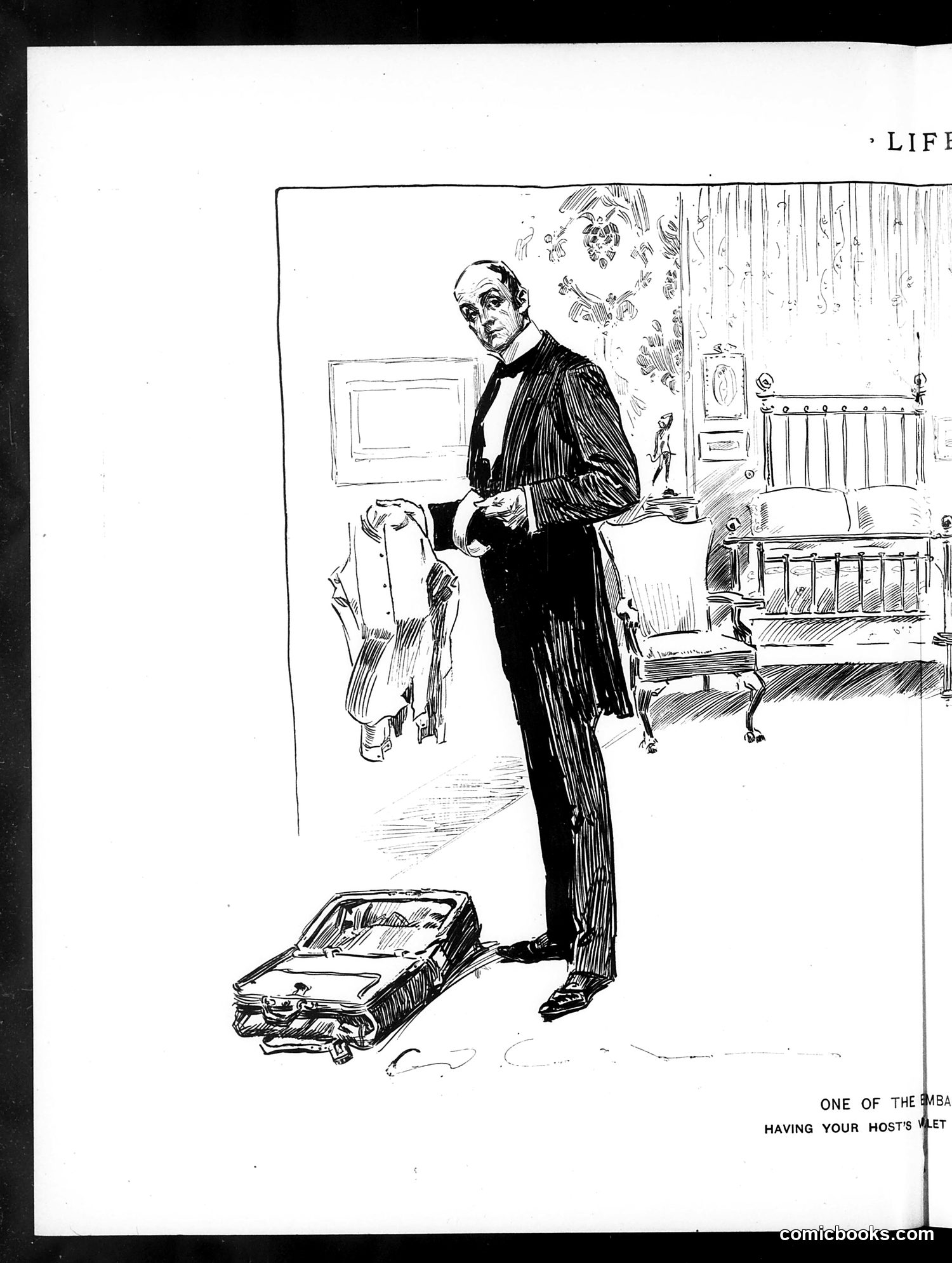
This appears to be a satirical illustration from *Life* magazine depicting a social etiquette scenario. The cartoon shows a formally dressed man in a tuxedo standing in an elegant bedroom, looking down at what appears to be a small toy car or automobile at his feet. The partially visible caption reads "ONE OF THE EMBARRASSING THINGS ABOUT HAVING YOUR HOST'S WALLET" (the text is cut off on the left). This suggests the joke concerns social awkwardness—the formal gentleman has apparently somehow ended up with his host's wallet, creating an uncomfortable situation. The satire likely mocks the pretensions of high society and the embarrassment of minor social mishaps among the wealthy. The contrast between the man's formal attire and the trivial toy car underscores the humor of the situation.
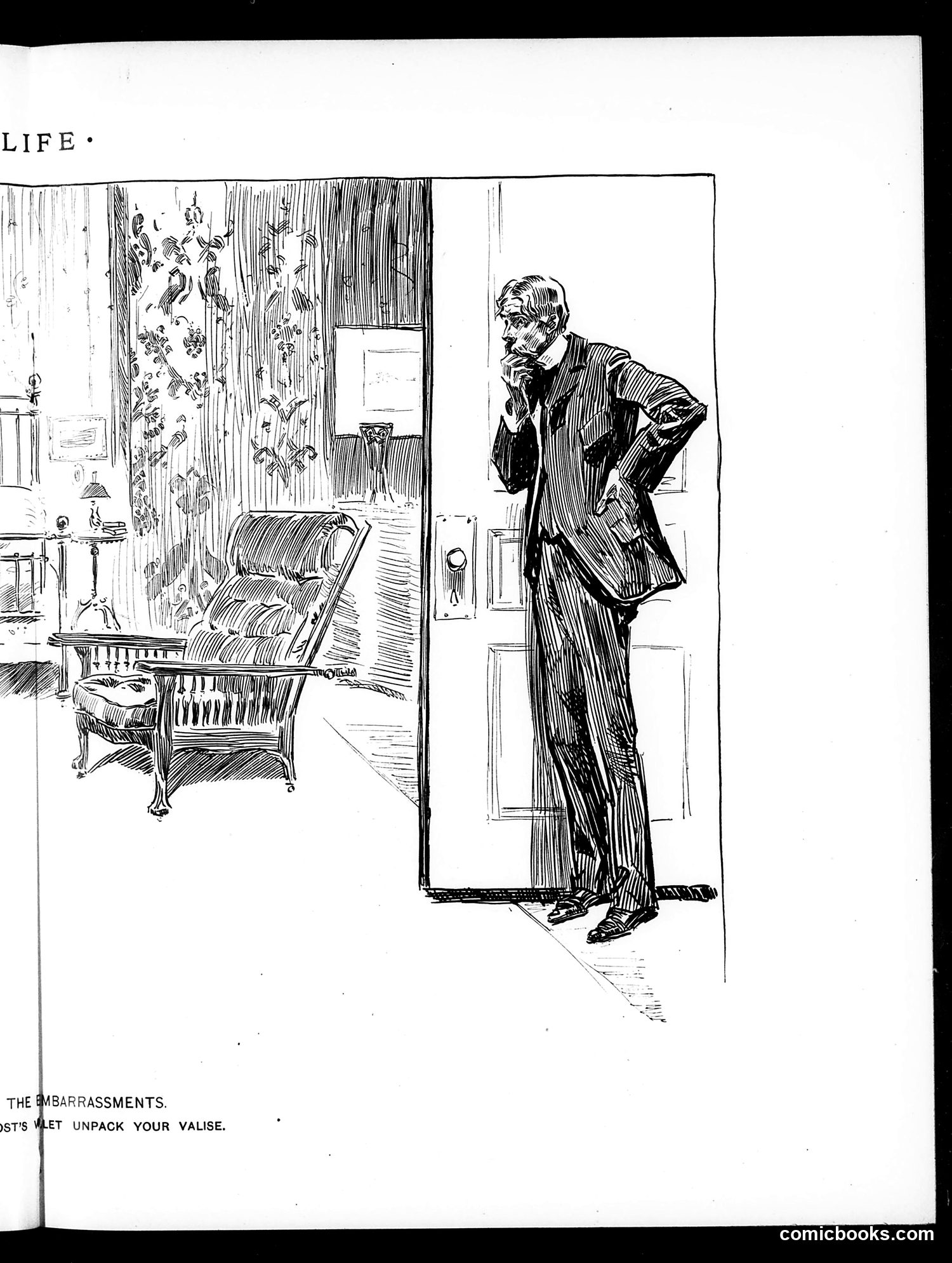
This cartoon depicts a social awkwardness scenario. A well-dressed man in a suit stands awkwardly at a doorway, hand to his face in an embarrassed gesture. Behind him is a furnished room with a chair and patterned curtains. The caption reads: "GUEST'S VALET UNPACK YOUR VALISE." The humor appears to center on a gentleman caller arriving at a woman's residence with a valet and luggage, creating an improper or scandalous appearance—suggesting an overnight stay that would be socially inappropriate or compromising to the woman's reputation. The guest's embarrassed posture indicates he's realized the awkwardness of the situation. This reflects early 20th-century social conventions where unmarried men and women had strict behavioral codes.
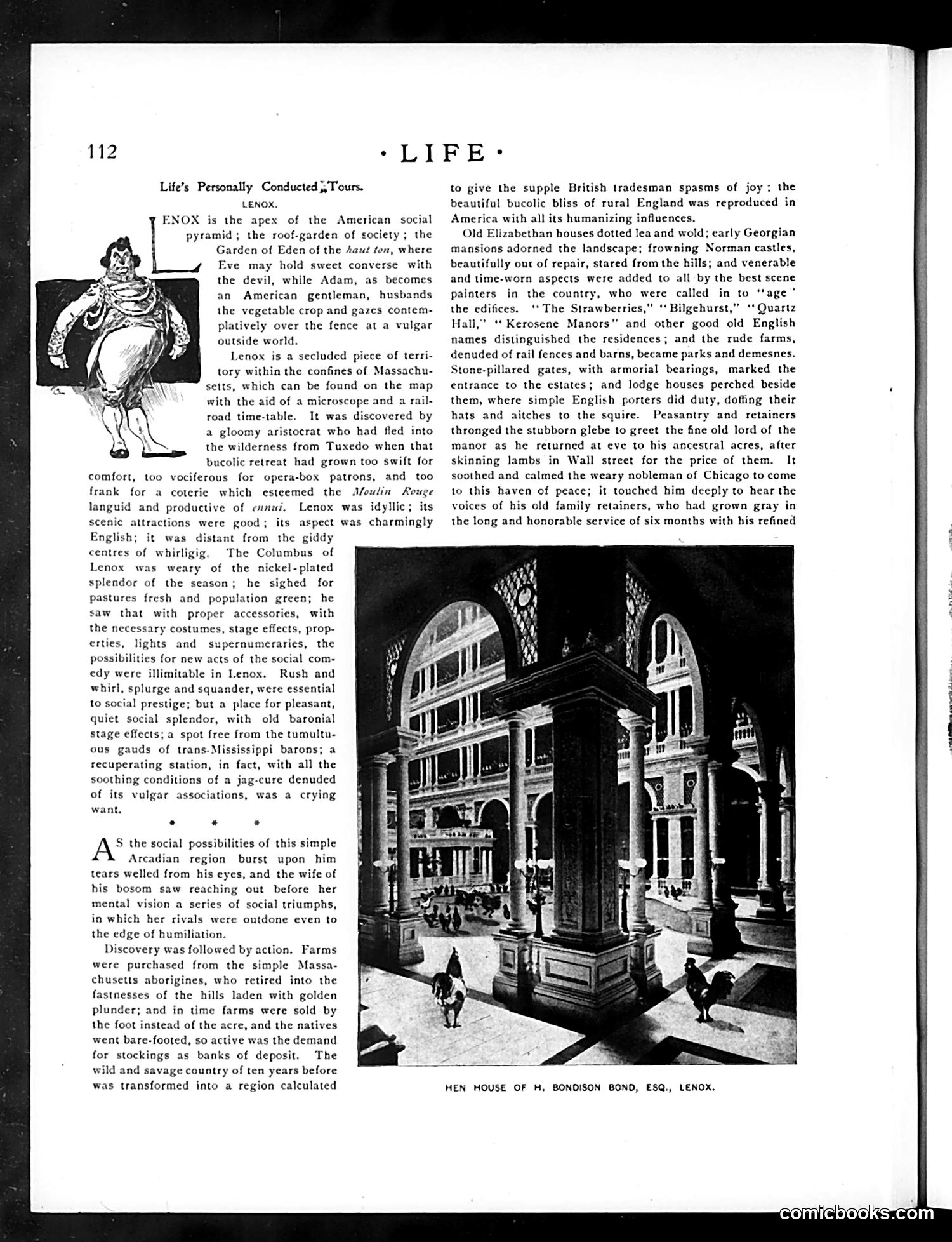
This page satirizes the American wealthy elite's attempt to recreate English aristocratic life in Lenox, Massachusetts. The cartoon (left) depicts a portly, self-satisfied aristocrat—likely representing a wealthy industrialist or robber baron who made his fortune through crude commercialism ("skinning lambs in Wall street"). The satire mocks how these nouveaux riche Americans purchased farmland from local Massachusetts residents, transforming the region into an artificial recreation of English country estates with fabricated "old" mansions (Elizabethan, Georgian, Norman castles). The estates bore pretentious English names like "Bilgehurst" and "Quartz Hall." Life ridicules the absurd contradiction: these men accumulate wealth through aggressive American capitalism, then retreat to a staged, aristocratic fantasy—complete with hired English porters and fake "aged" architecture—to escape both their own vulgar success and other wealthy rivals. The transformation cost locals their farmland but enriched them temporarily, until demand for "stockings as banks of deposit" (hoarded wealth) depleted their resources. The joke: American wealth cannot authentically purchase Old World refinement.
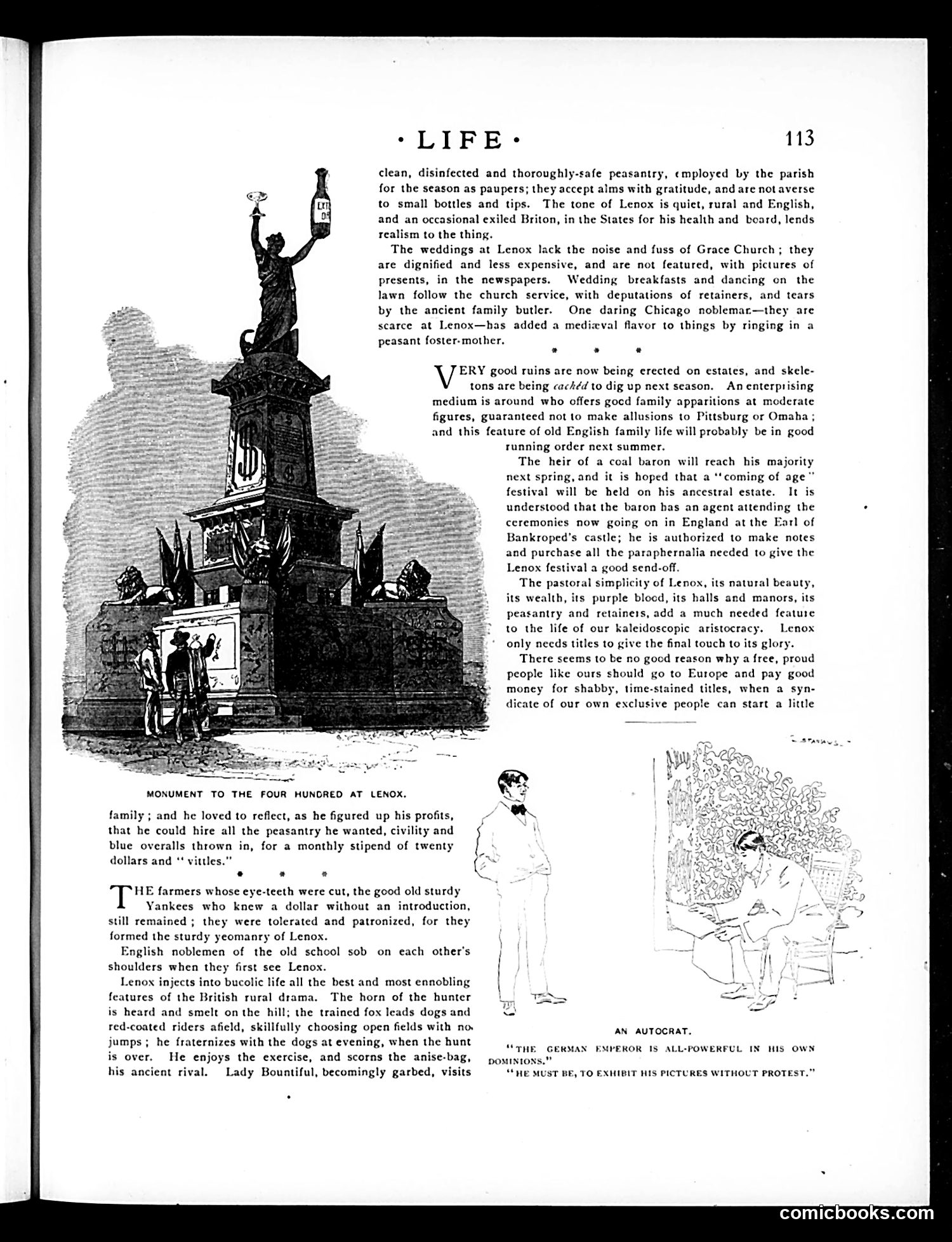
This page satirizes wealthy American industrialists attempting to recreate English aristocratic life in Lenox, Massachusetts. The text mocks their pretensions: they hire "peasants" seasonally, stage fake medieval weddings, and even artificially construct "ruins" and purchase "family apparitions" (ghosts) to simulate old-world authenticity. The central illustration shows the "Monument to the Four Hundred at Lenox"—referencing the elite social circle—depicting a church or tower where the wealthy gather. The satire's core joke: nouveaux-riche Americans, particularly coal barons and Chicago businessmen, are frantically importing European trappings (titles, servants, fox hunts, "Lady Bountiful" performances) to legitimize their status. The author argues sarcastically that America needs no European titles—"our own exclusive people can start a little" aristocracy instead. The "Autocrat" inset jokes about German imperial power, seemingly unrelated filler.
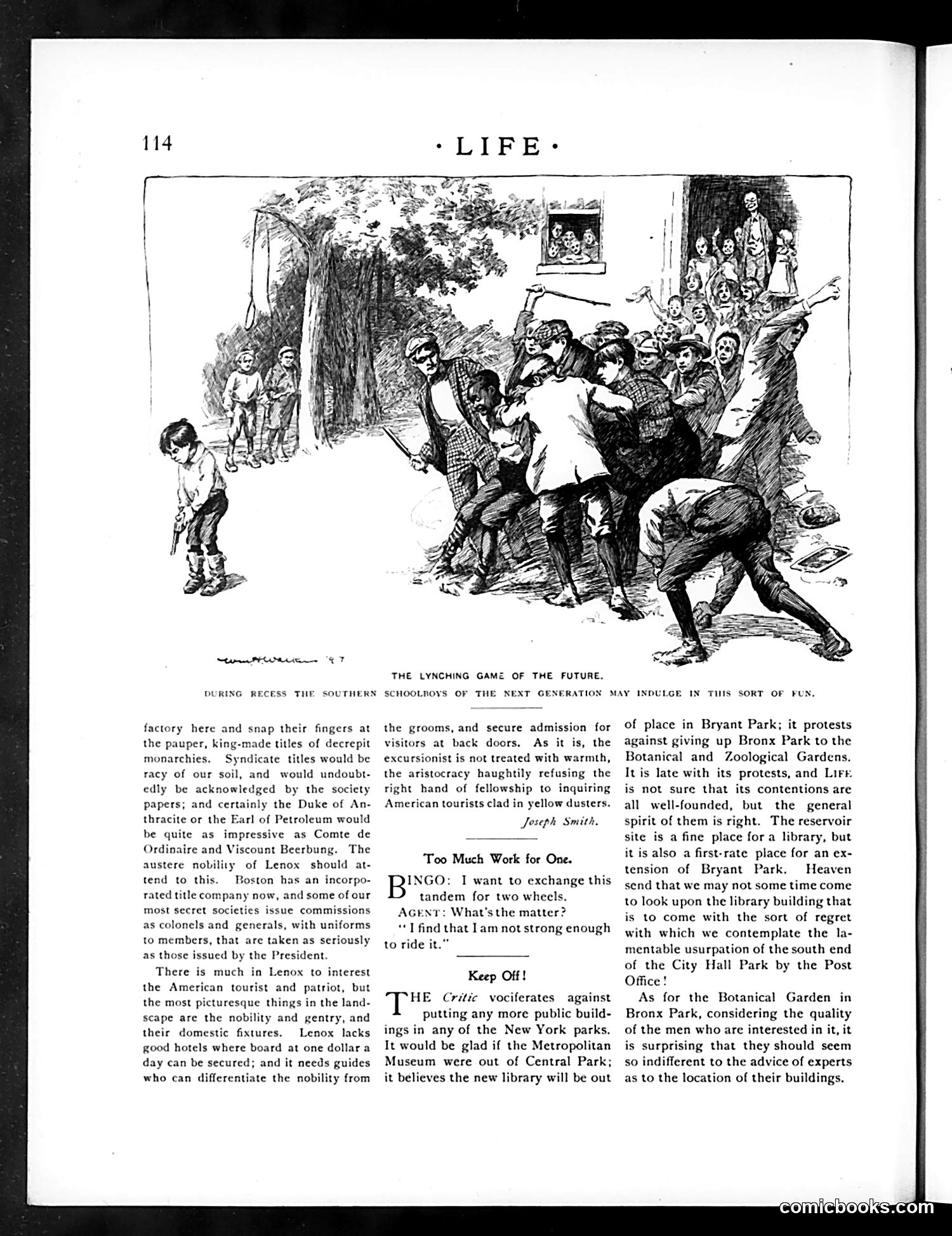
This satirical cartoon depicts schoolboys recreating a lynching as a casual game during recess. The image shows children in violent play—some hanging a figure, others cheering from a doorway—normalizing racial violence as entertainment. The satire targets the casual acceptance of lynching in American society, particularly in the South. By depicting it as children's recreation, the cartoonist critiques how normalized and acceptable such violence had become, suggesting that future generations would inherit this brutality as casual amusement rather than viewing it as aberrant. This reflects Life magazine's progressive stance on racial violence during the Jim Crow era. The accompanying text about Lenox, Massachusetts society and civic planning appears unrelated—typical of magazine layout from this period.
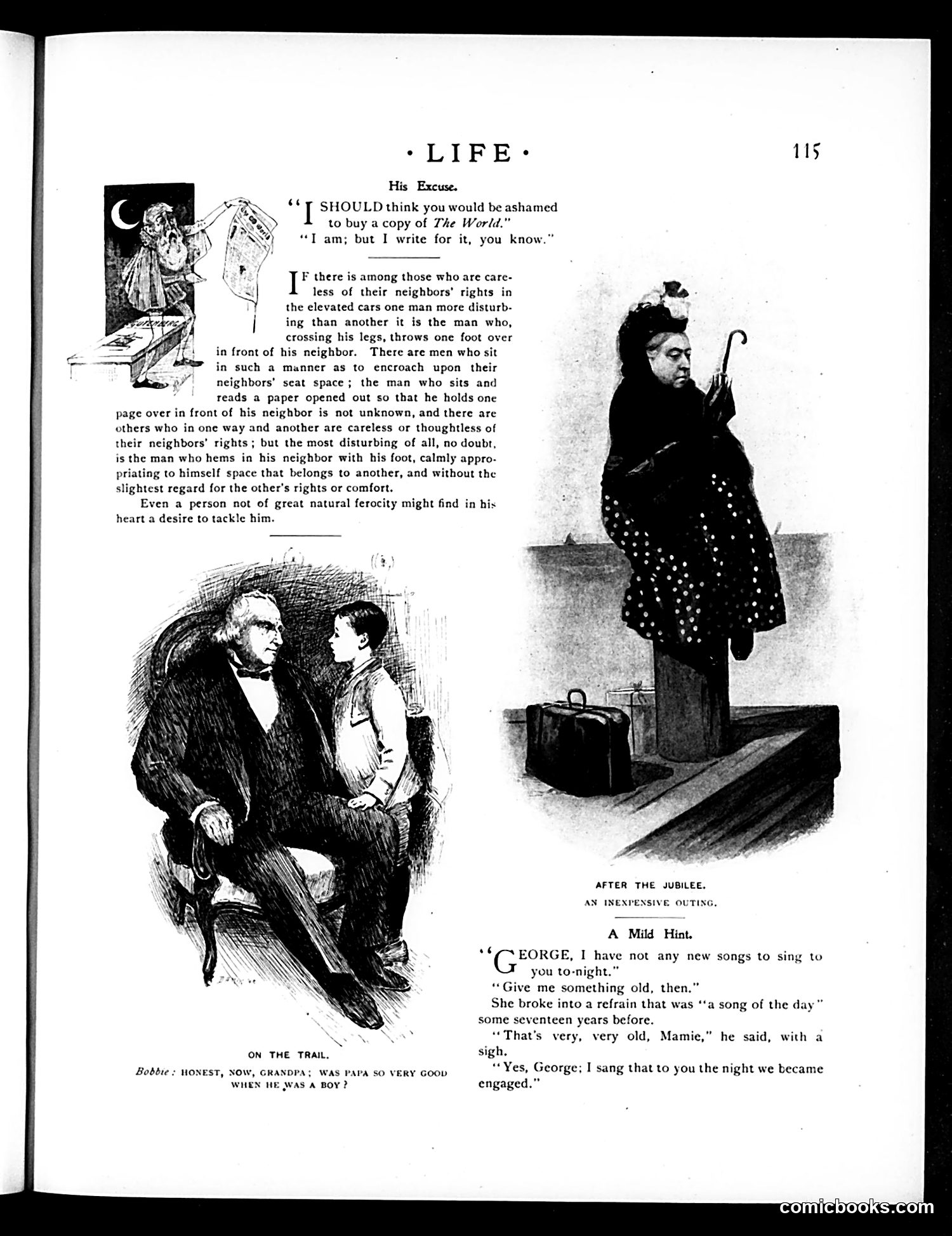
This page contains social satire typical of early 20th-century Life magazine. **"His Excuse"** mocks a writer for The World newspaper who defends buying it by claiming he writes for the publication—a self-serving justification. **"On the Trail"** depicts a grandfather and grandchild, with the boy asking if his father was good as a boy, presumably eliciting an embarrassing or unflattering reminiscence. **"After the Jubilee"** shows a woman departing after an outing, likely satirizing modest or disappointing entertainment. **"A Mild Hint"** presents marital domestic comedy: a husband asks his wife for new songs; she offers old ones instead. When he complains one song is "very, very old," she reveals it's the same song she sang the night they got engaged seventeen years prior—implying their relationship has stagnated unchanged since then. The "hint" suggests he should be grateful rather than critical. All pieces target everyday social behavior and relationships through gentle ridicule, characteristic of Life's humor style.
This page from *Life* magazine contains humorous anecdotal pieces typical of the publication's satirical format. The content mocks various social situations: **Key items:** - A Harvard/Yale/Cornell joke about competitive superiority - Domestic humor about a husband using tariff debates as an excuse to stay out late - Anecdotes about Old Peter Browning, a 19th-century baseball player known for drinking, who famously asked "Where is the chain?" when given a gold watch as a reward - A joke about punctuation: making "a dash after the notes" (pun on financial notes/musical notes) - Political satire about a senator's stock-market influence denial - Social commentary on jury duty excuses and poverty The advertisements (Ivory Soap, Yale tobacco, whiskey, etc.) reflect period consumer culture. The satirical tone targets human foibles—vanity, dishonesty, excess—rather than specific political figures.
This is primarily a **commercial advertising page** from Life magazine, not a political cartoon. It contains no satire or social commentary—just product promotions typical of early 1900s publications. The ads showcase consumer goods and services: Armour's beef extract, travel packages to California and Mexico, Boston hotels, Walden Cognac, Sozodont toothpaste (with a chemist's endorsement certificate), bicycle accessories, and pre-made cocktail mixes from Heublein & Bros. Notable is the heavy promotion of **alcohol and patent medicines** (Walden Cognac, Johann Hoff's Malt Extract, Beeman's Gum for indigestion). These products were heavily advertised before modern FDA regulations. The page reflects Gilded Age consumer culture: leisure travel, home entertaining, and the rising market for convenience products. The endorsement format (chemist's certificate, testimonials) represents early advertising strategy to build consumer trust.
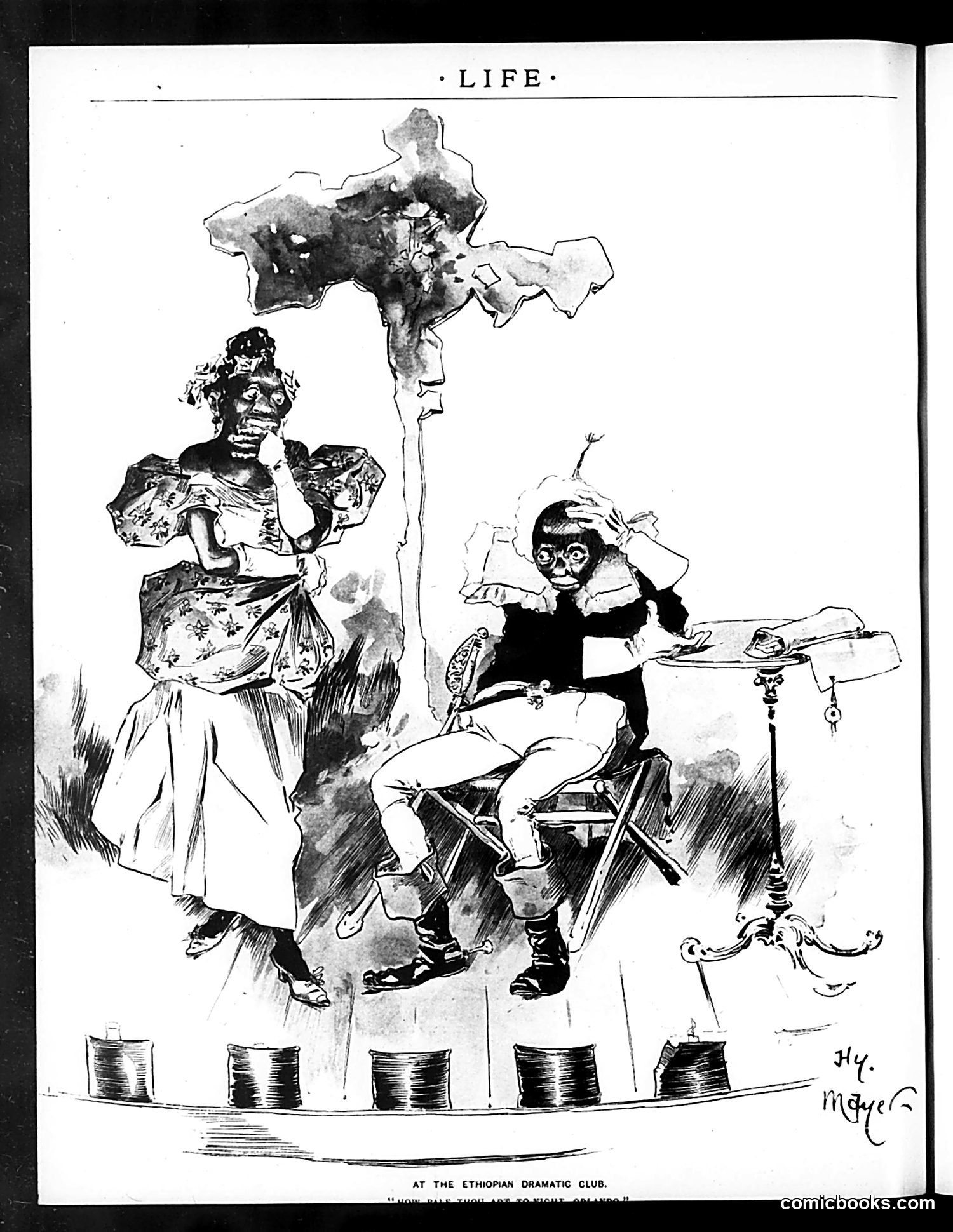
This cartoon depicts a scene "At the Ethiopian Dramatic Club" — the caption's use of "Ethiopian" refers to a minstrelsy tradition where performers wore blackface makeup. The image shows two figures: an adult woman in elaborate dress with exaggerated facial features, and a child sitting at a vanity table applying makeup. The satire appears to target theatrical blackface performance traditions of the era, mocking both the absurdity of the makeup application and the participation of even children in these performances. The vanity setup with multiple containers suggests the elaborate, artificial nature of the makeup process. This reflects early 20th-century satirical commentary on minstrelsy, though the cartoon's specific intent—whether critiquing the practice itself or simply mocking its performers—remains somewhat unclear from the image alone.
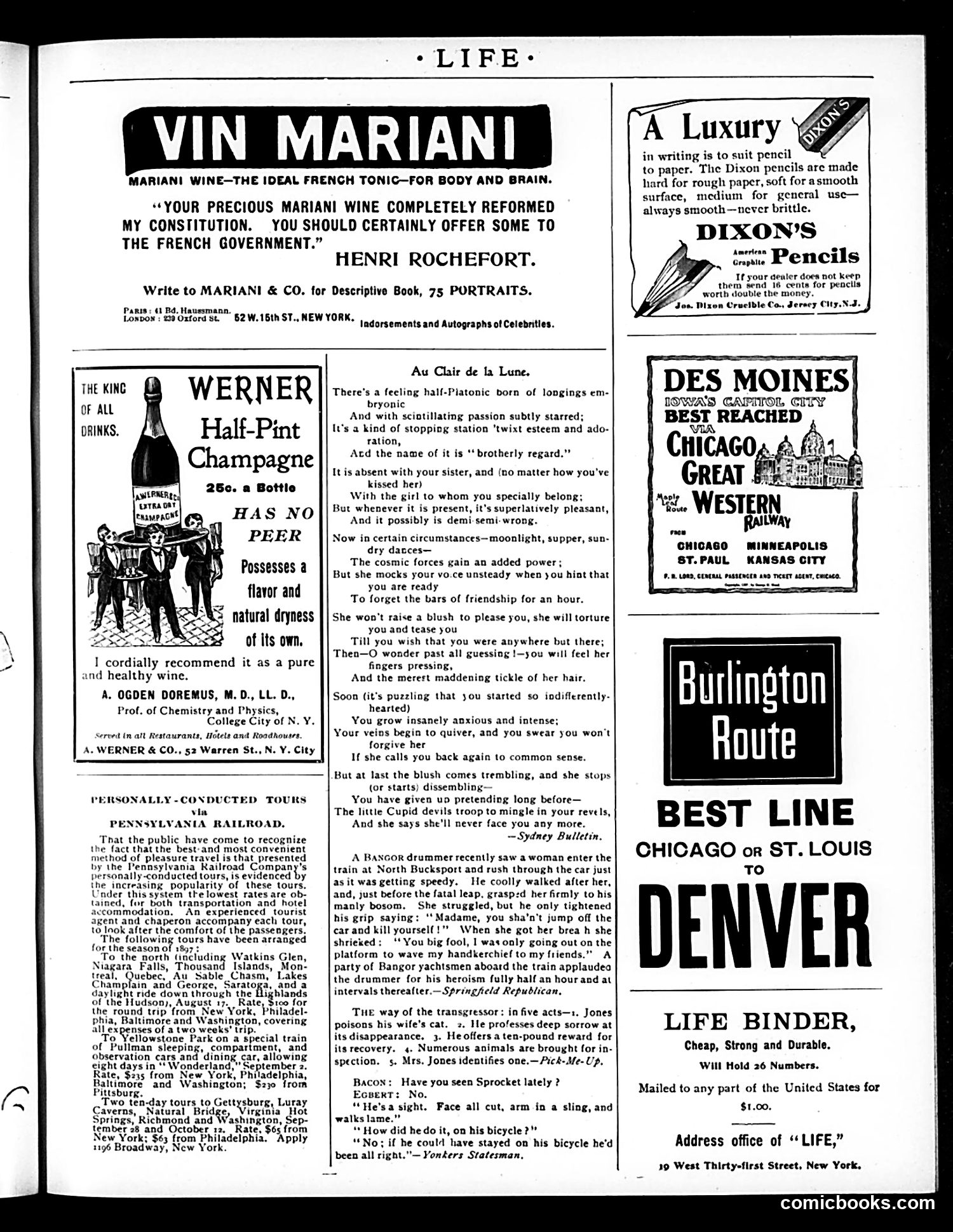
This page is primarily **advertising**, not satire or political commentary. It features several product endorsements typical of early 20th-century magazines: **Mariani Wine**: An advertisement quoting Henri Rochefort (a French politician/journalist) praising the wine as medicinal—reflecting the era when alcohol was marketed as a health tonic. **Werner Champagne** and **Dixon's Pencils**: Standard product ads with celebrity endorsements. **Pennsylvania Railroad tours**: Travel advertising offering organized excursions to popular destinations like Niagara Falls and Yellowstone. **The main text content** is a romantic poem titled "Au Clair de la Lune" about ambiguous feelings between friends that may become romantic—typical sentimental verse filler common in magazines of this period. The page reflects **late 19th/early 20th-century advertising culture** where celebrity testimonials and dubious health claims were unregulated. There is no political cartoon or satire visible—it's a commercial page presenting products and entertainment to readers.
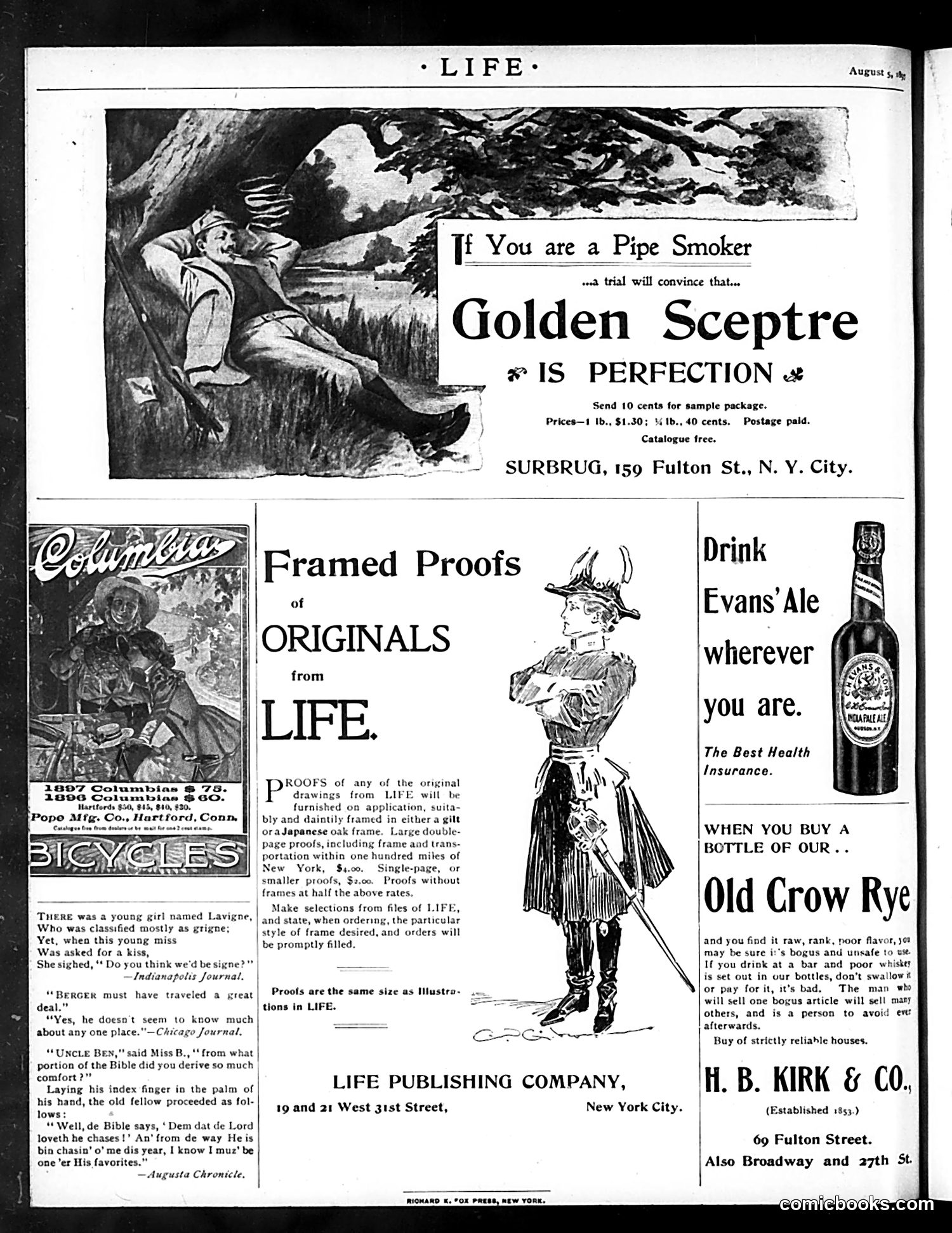
This page is primarily **advertising with light satirical humor**. ## Content: **Top section**: A relaxed gentleman smoking a pipe endorses "Golden Sceptre" tobacco—the joke being that pipe smoking was considered a leisurely, contemplative gentleman's pursuit worthy of product endorsement. **Left side**: Four brief humorous anecdotes (typical of Life's humor column): - A pun about a girl named Lavigne and "signe" - A joke about a well-traveled man who knows nothing about places - A biblical wordplay where an elderly Black man equates God's "chasing" with divine favor **Center**: Life Publishing Company advertises framed reproductions of original artwork from their magazine—a business service for readers. **Right side**: Advertisements for Evans' Ale and Old Crow Rye whiskey, with the latter emphasizing authenticity and warning against counterfeit bottles sold in bars. The page reflects late-19th-century advertising conventions and Life's format as a humor magazine supported by commercial advertisements.