
Life, 1897-08-05 · page 10 of 26
Life — August 5, 1897 — page 10: what you’re looking at
What you’re looking at
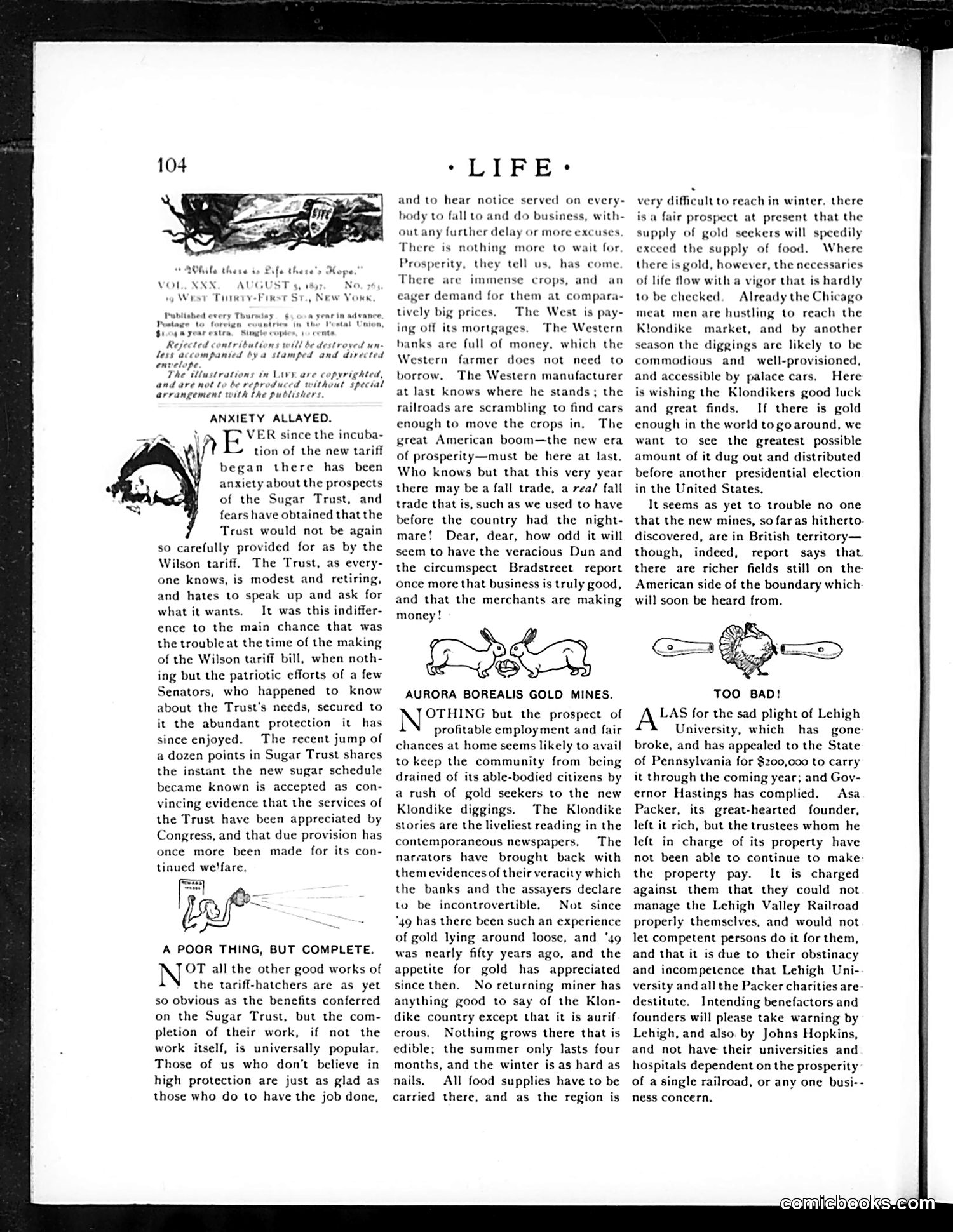
This page contains three editorial cartoons addressing contemporary economic and political issues: 1. **"Anxiety Allayed"** depicts anxieties about the Sugar Trust's monopoly power, referencing the Wilson tariff controversy. The cartoon satirizes trust supporters who claim prosperity has arrived. 2. **"Aurora Borealis Gold Mines"** shows two rabbits or hares—likely representing miners or prospectors—in a humorous take on the Klondike gold rush, which was attracting fortune-seekers to Canada. 3. **"Too Bad!"** concerns Lehigh University's financial difficulties. The text criticizes the university's trustees for mismanagement and inability to properly maintain their property, appealing for charitable donations to prevent institutional collapse. The page reflects 1890s concerns about monopolies, resource rushes, and institutional stability.
📄 Transcribed text from this page (OCR, searchable)
Machine-transcribed from the original scan — historical spelling and the odd misread are preserved.
*ADNile there as Life there's Mope VOL. XXX s No. 96 y West Thinry-Fikst Sr., NEW Yous The illustrations in Live. are copyrighted, and are not to be reproduced without special arrangement with the publishers ANXIETY ALLAYED. VER since the incuba- tion of the new tariff began there been anxiety about the prospects of the Sugar Trust, and fears have obtained thatthe Trust would not be again so carefully provided for as by the Wilson tariff. The Trust, as every- one knows, is modest and retiring, and hates to speak up and ask for what it wants. It was this indiffer- ence to the main chance that was the trouble at the time of the making of the Wilson tariff bill, when noth- ing but the patriotic efforts of a few Senators, who happened to know about the Trust's needs, secured to it the abundant protection it has since enjoyed. The recent jump of a dozen points in Sugar Trust shares the instant the new sugar schedule became known is accepted as con- vincing evidence that the services of the Trust have been appreciated by Congress, and that due provision has once more been made for its con- tinued welfare. ia A POOR THING, BUT COMPLETE. OT all the other good works of i the tariff-hatchers are as yet so obvious as the benefits conferred on the Sugar Trust, but the com- pletion of their work, if not the work itself, is universally popular. Those of us who don't believe in high protection are just as glad as those who do to have the job done, *> LIFE: and to hear notice served on every- body to fall to and do business, with- out any further delay or more excuses. There is nothing more to wait for. they immense crops, and an Prosperity tell us, has come. There are eager demand for them at compara- The West is pay- ing off its mortgages. The Western banks are full of money, which the Western farmer does not need to borrow. The Western manufacturer at last knows where he stands; the railroads are scrambling to find cars enough to move the crops in. The great American boom—the new era of prosperity—must be here at last. Who knows but that this very year there may be a fall trade, a read fall trade that is, such as we used to have before the country had the night- mare! Dear, dear, how odd it will seem to have the veracious Dun and the circumspect Bradstreet report once more that business is truly good, and that the merchants are making money! tively big prices. AURORA BOREALIS GOLD MINES. OTHING but the prospect of profitable employment and fair chances at home seems likely to avail to keep the community from being drained of its able-bodied citizens by a rush of gold seekers to the new Klondike diggings. The Klondike stories are the liveliest reading in the contemporancous newspapers. The narrators have brought back with them evidences of their veracity which the banks and the assayers declare to be incontrovertible. Not since “49 has there been such an experience of gold lying around loose, and ‘49 was nearly fifty years ago, and the appetite for gold has appreciated since then. No returning miner has anything good to say of the Klon- dike country except that it is aurif crous. Nothing grows there that is edible; the summer only lasts four montks, and the winter is as hard as All food supplies have to be carried there, and as the region is nails. very difficult to reach in winter. there is a fair prospect at present that the supply of gold seekers will speedily Where aries exceed the supply of food. there is gold, however, the nece of life flow with a vigor that is hardly to be checked. Already the Chicago meat men are hustling to reach the Klondike market, and by another season the diggings are likely to be commodious and well-prov and accessible by palace cars. is wishing the Klondikers good luck and great finds. If there is gold enough in the world to go around, we want to see the greatest possible amount of it dug out and distributed before another presidential election in the United States. It seems as yet to trouble no one that the new mines, so faras hitherto. discovered, are in British territory— though, indeed, report says that there are richer fields still on the American side of the boundary which will soon be heard from. TOO BAD! At» for the sad plight of Lehigh University, which has gone broke, and has appealed to the State of Pennsylvania for $200,000 to carry it through the coming year; and Gov- ernor Hastings has complied. Asa Packer, its great-hearted founder, left it rich, but the trustees whom he left in charge of its property have not been able to continue to make the property pay. It is charged against them that they could not manage the Lehigh Valley Railroad properly themselves, and would not let competent persons do it for them, and that it is due to their obstinacy and incompetence that Lehigh Uni- versity and all the Packer charities are destitute. Intending benefactors and founders will please take warning by Lehigh, and also. by Johns Hopkins, and not have their universities and hospitals dependent on the prosperity of a single railroad, or any one busi-- ness concern,