
Life, 1897-08-05 · page 12 of 26
Life — August 5, 1897 — page 12: what you’re looking at
What you’re looking at
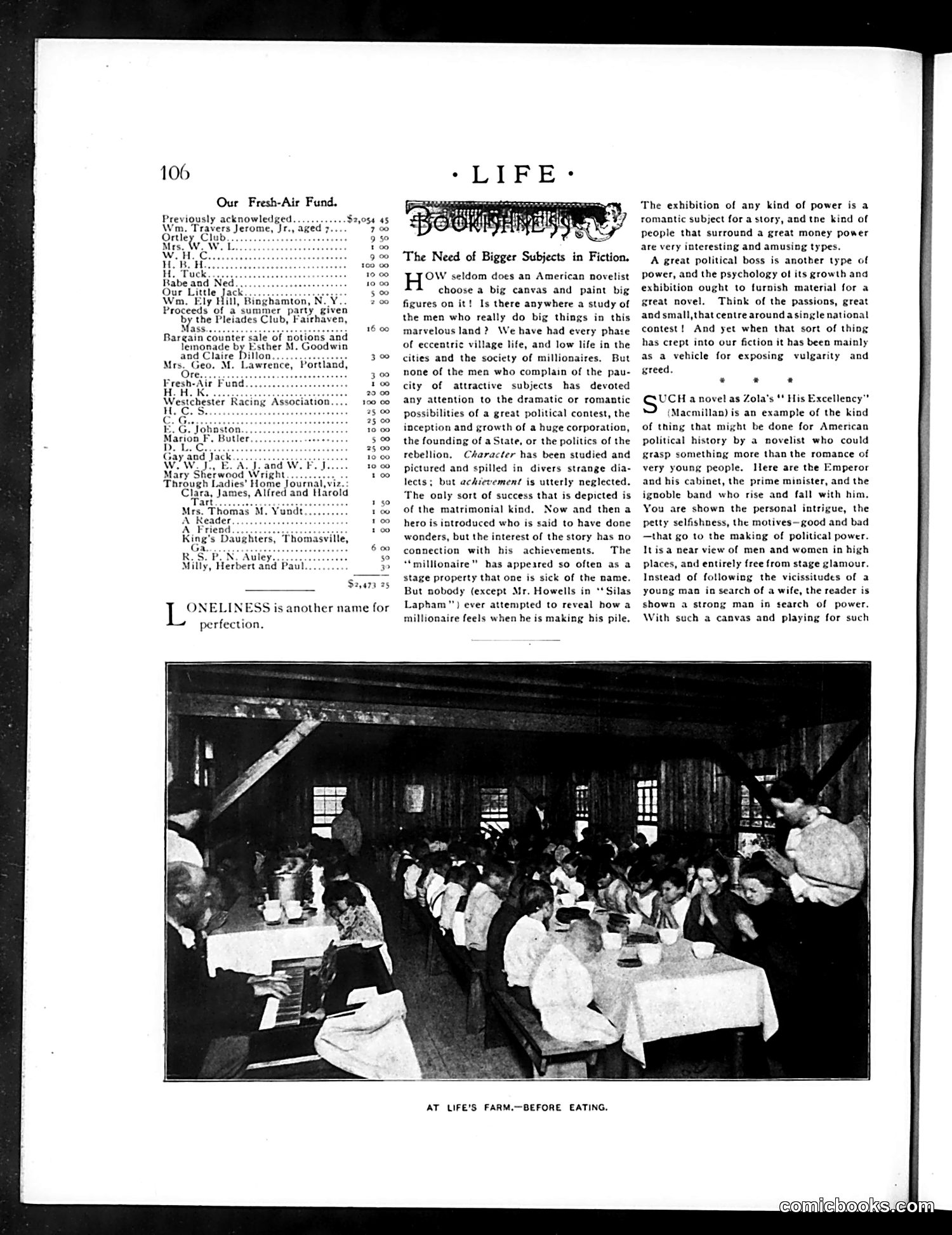
This page contains a fundraising appeal ("Our Fresh-Air Fund") listing donors, plus an article titled "The Need of Bigger Subjects in Fiction." The article critiques American novels for ignoring dramatic real-world subjects—political power, corporate growth, state politics, rebellion—in favor of romantic plotlines and "matrimonial" concerns. It specifically praises Zola's work and argues that American fiction should engage with larger political and social themes rather than personal intrigue. The photograph captioned "AT LIFE'S FARM—BEFORE EATING" shows what appears to be a charitable dining facility, likely the Fresh-Air Fund's operation providing meals to underprivileged urban residents. The image supports the fundraising appeal on the same page. The magazine thus combines social advocacy with cultural criticism about literature's proper scope.
📄 Transcribed text from this page (OCR, searchable)
Machine-transcribed from the original scan — historical spelling and the odd misread are preserved.
106 Our Fresh-Air Fund. Previously acknowledged. . Travers Jerome, Jr ae lex Chub VOW. 1 ged 3 Gar’ iittte Jack Wm. Ely Hill, Binghamton, N. Proceeds of a’summer party given y the Pleiades Club, asset vee Bargain counte ns an lemonade by Esther M. Goodwin and Claire Dillon. Mrs. Geo. M. Lawrence,” Portland, Ore. 7 Fresh- He Kc te festchester ir Fund: acing “Association Gay 40d Tack. cerry eneseesens Wwe: j, and W. 1 Mary Sherwood Wright ‘Through Ladies’ Home journal,viz. Clara, James, Alfred and Harold Tart... Mrs. Thomas’ M. ‘Vandi : A Reader ‘A Friend... King’s Da hier,” Ga Thomasville, , Herbert and Paul. J ONELINES — perfection, is another name for The Need of Bigger Subjects in Fiction. OW seldom does an American novelist choose a big canvas and paint big figures on it! Is there anywhere a study of the men who really do big things in this marvelous land? We have had every phase of eccentric village life, and low life in the cities and the society of millionaires, But none of the men who complain of the pau- city of attractive subjects has devoted any attention to the dramatic or romantic possibilities of a great political contest, the inception and growth of a huge corporation, the founding of a State, or the politics of the rebellion, Character has been studied and pictured and spilled in divers strange dia- lects; but achievement is utterly neglected. The only sort of success that is depicted is of the matrimonial kind. Now and then a hero is introduced who is said to have done wonders, but the interest of the story has no connection with his achievements. The “‘millionaire” has appeared so often as a stage property that one is sick of the name. But nobody (except Mr. Howells in *' Silas Lapham") ever attempted to reveal how a millionaire feels when he is making his pile. The exhibition of any kind of power is a romantic subject for a story, and tne kind of people that surround a great money power are very interesting and amusing types A great political boss is another type of power, and the psychology of its growth and exhibition ought to furnish material for a great novel. Think of the passions, great and small,that centre around asingle national contest! And yet when that sort of thing has crept into our fiction it has been mainly as a vehicle for exposing vulgarity and greed. * * * UCH a novel as Zola’s "* His Excellency’ (Macmillan) is an example of the kind of thing that might be done for American political history by a novelist who could grasp something more than the romance of very young people. Here are the Emperor and his cabinet, the prime minister, and the ignoble band who rise and fall with him, You are shown the personal intrigue, the petty selfishness, the motives~good and bad —that go to the making of political power. It isa near view of men and women in high places, and entirely free from stage glamour. Instead of following the vicissitudes of a young man in search of a wife, the reader is shown a strong man in search of power. With such a canvas and playing for such AT LIFE'S FARM.—BEFORE EATING.