
A complete issue · 20 pages · 1897
Life — July 15, 1897
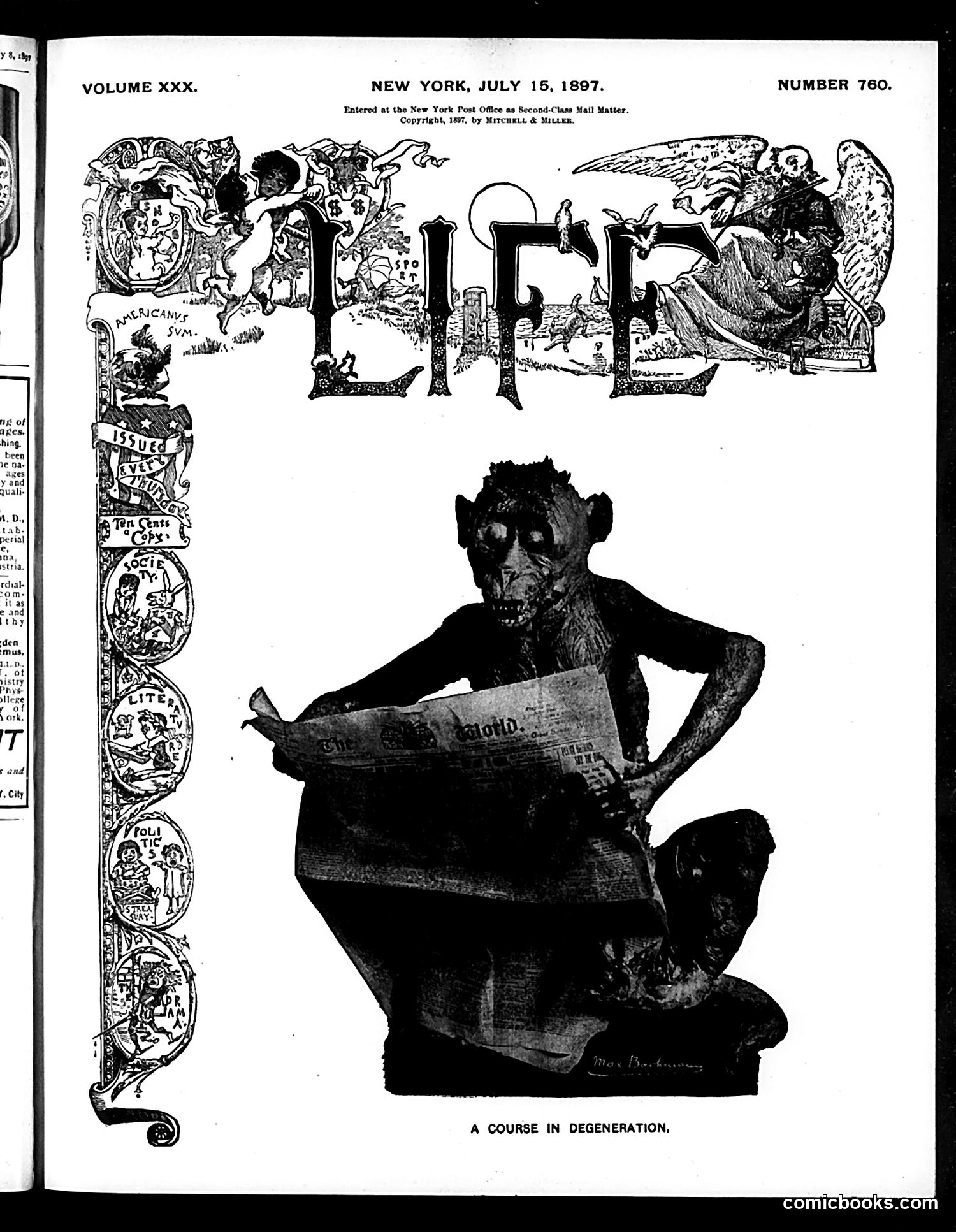
This satirical illustration depicts a demonic or ape-like creature reading a newspaper labeled "World," with the caption "A Course in Degeneration." The image appears to reference contemporary anxieties about social decline and corruption. The creature's bestial appearance suggests the satirist is equating newspaper reading—particularly sensational news—with moral and intellectual degradation. The "World" likely refers to Joseph Pulitzer's *New York World*, a major yellow journalism publication known for lurid, sensational reporting. The ornate left border contains period-specific emblems and vignettes, typical of Life's decorative style. This reflects fin-de-siècle concerns about mass media's influence on public morality and whether exposure to sensationalism would degenerate American society and culture.
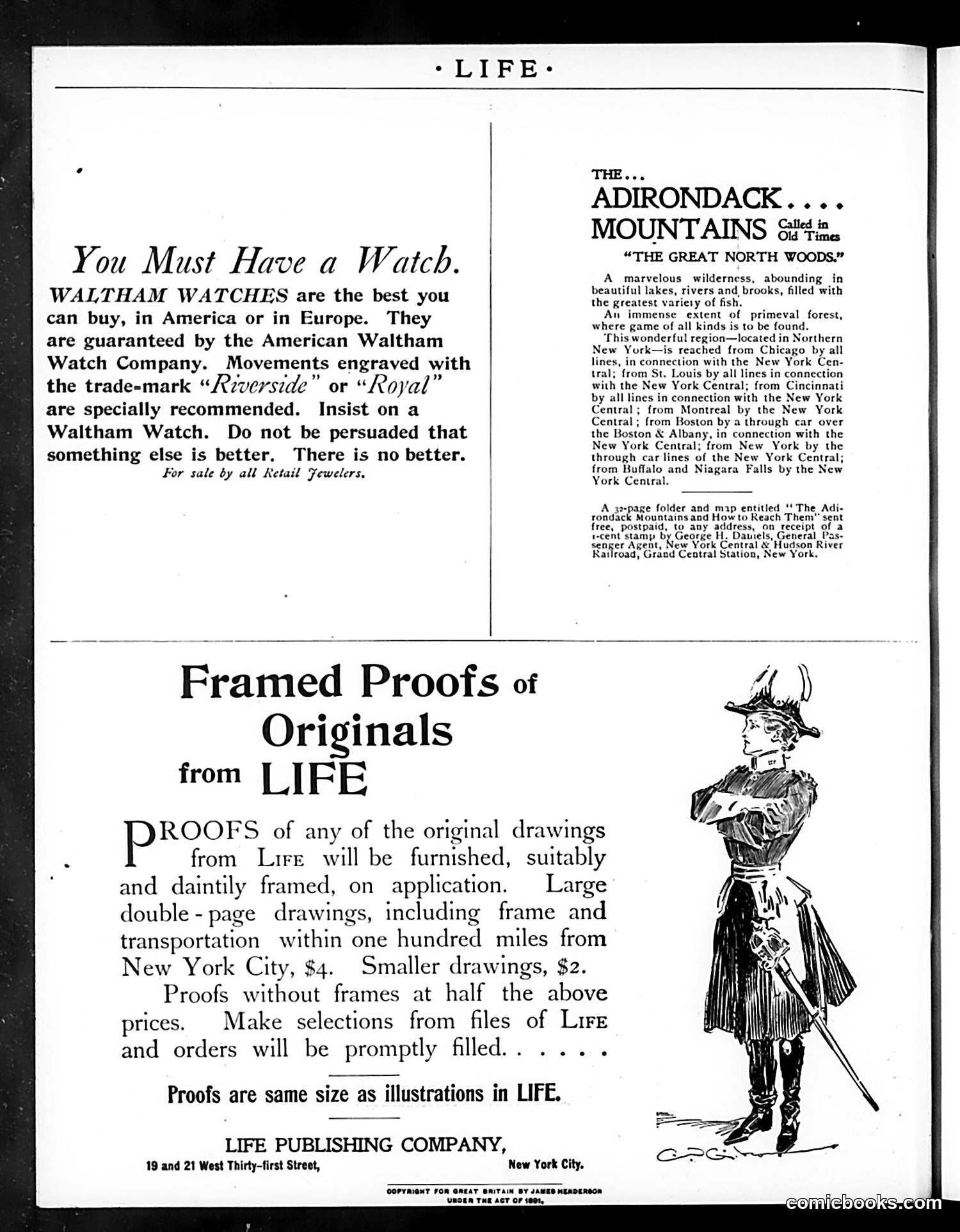
This page contains **three unrelated advertisements** rather than political satire or comics. 1. **Waltham Watches ad** (top left): Claims Waltham watches are superior to all competitors in America and Europe, with movements engraved with trademarks "Waltham" or "Royal." Targets jewelry retailers. 2. **Adirondack Mountains ad** (top right): Promotes the Northern New York region as "The Great North Woods," describing lakes, rivers, forests, and fishing. Lists railroad routes for access from major cities. 3. **Framed Proofs of Originals** (bottom): The Life Publishing Company offers framed reproductions of artwork from Life magazine—large double-page drawings for $4, smaller for $2, without frames at half price. The illustration is a decorative sketch of a fashionable woman in period dress, likely advertising Life's visual content generally.
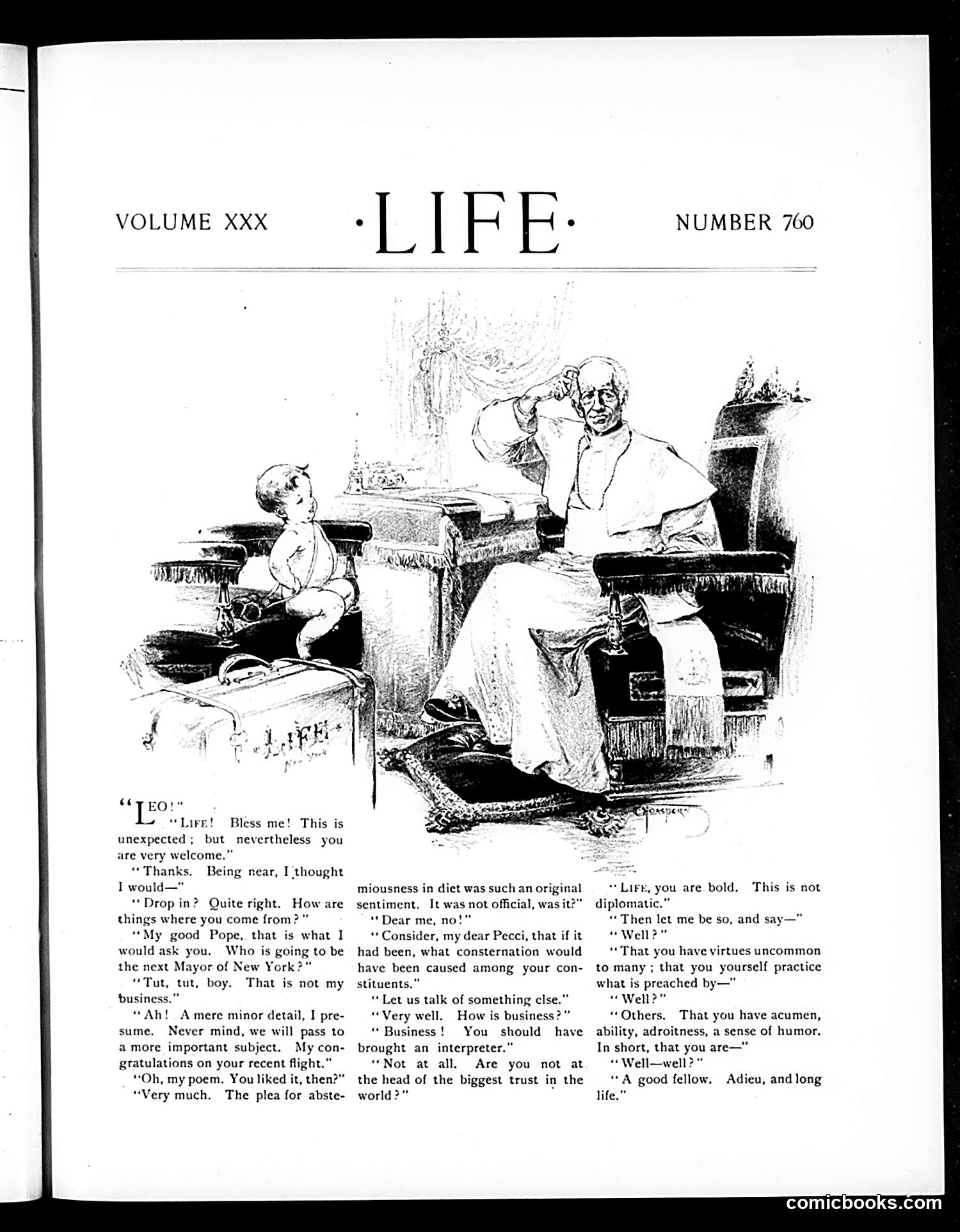
This page depicts a satirical conversation between two men—likely a visiting dignitary and an established political figure (possibly the Pope, given the reference to "Pecci" in the dialogue). The cartoon mocks diplomatic protocol and political self-importance. The humor centers on the visitor's boastful claim that he is "bold" and "not diplomatic," yet he practices exactly the virtues typically expected of diplomats: "acumen, ability, adroitness, a sense of humor." The satire exposes the hypocrisy of politicians who claim to reject formality while embodying it completely. The piece appears to critique both pompous self-regard and the empty rhetoric of political discourse, suggesting that distinguished visitors and officials are ultimately interchangeable in their affected behavior.
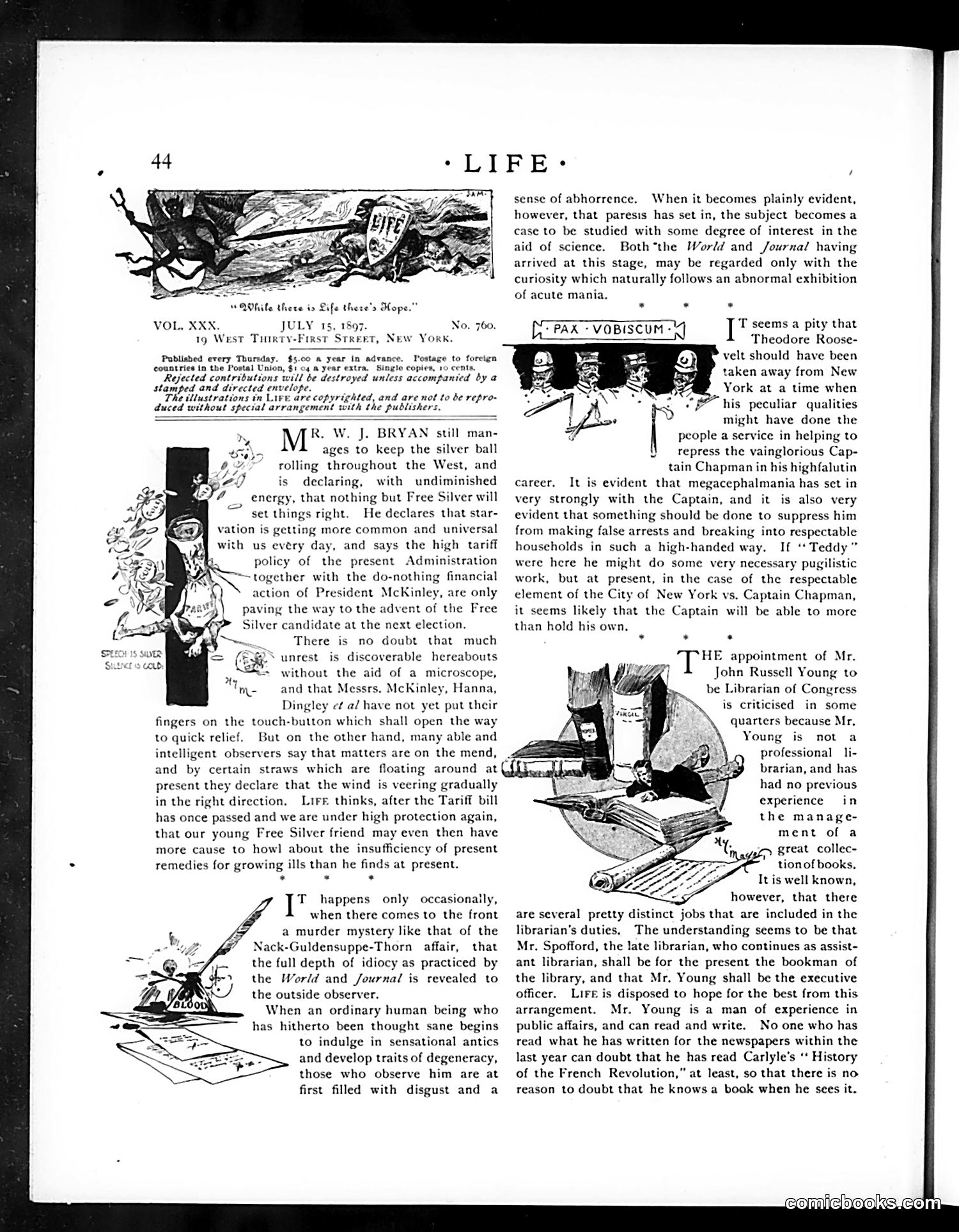
This page critiques two contemporary political figures and issues circa 1897: **W.J. Bryan's Silver Campaign:** The left cartoon mocks William Jennings Bryan's continued advocacy for free silver coinage. The text dismisses his "silver ball rolling" as futile, suggesting the protective tariff policy (supported by McKinley's administration) has made silver advocacy obsolete. Bryan is portrayed as an ineffectual dreamer. **Theodore Roosevelt & Captain Chapman:** The right section sarcastically suggests Roosevelt should have prevented Chapman's arrest in New York. It questions whether Chapman deserves "repressive" police treatment, implying Roosevelt's absence enabled overreach. **John Russell Young's Librarian Appointment:** The lower section defends Young's appointment as Librarian of Congress against criticism that he lacked professional credentials, arguing his journalism experience makes him qualified. All three topics reflect contemporary political and reform debates.
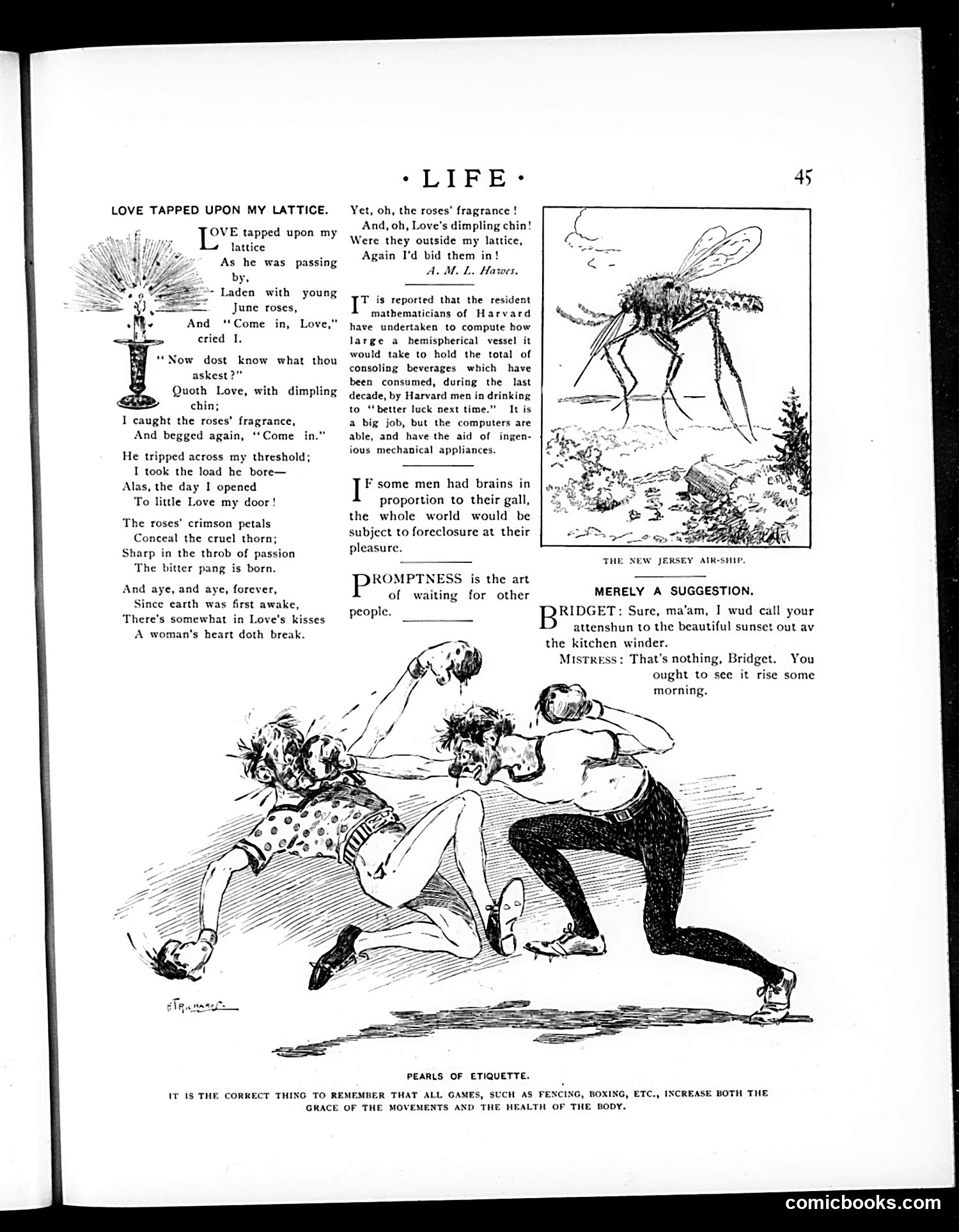
This page contains three distinct pieces of satirical content: 1. **"Love Tapped Upon My Lattice"**: A romantic poem with accompanying vase illustration, presenting sentimental verse about love and roses. 2. **"The New Jersey Air-Ship"**: An illustration of an early aircraft (mosquito-like design), likely referencing contemporary aviation experiments, possibly New Jersey-based aeronautical development. 3. **"Merely A Suggestion"**: A comic illustration showing a man and woman in physical combat/struggle on the ground, with dialogue about watching a sunset from the kitchen window. The humor appears to satirize domestic relationships and the contrast between romantic ideals versus marital reality. The "Pearls of Etiquette" caption at bottom makes a dry joke about games improving health and grace of movement. The page represents typical early-1900s Life magazine humor: literary sentiment mixed with satirical commentary on modern life, romance, and social behavior.
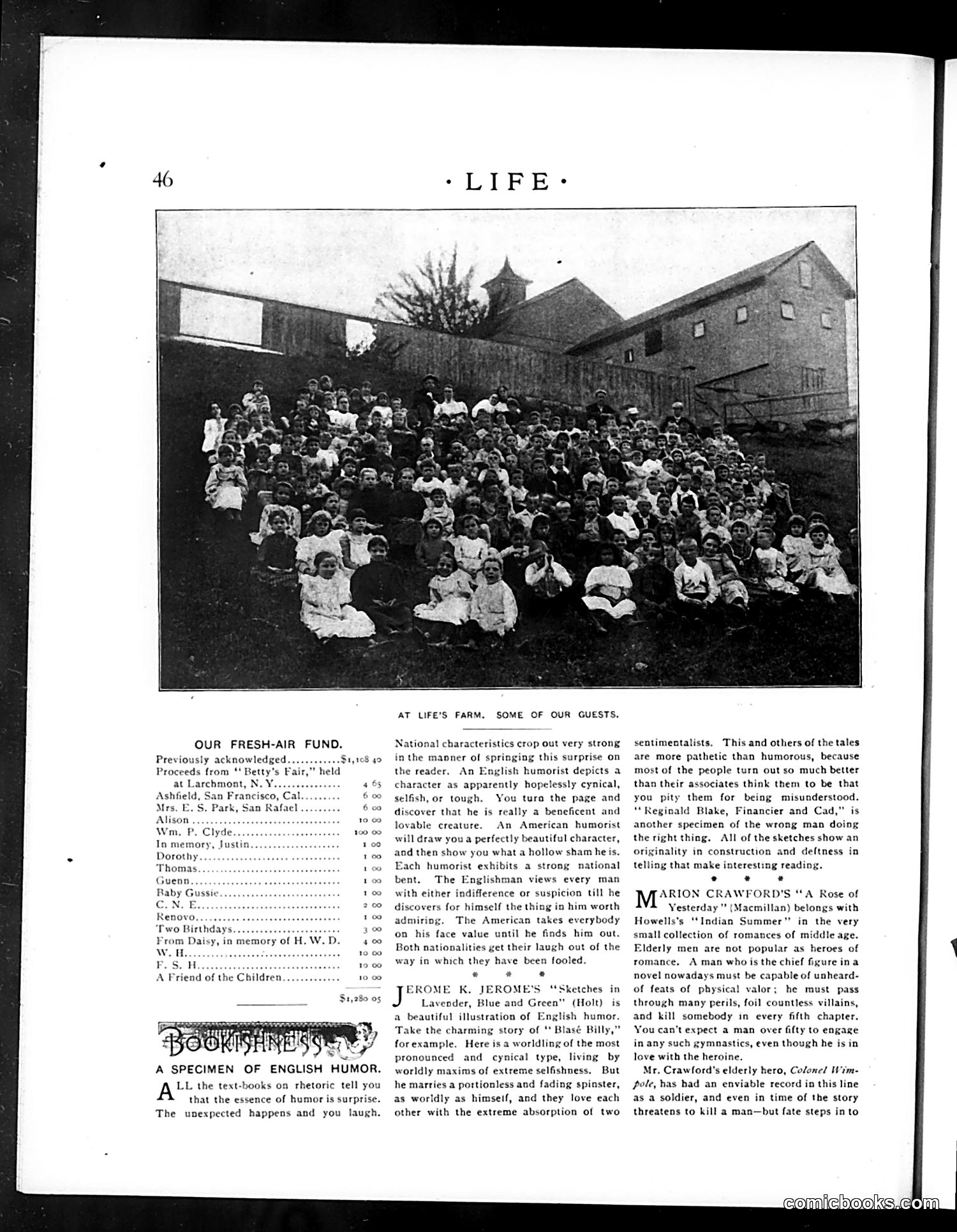
This page primarily contains **a charitable fundraising appeal** rather than political satire. The large photograph shows a large group of children and adults gathered at "Life's Farm," apparently an orphanage or children's charity. The "Fresh-Air Fund" section lists donations from readers, with amounts ranging from $1.08 to $19.00, supporting what appears to be a program providing outdoor recreation or respite for underprivileged children. The lower section, titled "A Specimen of English Humor," discusses Jerome K. Jerome's sketches and examines differences between English and American humor—noting that English humor emphasizes surprise and cynicism, while American humor focuses on character revelation. **This is essentially a charitable advertisement combined with literary commentary**, not political satire.
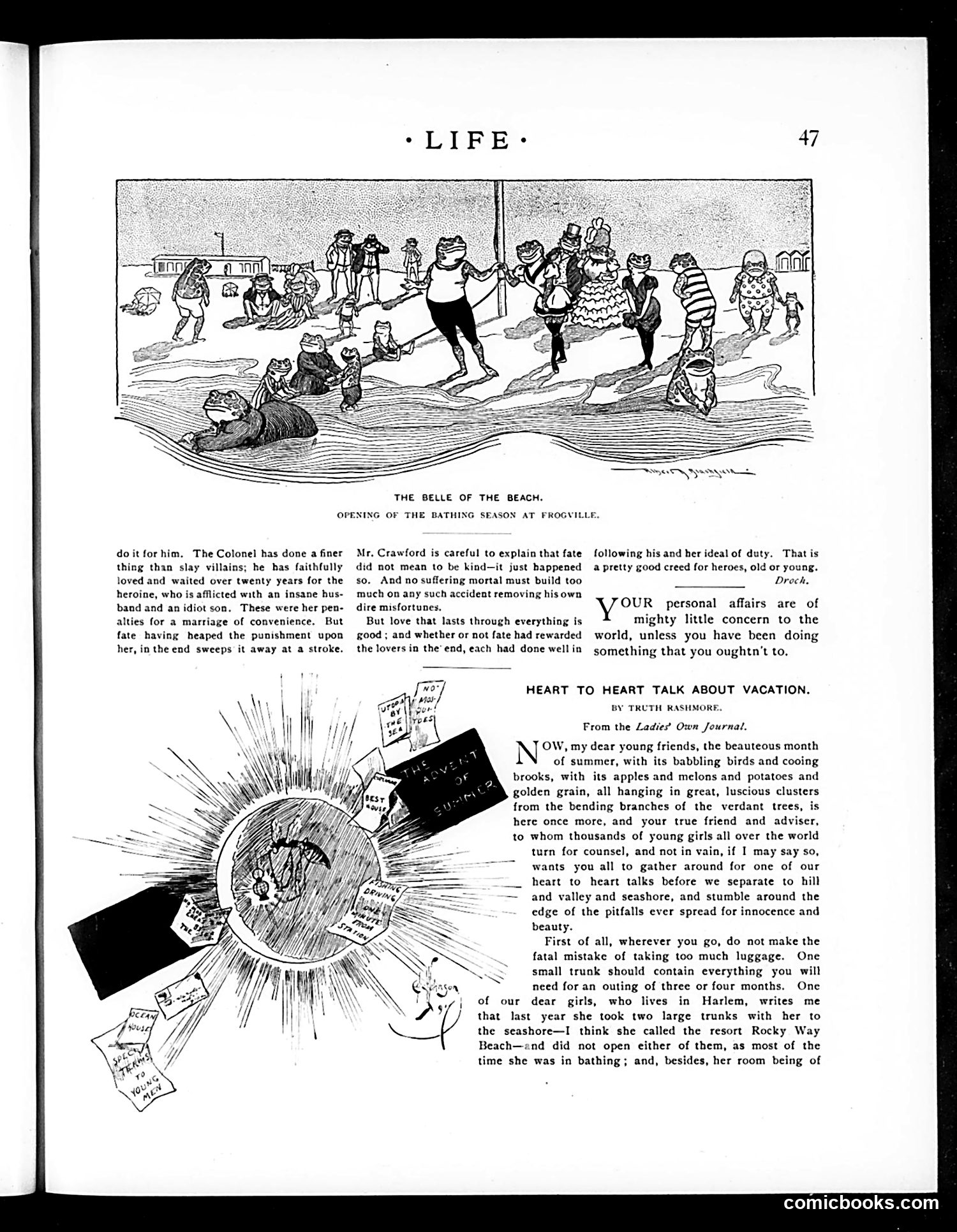
**Top Illustration: "The Belle of the Beach"** This sketch depicts the opening of bathing season at Frogville, showing anthropomorphized frogs in various swimming attire and activities. The satire appears to mock human beach culture by portraying frogs mimicking contemporary vacation behavior—a common technique in period humor using animal substitutes for social commentary. **Bottom Section: "Heart to Heart Talk About Vacation"** This article by Truth Rashmere addresses young women about summer vacation planning. The accompanying illustration shows a steamer trunk exploding with excessive luggage and papers. The satire warns against over-packing for vacations, using exaggerated visual humor. The text specifically references a woman from Harlem who brought two large trunks to the seashore but never opened them during her stay—mocking the impracticality of over-preparation.
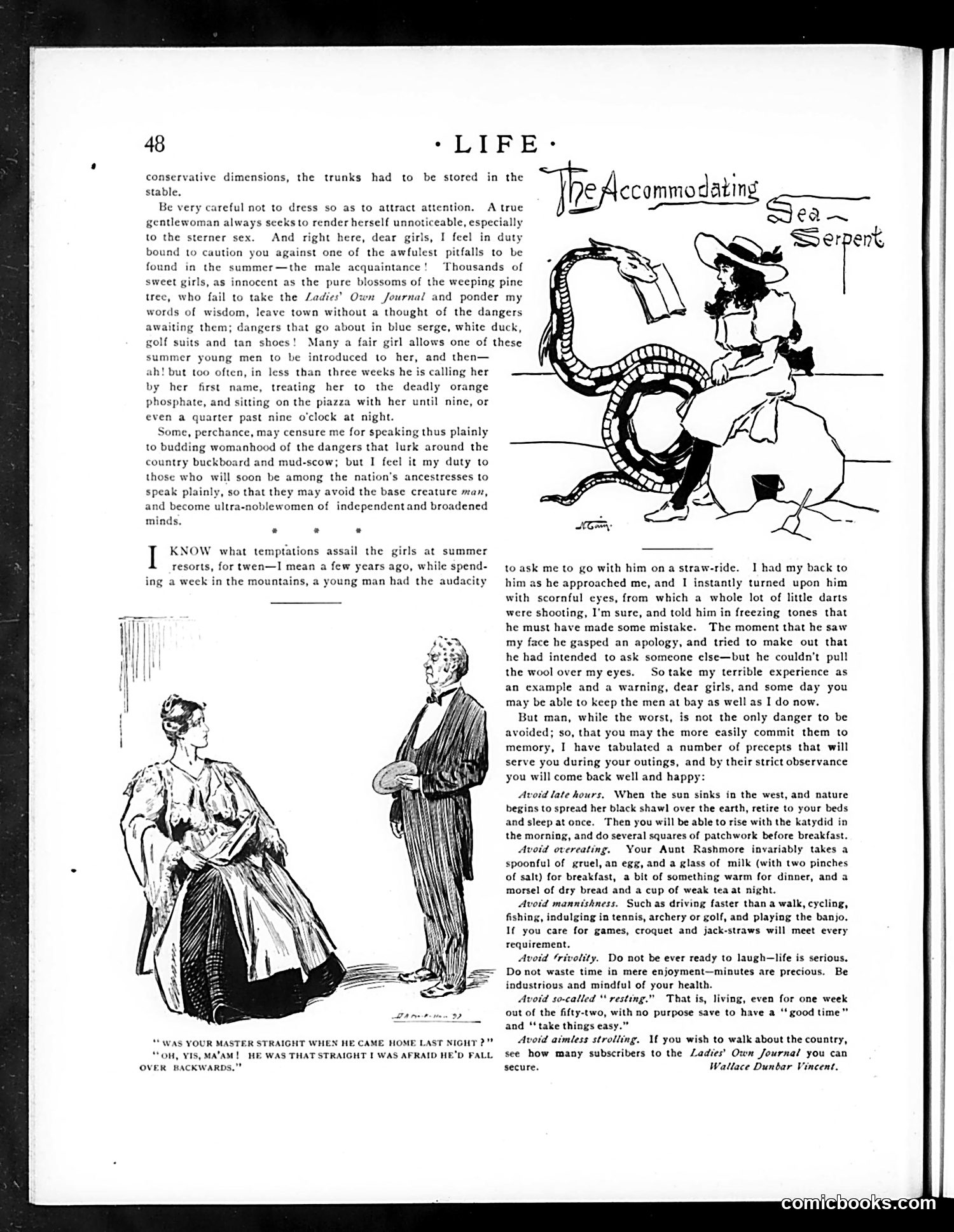
This page contains satirical advice to young women about proper summer conduct. The main cartoon depicts a sea serpent accosting a woman, illustrating the title "The Accommodating Sea Serpent"—a humorous warning about dangers lurking at summer resorts. The accompanying text, attributed to Wallace Dunbar Vincent, delivers mock-serious etiquette guidance for unmarried women, warning against late hours, overeating, excessive activity, and being "ready to laugh." The small illustration at bottom shows a couple in conversation, with the caption suggesting a woman making excuses about her escort's straightness, implying concerns about men's propriety or intentions. The satire targets Victorian-era anxieties about young women's independence and morality during leisure time, while poking fun at the elaborate social rules governing female behavior.
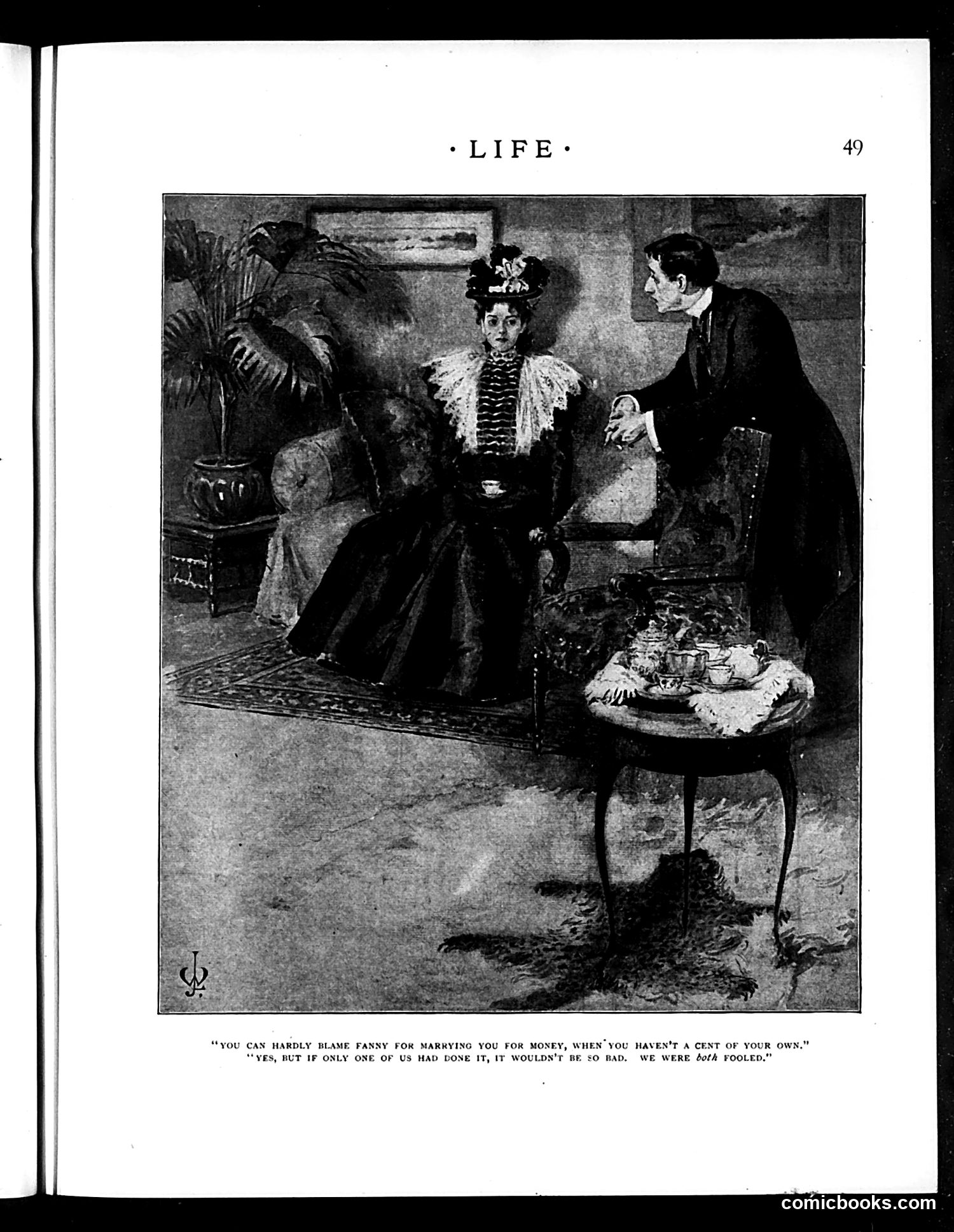
This illustration depicts a domestic scene satirizing marriage for money. A well-dressed man confronts an elegantly attired woman in an interior setting, while a third figure observes from the left. The caption reads: "You can hardly blame Fanny for marrying you for money, when you haven't a cent of your own." The woman responds: "Yes, but if only one of us had done it, it wouldn't be so bad. We were *both* fooled." The satire targets matrimonial hypocrisy: both parties entered marriage under false financial pretenses. Each assumed the other possessed wealth, but neither did. The joke exposes the mercenary nature of turn-of-the-century courtship among the upper classes, where financial calculation was often masked as romance—and mutual deception resulted in mutual disappointment.
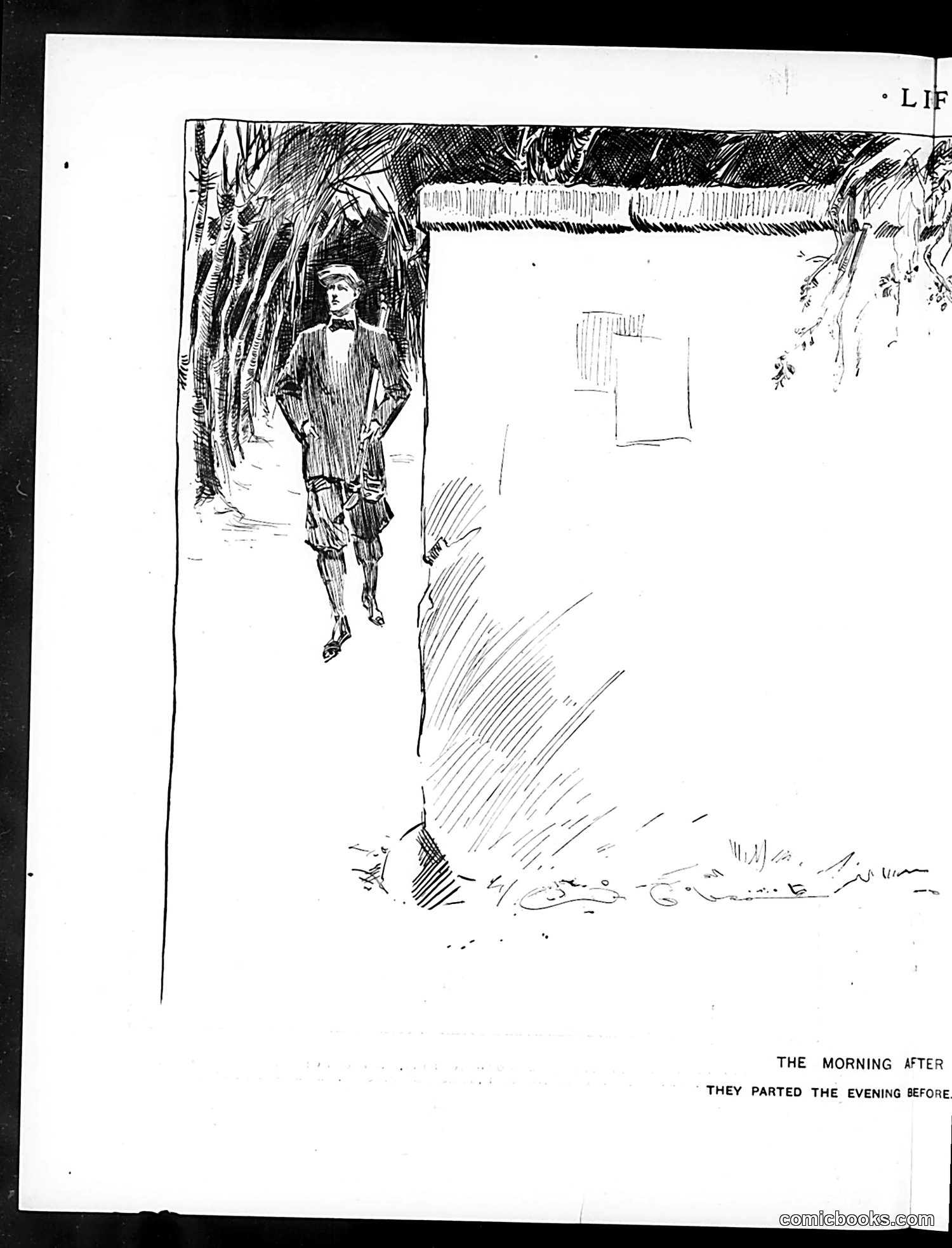
This illustration shows a well-dressed man in formal attire (hat, suit, bow tie) walking alone through what appears to be a bamboo grove or wooded area. The caption reads: "THE MORNING AFTER THEY PARTED THE EVENING BEFORE." The joke appears to be a romantic or social commentary: a gentleman is depicted the morning after parting from someone the previous evening—suggesting either a romantic encounter or social gathering. The solitary figure in refined dress contrasted with the natural setting creates a humorous juxtaposition. Without additional context from the magazine issue, the specific satirical target remains unclear, but this appears to be social satire about courtship, relationships, or upper-class romantic conventions typical of early-to-mid 20th-century Life magazine humor.
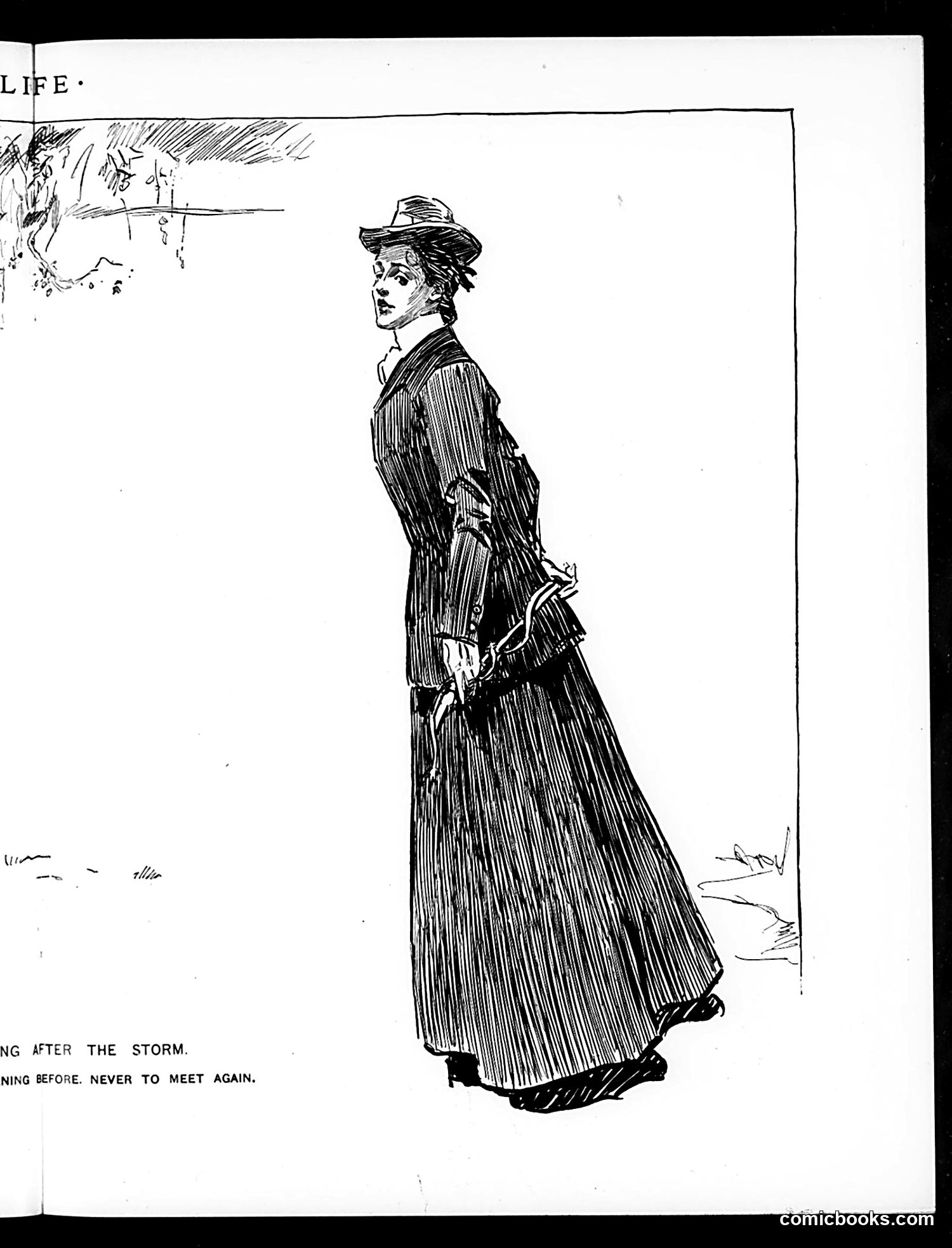
This page from *Life* magazine shows a fashionable woman in early 20th-century dress, standing in profile. The visible text fragments reference "AFTER THE STORM" and "NEVER TO MEET AGAIN," suggesting a romantic narrative about parting lovers. The illustration appears to be a literary or dramatic scene rather than political satire. The woman's elegant, high-collared jacket and long skirt with cinched waist represent Gibson Girl-era fashion. The styling and caption suggest this relates to a serialized story or emotional vignette typical of *Life's* content during this period—likely depicting a poignant farewell between two characters, perhaps separated by circumstance or social convention. Without additional context or visible bylines, the specific story being illustrated remains unclear.
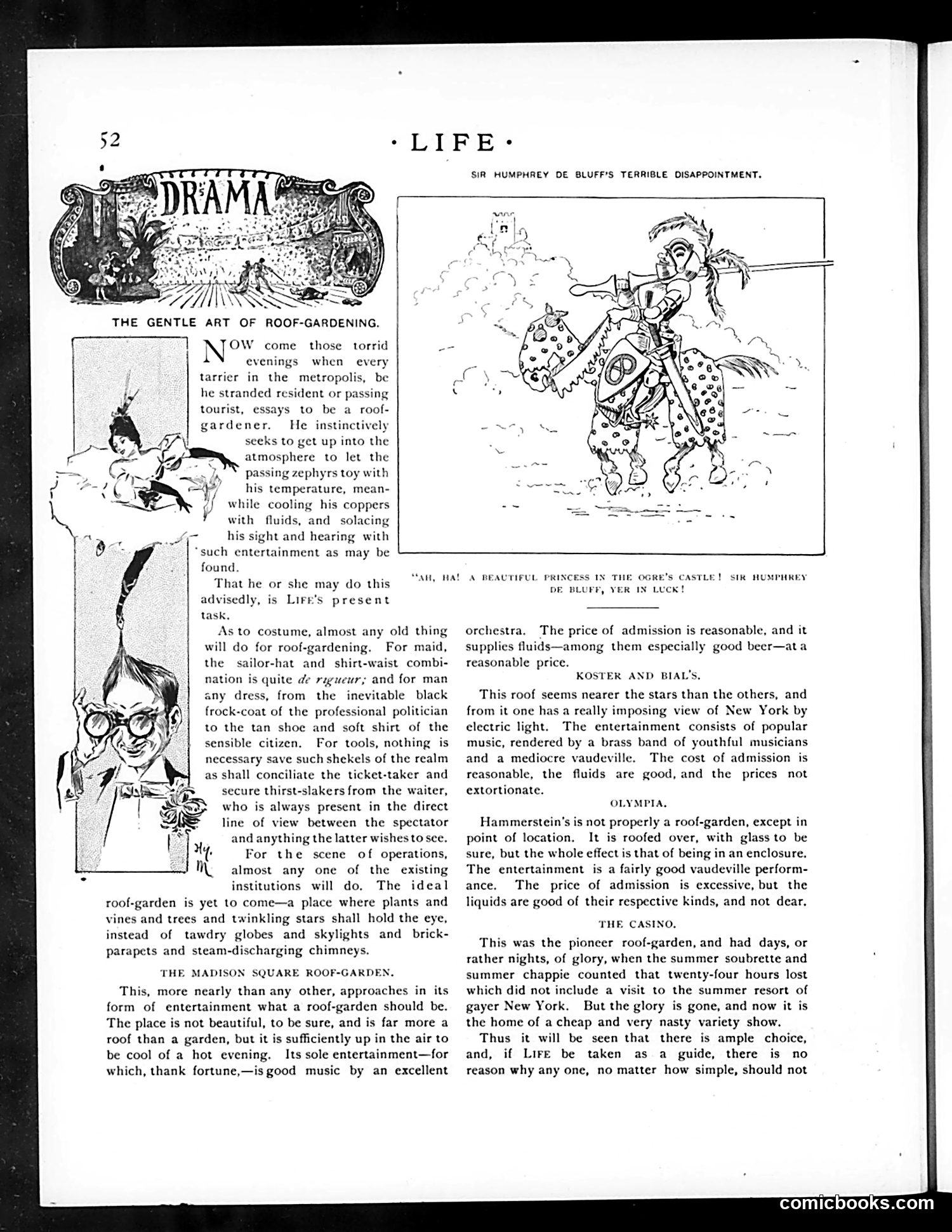
This page satirizes "roof-gardening"—a fashionable entertainment trend in early 1900s New York. The left cartoon mockingly depicts a woman in elaborate costume enjoying a rooftop venue, while the right illustration shows a man on a decorated donkey (captioned about an ogre's castle), playing on the absurdity of these venues. The satire criticizes how roof-gardens serve as poorly disguised attempts to provide cool evening entertainment while masking their actual function: allowing urban residents to escape hot apartments. The text notes these venues charge reasonable prices and serve beer, mocking their pretense as sophisticated entertainment when they're really just practical cooling solutions featuring mediocre music and entertainment. The piece gently ridicules New York's upper and middle classes for treating mundane rooftop gatherings as fashionable social events.
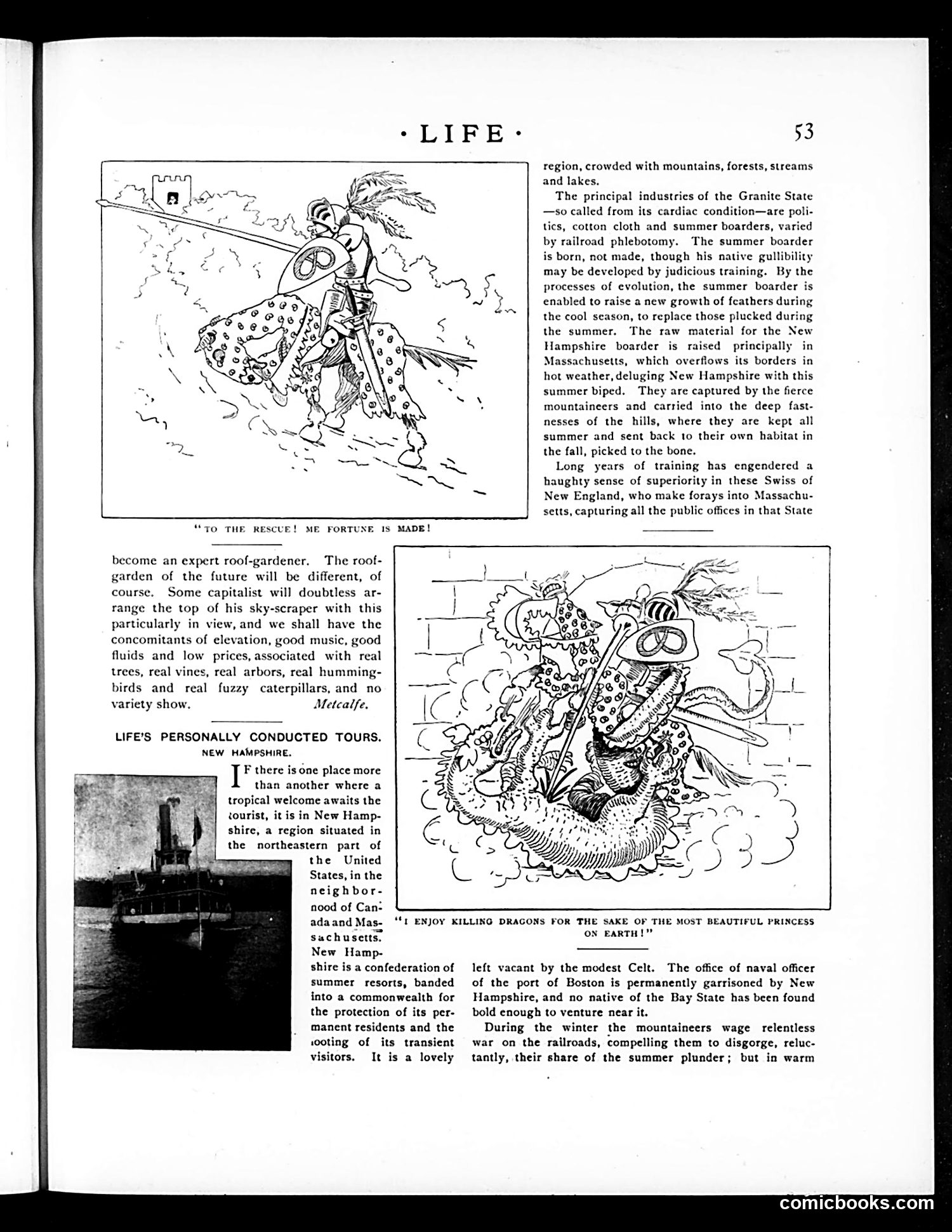
This satirical piece mocks New Hampshire's economy and character through exaggerated metaphors. The text describes summer tourists from Massachusetts as "summer boarders"—migratory creatures "captured by fierce mountaineers" and "plucked to the bone" before returning home each fall. The humor targets New Hampshire's dependence on wealthy Massachusetts visitors as its primary industry, alongside politics and textiles. The piece sarcastically portrays New Hampshire residents as superior ("Swiss of New England") who raid Massachusetts for public offices, while actually surviving by exploiting and extracting money from helpless tourists. The accompanying illustrations—a knight in armor ("To the Rescue! Me Fortune is Made!") and a fanciful dragon-slaying scene—reinforce the predatory theme through mock-heroic imagery. The cartoons suggest New Hampshire mountaineers view summer tourism as plunder, treating visitors as conquests rather than guests.
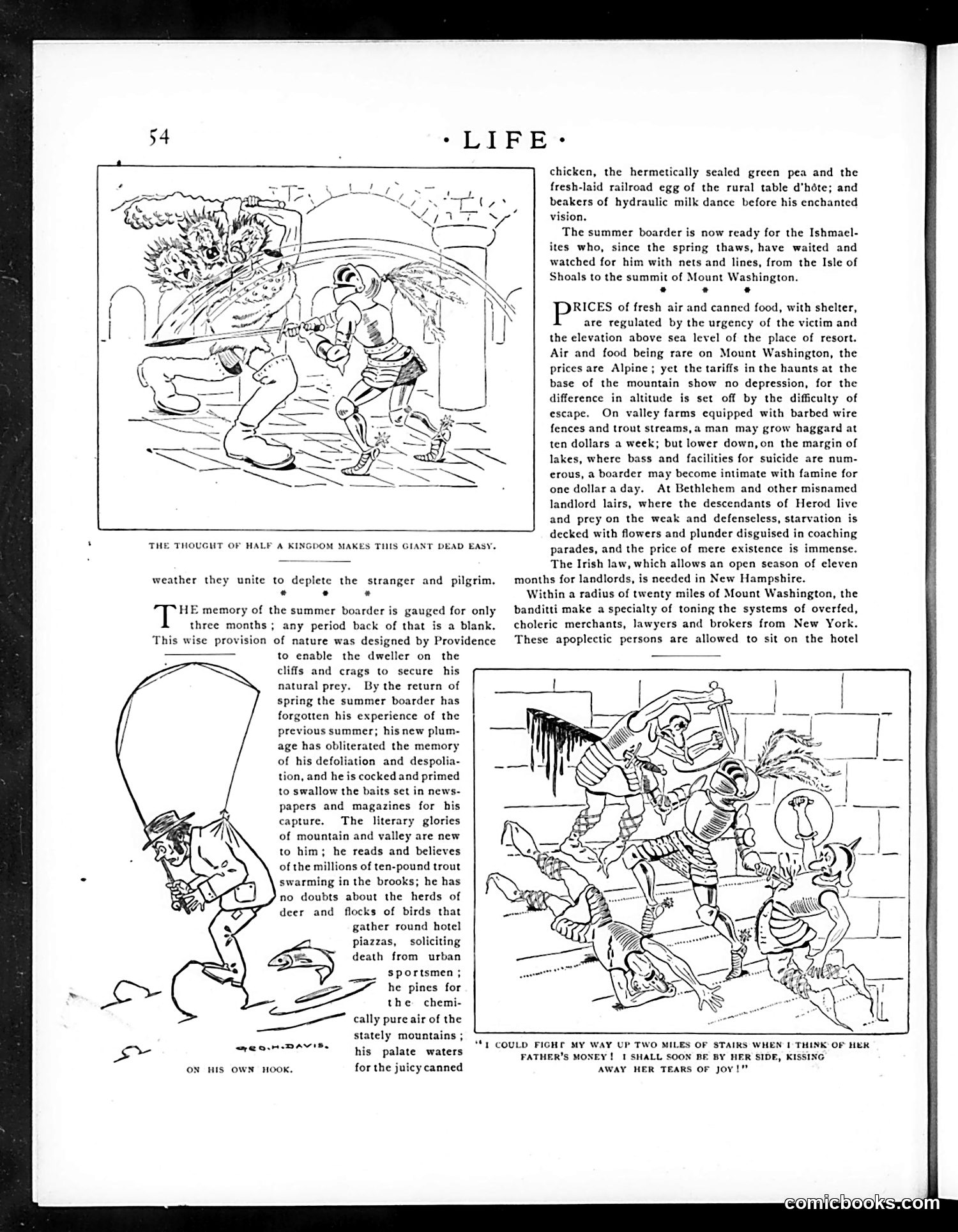
This Life magazine piece satirizes the American summer boarding industry and the predatory practices of mountain resort owners. The "summer boarder" is a wealthy urban visitor (likely a merchant, lawyer, or broker from New York) who arrives annually to vacation in places like Mount Washington and the New Hampshire mountains. The satire's targets: 1. **Boarders themselves**: Gullible, forgetful tourists who fall for the same marketing ploys yearly, believing exaggerated claims about trout populations and pristine wilderness. 2. **Resort owners**: Portrayed as "banditti" (bandits) and "descendants of Herod" who exploit visitors through inflated prices scaled to altitude and desperation. The comparison to Irish landlords suggests ruthless extraction of wealth. 3. **The business model**: Prices are absurdly high because escape is "difficult"—guests are trapped and must pay whatever charged for mediocre "canned food" and false promises. The cartoons depict the boarder as an easily-deceived mark, caught by resort owners' hooks and schemes. The satire reflects Gilded Age anxieties about commercialized leisure and the commodification of nature.
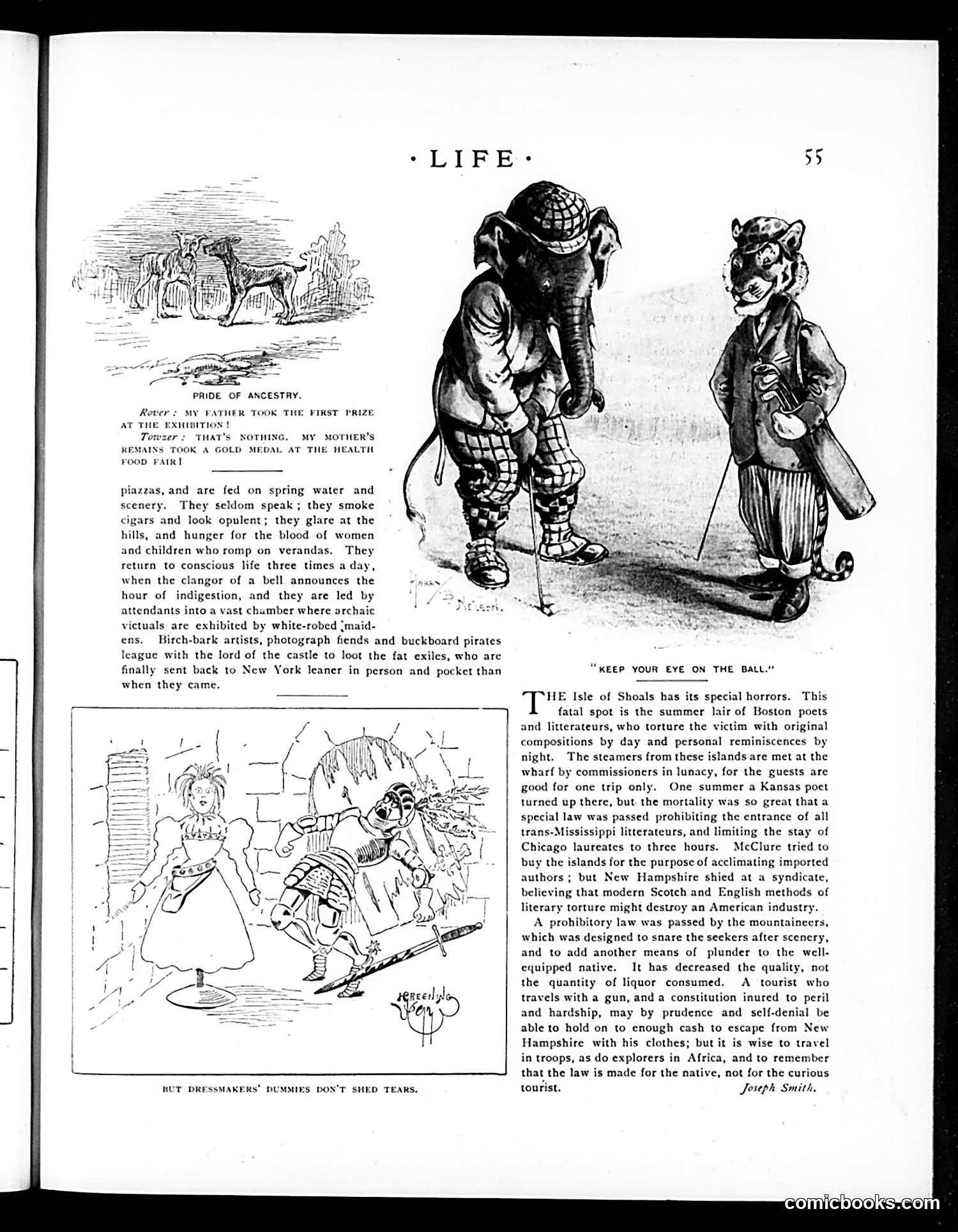
This page satirizes wealthy tourists and artistic/literary types who summered in New England resort areas. The top cartoon jokes about ancestral pride: one figure boasts his father won a prize; the other counters that his mother's remains won a medal at a "health food fair"—mocking pretentious genealogy claims. The main text mocks Boston poets and literati infesting places like the Isle of Shoals, where they torment visitors with amateur compositions and personal stories. It describes how summer tourism has become so problematic that New Hampshire passed laws restricting literary figures' visits. The piece also satirizes wealthy "fat exiles" from New York who visit mountain resorts, get fleeced by locals, and return home poorer. The cartoon "Keep Your Eye on the Ball" depicts a tourist (elephant-headed figure, unclear significance) with a local character, likely illustrating the predatory relationship between native con-artists and gullible visitors. The final cartoon about "dressmakers' dummies" likely comments on tourists as empty-headed, superficial targets.
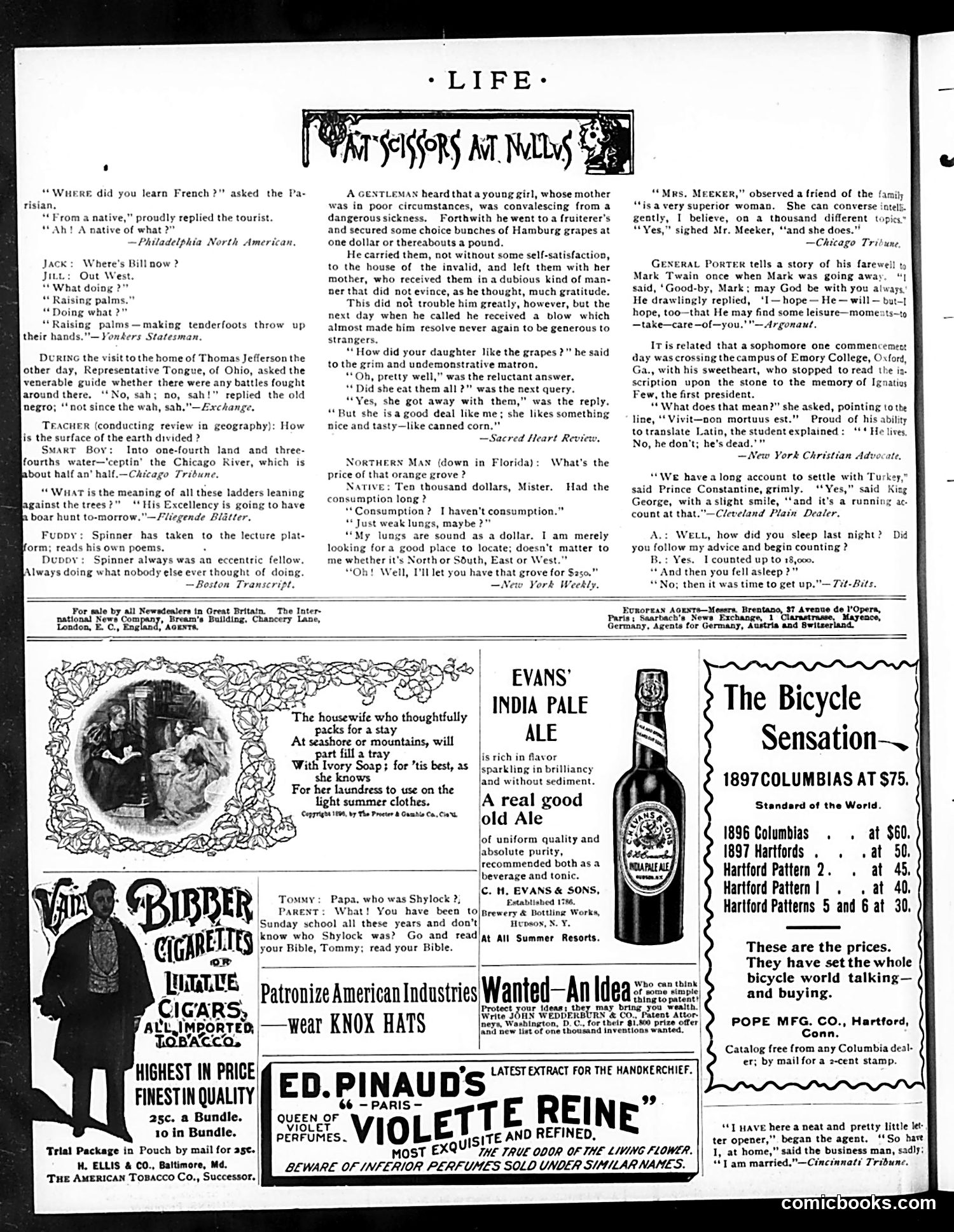
This page from Life magazine presents a collection of short humorous anecdotes and jokes typical of late 19th-century American satirical magazines. The humor relies on social observations and wordplay rather than political commentary. The jokes target recognizable types: a pretentious tourist claiming French fluency, con artists ("tenderfoots") in the American West, an eccentric lecturer, and a stingy woman ungrateful for expensive grapes. One anecdote mocks a Northern man seeking land in Florida for consumption (tuberculosis treatment), where a Native (likely Native American or local Floridian) opportunistically overcharges him. Other brief items reference Mark Twain and General Porter's witty farewell, a college student's Latin translation mishap, and a woman's superior conversational abilities. The page is primarily filler between advertisements for products like Evans India Pale Ale, Knox Hats, and bicycles—reflecting the era's commercial satire format. The humor is gentle social comedy rather than biting political satire.
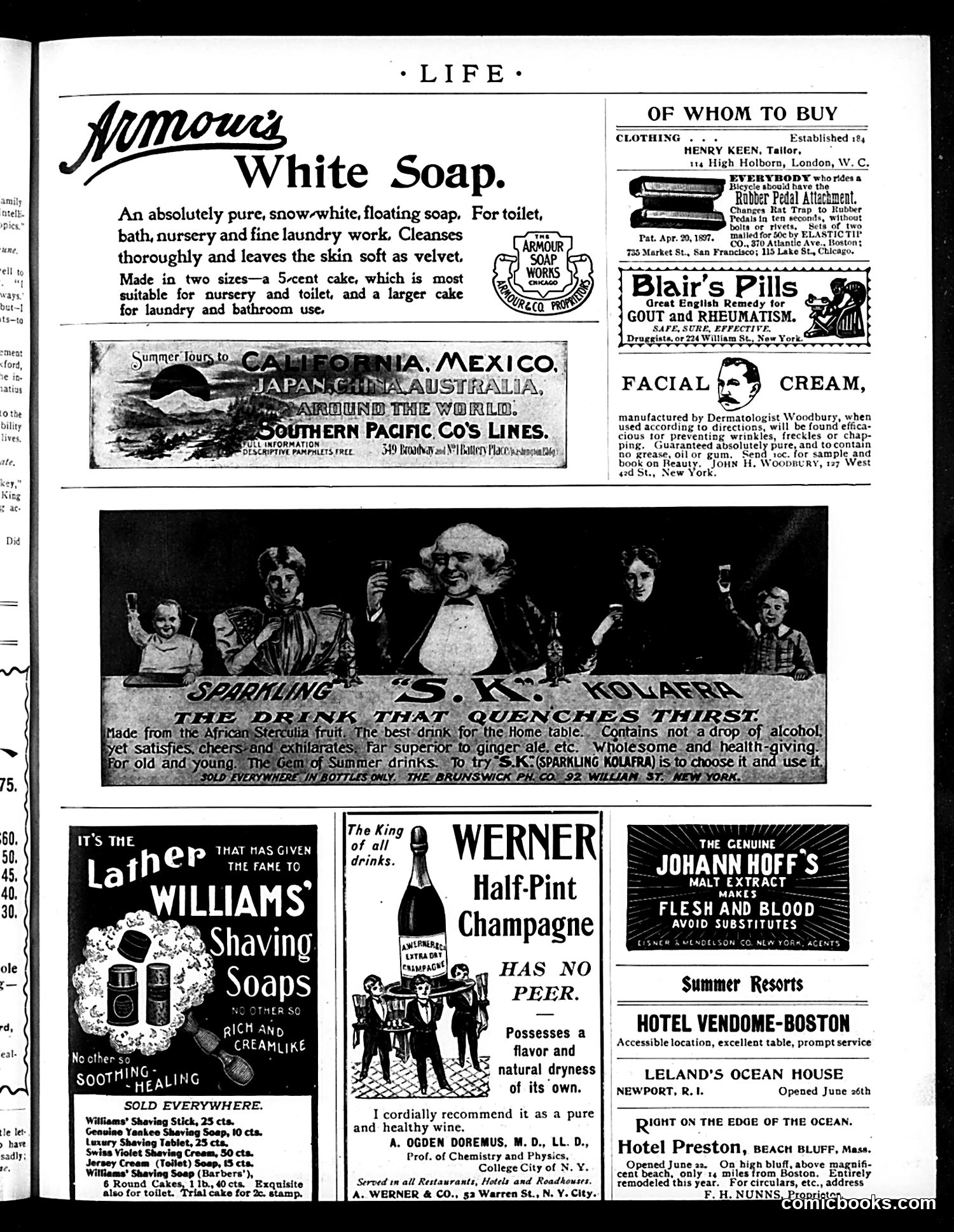
This page is primarily **advertising**, not political satire. It contains product advertisements typical of early 1900s American magazines: soaps (Armour's White Soap, Williams' Shaving Soaps), patent medicines (Blair's Pills for gout/rheumatism, Johann Hoff's Malt Extract), beverages (S.K. Sparkling Nolarra drink, Werner Half-Pint Champagne), and summer resort hotels. The **only visual imagery** is a travel advertisement for the Southern Pacific Railroad (Califorinia, Mexico, Japan, China, Australia) and a small advertisement showing figures toasting with S.K. Sparkling Nolarra, a non-alcoholic drink marketed as "the drink that quenches thirst." The page reflects **consumer culture and health claims** common to the era—products promised to cure ailments, improve appearance, and provide leisure. There is no discernible political cartoon or satire on this particular page.
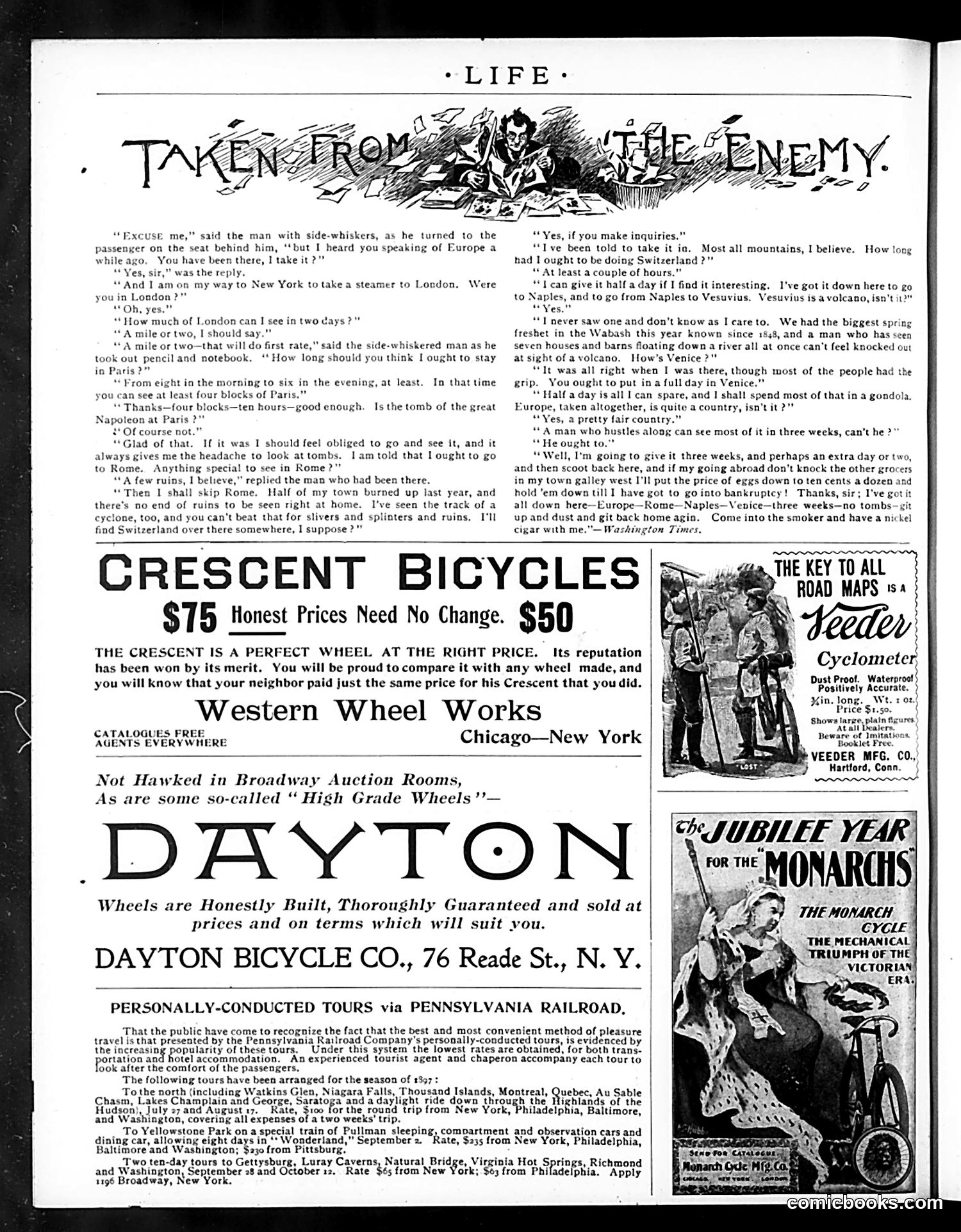
This page's main feature is a satirical dialogue poking fun at American tourists—specifically a provincial grocer from the Midwest visiting Europe for the first time. The joke centers on his comical ignorance and impatience: he wants to see all of Europe in three weeks, allocating mere hours to major cities (Paris, Rome, Venice) and considering famous attractions like Napoleon's tomb a headache. The humor relies on contrasting his small-town American practicality with European grandeur. He dismisses the Wabash River floods back home as more impressive than volcanoes, and plans to undercut local egg prices upon returning—treating his European tour as a business investment rather than cultural experience. The "enemy" reference in the title is unclear from the visible text alone. The page also contains period bicycle advertisements (Crescent, Dayton brands) and travel promotion for Pennsylvania Railroad tours—typical commercial content for *Life* magazine of this era.
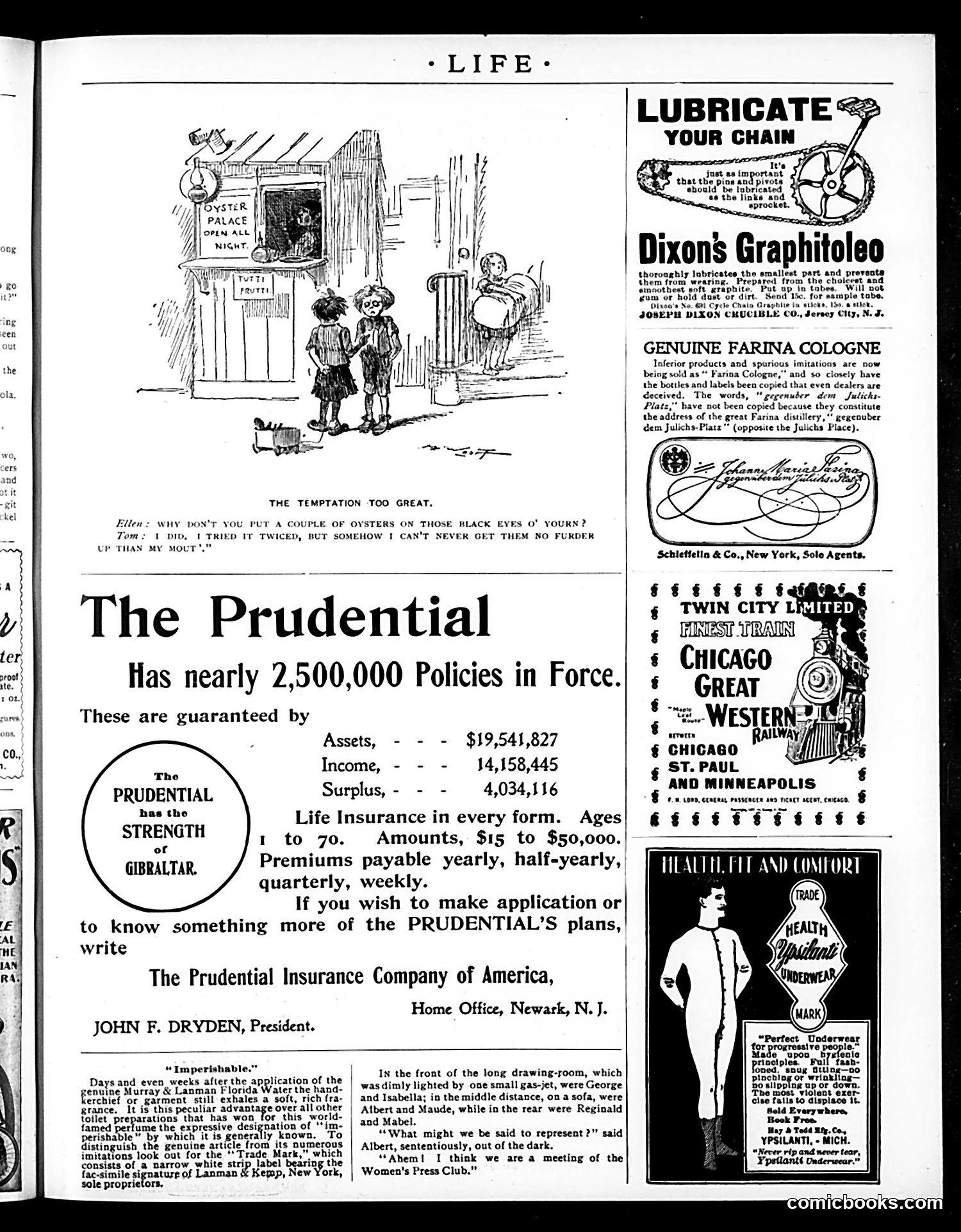
**Main Cartoon ("The Temptation Too Great"):** A visual joke about a poor man named Tom with black eyes (bruises). Ellen suggests applying oysters to them as a folk remedy for bruising. Tom's reply reveals the joke: he tried it twice but couldn't resist eating the oysters before they could heal his eyes—his hunger overcame the medical treatment. This satirizes both working-class poverty (oysters being expensive luxury food) and the difficulty of self-restraint. **Advertisements:** The page is primarily filled with period product ads: The Prudential Insurance Company (emphasizing financial strength), Dixon's Graphite chain lubricant, Farina Cologne (warning against counterfeits), genuine Murray & Lanman Florida Water perfume, Chicago Great Western Railway, and Ypsilanti Underwear. **Context:** This appears to be from an early-1900s *Life* magazine issue, mixing satirical humor with commercial advertising—a typical format for the era.
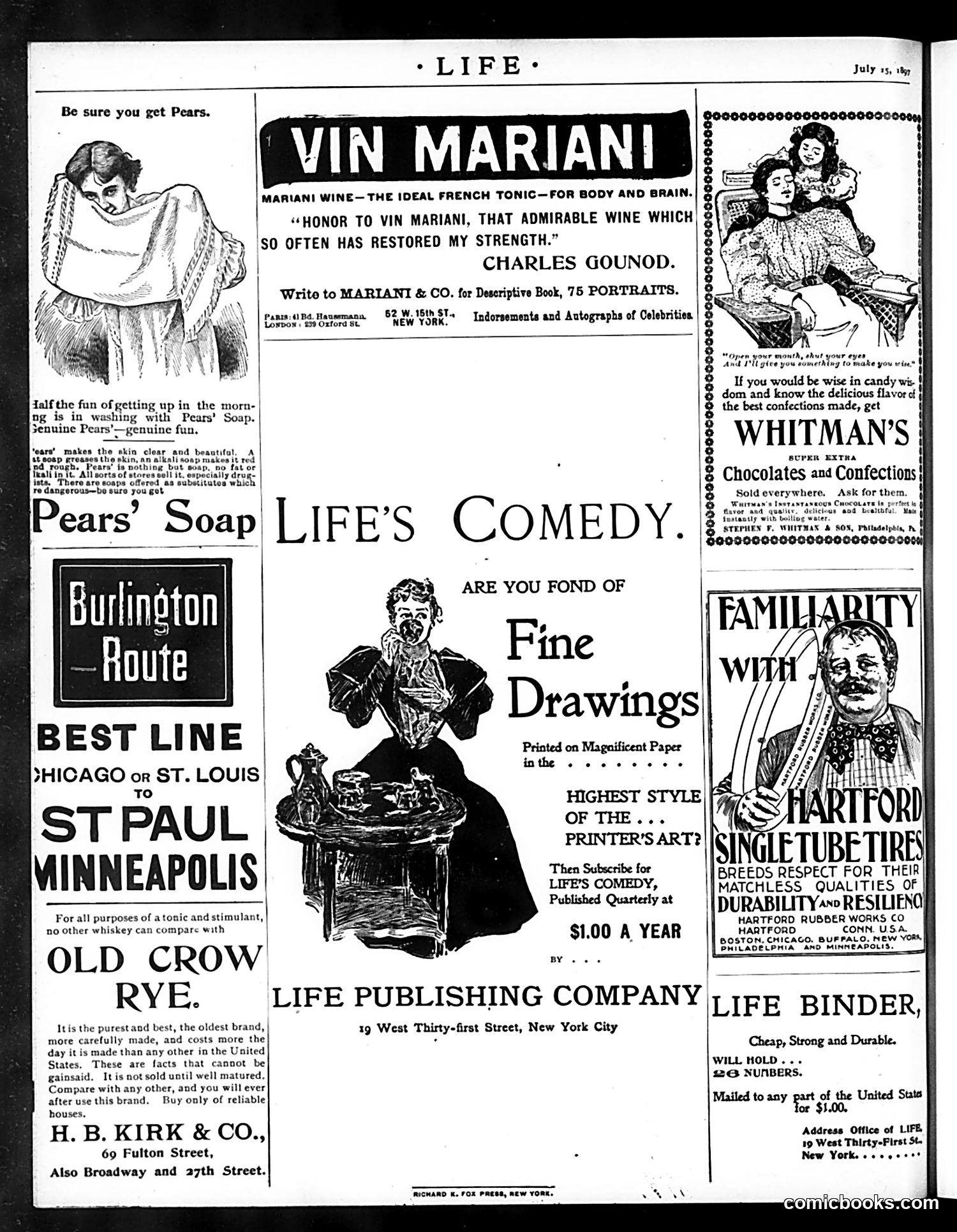
This page is primarily **advertising**, with a small central cartoon labeled "Life's Comedy." The ads promote period products: Pears' Soap, Old Crow whiskey, Vin Mariani wine (a cocaine-laced tonic), Whitman's chocolates, and Hartford Single Tube Tires. The central cartoon depicts a figure at a table in exaggerated distress—likely satirizing the absurd health claims made by these products. Charles Gounod (the famous composer) is quoted endorsing Vin Mariani, lending celebrity credibility to dubious tonics. The satire is implicit: Life magazine profits from advertising these patent medicines and tonics while simultaneously mocking their over-the-top promises through the cartoon. Modern readers should note Vin Mariani's cocaine content was legal and openly sold in the 1890s as a "tonic for body and brain." The page reflects turn-of-century American consumer culture and unregulated pharmaceutical marketing.