
Life, 1897-07-15 · page 6 of 20
Life — July 15, 1897 — page 6: what you’re looking at
What you’re looking at
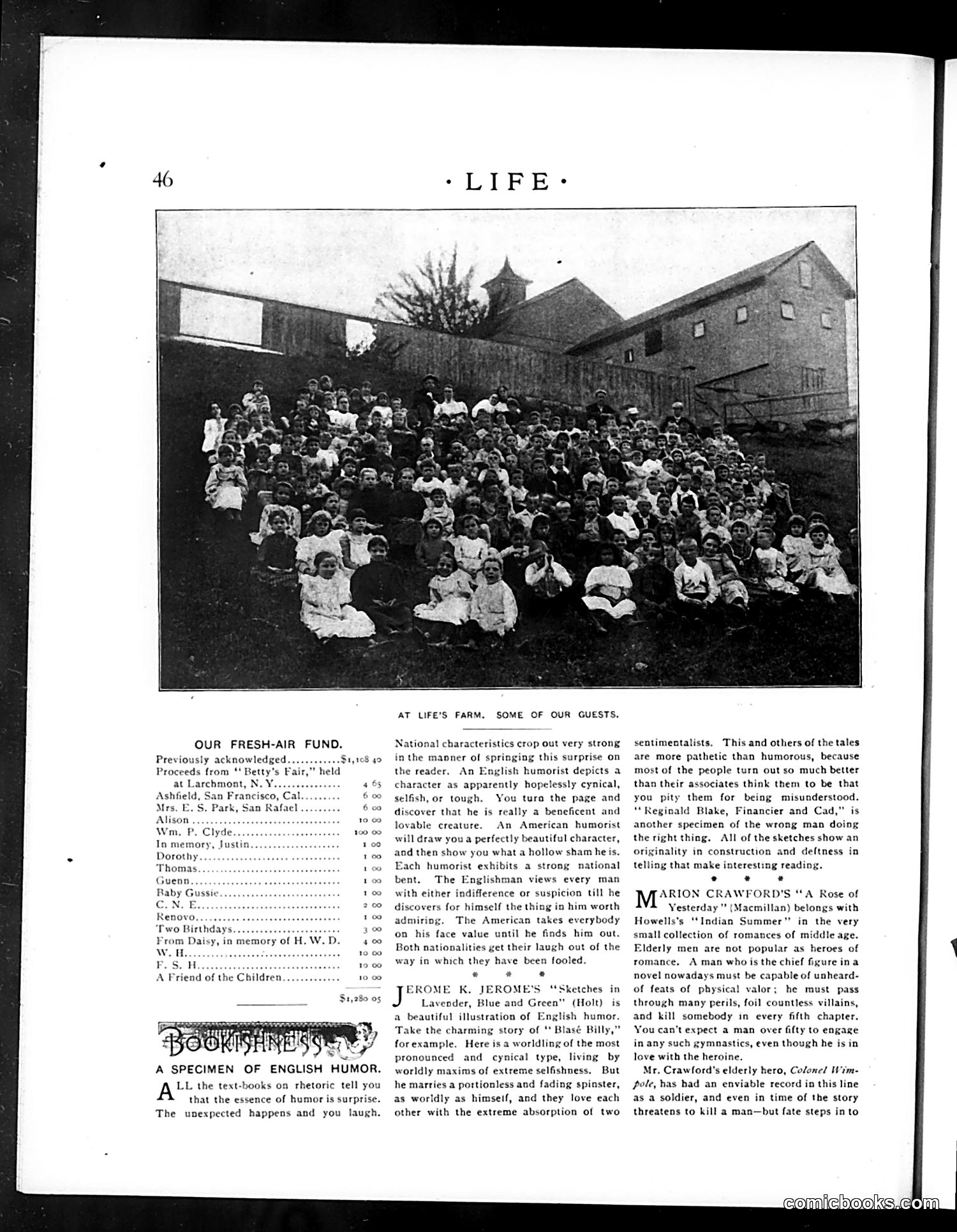
This page primarily contains **a charitable fundraising appeal** rather than political satire. The large photograph shows a large group of children and adults gathered at "Life's Farm," apparently an orphanage or children's charity. The "Fresh-Air Fund" section lists donations from readers, with amounts ranging from $1.08 to $19.00, supporting what appears to be a program providing outdoor recreation or respite for underprivileged children. The lower section, titled "A Specimen of English Humor," discusses Jerome K. Jerome's sketches and examines differences between English and American humor—noting that English humor emphasizes surprise and cynicism, while American humor focuses on character revelation. **This is essentially a charitable advertisement combined with literary commentary**, not political satire.
📄 Transcribed text from this page (OCR, searchable)
Machine-transcribed from the original scan — historical spelling and the odd misread are preserved.
OUR FRESH-AIR FUND. Previously acknowledged +e $1108 49 Proceeds from ‘Betty's Fair,” held at Larchmont, N.Y.....++ Ashfield, San Francisco, Cal. Mrs, E. S. Park, San Rafael . Alison ...... Wm. P. Clyde.. In memory, Justi Dorothy ‘Thomas. Guenn.. Raby Gussie Renovo ‘Two Birthdays From Daisy, in memory of H. W. HL... A Friend of the Children A SPECIMEN OF ENGLISH HUMOR. ALL the textbooks on rhetoric tell you that the essence of humor is surpri The unexpected happens and you laugh. AT LIFE’S FARM, SOME OF OUR GUESTS. National characteristics crop out very strong in the manner of springing this surprise on the reader, An English humorist depicts a character as apparently hopelessly cynical, selfish, or tough. You tura the page and discover that he is really a beneficent and lovable creature. An American humorist will draw you a perfectly beautiful character, and then show you what a hollow sham he is. Each humorist exhibits a strong national bent. The Englishman views every man with either indifference or suspicion till he discovers for himself the thing in him worth admiring. The American takes everybody on his face value until he finds him out. Both nationalities get their laugh out of the way in which they have been fooled. * * EROME K. JEROME'S Sketches in Lavender, Blue and Green” (Holt) is a beautiful illustration of English humor Take the charming story of ‘ Blasé Billy forexample. Here is a worldling of the most pronounced and cynical type, living by worldly maxims of extreme selfishness, But he marries a portionless and fading spinster, as worldly as himseif, and they love each other with the extreme absorption of two sentimentalists. This and others of the tales are more pathetic than humorous, because most of the people turn out so much better than their associates think them to be that you pity them for being misunderstood. “Reginald Blake, Financier and Cad,” is another specimen of the wrong man doing the right thing, All of the sketches show an originality in construction and deftness in telling that make interesting reading. * * * M2808 CRAWFORD'S “A Rose of Yesterday acmillan) belongs with Howells's ‘Indian Summer" in the very small collection of romances of middle age. Elderly men are not popular as heroes of romance. A man whois the chief figure ina novel nowadays must be capable of unheard- of feats of physical valor; he must pass through many perils, foil countless villains, and kill somebody in every fifth chapter. You can't expect a man over fifty to engage in any such gymnastics, even though he is in love with the heroine. Mr. Crawford's elderly hero, Colonel Wim- Pole, has bad an enviable record in this line as a soldier, and even in time of the story threatens to kill a man—but fate steps in to