
A complete issue · 20 pages · 1897
Life — July 1, 1897
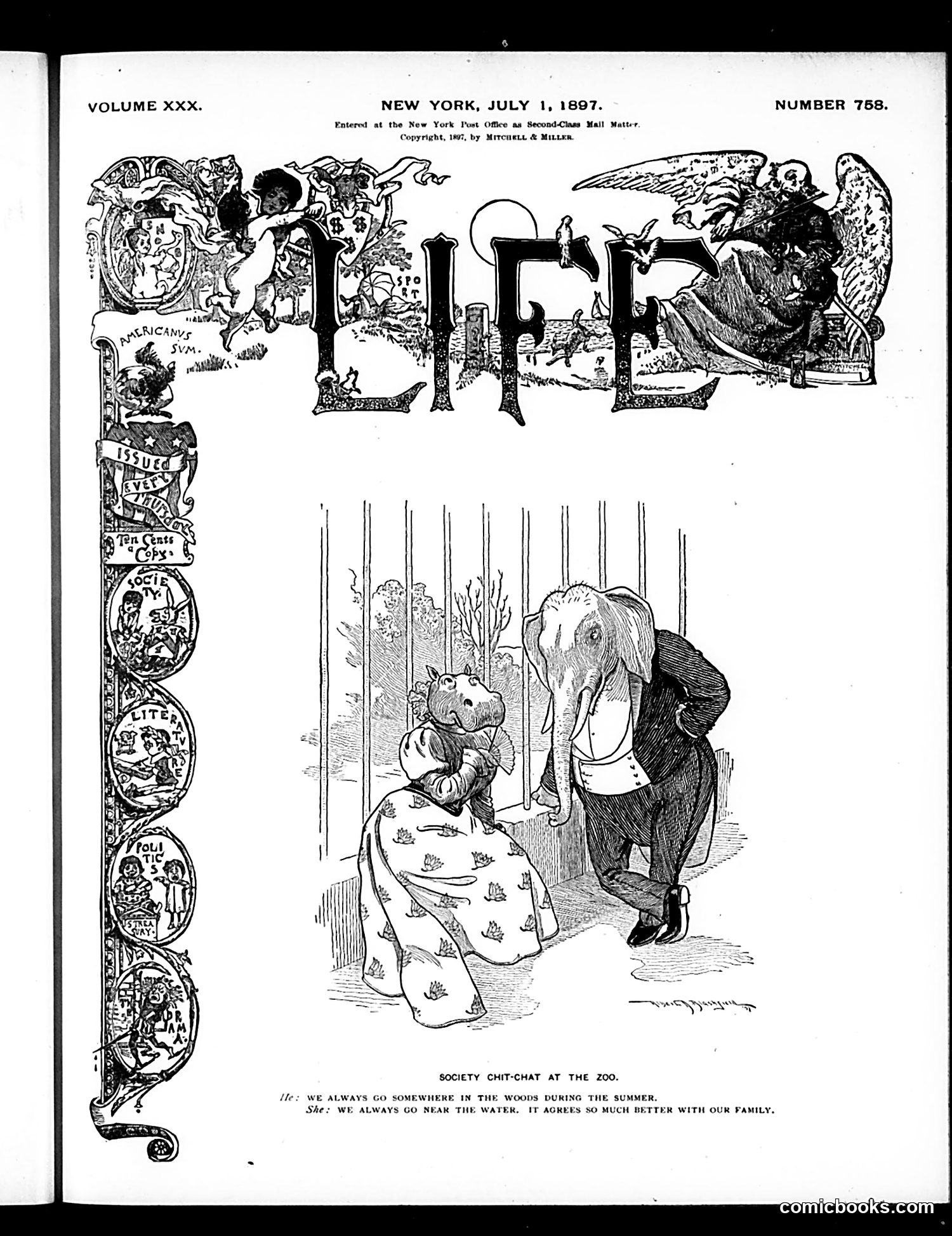
This cartoon depicts two anthropomorphic animals—a hippo and an elephant—engaged in conversation at a zoo, likely representing human society members. The hippo, dressed formally, appears to be a society woman, while the elephant in a coat represents a gentleman caller. The humor relies on social satire: the dialogue reveals how the upper class discusses leisure and family outings. The male figure claims "we always go somewhere in the woods during the summer," while the female responds "we always go near the water. It agrees so much better with our family." This is gentle satire of Victorian-era *haute société*—mocking how the wealthy discuss their seasonal habits and health concerns as markers of status, while being presented as animals rather than humans to emphasize the absurdity of such pretensions.
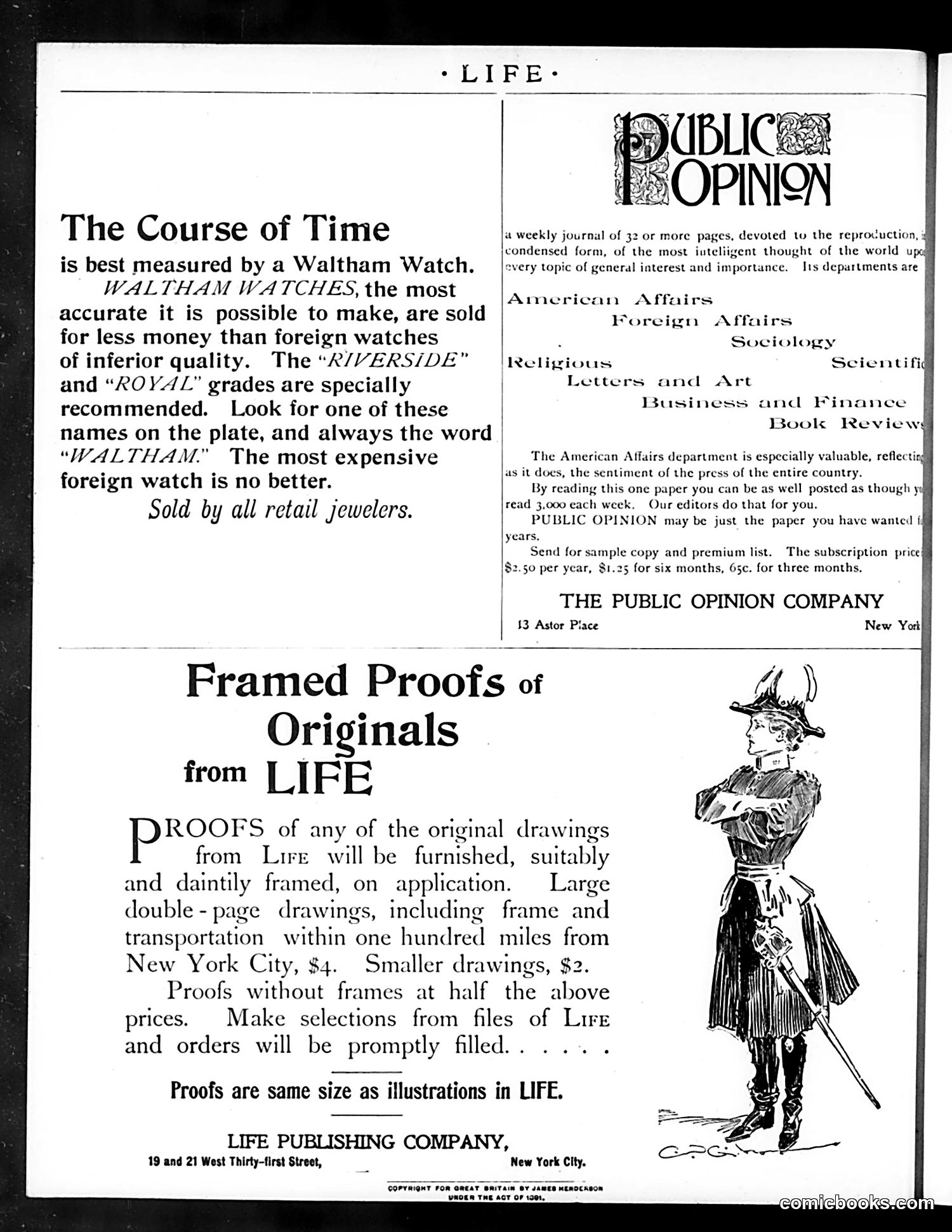
This page is primarily **advertising**, not satirical content. It contains three advertisements: 1. **Waltham Watches** (top left): Promotes American-made watches as superior value to foreign equivalents, highlighting specific grades ("Riverside" and "Royal"). 2. **Public Opinion Magazine** (top right): Advertises a weekly journal covering current affairs, literature, science, and business, with subscription pricing ($2.50/year). 3. **Framed Proofs** (bottom): Life Publishing Company offers framed reproductions of original drawings from Life magazine, with pricing based on size and whether frames are included. The illustration accompanying the framed proofs shows a woman in Edwardian-era dress but serves only as decorative advertisement material, not satire. This page reflects early 20th-century publishing business practices and consumer goods marketing.
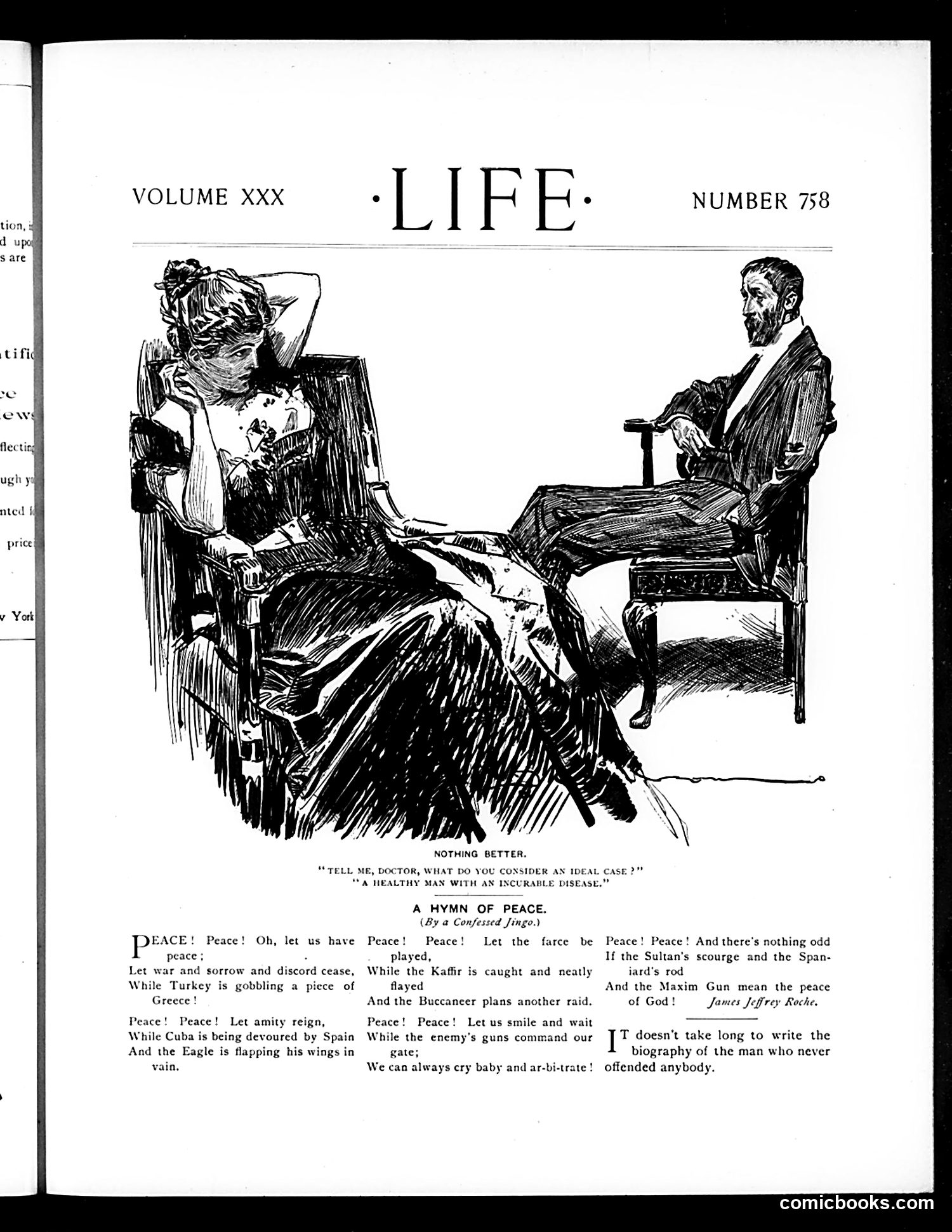
This page features a satirical cartoon titled "A Hymn of Peace" (subtitled "By a Confused Frago"). The illustration shows a woman reclining in a chair speaking with a bearded man, likely a doctor, with the caption: "Tell me, doctor, what do you consider an ideal case?" / "A healthy man with an incurable disease." The accompanying poem mockingly celebrates "peace" while cataloging active military conflicts: the Kafir Wars, Turkey's actions in Greece, Spain's conflict with Cuba, and Anglo-Afghan tensions. The satire exposes the hypocrisy of claiming peace exists while multiple colonial wars actively rage globally. The doctor-patient dialogue extends this dark humor: ideal health paradoxically requires untreatable illness—mirroring how "peace" coexists with widespread warfare in the contemporary world.
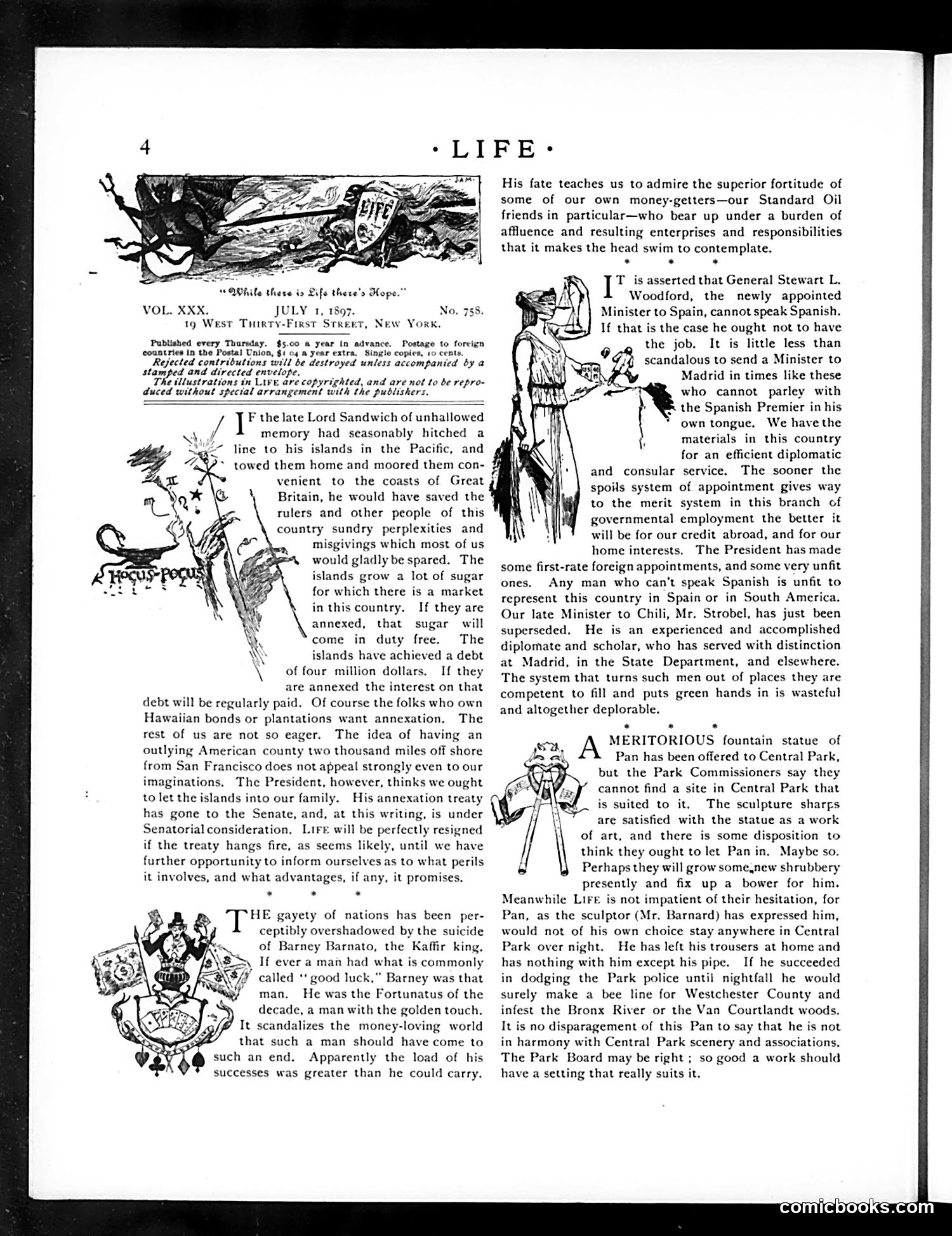
**Top Cartoon ("While there is Life there's Hope"):** Shows a dead or dying figure labeled "LIFE" - appears to be satirizing the magazine's own struggles or relevance. **Main Articles Address:** 1. **General Stewart L. Woodford's Spanish Appointment:** The text mocks his appointment as Minister to Spain despite being unable to speak Spanish. This critiques the "spoils system" of political patronage appointments where unqualified candidates received positions through political connections rather than merit. 2. **Pan Statue in Central Park:** Discusses a meritorious fountain statue offering and the Park Commissioners' hesitation about placement—satirizing bureaucratic indecision and the sculptor's eccentric attempts to keep the statue. 3. **Barney Barnato's Suicide:** References the death of the wealthy financier, commenting on how his extraordinary success created unsustainable expectations. The page critiques political corruption, incompetence, and bureaucratic obstruction.
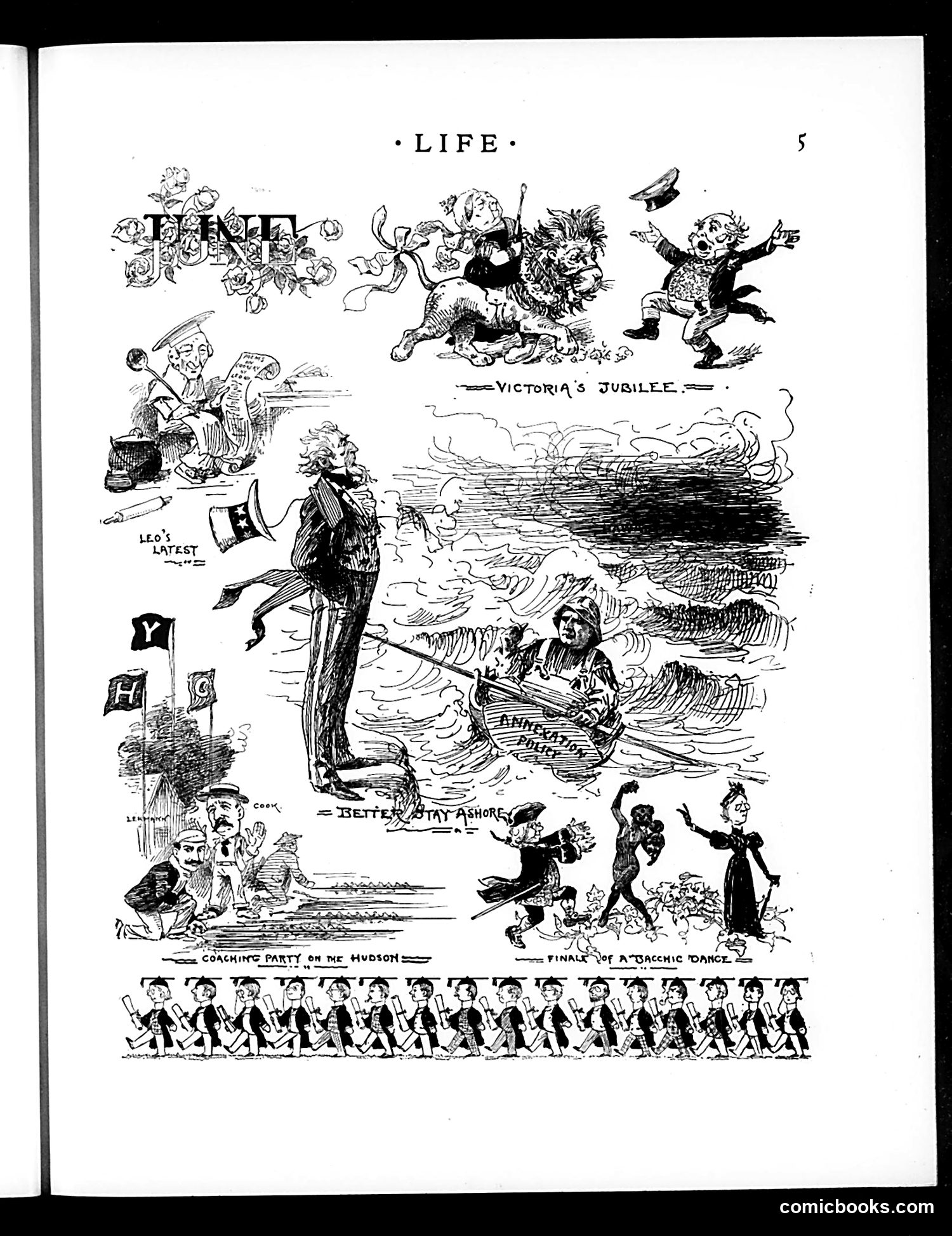
This page from *Life* magazine presents satirical cartoons mocking late Victorian-era society and Queen Victoria's Diamond Jubilee (1897). The panels include: **"Victoria's Jubilee"** - depicts chaotic celebration scenes, likely satirizing the excessive patriotic fervor surrounding the Queen's 60-year reign. **"Leo's Latest"** - references Pope Leo XIII, apparently mocking contemporary papal activities or statements. **"Better Stay Ashore"** - shows a tall figure (possibly a politician or public figure) warning against maritime ventures, likely political commentary on naval or colonial matters. **"Coaching Party on the Hudson"** and **"Finale of a Classical Dance"** - social satire of American leisure activities and cultural pretensions. The bottom frieze depicts a parade of identical figures, possibly satirizing conformity or mass behavior. The overall tone mocks both British imperial celebration and American society's pretensions.
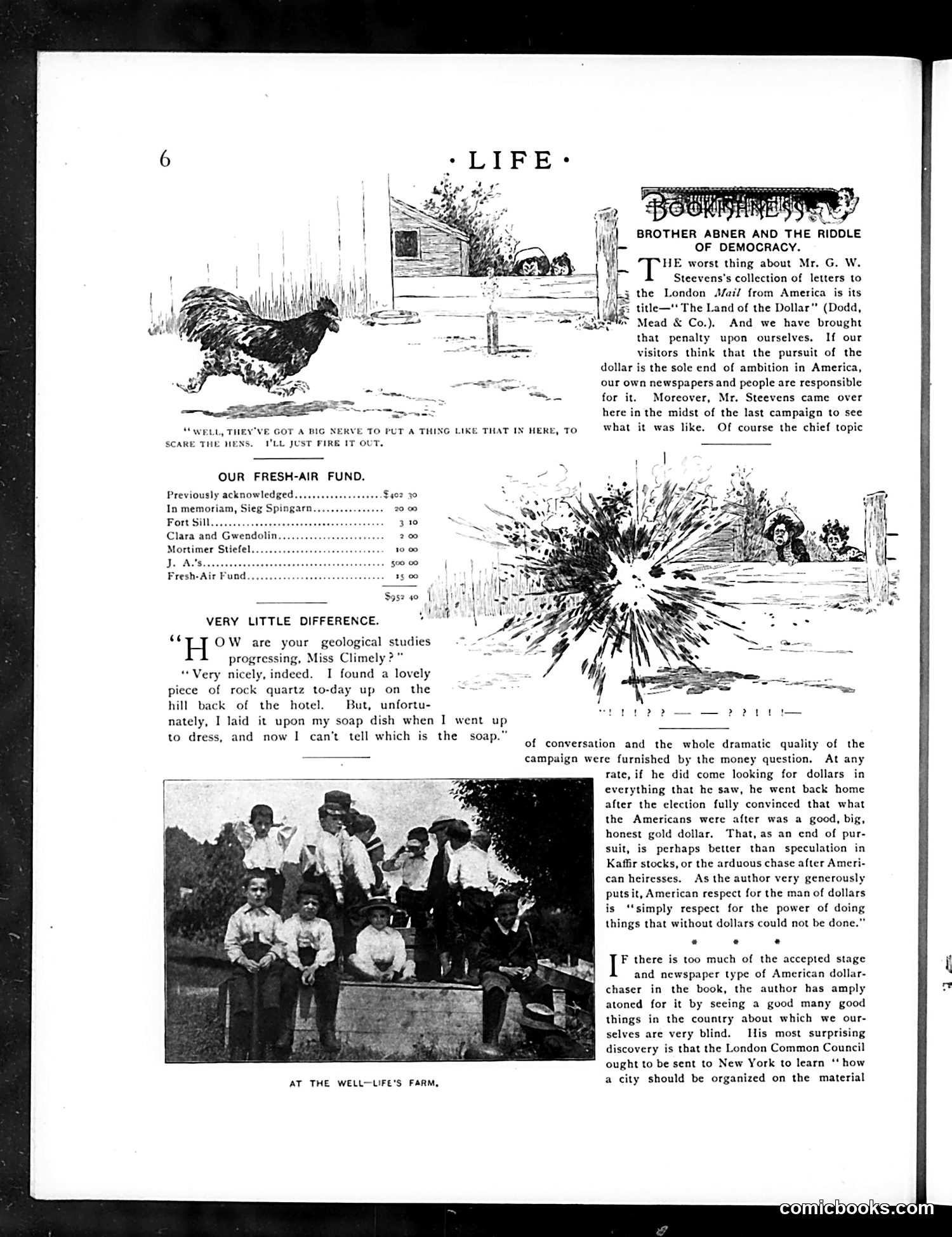
This page contains three distinct items: 1. **"Well, They've Got a Big Serve to Put a Thing Like That Is Here"** — A cartoon depicting a rooster, likely satirizing American agricultural or rural practices, though the specific reference is unclear from the image alone. 2. **"Our Fresh-Air Fund"** — A fundraising list for a charitable organization providing outdoor experiences for urban residents, a common Progressive-era cause. 3. **"Very Little Difference"** — A brief comedic exchange about geological studies and soap, playing on words and everyday confusion. 4. **"Brother Abner and the Riddle of Democracy"** — A book review criticizing G.W. Stevens' collection of letters about America's pursuit of wealth ("The Land of the Dollar"), suggesting American materialism and the reader's commentary on American values. The page reflects early 20th-century American social satire and concerns about consumerism.
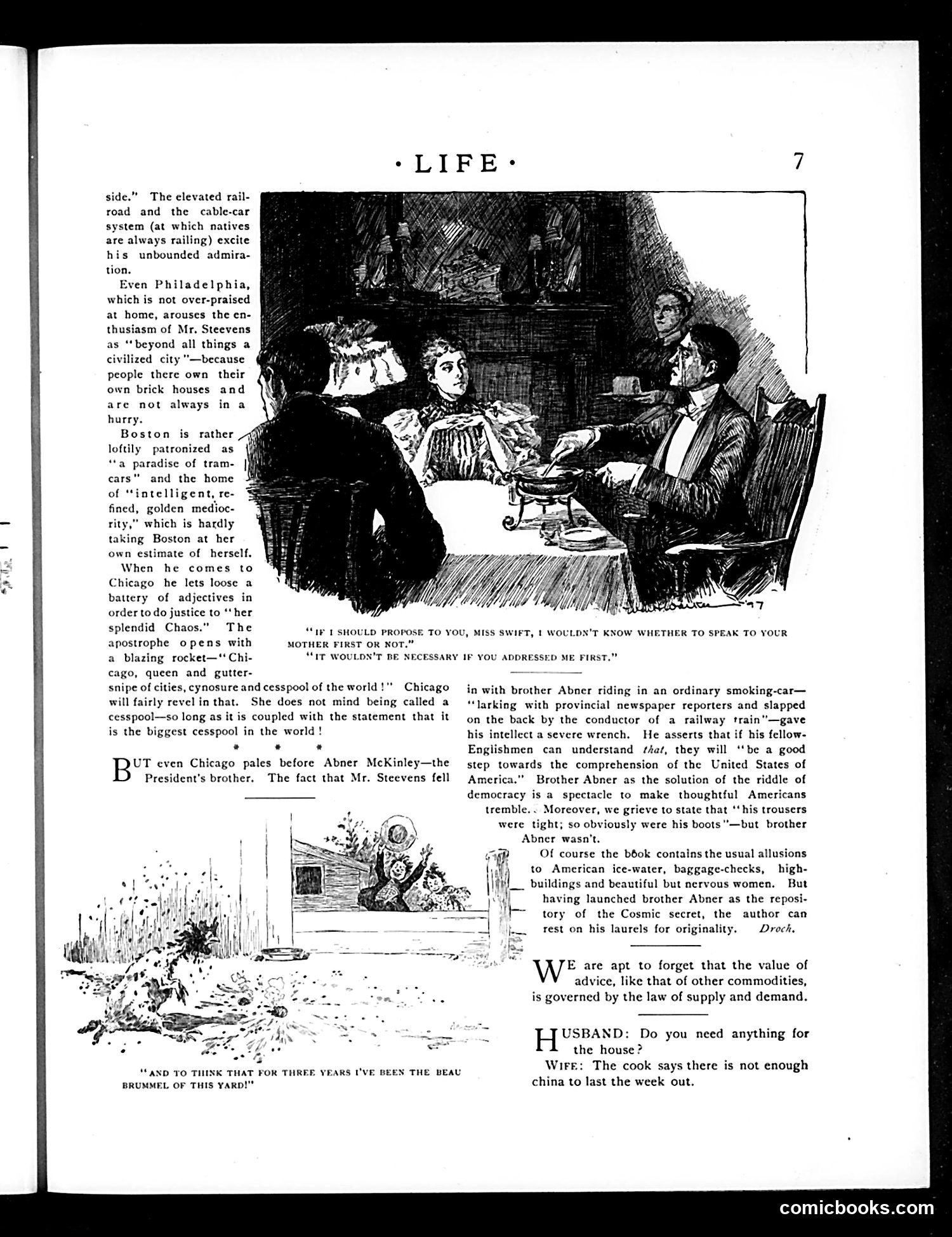
This page satirizes American regional attitudes and pretensions. The upper illustration depicts a social scene where someone proposes to "Miss Swift," with the caption establishing tension about proper etiquette between classes or regions. The main text discusses how different cities—Philadelphia, Boston, and Chicago—cultivate distinct self-images. Philadelphia claims refined domesticity; Boston prides itself on "intelligent" culture; Chicago boasts being a "paradise of tramcars" and "splendid Chaos." The satire centers on **Abner McKinley** (President's brother), apparently visiting from the Midwest. The text mocks how Easterners patronize Westerners as unsophisticated, while acknowledging Chicago's actual vitality. The humor targets regional snobbery and provincial attitudes about American identity and manners during the early 20th century.
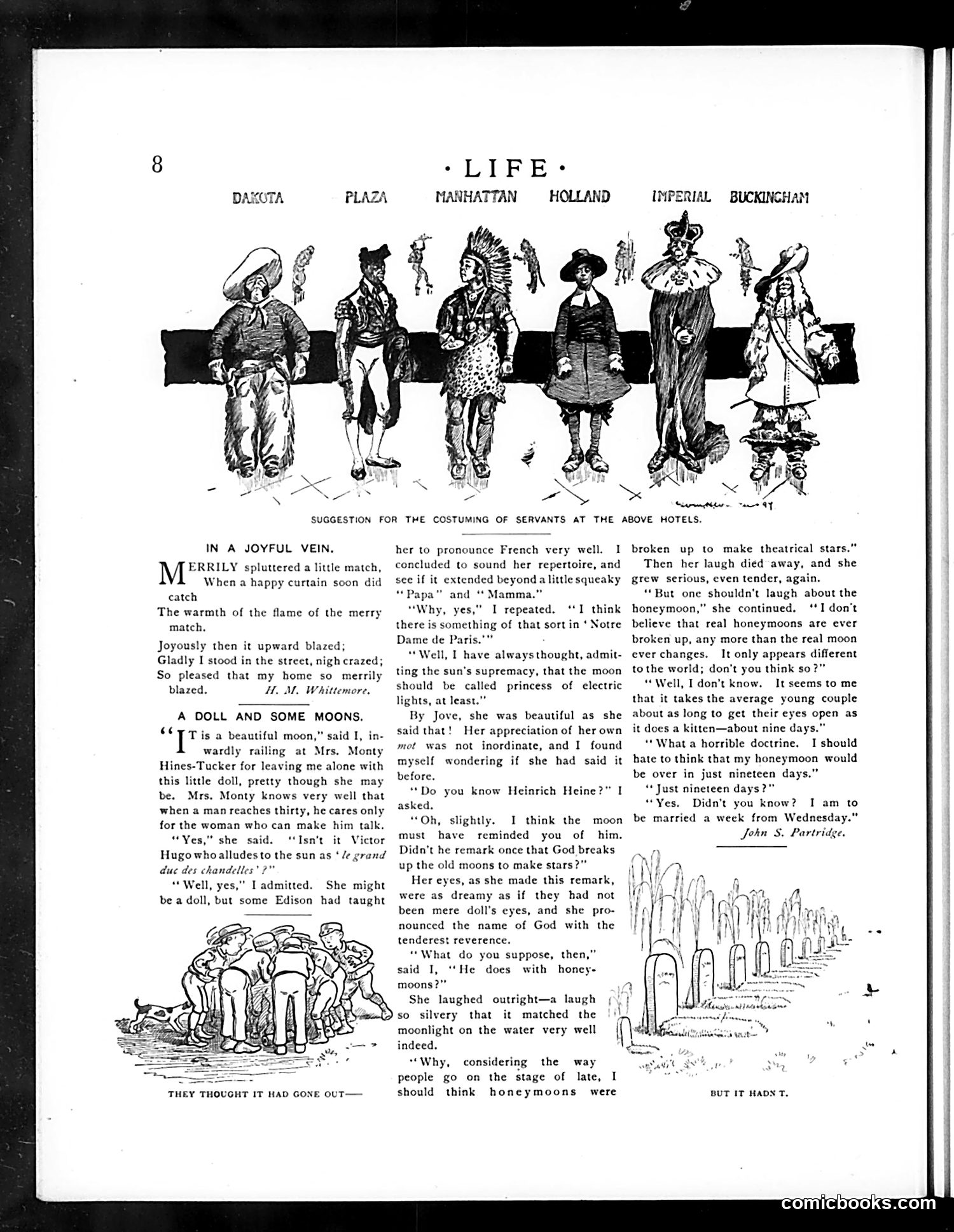
**Top Section:** A satirical illustration showing six hotel servants in period costumes labeled "Dakota," "Plaza," "Manhattan," "Holland," "Imperial," and "Buckingham." This mocks the pretentious naming practices of American luxury hotels, which adopted grand European-sounding names to suggest aristocratic elegance. The joke: these are just ordinary servants at American establishments trying to appear sophisticated through borrowed Old World grandeur. **Main Story:** "A Doll and Some Moons" is a humorous dialogue about honeymoons. A woman discusses romance and the moon with a man, including a reference to Heinrich Heine (the German Romantic poet). The satire gently mocks sentimental honeymoon clichés and naive romantic expectations among newlyweds—suggesting real honeymoons are disappointingly brief compared to idealized notions.
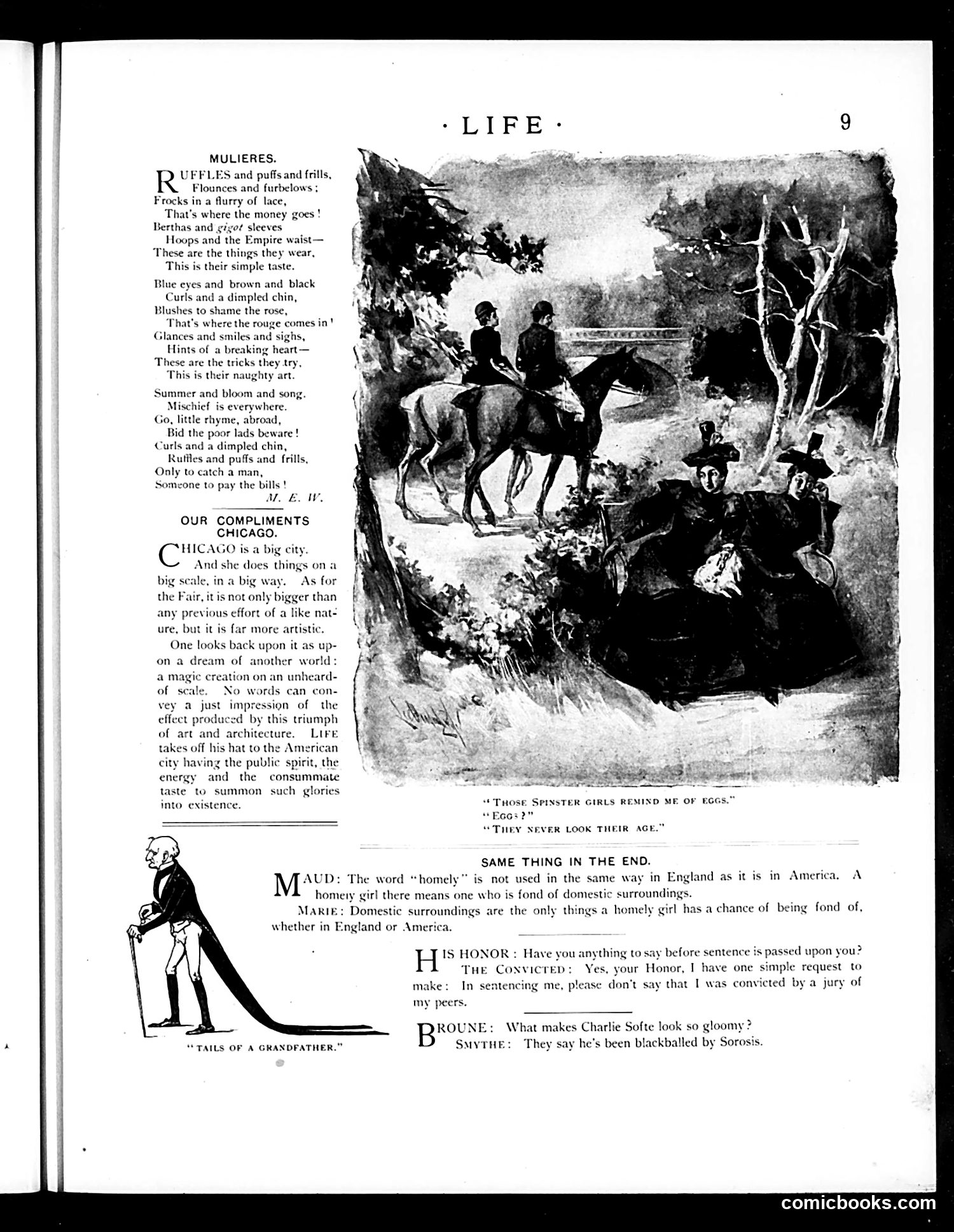
This page contains satirical poetry and social commentary typical of early Life magazine. The poem "Mulieres" mocks fashionable women's affectations—their elaborate clothing (ruffles, frills, Empire waists), cosmetics (rouge, blushes), and calculated charm ("glances and smiles"). It critiques their superficiality while suggesting they're financially dependent ("That's where the money goes"). The illustration captioned "Those Spinster Girls Remind Me of Eggs" appears to reference unmarried women, with dialogue suggesting they "never look their age"—likely a jab at women's efforts to appear younger. The bottom dialogue snippets mock legal proceedings and social gossip (references to "blackballing by Sorosis," likely the women's club). Overall, the page reflects period attitudes mixing misogyny with humor about women's social status and appearance.
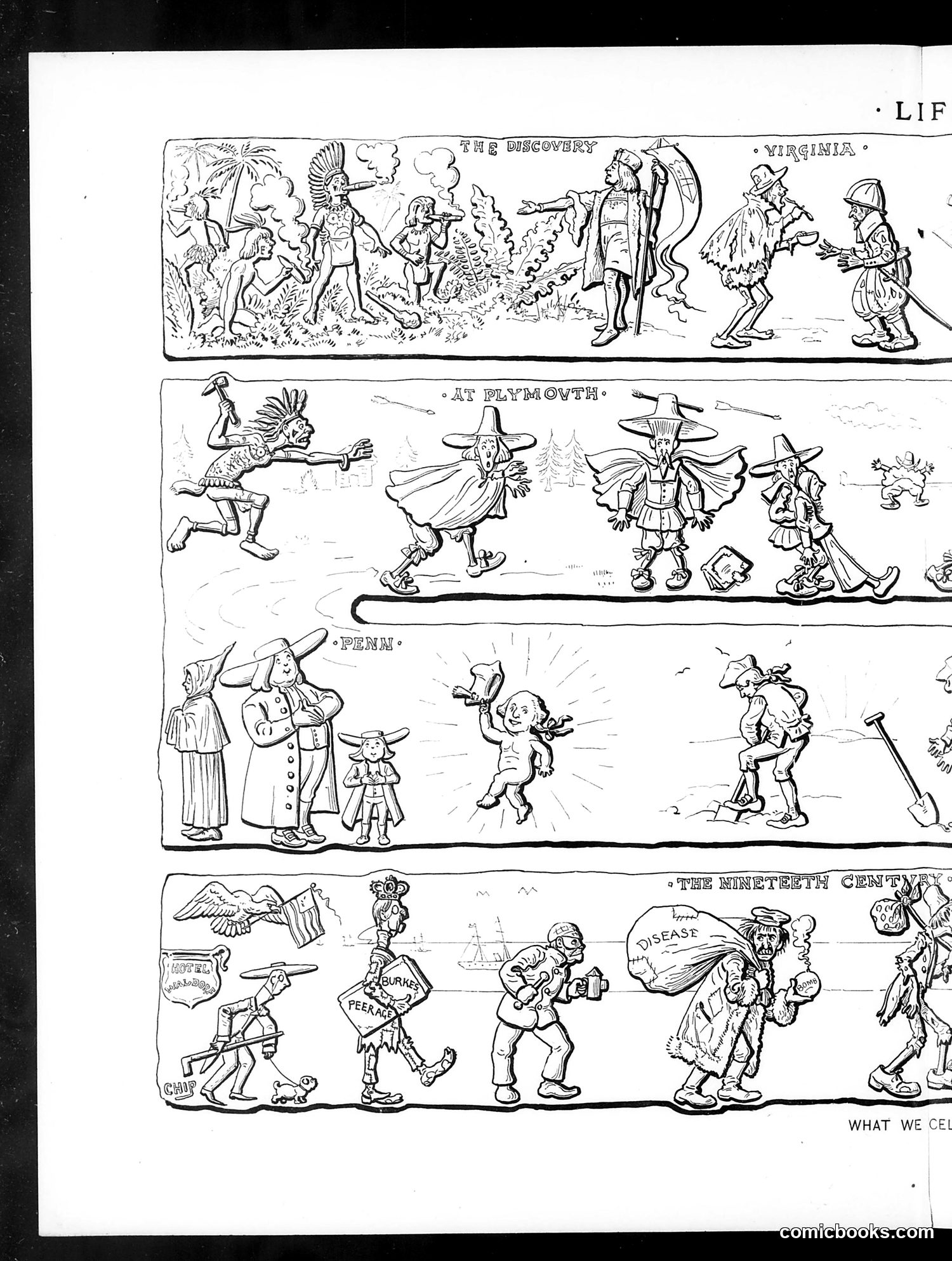
This page presents satirical strips depicting the settlement history of American colonies. The top panel labeled "THE DISCOVERY" shows Native Americans encountering European explorers, with colonial figures gesturing dramatically. The subsequent panels labeled "AT PLYMOUTH," "PENN," and "THE NINETEENTH CENTURY" trace colonial progression through different founding narratives. The final panel appears to show 19th-century social problems including disease and poverty, suggesting a satirical commentary on how colonial ideals deteriorated over time. The satire likely critiques romanticized founding narratives by contrasting idealized colonial settlement images with realistic depictions of later societal problems—poverty, disease, and hardship—implying that America's founding promises weren't fulfilled.
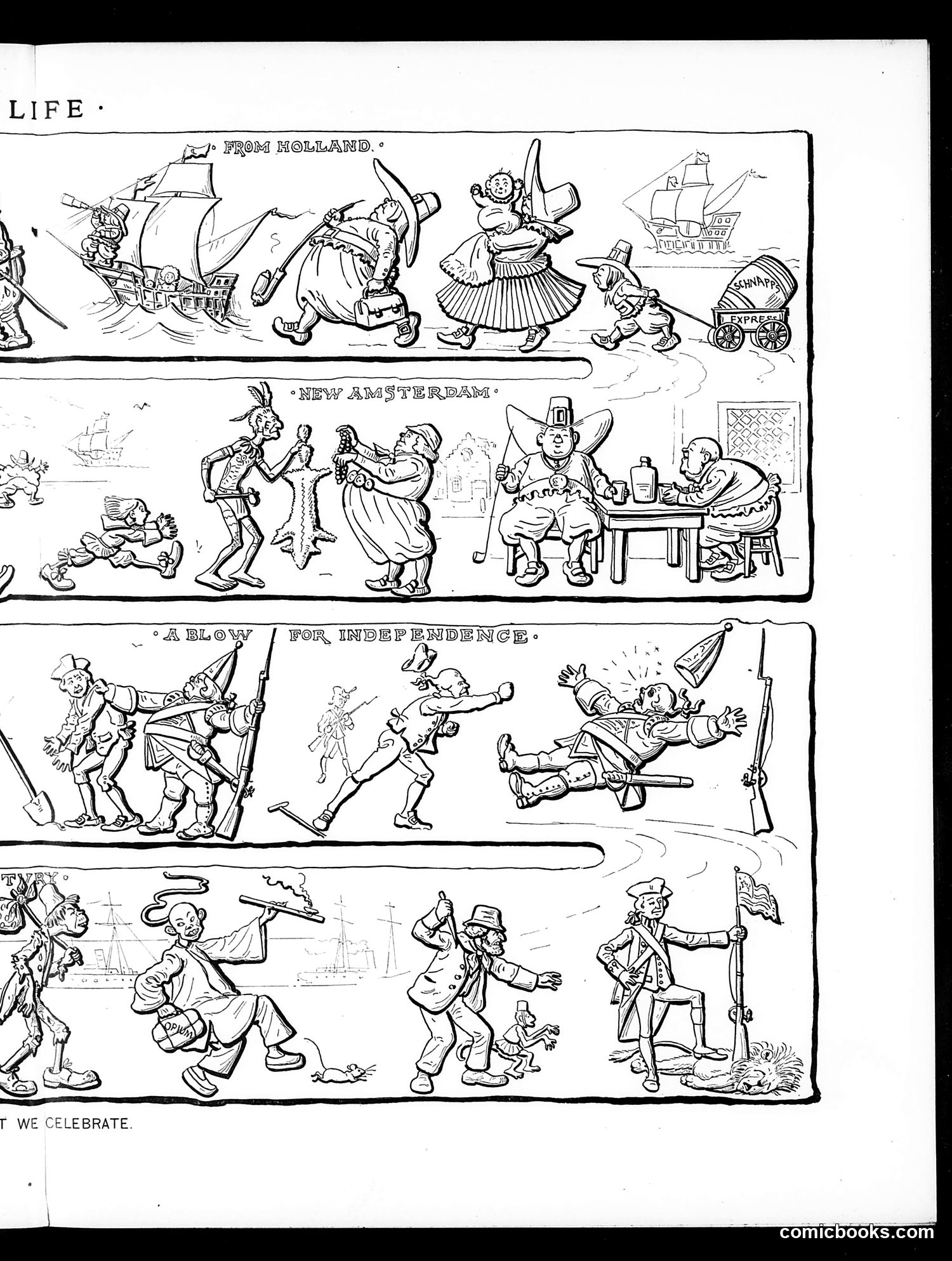
This page contains four satirical cartoon strips depicting Dutch and American colonial history: **"From Holland"** shows Dutch settlers arriving by ship with their belongings. **"New Amsterdam"** depicts early colonial life with dancing, socializing, and drinking. **"A Blow for Independence"** portrays Revolutionary War scenes with soldiers fighting and celebrating. **The bottom strip** (partially visible) continues independence themes with colonial figures and ships. The satire appears to trace American history from Dutch colonial origins through independence, likely mocking or humorously celebrating the transformation of New Amsterdam (New York) into an American city. The exaggerated, comedic character drawings emphasize the "primitive" or rustic nature of early colonial life. This reflects Life magazine's typical approach of using historical narratives for contemporary social commentary.
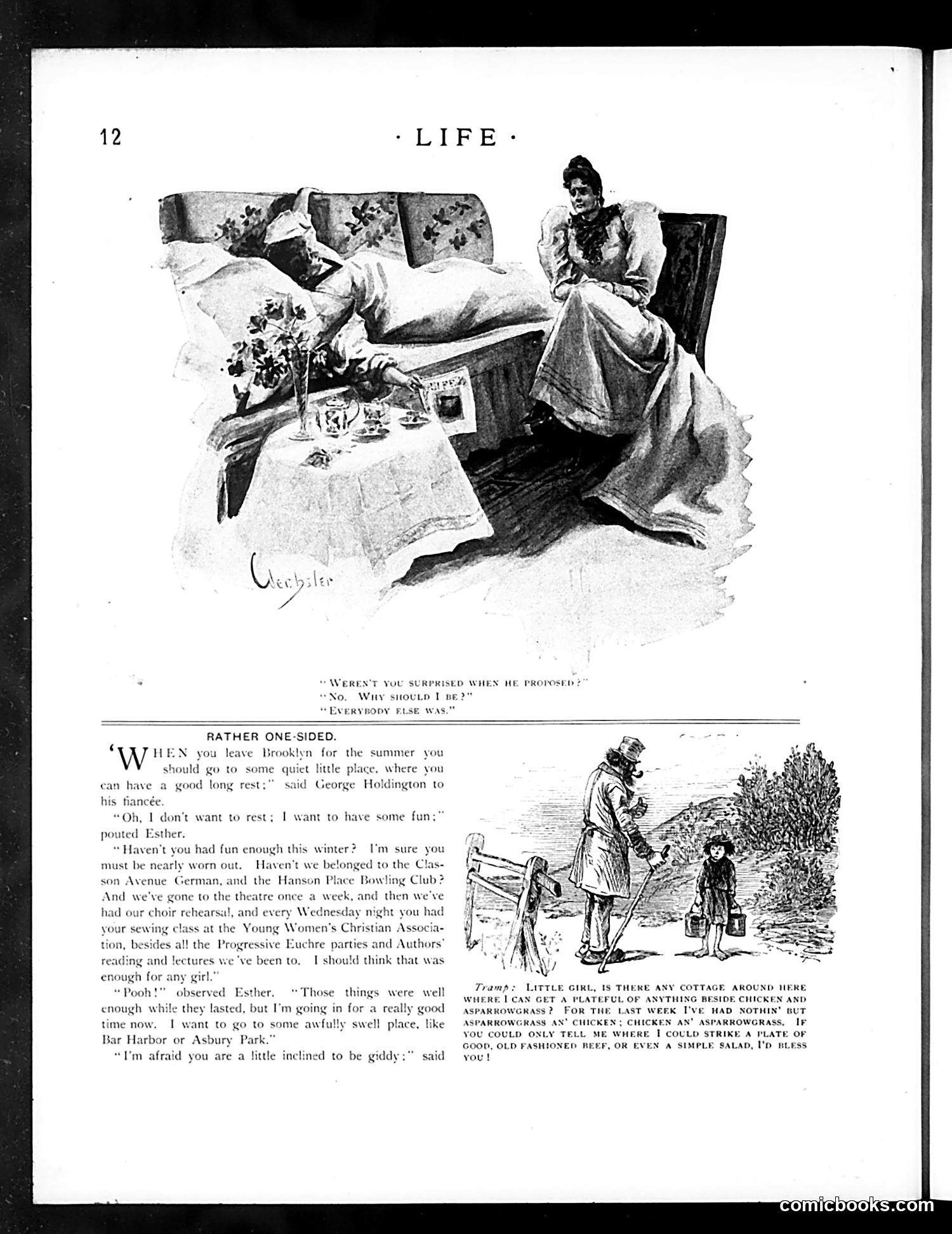
This page contains two separate pieces of social satire: **Top illustration**: A cartoon captioned "Weren't you surprised when he proposed?" / "Why should I be?" / "Everybody else was." The drawing shows a woman reclining on a couch speaking with a visitor, satirizing sudden marriage proposals and the social gossip surrounding engagements. **Bottom story "Rather One-Sided"**: A dialogue between George Holdington and his fiancée Esther about summer plans. George suggests rest; Esther insists on activities (clubs, theater, lessons). The accompanying sketch shows a tramp asking a girl about food sources. The satire critiques how women's social obligations and activities leave no actual leisure time, despite claims of needing "rest." The overall theme targets leisured-class contradictions between stated desires and actual behavior.
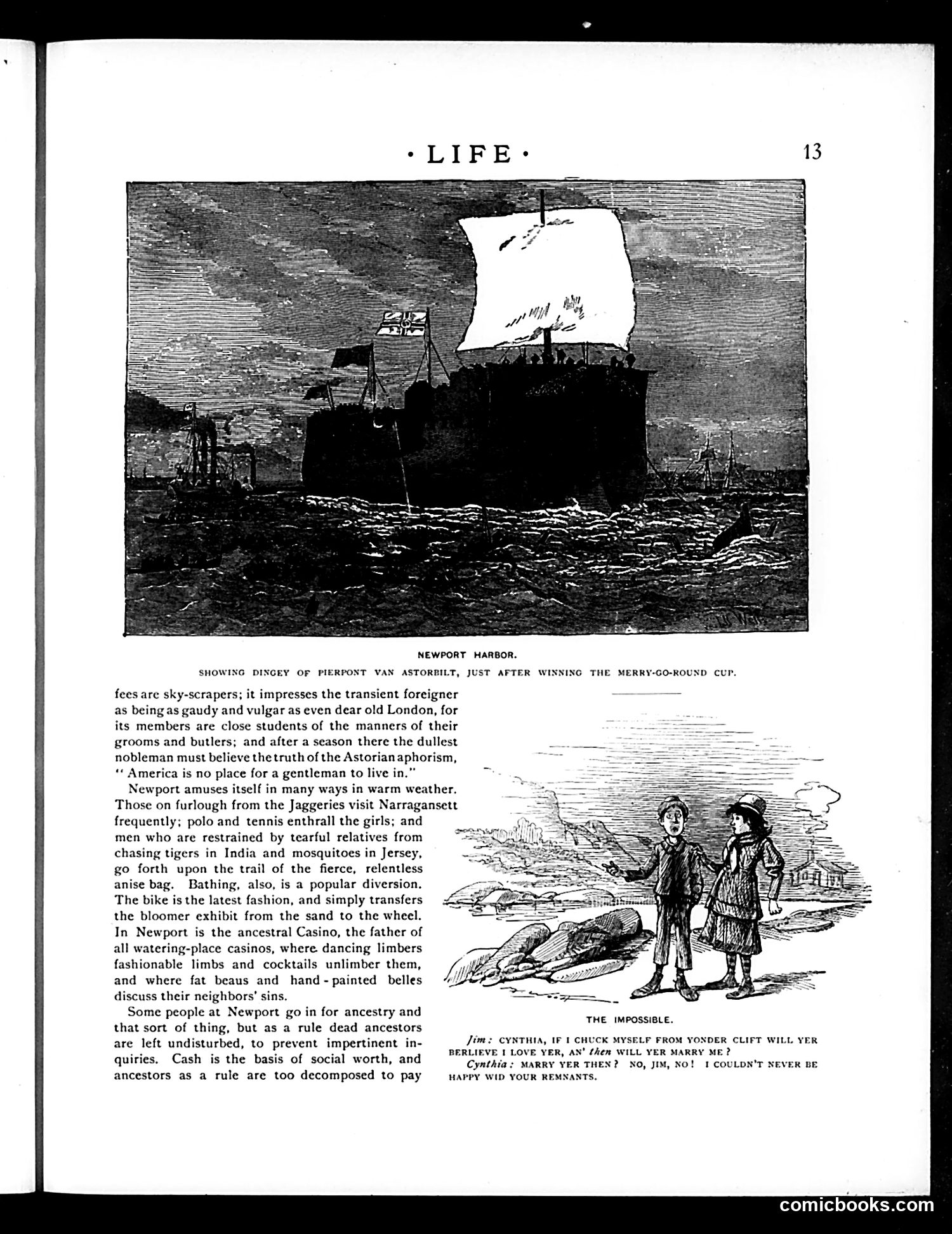
The top image mocks Newport's wealthy elite by showing a tiny "dingey" (small boat) labeled as belonging to "Pierpont Van Astorbilt"—a clear jab at the Astor family's ostentatious wealth. The caption sarcastically suggests even their leisure vessels are grandiose. The bottom cartoon, titled "The Impossible," depicts a working-class romantic scenario. Jim proposes to Cynthia by offering to jump from a cliff as proof of love. Cynthia refuses, saying she couldn't be happy with his "remnants" (remains/corpse)—a darkly humorous rejection of melodramatic sentimentality. Together, the page contrasts Newport's frivolous upper-class culture with working-class courtship, using satire to critique both excessive wealth and romantic excess. The overall tone mocks American social pretension and materialism.
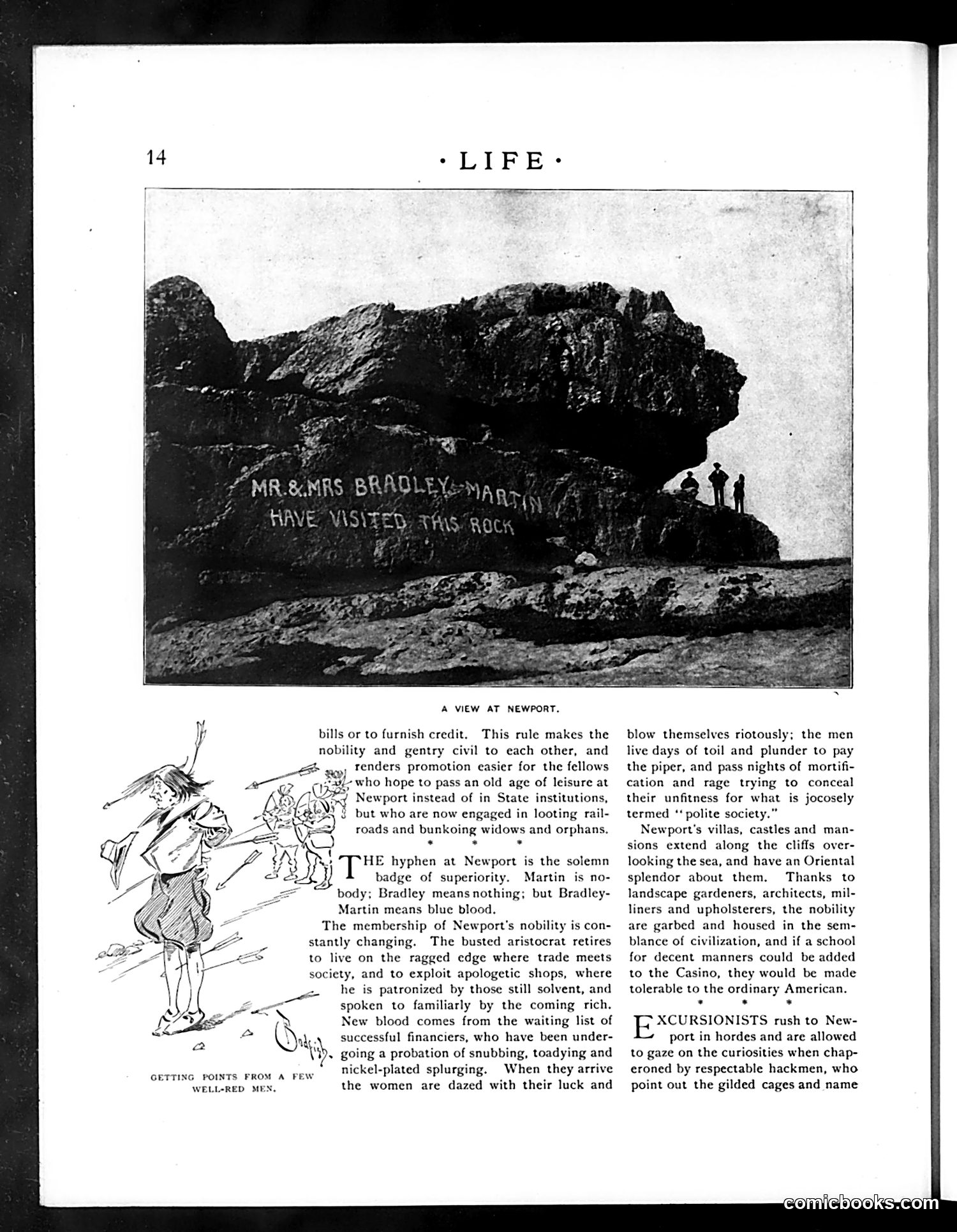
This page satirizes Newport, Rhode Island's wealthy elite during the Gilded Age. The photograph shows a rock inscribed with tourists' names—mocking how even the geography gets branded by visitors seeking status. The text attacks Newport's "nobility" as newly rich fraudsters: railroad looters and swindlers masquerading as aristocrats through hyphenated names (Bradley-Martin = "blue blood"). The satire skewers their constant social climbing, where successful financiers undergo "probation of snubbing" before acceptance, then "blow themselves riotously" while men "live days of toil and plunder." The cartoon illustration labeled "Getting Points from a Few Well-Red Men" (likely showing nouveau riche types) reinforces the mockery of their pretense. The author argues that despite Oriental-style mansions and decorators' efforts, Newport's wealthy remain culturally unfit—needing not just architecture but "a school for decent manners" to be "tolerable to the ordinary American."
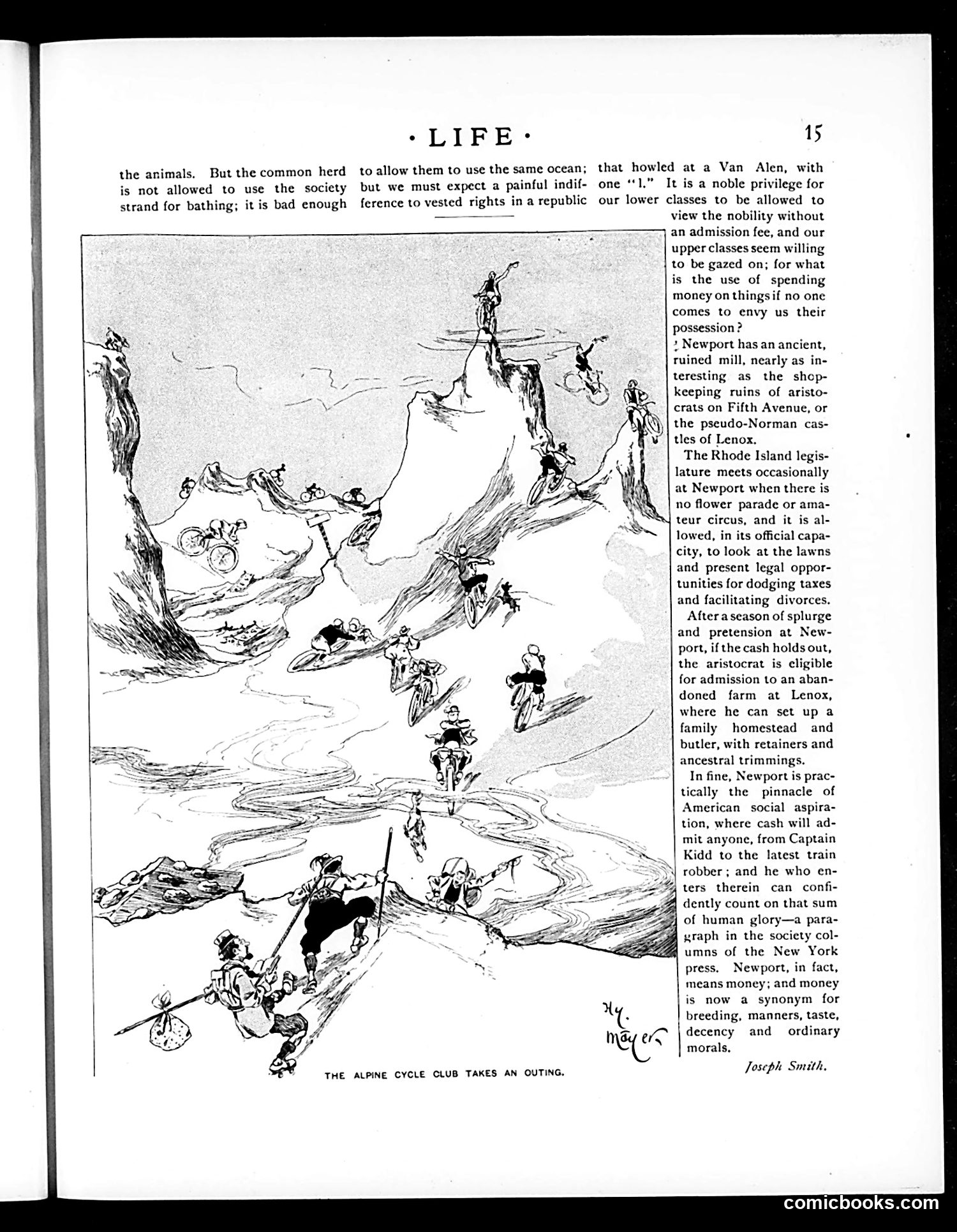
This page satirizes American wealth and class hierarchy, particularly Newport's elite society. The cartoon "The Alpine Cycle Club Takes an Outing" (by Joseph Smith) depicts cyclists navigating mountainous terrain—a visual metaphor for the social climbing of the wealthy. The accompanying text mocks Newport's exclusivity: the rich monopolize beaches while common people are denied access; aristocrats display their mansions like museum pieces to be envied; and social acceptance is purely transactional—"cash will admit anyone, from Captain Kidd to the latest train robber." The satire's core message: in Gilded Age America, money has replaced actual morality or breeding as the measure of respectability. Wealth now defines "manners, taste, decency and ordinary morals." The joke is that Newport's pretense of aristocratic tradition is exposed as mere financial performance—whoever has cash gains social standing, regardless of character.
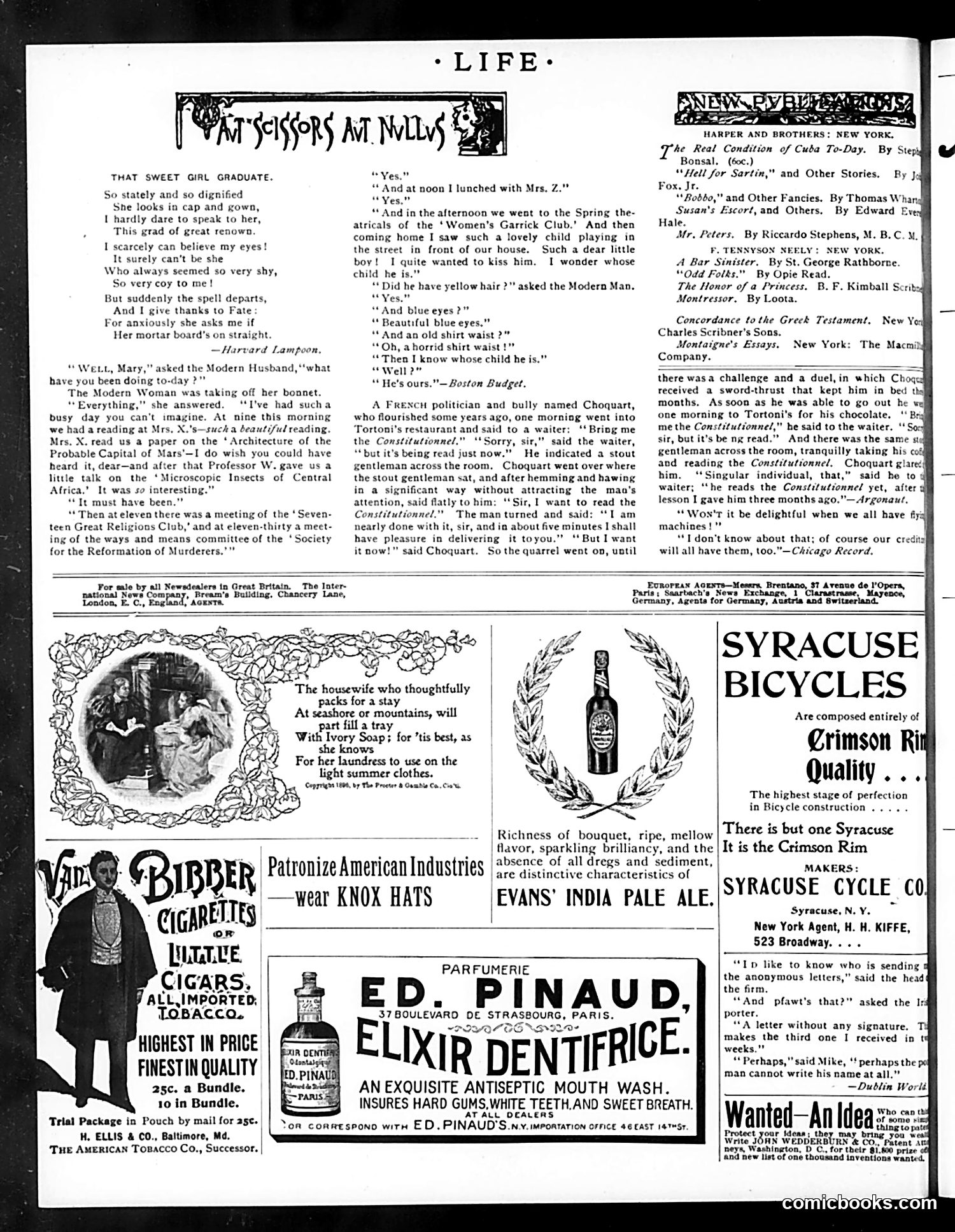
This page from Life magazine (a 19th-century American satirical publication) contains **primarily humorous short pieces and advertisements** rather than political cartoons. The main content includes: **"That Sweet Girl Graduate"** — A Harvard Lampoon poem satirizing the contradiction between a graduate's dignified academic appearance and her trivial concern (asking if her mortar board is straight). **"The Modern Woman"** — A joke about a busy society wife who attends lectures on esoteric topics ("Architecture of the Probable Capital of Mars," "Microscopic Insects of Central Africa") and club meetings, yet fails to recognize her own child on the street—mocking the pretensions and scattered priorities of upper-class women engaged in fashionable self-improvement. **The Choquart anecdote** — A humorous story about a French bully's comical defeat: after being stabbed over a newspaper dispute at a café, he encounters the same man reading the same paper months later. The page is heavily laden with period advertisements (bicycles, cigarettes, dental products, ale) typical of the era's commercial magazines.
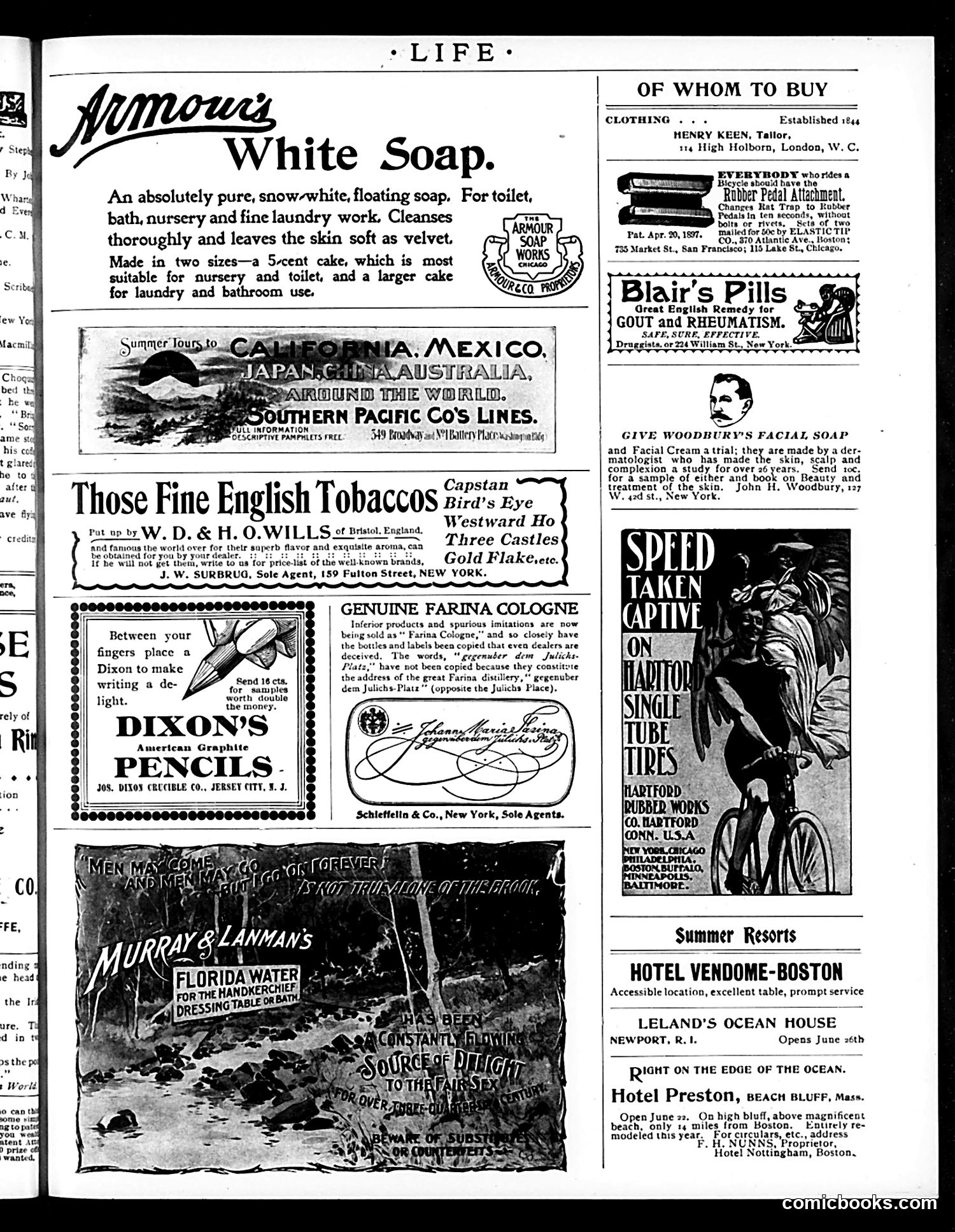
This is primarily a **advertisements page** from Life magazine (early 1900s based on styling), containing no political cartoons or satire requiring historical context. The page features period product ads: Armour's White Soap, English tobaccos (W.D. & H.O. Wills brands), Dixon's pencils, Farina Cologne, Blair's Pills for gout/rheumatism, and Woodbury's facial products. A large illustrated ad for Murray & Lanman's Florida Water promotes it as a "handkerchief chief" product and "source of delight." The right column includes a travel section advertising summer resorts around Boston and Newport, Rhode Island—luxury destinations for wealthy Americans. **No satire is present.** This reflects standard commercial advertising practices of the era, emphasizing product purity, English manufacture (a mark of quality), and leisure travel accessibility for the magazine's affluent readership.
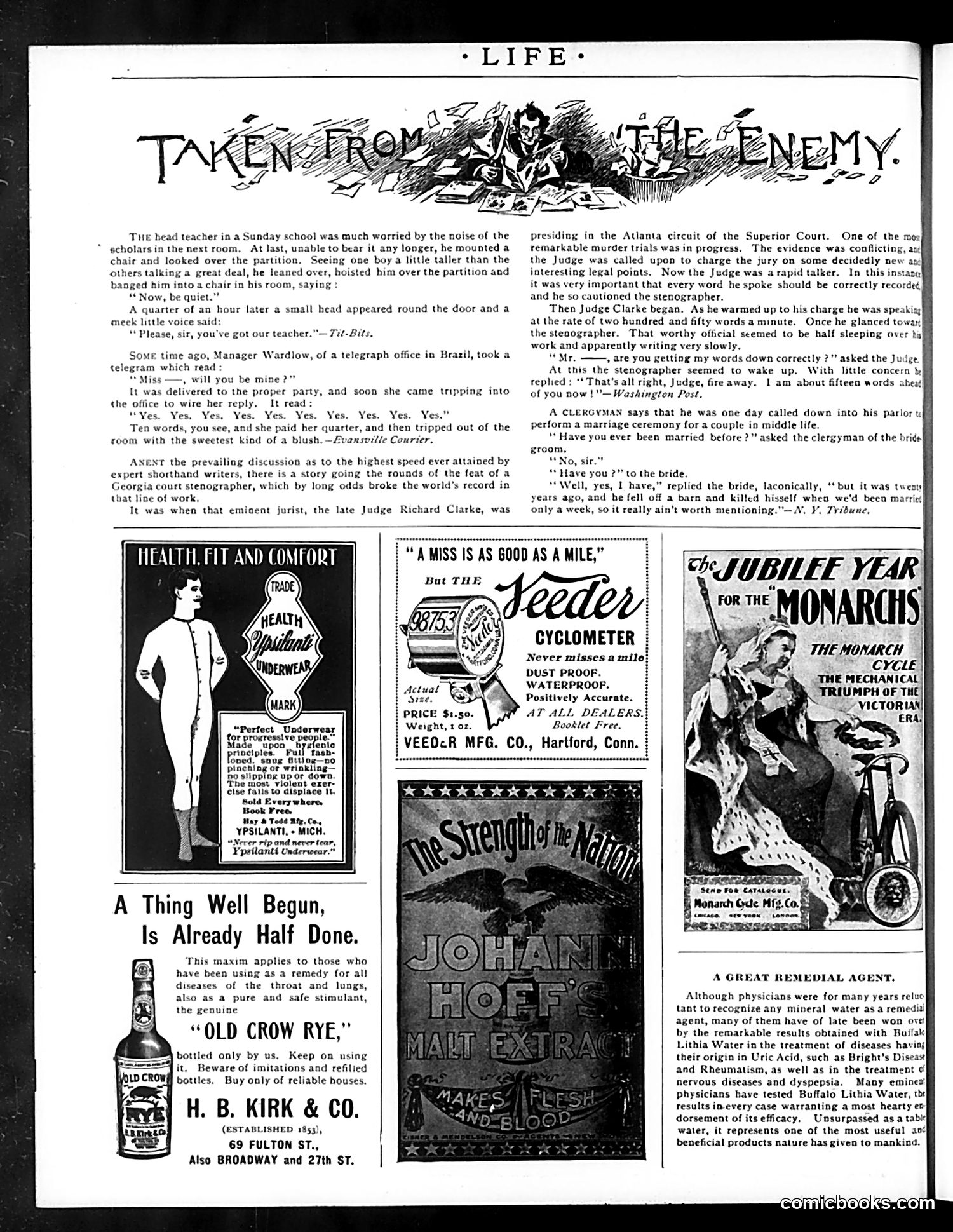
This page presents three brief humorous anecdotes typical of early Life magazine's satirical format: 1. **The Sunday School Incident**: A disciplinarian teacher physically removes a talkative boy from one classroom, only to accidentally eject the visiting head teacher instead—a reversal joke highlighting the authority figure's mistake. 2. **The Telegraph Proposal**: A Brazil telegraph operator receives a marriage proposal and relays an enthusiastic acceptance ("Yes" repeated nine times), playing on the absurdity of conducting romance via telegram and the woman's excessive enthusiasm. 3. **The Court Stenographer**: A judge speaking at 250 words per minute doubts the stenographer's ability to keep up, only to discover the court reporter is actually ahead of schedule—a joke about underestimating quiet, efficient workers. The page is otherwise dominated by period **advertisements** for underwear, cyclometers, bicycles, malt extract, rye whiskey, and patent medicines—typical commercial content of the era. These anecdotes exemplify Life's focus on everyday social mishaps and verbal wit rather than political satire.
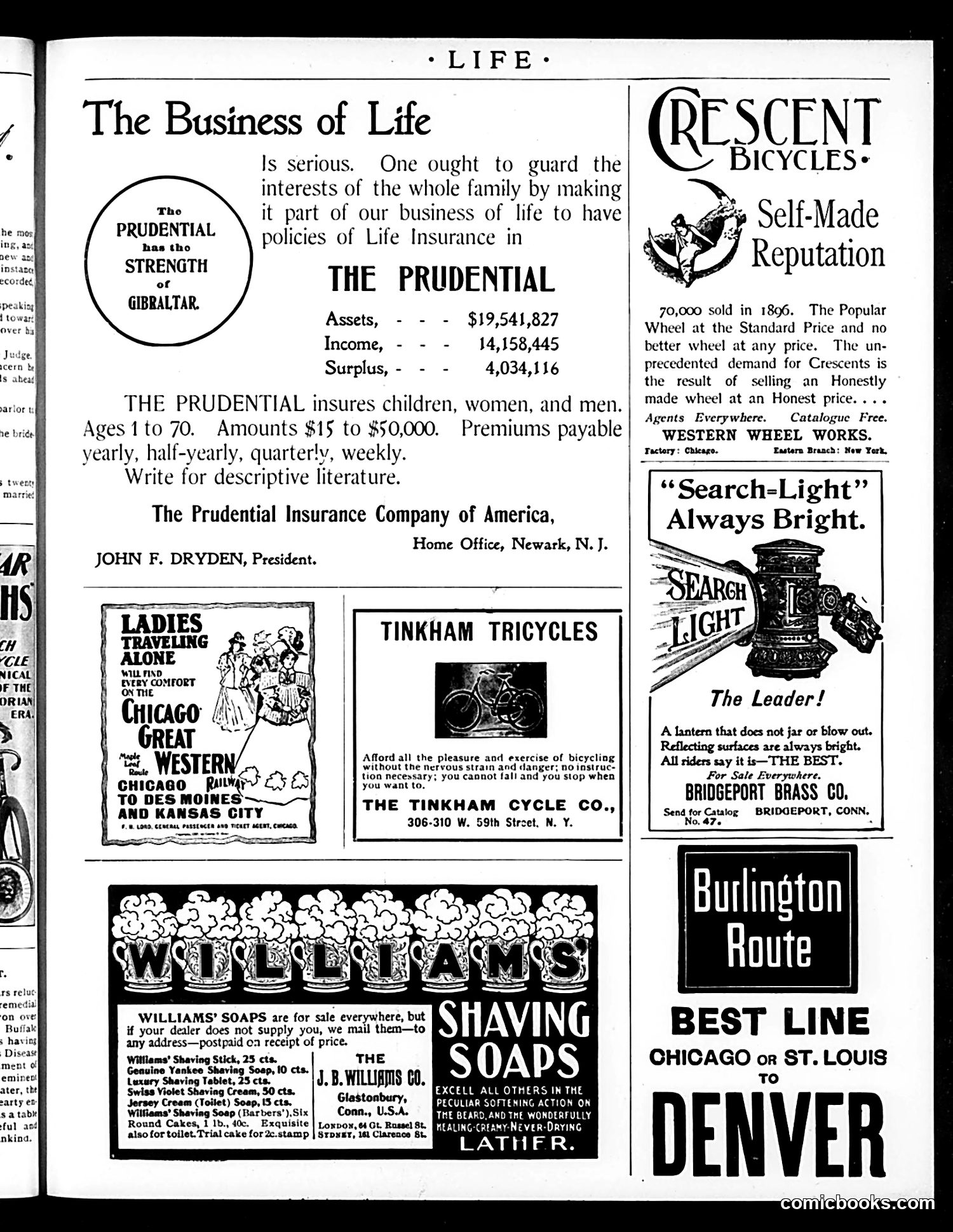
This page is primarily **advertising**, not satire or political commentary. It's from Life magazine's "Business of Life" section, featuring period product ads circa 1896. The main content promotes **The Prudential Insurance Company**, emphasizing financial responsibility for families—a serious business matter. The company's substantial assets ($19.5 million) are displayed to establish credibility. The surrounding ads showcase late-19th-century consumer goods: bicycles (Crescent, Tinkham), a railroad (Burlington Route to Denver), a bicycle lantern (Search-Light), soaps (Williams'), and railroad travel for women traveling alone to Chicago/Kansas City. The only quasi-humorous element is a small illustrated ad addressing "Ladies Traveling Alone," which reflects period gender anxieties about women's independence—though presented matter-of-factly rather than satirically. This is primarily a **commercial page reflecting 1890s consumer culture and middle-class values** around safety, reliability, and respectability.
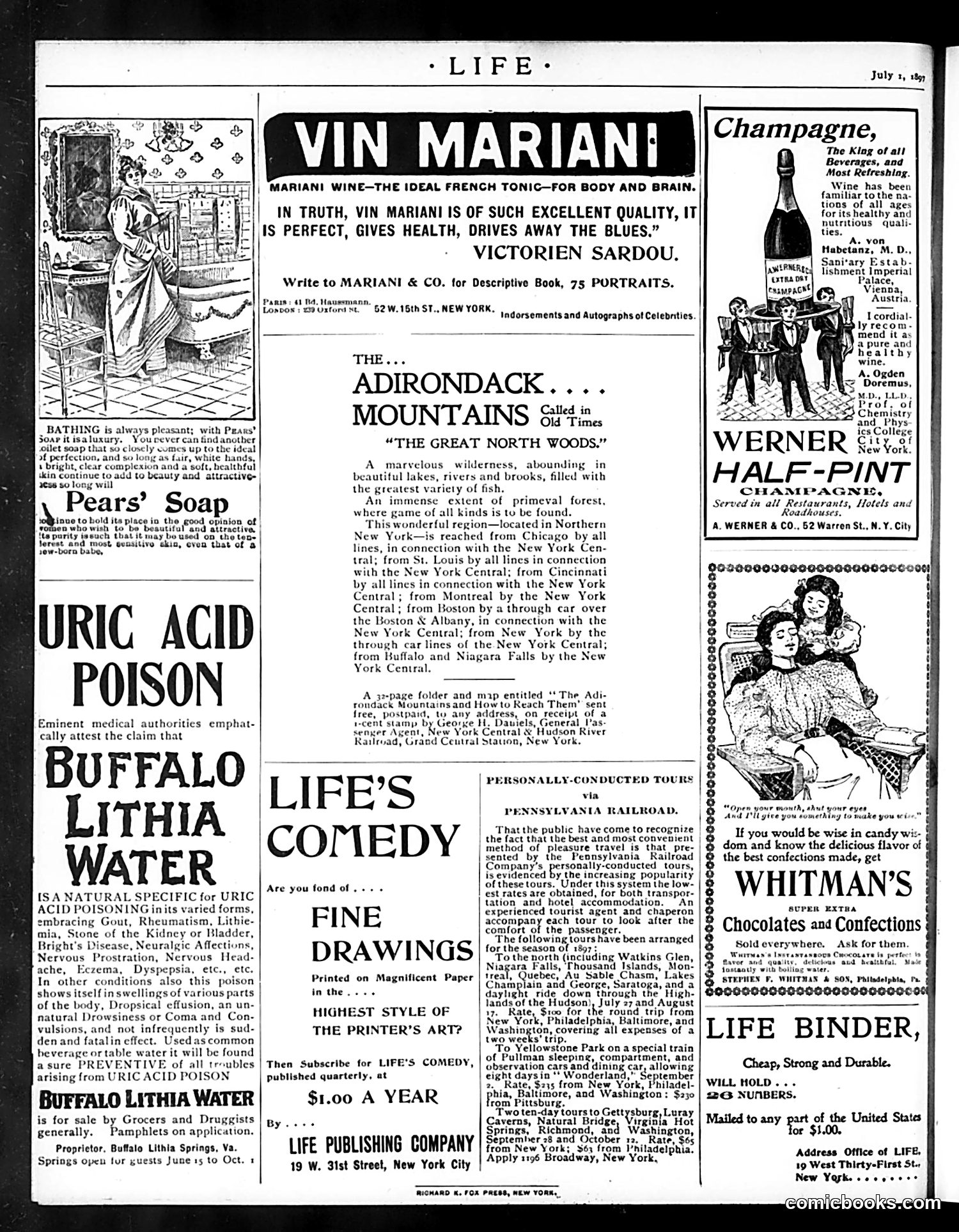
This is primarily an **advertising page** rather than editorial content or political satire. The page showcases period patent medicines and consumer products typical of 1890s American magazines. Notable advertisements include: - **Pears' Soap**: Marketed with claims about beauty and skin health - **Buffalo Lithia Water**: Promoted as a "natural specific" cure for gout, rheumatism, and "uric acid poisoning"—a common pseudo-medical claim of the era - **Vin Mariani**: A wine tonic endorsed by celebrity Victorien Sardou, claimed to provide health and mental benefits The **Adirondack Mountains** travel ad and Pennsylvania Railroad tour promotions reflect the growing leisure-travel industry. These advertisements reflect the **unregulated patent medicine market** of the 1890s, before FDA oversight. Modern readers should note these products made exaggerated health claims without scientific basis—what we'd now recognize as false advertising. The celebrity endorsements (a marketing tactic still used today) added perceived credibility to dubious remedies.