
Life, 1897-07-01 · page 8 of 20
Life — July 1, 1897 — page 8: what you’re looking at
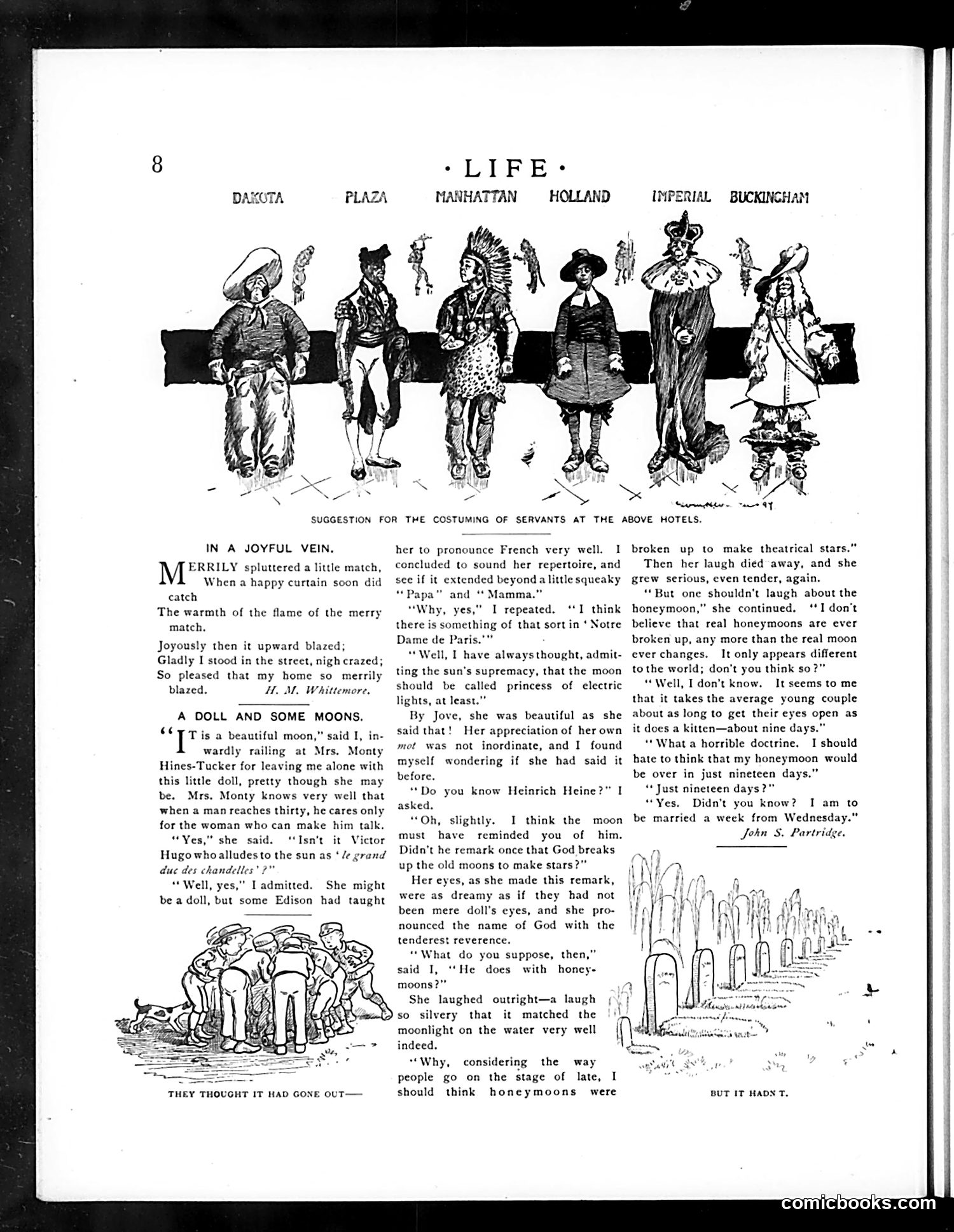
What you’re looking at
**Top Section:** A satirical illustration showing six hotel servants in period costumes labeled "Dakota," "Plaza," "Manhattan," "Holland," "Imperial," and "Buckingham." This mocks the pretentious naming practices of American luxury hotels, which adopted grand European-sounding names to suggest aristocratic elegance. The joke: these are just ordinary servants at American establishments trying to appear sophisticated through borrowed Old World grandeur. **Main Story:** "A Doll and Some Moons" is a humorous dialogue about honeymoons. A woman discusses romance and the moon with a man, including a reference to Heinrich Heine (the German Romantic poet). The satire gently mocks sentimental honeymoon clichés and naive romantic expectations among newlyweds—suggesting real honeymoons are disappointingly brief compared to idealized notions.
📄 Transcribed text from this page (OCR, searchable)
Machine-transcribed from the original scan — historical spelling and the odd misread are preserved.
La *LIFE: MANHATTAN HOLLAND IMPERIAL BUCKINGHAM SUGGESTION FOR THE COSTUMING OF SERVANTS AT THE ABOVE HOTELS. IN A JOYFUL VEIN. ERRILY spluttered a little match, When a happy curtain soon did catch The warmth of the flame of the merry match, Joyously then it upward blazed; Gladly I stood in the street, nigh crazed; So pleased that my home so merrily blazed. HM. Whittemore, A DOLL AND SOME MOONS. £7 Tis a beautiful moon,” said I, in- wardly railing at Mrs. Monty Hines-Tucker for leaving me alone with this little doll, pretty though she may be. Mrs. Monty knows very well that when a man reaches thirty, he cares only for the woman who can make him talk. “Yes,” she said. ‘‘Isn’t it Victor Hugo whoalludesto the sun as ‘/e grand duc des chandelles' ?" “Well, yes," I admitted. She might be a doll, but some Edison had taught THEY THOUGHT IT HAD GONE OUT— her to pronounce French very well. 1 concluded to sound her repertoire, and see if it extended beyond a little squeaky ** Pap. and ‘* Mamma.” “Why, yes," I repeated. ‘I think there is something of that sort in ‘ Notre Dame de Paris.’ “Well, I have always thought, admit- ting the sun's supremacy, that the moon should be called princess of electric lights, at least.” By Jove, she was beautiful as she said that! Her appreciation of her own mot was not inordinate, and I found myself wondering if she had said it before. **Do you know Heinrich Heine?” I asked, “Oh, slightly. I think the moon must have reminded you of him. Didn't he remark once that God breaks up the old moons to make stars?” Her eyes, as she made this remark, were as dreamy as if they had not been mere doll’s eyes, and she pro- nounced the name of God with the tenderest reverence. “What do you suppose, then, said I, ‘‘He does with honey- moons?” She laughed outright—a laugh so silvery that it matched the moonlight on the water very well indeed. “Why, considering the people go on the stage of should think honeymoons way late, I were broken up to make theatrical stars.” Then her laugh died away, and she grew serious, even tender, again. “But one shouldn't laugh about the honeymoon,” she continued. ‘I don’t believe that real honeymoons are ever broken up, any more than the real moon ever changes. It only appears different tothe world; don't you think so?” “Well, I don’t know, It seems to me that it takes the average young couple about as long to get their eyes open as it does a kitten—about nine days.” **What a horrible doctrine. I should hate to think that my honeymoon would be over in just nineteen days.” “Just nineteen days?” “Yes, Didn't you know? I am to be married a week from Wednesday.” Jokn S. Partridge. BUT IT HADNT,