
A complete issue · 21 pages · 1897
Life — June 24, 1897
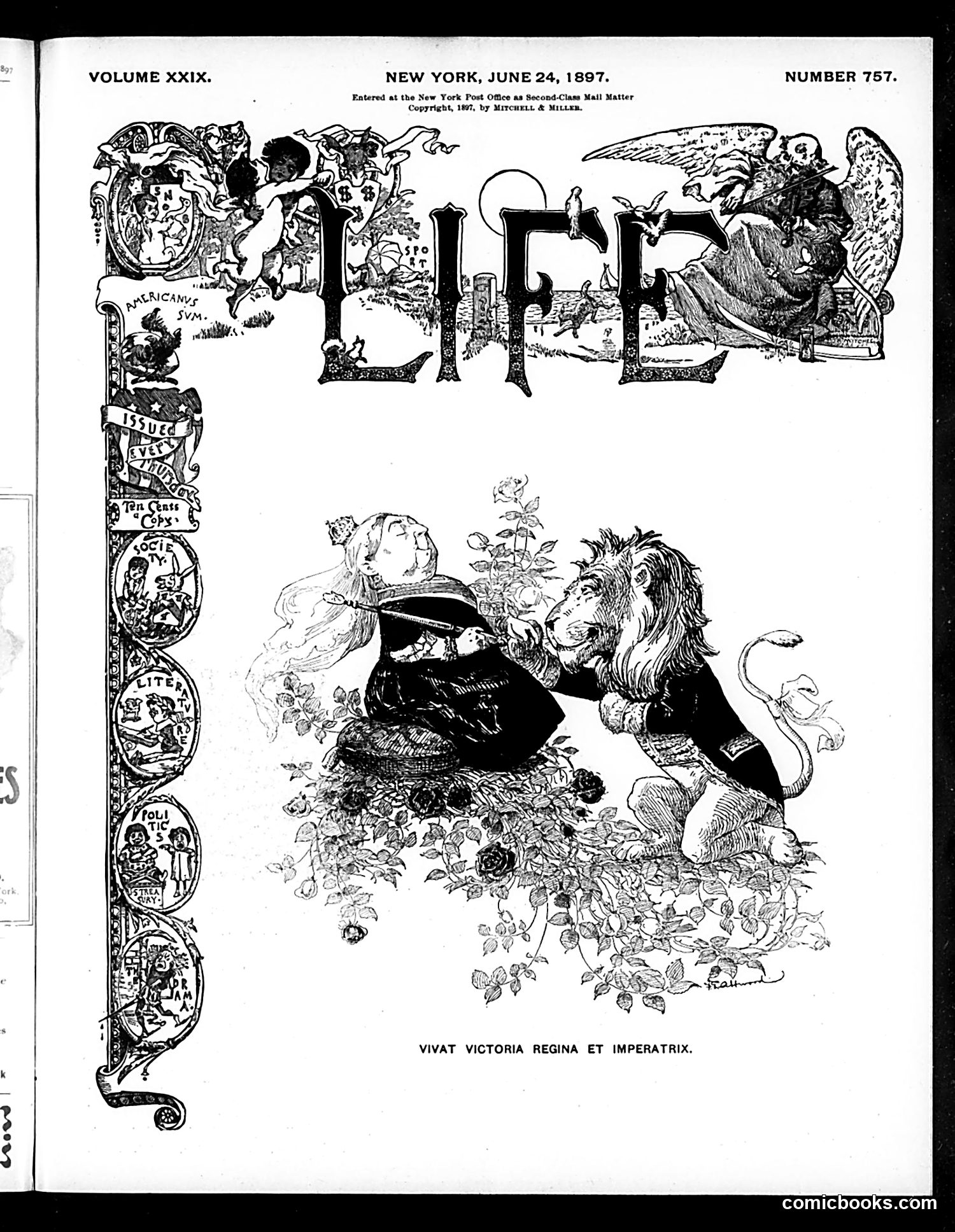
This is the cover of *Life* magazine, a prominent American satirical publication. The main illustration depicts a lion with a human face (appearing to be a political figure) being restrained or controlled by a woman in dark clothing and a hat. The woman appears to be Queen Victoria, indicated by the Latin motto at bottom: "Vivat Victoria Regina et Imperatrix" ("Long live Victoria, Queen and Empress"). The satire likely comments on British imperial power and Queen Victoria's dominance in global affairs during the late Victorian era. The lion—traditionally a symbol of Britain—is portrayed as wild and dangerous but held in check by the Queen's authority. This visual metaphor suggests commentary on British imperialism or Victoria's political influence during this period of extensive colonial expansion.
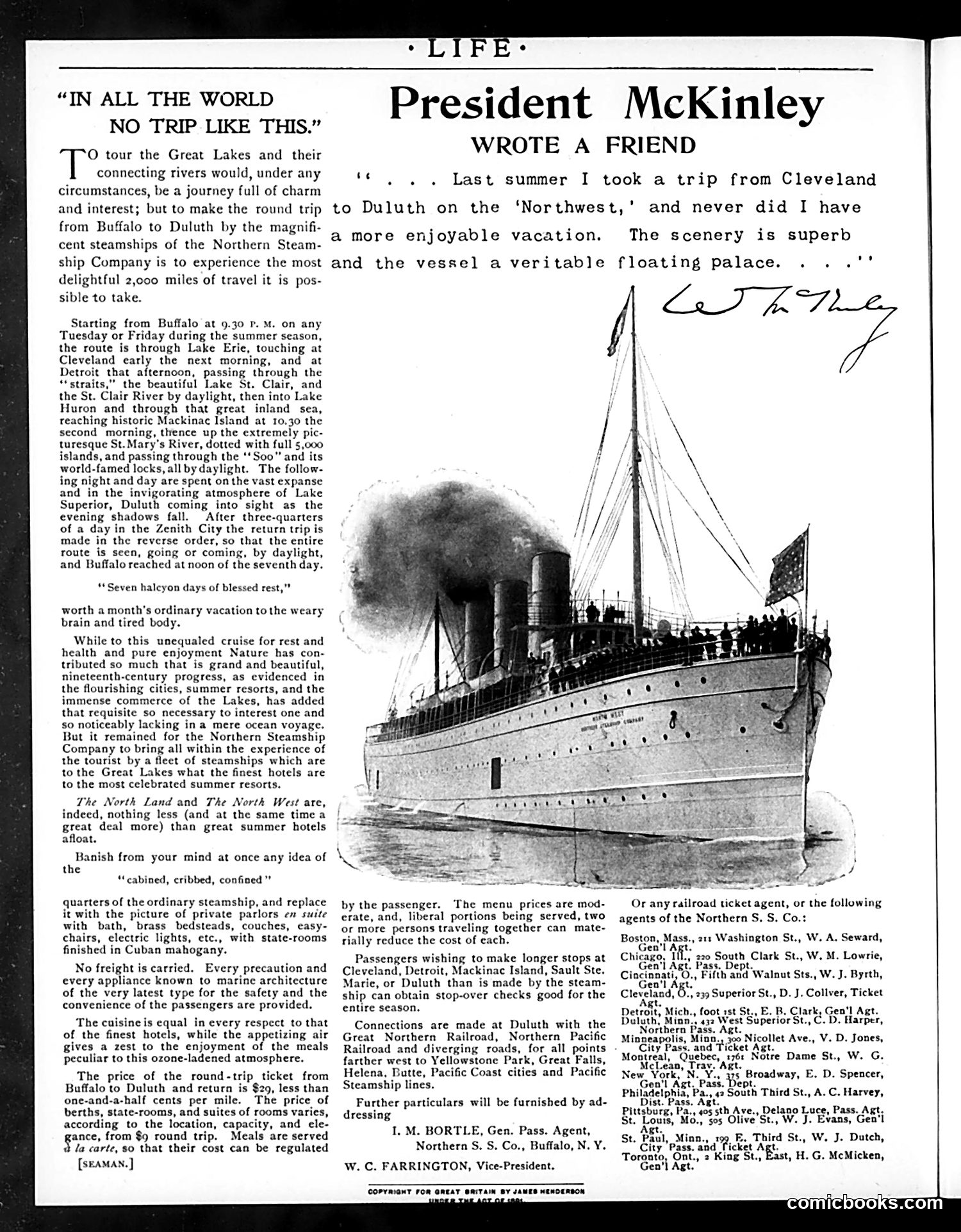
This page is primarily **advertising and promotional content**, not political satire. It features an endorsement of the Northern Steamship Company's Great Lakes cruise service, purportedly written by President McKinley (whose signature appears on the page). The piece describes a scenic 2,000-mile round trip from Buffalo to Duluth aboard the steamship, highlighting luxurious accommodations and natural beauty. The large illustration shows the vessel, a grand passenger ship typical of the era. This represents **early 20th-century promotional journalism** where celebrity endorsements—in this case, from a sitting U.S. President—were used to market tourist experiences. The emphasis on the ship as a "floating palace" reflects the era's pride in industrial achievement and leisure travel.
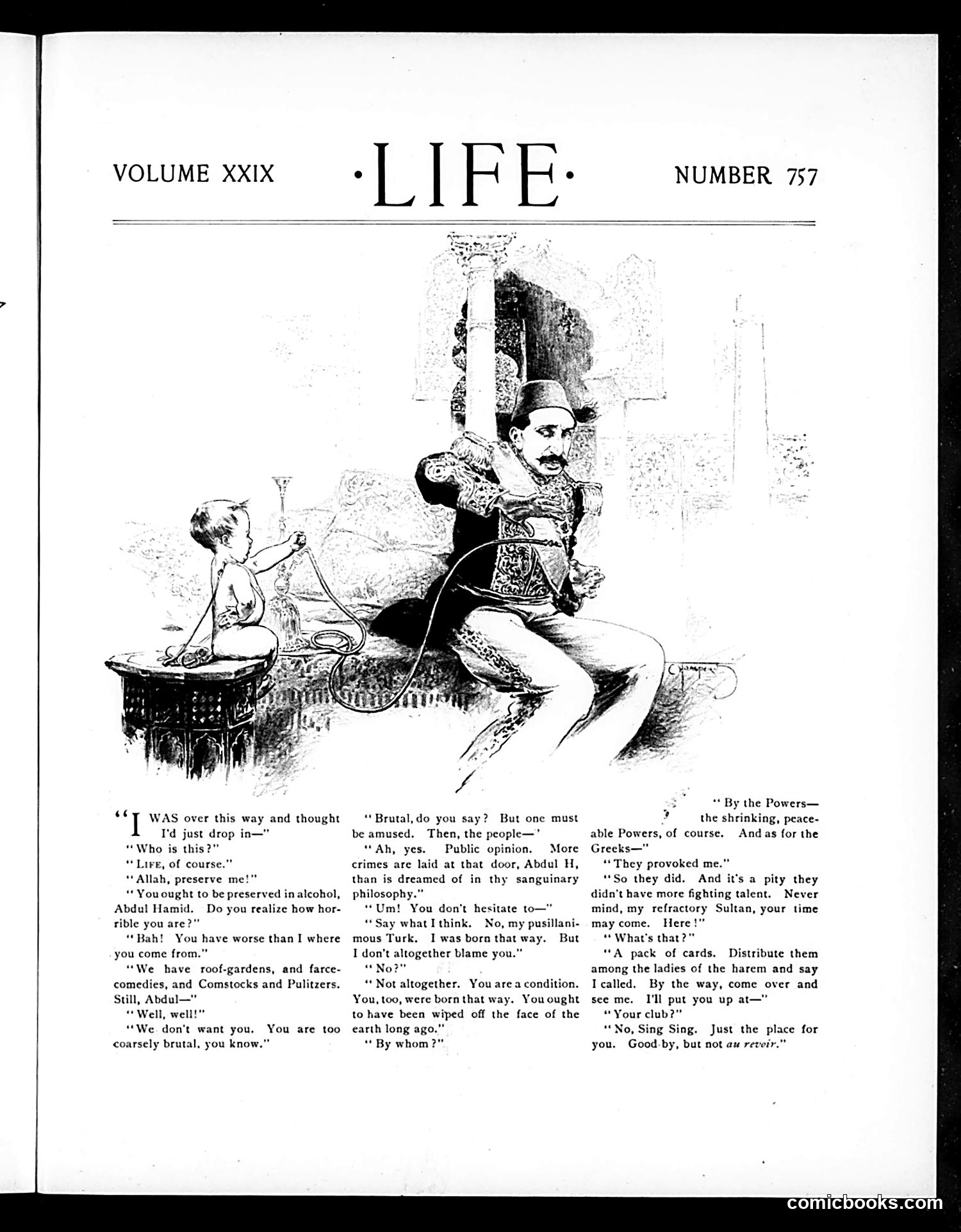
This satirical cartoon depicts a figure in Ottoman Turkish dress (identifiable by the distinctive tall headdress and ornate military garments) being manipulated like a puppet by a cherubic figure representing Western powers. The dialogue reveals the satire's target: critiques of Western imperial interference in Ottoman affairs and Turkish sovereignty. The conversation mocks Turkish leadership's weakness and foreign dependence, with references to "public opinion," Greek conflicts, and the shrinking Ottoman Empire. The "pack of cards" reference suggests the fragility of Turkish political structures. The cartoon satirizes both Ottoman decline and Western manipulation of Middle Eastern politics during the empire's late period, likely early 20th century.
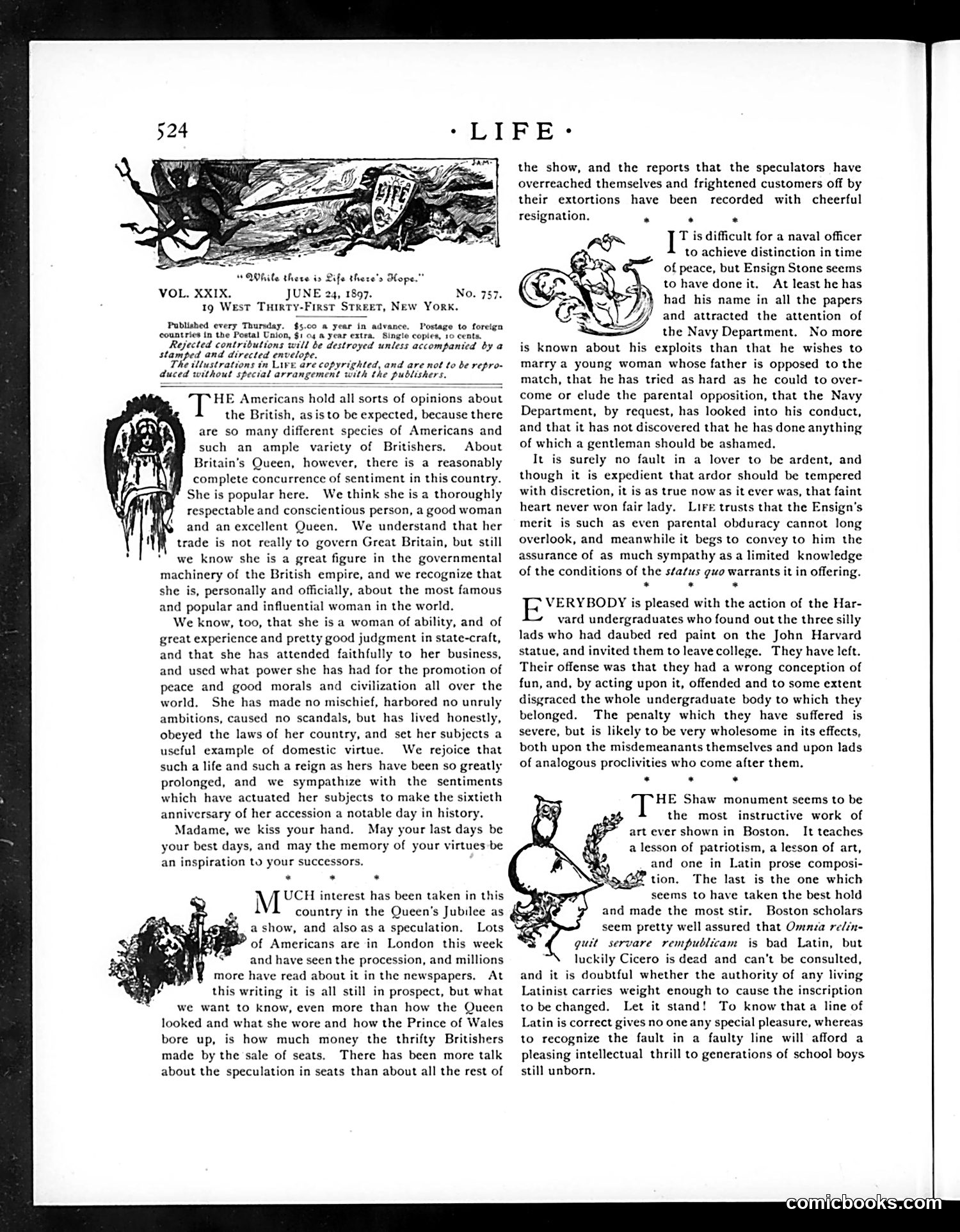
This page contains editorial commentary rather than political cartoons. The main topics discussed are: 1. **Queen Victoria's Jubilee**: The editors praise Queen Victoria as a "respectable and conscientious person" and a "great figure" in British governance, celebrating the 60th anniversary of her reign. 2. **Ensign Stone**: A naval officer who apparently wished to marry against his superior's wishes. The editorial sympathetically portrays his romantic ardor while suggesting discretion was warranted. 3. **Harvard Statue Prank**: Undergraduates who defaced a John Harvard statue face criticism—their "strong conception of fun" is deemed offensive to the entire undergraduate body. 4. **Shaw Monument in Boston**: The editors praise this artwork as an instructive patriotic lesson, defending its Latin inscription against potential criticism from those who might want it changed. The page emphasizes propriety, institutional respect, and cultural tradition.
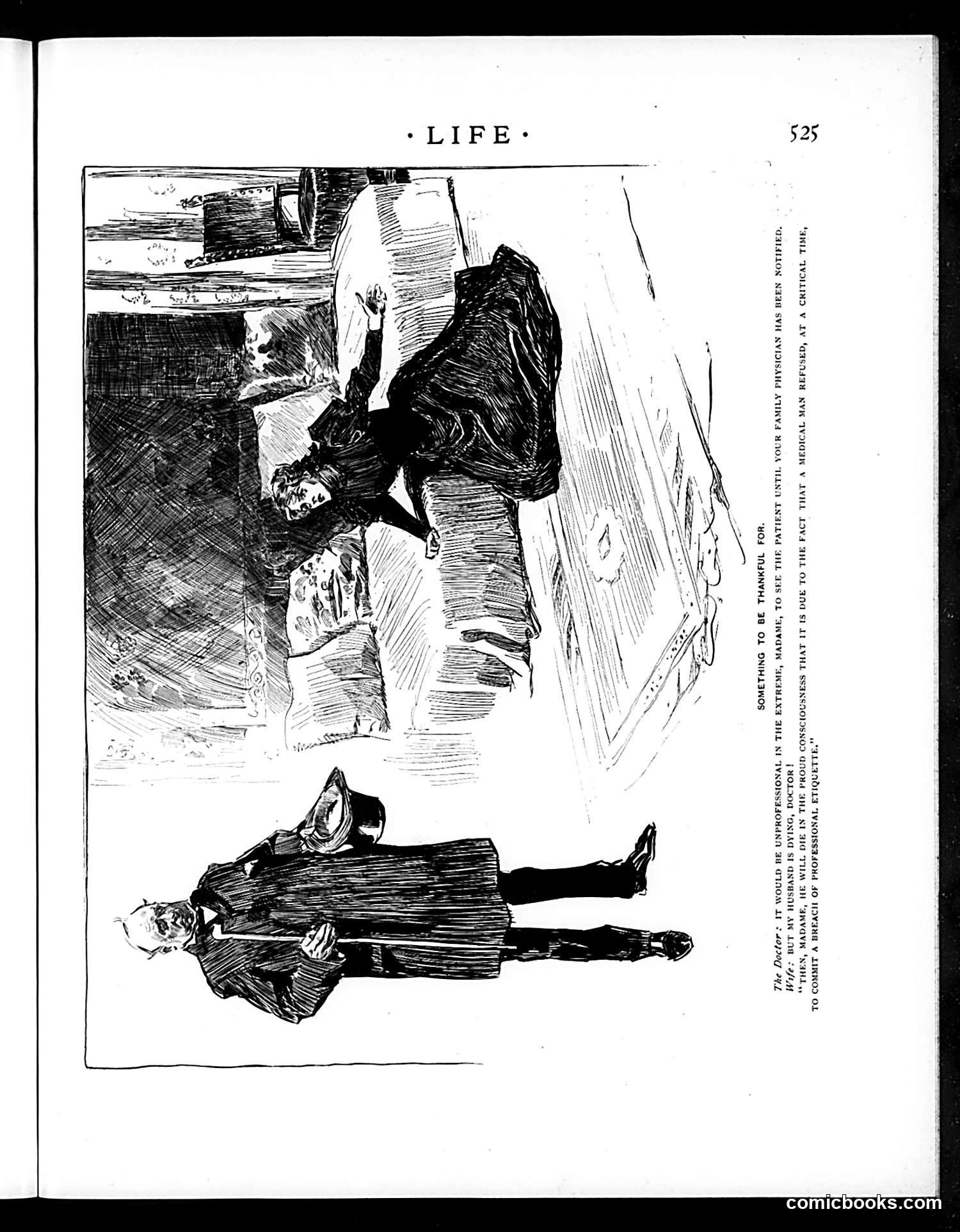
This page contains two satirical sketches depicting what appears to be a social or political situation involving wealthy individuals. The upper illustration shows a figure in dark clothing in an interior domestic setting, while the lower sketch portrays a standing figure in formal dress. The accompanying caption (partially legible in the right margin) references "scouring" and "personal" matters, though the complete text is difficult to read clearly in this reproduction. The sketches employ the exaggerated line-work typical of early-to-mid 20th century satirical cartooning. Without clearer caption text, I cannot definitively identify the specific individuals, events, or social commentary being targeted. The style suggests commentary on upper-class behavior or domestic situations, but the precise satirical point remains unclear from this image alone.
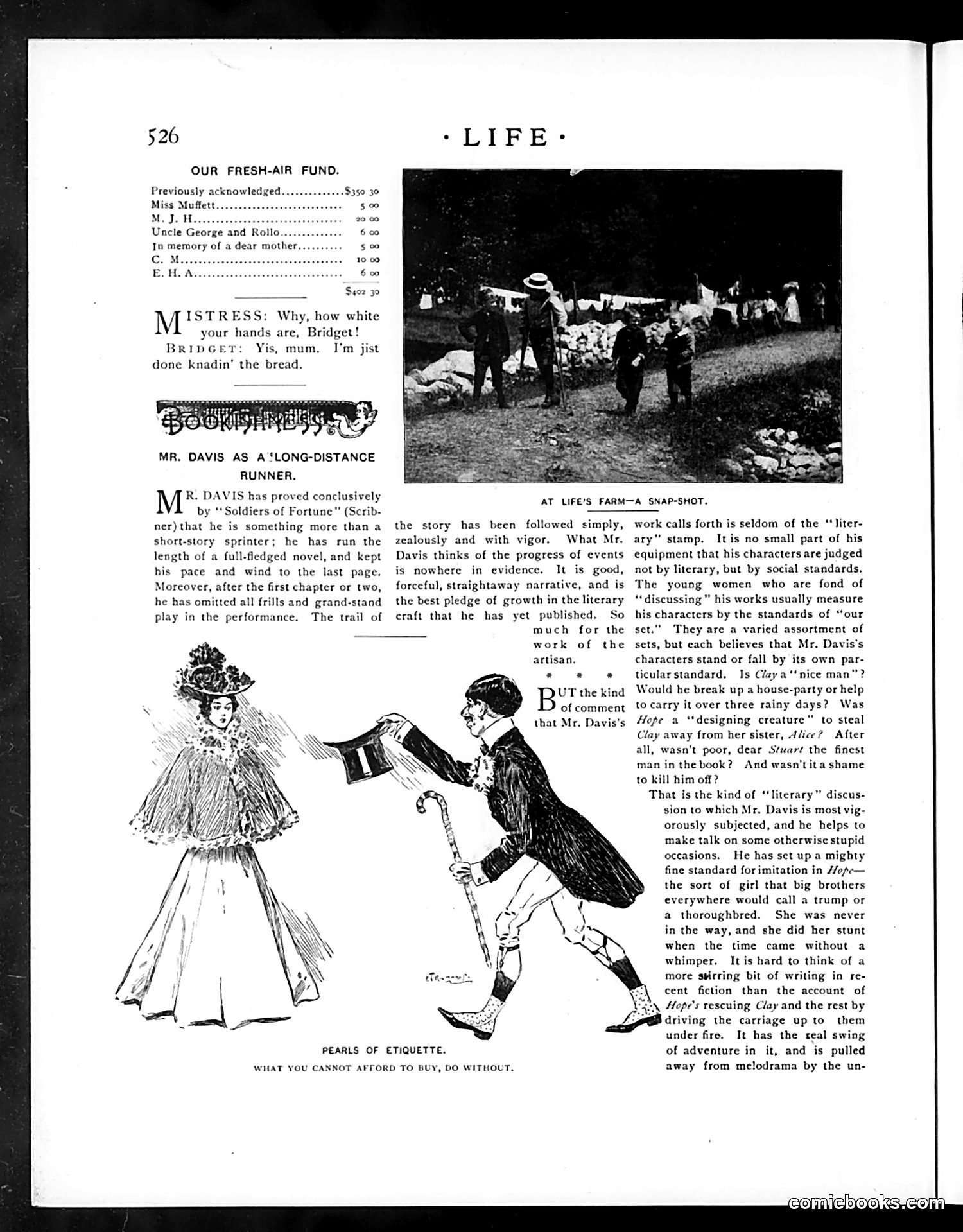
This page contains two distinct items: **"Pearls of Etiquette" cartoon** (lower left): A satirical illustration showing a man offering a woman a book or package. The caption "What you cannot afford to buy, do without" mocks upper-class social pretension—specifically the expectation that proper ladies should receive expensive gifts. The joke critiques the artificiality of etiquette rules that demand conspicuous consumption, suggesting that honesty about one's means is preferable to maintaining false appearances. **Literary criticism** (right side): Reviews Mr. Davis's story "Soldiers of Fortune," praising his character development and narrative skill, particularly his female character *Hope*, whom the critic contrasts with other contemporary heroines as genuinely admirable rather than melodramatic. Both items reflect early 1900s concerns with class performance and literary standards.
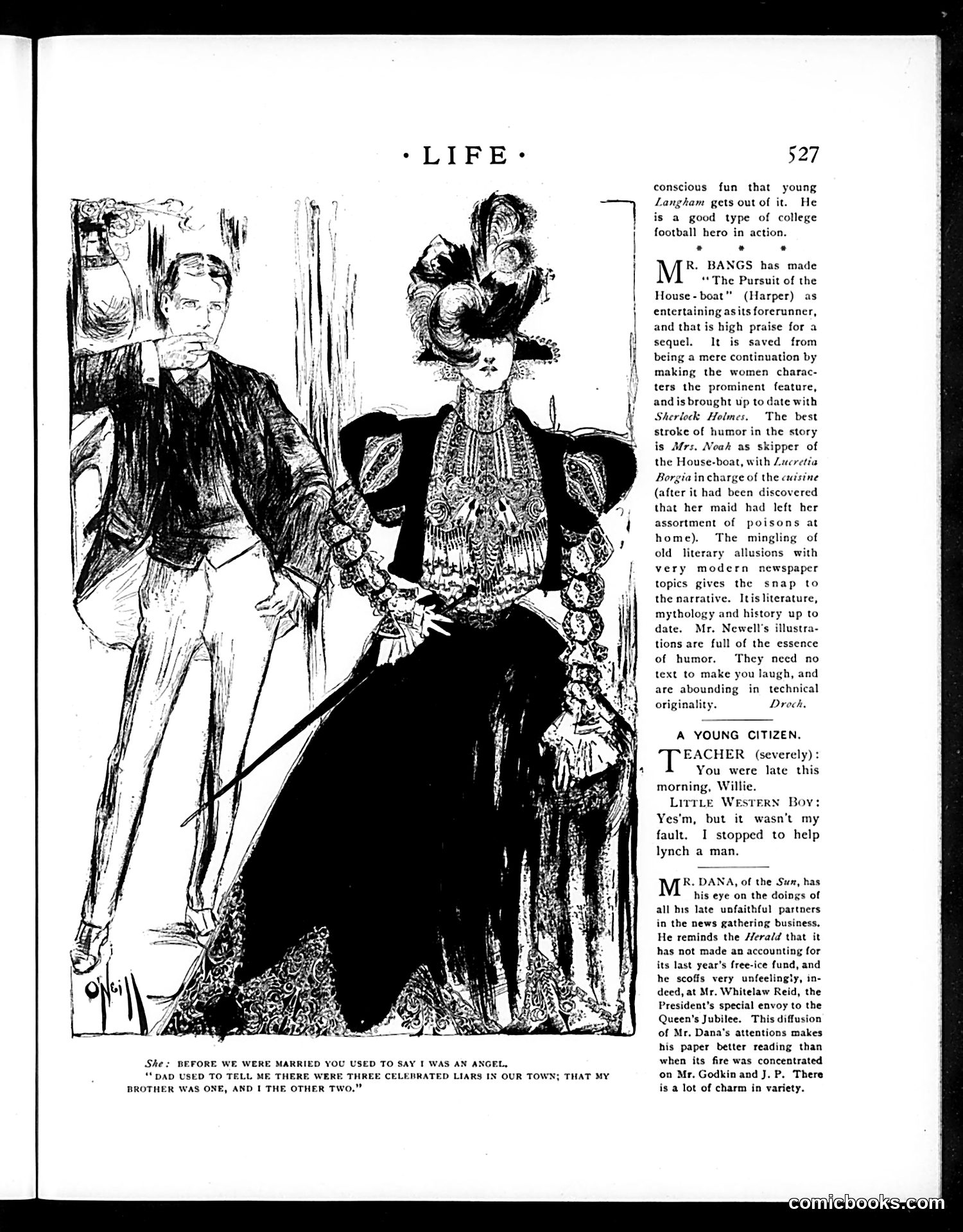
This page contains a satirical illustration and literary reviews rather than a political cartoon. The main image depicts an elegantly dressed woman with an elaborate feathered hat confronting a man, illustrating a humorous domestic exchange quoted below: "Before we were married you used to say I was an angel... Dad used to tell me there were three celebrated liars in our town; that my brother was one, and the other two." The satire mocks romantic courtship dishonesty—the contrast between suitors' flattery before marriage versus marital reality. The woman's ornate costume emphasizes vanity and status-consciousness. The text reviews books by Mr. Hangs and Mr. Dana, praising their humor and literary merit. The page targets both romantic pretense and contemporary literature through gentle mockery.
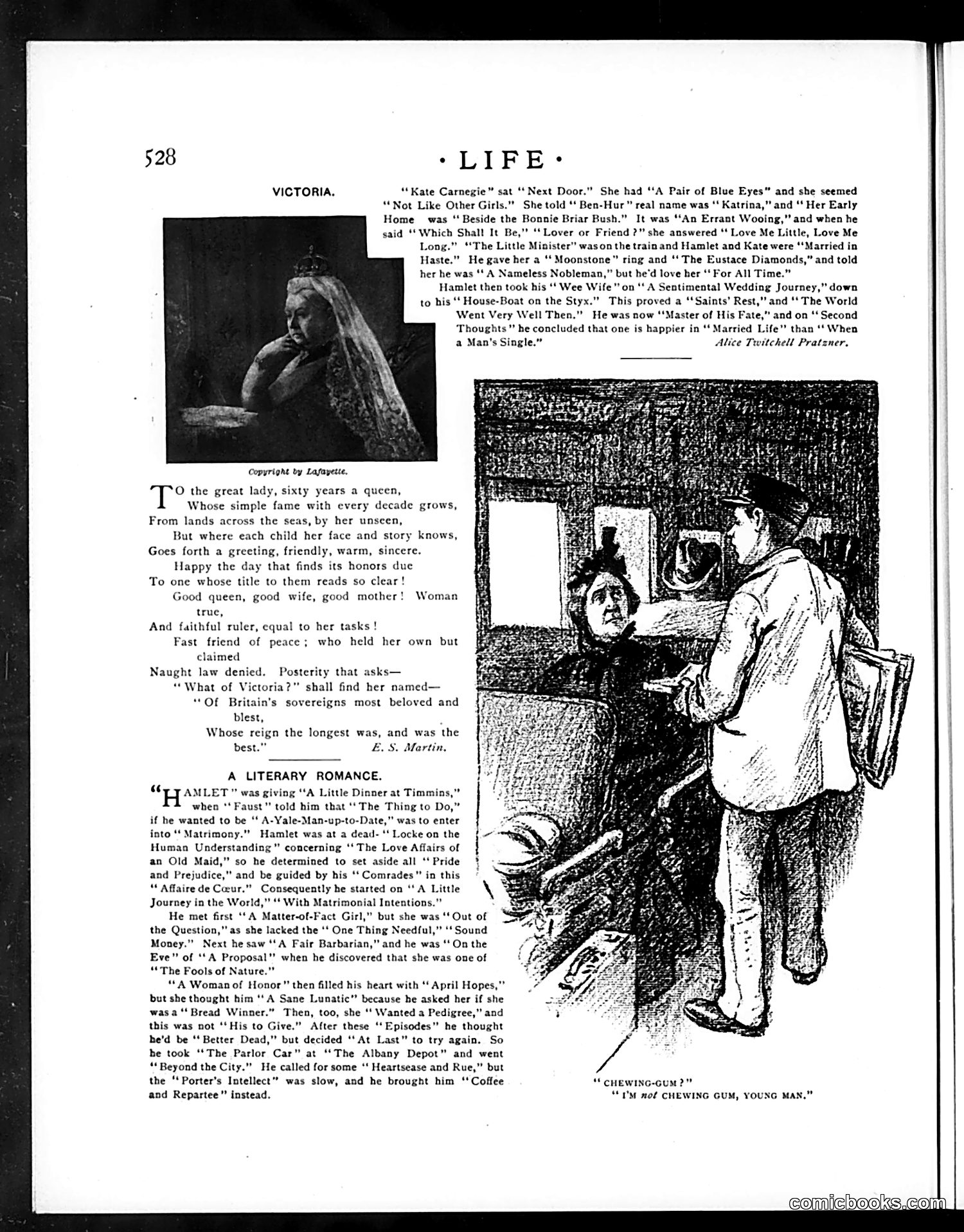
This page contains two distinct elements: **Upper section**: A poem praising Queen Victoria on her 60+ years as monarch, celebrating her as "good queen, good wife, good mother" and "faithful ruler." The accompanying photograph shows an elderly woman in formal dress. **Lower section titled "A Literary Romance"**: A humorous sketch mocking overwrought Victorian literary conventions. It satirizes Hamlet's romantic pursuits through absurdly florid novel titles and plots ("A-Yak-Man-up-to-Date," "Pride and Prejudice," etc.). The accompanying cartoon shows two figures in what appears to be a domestic scene, with dialogue about chewing gum—likely poking fun at the contrast between pretentious literary aspirations and mundane reality. The satire targets the gap between romantic literary ideals and actual human behavior in the Victorian era.
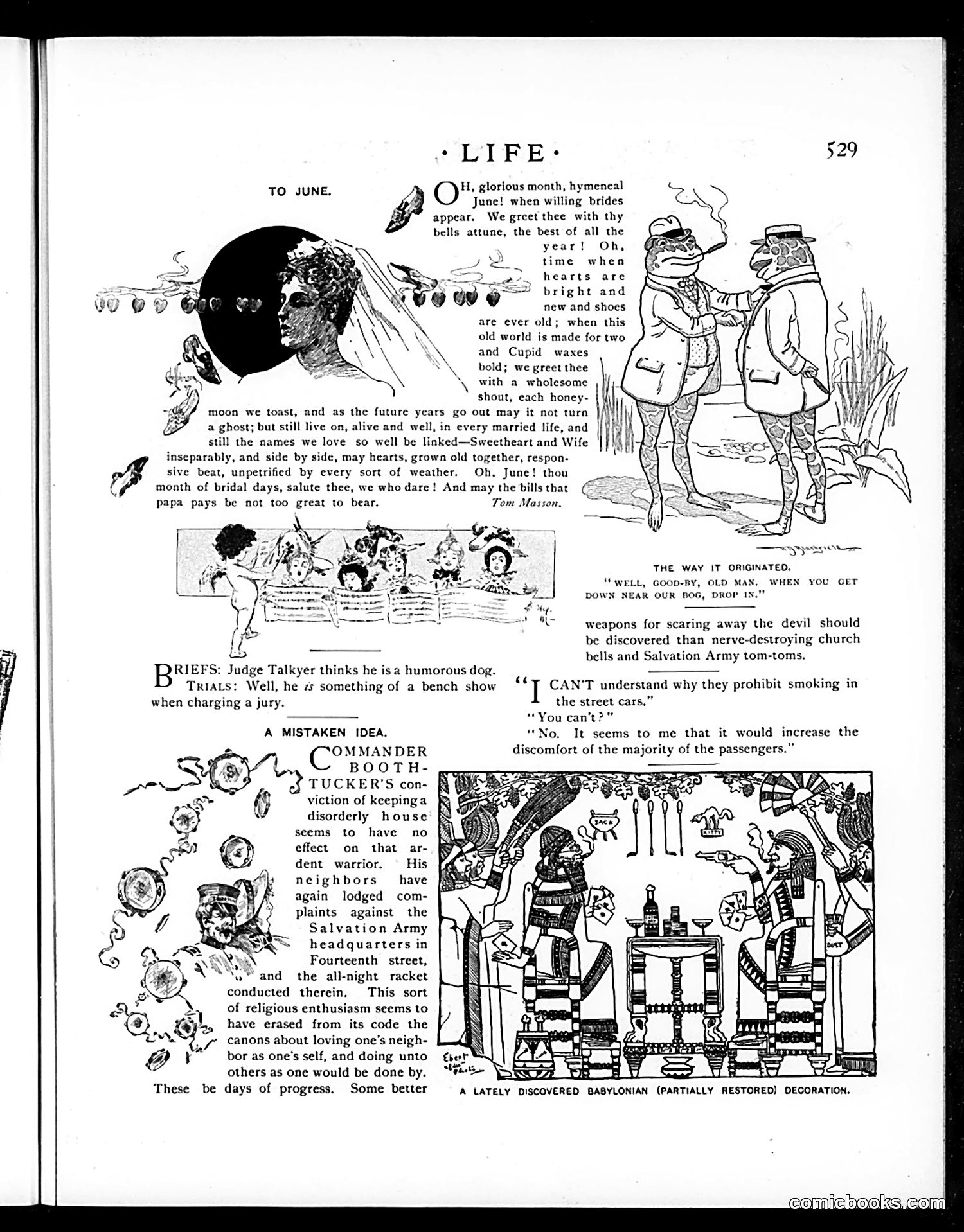
This page contains several satirical pieces about early 20th-century social issues: **"To June"** is a poetic tribute to weddings and marriage, illustrated with a couple and wedding bells. It celebrates June as the traditional wedding month. **"The Way It Originated"** depicts a man warning another to avoid the Salvation Army, suggesting their street evangelism was intrusive or annoying to some. **"A Mistaken Idea"** mocks Commander Booth-Tucker of the Salvation Army, criticizing the organization's nighttime religious activities at their Fourteenth Street headquarters. The satire suggests their enthusiastic evangelism disturbed neighbors, and implies the Salvation Army's religious code about loving neighbors seemed hypocritical given the complaints they generated. **The smoking debate** comments on transit regulations restricting smoking in street cars, presenting both sides of the public health discussion. The overall tone criticizes the Salvation Army's methods as disruptive despite their charitable intentions.
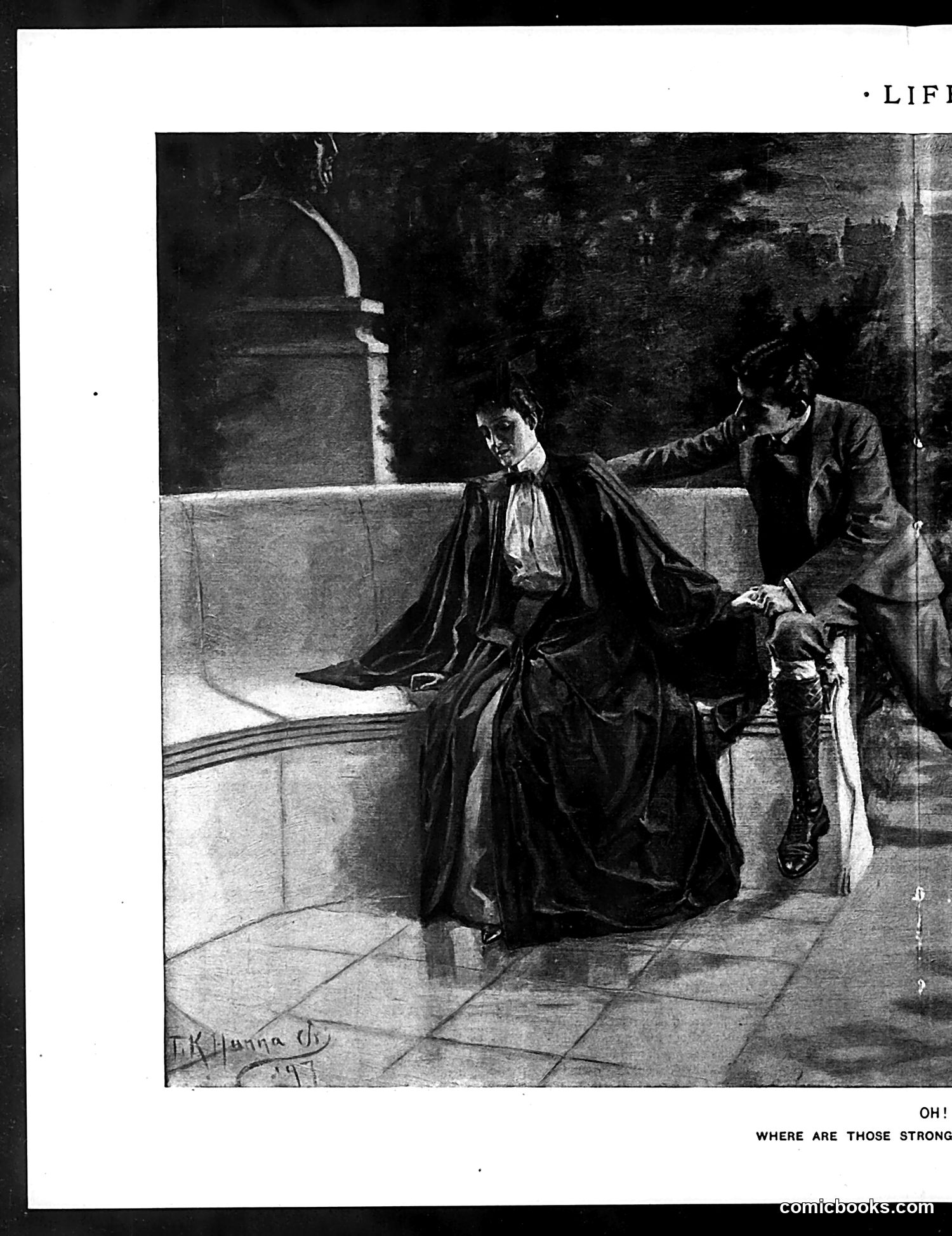
This appears to be a satirical illustration from *Life* magazine signed "F.K. Hanna" (dated 1897 based on visible marking). The image shows a woman in dark, flowing robes seated on a bench, looking downward in a posture of despair or resignation. A man stands beside her with his hand raised in a gesture that could suggest authority, dismissal, or consolation—the interpretation depends on context. The caption reads: "OH! WHERE ARE THOSE STRONG..." (text cuts off). Without the complete caption, the specific satirical target is unclear. However, the composition—a woman in distress and a man in a position of power—suggests commentary on gender relations, possibly critiquing either masculine authority or a woman's vulnerability. The formal dress and interior setting indicate this addresses middle-class social dynamics rather than working-class issues.
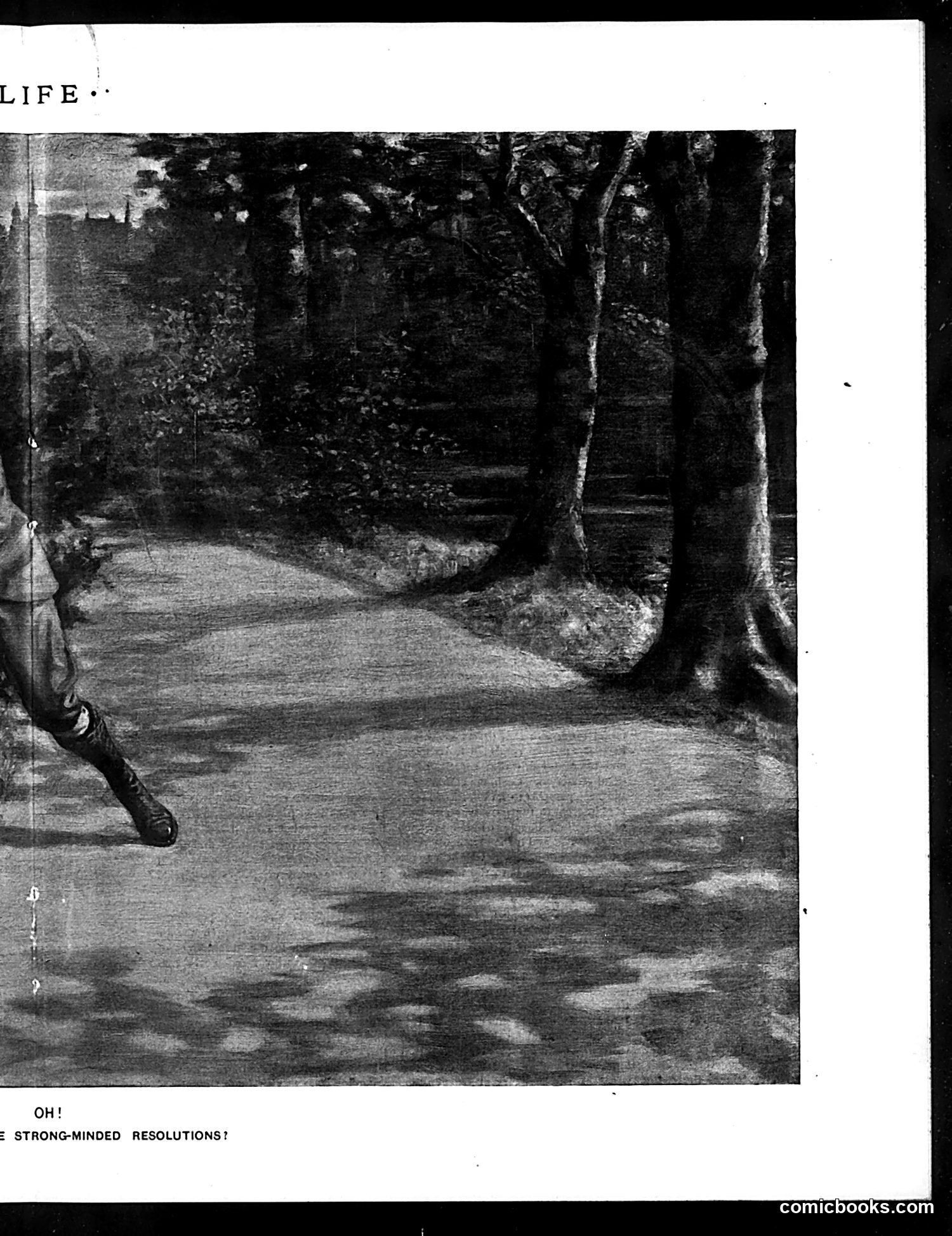
This appears to be a page from *Life* magazine showing a forest or wooded path scene. The partially visible text at bottom reads "OH!" and what seems to be "E STRONG-MINDED RESOLUTIONS!" (likely "MAKE STRONG-MINDED RESOLUTIONS!" or similar). The image depicts a peaceful woodland setting with tall trees lining a path. On the left side, there's a partial figure visible—appears to be a person's leg or lower body. Without clearer text or additional context, I cannot definitively identify the specific cartoon's subject or satirical point. The reference to "strong-minded resolutions" suggests this may relate to New Year's resolutions or personal determination, possibly with humorous commentary about nature, exercise, or self-improvement goals, but the fragmentary nature of what's visible prevents confident interpretation of the intended satire.
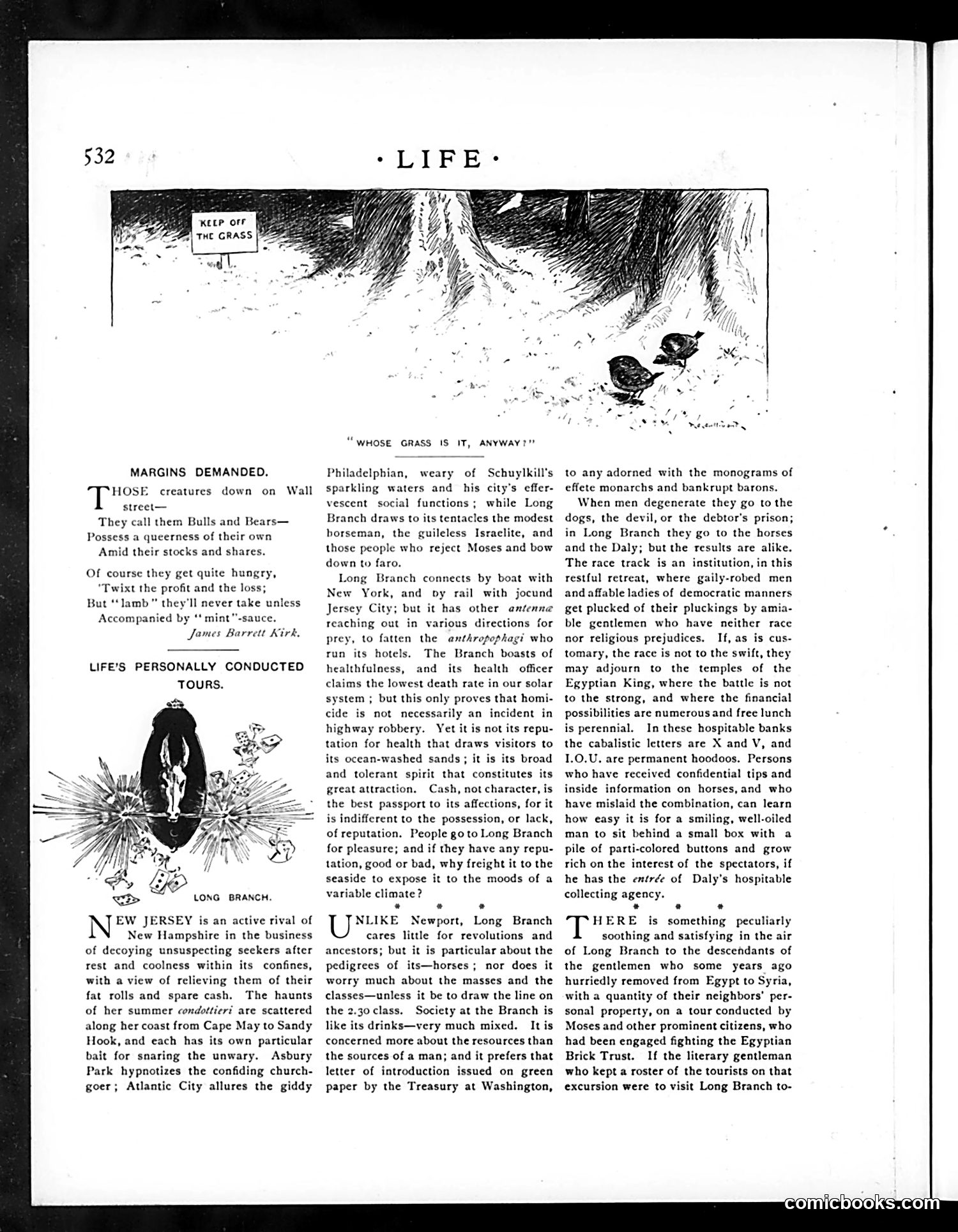
The page features satirical commentary about Long Branch, New Jersey, a fashionable seaside resort. The cartoon shows a small figure near tree roots with a "Keep Off The Grass" sign and caption "Whose grass is it, anyway?!" The text mocks Long Branch's wealthy clientele—describing it as a retreat for "gaily-robed and affable ladies of democratic manners" and "amiable gentlemen" from various social circles. The satire targets the resort's pretension: it claims to foster democratic ideals while actually catering to the rich and socially ambitious. The piece ridicules how visitors use Long Branch to display wealth and status rather than genuinely enjoy nature or relaxation, suggesting the resort's real appeal is vanity and social positioning among the elite.
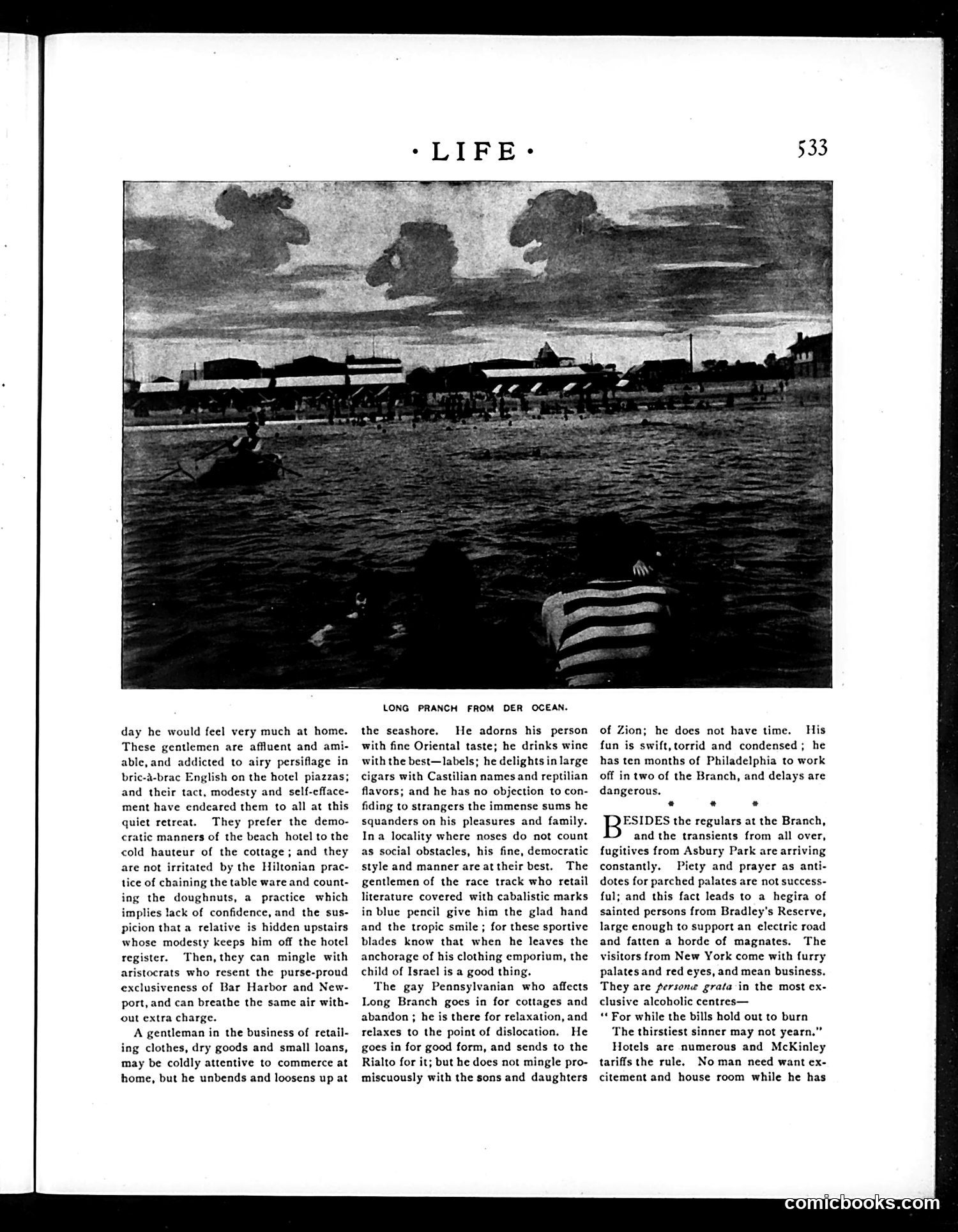
This page satirizes the social dynamics at Long Branch, a fashionable New Jersey seaside resort. The text mockingly describes three types of visitors: 1. **Affluent Jewish businessmen** (implied by "child of Israel" and "sons and daughters of Zion")—retailers of clothes and goods who adopt pretentious airs at the shore, displaying wealth through fine wines and large cigars while mingling democratically at beach hotels rather than exclusive cottages. 2. **Wealthy Pennsylvanians**—who visit for uninhibited relaxation and entertainment, keeping themselves socially separate from Jewish visitors. 3. **Escapees from Asbury Park's religious community**—who come seeking alcohol and pleasure as relief from piety. The satire targets class pretension, ethnic/religious social segregation, and the hypocrisy of leisure culture. The photograph shows Long Branch's waterfront with bathers and shoreline buildings, illustrating the resort's actual appearance during this era of American resort society.
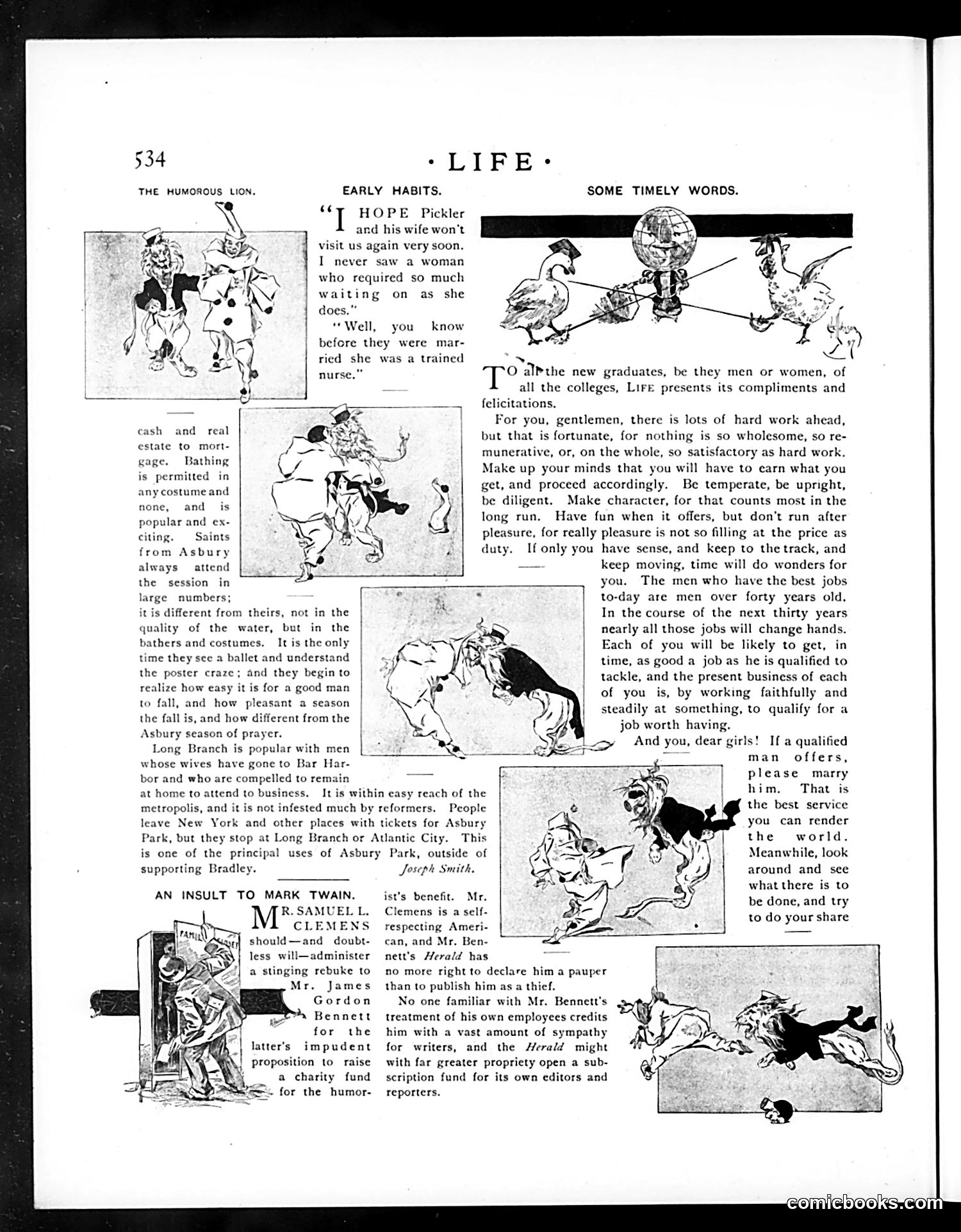
This page contains three distinct sections: **"The Humorous Lion"** (left): A domestic humor cartoon about a wife who demands excessive attention, with the punchline that she was "trained" as a nurse before marriage—implying she's accustomed to attending to others' needs, making her demanding now. **"Early Habits"** (center): Illustrated vignettes about bathing at Asbury Park and Long Branch, New Jersey resorts. The text humorously notes that while wealthy people avoid the reformers at Asbury Park by stopping at Long Branch instead, bathing there is popular because it's one of the few times people see theatrical posters and understand avant-garde art—a satirical jab at high society's pretensions. **"Some Timely Words"** and **"An Insult to Mark Twain"** (right): Graduation advice to young men and women; separately, a critique of James Gordon Bennett's *Herald* newspaper for proposing a charity fund for Mark Twain. Life argues Bennett has no moral standing—his own treatment of employees is poor—and calling Twain a pauper is insulting.
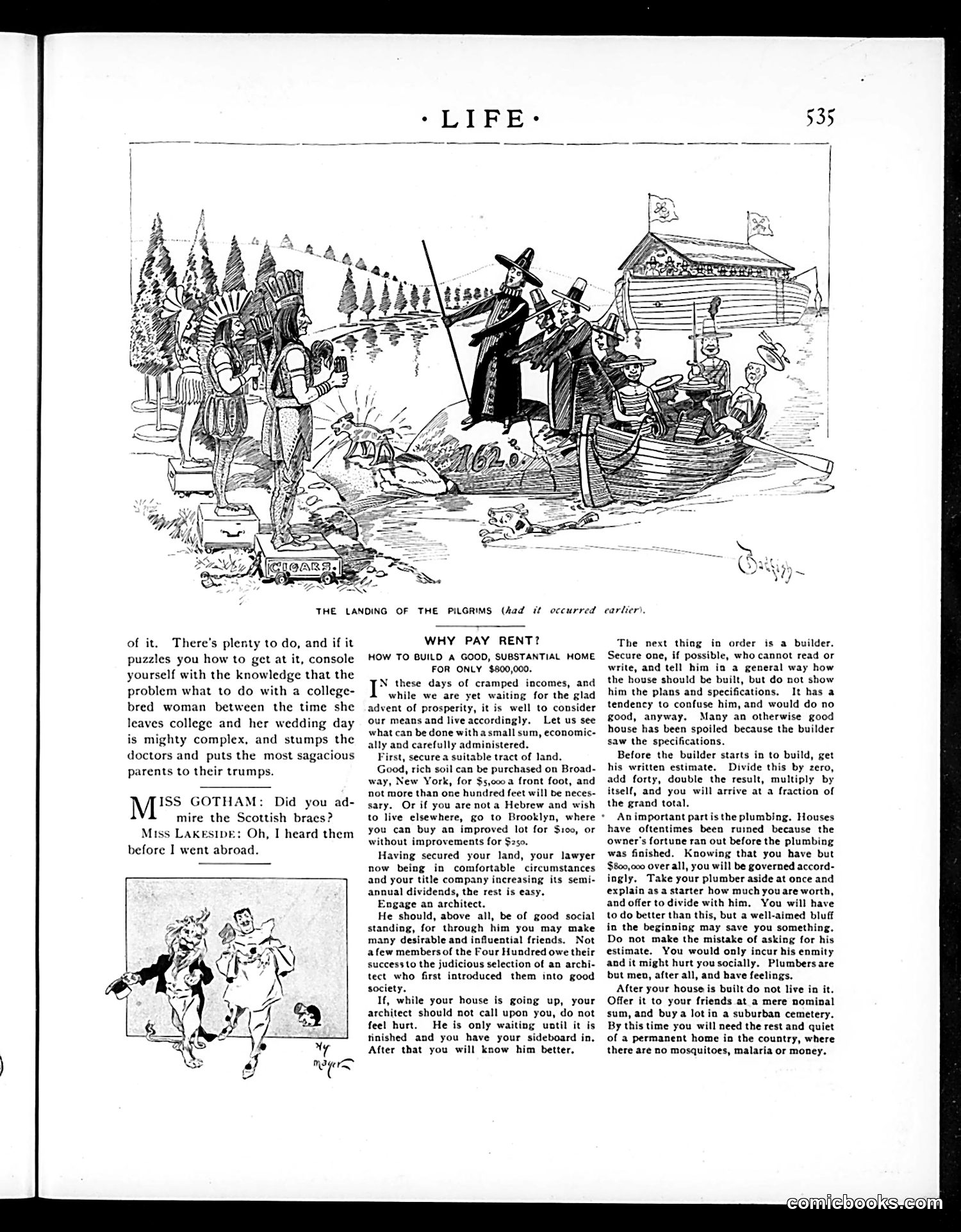
**The Main Cartoon**: "The Landing of the Pilgrims (had it occurred earlier)" satirizes how commercialism and social pretension would corrupt the Pilgrims' historical landing. Instead of religious refugees, we see Native Americans encountering wealthy colonists in formal dress, complete with an elaborate ark-like vessel and flags. The joke suggests that if this iconic moment happened in the contemporary Gilded Age, it would be reduced to a real estate transaction and status-seeking opportunity. **The Text Content**: The page contains satirical advice on building a house for "$800,000"—a deliberately ironic title, since the sum is presented as modest while being absurdly large for the era. The humor attacks: - Social climbing through hiring fashionable architects - Unreliable builders and inflated contractor estimates - The absurdity of wealthy people who, after exhausting themselves building elaborate homes, abandon them and buy cemetery plots instead The overall message mocks American wealth obsession and the performative nature of upper-class consumption.
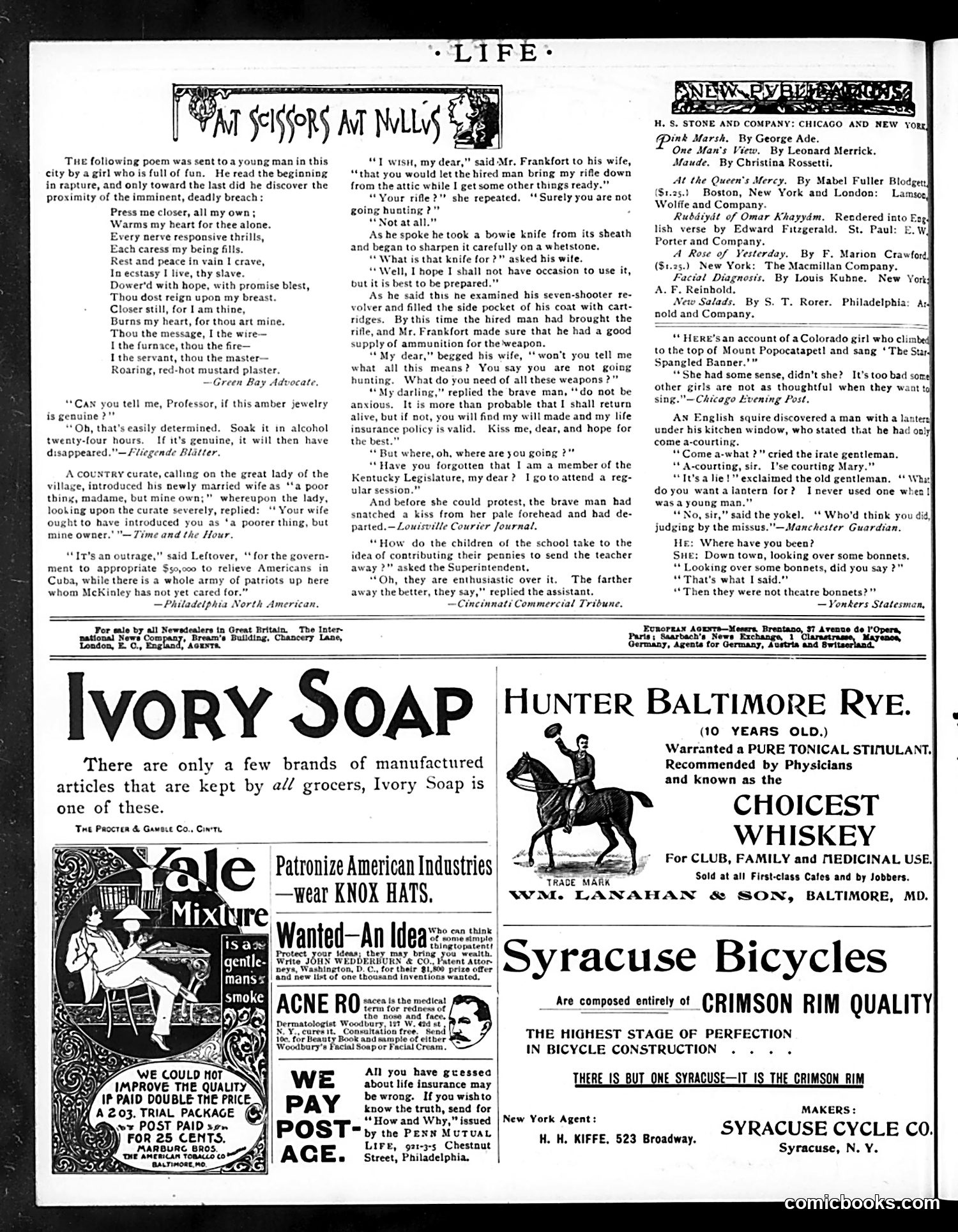
This page contains **humorous short pieces and jokes** rather than political cartoons. The content satirizes everyday social situations and absurdities: **Key pieces:** 1. **"Scissors at Nully's"** – A prank poem where a young man reads what appears to be romantic verse, only to discover the final lines mock him ("red-hot mustard plaster"). 2. **Kentucky Legislature joke** – A husband prepares weapons (rifle, bowie knife, revolver, ammunition) before attending a legislative session, treating it as a dangerous expedition. The satire mocks the Kentucky Legislature as violent and lawless. 3. **Teacher removal joke** – Schoolchildren enthusiastically contribute pennies to send their teacher away, preferring he leave entirely. 4. **Other brief jokes** on amber jewelry, a clergyman's wife, and government spending priorities. **Historical context:** These reflect turn-of-the-century American humor conventions—playful wordplay, social observation, and gentle mockery of institutions and relationships. The page is primarily **editorial content with advertisements**, not political satire requiring specialized historical knowledge.
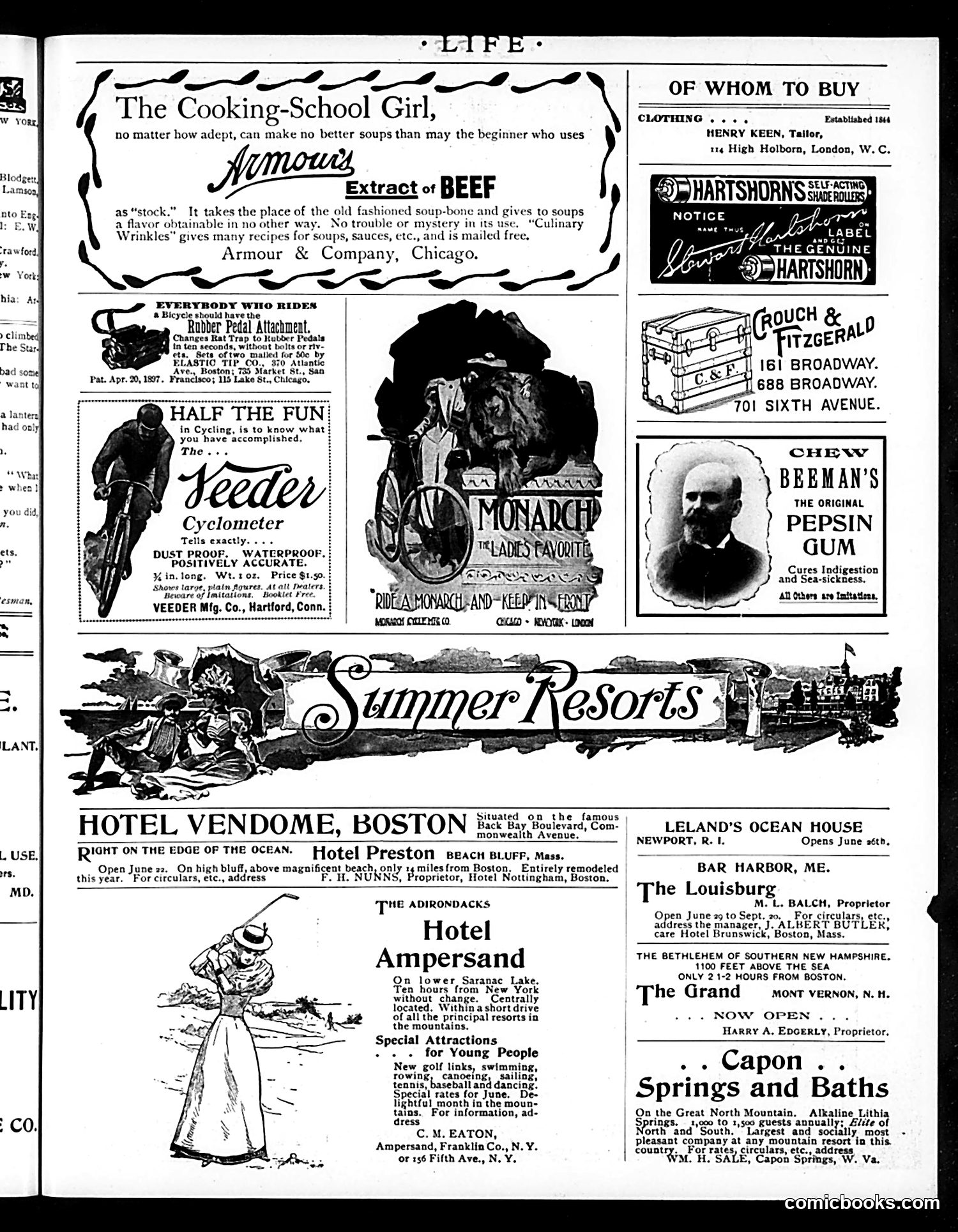
This page is primarily **advertising**, not satirical content. The top features a cooking product advertisement for Armour's Extract of Beef, targeting housewives by claiming even beginners can make superior soups using their product rather than traditional soup bones. Below are various commercial advertisements typical of the era (late 1890s based on patent dates): bicycle accessories (pedal attachments, cyclometers), patent medicines (Beeman's Pepsin Gum for indigestion), and clothing. The bulk of the page advertises **summer resort hotels** across New England—Hotel Vendome in Boston, Hotel Preston in Massachusetts, the Grand in New Hampshire, and Capon Springs in West Virginia. These establishments marketed themselves to affluent vacationers, emphasizing oceanside locations, recreational facilities (golf, tennis, boating), and social exclusivity ("Elite" clientele). There is **no political satire or cartoon** on this page. It represents typical *Life* magazine advertising from the Gilded Age leisure economy.
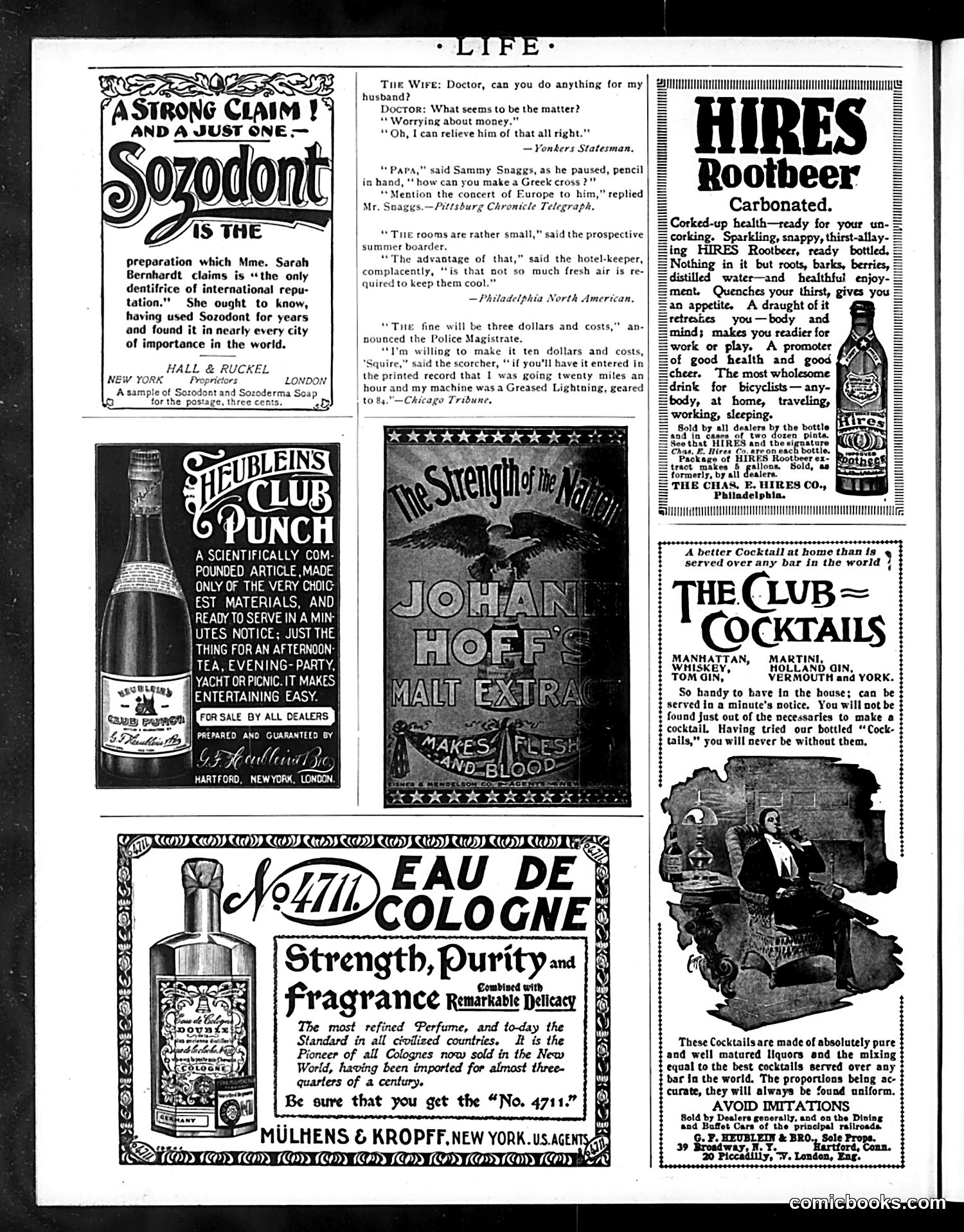
This page is primarily **advertising** from an early 20th-century American publication, interspersed with brief humorous anecdotes. The **humor pieces** are light, topical jokes: one about a doctor relieving a man's money worries (likely referencing economic anxiety of the era), another about a "Greased Lightning" bicycle geared to 84 mph (satirizing cyclists' boasting), and wordplay about the "Concert of Europe" (a diplomatic term). The **advertisements** promote period products: Sozodont toothpaste (endorsed by actress Sarah Bernhardt), Shuebleins Club Punch (an alcoholic beverage), Johann Hoff's Malt Extract (a health tonic claiming to build "flesh and blood"), Eau de Cologne No. 4711 (imported perfume), Hires Rootbeer (carbonated soft drink), and bottled cocktail mixers. These ads reflect the commercial anxieties and consumer culture of the era—products marketed for health, refinement, and modern convenience. The page shows Life functioning as both satirical commentary and commercial vehicle.
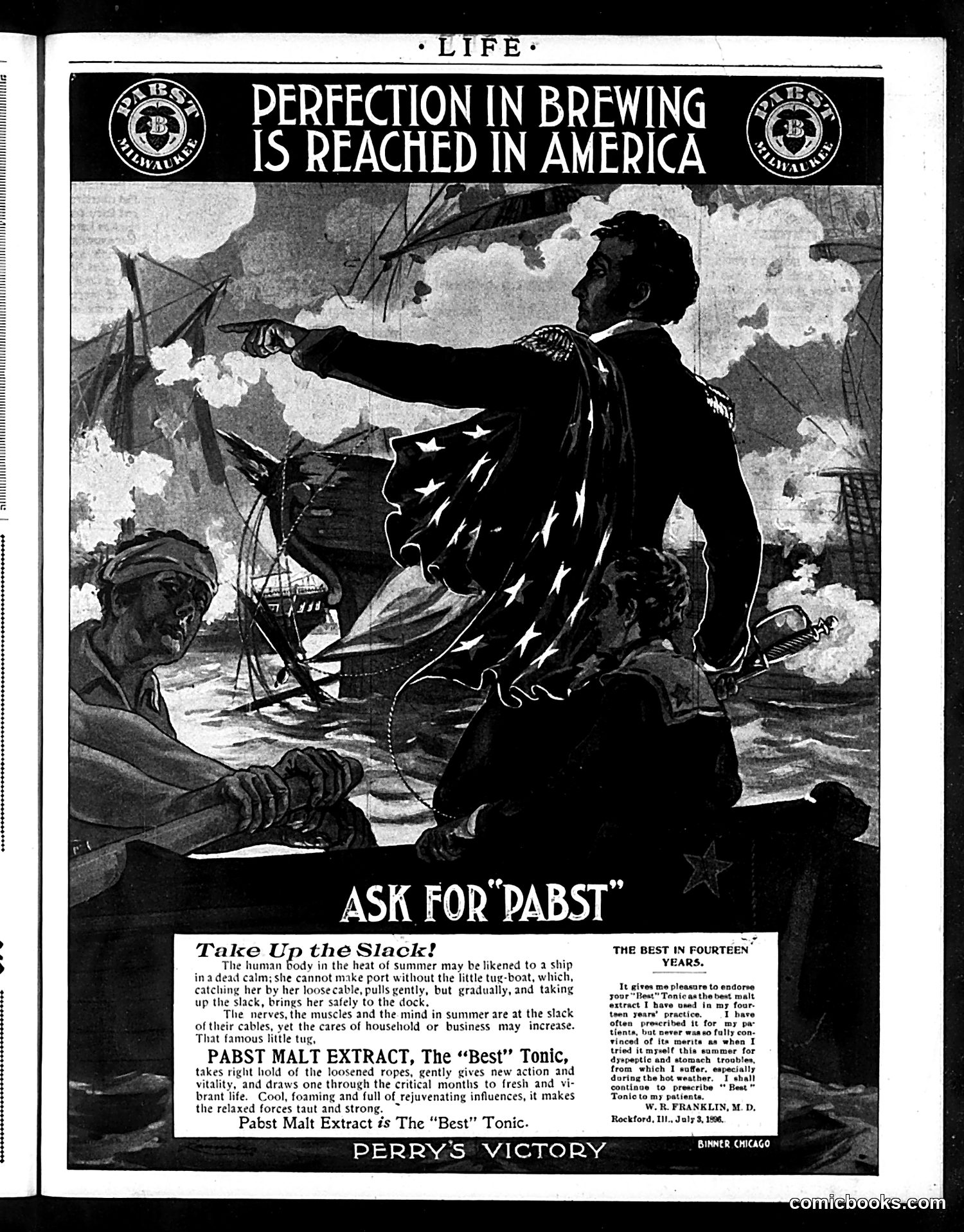
This is primarily a **Pabst beer advertisement** disguised as editorial content in Life magazine. The main image depicts a patriotic scene with an American flag and figures suggesting naval/maritime themes, connecting to the text's metaphor comparing the human body to a ship needing a "tug-boat" to function properly in summer heat. The ad promotes "Pabst Malt Extract" as a health tonic for summer fatigue, claiming it restores strength to depleted nerves, muscles, and mind. A testimonial from "W.R. Franklin, M.D." endorses it as superior to other products he's used in fourteen years of practice. The patriotic imagery and "Perry's Victory" reference (likely the 1813 naval battle) lend nationalist credibility to the product. This reflects early-20th-century advertising practices where breweries marketed malt extract as medicinal tonics to circumvent or appear respectable within increasingly restrictive alcohol regulations.
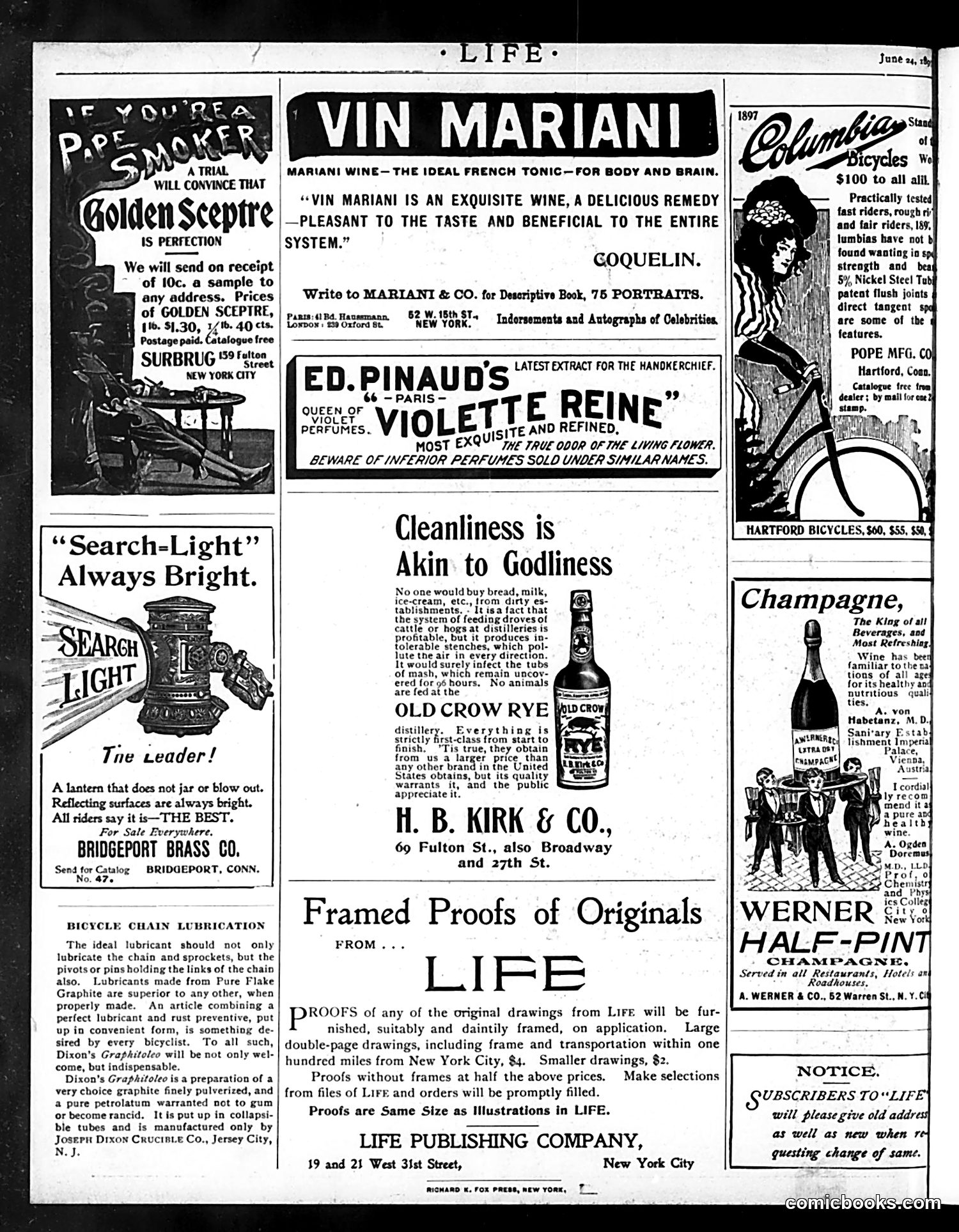
This is primarily a **advertisements page** with no political cartoons. The content reflects late-19th-century consumer culture and product marketing. The ads reveal attitudes of the era worth noting: **Old Crow Rye whiskey** uses the slogan "Cleanliness is Akin to Godliness," ironically marketing liquor by emphasizing the distillery's hygiene standards—a credibility appeal in an era of questionable food/beverage safety. **Vin Mariani wine** quotes the celebrity "Coquelin" (likely French actor Constant-Benoît Coquelin) endorsing it as medicinal—cocaine-infused wines were legal tonics marketed as health remedies until the early 1900s. **Pinaud's Violette Reine perfume** and bicycle advertisements reflect consumer goods targeting middle-class buyers with disposable income. The **Life Publishing Company advertisement** offers framed reproductions of original drawings from the magazine itself—early merchandise tying editorial content to commercial products.
I can see this is a page from *Life* magazine with text fragments visible on the left margin, but **the main content area is almost entirely blank white space**. The OCR'd text provided is too fragmentary and unclear to establish context—it appears to be partial words and phrases rather than coherent passages. Without being able to read the actual cartoon caption, article text, or clearly identify any illustrated figures or captions, I cannot reliably explain what political or social references this page contains, or what satire or joke it presents. To provide accurate analysis as requested, I would need a page where the cartoon(s), illustrations, or article text are legible enough to read and interpret.