
Life, 1897-06-24 · page 6 of 21
Life — June 24, 1897 — page 6: what you’re looking at
What you’re looking at
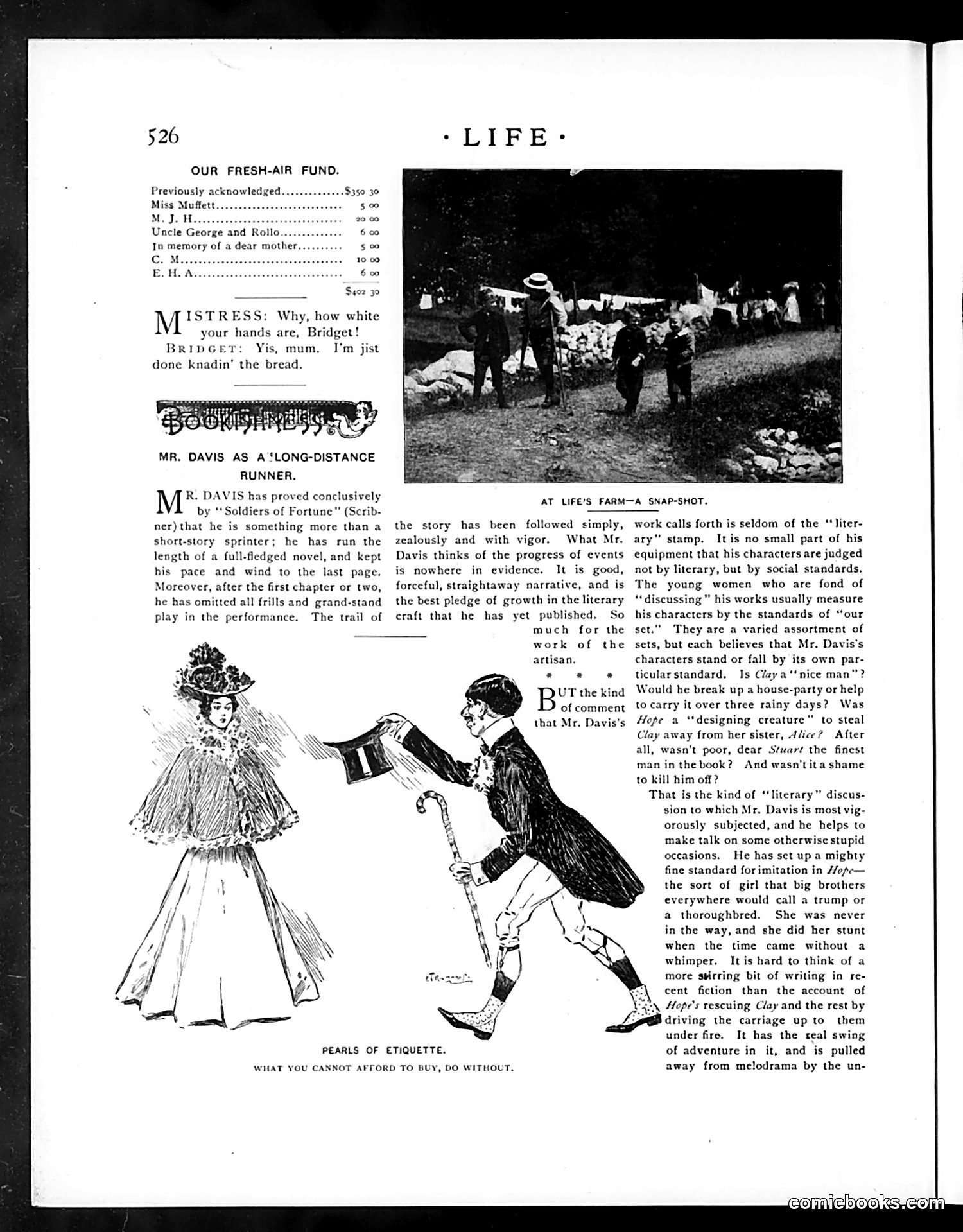
This page contains two distinct items: **"Pearls of Etiquette" cartoon** (lower left): A satirical illustration showing a man offering a woman a book or package. The caption "What you cannot afford to buy, do without" mocks upper-class social pretension—specifically the expectation that proper ladies should receive expensive gifts. The joke critiques the artificiality of etiquette rules that demand conspicuous consumption, suggesting that honesty about one's means is preferable to maintaining false appearances. **Literary criticism** (right side): Reviews Mr. Davis's story "Soldiers of Fortune," praising his character development and narrative skill, particularly his female character *Hope*, whom the critic contrasts with other contemporary heroines as genuinely admirable rather than melodramatic. Both items reflect early 1900s concerns with class performance and literary standards.
📄 Transcribed text from this page (OCR, searchable)
Machine-transcribed from the original scan — historical spelling and the odd misread are preserved.
526 OUR FRESH-AIR FUND. Previously acknowledged Miss Muffett 350 30 $00 Uncle George and Rollo. In memory of a dear mother 60 $00 10.0 6 00 $402 30 M ISTRESS: Why, how white your hands are, Bridget! BRIDG I'm jist MR. DAVIS AS A ‘LONG-DISTANCE RUNNER. R. DAVIS bas proved conclusively by ‘Soldiers of Fortune" (Scrib- ner) that he is something more than a short-story sprinter; he has run the length of a full-fledged novel, and kept his pace and wind to the last Moreover, after the first chapter or tw he has omitted all frills and grand-stand play in the performance. The trail of AT LIFE’S FARM—A SNAP-SHOT. the story has been followed simply, zealously and with vigor, What Mr. Davis thinks of the progress of events is nowhere in evidence. It is good, forceful, straightaway narrative, and is the best pledge of growth in the literary craft that he has yet published. So much for the work of the artisan. * 8 B the kind of comment that Mr, Davis's PEARLS OF ETIQUETTE. WHAT YOU CANNOT AFFORD TO BUY, DO WITHOUT. work calls forth is seldom of the “‘liter- ary” stamp. Itis no small part of his equipment that his characters are judged not by literary, but by social standards. The young women who are fond of “discussing” his works usually measure his characters by the standards of “our set.” They are a varied assortment of sets, but each believes that Mr. Davis's characters stand or fall by its own par- ticular standard. Is Claya ‘nice man"? Would he break up a house-party or help tocarry it over three rainy days? Was Hope “designing creature" to steal Clay away from her sister, Alice? After all, wasn't poor, dear Stwart the finest man in the book? And wasn'tita shame to kill him off? That is the kind of ‘‘literary” discus- sion to which Mr. Davis is most vig- orously subjected, and he helps to make talk on some otherwise stupid occasions. He has set up a mighty fine standard forimitation in //ope— the sort of girl that big brothers everywhere would call a trump or a thoroughbred. She was never in the way, and she did her stunt when the time came without a whimper. It is hard to think of a more stirring bit of writing in re- cent fiction than the account of Hope's rescuing Clay and the rest by driving the carriage up to them under fire. It has the ceal swing of adventure in it, and is pulled away from melodrama by the un-