
Life, 1897-06-24 · page 4 of 21
Life — June 24, 1897 — page 4: what you’re looking at
What you’re looking at
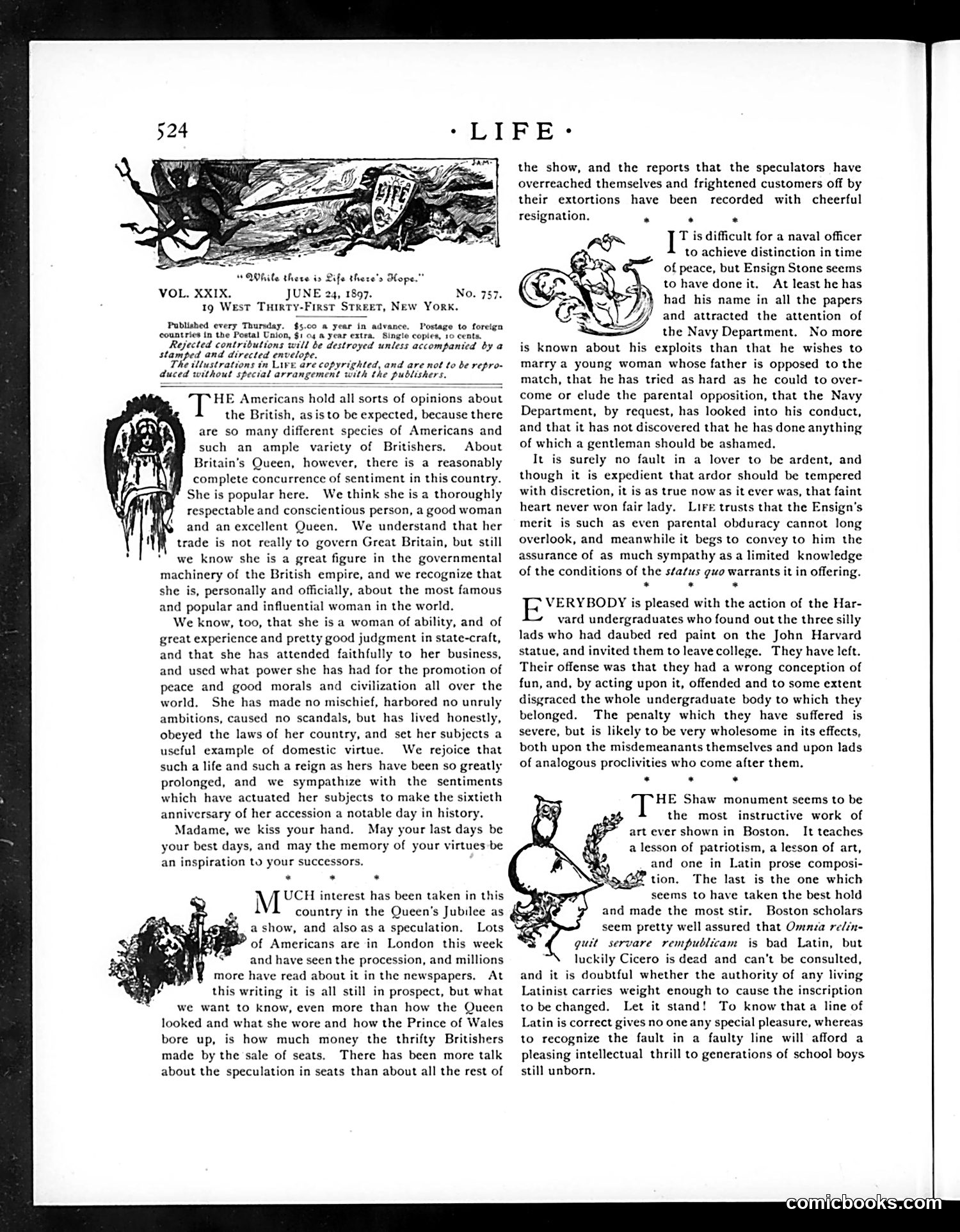
This page contains editorial commentary rather than political cartoons. The main topics discussed are: 1. **Queen Victoria's Jubilee**: The editors praise Queen Victoria as a "respectable and conscientious person" and a "great figure" in British governance, celebrating the 60th anniversary of her reign. 2. **Ensign Stone**: A naval officer who apparently wished to marry against his superior's wishes. The editorial sympathetically portrays his romantic ardor while suggesting discretion was warranted. 3. **Harvard Statue Prank**: Undergraduates who defaced a John Harvard statue face criticism—their "strong conception of fun" is deemed offensive to the entire undergraduate body. 4. **Shaw Monument in Boston**: The editors praise this artwork as an instructive patriotic lesson, defending its Latin inscription against potential criticism from those who might want it changed. The page emphasizes propriety, institutional respect, and cultural tradition.
📄 Transcribed text from this page (OCR, searchable)
Machine-transcribed from the original scan — historical spelling and the odd misread are preserved.
While there is Life there's Hope.” VOL. XXIX. JUNE 24, 1897. 1g West THirTY-First STREET, New York. Published every Thursday. $5.00 a year in advance. Postage to foreign countries in the Postal Union, $1 04 a year extra. Single copies, 10 cents. Rejected contributions will be destroyed unless accompanied by a stamped and directed envelope. The illustrations in Live are copyrighted, and are not to be repro- duced without special arrangement with the publishers. T HE Americans hold all sorts of opinions about the British, as isto be expected, because there are so many different species of Americans and such an ample variety of Britishers. About Britain's Queen, however, there is a reasonably complete concurrence of sentiment in this country. She is popular here. We think she is a thoroughly respectable and conscientious person, a good woman and an excellent Queen. We understand that her trade is not really to govern Great Britain, but still we know she is a great figure in the governmental machinery of the British empire, and we recognize that she is, personally and officially, about the most famous and popular and influential woman in the world, We know, too, that she is a woman of ability, and of great experience and pretty good judgment in state-craft, and that she has attended faithfully to her business, and used what power she has had for the promotion of peace and good morals and civilization all over the world. She has made no mischief, harbored no unruly ambitions, caused no scandals, but has lived honestly, obeyed the laws of her country, and set her subjects a useful example of domestic virtue. We rejoice that such a life and such a reign as hers have been so greatly prolonged, and we sympathize with the sentiments which have actuated her subjects to make the sixtieth anniversary of her accession a notable day in history. Madame, we kiss your hand. May your last days be your best days, and may the memory of your virtues be an inspiration to your successors. . . . N UCH interest has been taken in this country in the Queen's Jubilee as a show, and also as a speculation. Lots of Americans are in London this week and have seen the procession, and millions ¥ more have read about it in the newspapers. At this writing it is all still in prospect, but what we want to know, even more than how the Queen looked and what she wore and how the Prince of Wales bore up, is how much money the thrifty Britishers made by the sale of seats. There has been more talk about the speculation in seats than about all the rest of the show, and the reports that the speculators have overreached themselves and frightened customers off by their extortions have been recorded with cheerful resignation. . . * rey T is difficult for a naval officer to achieve distinction in time of peace, but Ensign Stone seems to have done it. At least he has had his name in all the papers and attracted the attention of the Navy Department. No more is known about his exploits than that he wishes to marry a young woman whose father is opposed to the match, that he has tried as hard as he could to over- come or elude the parental opposition, that the Navy Department, by request, has looked into his conduct, and that it has not discovered that he has done anything of which a gentleman should be ashamed, It is surely no fault in a lover to be ardent, and though it is expedient that ardor should be tempered with discretion, it is as true now as it ever was, that faint heart never won fair lady. Lire trusts that the Ensign’s merit is such as even parental obduracy cannot long overlook, and meanwhile it begs to convey to him the assurance of as much sympathy as a limited knowledge of the conditions of the séa¢us guo warrants it in offering. . * . VERYBODY is pleased with the action of the Har- vard undergraduates who found out the three silly lads who had daubed red paint on the John Harvard statue, and invited them to leave college. They have left. Their offense was that they had a wrong conception of fun, and, by acting upon it, offended and to some extent disgraced the whole undergraduate body to which they belonged. The penalty which they have suffered is severe, but is likely to be very wholesome in its effects, both upon the misdemeanants themselves and upon lads of analogous proclivities who come after them. . . . HE Shaw monument seems to be the most instructive work of art ever shown in Boston. It teaches a lesson of patriotism, a lesson of art, and one in Latin prose composi- tion. The last is the one which seems to have taken the best hold and made the most stir. Boston scholars seem pretty well assured that Omnza relin- guit servare rempublicam is bad Latin, but luckily Cicero is dead and can't be consulted, and it is doubtful whether the authority of any living Latinist carries weight enough to cause the inscription to be changed. Let it stand! To know that a line of Latin is correct gives no one any special pleasure, whereas to recognize the fault in a faulty line will afford a pleasing intellectual thrill to generations of school boys still unborn,