
A complete issue · 20 pages · 1897
Life — March 11, 1897
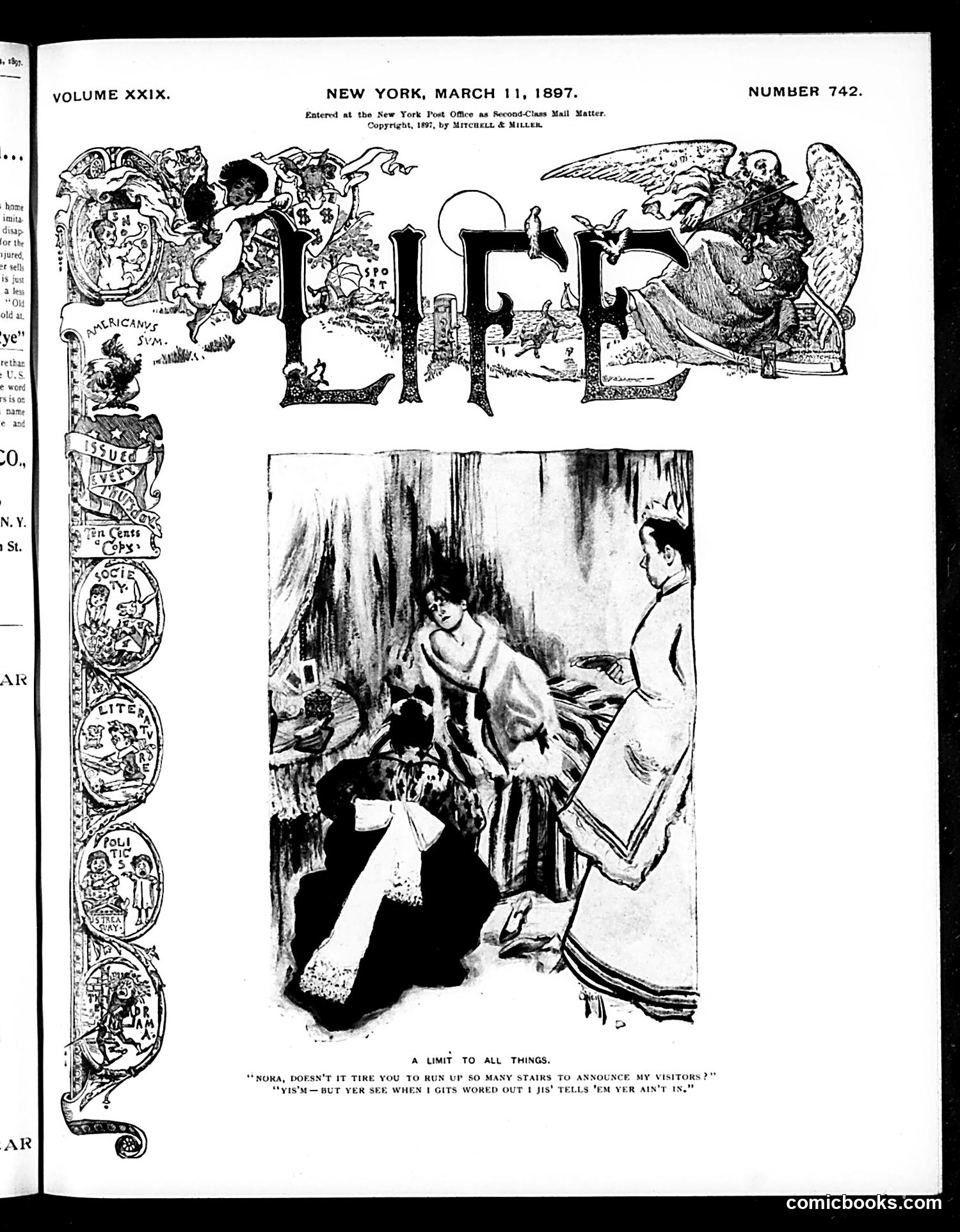
This cartoon satirizes domestic service complaints in the 1890s. A maid kneels exhausted before her employer, who complains about the servant announcing visitors. The maid responds in dialect: "NORA, DOESN'T IT TIRE YOU TO RUN UP SO MANY STAIRS TO ANNOUNCE MY VISITORS?" The maid replies sarcastically that the employer should complain when she's "worried out" and tells her she "ain't in." The satire targets upper-class employers who demanded excessive labor from live-in servants while remaining oblivious to their exhaustion. The title "A Limit to All Things" suggests even servants have breaking points. The heavy use of dialect caricature was typical of period humor, though offensive by modern standards. The piece reflects genuine labor tensions between household workers and their employers during this era.
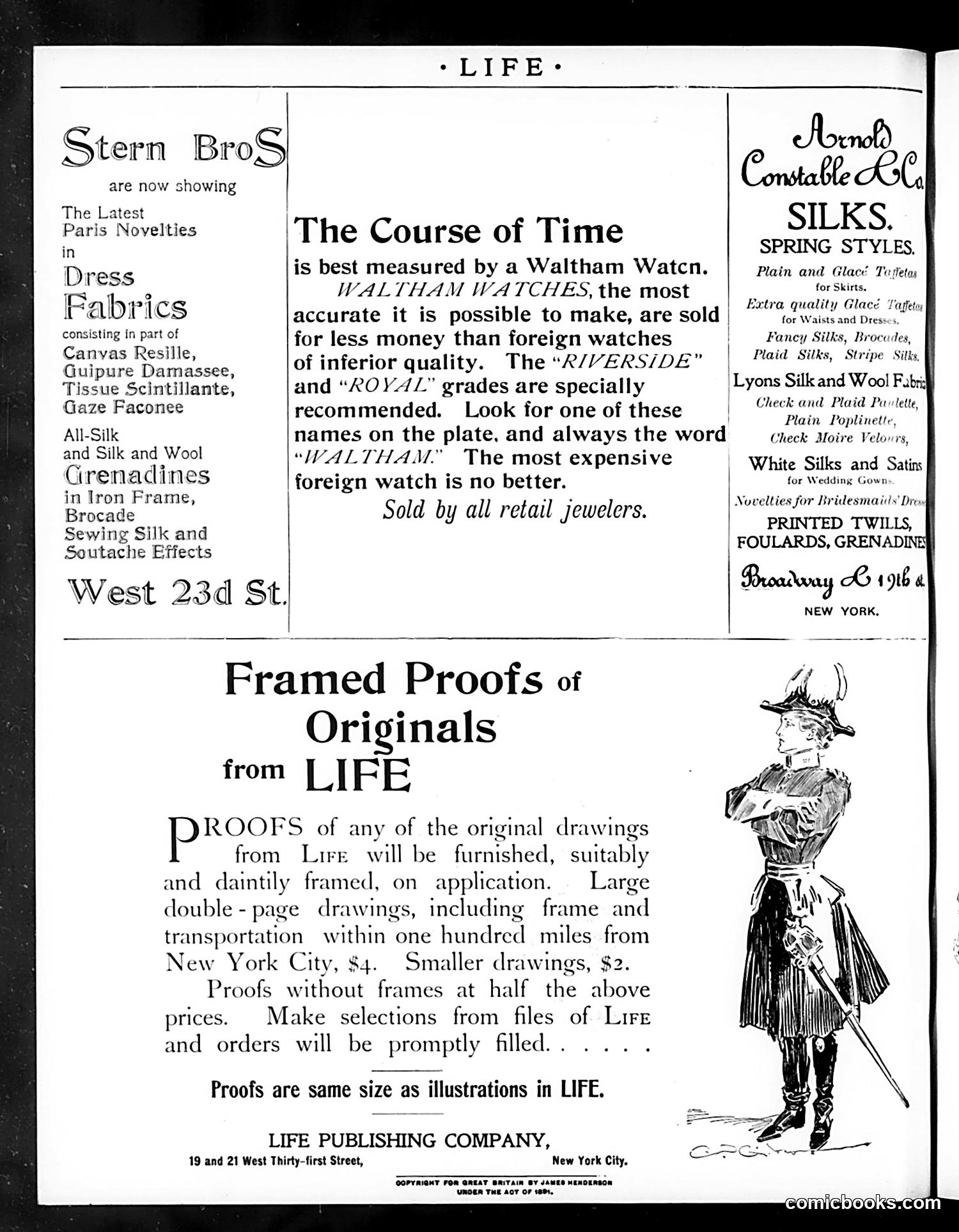
This page is primarily **advertising**, not satire or political commentary. The content consists of three distinct advertisements: 1. **Stern Bros.** promotes Paris novelty dress fabrics for women 2. **Waltham Watches** advertisement claiming superior accuracy and value compared to foreign watches 3. **Arnold Constable & Co.** advertises spring silks and fabrics 4. **Life Publishing Company** offers framed proofs of original drawings from the magazine The only illustration is a **fashion sketch** of an elegantly dressed woman in early 20th-century attire with a large feathered hat and walking stick—typical of Life magazine's fashion content of the era. This serves as decorative accompaniment to the textile advertisements rather than political commentary.
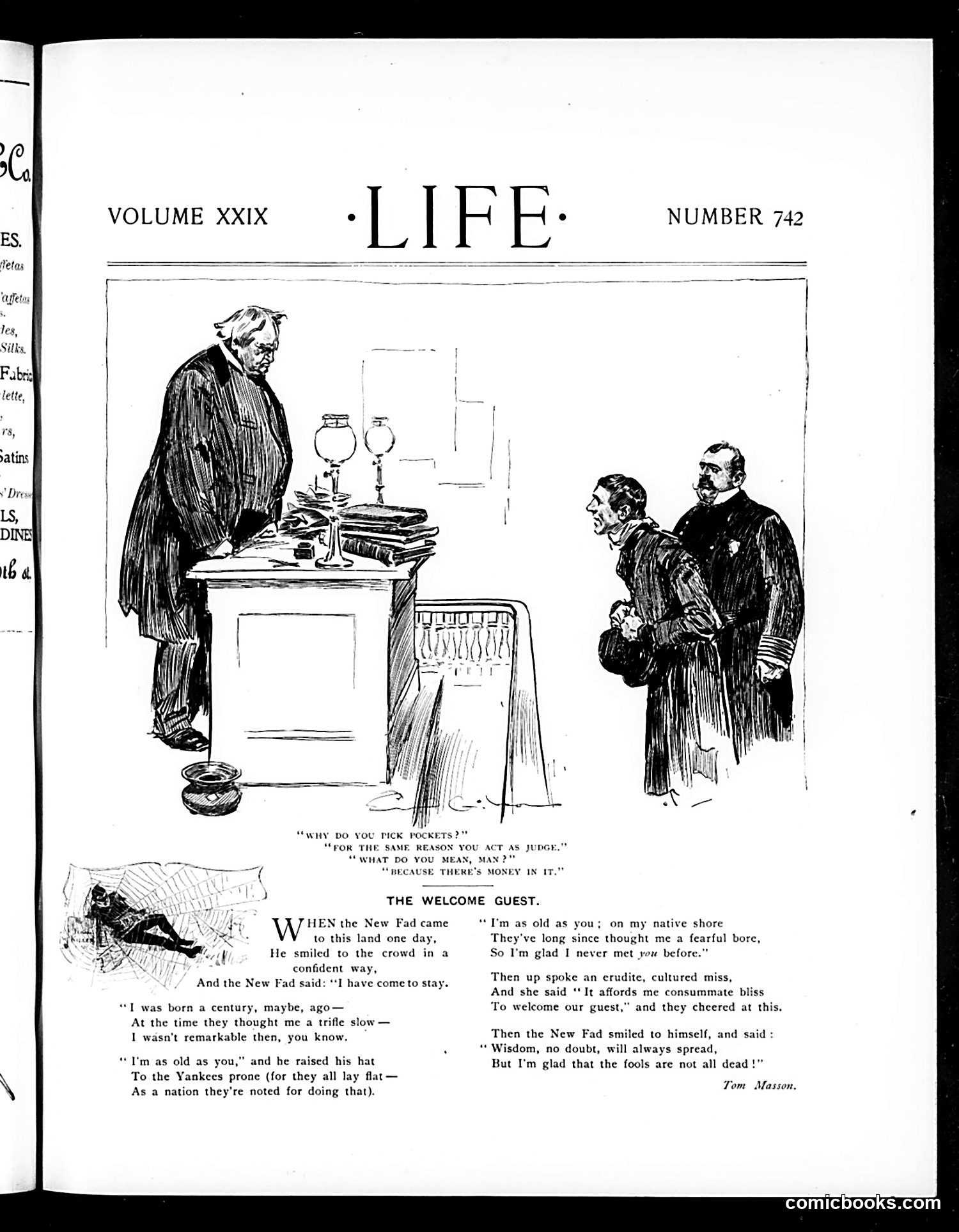
This satirical piece depicts "the New Fad" arriving in America, personified as a shabby, somewhat disreputable figure. The top cartoon shows three men in conversation about pickpocketing and judging, with money as motivation—suggesting the newcomer's questionable character. "The Welcome Guest" poem mocks American naïveté and hypocrisy. The "New Fad" claims ancient origins and has come "to stay," while an "erudite, cultured miss" welcomes him despite his obvious unworthiness. The satire critiques Americans for embracing fashionable trends uncritically, even when they're morally dubious. The final line—"I'm glad that the fools are not all dead!"—reveals the bitter joke: foolish people will always exist to accept whatever fashionable nonsense arrives. The specific "fad" referenced remains unclear without additional historical context.
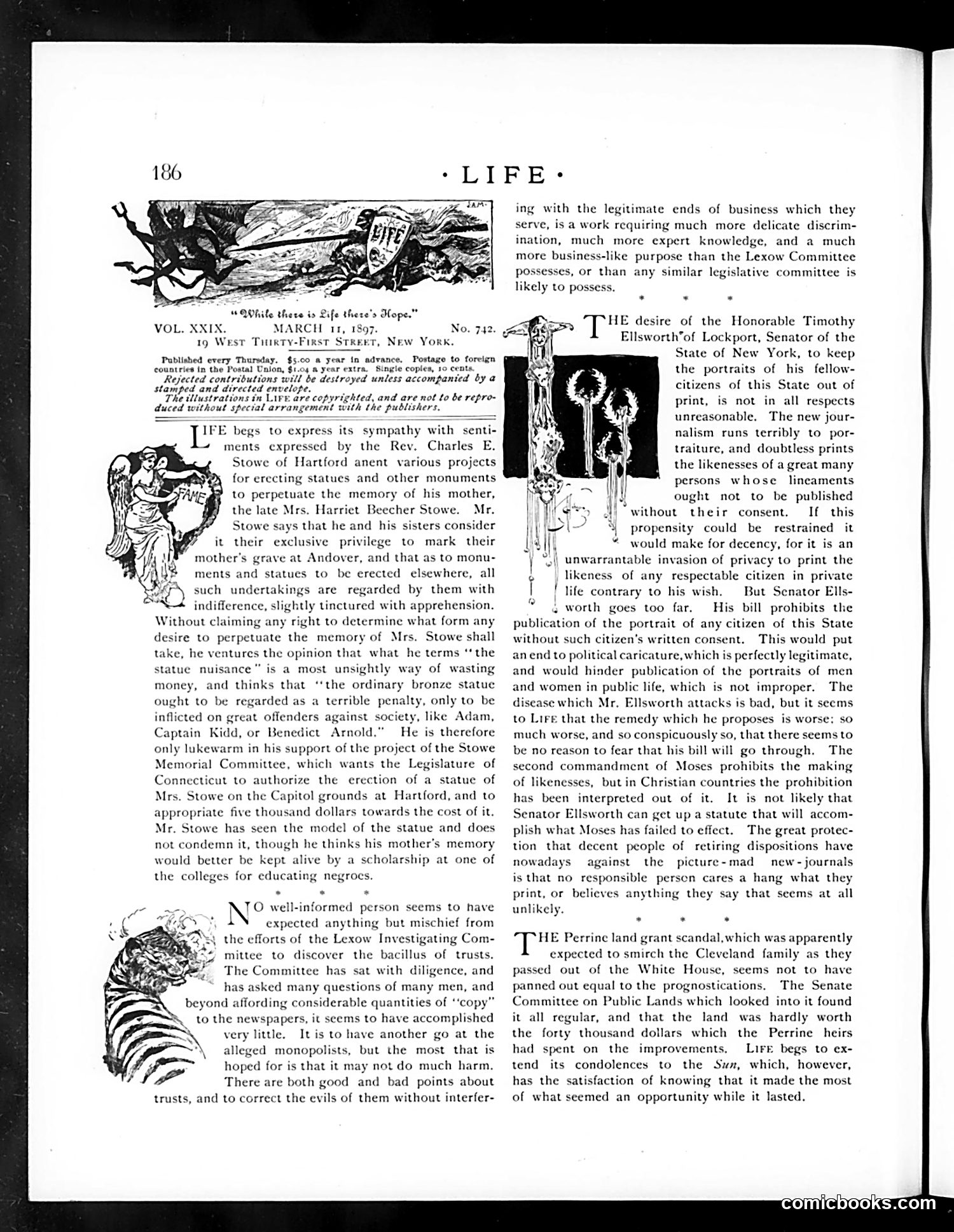
This page contains **editorial commentary** rather than traditional political cartoons. The main text discusses Senator Timothy Ellsworth of New York's proposed bill restricting publication of citizens' portraits without consent—framed as protecting privacy against "yellow journalism." Life argues the bill is misguided, comparing it to biblical prohibitions on graven images. The editors contend that responsible people shouldn't fear their likenesses being printed, and that the remedy for bad press is more speech, not censorship. The page also briefly mentions the **Perrine land grant scandal**, apparently affecting the Cleveland family, noting that the Senate's Public Lands Committee found the land's actual value far exceeded initial assessments—disappointing those hoping for scandal. The decorative illustrations are generic period engravings, not specific caricatures.
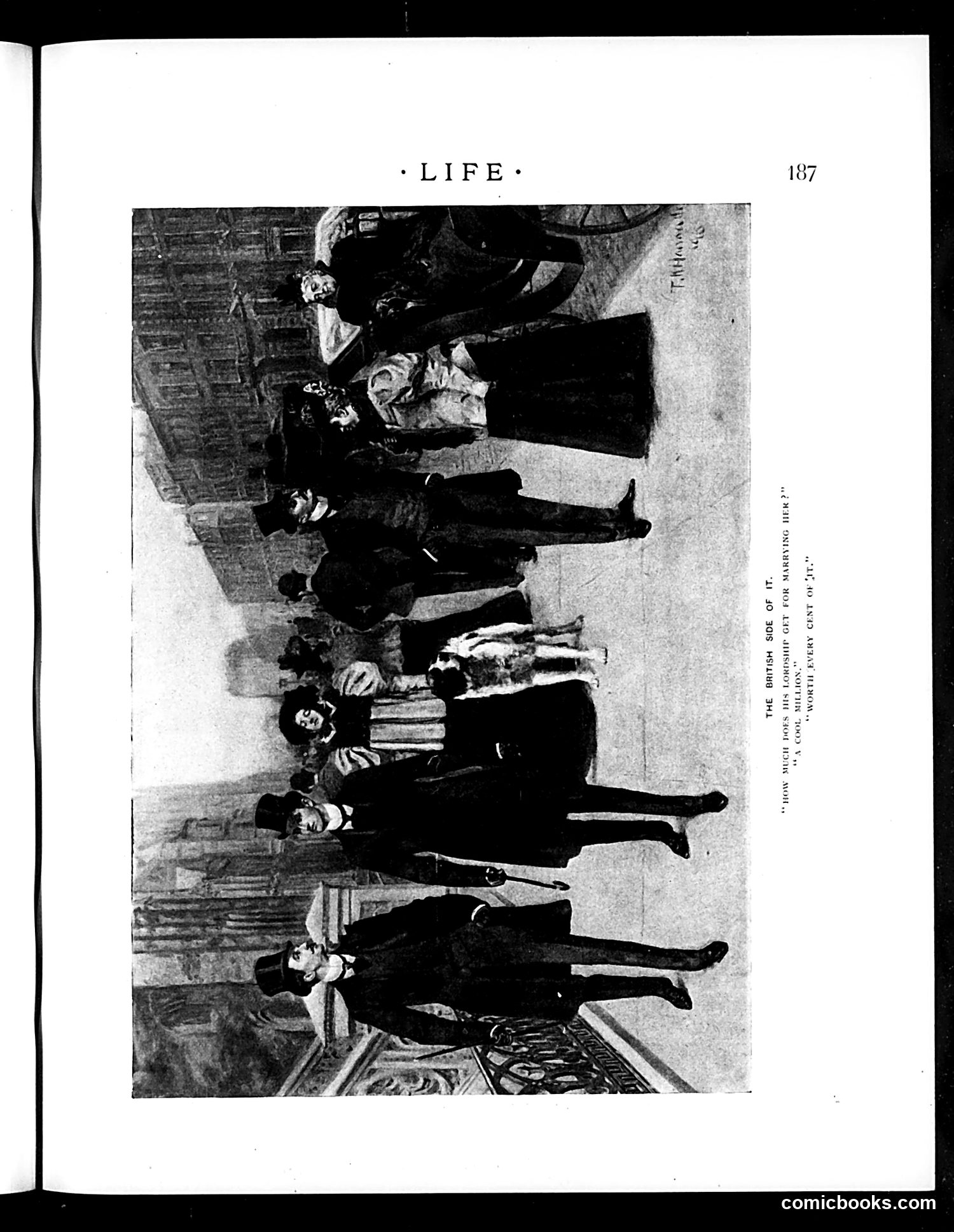
I can see this is page 187 from Life magazine, but the image quality and rotation make it difficult to read the caption text clearly or identify the specific figures with certainty. The photograph appears to show multiple people in formal attire from what seems to be an early-to-mid 20th century period, positioned in a way that suggests social satire or commentary. Without being able to reliably read the caption or clearly identify the individuals pictured, I cannot accurately explain what political or social commentary this image intends. To provide accurate historical context rather than speculation, I would need either a clearer image or confirmation of the specific issue date and article title.
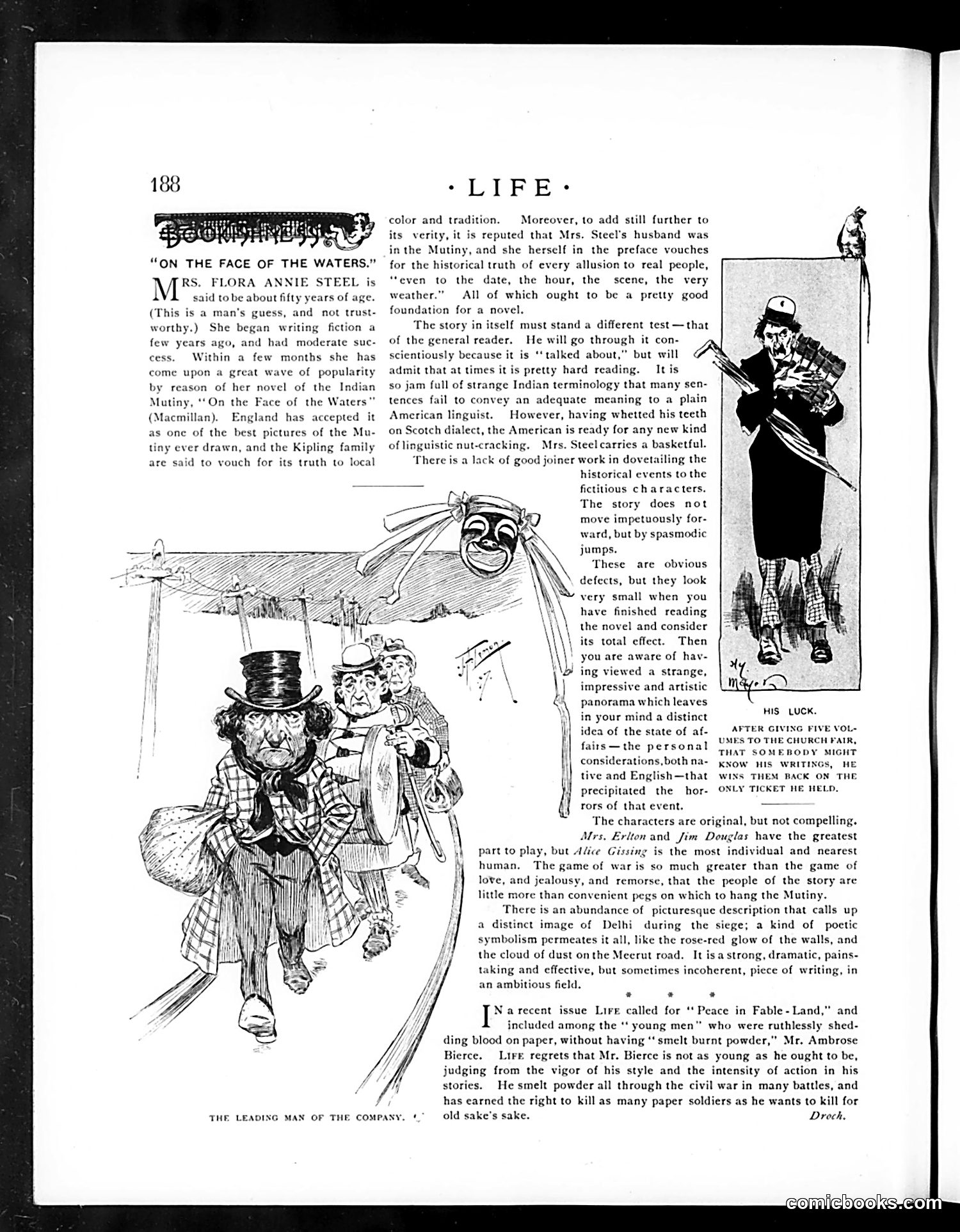
This page reviews Mrs. Flora Annie Steel's novel "On the Face of the Waters" (Macmillan), set during India's Mutiny. The left illustration depicts "The Leading Man of the Company"—a caricatured figure in top hat alongside another character, likely representing stock theatrical types or social archetypes. The right illustration, captioned "His Luck," shows a woman in Victorian dress. The review discusses the novel's strengths and weaknesses: original characters but slow pacing, effective but sometimes incoherent descriptions of Delhi during the siege, and Indian terminology that challenges American readers. Below, a brief note criticizes writer Ambrose Bierce for glorifying violence in fiction, calling his style overly intense and suggesting his Civil War experiences have made him callous about fictional bloodshed.
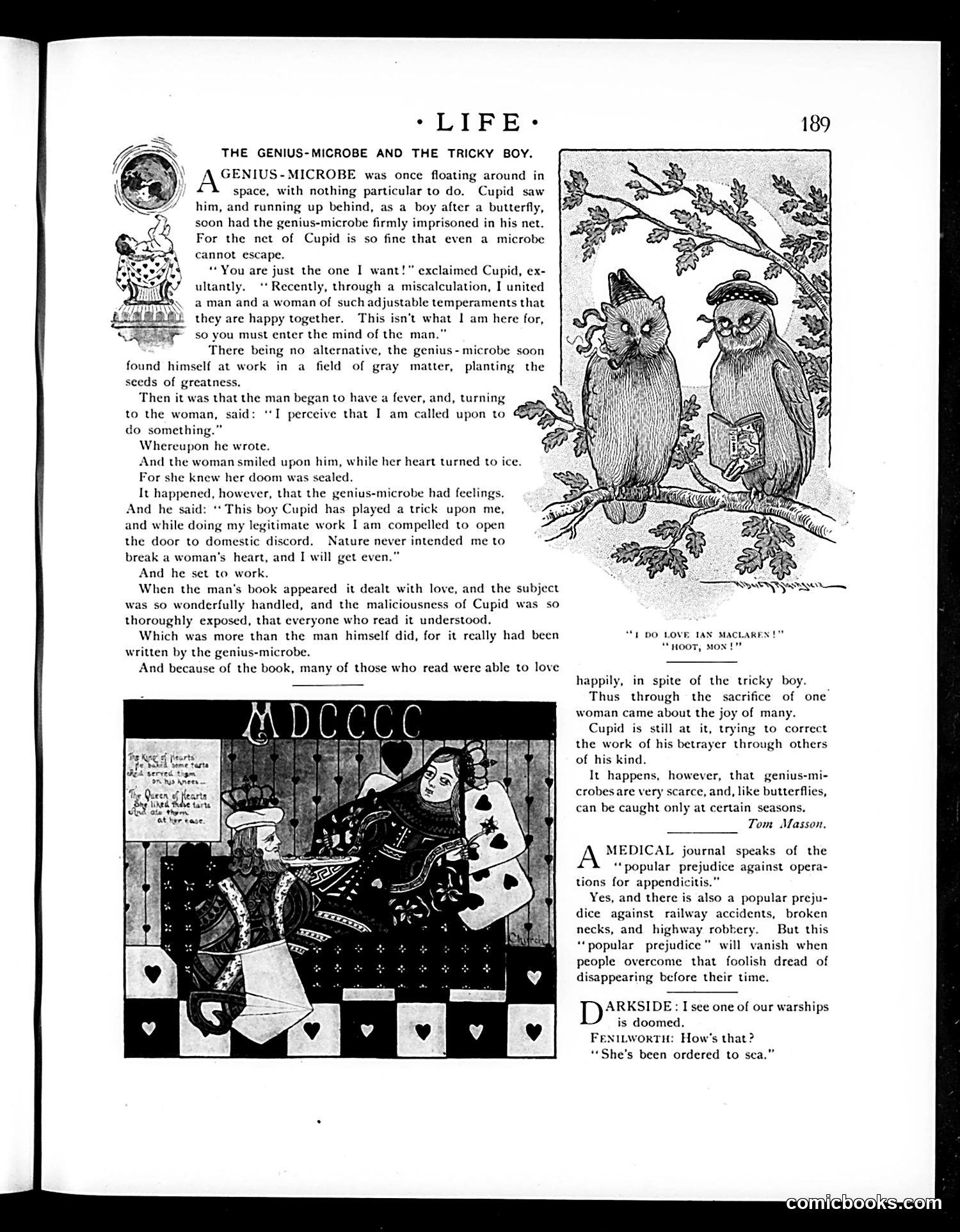
This allegorical tale satirizes **Cupid's meddling in human affairs**. A microscopic genius—a supernatural being—is imprisoned by Cupid for uniting incompatible lovers. Forced into mortal work, the genius plants seeds of greatness, but when the man develops fever, his wife coldly abandons him. The genius exposes her heartlessness through a published book about love so thoroughly that Cupid's malicious nature becomes obvious to all readers. The story critiques **romantic idealism versus reality**: Cupid (love itself) appears as a trickster causing human suffering rather than joy. The illustrated playing-card figures reinforce the theme of love as mere games and artifice. The satire suggests that blind faith in romantic love leads to disappointment and that exposing love's true nature is preferable to perpetuating illusions.
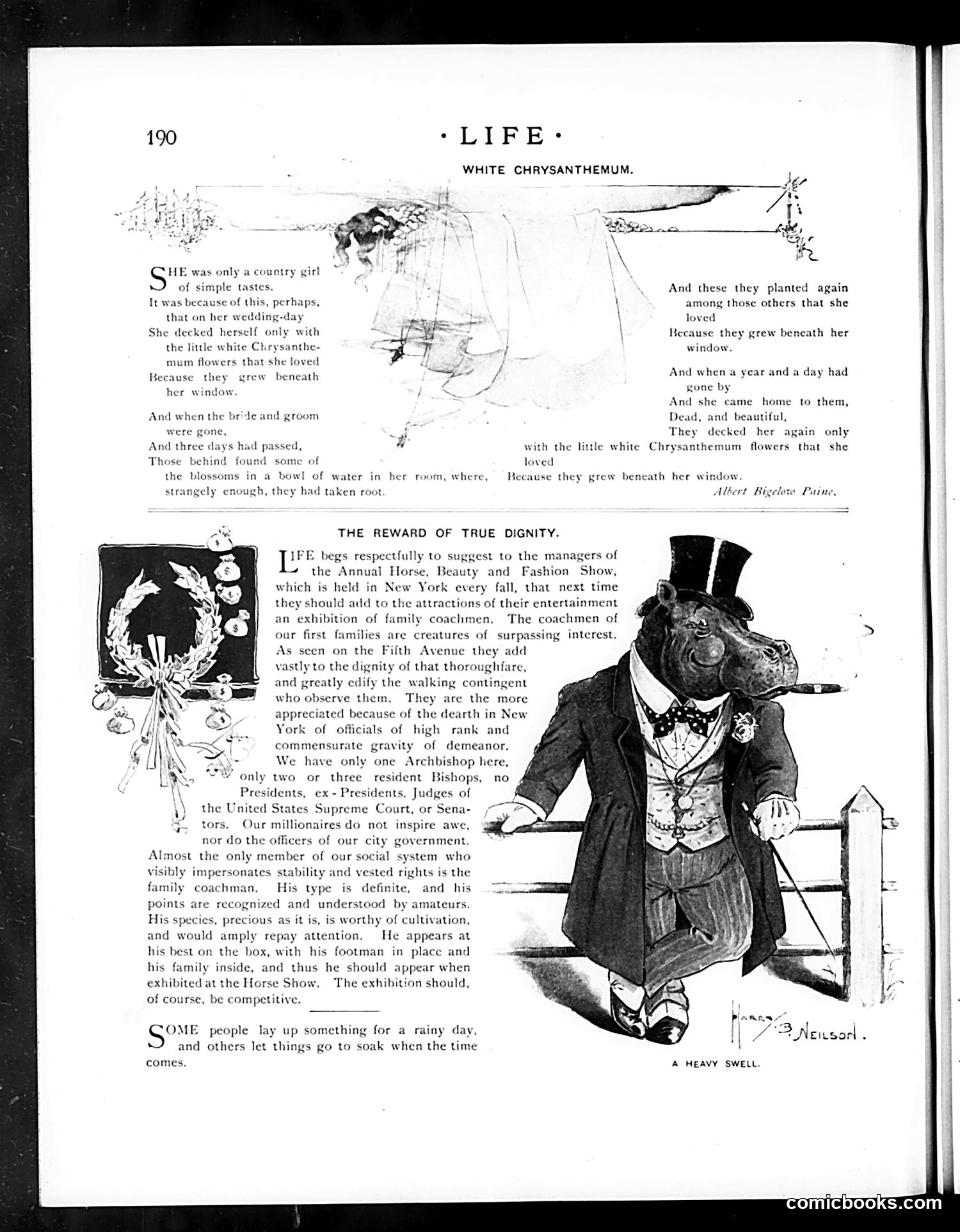
**Upper section ("White Chrysanthemum"):** A sentimental poem about a country girl who decorates her room with white chrysanthemums on her wedding day. The narrative describes how she replants them after her husband departs, and later finds joy when they bloom again. This is straightforward romantic fiction, not satire. **Lower section ("The Reward of True Dignity"):** A satirical article proposing that New York's annual Horse Show add an exhibition of "family coachmen" — the drivers of wealthy families' carriages. The accompanying caricature, labeled "A Heavy Swell," depicts a well-dressed coachman as pompous and self-important. The satire mocks how such working-class employees adopt aristocratic pretensions while New York lacks sufficient high-ranking government officials or religious leaders to demonstrate "true" dignity.
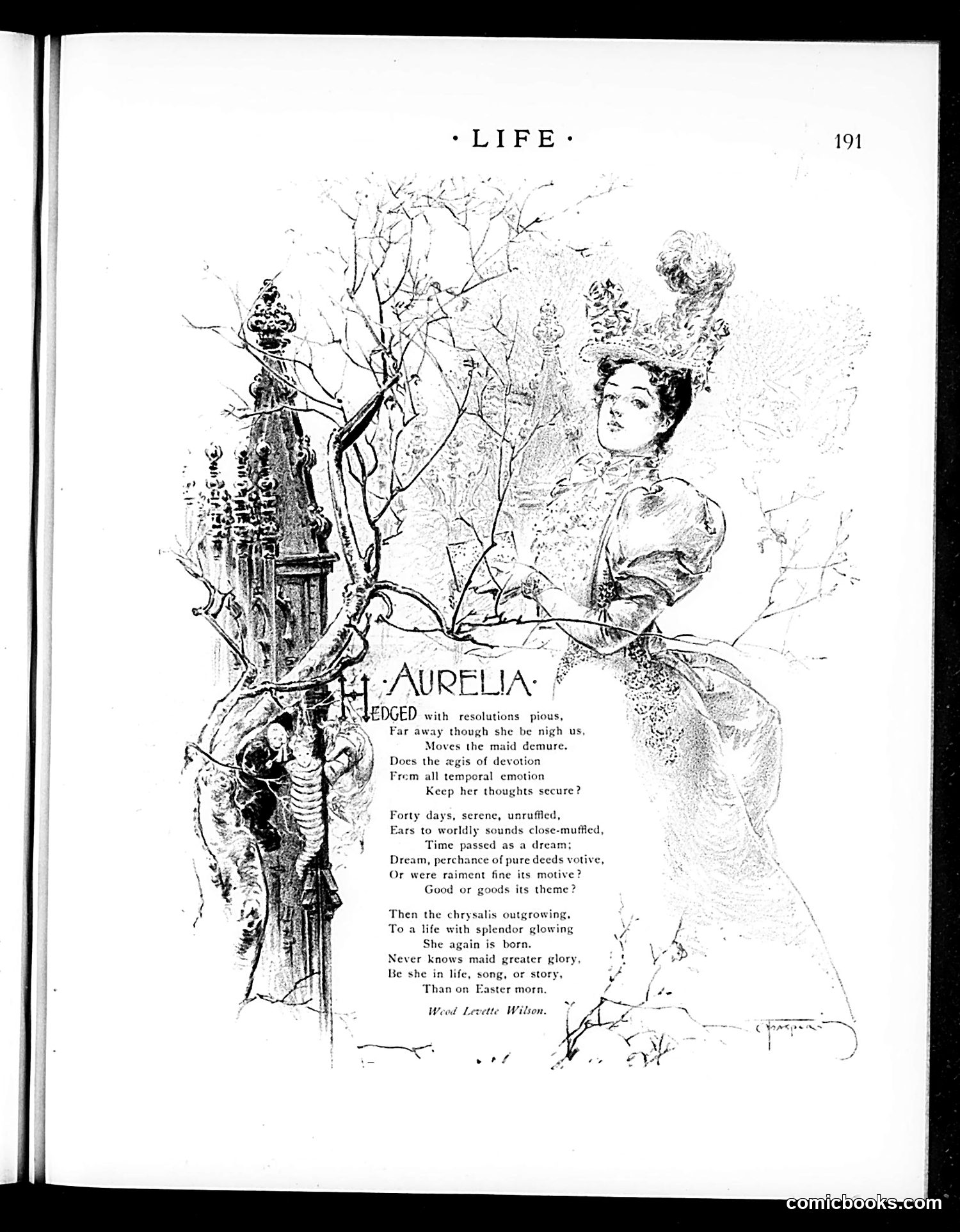
This page features a poetic illustration titled "Aurelia" by Wood Lewette Wilton. The image depicts an elegant woman in Edwardian-era dress with an elaborate upswept hairstyle and ornate headpiece, positioned against stylized natural elements (bare branches, flowers). The accompanying poem appears to contemplate themes of spiritual devotion and Easter resurrection—"the chrysalis outgrowing, / To a life with splendor glowing / She again is born." The text references "Easter morn" and discusses whether noble thoughts and pure deeds motivate human experience. Rather than political satire, this appears to be an artistic/literary piece celebrating idealized femininity and spiritual renewal—typical of Life magazine's aesthetic content from the early 1900s. The elaborate visual presentation emphasizes decorative elegance over social commentary.
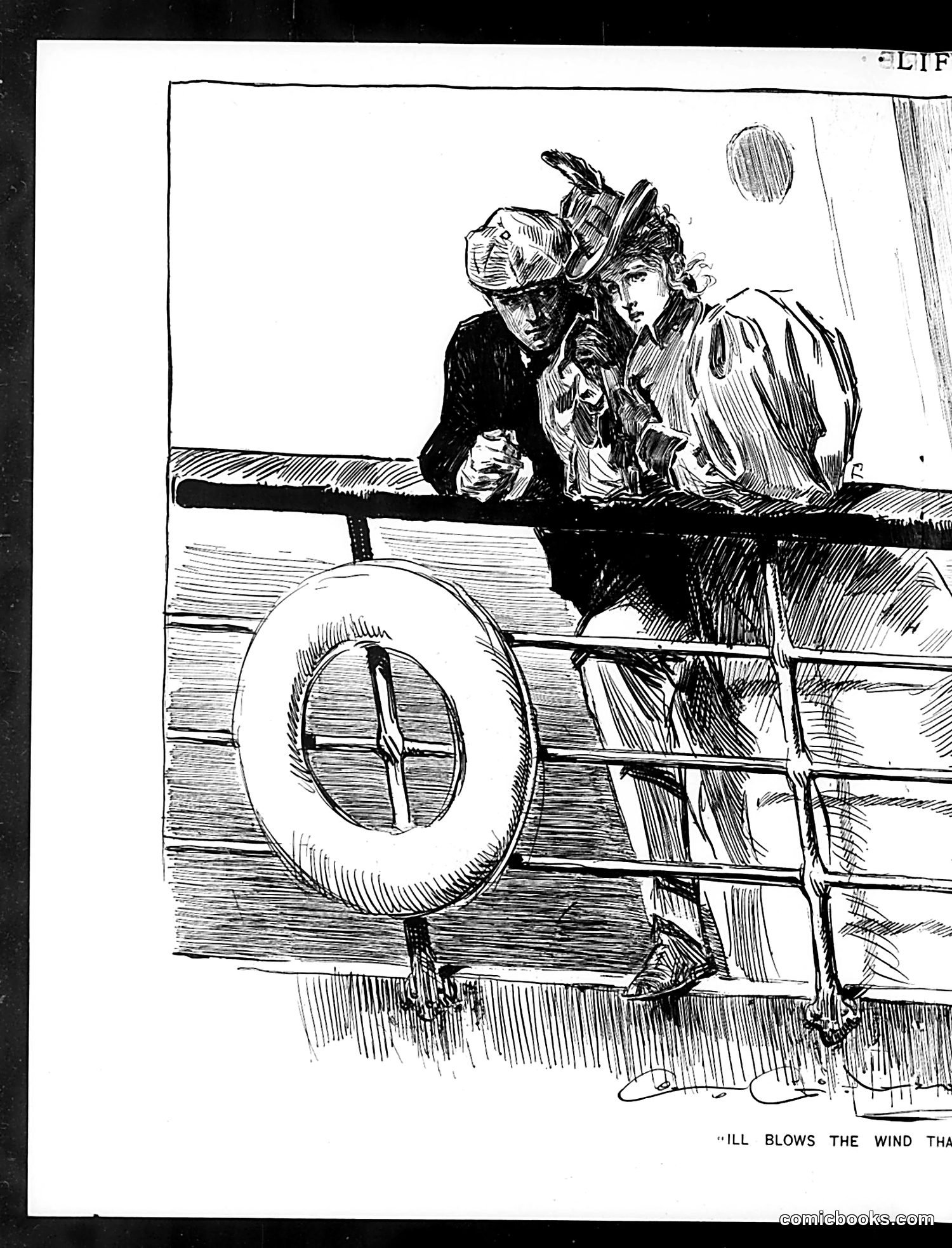
This appears to be a satirical cartoon from Life magazine depicting two figures on what looks like a ship's railing, with a life preserver visible. Based on the partial caption visible at bottom ("ILL BLOWS THE WIND THA[T]"), this references the common saying "ill wind that blows no good." The cartoon likely satirizes some contemporary political or social situation, showing two characters in what appears to be a precarious or compromising position. One figure wears a hat and formal dress, while the other is dressed more casually. The maritime setting with life preserver suggests themes of danger, rescue, or being "in the same boat." Without the complete caption or more contextual information, I cannot definitively identify the specific figures or the exact political reference intended, though the composition suggests commentary on shared predicament or mutual culpability.
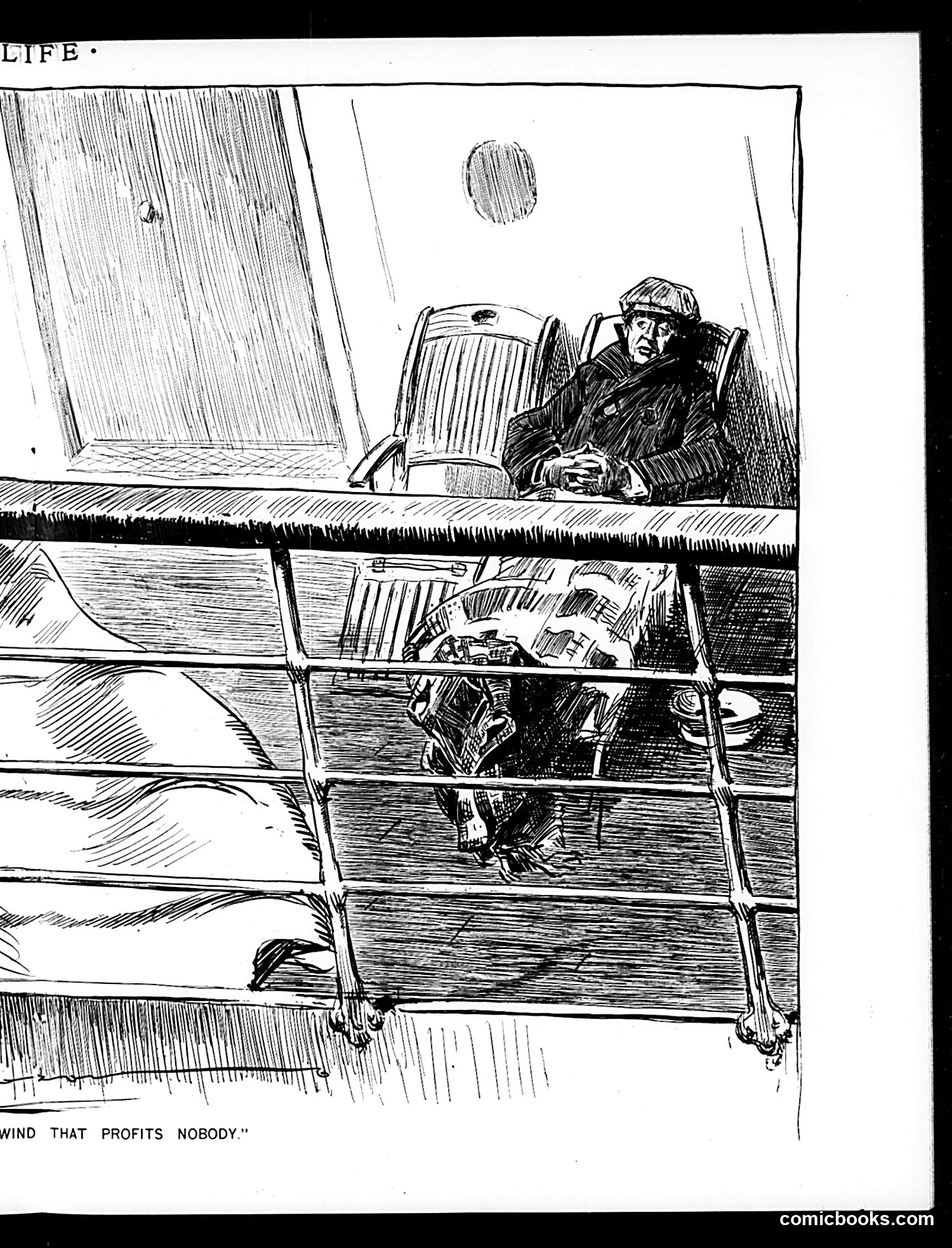
This political cartoon depicts a man in a car looking down anxiously at what appears to be a newspaper or document. The caption reads "WIND THAT PROFITS NOBODY." The cartoon appears to satirize economic conditions—likely referring to a "wind" or trend (possibly stock market volatility, inflation, or economic downturn) that benefits no one. The man's worried expression and posture suggest financial anxiety. His vehicle and formal attire indicate he's a person of some means, making the irony pointed: even those with resources are troubled by whatever economic force is referenced. Without a specific date or byline visible, the exact historical moment remains unclear, but this reflects Life magazine's typical focus on contemporary economic or social commentary targeting middle and upper-class concerns.
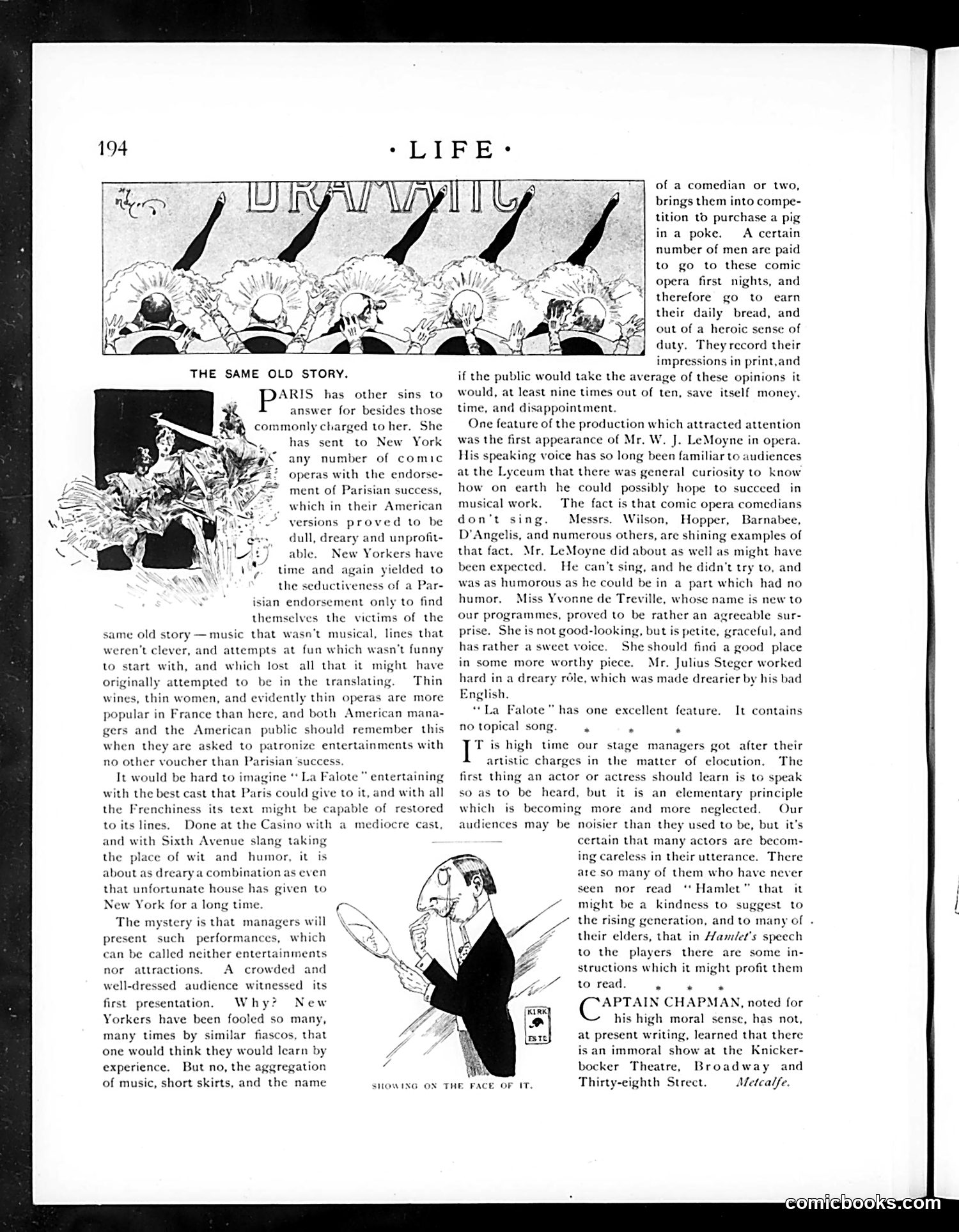
This page satirizes Parisian comic opera's export to America. The top cartoon shows five identical opera singers in elaborate headdresses—visual mockery of repetitive, derivative productions. The article criticizes how Paris sends "thin wines, thin women" and "dreary" operettas to New York, claiming these entertainments lack originality and cleverness. The satire targets both French cultural pretension and American managers' willingness to present inferior work under the Parisian brand name. The small illustration labeled "Showing on the Face of It" depicts a theatrical figure, likely commenting on performers' lack of genuine skill or authenticity. The piece argues that audiences and managers would benefit from supporting original entertainment rather than accepting mediocre Parisian imports simply for their prestigious origin.
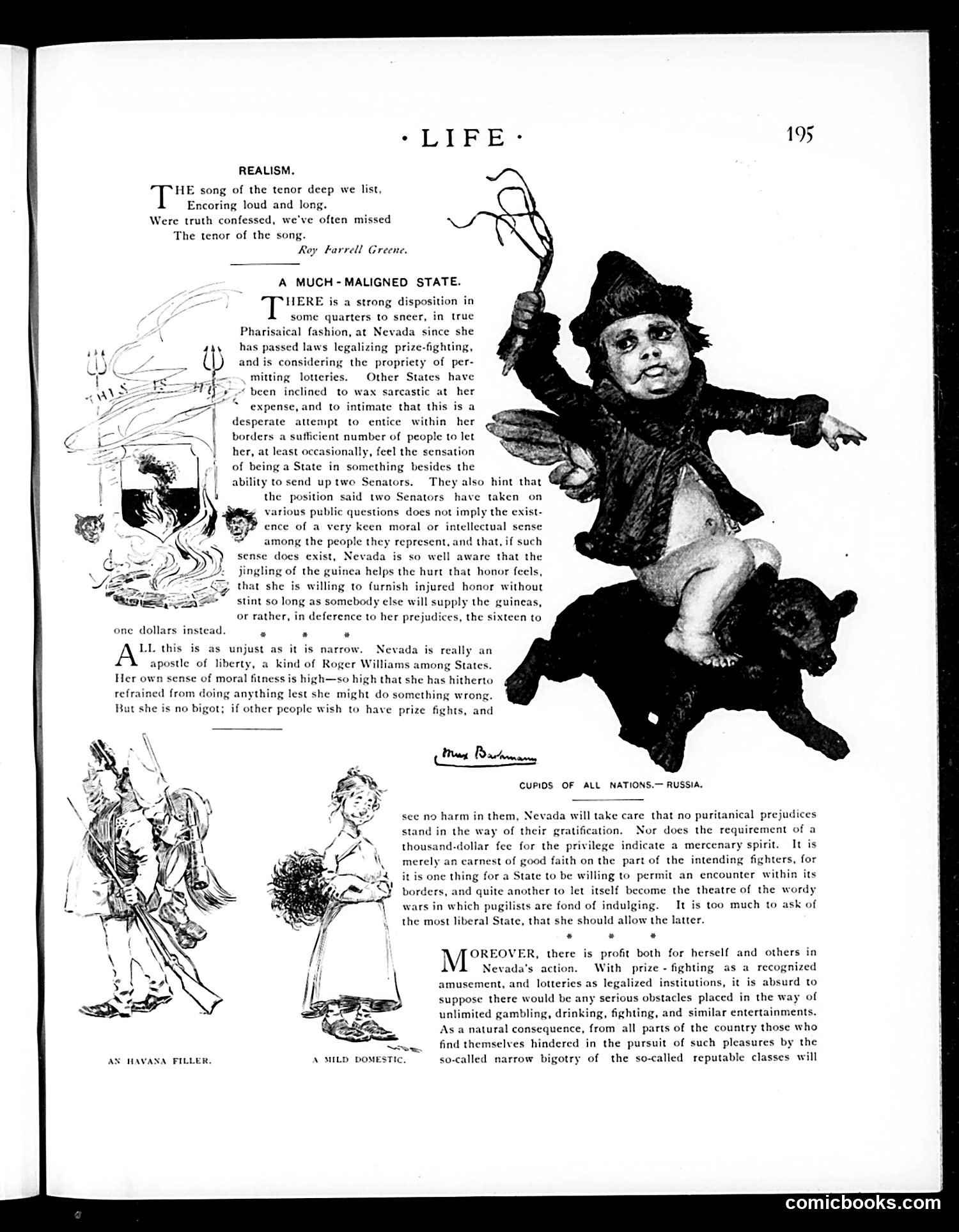
This page satirizes Nevada's moral hypocrisy regarding legalized vice. The main article titled "A Much-Maligned State" defends Nevada's recent laws legalizing prize-fighting and considering lotteries—but the defense is deeply ironic. The author pretends to praise Nevada as a "apostle of liberty" like Roger Williams, claiming moral consistency: if others want gambling and fighting, Nevada permits it without judgment. However, the satire becomes explicit in the final section: the author acknowledges that legalizing prize-fighting will inevitably lead to gambling, drinking, and vice becoming widespread attractions—drawing morally questionable people from across America. The accompanying illustrations (a cherub-like figure labeled "Cupids of All Nations—Russia," and sketches labeled "An Havana Filler" and "A Mild Domestic") appear to represent vice and moral corruption spreading from foreign and domestic sources. The joke: Nevada claims moral principle while obviously profiting from vice and luring disreputable populations—making it both mercenary and hypocritical rather than liberally principled.
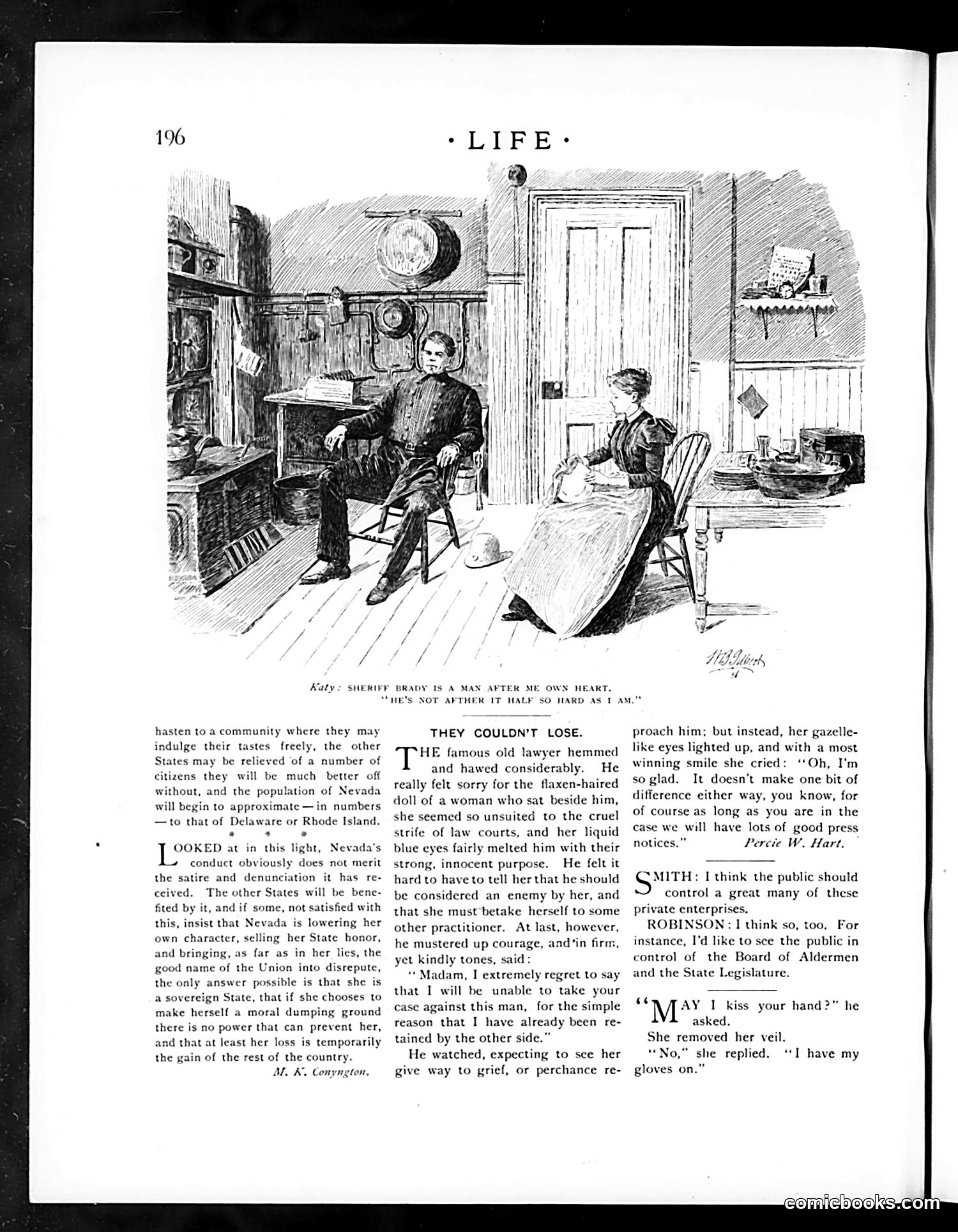
This page contains three distinct satirical pieces typical of Life's humor: 1. **Top cartoon** ("Katy"): A domestic scene where a woman tells a man (Sheriff Brady) he's "a man after me own heart" because he pursues law cases so aggressively. The Irish dialect suggests working-class characters. 2. **Middle article** ("They Couldn't Lose"): A short story satirizing legal ethics and female cunning. A lawyer refuses a woman's case because he's already representing the opposing side. Rather than distressed, she's delighted—because his involvement guarantees good press coverage for her side regardless. The joke mocks both legal hypocrisy and suggests women are shrewd manipulators of public opinion. 3. **Bottom exchange** (Smith/Robinson): A brief political satire where two men discuss public control of private enterprises, but Robinson reveals he only supports public control when it benefits politicians' personal power (the Board of Aldermen and State Legislature). The "May I kiss your hand?" closing is a separate romantic vignette where a woman declines, humorously citing she's wearing gloves. These reflect turn-of-century American attitudes toward gender, law, and politics.
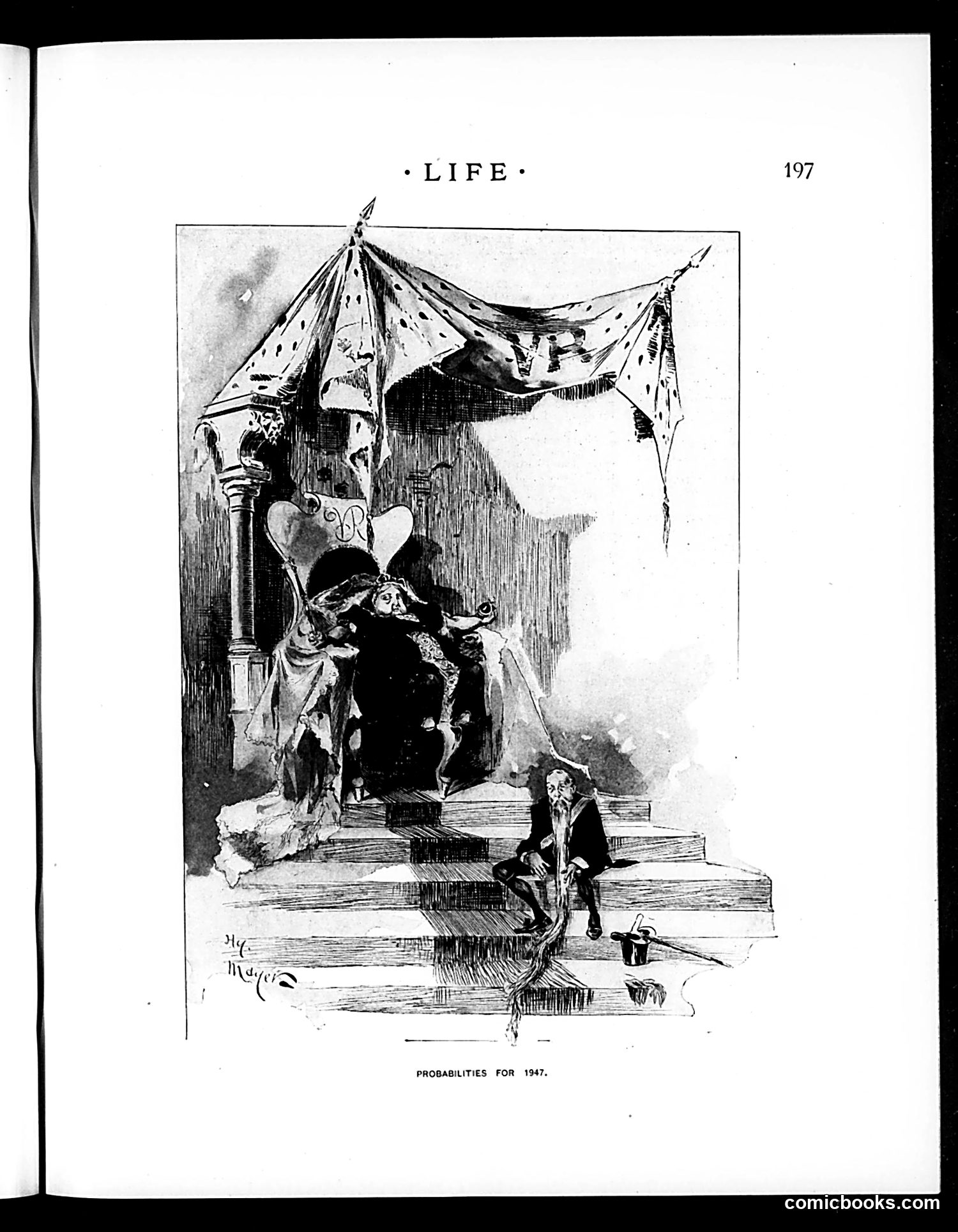
This satirical cartoon from Life magazine presents a fortune-teller's tent scene, likely commenting on uncertainty and speculation about what 1947 would bring. An elderly fortune-teller sits inside an ornate tent, while a client (appearing to be a common person or everyman figure) waits outside with tools or possessions, suggesting anxiety about the future. The caption "Probabilities for 1947" indicates this is predictive satire—mocking the widespread desire to know what the post-WWII year would hold. Given 1946's publication timing, Americans faced genuine unknowns: economic transitions, geopolitical tensions, and social changes. The cartoon satirizes both public anxiety and the human tendency to seek certainty through dubious means like fortune-telling, suggesting 1947's "probabilities" remain unknowable.
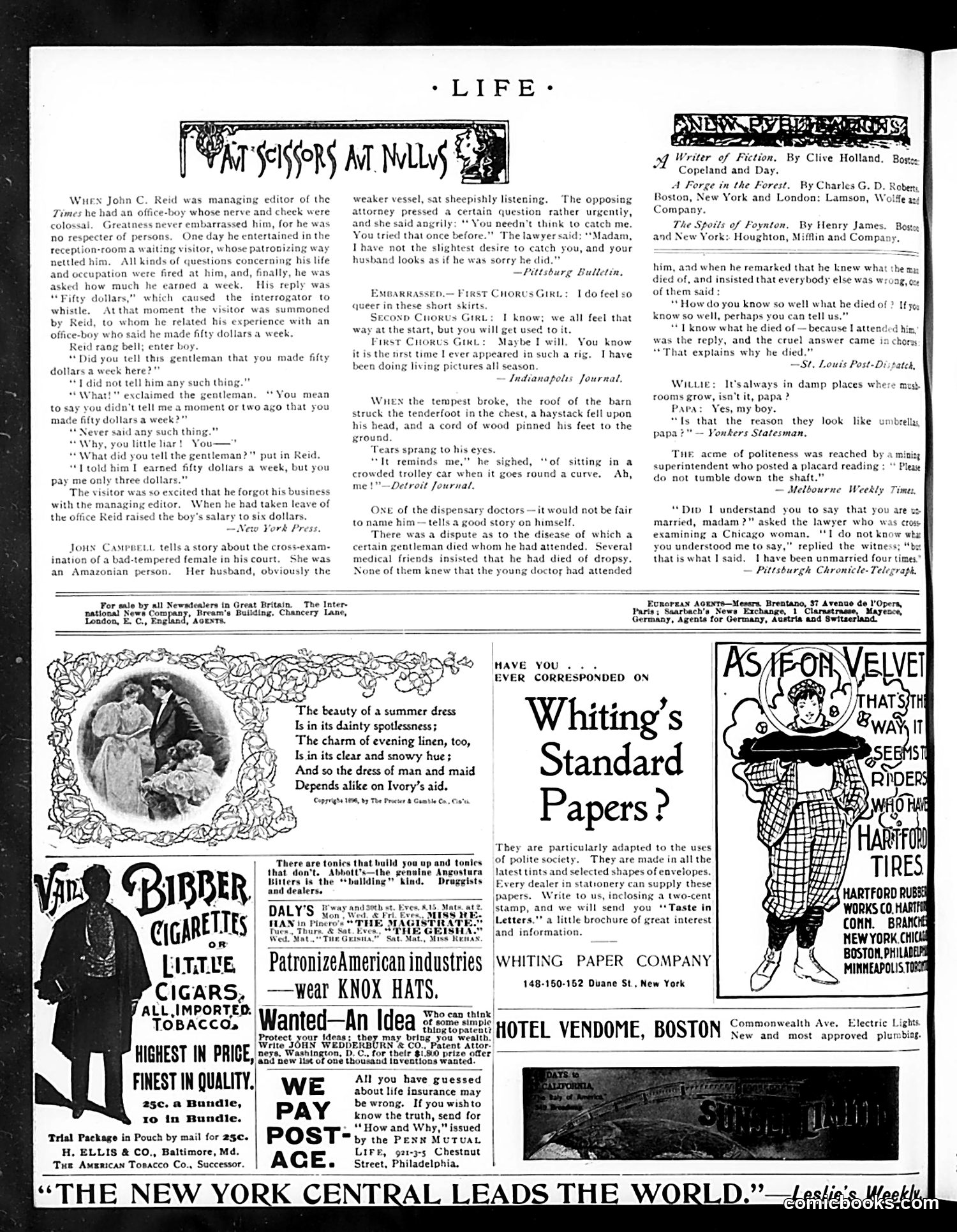
This page contains several humorous anecdotes typical of Life's satirical humor circa early 1900s. The stories mock: **"Scissors at Nulls"** (top): An office boy's cheekiness. When a visitor condescendingly asks his salary, the boy claims fifty dollars weekly. When confronted, he admits lying—but claims his boss only pays him three dollars. Reid, impressed by the boy's wit, raises his salary to six dollars. The joke satirizes both class pretension and rewarding clever impertinence. **Other brief jokes** include: a female litigant outwitting a lawyer; a chorus girl uncomfortable in short skirts; a tenderboy reminiscing about trolley cars while pinned under wood; a doctor claiming expertise he lacks; and a child noting that umbrellas always appear in damp places. The page also contains period advertisements (Bibber Cigarettes, Knox Hats, Whiting Paper) and book reviews. Overall, this represents Life's characteristic blend of workplace humor, gender dynamics satire, and social observation aimed at educated, urban American readers.
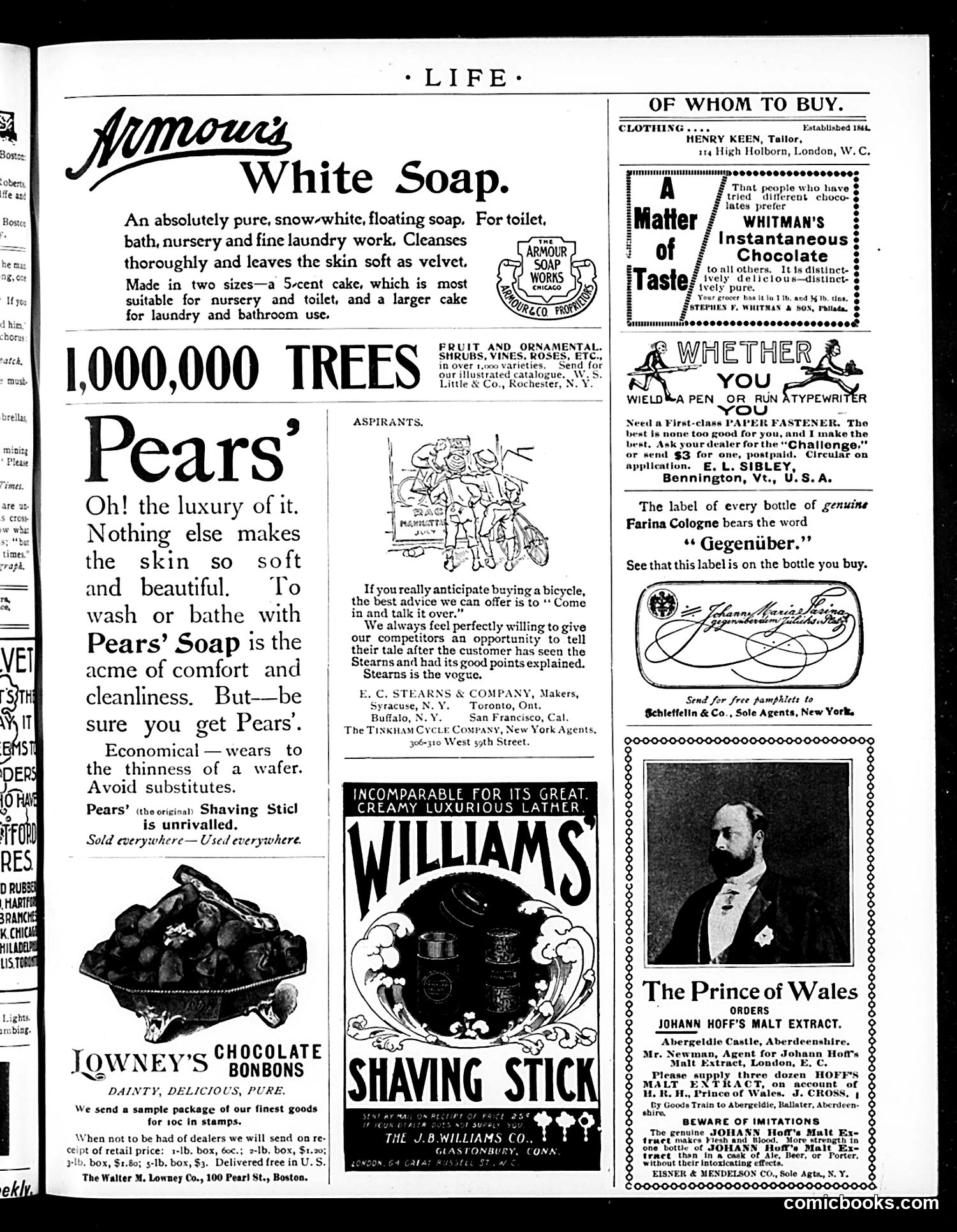
This page is **primarily advertisements** with no political cartoons or satire. It's a collection of product endorsements typical of early 20th-century American magazines. Notable content includes: **The "Prince of Wales" advertisement** features a photograph of a bearded man and claims he ordered Johann Hoff's Malt Extract to Abergeldie Castle. This appears to be a celebrity endorsement (likely the future King Edward VII), lending prestige to the product by associating it with British royalty—a common marketing tactic of the era. **Other ads** promote luxury soaps (Armour's, Pears'), chocolate, bicycles, and toiletries. The emphasis on purity, gentility, and refinement reflects the period's consumer culture and class aspirations. **The warning "BEWARE OF IMITATIONS"** suggests counterfeit products were common concerns for consumers, making official endorsements valuable reassurance. This page documents commercial messaging rather than satirical commentary—Life magazine's advertising revenue model, not its editorial voice.
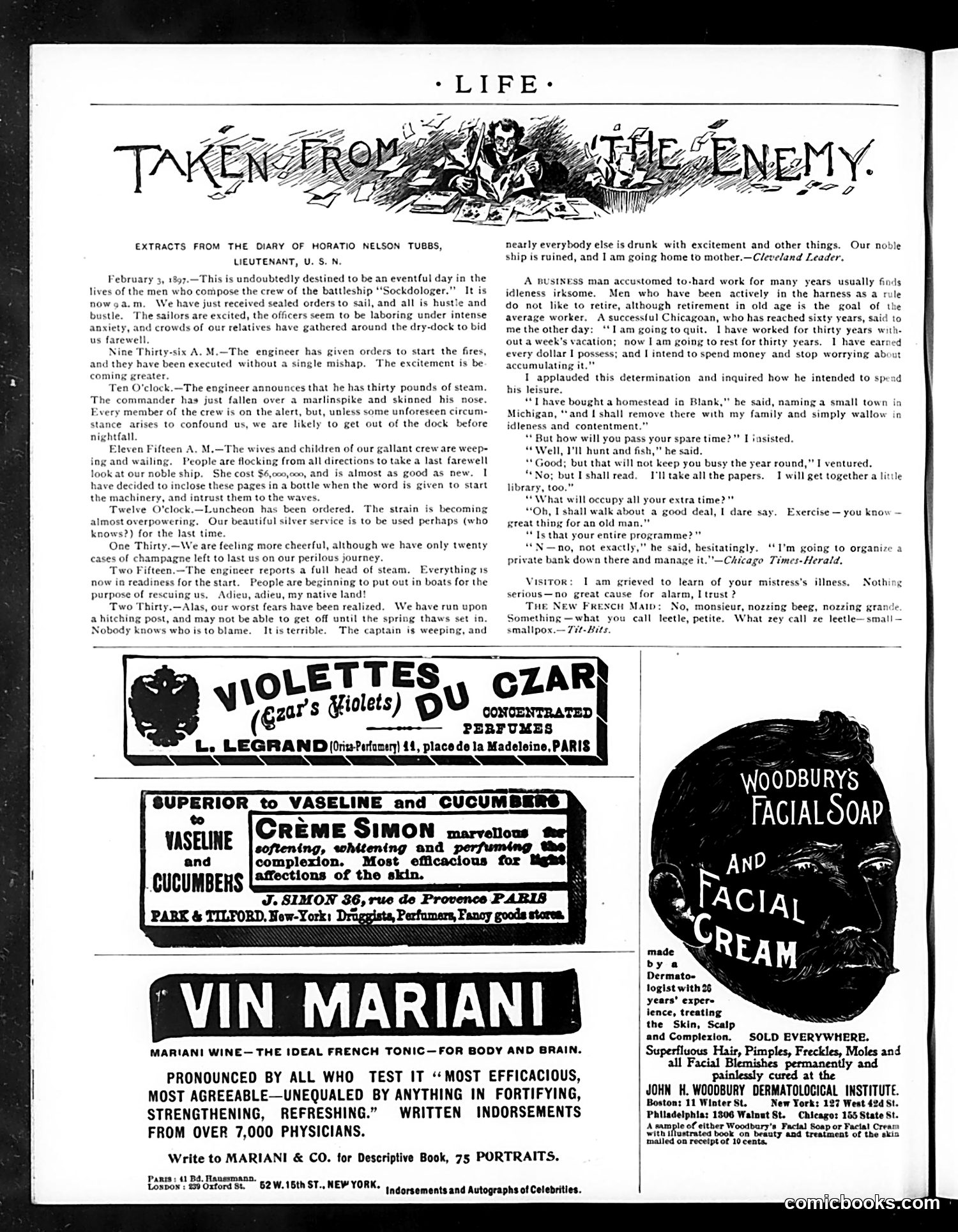
This page features a humorous diary extract satirizing naval incompetence during what appears to be the late 1890s. Lieutenant Horatio Nelson Tubbs documents the USS *Sockdologer* attempting to launch—a mission that descends into absurd mishap. The satire targets: - **Military bumbling**: The commander literally falls over equipment; the ship immediately runs aground on a hitching post despite elaborate preparations - **Institutional waste**: A $6,200 vessel (expensive for the era) is rendered useless by basic negligence - **Overwrought ceremony**: Elaborate farewell crowds and formal procedures contrast with farcical reality - **Drunken chaos**: Officers and crew become intoxicated; the captain weeps The joke culminates in the ship's ruin before it even leaves dock—a pointed commentary on naval readiness or military bureaucratic failure. The diary format creates dark comedy through deadpan documentation of escalating disaster, with the final line capturing deflated resignation: the noble ship is ruined, and Tubbs is "going home to mother."
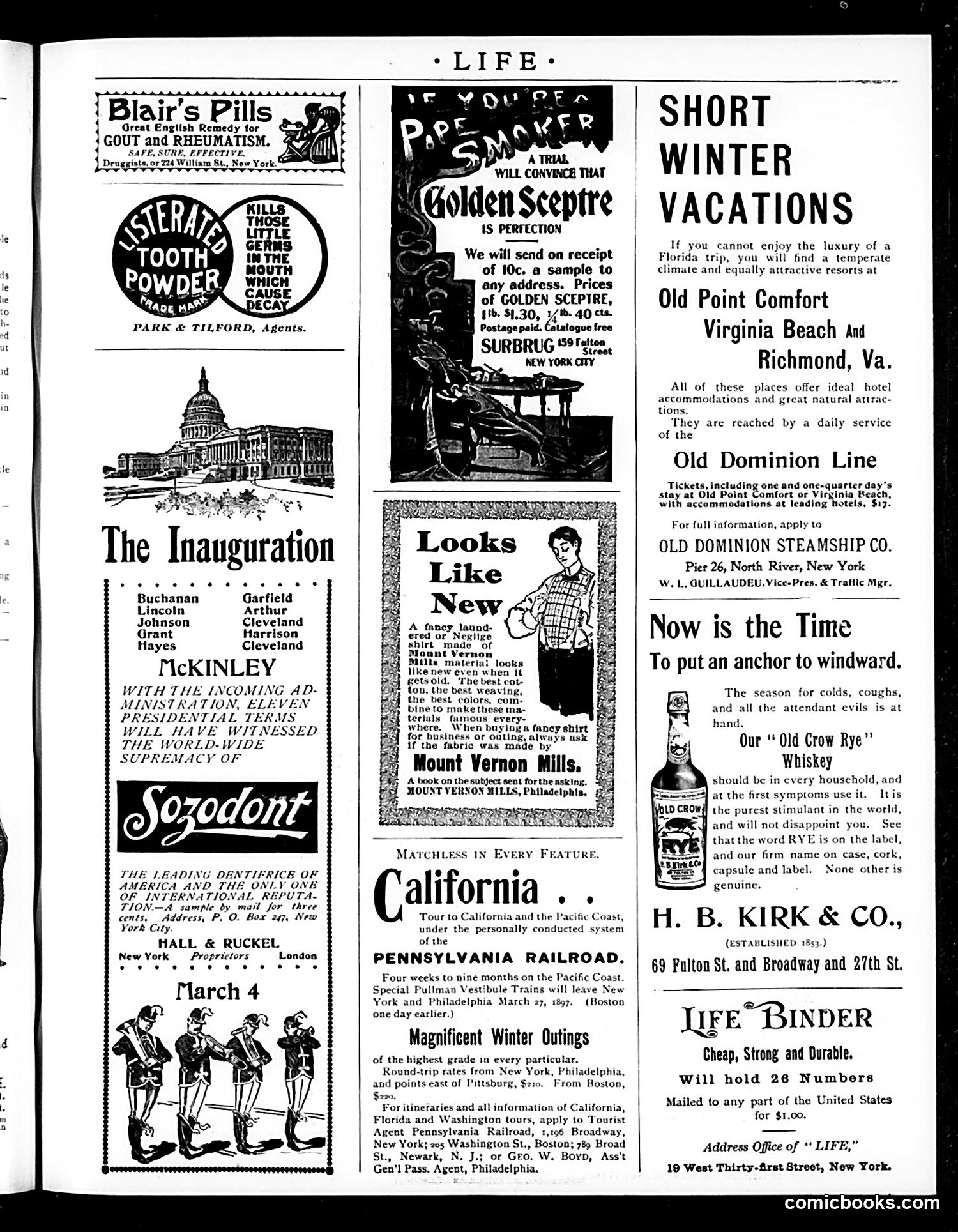
This page is primarily **advertising with one historical cartoon**. The main visual content is "The Inauguration," depicting McKinley's incoming presidency on March 4th. The cartoon lists eleven U.S. presidents whose administrations will have "witnessed the world-wide supremacy of America"—from Buchanan through McKinley. This reflects **American imperial expansion** during the 1890s, celebrating U.S. global power during the era of overseas colonization (Philippines, Hawaii, etc.). The surrounding ads are period-typical: patent medicines (Blair's Pills for gout), dental powder, laundry services, luxury travel (California tours via Pennsylvania Railroad), and notably, **Old Crow Rye whiskey marketed as preventative medicine** for winter illnesses—reflecting pre-FDA attitudes toward alcohol as therapeutic. The satirical point appears subtle: McKinley's presidency is presented alongside mundane commercial pitches, perhaps gently mocking the commercialization of political power or American self-congratulation about imperial dominance. The juxtaposition of grandiose political claims with dubious medicinal products creates implicit irony.
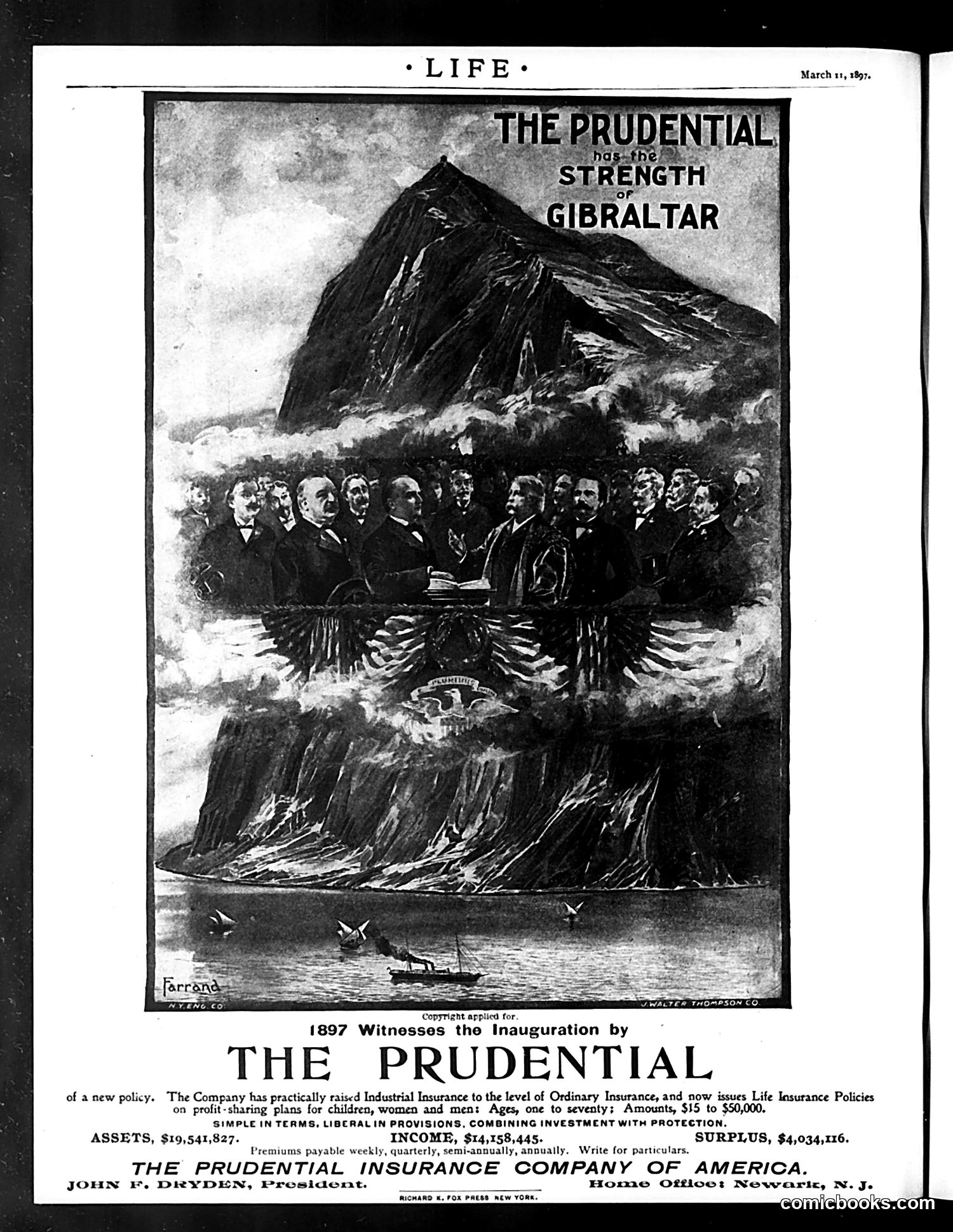
This is primarily **insurance advertising**, not political satire. The 1897 illustration uses allegorical imagery to promote The Prudential Insurance Company's new life insurance policies. **The Visual Metaphor:** The cartoon depicts dignified businessmen (likely company executives) positioned before the Rock of Gibraltar—a symbol of permanence, stability, and strength. A ship on the water below suggests safe passage through life's uncertainties. **The Marketing Message:** The headline claims Prudential now offers life insurance "on profit-sharing plans for children, women and men" with flexible terms and amounts ($15-$50,000). By invoking Gibraltar's famous solidity, the advertisement suggests that Prudential itself is an unshakeable, trustworthy institution. **Historical Context:** This represents late-19th-century industrial insurance expansion—making life coverage accessible to working and middle-class Americans, not just the wealthy. The emphasis on women and children indicates this was relatively progressive marketing for 1897. This is corporate advertising masquerading as civic commemoration, using monumental imagery to inspire confidence in a financial institution.