
Life, 1897-03-11 · page 12 of 20
Life — March 11, 1897 — page 12: what you’re looking at
What you’re looking at
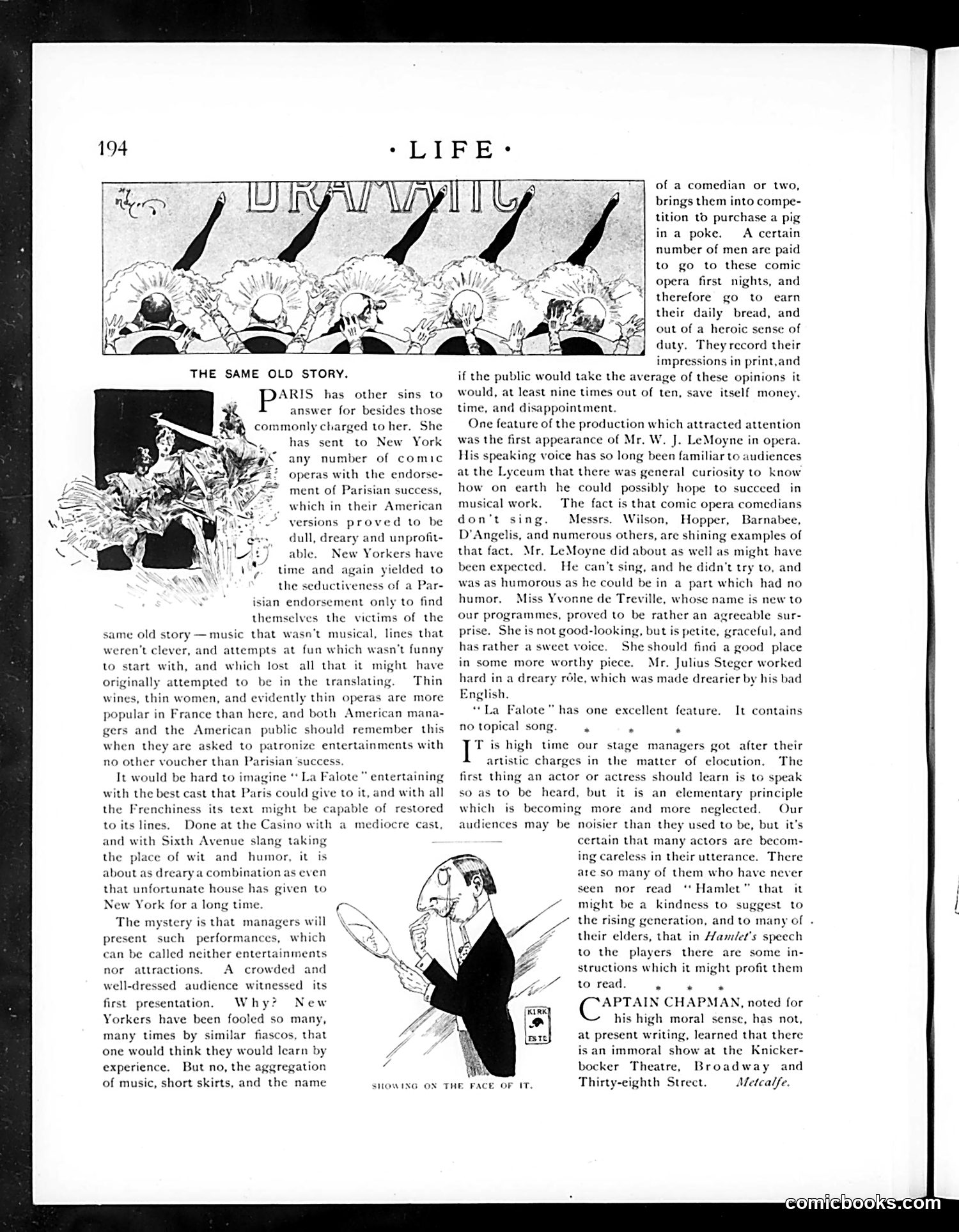
This page satirizes Parisian comic opera's export to America. The top cartoon shows five identical opera singers in elaborate headdresses—visual mockery of repetitive, derivative productions. The article criticizes how Paris sends "thin wines, thin women" and "dreary" operettas to New York, claiming these entertainments lack originality and cleverness. The satire targets both French cultural pretension and American managers' willingness to present inferior work under the Parisian brand name. The small illustration labeled "Showing on the Face of It" depicts a theatrical figure, likely commenting on performers' lack of genuine skill or authenticity. The piece argues that audiences and managers would benefit from supporting original entertainment rather than accepting mediocre Parisian imports simply for their prestigious origin.
📄 Transcribed text from this page (OCR, searchable)
Machine-transcribed from the original scan — historical spelling and the odd misread are preserved.
of a comedian or two, brings them into compe- tition to purchase a pig in a poke. A certain number of men are paid to go to these comic opera first nights, and therefore go to earn their daily bread, and out of a heroic sense of duty. They record their THE SAME OLD STORY. ARIS. answer for besides those rged to her. She to New York of comic has other sins to commonly ct has sent any number operas with the endorse- ment of Parisian success, which in their American versions proved to be dull, dreary and unprofit- able. New Yorkers have time and again yielded to the seductiveness of a Par- isian endorsement only to find themselves the victims of the same old story —music that wasn't musical, lines that weren't clever, and attempts at fun which wasn’t funny all that it might have hin wines, thin women, and evidently thin operas are more popular in France than here, and both American mana- gers and the American public should remember this when they are asked to patronize entertainments with no other voucher than Parisian ‘suc It would be hard to imagine “ La with the best cast that Paris could give to it, and with all apable of restored to start with, and which lost originally attempted to be in the translating. ote " entertaining the Frenchiness its text might be to its lines. Done at the Casino with a mediocre cast, and with Sixth Avenue slang taking the place of wit and humor, it is about as dreary a combination as even that unfortunate house has given to New York for a long time. The mystery is that managers will present such performances, which can be called neither entertainments nor attractions. A crowded and well-dressed audience witnessed its Why? New Yorkers have been fooled so many, many times by similar fiascos, that one would think they would learn by experience. But no, the aggregation of music, short skirts, and the name first’ presentation, SHOWING ON THE FACE OF IT. impressions in print,and if the public would take the average of these opinions it would, at least nine times out of ten, time, and disappointment. One feature of the production which attracted attention was the first appearance of Mr. W. J. LeMoyne in opera. His speaking voice has so long been familiar to audiences at the Lyceum that there was general curiosity to know how on earth he could possibly hope to succeed in sical work, The fact is that comic opera comedians don't sing. Wilson, Hopper, Barnabee, D'Angelis, and numerous others, are shining examples of that fact. Mr. LeMoyne did about as well as might have been expected. He can't sing, and he didn’t try to, and was as humorous as he could be in a part which had no humor. Miss Yvonne de Treville, whose name is new to our programmes, proved to be rather an a ve itself money, Messrs. ecable sur- prise. She is not good-looking, but is petite, graceful, and has rather a sweet voice. She should find a good place in some more worthy piece. Mr. Julius Steger worked hard in a dreary role, which was made drearier by his bad English. “La Falote” has one excellent feature. no topical song. It contains after their he managers got I is high time our st so as to be heard, but it is an elementary principle which is becoming more and more neglected. Our be noisier than they used to be, but it’s certain that many actors are becom- ing careless in their utterance. There are so many of them who have never nor read ‘ Hamlet” that it might be a kindness to suggest to the rising generation, and to many of « audiences may seen their elders, that in Hamlet's speech to the players there are some in- structions which it might profit them to read. Ps % o C PTAIN CHAPMAN, noted for his high moral sense, has not, at present writing, learned that there is an immoral show at the Knicker- bocker Theatre, Broadway and Thirty-eighth Strect. Metcalfe.