
Life, 1897-03-11 · page 4 of 20
Life — March 11, 1897 — page 4: what you’re looking at
What you’re looking at
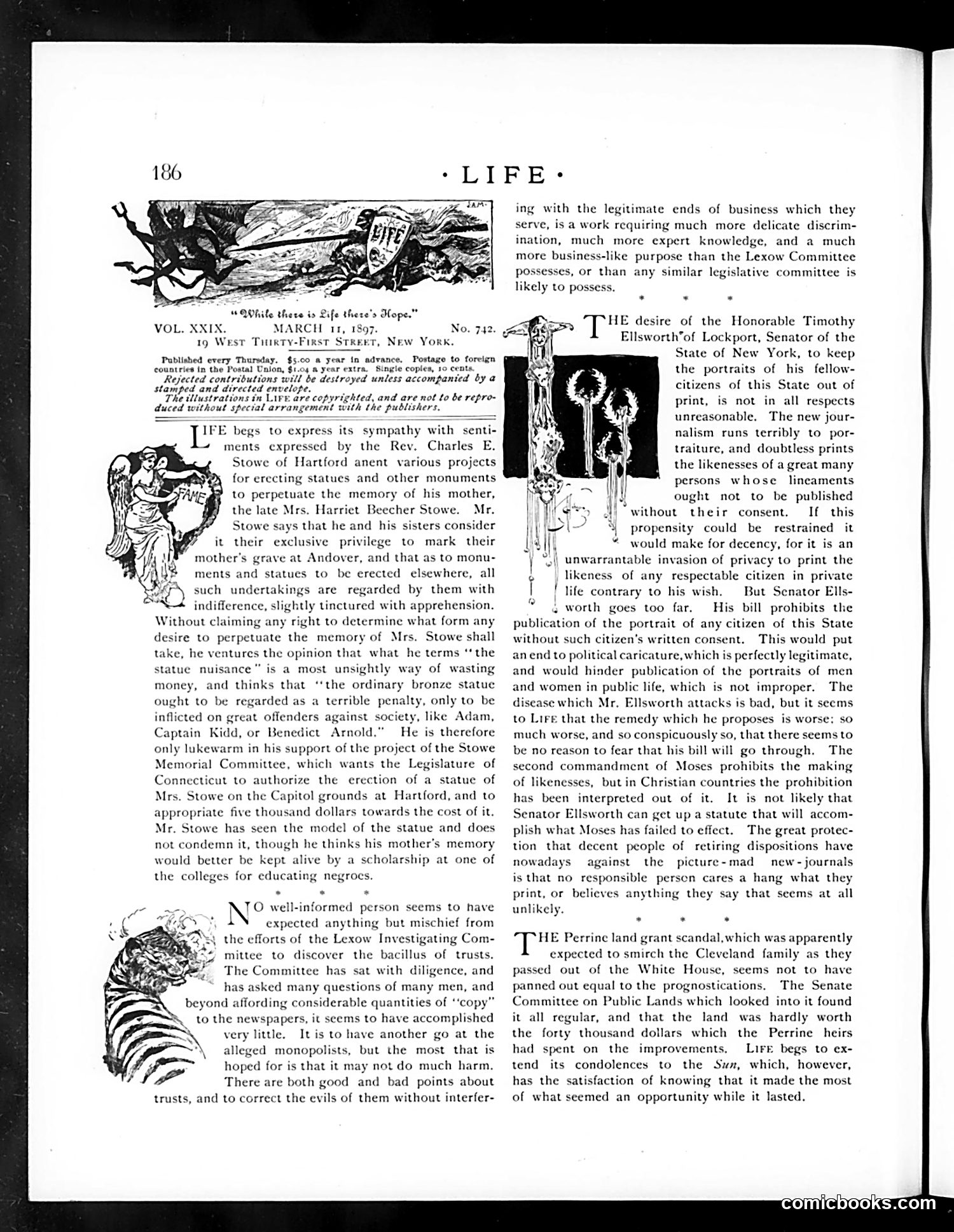
This page contains **editorial commentary** rather than traditional political cartoons. The main text discusses Senator Timothy Ellsworth of New York's proposed bill restricting publication of citizens' portraits without consent—framed as protecting privacy against "yellow journalism." Life argues the bill is misguided, comparing it to biblical prohibitions on graven images. The editors contend that responsible people shouldn't fear their likenesses being printed, and that the remedy for bad press is more speech, not censorship. The page also briefly mentions the **Perrine land grant scandal**, apparently affecting the Cleveland family, noting that the Senate's Public Lands Committee found the land's actual value far exceeded initial assessments—disappointing those hoping for scandal. The decorative illustrations are generic period engravings, not specific caricatures.
📄 Transcribed text from this page (OCR, searchable)
Machine-transcribed from the original scan — historical spelling and the odd misread are preserved.
While there is Life there's Hope.” Hoan, 1897. No. 742. 19 West Tiety-First STREET, New York. Published every Thursday. $5.00 a year in advance, Postage to foreign countries in the Postal Union, $1.04 @ year extra. Single coples, 10 cents Rejected contributions will be destroyed unless accompanied by a stamped and directed envelope. The illustrations in Live are copyrighted, and are not to be repro- duced without special arrangement with the publishers. = begs to express its sympathy with senti- ments expressed by the Rev. Charles Stowe of Hartford anent various projects for erecting statues and other monuments to perpetuate the memory of his mother, the late Mrs. Harriet Beecher Stowe. Mr. that he and his sisters consider it their exclusive mark their mother’s grave at Andover, and that as to monu- ments and statues to be erected elsewhere, all such undertakings are regarded by them with indifference, slightly tinctured with apprehension. Without claiming any right to determine what form any ire to perpetuate the memory of Mrs. Stowe shall take, he ventures the opinion that what he terms ‘the statue nuisance" is a most unsightly way of wasting money, and thinks that ‘the ordinary bronze statue Stowe sa privilege to arded as a terrible penalty, only to be inflicted on great offenders against society, li Adam, Captain Kidd, or Benedict Arnold.” He is therefore only lukewarm in his support of the project of the Stowe Memorial Committee, which wants the Legislature of Connecticut to authorize the erection of a statue of ought to be r Mrs. Stowe on the Capitol grounds at Hartford, and to appropriate five thousand dollars towards the cost of it. Mr. Stowe has seen the model of the statue and does not condemn it, thoi would better be kept alive by a scholarship at one of negroes. n he thinks his mother’s memory the colleges for educating TO well-informed person seems to have expected anything but mischief from the efforts of the Lexow Investigating Com- mittee to discover the bacillus of trusts. The Committee has sat with diligence, and has asked many questions of many men, and beyond affording considerable quantities of ‘‘copy” to the newspapers, it seems to have accomplished 3 very little. It is to have another go at the alleged monopolists, but the most that is hoped for is that it may not do much harm, There are both good and bad points about trusts, and to correct the evils of them without interfer- ing with the legitimate ends of business which they erve, is a work requiring much more delicate discrim- ination, much more expert knowledge, and a much iness-like purpose than the Lexow Committee or than any similar legislative committee is likely to posses: HE desire of the Honorable Timothy Ellsworth’of Lockport, Senator of the State of New York, to keep the portraits of his fellow- citizens of this State out of print, is not in all respects unreasonable. The new jour- nalism runs terribly to por- traiture, and doubtless prints the likenesses of a great many persons whose lineaments , ought not to be published without their consent. If this propensity could be restrained it would make for decency, for it is an | unwarrantable invasion of privacy to print the Ss of any respectable citizen in private ! life contrary to his wish. | But Senator Ells- 5 worth goes too far. His bill prohibits the ion of the portrait of any citizen of this State without such citizen's written consent. This would put an end to political caricature, which is perfectly legitimate, and would hinder publication of the portraits of men and women in public life, which is not improper. The disease which Mr. Ellsworth attacks is bad, but it seems to Lire that the remedy which he proposes is wors much worse, and so conspicuously so, that there seems to be no reason to fear that his bill will go through. The second commandment of Moses prohibits the making of lik es, but in Christian countries the prohibition h been interpreted out of it. It is not likely that Senator Ellsworth can get up a statute that will accom- The great protec- ions have journals plish what Moses has failed to effect. tion that decent people of retiring dispos against the picture-mad new ares a hang what they nowadays is that no r print, or believes anything they say that seems at all unlikely. HE Perrine land grant scandal,which was apparently expected to smirch the Cleveland family as they passed out of the White House, seems not to have panned out equal to the prognostications. The Senate Committee on Public Lands which looked into it found it all regular, and that the land was hardly worth the forty thousand dollars which the Perrine heirs had spent on the improvements. Lire begs to ex- tend its condolences to the Suz, which, however, has the satisfaction of knowing that it made the most of what seemed an opportunity while it lasted.