
Life, 1897-03-11 · page 6 of 20
Life — March 11, 1897 — page 6: what you’re looking at
What you’re looking at
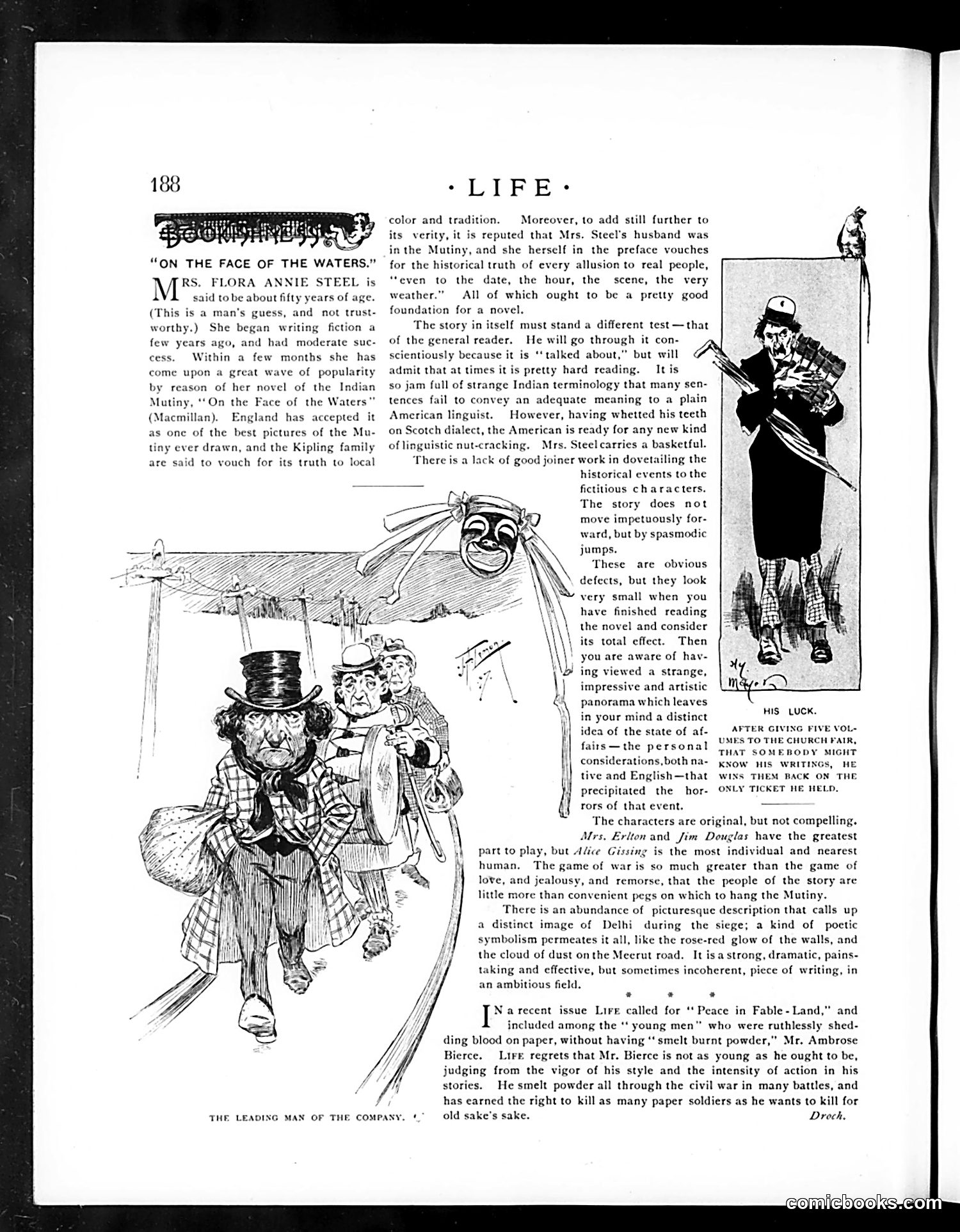
This page reviews Mrs. Flora Annie Steel's novel "On the Face of the Waters" (Macmillan), set during India's Mutiny. The left illustration depicts "The Leading Man of the Company"—a caricatured figure in top hat alongside another character, likely representing stock theatrical types or social archetypes. The right illustration, captioned "His Luck," shows a woman in Victorian dress. The review discusses the novel's strengths and weaknesses: original characters but slow pacing, effective but sometimes incoherent descriptions of Delhi during the siege, and Indian terminology that challenges American readers. Below, a brief note criticizes writer Ambrose Bierce for glorifying violence in fiction, calling his style overly intense and suggesting his Civil War experiences have made him callous about fictional bloodshed.
📄 Transcribed text from this page (OCR, searchable)
Machine-transcribed from the original scan — historical spelling and the odd misread are preserved.
“ON THE FACE OF THE WATERS.” AY RS, FLORA ANNIE STEEL is said to be about fifty years of age. (This is "s guess, and not trust- worthy.) She began writing fiction a few years ago, and had moderate suc- Within a few come upon a great wave of popularity by reason of her novel of the Ind Mutiny, ‘On the Face of the Waters” (Macmillan). as one of the best pictures of the Mu- tiny ever drawn, and the Kipling family are said to vouch for its truth to local an cess. months she has England has accepted it *>LIFE: color and tradition. | Moreover, to add still further to its verity, it is reputed that Mrs. Steel's husband was inthe Mutiny, and she herself in the preface vouches for the historical truth of every allusion to real people, “‘even to the date, the hour, the scene, the very weather.” All of which ought to be a pretty good foundation for a novel. The story in itself must stand a different test —that of the general reader. He will go through it con- scientiously because it is ‘talked about,” but will admit that at times itis pretty hard reading. It is so jam fall of strange Indian terminology that many sen- tences fail to convey an adequate meaning to a plain American linguist. However, having whetted his teeth on Scotch dialect, the American is ready for any new kind of linguistic nut-cracking. Mrs. Steel carries a basketful. There is a lack of good joiner work in dovetailing the historical events to the fictitious characters. The story does not move impetuously for- ward, but by spasmodic jumps. These defects, but they look very small when you have finished reading the novel and consider its total effect. Then you are aware of hav- ing viewed a strange, impres id artistic panorama which leaves in your mind a distinct idea of the state of af- faits—the personal considerations, both na- tive and English—that precipitated the hor- rors of that event, The characters are original, but not compelling. Mrs, Erlton and Jim Douglas have the greatest part to play, but Alice Gissing is the most individual and nearest human, The game of war is so much greater than the game of love, and jealousy, and remorse, that the people of the story are little more than convenient pegs on which to hang the Mutiny. There is an abundance of picturesque description that calls up a distinct image of Delhi during the siege; a kind of poetic symbolism permeates it all, like the rose-red glow of the walls, and the cloud of dust onthe Meerut road. It isa strong, dramat taking and effective, but sometimes incoherent, piece of writing, in an ambitious field. J Narecent issue Lire called for ‘* Peace in Fable-Land," and included among the ‘t young men” who were ruthlessly shed- ding blood on paper, without having “smelt burnt powder,” Mr. Ambrose Bierce. Lire regrets that Mr. Bierce is not as young as he ought to be, judging from the vigor of his style and the intensity of action in his stories. He smelt powder all through the civil war in many battles, and has earned the right to kill as many paper soldiers as he wants to kill for old sake’s sake. Dreoch. are obvious HIS LUCK. AFTER GIVING FIVE VOL- UMES TO THE CHURCH FAIR, THAT SOMEBODY MIGHT W HIS WRITINGS, HE VINS THEM BACK ON THE TICKET HE HELD, * * MAN OF THE COMPANY. 4° THE LEADI