
A complete issue · 24 pages · 1896
Life — November 26, 1896
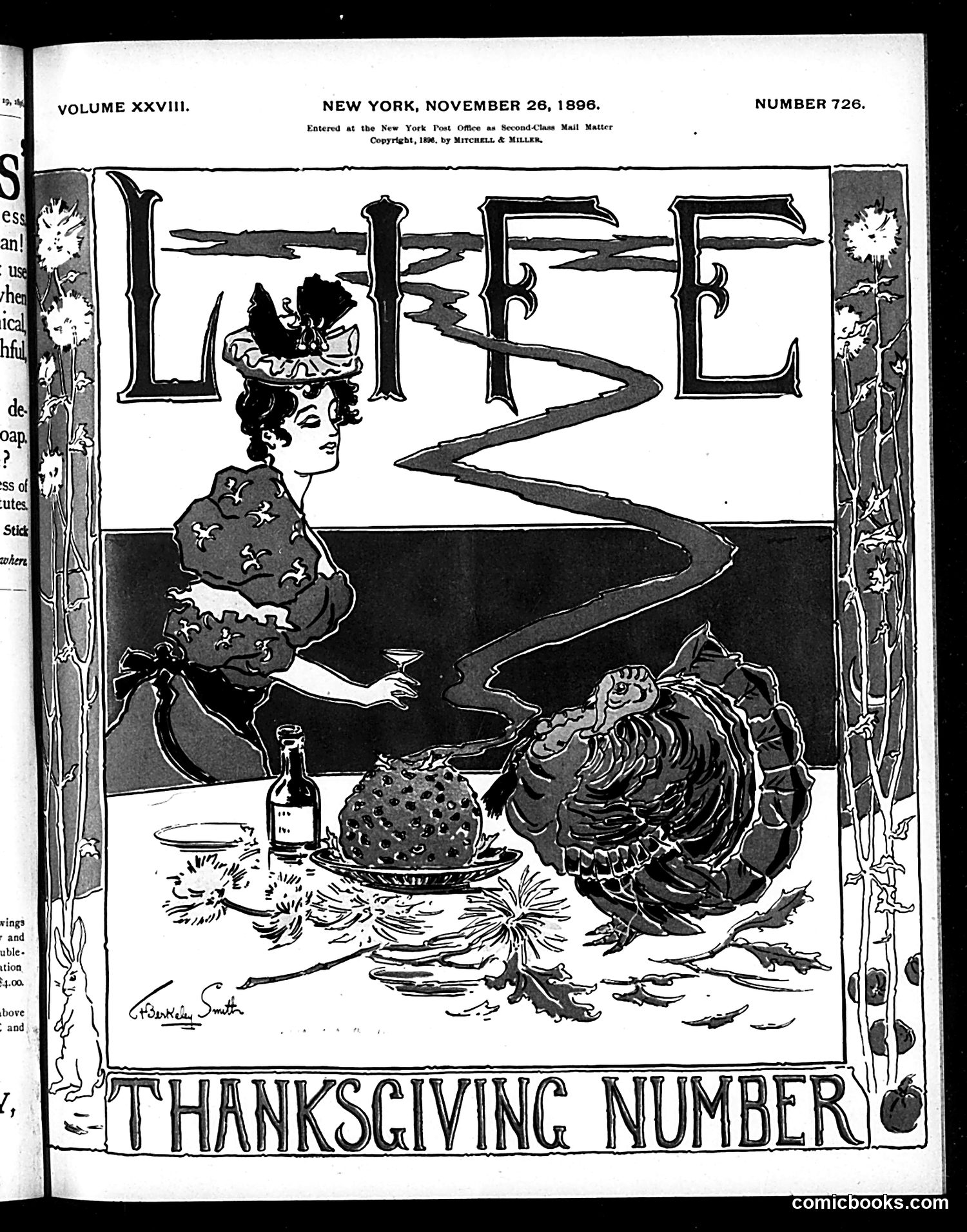
This is the cover of Life's Thanksgiving issue from 1898. The illustration depicts a fashionably dressed woman in an elaborate feathered hat gazing down at a lavish holiday feast—featuring a large turkey, wine bottle, and flowers scattered on the table below her. The cartoon appears to be satirizing the contrast between wealthy, upper-class women's elaborate consumption and display during Thanksgiving celebrations versus the actual holiday's traditional significance. The woman's exaggerated hat, fashionable clothing, and somewhat detached expression suggest mockery of Gilded Age excess and materialism. The decorative borders featuring chrysanthemums frame the seasonal theme. The artist's signature appears in the lower left corner. This represents typical turn-of-the-century American satirical commentary on wealth and social pretension.
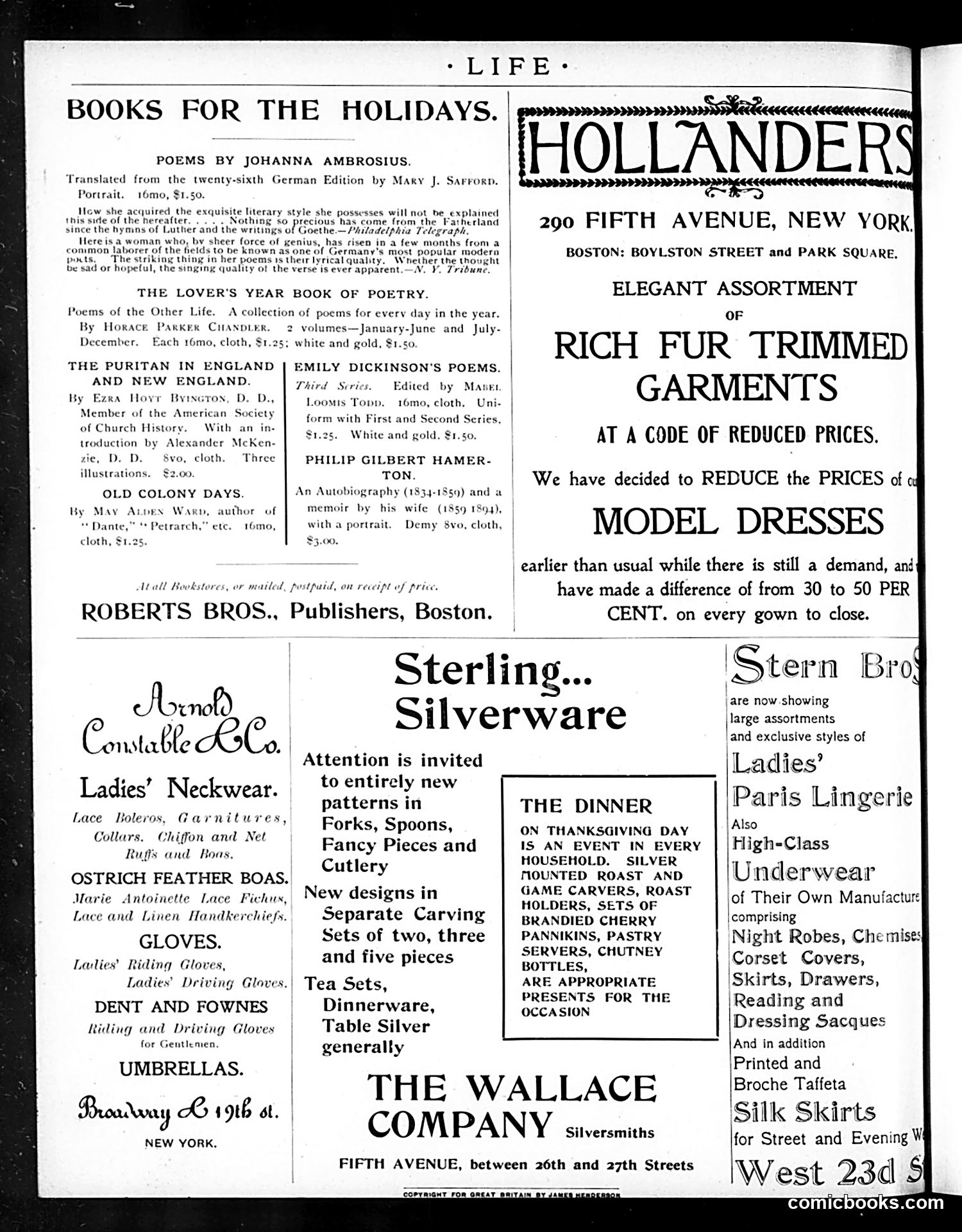
This page is primarily **advertising, not editorial content or cartoons**. It contains multiple commercial advertisements from the early 20th century, including: - **Roberts Bros. Publishers** promoting poetry books and literary collections - **Hollanders** advertising fur-trimmed garments at reduced prices - **Arnold Constable & Co.** selling ladies' neckwear, ostrich feather boas, gloves, and umbrellas - **The Wallace Company** promoting sterling silverware and tableware - **Stern Bros.** showcasing Paris lingerie and undergarments The header "BOOKS FOR THE HOLIDAYS" and "LIFE" at the top indicates this is a seasonal shopping issue. There are no political cartoons or satire visible on this page—it represents standard commercial advertising typical of Life magazine's business model during this era.
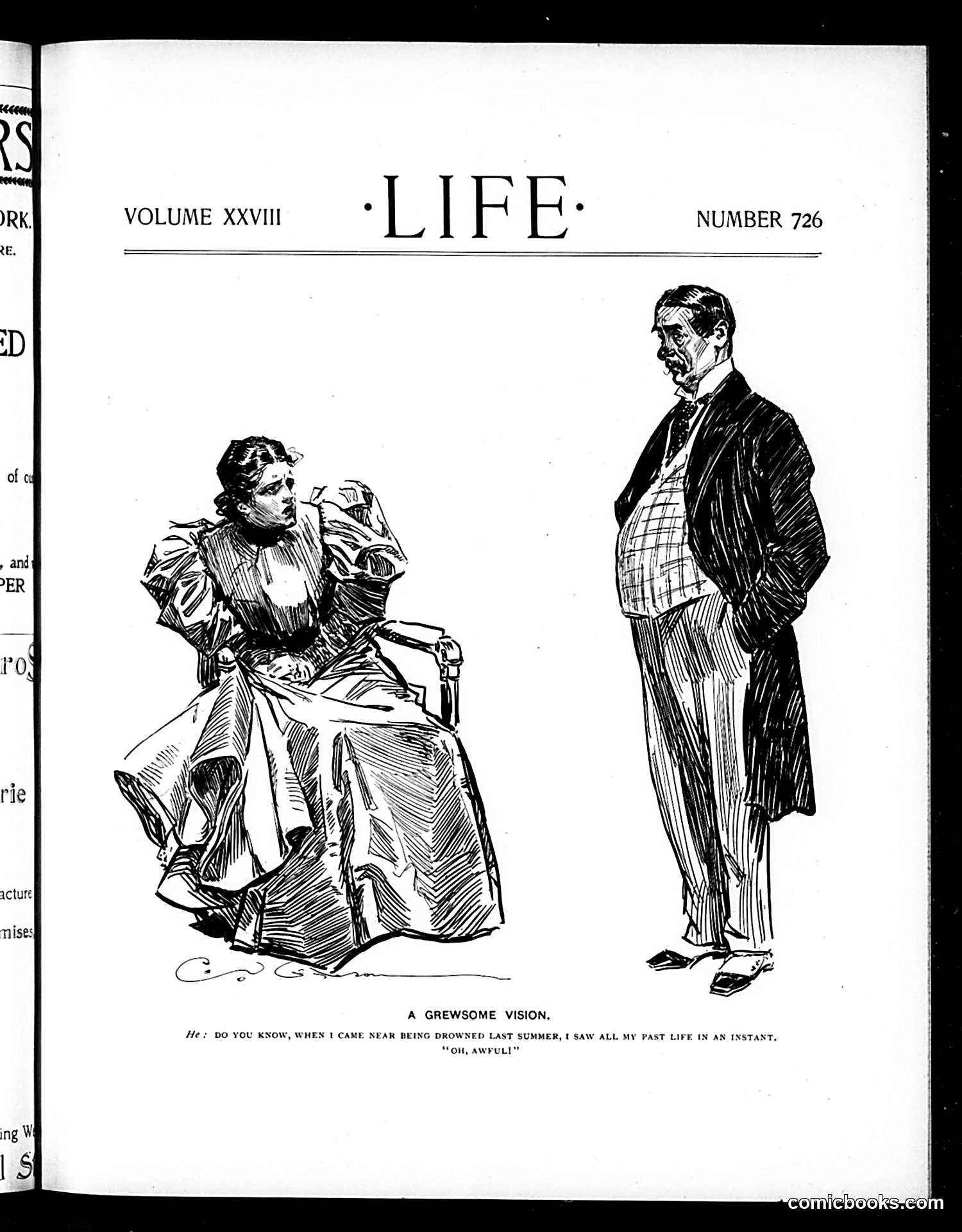
This cartoon satirizes the Victorian-era belief in near-death experiences and life flashing before one's eyes. The man recounts to a woman: "Do you know, when I came near being drowned last summer, I saw all my past life in an instant. 'Oh, awful!'" The humor lies in the woman's apparent reaction—her distressed expression suggests she finds *his past* (not the drowning itself) to be the truly horrifying thing. The satire mocks both the popular fascination with mystical near-death visions and, implicitly, the man's character or history. The woman's fashionable 1890s dress with puffy sleeves marks this as contemporary social commentary on courtship and judgment of one's romantic prospects.
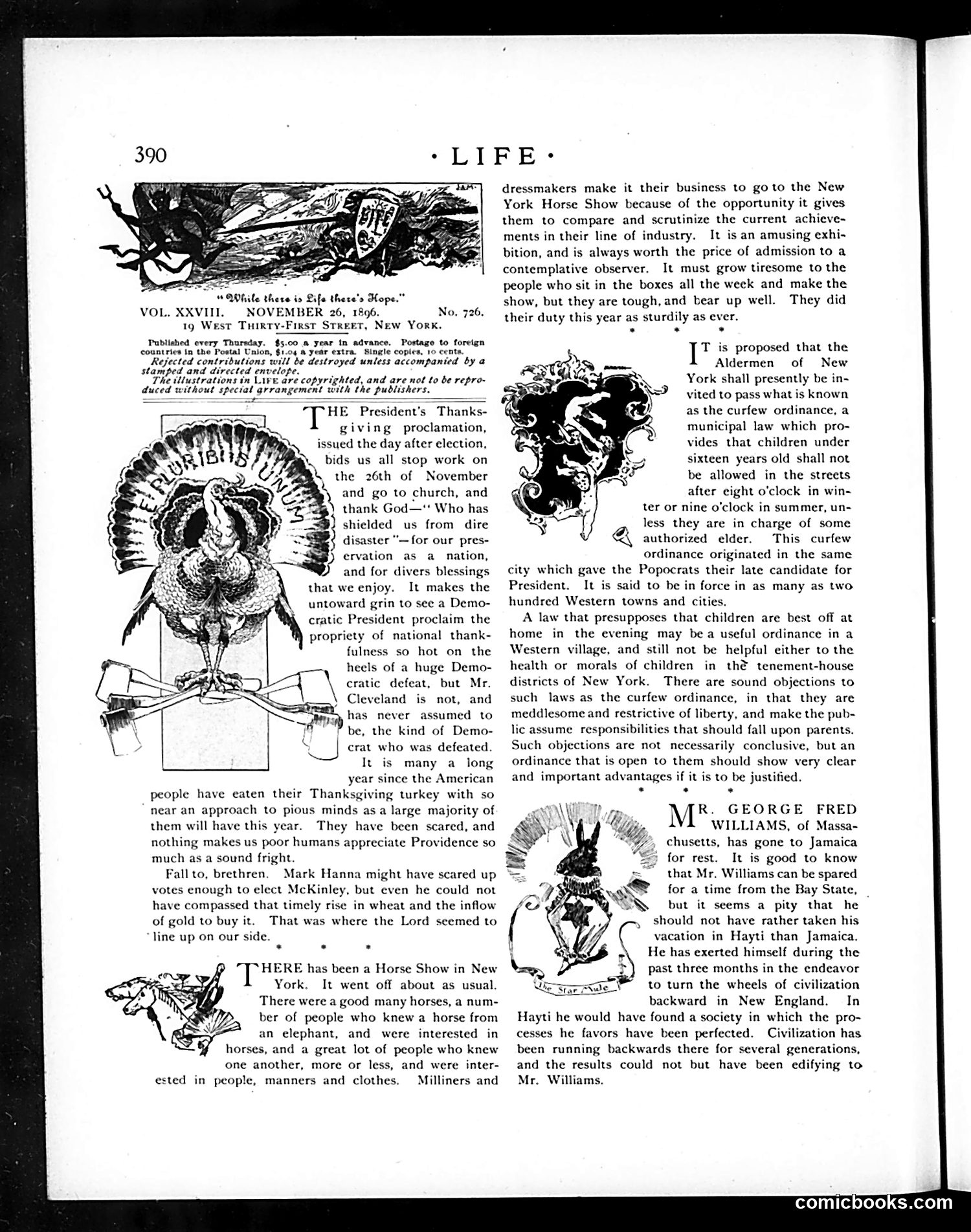
**The Turkey Cartoon**: The large illustration depicts a turkey with an ornate, decorative tail fan. This accompanies text about President Cleveland's Thanksgiving proclamation and commentary on the recent Democratic electoral defeat. The turkey appears to satirize the Democratic Party's losses—suggesting they've been "plucked" or defeated, while the text wryly notes Cleveland accepts defeat gracefully unlike a typical partisan. **The Curfew Ordinance Section**: This discusses a proposed New York City law restricting children under sixteen from street presence after 8-9 PM. The text critiques the ordinance as paternalistic overreach, questioning whether such laws serve children's welfare or merely assume parental responsibilities belong to government. **The Jamaica Reference**: A brief note mocks George Fred Williams's choice of Jamaica over Haiti for vacation, sarcastically suggesting Haiti's "backward" civilization would have suited him poorly.
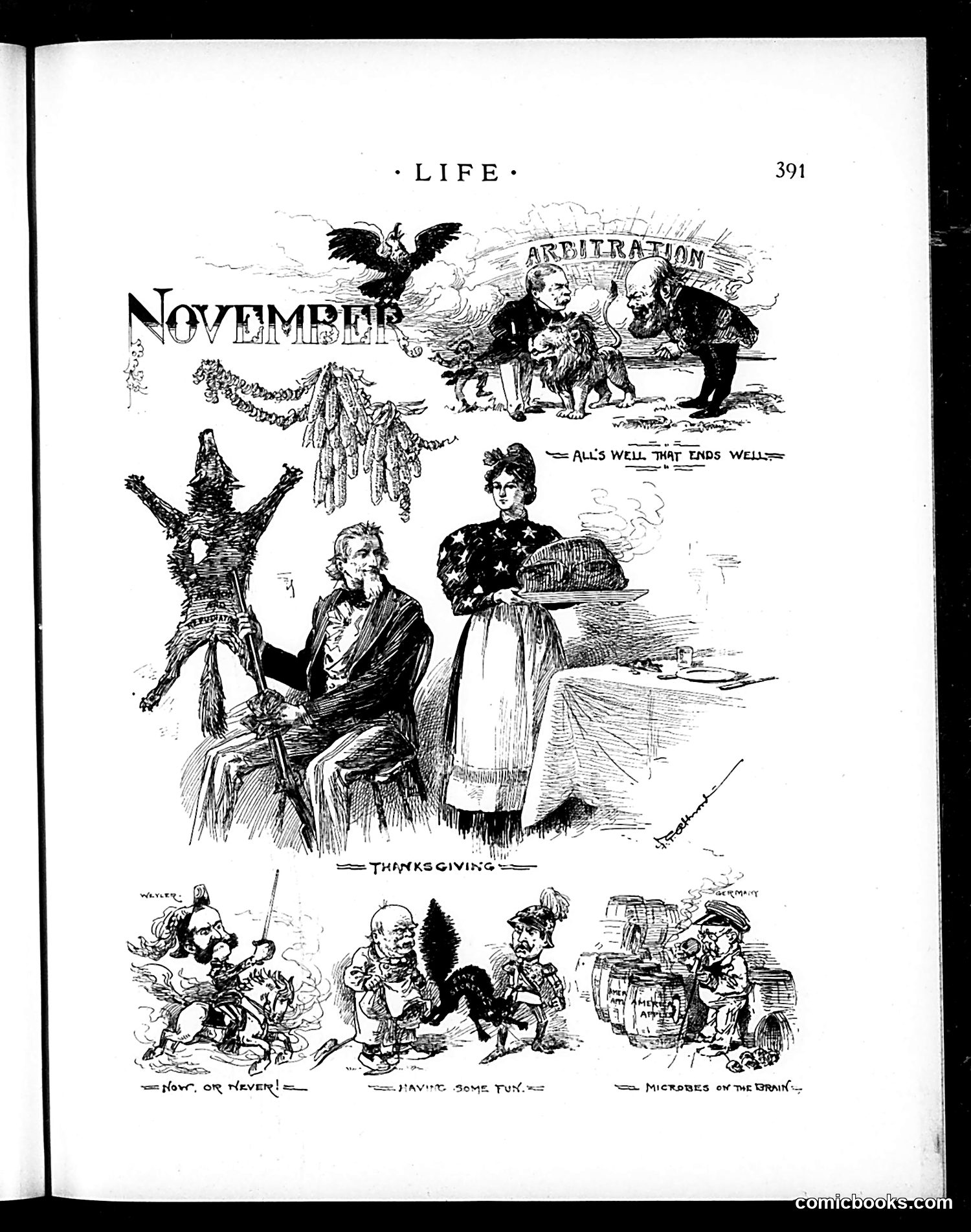
This satirical page presents November themes through Victorian-era cartoon vignettes. The top section labeled "ARBITRATION" shows two gentlemen and a dog, likely commenting on contemporary dispute-resolution practices. "ALL'S WELL THAT ENDS WELL" depicts a domestic scene with a woman presenting food to an older man, suggesting household harmony. "THANKSGIVING" features a man with an elaborate turkey decoration, celebrating the holiday with characteristic humor. The bottom three panels—"HASTE OR HEAVEN," "HAUNT SOME FUN," and "MISRULES OF THE BRAIN"—appear to reference supernatural or comedic November themes, possibly relating to Halloween traditions or autumn follies, though specific references are unclear without additional historical context. The style is typical of Life's humorous social commentary through illustrated scenarios.
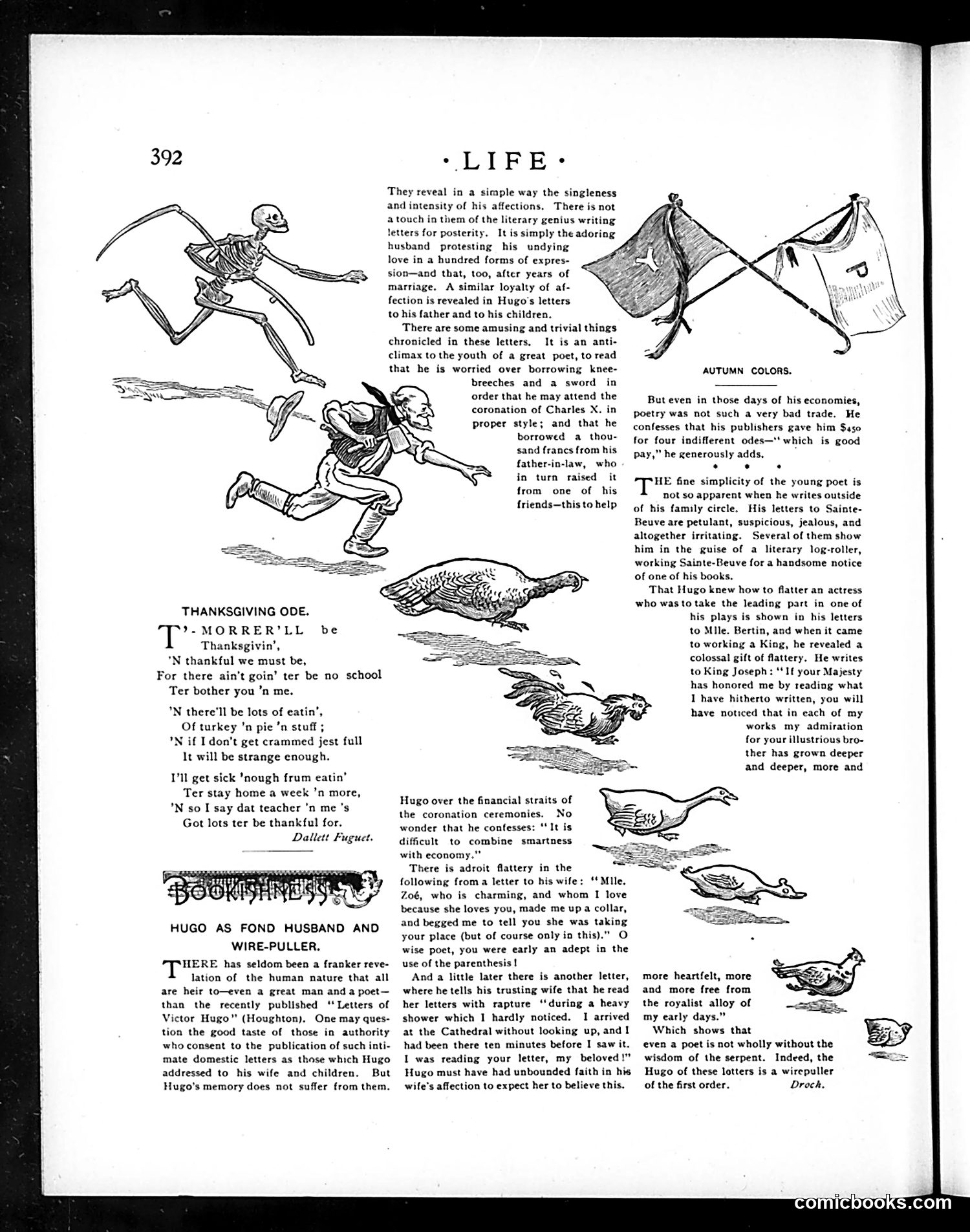
This page contains literary content about Victor Hugo rather than political satire. The main feature, "Hugo as Fond Husband and Wife-Killer," discusses Hugo's personal life through his correspondence—particularly his affectionate letters to his wife and children, which reveal his devotion despite financial struggles. The "Thanksgiving Ode" by Dallett Paguet is a humorous poem about a working-class family's modest holiday meal, using dialect humor typical of the era. The skeletal figures and animal illustrations appear decorative rather than satirical. The page focuses on cultural criticism and literary analysis rather than political commentary, examining Hugo's character through his intimate writings.
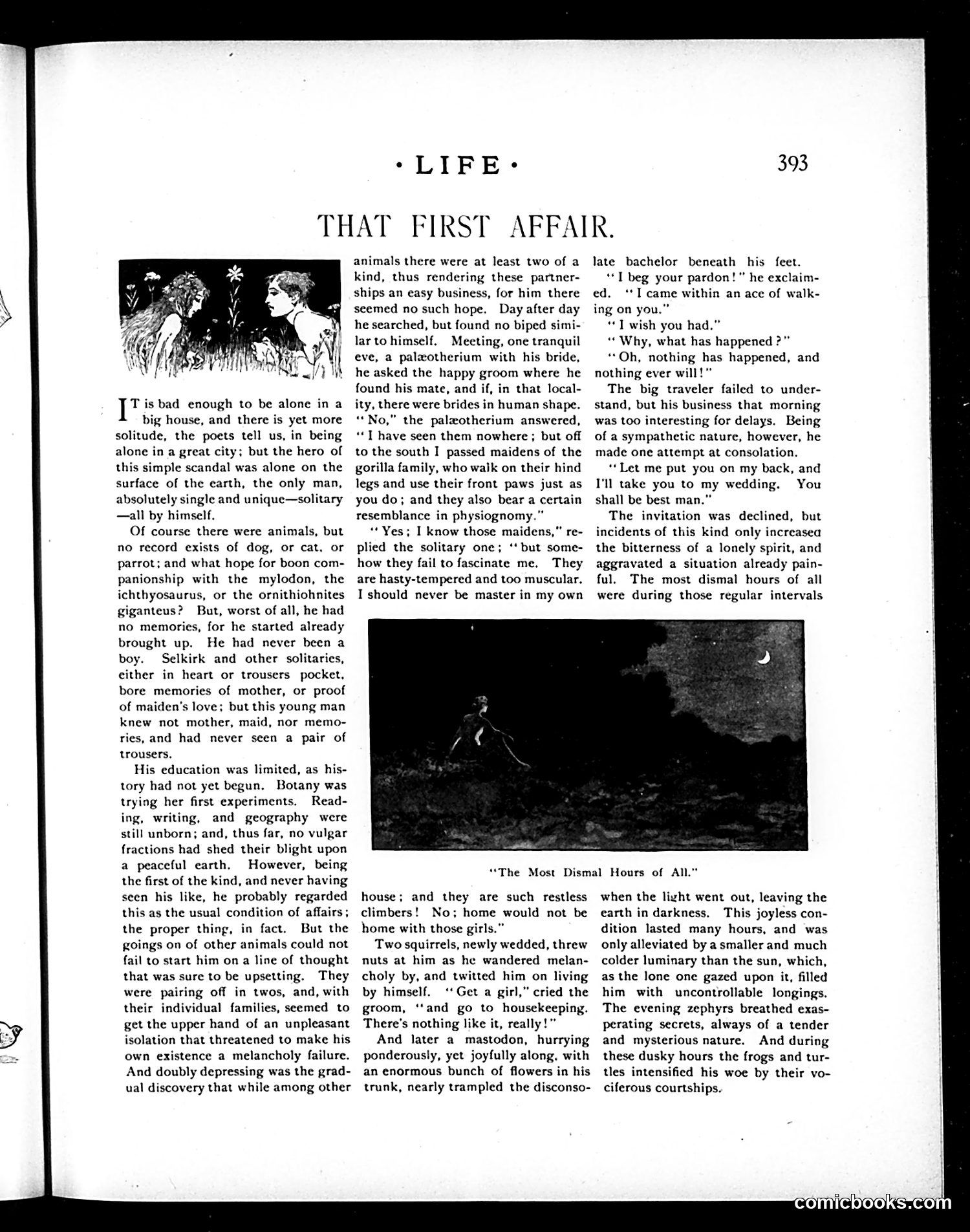
This page from *Life* magazine presents a short story titled "That First Affair" with accompanying illustrations. The narrative depicts a solitary man isolated in a great city, troubled by loneliness despite being surrounded by animals. The text explores his inexperience with romance and relationships—he's never known family love or companionship. The two illustrations show nighttime scenes: one appears to depict the man in isolation, the other titled "The Most Dismal Hours of All" shows a solitary figure under moonlight. This is **literary fiction, not political satire**. The piece uses the urban isolation theme common to early 20th-century literature, examining modern alienation and romantic inexperience rather than commenting on politics or public figures. The "satire" in *Life* here refers to social observation through storytelling rather than cartoon mockery.
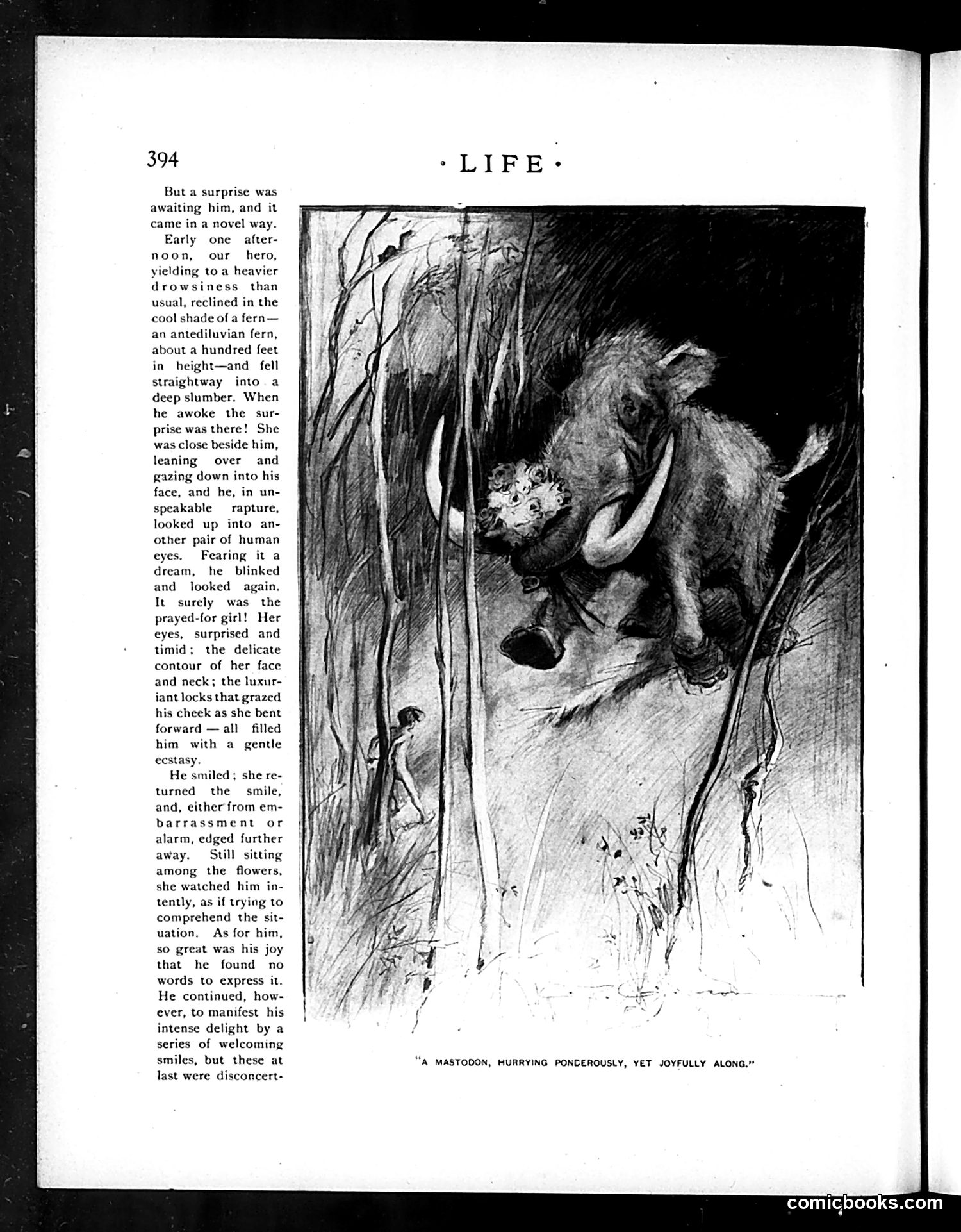
This page contains a narrative illustration rather than political satire. The text describes a man awakening from a nap beneath an antediluvian fern to discover a woman gazing at him. The illustration depicts a mastodon (prehistoric elephant) in a cave setting with the caption: "A MASTODON, HURRYING PONDEROUSLY, YET JOYFULLY ALONG." The content appears to be from a serialized story in *Life* magazine, likely a fantasy or science-fiction narrative. The mastodon illustration suggests the tale involves prehistoric or fantastical elements. Without additional context or preceding pages, the specific plot and characters remain unclear, though the romantic tone suggests this is a dramatic fictional work rather than political commentary or satire.
This page (395) contains **narrative fiction or serialized story text** rather than political cartoons or satire. The dialogue depicts a conversation between two characters—apparently a young woman and a man—discussing her isolated origins and background. The text reveals she comes from an unusual, solitary upbringing with only animals for companions, and she's never seen other humans or her own reflection except in water. The man expresses amazement at her isolation. This appears to be a **literary piece** rather than satirical commentary. Without seeing illustrations or identifying the story's title and date, I cannot determine the specific literary work or its social/political context. The content suggests a narrative exploring themes of isolation and discovery rather than contemporary satire.
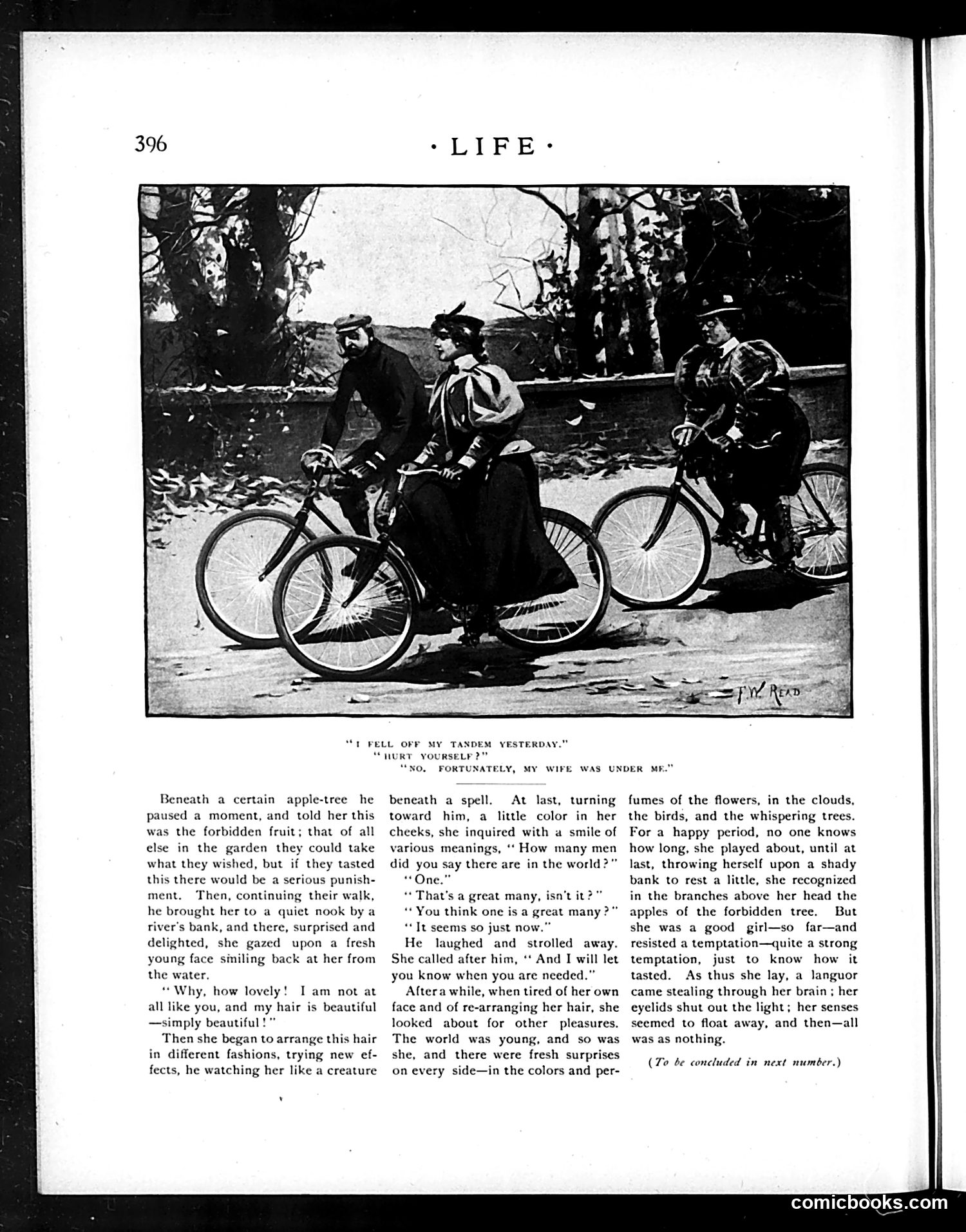
This page from *Life* magazine contains an illustrated story or serialized fiction, not political satire. The image shows three people with bicycles in an outdoor setting with trees. The caption reads: "I FELL OFF MY TANDEM YESTERDAY." "HURT YOURSELF?" "NO. FORTUNATELY, MY WIFE WAS UNDER ME." The humor is a genteel romantic joke typical of early 20th-century magazine fiction—playing on the gallantry of a husband protecting his wife from injury during a bicycle accident. The accompanying text describes a romantic encounter between two characters beneath an apple tree, discussing marriage, beauty, and youth. This is domestic fiction with light humor rather than political commentary or social satire. The bicycle and period clothing suggest an Edwardian-era setting.
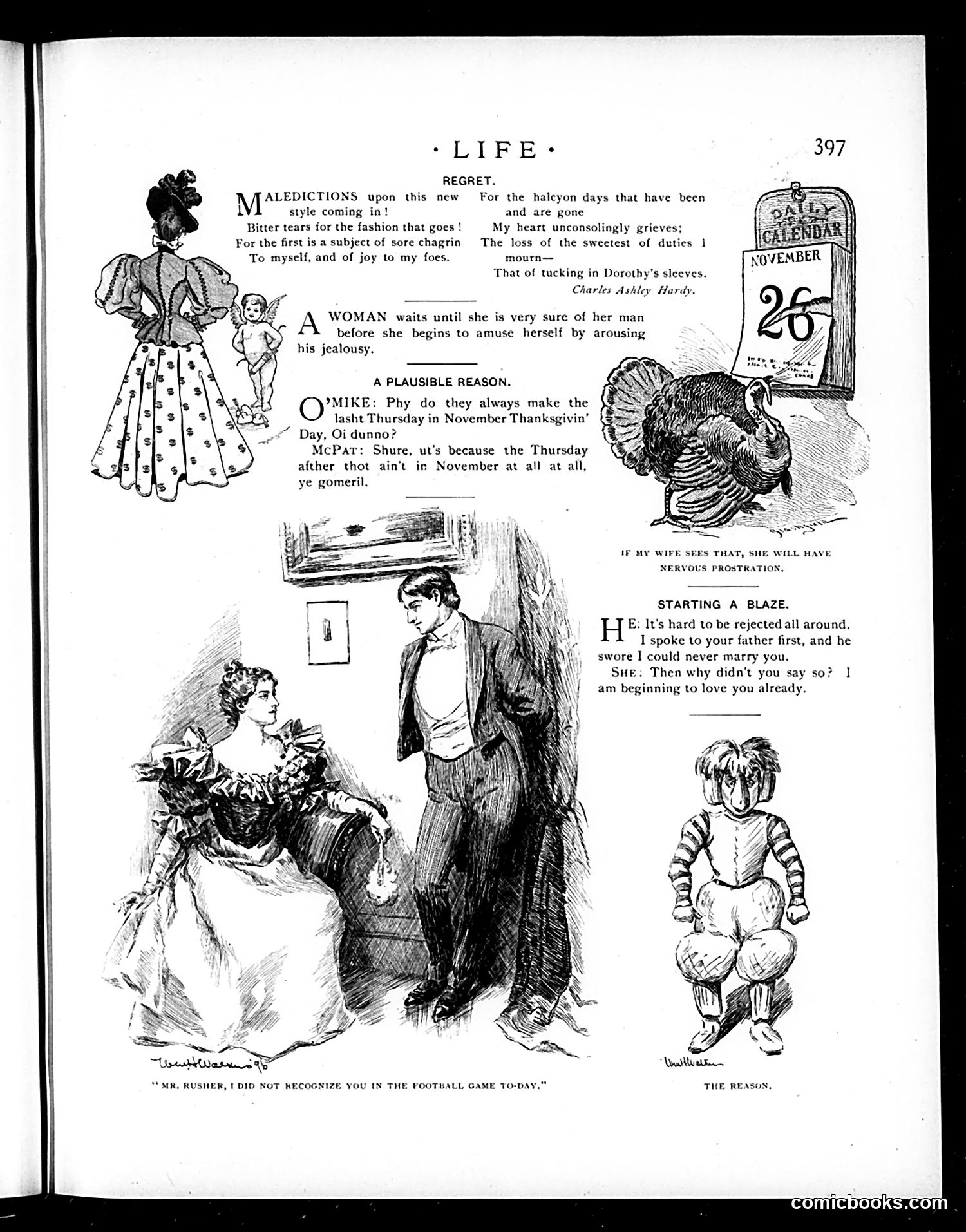
This page contains several humor pieces typical of early 20th-century Life magazine: **"Regret"** - A poem lamenting a new fashion style ("maledictions upon this new style coming in"), with a woman's illustration showing puffy sleeves. **"A Plausible Reason"** - A brief comedic dialogue where O'Mike and McPat joke about why Thanksgiving falls on Thursday in November, with McPat's answer being a pun about the day not being in November "at all." **"Starting a Blaze"** - A romantic sketch showing a rejected suitor telling a woman he cannot marry her, only for her to respond that she was already falling in love with him. **Additional humor pieces** include a football-related joke and a cartoon of an infant, captioned "The Reason." The content reflects period social customs around courtship, fashion criticism, and domestic humor.
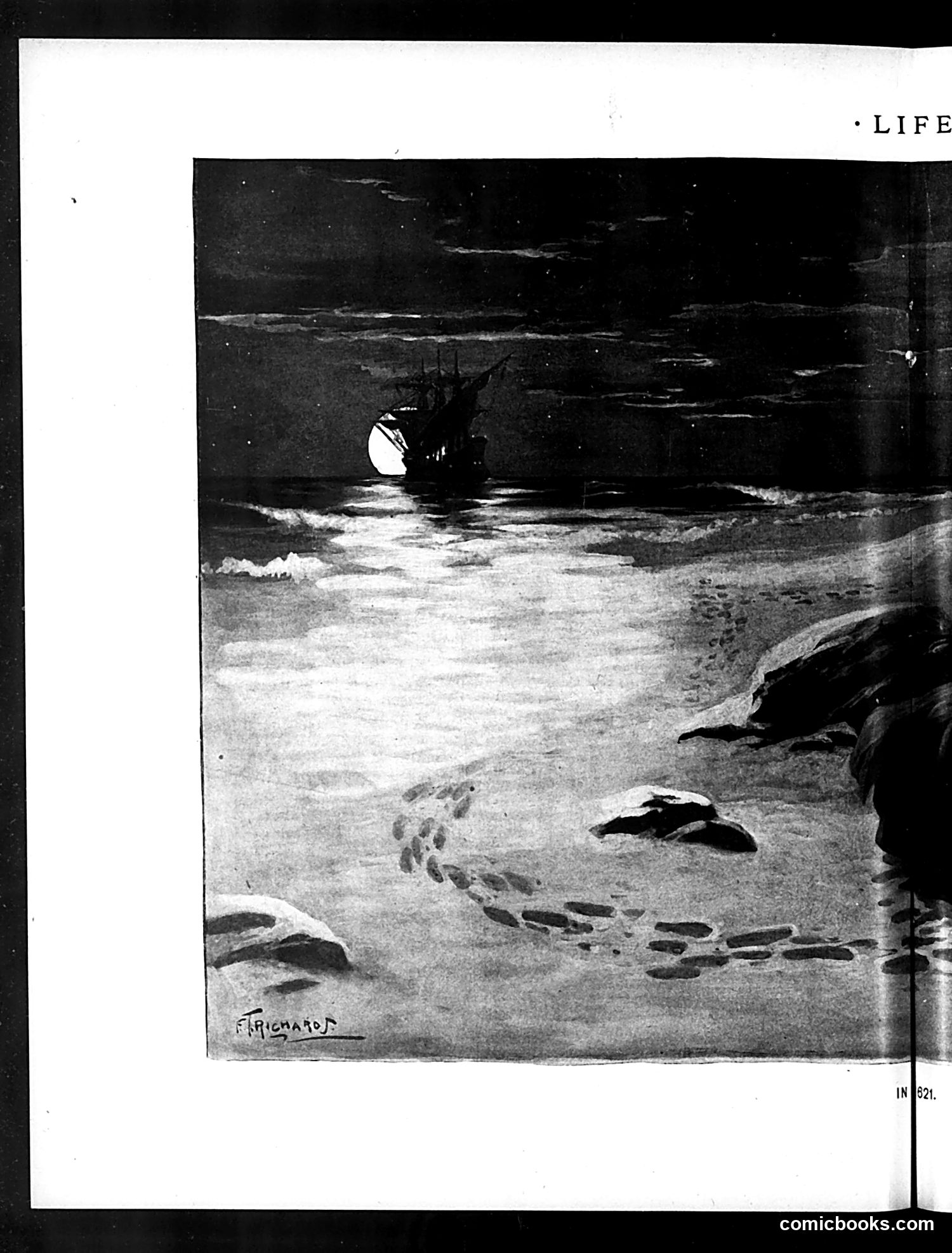
This appears to be a romantic or atmospheric illustration rather than a political cartoon. The image shows a moonlit beach scene with two figures silhouetted against a bright moon over water. Footprints trail across the sand in the foreground, and rocks are scattered about. The signature reads "F. RICHARDSON" (likely artist Frederic Richardson, a Life magazine contributor). The scene evokes a nostalgic, sentimental mood—likely depicting a romantic beach encounter or promenade. Without accompanying text or caption visible on this page, the specific satirical point is unclear to a modern reader. The image appears illustrative rather than overtly political or comedic in nature.
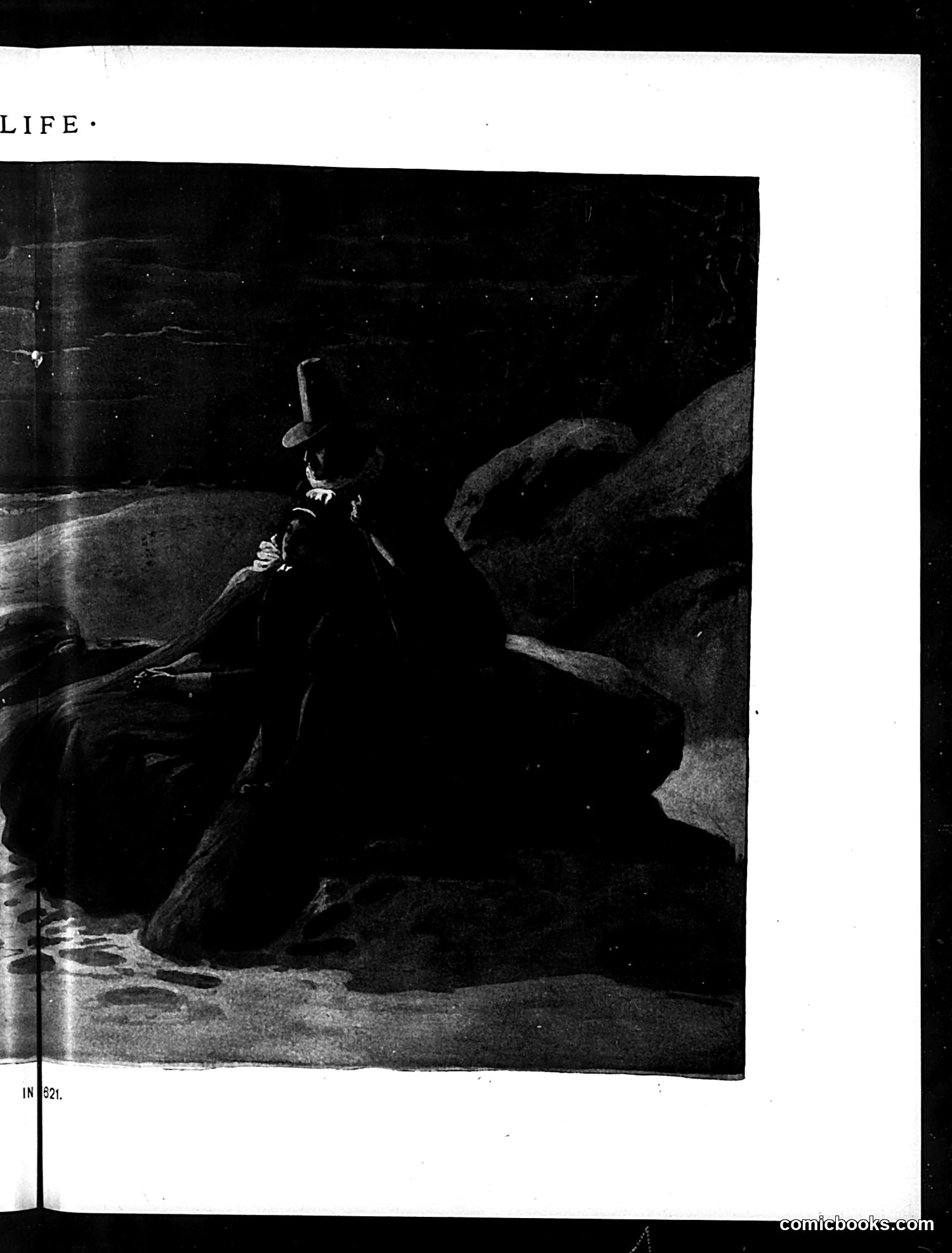
This page from *Life* magazine appears to be from an early 20th-century issue (marked "IN 821"). The image shows a dramatic black-and-white illustration of a figure in formal attire (top hat and coat) positioned among large rocks or boulders in what appears to be a confined or treacherous space. Without clearer text or caption visible on this page, the specific political or social satire is difficult to identify with certainty. The composition suggests commentary on a public figure navigating difficult circumstances or "rocky" political terrain—a common *Life* magazine motif. However, without readable identifying text or context, I cannot definitively name the figure or explain the particular reference this cartoon makes.
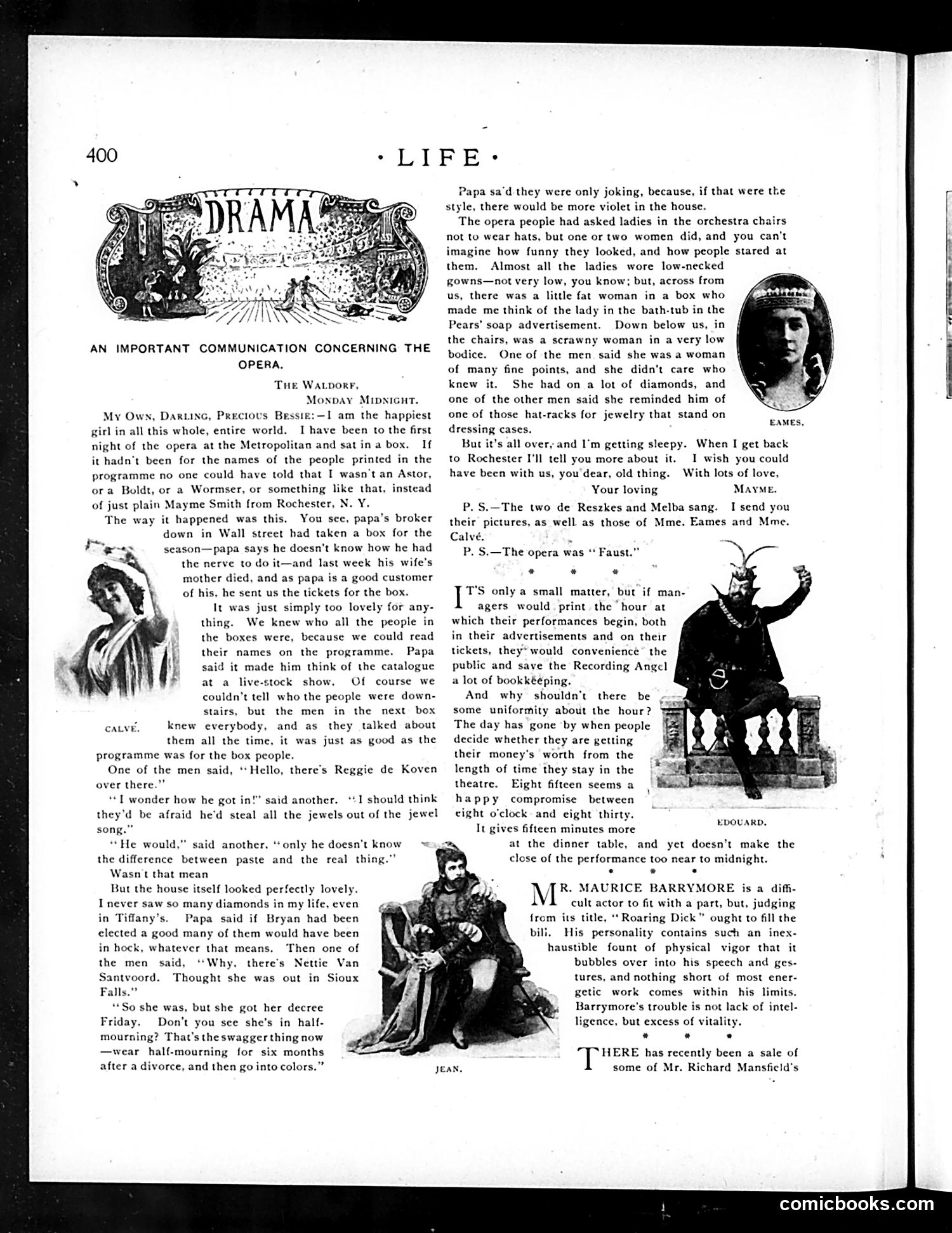
This page satirizes the social pretensions of opera-goers, particularly wealthy New Yorkers. The letter from "Mayme Smith from Rochester, N.Y." describes attending the Metropolitan Opera in a box seat, mocking how the newly monied middle class attempts to appear as wealthy as established aristocracy (Astors, Boldts). The humor targets: 1. **Class aspiration**: Mayme conflates attending opera with social status, comparing the audience to "a live-stock show catalogue" 2. **Gossip about society figures**: References to "Reggie de Koven" (likely a composer), Nettie Van Santvoord (recently divorced), and the "Pears soap advertisement" woman mock both the obsession with celebrity and appearance 3. **Social conventions**: The joke about "half-mourning" after divorce, women's low necklines, and hat-wearing etiquette satirizes rigid upper-class rules 4. **Political reference**: A mention of "Bryan" (William Jennings Bryan, presidential candidate) suggests concerns that diamonds would "be in hock" if he'd been elected—mocking fears of economic upheaval The accompanying illustrations appear to show opera performers (labeled Calvé, Eames, Udocaert, Jean), though their specific relevance isn't entirely clear from context.
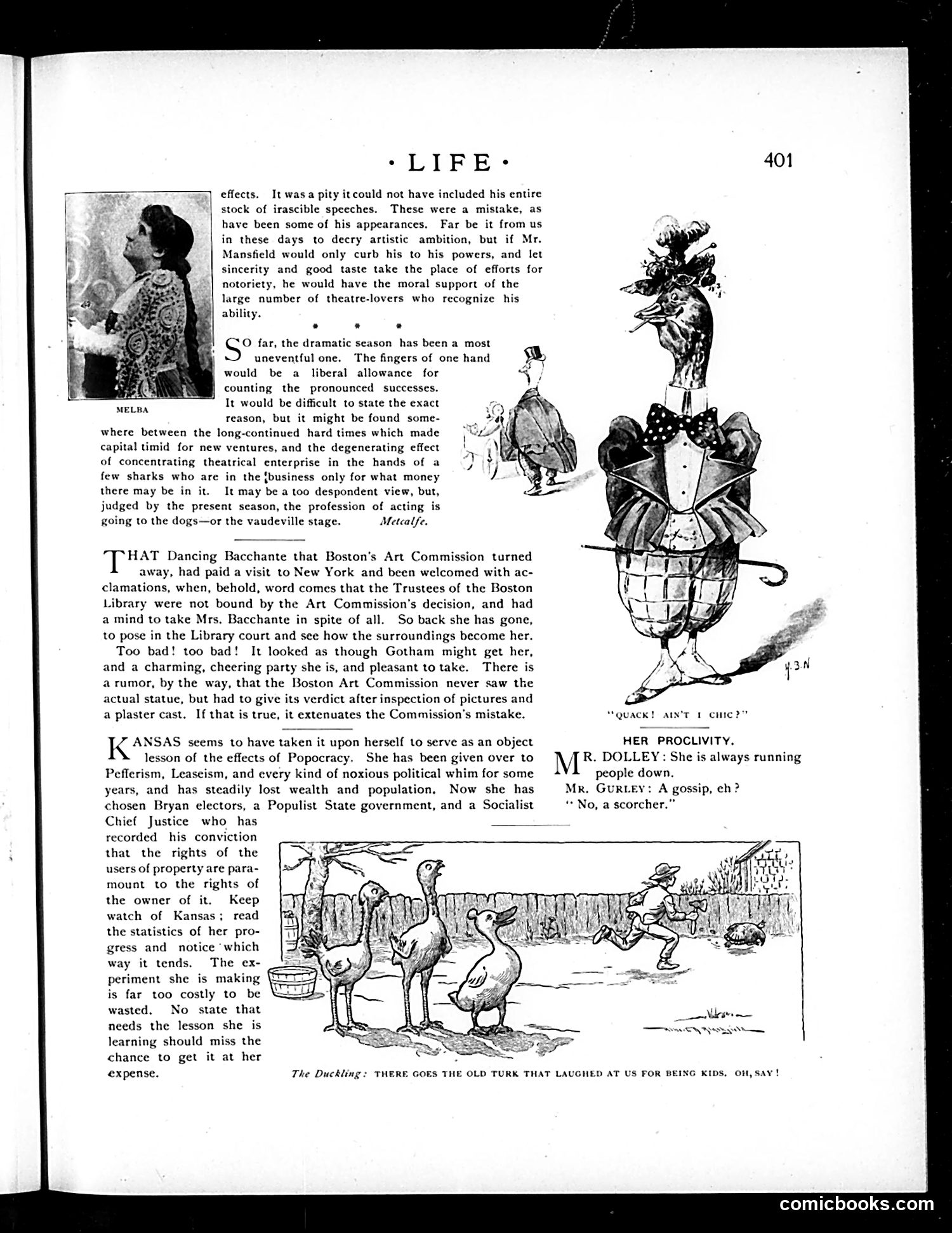
This page contains theatrical criticism and political satire typical of 1890s Life magazine. **Theater Criticism:** The text discusses actor Richard Mansfield's dramatic season, criticizing both his ambitions and the state of theater generally. It mentions the "Dancing Bacchante" statue that Boston's Art Commission rejected but New York welcomed—a real controversy about whether a statue depicting a nude female figure was appropriate for public display. The satire notes the Commission may have decided without seeing the actual sculpture. **Political Satire:** The Kansas section attacks Populism ("Popocracy"), specifically criticizing William Jennings Bryan and socialist/populist politicians. The author warns other states to observe Kansas's economic decline as a cautionary tale against populist policies. **Cartoons:** Small illustrated jokes accompany the text, including one about ducks mocking a child, and another titled "Her Proclivity" about a gossipy woman ("scorcher" slang for a fast woman). The page reflects elite anxieties about populism, artistic propriety, and theatrical standards in the 1890s.
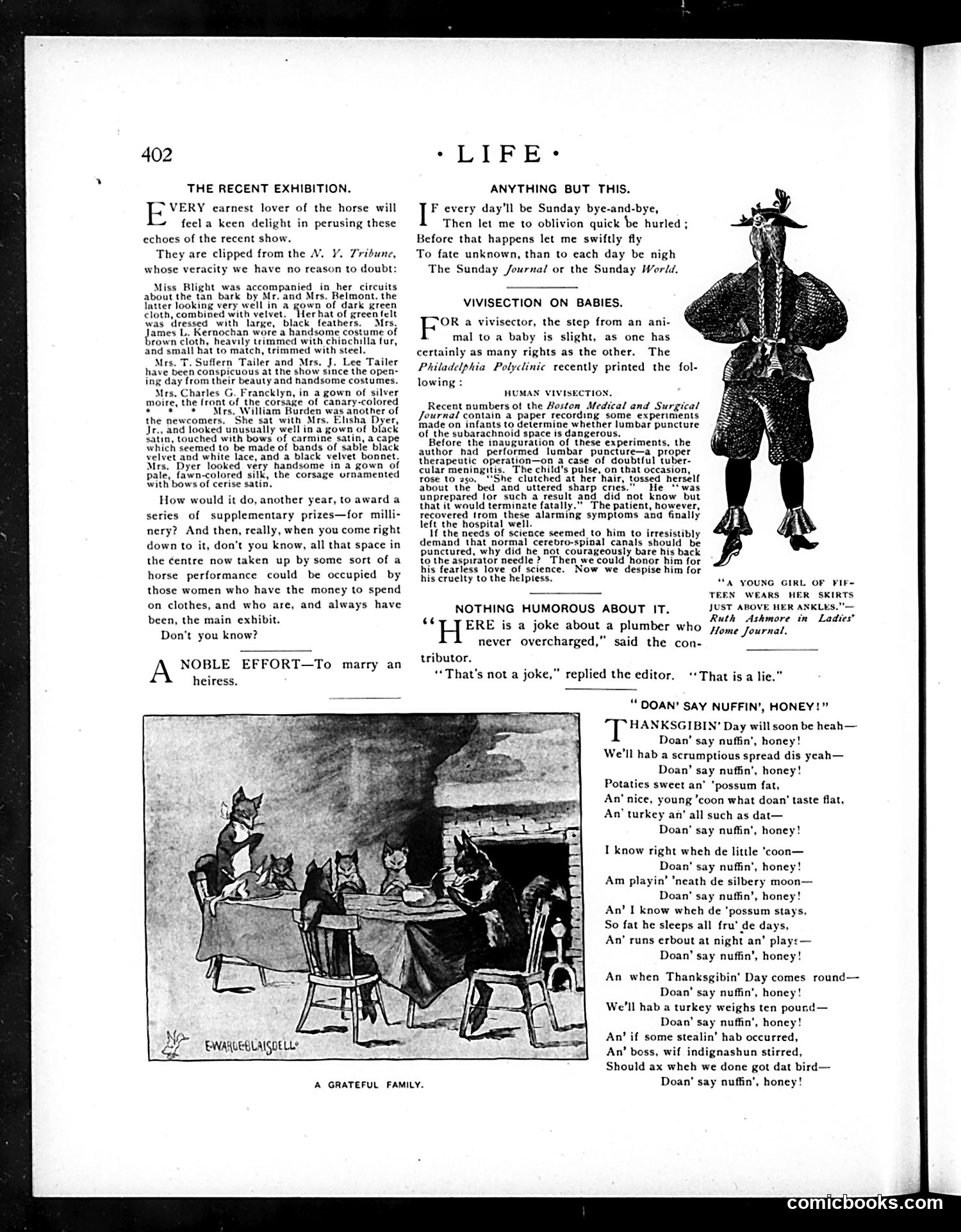
This page contains several distinct satirical pieces targeting American upper-class culture and contemporary social issues: **"The Recent Exhibition"** mocks wealthy New York society women obsessing over fashion details at a horse show—their elaborate gowns and millinery become the "main exhibit," rendering the actual horses secondary. The satire suggests these women are the true spectacle. **"A Noble Effort"** jokes about marrying an heiress, implying fortune-hunting among the wealthy. **"Vivisection on Babies"** exposes unethical medical experiments on infants conducted under the guise of scientific research—a genuine contemporary scandal. The satire condemns doctors who wouldn't subject themselves to such procedures. **"Doan' Say Nuffin', Honey"** is a Thanksgiving dialect poem in stereotypical African American vernacular, reflecting the period's casual racial caricature common in American humor magazines. The cartoons and poems collectively critique class pretension, medical ethics violations, and social hypocrisy.
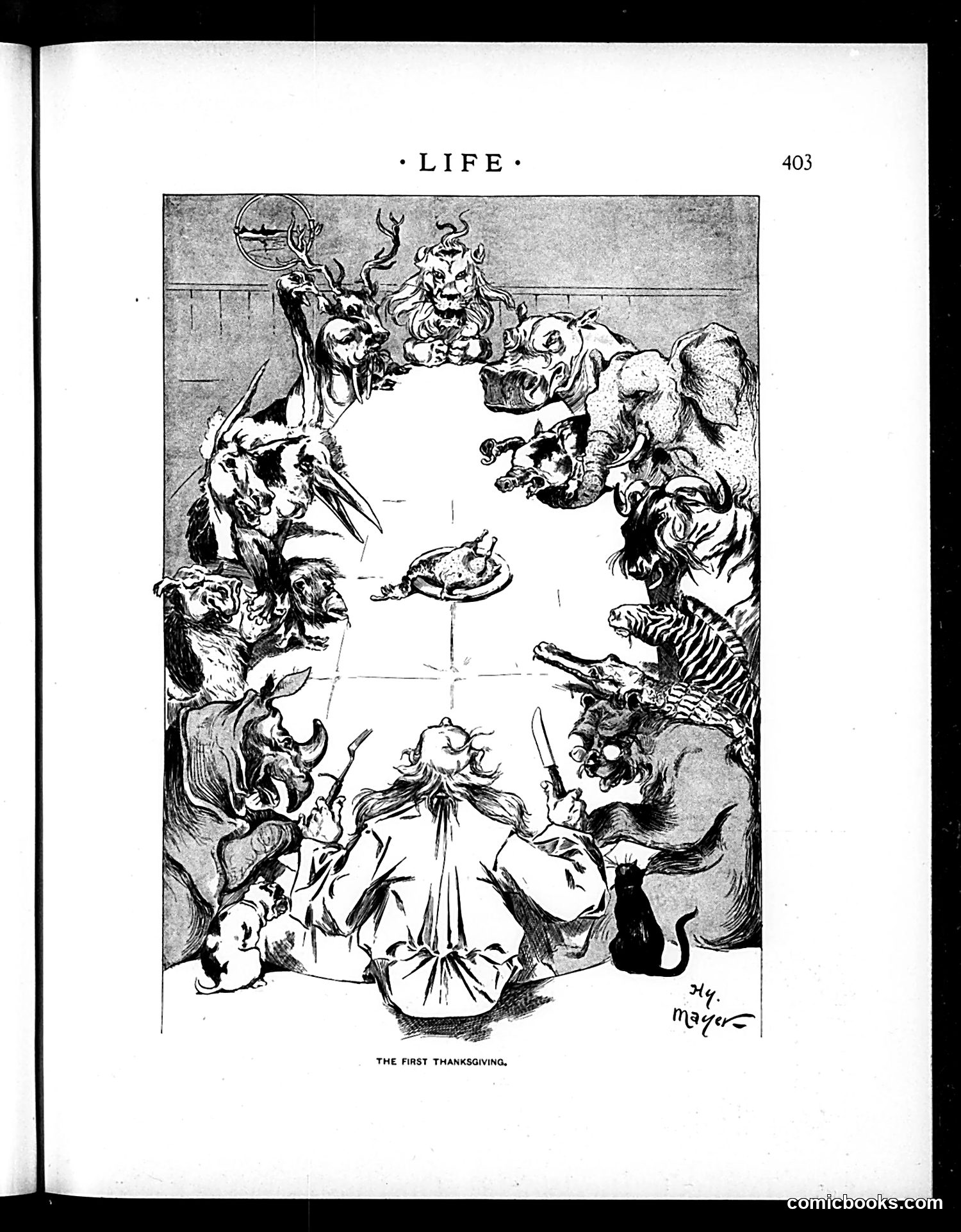
This satirical cartoon depicts a human figure (appearing to be a Native American or indigenous person) surrounded by a circle of aggressive animals—wolves, bears, deer, and other creatures—all wielding weapons or threatening poses. The central figure sits defenseless with raised hands. The cartoon is a dark commentary on the historical narrative of "The First Thanksgiving." Rather than depicting peaceful coexistence, it shows the indigenous person threatened and outnumbered by predatory forces, likely representing European colonizers depicted as animals or beasts. The satire critiques the romanticized myth of harmonious first contact, instead suggesting colonization as a violent, one-sided assault on Native peoples. The "Thanksgiving" title underscores the bitter irony—celebrating a narrative that obscures the actual violence and subjugation of indigenous populations.
This page contains a satirical cartoon-dialogue mocking sensationalist journalism practices of the era. The "World-Charnal" (appears to parody the *New York World*) is hiring a Cuban correspondent. **The satire's point:** The first candidate—actually qualified with Spanish fluency, Cuban birth, and serious writing experience—is rejected as unsuitable. The second candidate, who knows *nothing* about Cuba or Spanish and writes only lowbrow "Hell's Kitchen dialect sketches," is eagerly hired. **The joke:** The editor explicitly values sensationalism and self-promotion over accuracy. He demands the correspondent mention the newspaper's name "eighty times" per dispatch and fabricate interviews rather than report facts. The cartoon criticizes how major newspapers prioritized circulation-boosting exaggeration over journalism integrity when covering foreign events—a common complaint about press practices in this period. The accompanying anecdotes on the page reinforce themes of absurdity and pretense in public life.
This page is **primarily advertising and book announcements**, not satirical content. The main visual element is a **Sozodont toothpaste advertisement** featuring two illustrated faces in profile, promoting the product's established reputation since 1859. The page contains: 1. **Product ads** (Armour beef extract, Sozodont dentifrice) 2. **New book listings** from publishers Estes & Lauriat and Houghton Mifflin, including titles like "The American Revolution" by John Fiske and "Cape Cod" by Thoreau 3. **Publishing/subscription notices** for Life magazine's offices and distribution There is **no political cartoon or satirical commentary** visible. This appears to be a typical late-19th-century magazine page mixing editorial content with commercial advertising—a standard format before modern advertising separation. The Sozodont ad's ornate Victorian design is characteristic of period marketing rather than satire.
This page features a humorous short story satirizing evolving attitudes about women's roles and "feminine bravery." The unnamed female narrator describes how she abandoned her athletic, independent lifestyle after deciding society doesn't appreciate bold women. The joke centers on irony: to prove this theory, she performs an act of genuine courage—capturing an armed burglar at gunpoint while housekeeping for her brother. Yet her brother Tom is *not* proud. The story's final line ("The fact was that it...") cuts off before revealing his actual reaction, but the setup suggests he disapproved, possibly viewing her action as unfeminine or inappropriate. The satire mocks both rigid gender conventions and the paradox they create: society simultaneously celebrates and punishes women for displaying courage. The story appears to critique how women's genuine heroism gets dismissed or reframed as improper. The page also contains period advertisements for patent medicines and consumer goods, typical of *Life* magazine's revenue model.
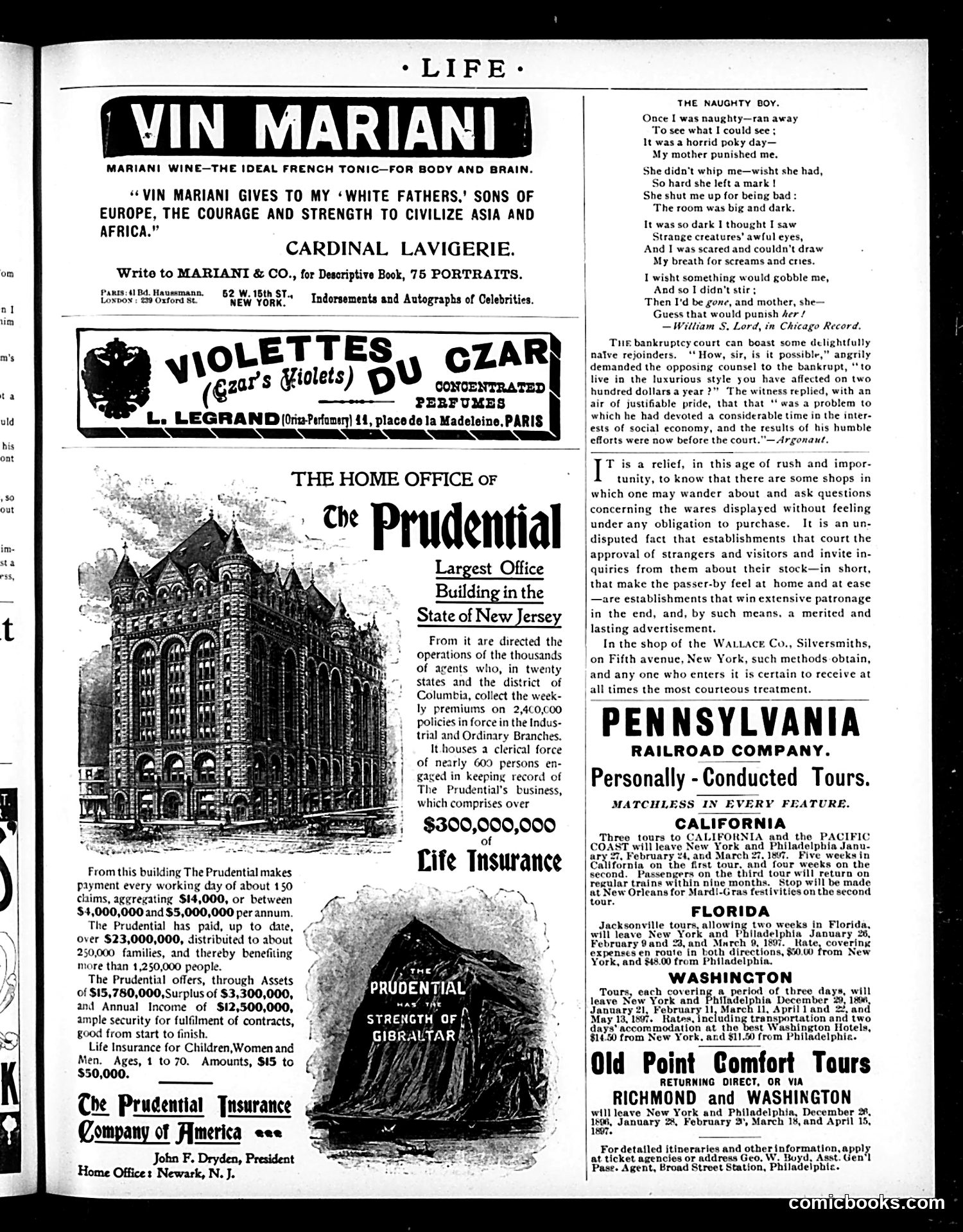
This page is primarily **advertising**, not satire or political commentary. The content includes: 1. **Vin Mariani wine ads**: A tonic wine endorsed by Cardinal Lavigerie, using colonial rhetoric about bringing "civilization" to Asia and Africa—reflecting late-19th-century imperialist attitudes. 2. **Perfume and insurance ads**: Standard commercial promotions for the Prudential Insurance Company and other products. 3. **Poetry and humor**: "The Naughty Boy" is sentimental verse about childhood punishment; the bankruptcy court anecdote is light social humor about a debtor's wit. 4. **Travel ads**: Pennsylvania Railroad promoting tours to California, Florida, and Washington. The page shows Life magazine's dual function: satirical commentary mixed with paying advertisements. The only potentially satirical element is Vin Mariani's blatant colonial messaging, though this appears presented earnestly rather than critically. The overall content reflects Gilded Age consumer culture and leisured-class preoccupations with travel and insurance.
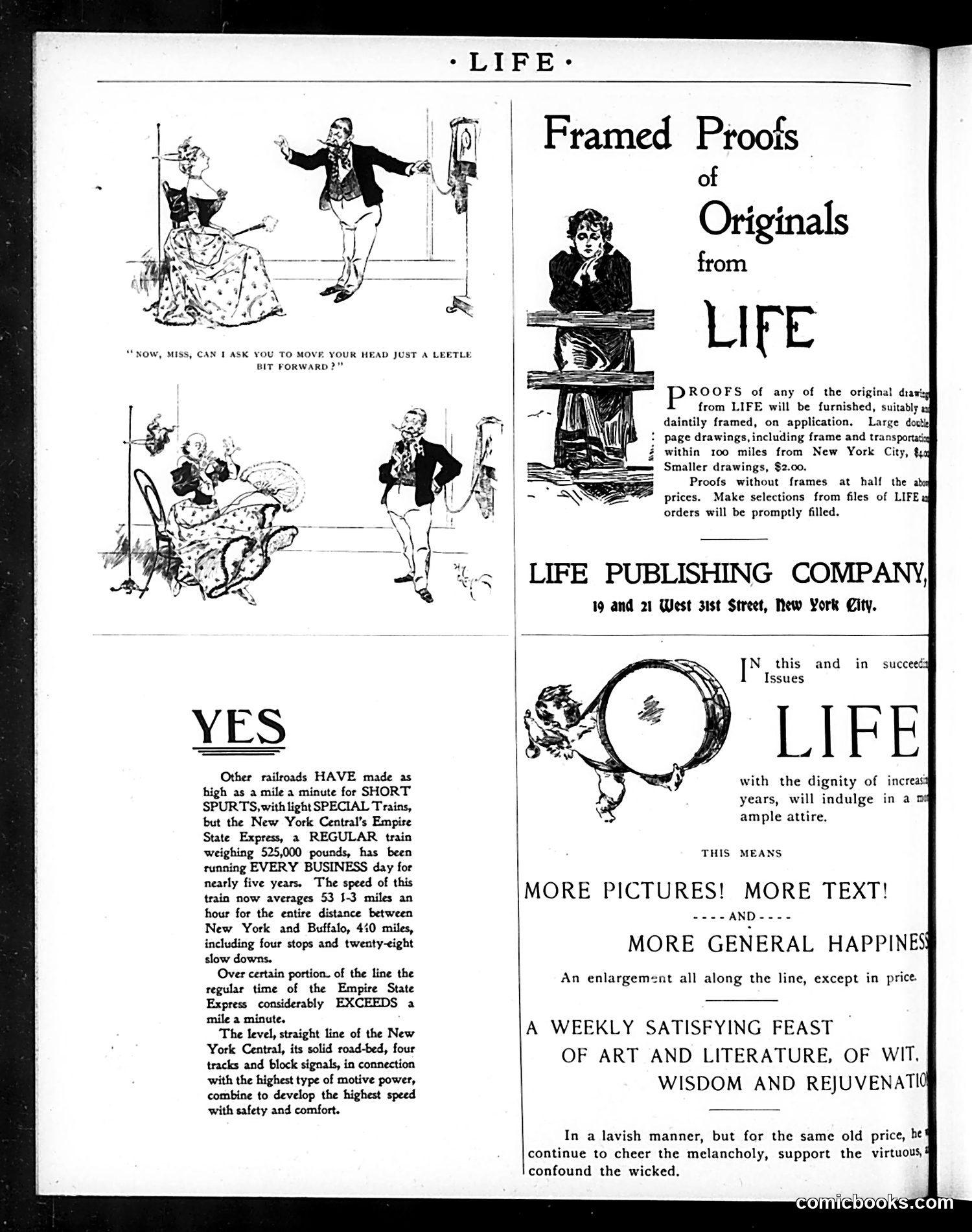
This page mixes editorial content with advertising. The left side features two cartoon panels depicting a photographer attempting to photograph a woman, with the caption "Now, miss, can I ask you to move your head just a little bit forward?" The humor appears to rely on physical comedy—likely showing the woman's difficulty complying or an awkward pose. Below this is promotional text celebrating the New York Central's Empire State Express railroad, emphasizing its regular 53.3-mile-per-hour average speed between New York and Buffalo—notably claiming it exceeds one mile per minute on certain stretches. This represents genuine railroad achievement being promoted as advertising. The right side advertises Life Publishing Company's framed artwork reproductions and announces expansion of the magazine with "more pictures" and "more text" while maintaining the same price—positioning Life as a superior publication offering greater value and cultural substance (art, literature, wit, and wisdom).
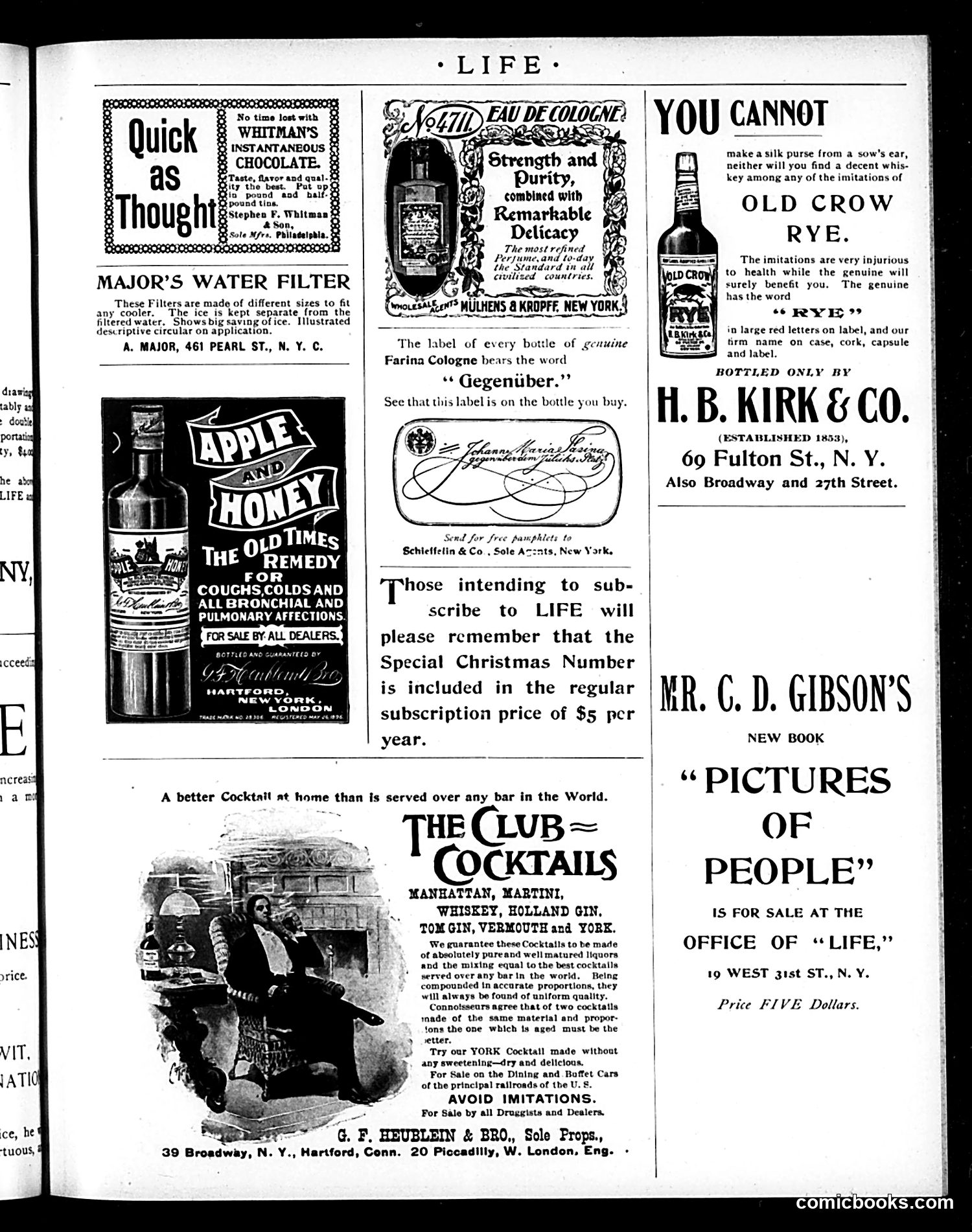
This is primarily an **advertising page** from an early 20th-century issue of *Life* magazine, not a satirical cartoon page. The ads reflect period concerns and marketing strategies: **Key advertisements:** - **Water filters and patent medicines** (cough remedy, water filtration) — common in an era before food/drug regulation, when such products made dubious health claims - **Alcohol products** dominate: Old Crow Rye, Farina Cologne, and "The Club Cocktails" — notably advertised *during Prohibition's approach* (this appears pre-1920), emphasizing authenticity and warning against counterfeits - **C.D. Gibson's book** — Gibson was a famous illustrator whose "Gibson Girl" defined American beauty standards **The satire is minimal.** The repeated emphasis on "genuine" vs. "imitations" and warnings like "you cannot make a silk purse from a sow's ear" reflect contemporary anxiety about product fraud—a legitimate concern in an unregulated marketplace. The page documents consumer culture and advertising techniques of the 1900s-1910s more than it satirizes specific events or figures.
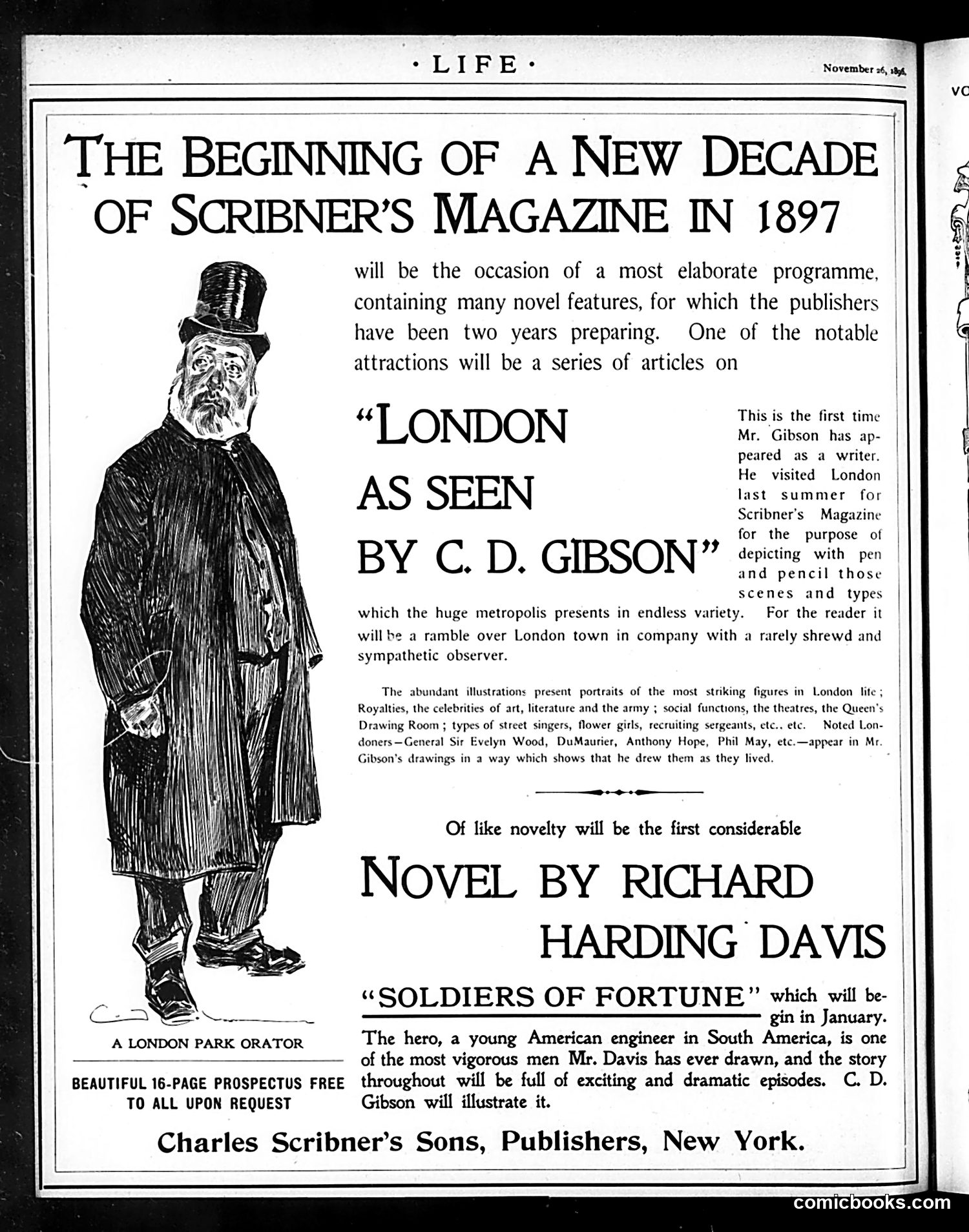
This is primarily an **advertisement**, not a political cartoon. It announces Scribner's Magazine's new decade of content beginning in 1897. The page features: 1. **"A London Park Orator"** — a sketch by C.D. Gibson depicting a working-class Londoner, likely a street speaker or social commentator. The figure represents the type of "authentic" urban character Gibson will document in his forthcoming illustrated series "London as Seen by C.D. Gibson." 2. **Promotion of two major features**: Gibson's illustrated travel pieces on London society (royalties, celebrities, street types) and Richard Harding Davis's serialized novel *Soldiers of Fortune* about an American engineer in South America. The appeal is to readers wanting sophisticated literary content paired with vivid contemporary illustration—a selling point of the magazine's modernizing direction. The sketch itself isn't satirical but rather demonstrates Gibson's observational drawing style that the advertisers are promoting to potential subscribers.