
Life, 1896-11-26 · page 7 of 24
Life — November 26, 1896 — page 7: what you’re looking at
What you’re looking at
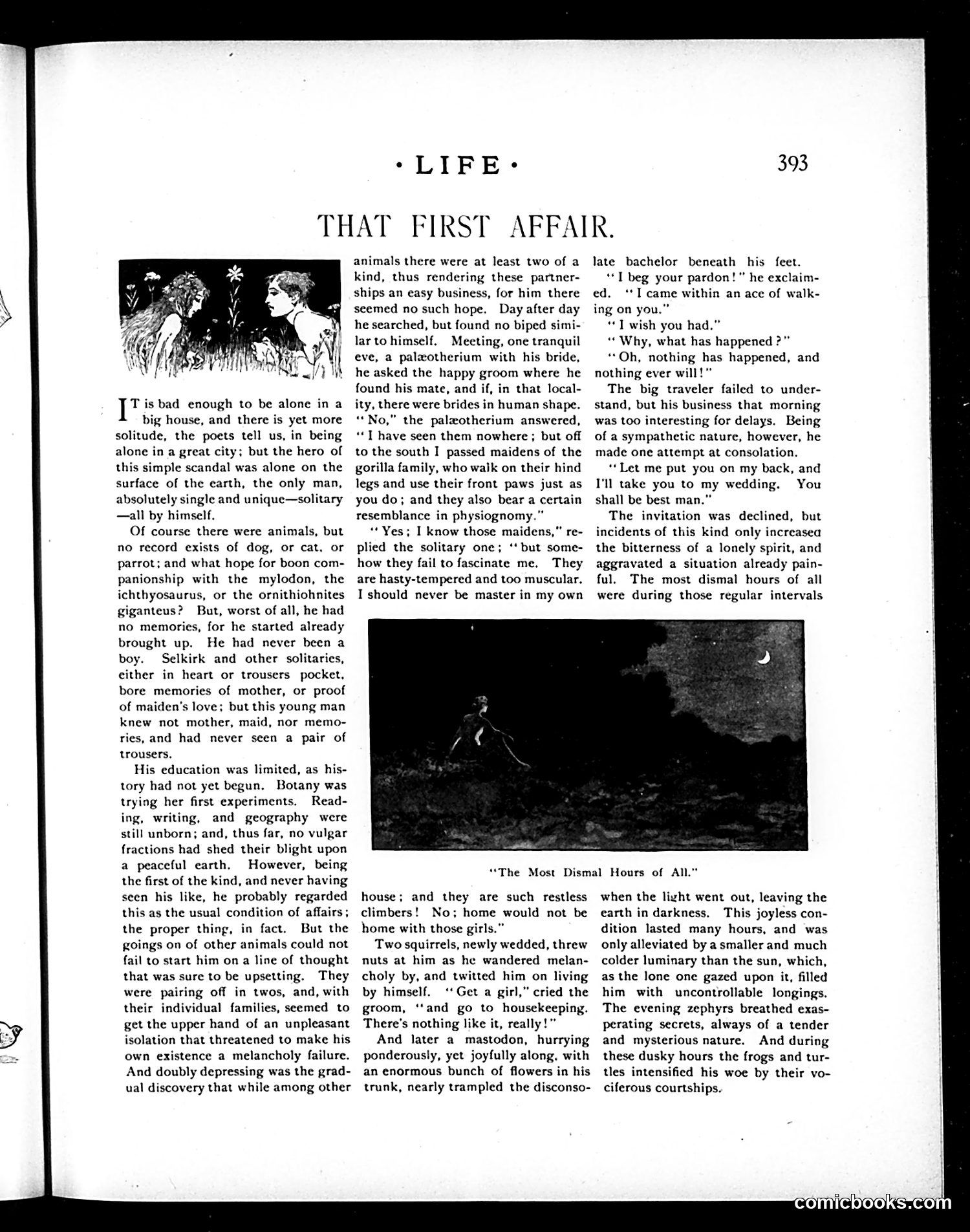
This page from *Life* magazine presents a short story titled "That First Affair" with accompanying illustrations. The narrative depicts a solitary man isolated in a great city, troubled by loneliness despite being surrounded by animals. The text explores his inexperience with romance and relationships—he's never known family love or companionship. The two illustrations show nighttime scenes: one appears to depict the man in isolation, the other titled "The Most Dismal Hours of All" shows a solitary figure under moonlight. This is **literary fiction, not political satire**. The piece uses the urban isolation theme common to early 20th-century literature, examining modern alienation and romantic inexperience rather than commenting on politics or public figures. The "satire" in *Life* here refers to social observation through storytelling rather than cartoon mockery.
📄 Transcribed text from this page (OCR, searchable)
Machine-transcribed from the original scan — historical spelling and the odd misread are preserved.
*LIFE: THAT FIRST AFFAIR. I" is bad enough to be alone in a big house, and there is yet more solitude, the poets tell us, in being alone in a great city; but the hero of this simple scandal was alone on the surface of the earth, the only man, absolutely single and unique—solitary —all by himself. Of course there were animals, but no record exists of dog, or cat, or parrot; and what hope for boon com- panionship with the mylodon, the ichthyosaurus, or the ornithiohnites giganteus? But, worst of all, he had no memories, for he started already brought up. He had never been a boy. Selkirk and other solitaries, either in heart or trousers pocket, bore memories of mother, or proof of maiden’s love; but this young man knew not mother, maid, nor memo- ries, and had never seen a pair of trousers. His education was limited, as his- tory had not yet begun, Botany was trying her first experiments. Read- ing, writing, and geography were still unborn; and, thus far, no vulgar fractions had shed their blight upon a peaceful earth. However, being the first of the kind, and never having seen his like, he probably regarded this as the usual condition of affairs; the proper thing, in fact. But the goings on of other animals could not fail to start him on a line of thought that was sure to be upsetting. They were pairing off in twos, and, with their individual families, seemed to get the upper hand of an unpleasant isolation that threatened to makc his own existence a melancholy failure. And doubly depressing was the grad- ual discovery that while among other animals there were at least two of a kind, thus rendering these partner- ships an easy business, for him there seemed no such hope. Day after day he searched, but found no biped simi- lar to himself. Meeting, one tranquil eve, a palxotherium with his bride, he asked the happy groom where he found his mate, and if, in that local- ity, there were brides in human shape. “No,” the palzotherium answered, ‘‘T have seen them nowhere ; but off to the south I passed maidens of the gorilla family, who walk on their hind legs and use their front paws just as you do; and they also bear a certain resemblance in physiognomy.” “Yes; I know those maidens,” re- plied the solitary one; ‘* but some- how they fail to fascinate me. They are hasty-tempered and too muscular. I should never be master in my own late bachelor beneath his feet. “IT beg your pardon!” he exclaim- ed. ‘I came within an ace of walk- ing on you.” “IT wish you had.” “Why, what has happened ?” “Oh, nothing has happened, and nothing ever will!” The big traveler failed to under- stand, but his business that morning was too interesting for delays. Being of a sympathetic nature, however, he made one attempt at consolation. ‘Let me put you on my back, and I'll take you to my wedding. You shall be best man.” The invitation was declined, but incidents of this kind only increasea the bitterness of a lonely spirit, and aggravated a situation already pain- ful. The most dismal hours of all were during those regular intervals “The Most Dismal Hours of All.” house; and they are such restless climbers! No; home would not be home with those girls.” Two squirrels, newly wedded, threw nuts at him as he wandered melan- choly by, and twitted him on living by himself. ‘Get a girl,” cried the groom, ‘‘and go to housekeeping. There's nothing like it, really!” And later a mastodon, hurrying ponderously, yet joyfully along. with an enormous bunch of flowers in his trunk, nearly trampled the disconso- when the light went out, leaving the earth in darkness. This joyless con- dition lasted many hours, and was only alleviated by a smaller and much colder luminary than the sun, which, as the lone one gazed upon it, filled him with uncontrollable longings. The evening zephyrs breathed exas- perating secrets, always of a tender and mysterious nature. And during these dusky hours the frogs and tur- tles intensified his woe by their vo- ciferous courtships.