
Life, 1896-11-26 · page 6 of 24
Life — November 26, 1896 — page 6: what you’re looking at
What you’re looking at
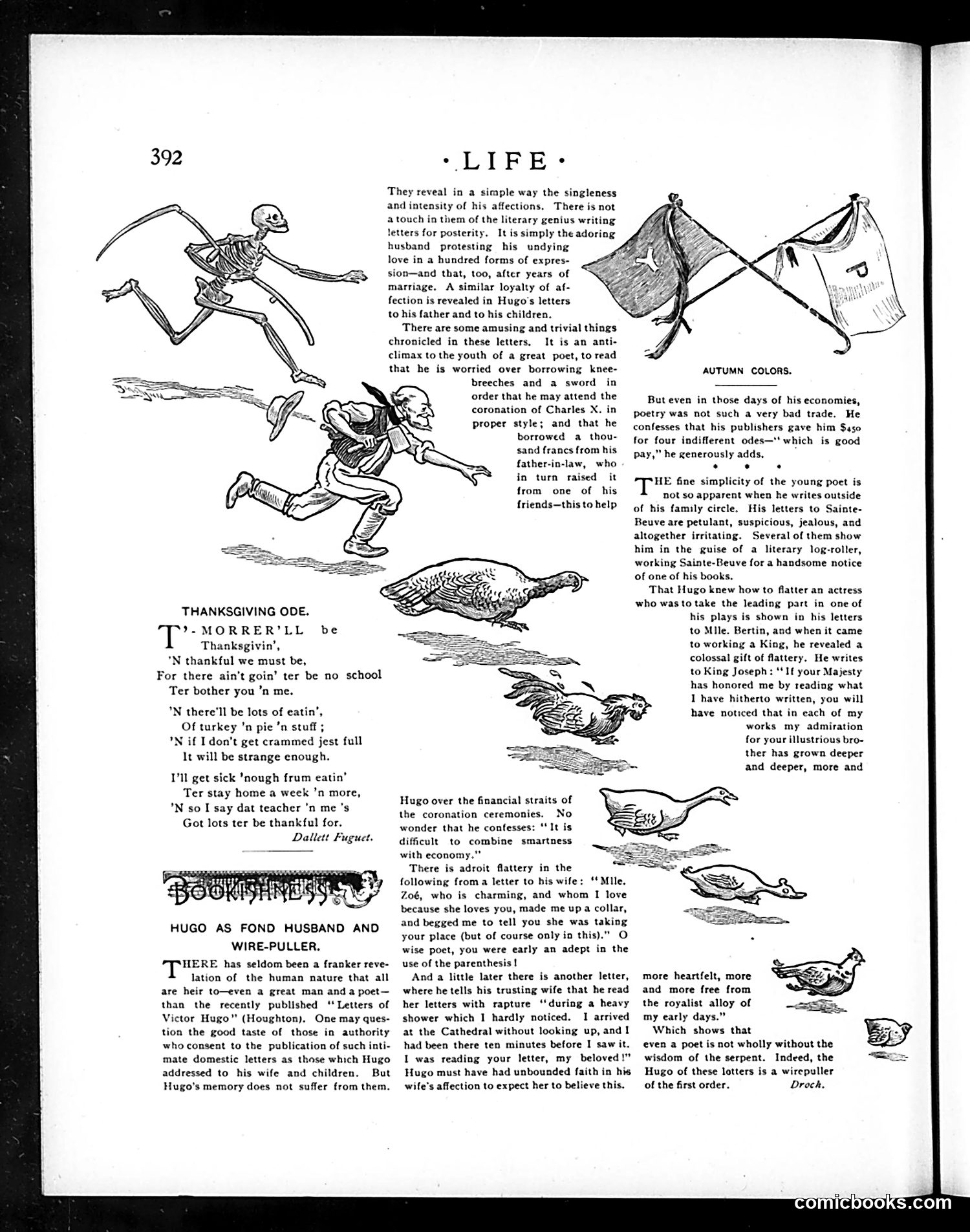
This page contains literary content about Victor Hugo rather than political satire. The main feature, "Hugo as Fond Husband and Wife-Killer," discusses Hugo's personal life through his correspondence—particularly his affectionate letters to his wife and children, which reveal his devotion despite financial struggles. The "Thanksgiving Ode" by Dallett Paguet is a humorous poem about a working-class family's modest holiday meal, using dialect humor typical of the era. The skeletal figures and animal illustrations appear decorative rather than satirical. The page focuses on cultural criticism and literary analysis rather than political commentary, examining Hugo's character through his intimate writings.
📄 Transcribed text from this page (OCR, searchable)
Machine-transcribed from the original scan — historical spelling and the odd misread are preserved.
THANKSGIVING ODE. %9-MORRER’LL be Thanksgivin’, 'N thankful we must be, For there ain't goin’ ter be no Ter bother you 'n me. ‘N there'll be lots of eatin’ Of turkey ’n pie ’n stuff ; ’N if Idon’t get crammed jest full It will be strange enough. I'll get sick ’nough frum eatin’ Ter stay home a week ’n more, ’N so I say dat teacher 'n me 's Got lots ter be thankful for. Dallett Fuguet. HUGO AS FOND HUSBAND AND WIRE-PULLER. HERE has seldom been a franker reve- lation of the human nature that all are heir to—even a great man and a poet— than the recently published “Letters of Victor Hugo” (Houghton). One may ques- tion the good taste of those in authority who consent to the publication of such inti- mate domestic letters as those which Hugo addressed to his wife and children. But Hugo's memory does not suffer from them. > LIFE- They reveal in a simple way the singleness and intensity of his affections, There is not a touch in them of the literary genius writing letters for posterity. It is simply the adoring husband protesting his undying love in a hundred forms of expres- sion—and that, too, after years of marriage. A similar loyalty of af- fection is revealed in Hugo's letters to his father and to his children, There are some amusing and trivial things chronicled in these letters, It is an anti- climax to the youth of a great poet, to read that he is worried over borrowing knee- breeches and a sword in order that he may attend the coronation of Charles X. in proper style; and that he borrowed a thou- sand francs from his father-in-law, who in turn raised it from one of his friends—this to help Hugo over the financial straits of the coronation ceremonies. No wonder that he confesses: ‘It is difficult. to combine smartness with economy.” There is adroit flattery in the following froma letter to his wife: ‘Mlle. Zo6, who is charming, and whom I love because she loves you, made me up a collar, and begged me to tell you she was taking your place (but of course only in this). O wise poet, you were early an adept in the use of the parenthesis | And a little later there is another letter, where he tells his trusting wife that he read her letters with rapture “during a heavy shower which I hardly noticed. I arrived at the Cathedral without looking up, and I had been there ten minutes before I saw it. I was reading your letter, my beloved!" Hugo must have had unbounded faith in his wife's affection to expect her to believe this. AUTUMN COLORS. Buteven in those days of his economies, poetry was not such a very bad trade. He confesses that his publishers gave him $4so for four indifferent odes—" which is good pay," he generously adds. oe HE fine simplicity of the young poet is not so apparent when he writes outside of his family circle, His letters to Sainte- Beuve are petulant, suspicious, jealous, and altogether irritating. Several of them show him in the guise of a literary log-roller, working Sainte-Beuve for a handsome notice of one of his books. That Hugo knew how to flatter an actress who was to take the leading part in one of his plays is shown in his letters to Mile. Bertin, and when it came to working a King, he revealed a colossal gift of flattery. He writes to King Joseph: If your Majesty has honored me by reading what I have hitherto written, you will have noticed that in each of my works my admiration for your illustrious bro- ther has grown deeper and deeper, more and more heartfelt, more and more free from the royalist alloy of my early days.” Which shows that even a poet is not wholly without the wisdom of the serpent. Indeed, the Hugo of these lotters is a wirepuller of the first order. Droch,