
A complete issue · 18 pages · 1896
Life — August 27, 1896
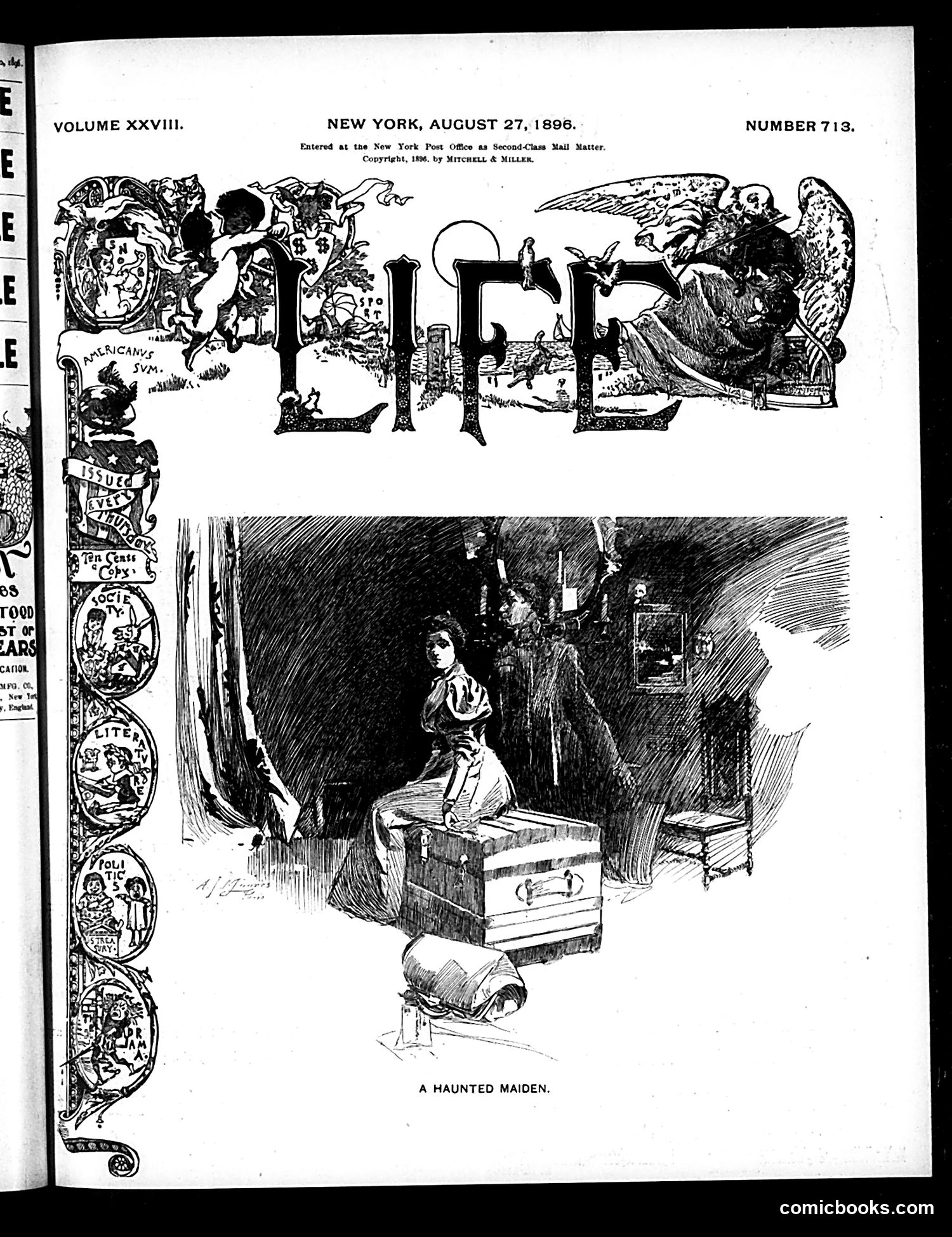
This page features an illustration titled "A Haunted Maiden," showing a woman sitting on a trunk in what appears to be a darkened room or attic, with shadowy figures of men visible in the background. The cartoon likely represents anxieties about unmarried women's vulnerability or romantic uncertainty—common satirical subjects in 1890s popular culture. The "haunting" by male figures suggests either persistent suitors or the specter of romantic complications. The trunk suggests travel or displacement, possibly implying a woman in limbo regarding marriage or social position. Without additional context about specific events from August 1896, the precise political or social target remains unclear, though the image appears to mock contemporary concerns about women's situations in courtship or domestic life.
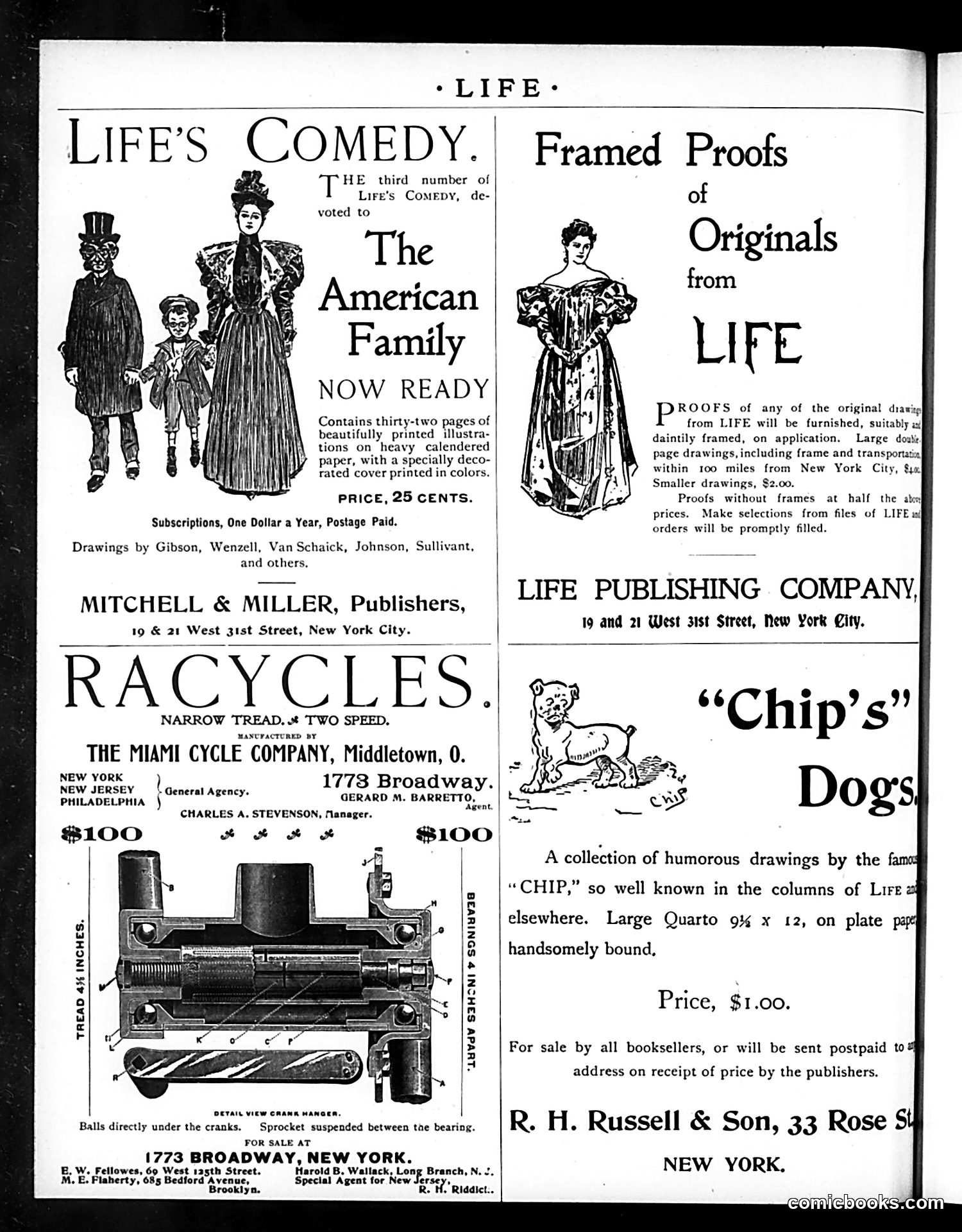
This page is primarily **advertising**, not editorial content or satire. It contains four advertisements: 1. **Life's Comedy** — promoting the third issue of Life magazine's "Comedy" series, featuring "The American Family," with illustrations by Gibson, Wenzel, and others. Price: 25 cents. 2. **Framed Proofs** — offering original artwork from Life magazine, available framed or unframed at various prices. 3. **Racycles** — advertising bicycles manufactured by The Miami Cycle Company, priced at $100. 4. **"Chip's Dogs"** — promoting a humorous illustrated book by an artist known as "Chip" from Life magazine, priced at $1.00. The page reflects late 19th/early 20th-century Life magazine's business model: selling both the magazine itself and related merchandise to readers.
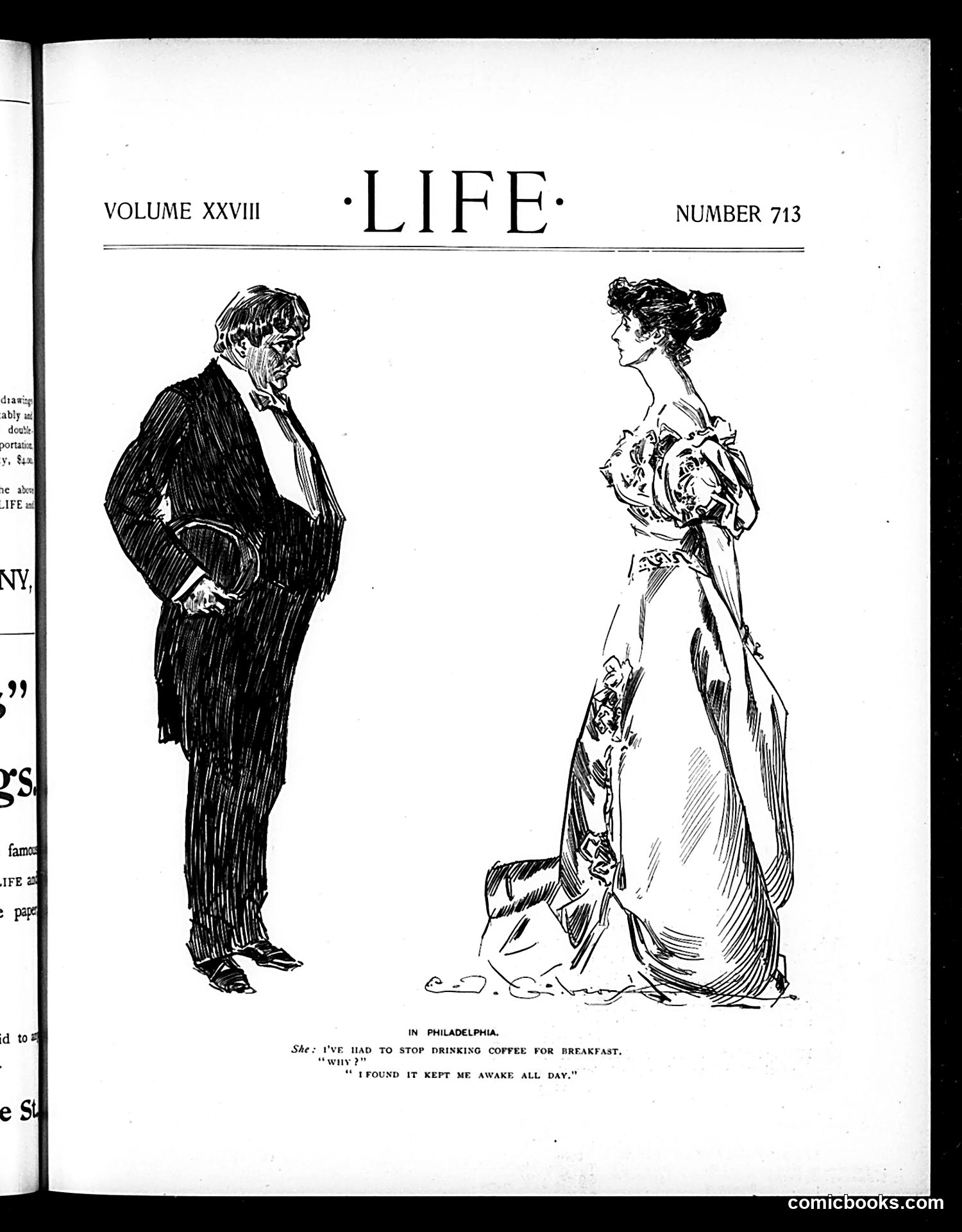
This is a comic illustration from *Life* magazine (Volume XXVIII, Number 713) showing a social interaction labeled "IN PHILADELPHIA." The cartoon depicts a well-dressed man in a suit confronting an elegantly dressed woman in an elaborate gown. The caption reads: "She: 'I'VE HAD TO STOP DRINKING COFFEE FOR BREAKFAST. WHY?' 'I FOUND IT KEPT ME AWAKE ALL DAY.'" The joke is a gentle satire on upper-class social pretense and afternoon fatigue. The woman's complaint—that coffee's stimulant effects prevent her from sleeping during the day—implies idle leisure time where daytime napping is a normal expectation. The man's bemused expression suggests he finds her complaint absurd or her priorities questionable. The humor targets the lifestyle of affluent Philadelphians who apparently spend their days sleeping and socializing rather than working.
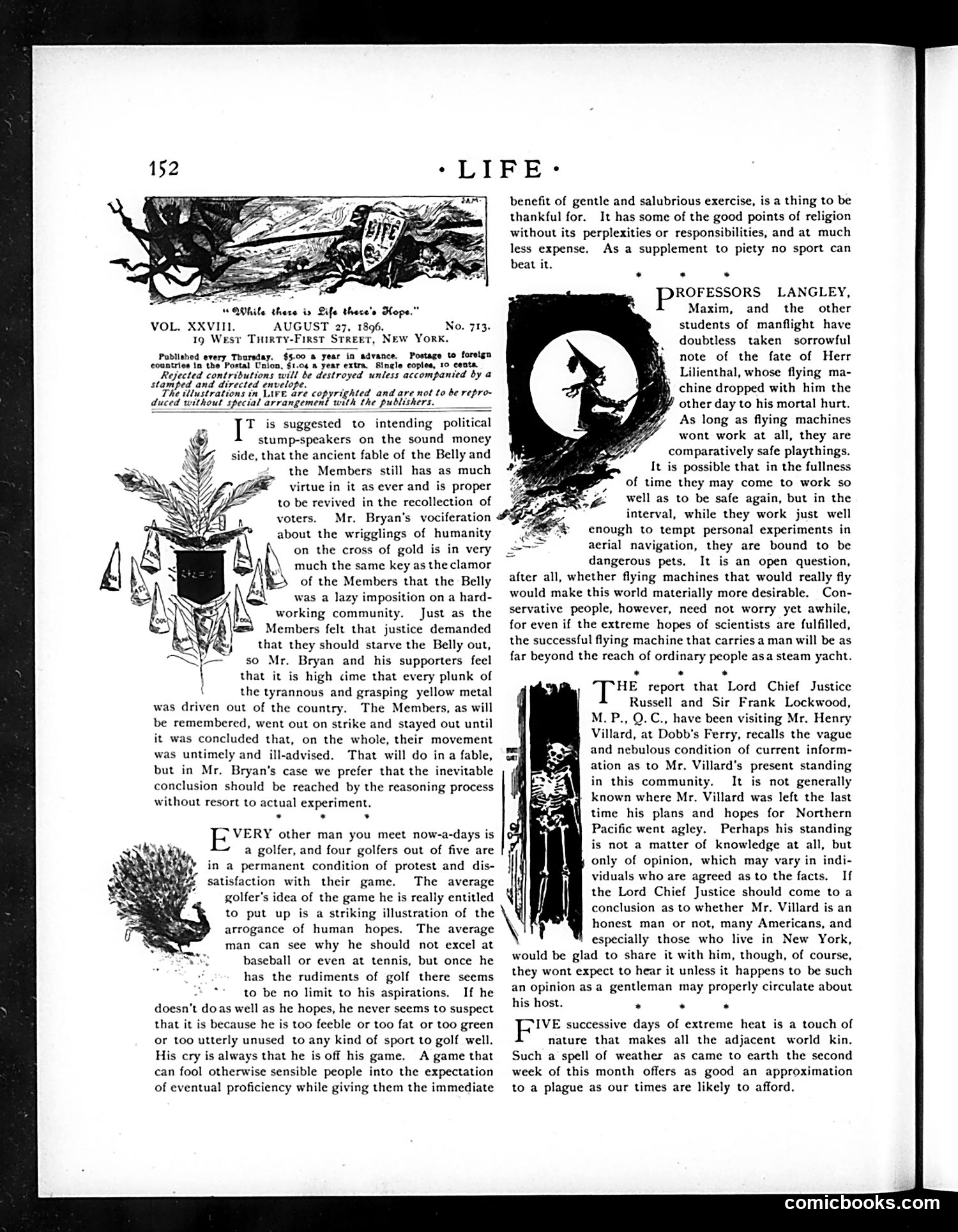
The page contains two satirical pieces addressing contemporary issues: **The Political Cartoon (top left):** Shows a figure labeled as representing a member of the "Belly and Members" fable, criticizing wealthy industrialists who opposed sharing wealth. The text argues their resistance to labor justice was "lazy" and harmful to the working community—likely referencing post-WWI labor disputes and wealth inequality debates. **The Golfer Satire (bottom):** Mocks golfers as delusional about their abilities. The satirist suggests average golfers fool themselves into believing they're skilled, when they're actually unsuited for the sport. This reflects class commentary on leisure pursuits among the wealthy during this era. **The Villard Section:** Discusses Henry Villard's standing in the community regarding Northern Pacific railroad interests—a business/society matter.
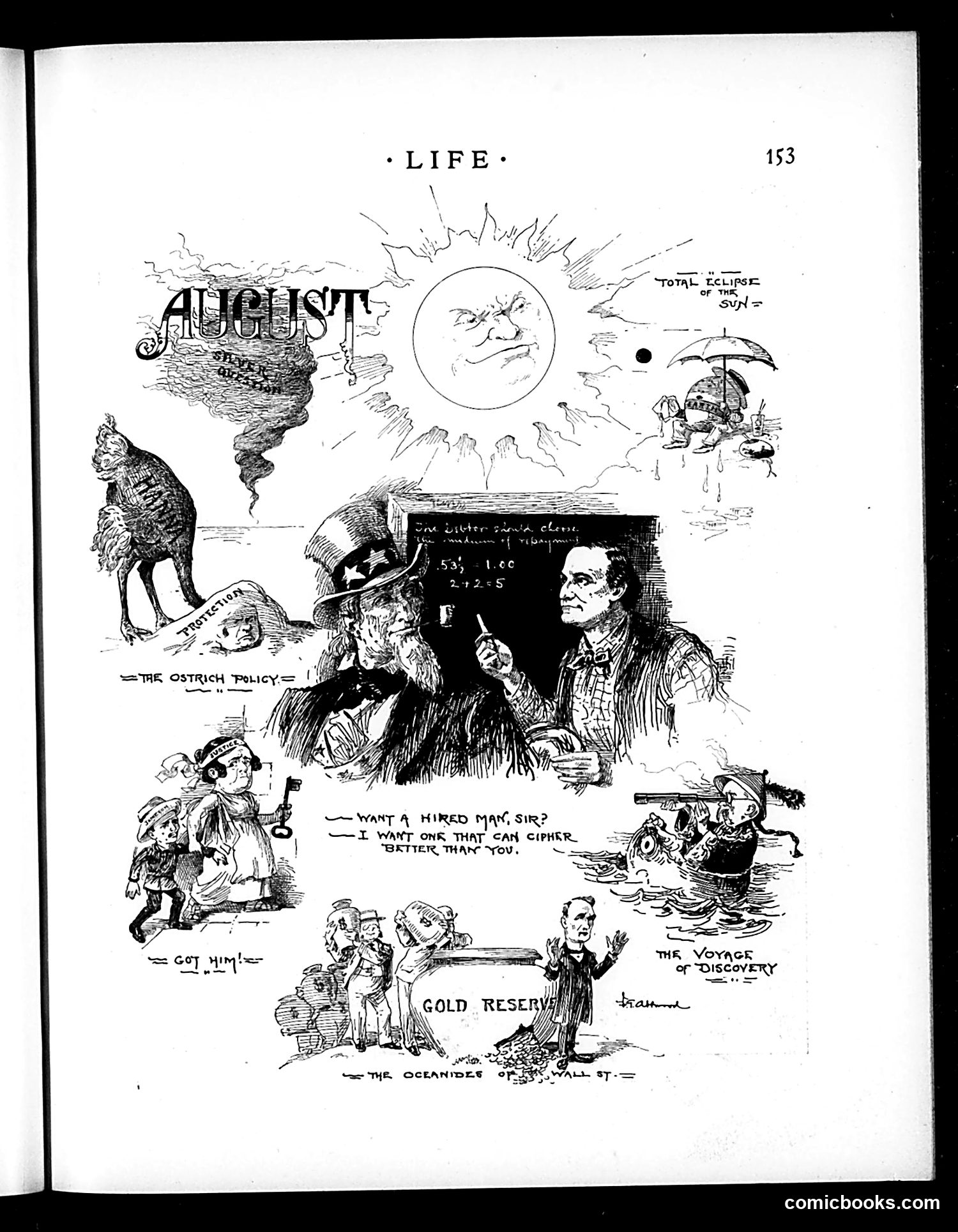
This satirical page combines several early 20th-century commentary pieces: **"The Ostrich Policy"** (left): References the common idiom of ostriches burying their heads in sand to avoid problems—here apparently critiquing avoidant political or business strategy. **Central scene**: Two bearded figures examine documents with mathematical calculations visible, suggesting financial or scientific analysis during a period of economic concern. **"Gold Reserve"** (bottom): References banking/currency policy, likely commenting on financial management during economic uncertainty. **"The Voyage of Discovery"** (right): Shows figures in water, possibly satirizing exploration or business ventures. **"The Oceanides of Wall St."** (bottom): Directly references Wall Street, mocking financial institutions or stock market behavior. The overall tone suggests criticism of financial mismanagement, avoidance of economic problems, and Wall Street practices—typical Life magazine social satire from the early 1900s.
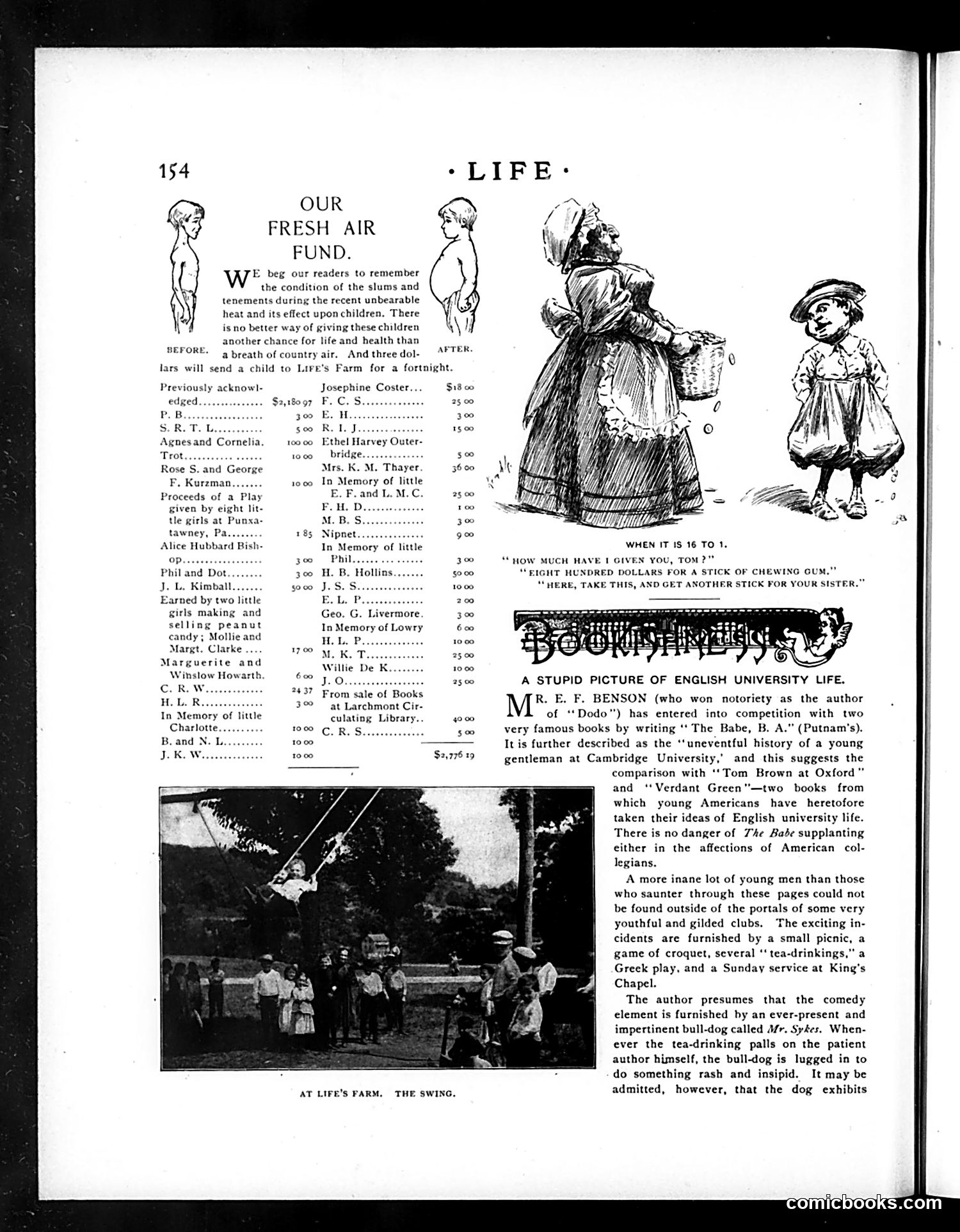
This page combines two distinct sections: **Upper Left: "Our Fresh Air Fund"** - A charitable fundraising appeal listing donors and amounts. The accompanying "Before/After" illustration shows a malnourished child transforming after receiving care at Life's Farm, addressing the documented poor health conditions of urban slum children during this era. This reflects Progressive Era concerns about child welfare in crowded tenements. **Right Side: "Book Reviews"** - A satirical review of Mr. E.F. Benson's book about Cambridge University life, comparing it to American university novels like "The Babe" and "Verdant Green." The humor critiques the portrayal of upper-class British university culture as insular and populated by silly young men engaged in pranks, tea-drinking, and croquet rather than serious study. **Bottom: "At Life's Farm—The Swing"** - A photograph documenting the actual fresh air charity facility in operation.
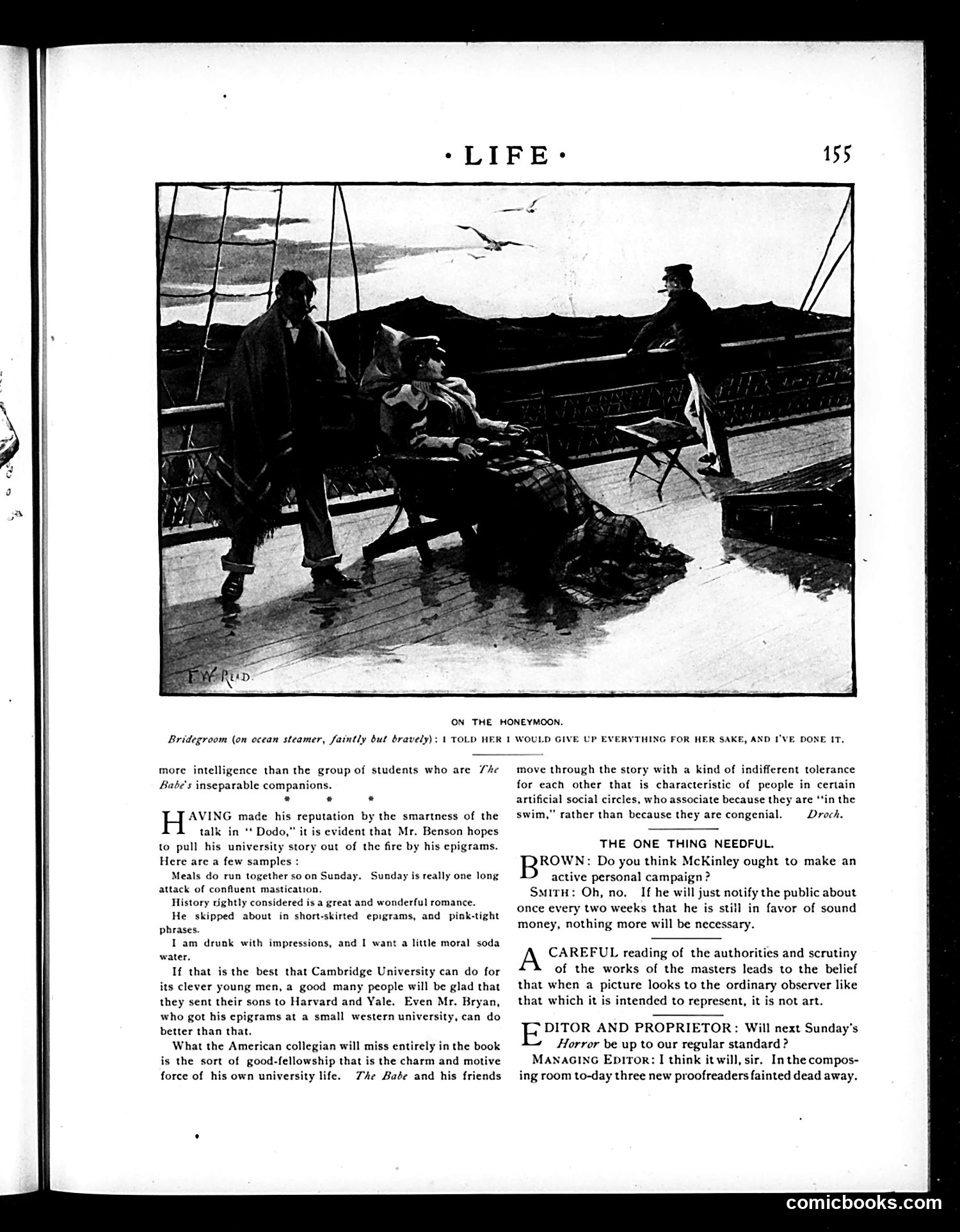
The illustration depicts a couple on an ocean steamer's deck during their honeymoon. The caption reads: "Bridegroom (on ocean steamer, faintly but bravely): I TOLD HER I WOULD GIVE UP EVERYTHING FOR HER SAKE, AND I'VE DONE IT." **The Satire:** The joke mocks newlywed self-sacrifice—the groom appears to be seasick or suffering, suggesting his gallant pre-marital promises have immediately proven costly. The "everything" he's given up likely refers to his comfort, health, or independence. **Social Context:** This reflects early 20th-century attitudes about marriage as requiring male compromise and female domesticity, while humorously portraying the groom's regret over his romantic declarations. The accompanying text discusses Cambridge University and epigrams, seemingly unrelated editorial content.
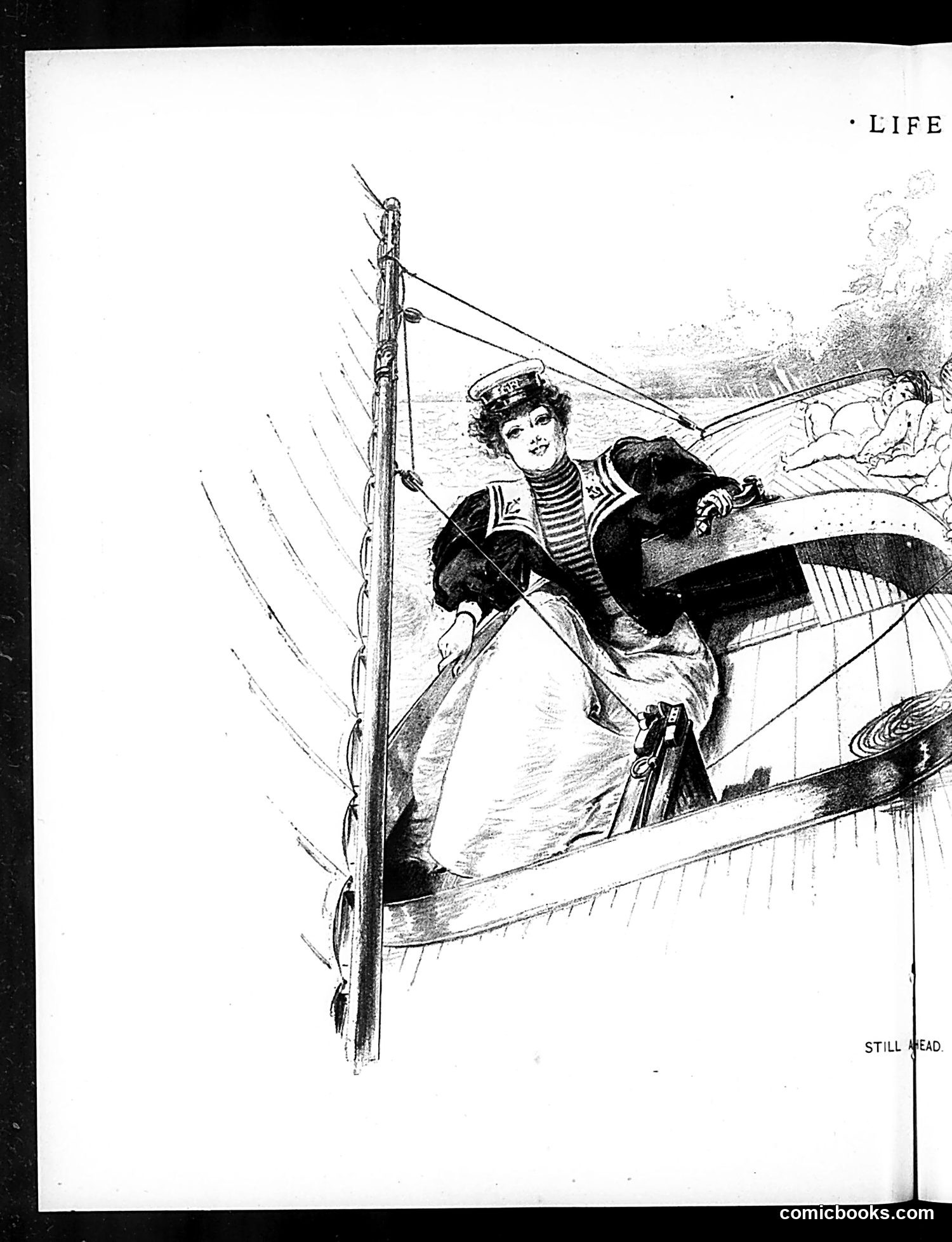
This page from *Life* magazine features a nautical-themed illustration captioned "STILL AHEAD." The drawing shows a fashionably dressed woman in a sailor outfit positioned at a ship's bow, leaning dramatically outward while holding a rope or rigging. She wears a striped sailor shirt, dark jacket, and hat. The satire likely critiques early 20th-century women's fashion or women's increasing public presence and independence. The "still ahead" caption suggests competitive or progressive advancement. The theatrical pose and nautical styling may mock the fashionable appropriation of sailor aesthetics by society women, or celebrate women's newfound freedoms during this era. Without additional context, the specific social commentary remains somewhat unclear, though the tone appears gently satirical of contemporary women's fashion trends.
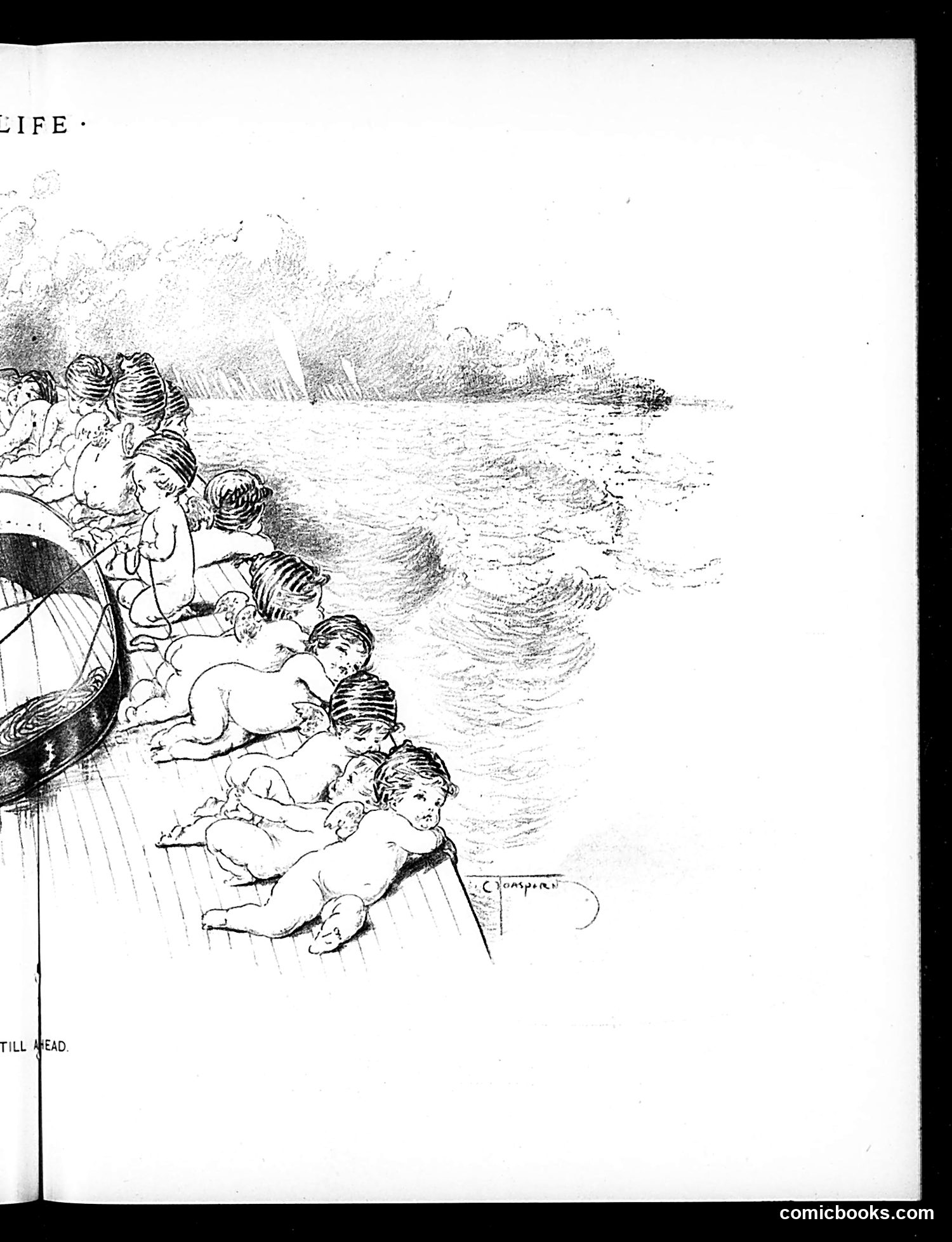
This page features an illustration signed by C. Camsiere showing cherubic putti (baby figures) arranged along a shoreline, gazing toward water and distant landscape. The cherubs wear striped caps and appear peaceful, possibly sleeping or resting. Without additional visible text or context on this page, the precise satirical meaning is unclear. However, given *Life* magazine's satirical nature, this could allegorically represent innocence, childhood, or national ideals. The water vista might suggest leisure, paradise, or aspiration. The identical striped caps suggest uniformity or collective identity. The page heading reads "LIFE" and a partial text fragment at bottom left reads "TILL HEAD," though its connection to the image is uncertain. I cannot definitively identify the cartoon's specific political or social target without clearer contextual information.
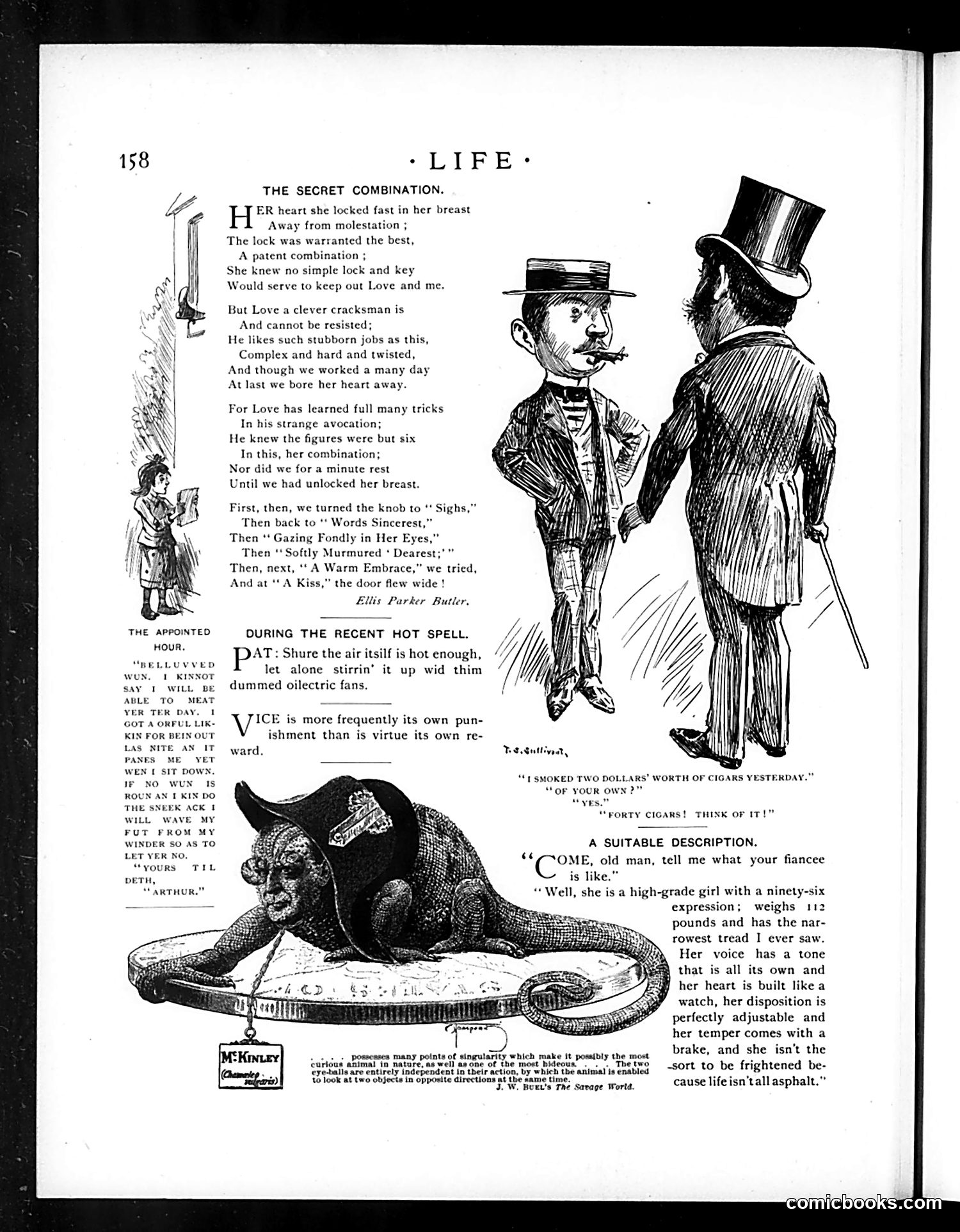
This page contains three distinct pieces of satirical content: 1. **"The Secret Combination"** (top left): A poem by Ellis Parker Butler about a woman whose locked heart Love has finally opened—a romantic metaphor about overcoming emotional barriers through persistence and clever manipulation of one's feelings. 2. **"The Appointed Hour"** (left margin): A brief poem about romantic anticipation and devotion. 3. **Two cartoon figures** (center-right): Two well-dressed men in top hats appear to be discussing cigars, with dialogue suggesting one smoked expensive cigars. The satire likely mocks pretension or social posturing about luxury goods. 4. **"A Suitable Description"** (bottom right): A humorous personal ad describing a woman's physical and personality traits in mechanical/clinical terms, satirizing how people were described in matrimonial advertisements of the era. The McKinley Company animal illustration below appears to be unrelated advertising.
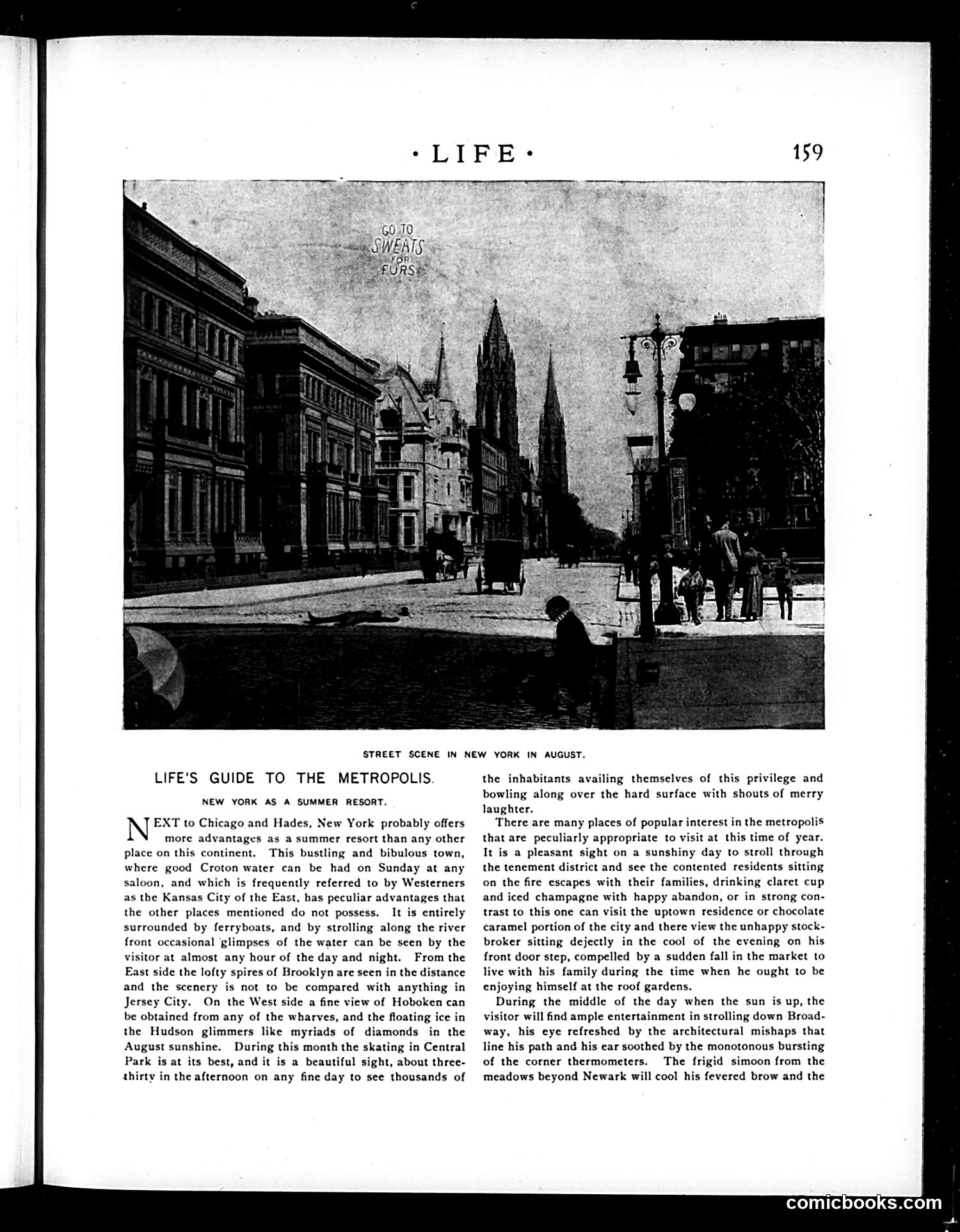
This is **not a political cartoon**, but rather a travel guide article titled "Life's Guide to the Metropolis: New York as a Summer Resort." The page features a street photograph of New York City in August, showing classical architecture, pedestrians, and church spires. The accompanying text promotes New York as a summer destination, comparing it favorably to Chicago and recommending specific activities: viewing tenement districts, visiting roof gardens, strolling Broadway to admire architecture, and enjoying Central Park skating. The article's tone is lighthearted tourism promotion, positioning Manhattan's urban landscape and working-class neighborhoods as attractions for summer visitors seeking novelty and entertainment during hot weather months.
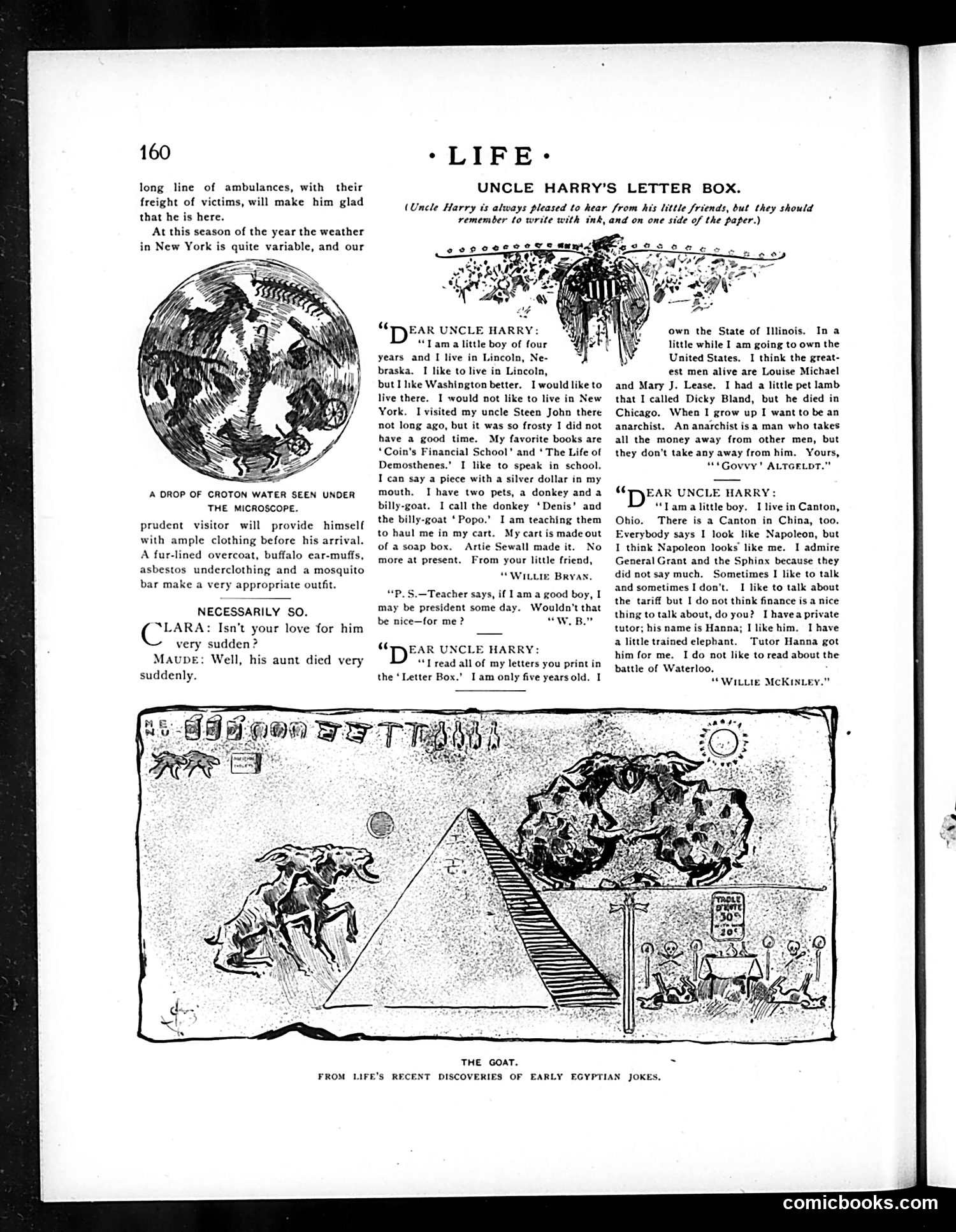
This page satirizes prominent American political figures of the 1890s by presenting fake letters from "children" who are actually thinly-veiled caricatures of real politicians. **The letters mock:** - **"Willie Bryan"** — William Jennings Bryan, Democratic politician and "Coin's Financial School" advocate, depicted as a boy with pet animals and presidential ambitions - **"Govvy Altgeldt"** — Governor John Peter Altgeld of Illinois, characterized as an anarchist wanting to redistribute wealth - **"Willie McKinly"** — William McKinley, future president, described as vain (comparing himself to Napoleon), influenced by his adviser Mark Hanna ("tutor"), and disinterested in intellectual matters The humor works by having these figures speak through childish voices, making them appear naive, foolish, or dangerous. The satire criticizes their economic policies, anarchist sympathies, and vanity. The cartoon at bottom, "The Goat," likely relates to these political figures as well, though its specific meaning is unclear without additional context.
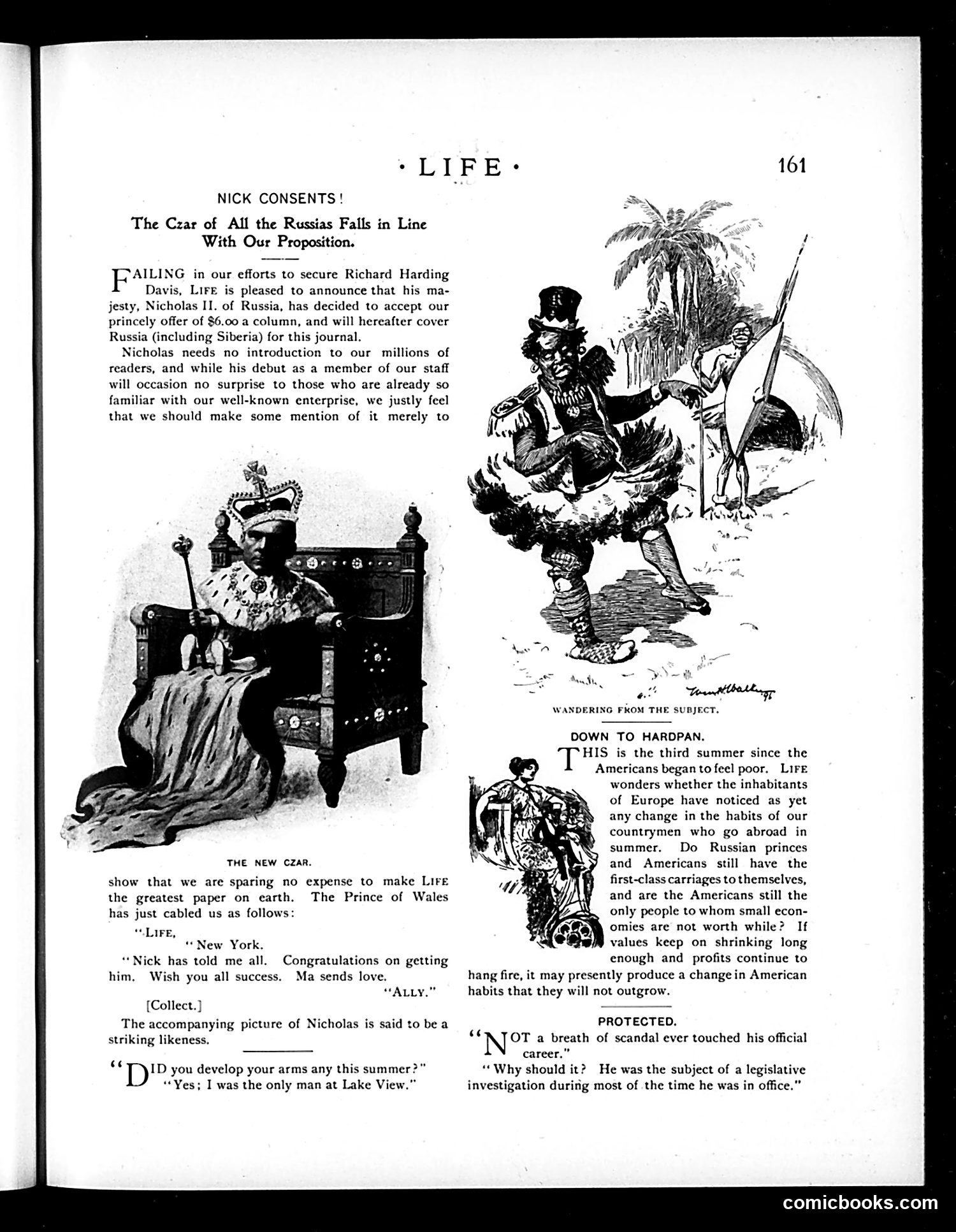
This page satirizes **Tsar Nicholas II of Russia** through mock-serious announcements. Life magazine humorously "announces" it has hired Nicholas II as a foreign correspondent for $6 per column to cover Russia—a joke mocking both the Tsar's autocratic power and American media's sensationalism. The cartoons caricature Nicholas II as an absurd, imperious figure (left image: "The New Czar" shows him pompously seated). The satire suggests that even absolute monarchs are subject to American commercial enterprise and journalistic appetite. A secondary joke references **Richard Harding Davis**, a famous war correspondent Life actually competed to recruit. The page also includes unrelated satirical items: commentary on wealthy Americans abroad economizing during financial hardship, and a jab at an unnamed politician whose career avoided scandal only because he was perpetually under "legislative investigation." The overall tone mocks American ambition, Russian autocracy, and political corruption with characteristic turn-of-century irreverence.
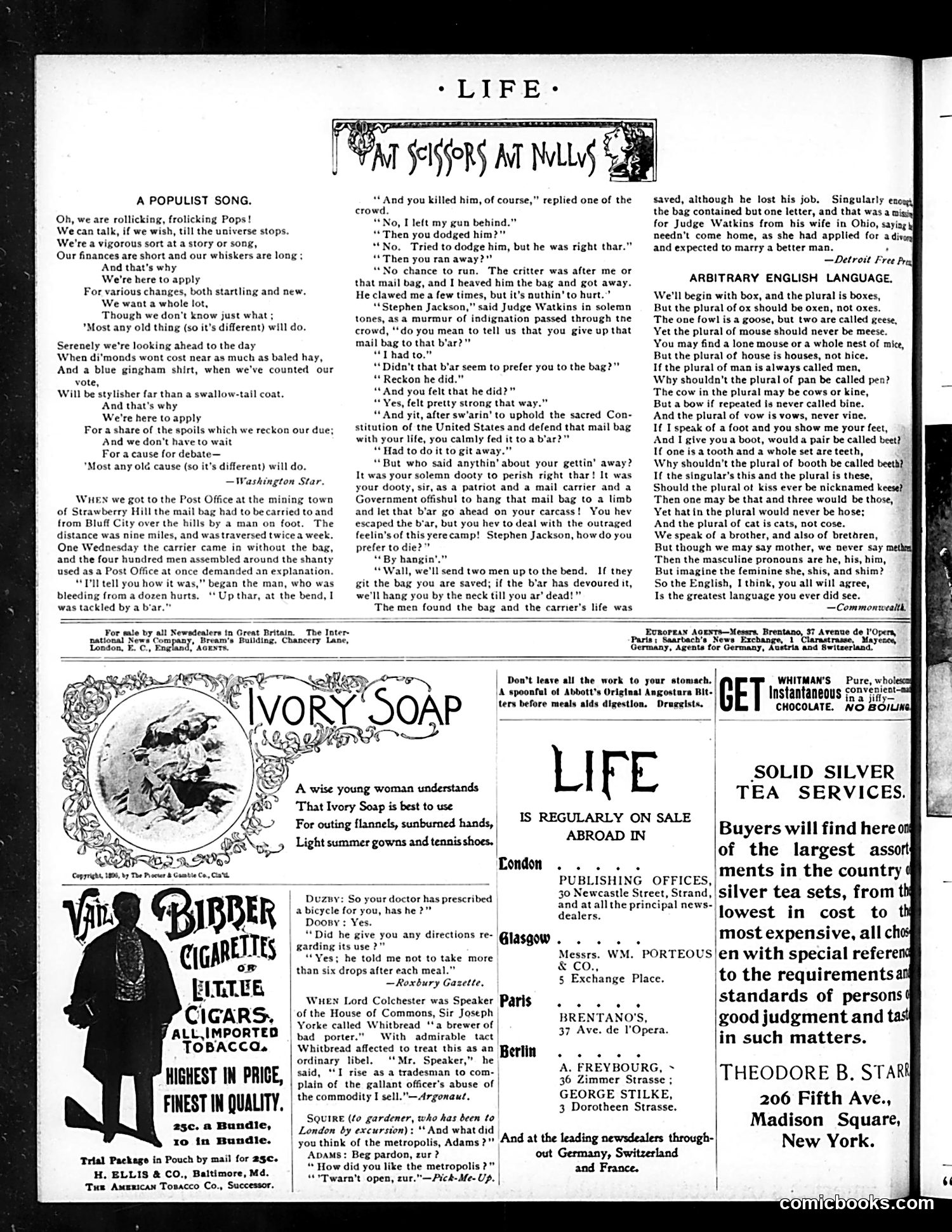
This page from the satirical magazine *Life* contains two main pieces of political/social commentary: **"A Populist Song"** mocks the Populist Party (a late-19th-century American movement) by portraying them as directionless rabble-rousers who want change simply for change's sake. The verse ridicules their lack of coherent policy—they want "a whole lot" but "don't know just what," demanding "most any old thing (so it's different) will do." It satirizes their perceived desperation for power and reform without substance. **"The Mail Bag and the Bear"** is a frontier tall tale satirizing rigid bureaucratic thinking. A mail carrier sacrifices the mail bag to escape a bear, but a judge insists he should have died defending it—criticizing the absurd prioritization of duty over reason and human life. The page also contains period advertising (Ivory Soap, tobacco products) and a section on English language irregularities, typical of *Life's* miscellaneous satirical content format.
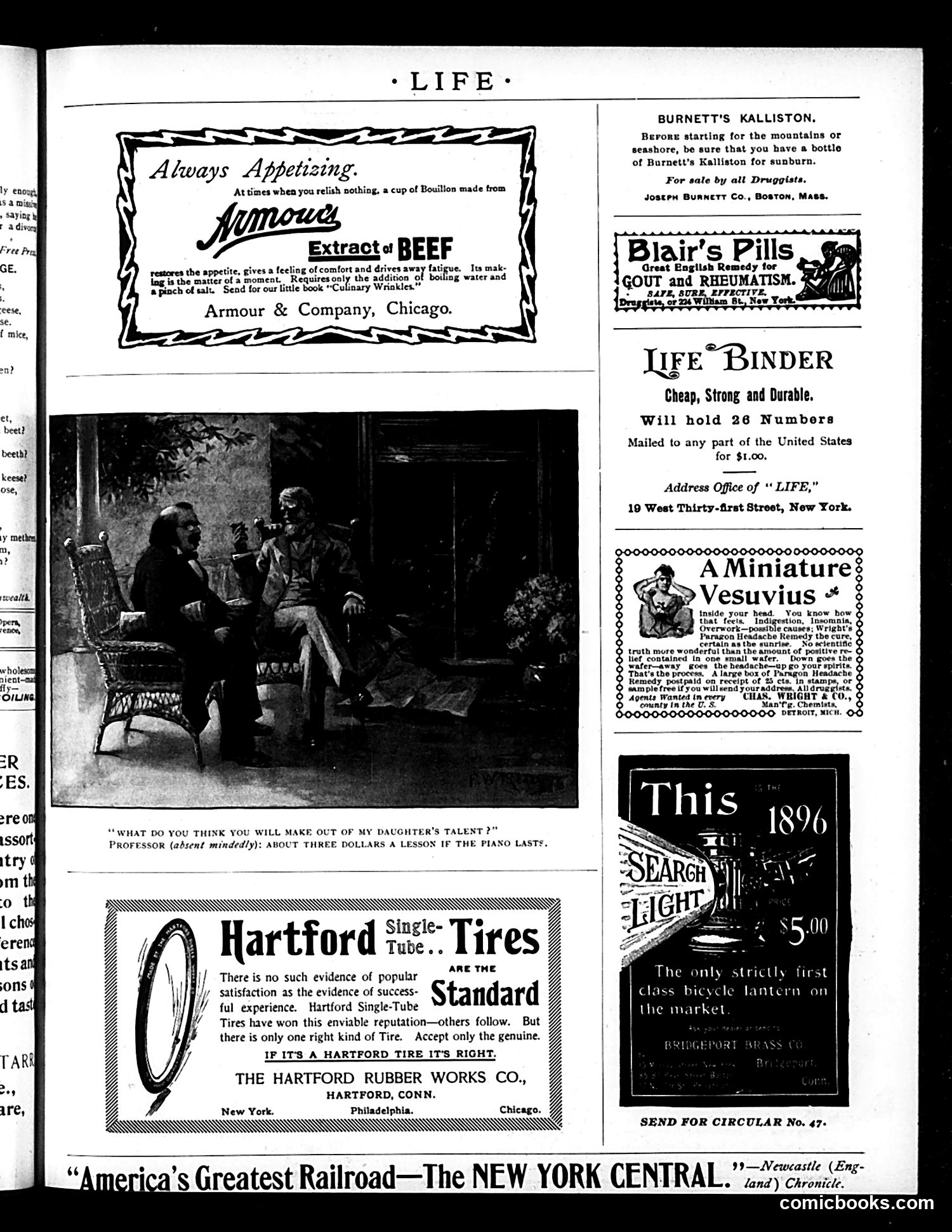
The main cartoon depicts a social satire about music lessons and class expectations. A prosperous parent asks a music professor what financial return he expects from teaching their daughter piano. The professor, "absent mindedly," responds he'll make "about three dollars a lesson if the piano lasts"—a cynical joke suggesting the piano's durability matters more than the student's talent or progress. The humor targets the wealthy's assumption that hiring professionals guarantees their children's success, while also mocking the professor's mercenary indifference. It reflects late 19th-century anxieties about class mobility and the commercialization of cultural refinement—music lessons were markers of genteel status, yet were often pursued without genuine aptitude. The surrounding page contains product advertisements (beef extract, tires, pills, bicycle lanterns) typical of Life's revenue model, rather than additional editorial content.
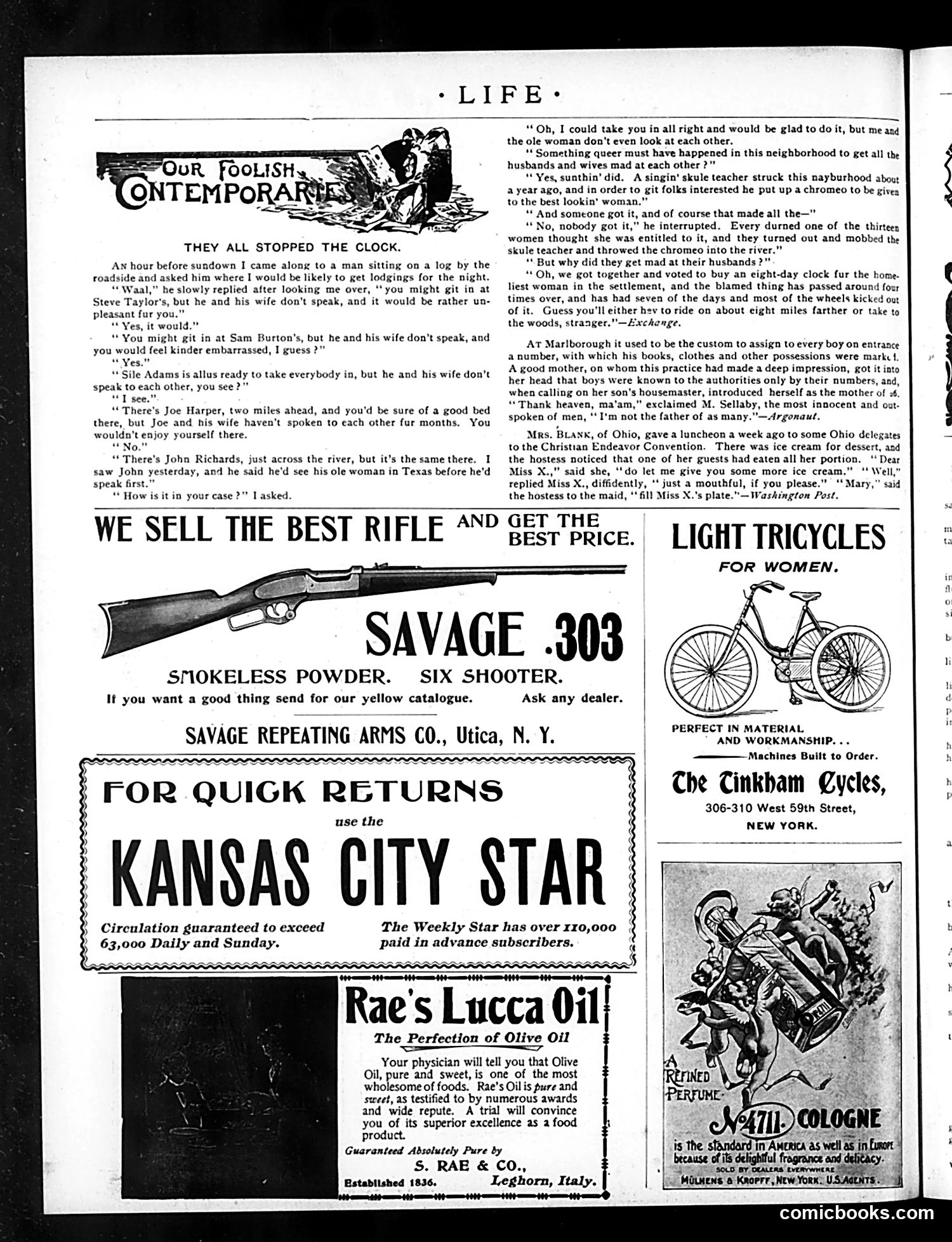
This page contains three unrelated humorous anecdotes typical of early Life magazine's satirical content. **The main cartoon story** satirizes small-town marital discord. A traveling stranger seeks lodging and learns that every couple in the neighborhood has stopped speaking to each other. The cause: a singing teacher offered a chromolithograph prize to "the best lookin' woman." All thirteen women claimed they deserved it; none won. Rather than resolve the dispute, the humiliated husbands and wives directed their anger at each other instead of the real problem, leading to widespread domestic silence. The satire targets how petty vanity and wounded pride can poison entire communities, with people choosing prolonged resentment over rational discussion. **Secondary anecdotes** mock bureaucratic dehumanization (a mother identifying herself by her son's school number) and social awkwardness (a guest eating all her dessert, then accepting more when offered). The remainder is advertising for rifles, newspapers, bicycles, and olive oil—typical of Life's revenue model.
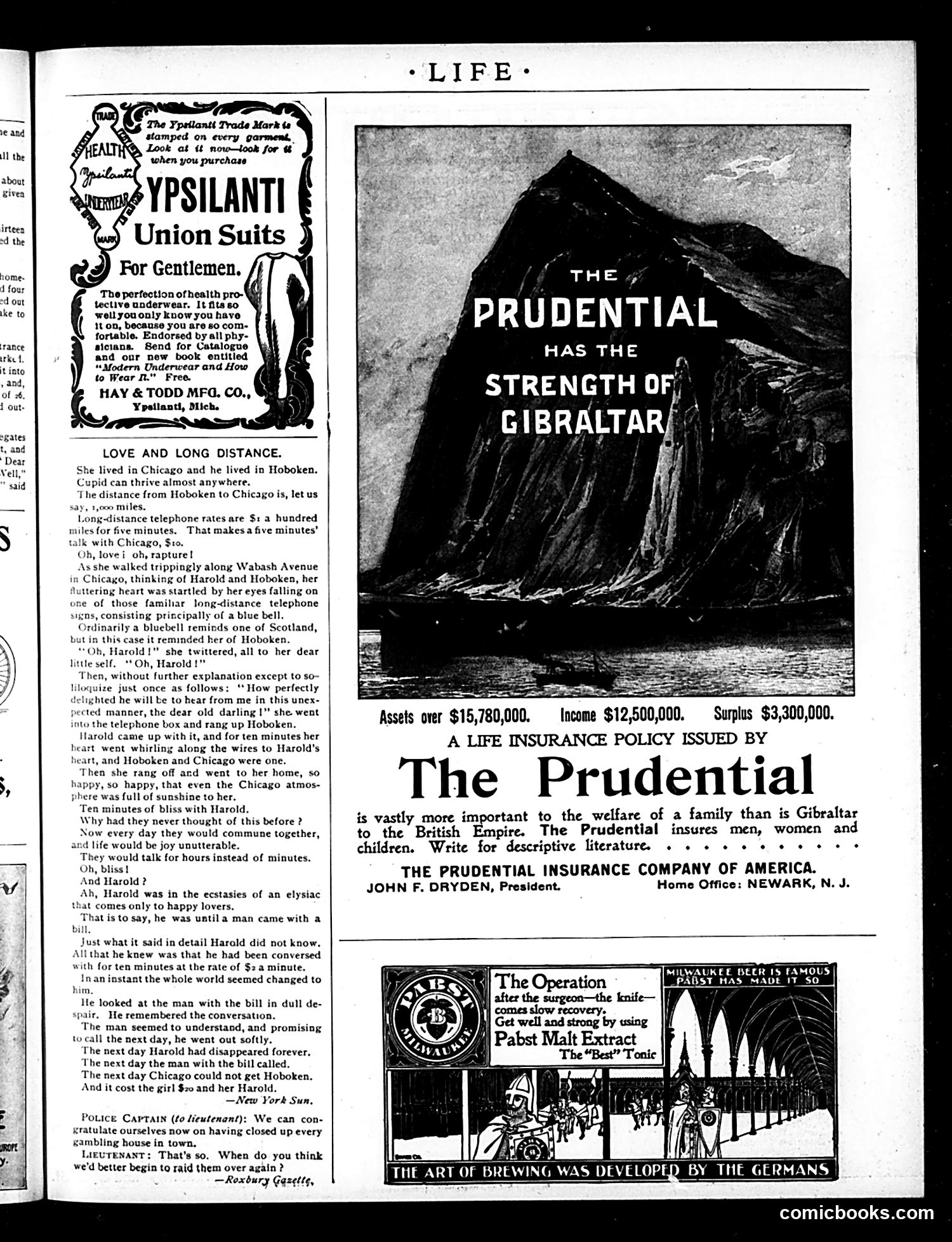
This page contains three distinct elements: **Main Story: "Love and Long Distance"** — A satirical narrative about a young woman in Chicago who impulsively calls her boyfriend in Hoboken after spotting a telephone sign. The joke's punch line: she's thrilled by ten minutes of conversation until Harold receives a bill for $20 (at $2/minute for long-distance rates). He immediately abandons her, and she's left heartbroken and financially ruined. The satire mocks both the extortionate telephone rates of the era and romantic idealism meeting harsh economic reality. **Advertisements:** The page includes ads for Ypsilanti Union Suits (underwear), The Prudential Insurance Company (with Gibraltar imagery suggesting strength), and Pabst Malt Extract. **Police Joke:** A brief satirical exchange at bottom between a police captain and lieutenant, joking that after closing all gambling houses, they should "raid them over again"—mocking ineffective law enforcement and corruption. The telephone story is the primary satirical content, targeting both the telephone monopoly's pricing and naive romance.
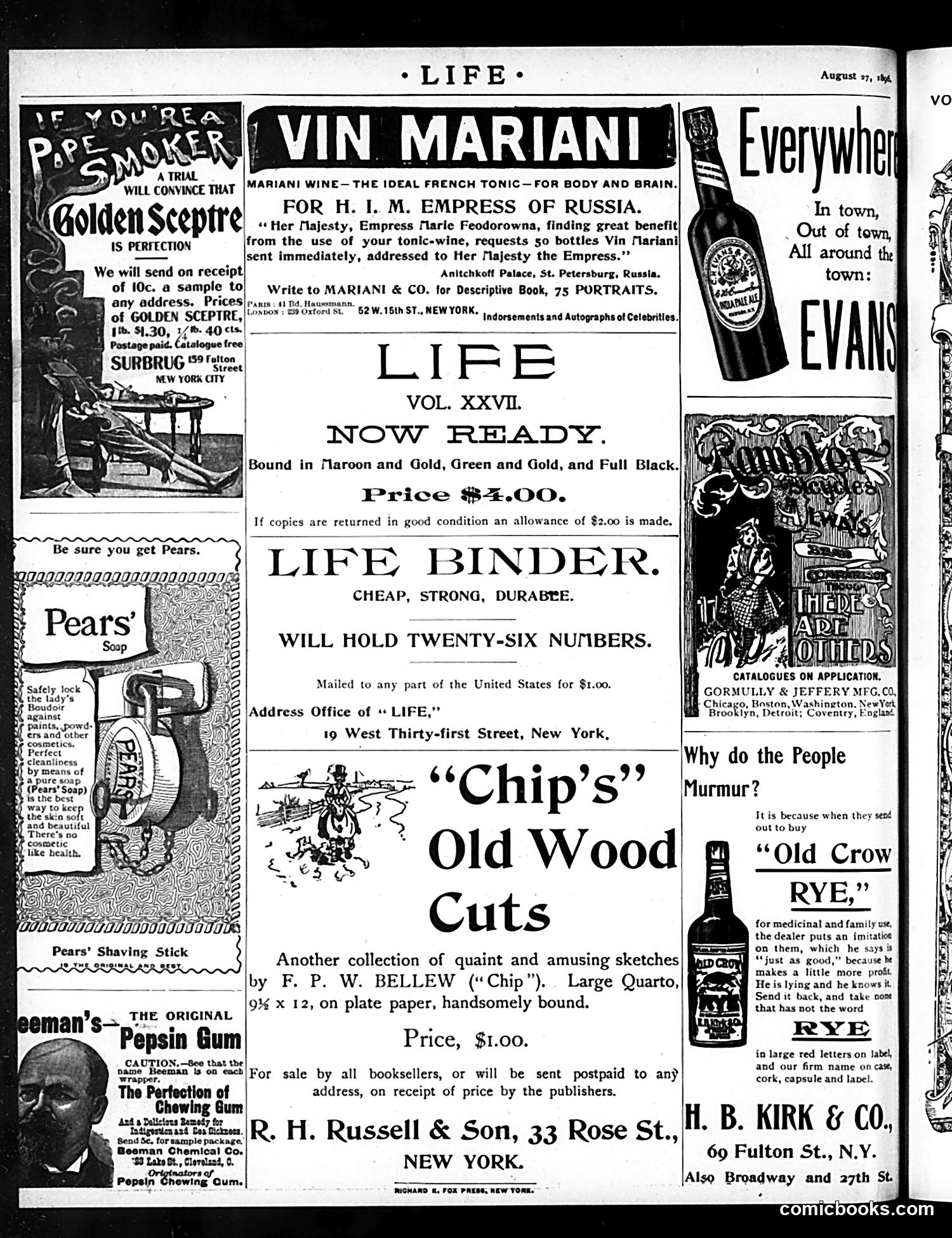
This is primarily a **title page and advertisement collection**, not a satirical cartoon page. It announces Life Vol. XXVII is "now ready" at $4.00, bound in various colors, with a $2.00 allowance for returned copies. The page contains multiple period advertisements: - **Vin Mariani wine** claims endorsement from Russia's Empress Marie Feodorowna as a health tonic - **Pears' Soap** advertises its safety-lock shaving stick - **"Chip's Old Wood Cuts"** by F.P.W. Bellew—a collection of sketches for $1.00 - **Old Crow Rye** whiskey warns against counterfeits; consumers complain because dealers substitute inferior brands claiming equivalence - **Beeman's Pepsin Gum** and other products round out the page The Old Crow ad is the only piece with satirical bite—it mocks consumer frustration with fraudulent product substitution, a legitimate commercial complaint of the era. The rest is straightforward commercial promotion typical of the magazine's revenue model.