
A complete issue · 18 pages · 1896
Life — July 30, 1896
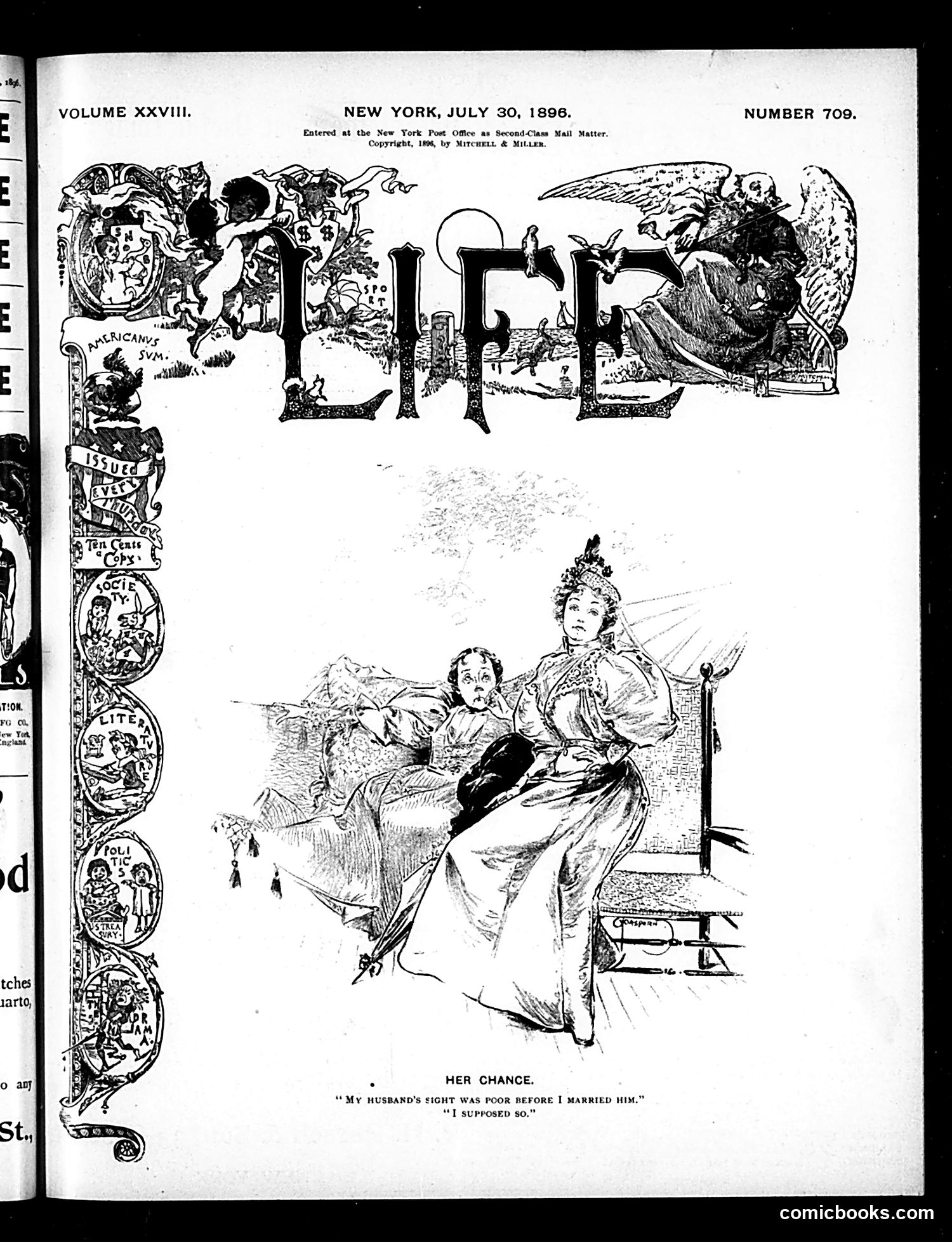
This page features a single cartoon titled "Her Chance," with the caption: "My husband's fight was poor before I married him. I supposed so." The illustration shows a woman with an elaborate feathered hat sitting with a young child, appearing to be in a fashionable interior. The satire targets the common practice of women marrying men hoping to "improve" them—particularly their financial circumstances or moral character. The woman's expensive, fashionable appearance contrasts ironically with her claim that she "supposed" (accepted) her husband's poor fighting record or poor fortune before marriage, suggesting she either misunderstood his prospects or was naive about marriage's transformative powers. The cartoon mocks both the woman's expectations and the general social delusion that marriage could remedy a man's fundamental failings.
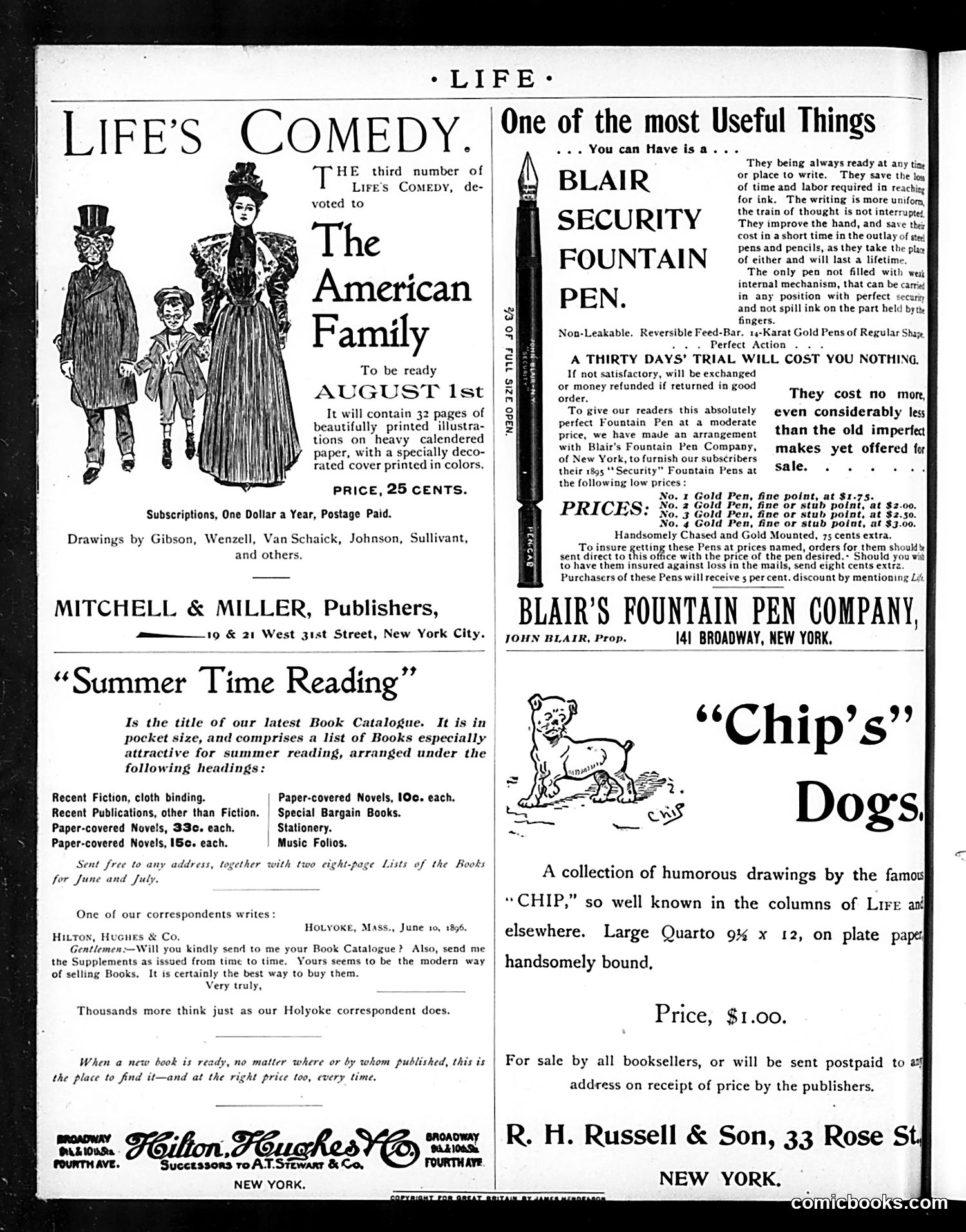
This page is primarily **advertising and promotional content** rather than political satire. The main feature advertises the third issue of *Life*'s "Comedy" series, promoting "The American Family" comic installment (price 25 cents). The illustration shows three figures in period dress—likely representing different generations or social classes—though specific individuals aren't identifiable as caricatures. The page contains advertisements for Blair Security Fountain Pens and "Chip's" Dogs (a humorous drawing collection). The publication date and specific satirical targets are unclear from the visible text, but the overall tone suggests genteel, family-oriented humor typical of early *Life* magazine rather than pointed political commentary.
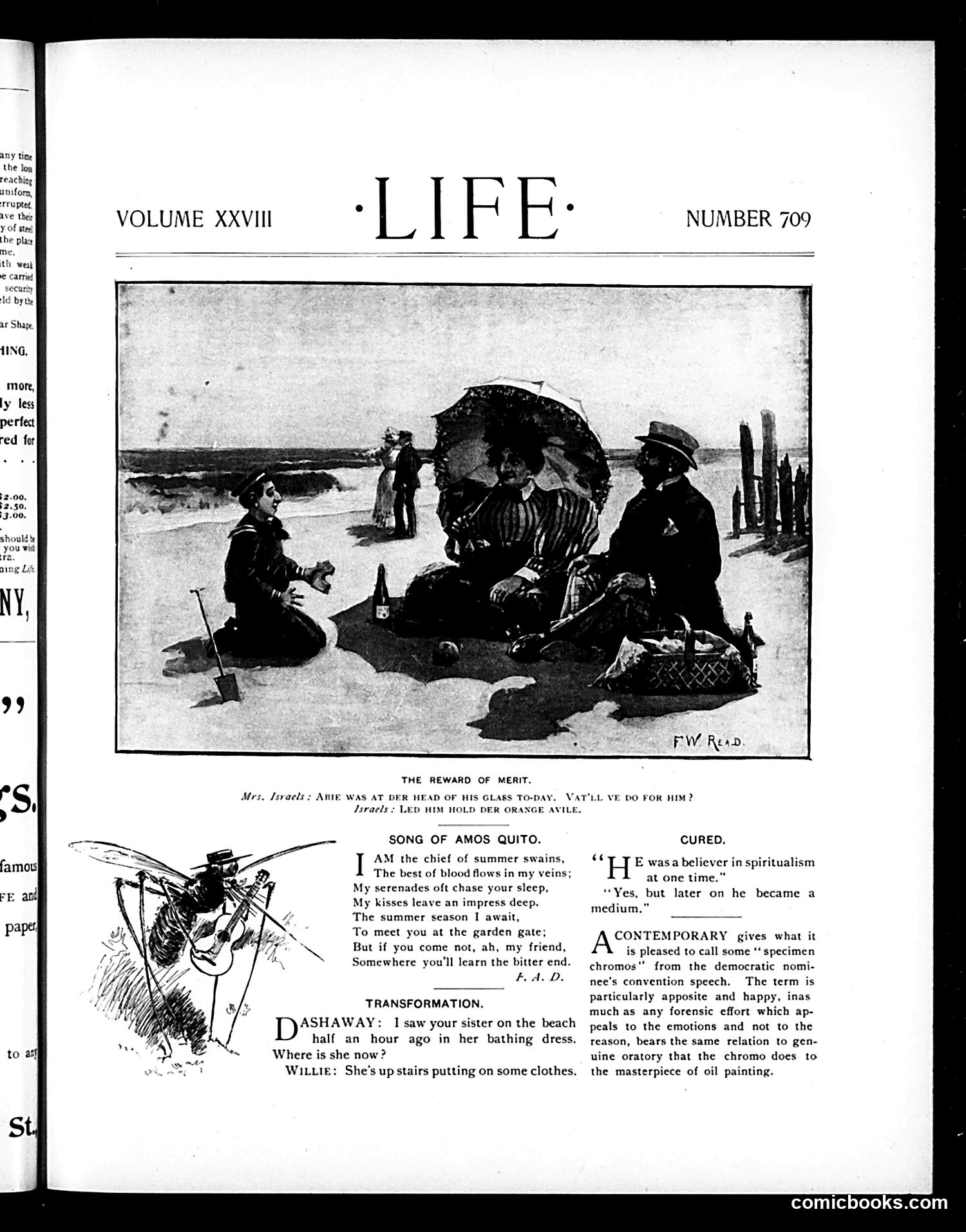
This page contains three separate humorous pieces: **"The Reward of Merit"** (top): A beach scene where Mrs. Israel asks if Abe was at the head of his glass today, and Israel replies he held her orange awhile. The joke likely plays on double meanings and marital dynamics, though the specific reference is unclear. **"Song of Amos Quito"** (bottom left): A poem by F.A.D. about summer romance, featuring an illustration of an insect. It's sentimental verse about courtship and potential heartbreak. **"Cured"** and **"Transformation"** (right): Brief humorous dialogues. The first mentions spiritualism; the second involves a sister seen in a bathing dress who's now fully clothed upstairs—a simple joke about quick costume changes. These represent typical early 20th-century Life magazine humor: domestic situations, light verse, and wordplay.
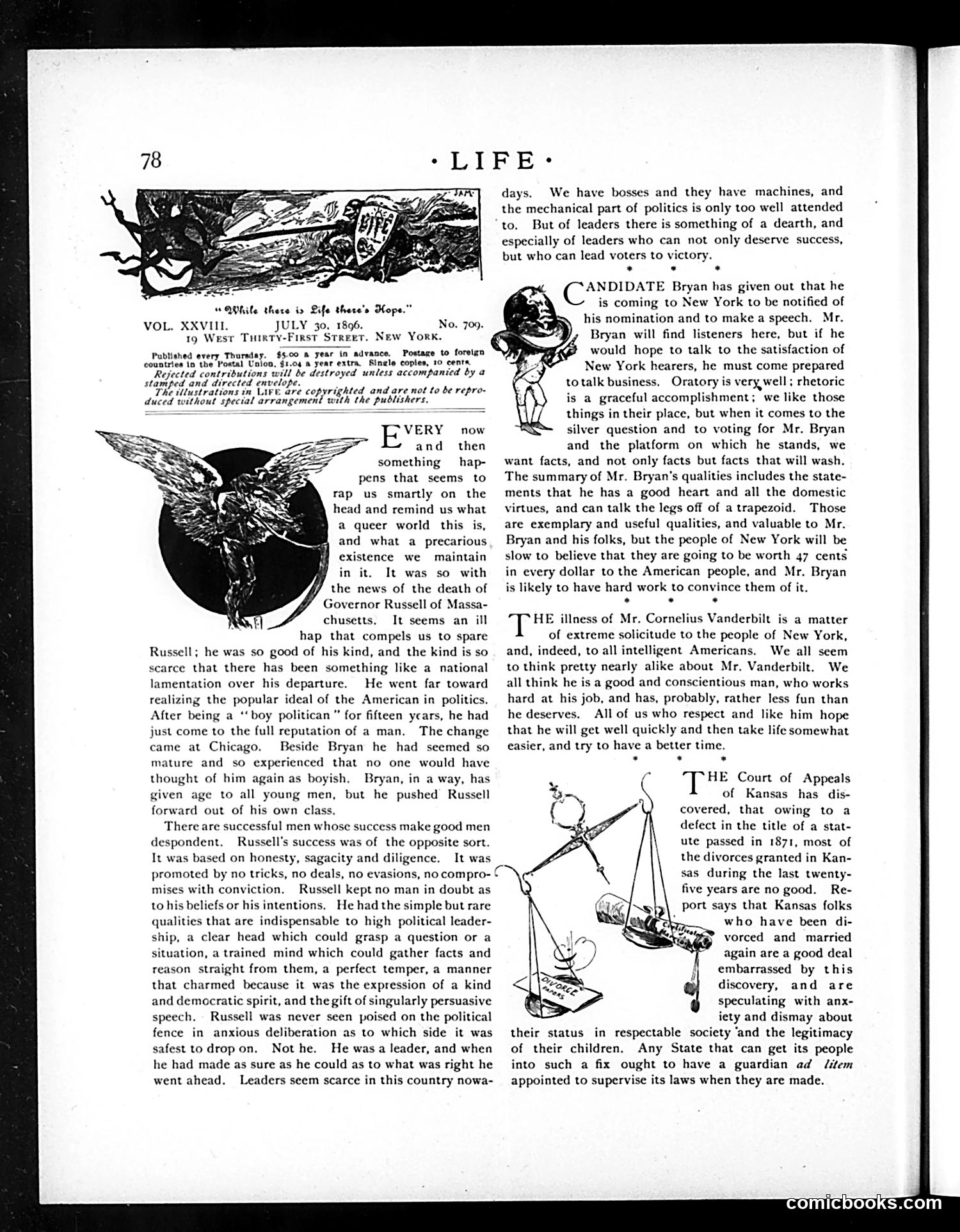
This page contains three distinct political commentaries: 1. **The dead bird illustration** mourns Russell of Massachusetts—likely a political figure whose death is compared to losing "something like a national lamentation." The text praises his integrity and independence in politics. 2. **The Bryan cartoon** (top right) addresses William Jennings Bryan's upcoming New York speech regarding his presidential nomination. The satire suggests New York voters won't be easily convinced by Bryan's oratory, implying his platform lacks substantive appeal beyond rhetoric. 3. **The scales of justice cartoon** (bottom) critiques a Kansas Court ruling that invalidated divorces granted under an 1871 statute, leaving divorced-and-remarried individuals in legal limbo and social embarrassment. All three pieces mock political and legal failures of leadership.
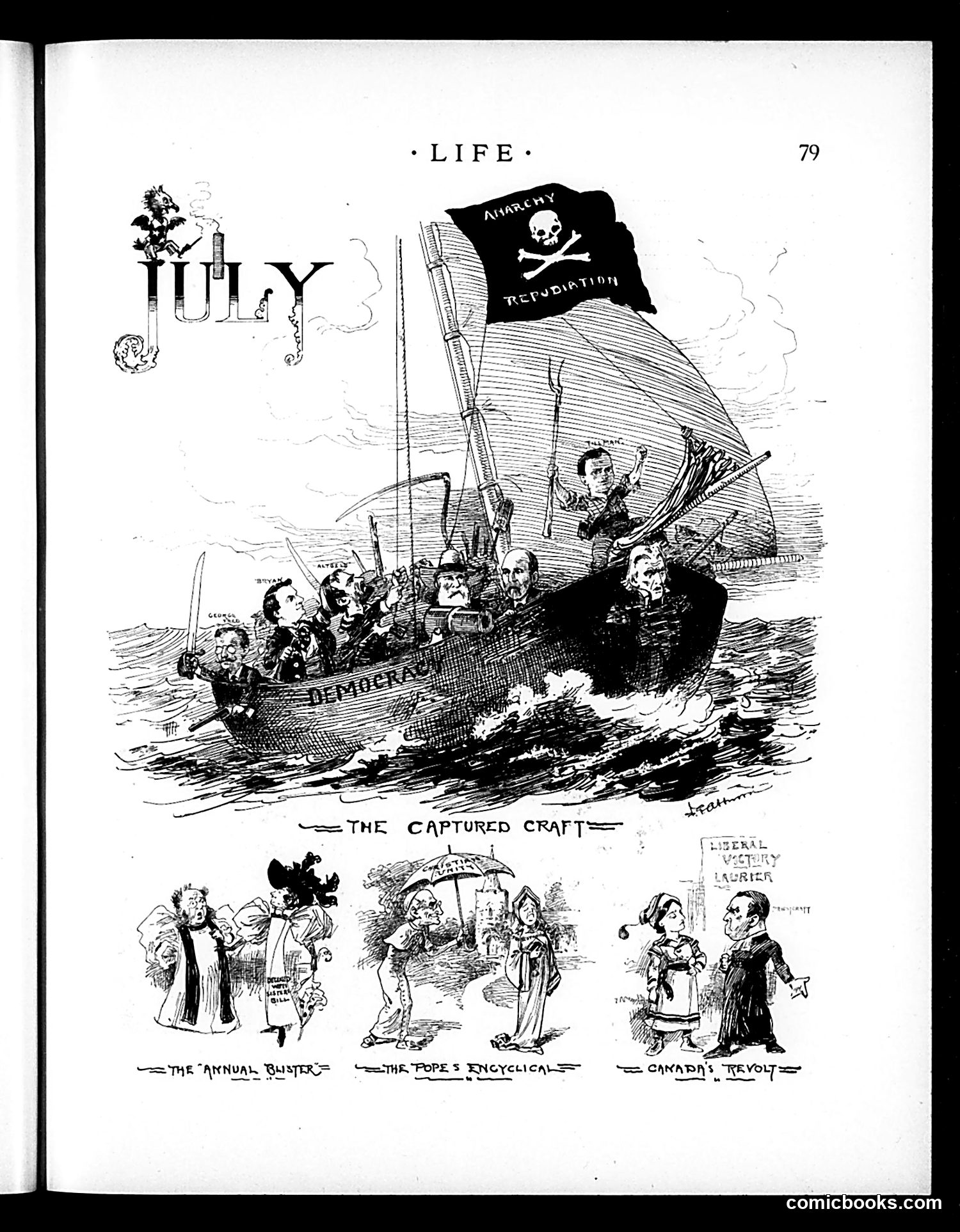
This page contains four political cartoons satirizing late 19th-century American politics: **"The Captured Craft"** (main image): A boat labeled "Democracy" is captured by a pirate ship flying a flag reading "Anarchy" and "Republicanism." Multiple caricatured figures man the vessel, suggesting Republican leaders are steering democracy toward anarchic or destructive policies. **"The Annual Bluster"**: Two figures in confrontation, likely depicting routine political posturing. **"The Pope's Encyclical"**: Religious authority addressing political matters, possibly critiquing papal intervention in American affairs. **"Canada's Tryout"**: Two figures, unclear reference but likely commenting on Canadian-American relations. The cartoons collectively mock Republican governance, anarchist associations, and institutional overreach during a period of significant political tension.
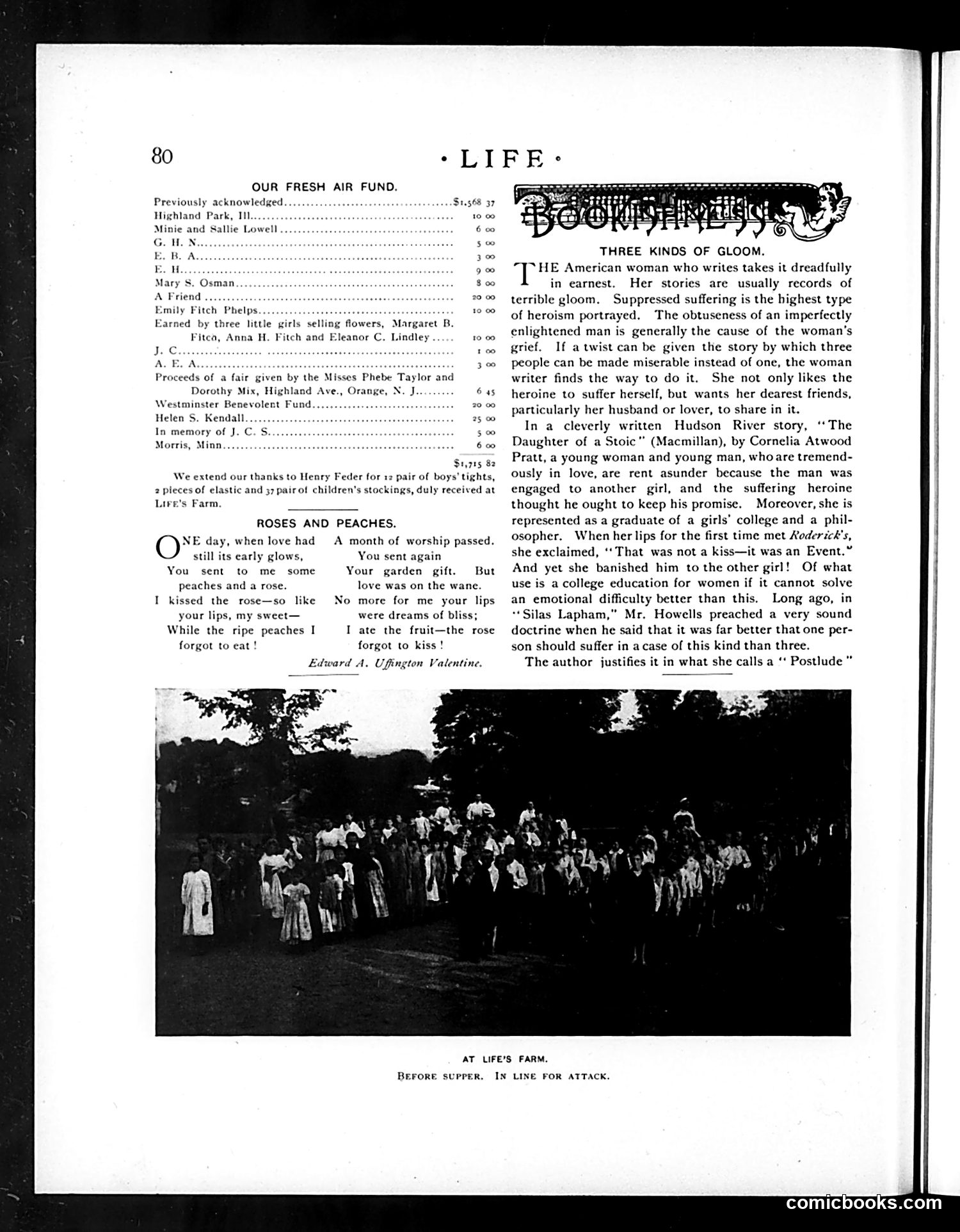
This page contains **no political cartoon**, but rather literary and philanthropic content. The top section lists donors to "Our Fresh Air Fund," a charitable initiative providing outdoor recreation for underprivileged children. Names and donation amounts suggest a community fundraising effort. Below is a short poem titled "Roses and Peaches" by Edward A. Uflington Valentine, a sentimental piece about love and romance using floral imagery. The main feature is an article titled "Three Kinds of Gloom" discussing how American women writers depict suffering in literature. It references Hudson River school stories and mentions specific works like "The Daughter of a Stoic" and "Silas Lapham," analyzing how female authors handle emotional difficulties in their narratives. The photograph shows a crowd gathering at "Life's Farm" before supper, "in line for attack"—likely a humorous caption for what appears to be a community event.
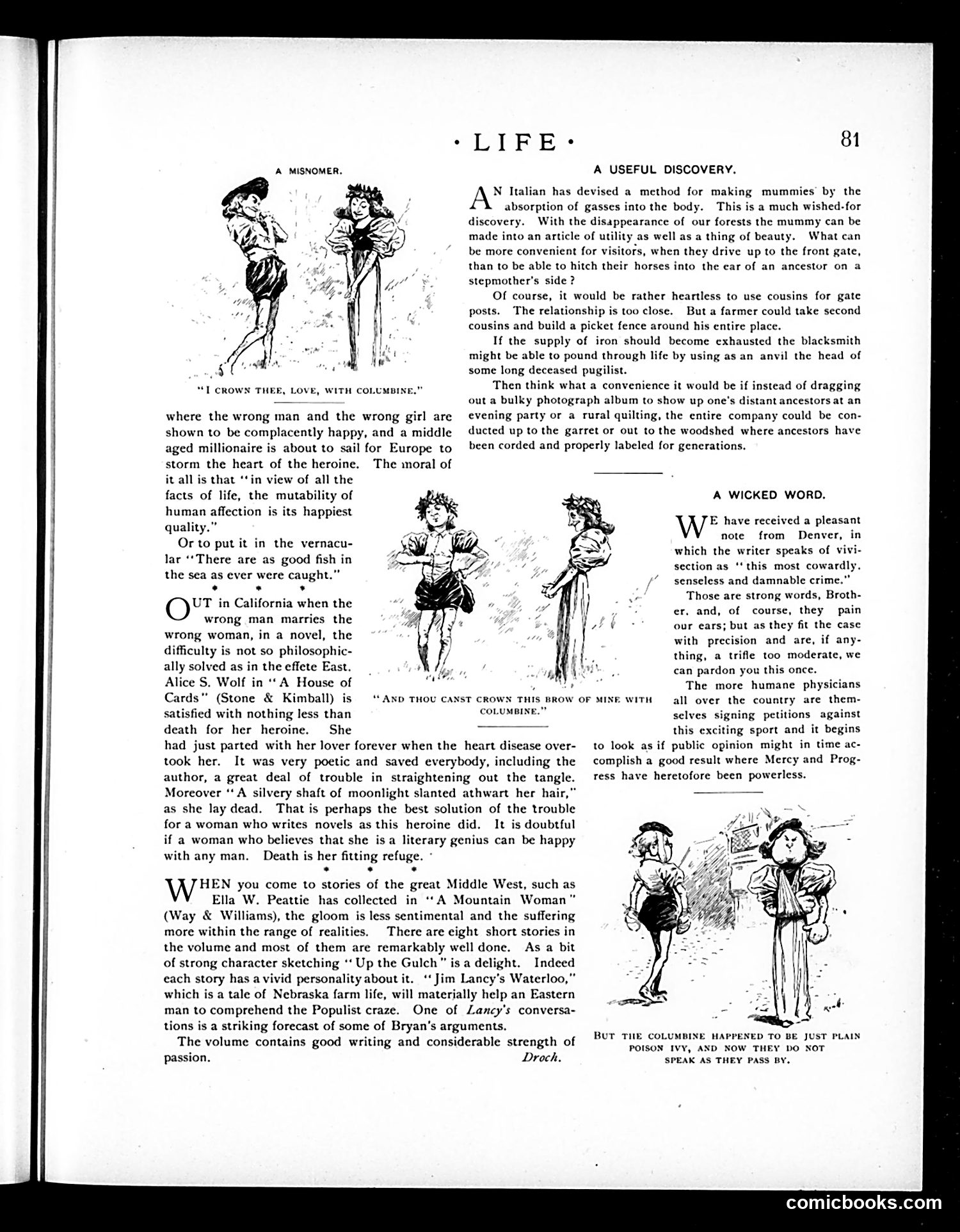
This page contains three sections of satirical editorial content with accompanying illustrations. **"A Misnomer"** features two sketched figures with the caption "I crown thee, love, with columbine." The text satirizes romantic mismatches—specifically a scenario where the wrong man marries the wrong woman in California, creating domestic difficulty. The satire suggests that literary genius doesn't guarantee happiness in marriage, referencing Alice S. Wolf's novel "A House of Cards." **"A Useful Discovery"** mocks an Italian method for preserving mummies by gas absorption, absurdly suggesting practical applications like replacing fence posts or using deceased pugilists as iron sources. **"A Wicked Word"** responds to a Denver writer's criticism of vivid fiction, defending strong language in literature as sometimes necessary. The illustrations are period ink sketches typical of early 20th-century Life magazine's visual style.
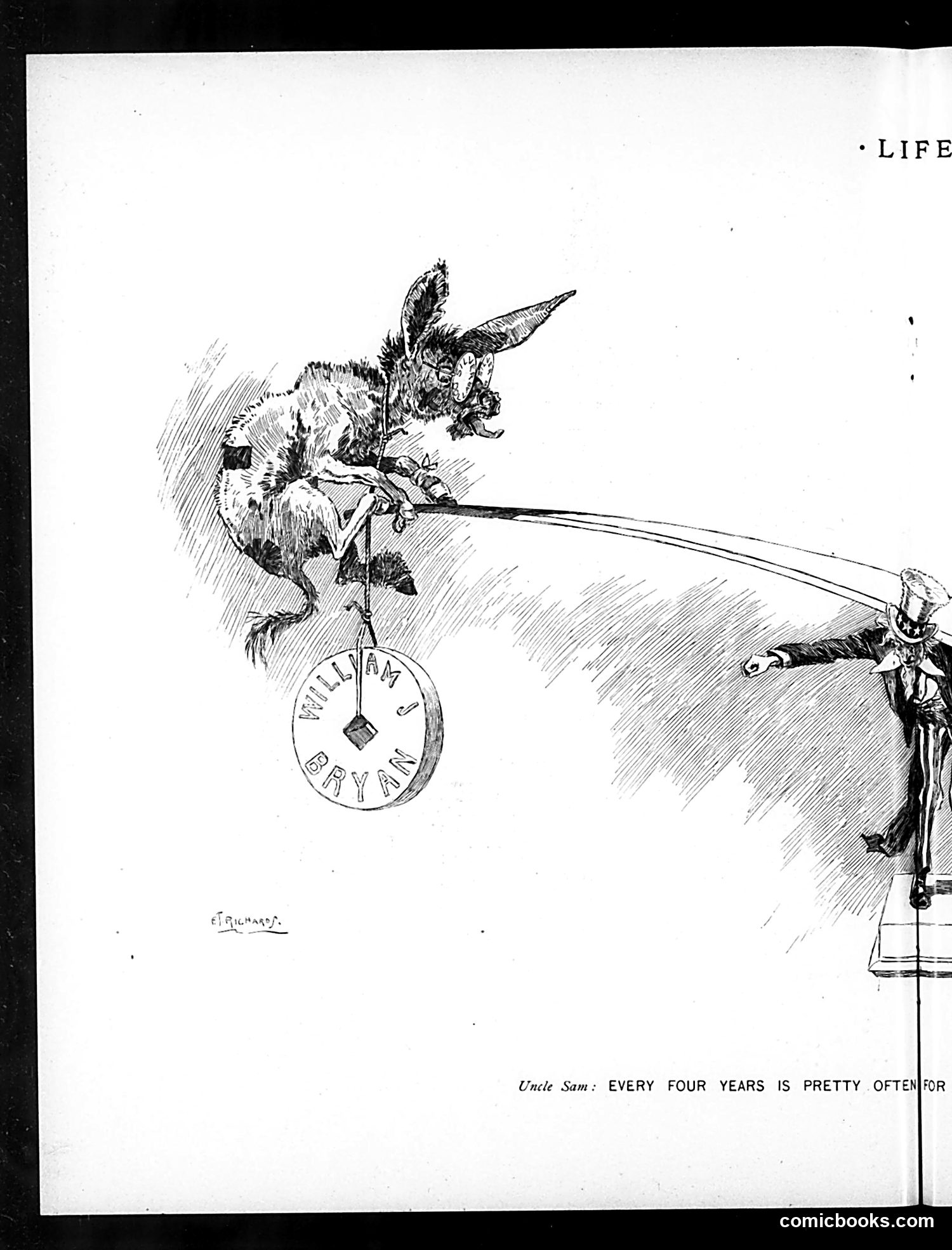
This Life magazine cartoon satirizes U.S. presidential elections. Uncle Sam (the bearded figure on the right, representing America) dangles a donkey on a string above a scale labeled "WILLIAM J. BRYAN"—likely referring to William Jennings Bryan, a three-time presidential candidate. The donkey represents the Democratic Party. The caption states: "EVERY FOUR YEARS IS PRETTY OFTEN FOR"—the sentence appears cut off, but the implication is clear: the cartoon mocks how frequently Bryan ran for president or how often elections recur. The swinging scale suggests the election process is a controlled manipulation, with the donkey/Democratic Party repeatedly being tested or weighed by the nation's leadership. The satirist criticizes either Bryan's persistent candidacy or the predictability of electoral cycles.
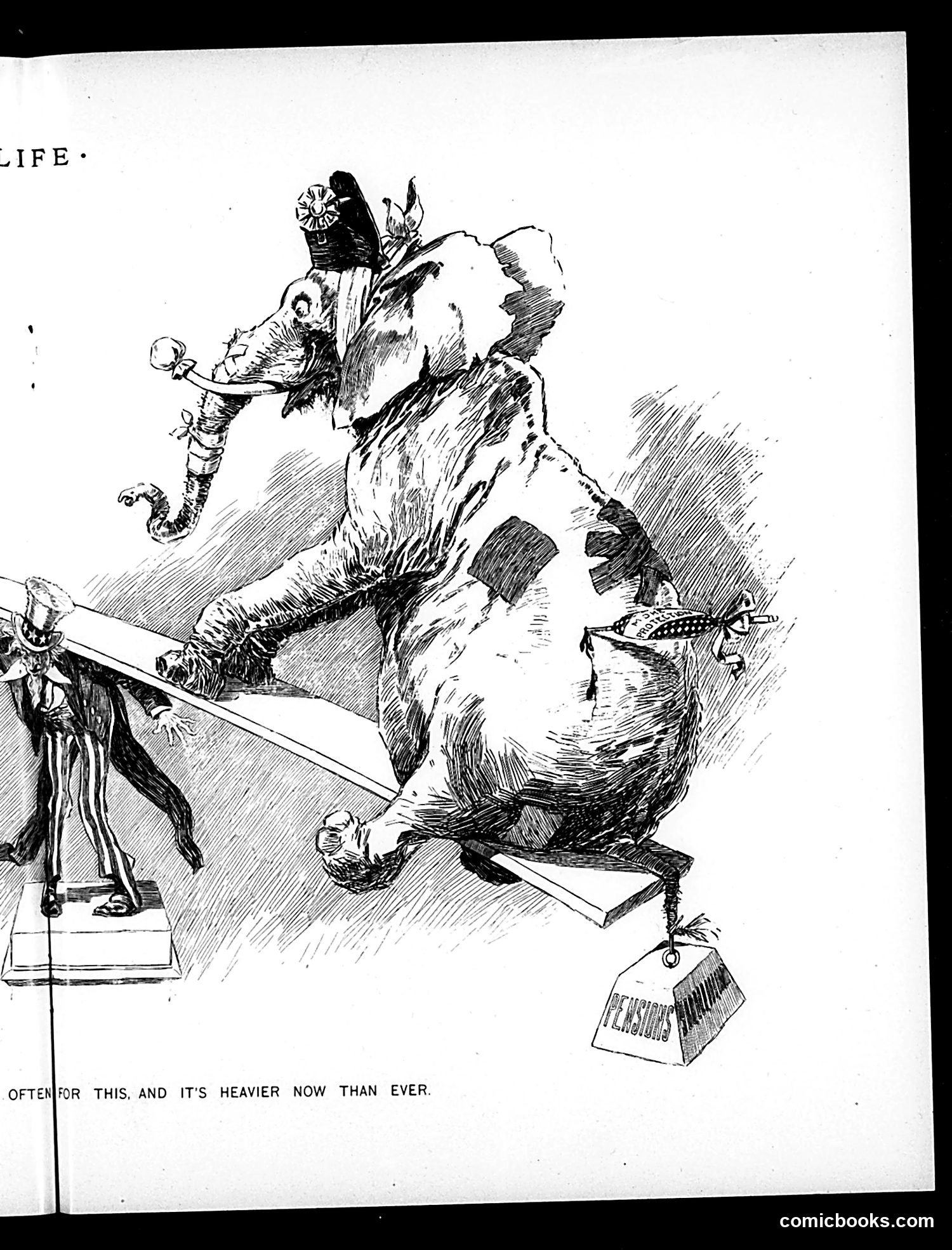
This is a satirical cartoon showing a man in formal dress controlling an elephant like a tightrope performer with a whip and platform. The elephant appears to be struggling and weighted down, labeled what appears to be "Tariff" on a weight attached below. The caption reads: "OFTEN FOR THIS, AND IT'S HEAVIER NOW THAN EVER." This is likely commentary on the burden of tariff policy—the elephant traditionally represents the Republican Party in American political cartoons. The cartoon suggests that tariff policies, controlled by political leaders, have become an increasingly heavy burden on the nation (represented by the struggling elephant). The trainer's dominance illustrates how politicians manipulate these policies despite their growing weight and negative impact on the economy or public welfare.
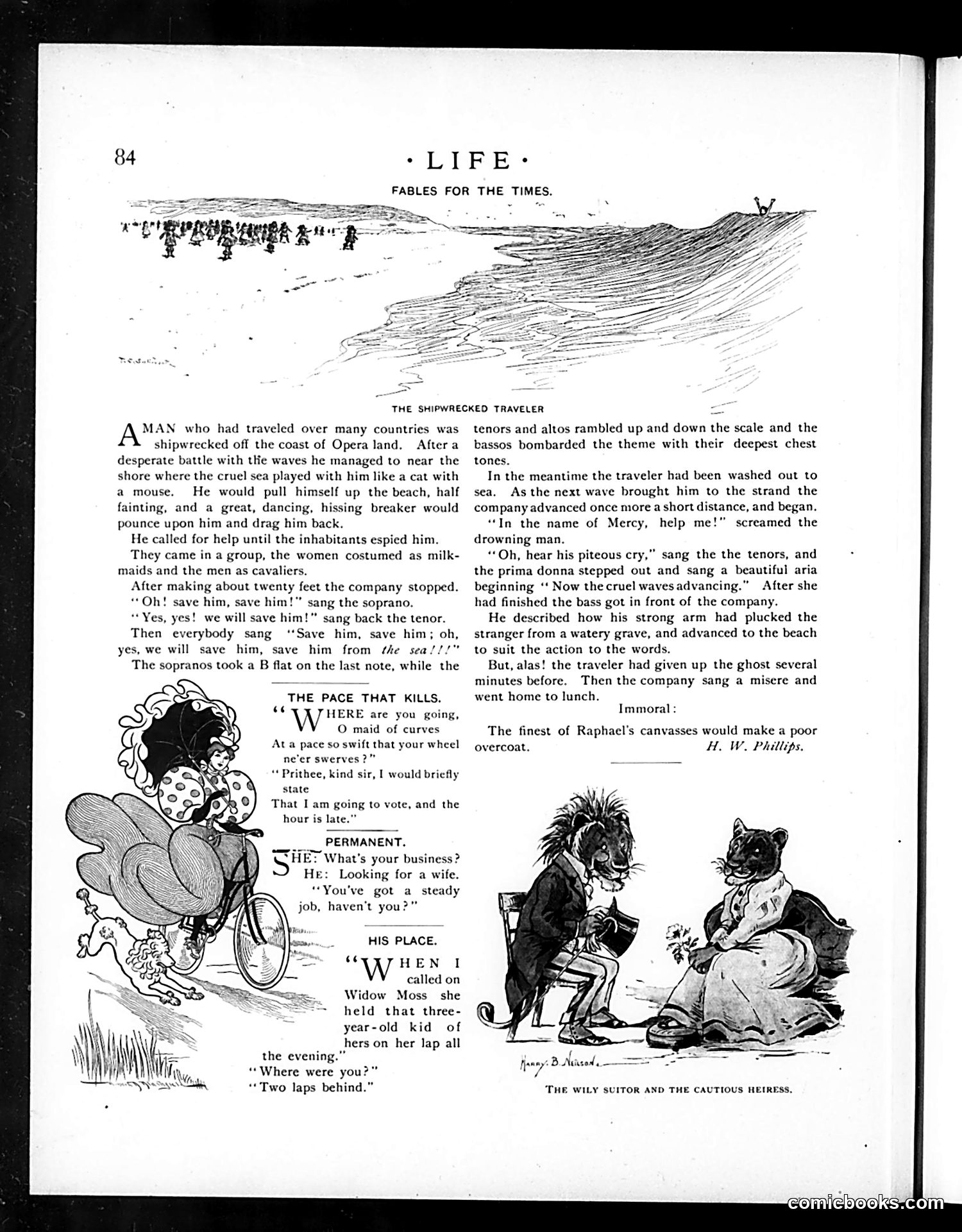
This page contains three satirical pieces: 1. **"The Shipwrecked Traveler"**: A fable mocking operatic conventions. A drowning man is rescued but the opera company singing nearby prioritizes finishing their aria over saving him—satirizing how performers prioritize their art above real human suffering. 2. **"The Pace That Kills"**: A cartoon of a woman on a bicycle with exaggerated curves, captioned about voting being "late"—likely satirizing the "New Woman" of the early 1900s who rode bicycles and sought voting rights, with the humor playing on anxieties about women's changing social roles. 3. **"His Place" and "The Wily Suitor and the Cautious Heiress"**: Brief dialogue jokes about courtship and wealth. The illustrations throughout mock contemporary social pretensions and changing gender dynamics.
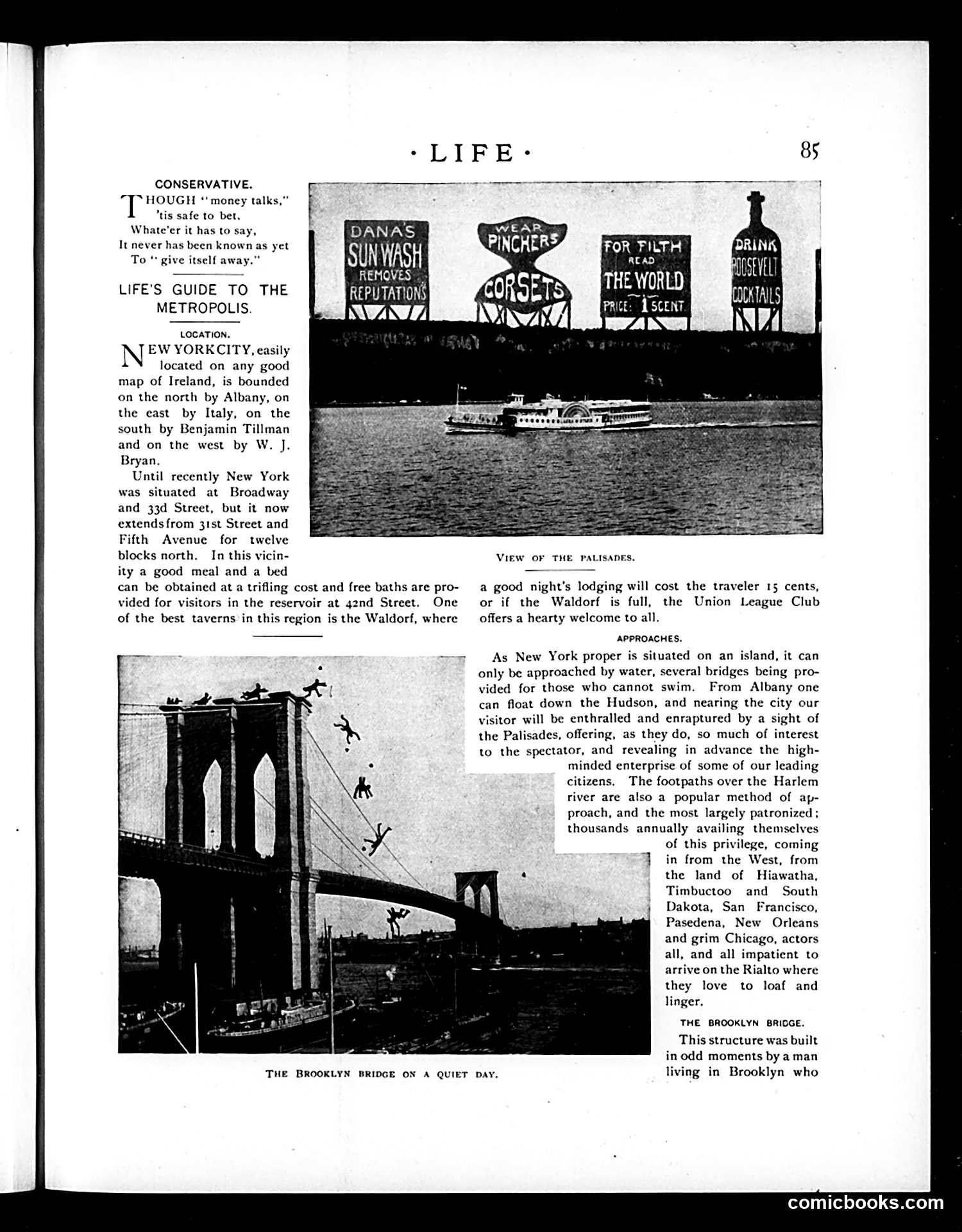
This page from *Life* magazine contains a satirical section titled "Life's Guide to the Metropolis" focused on New York City. The top image shows rooftop advertisements for period products (Dana's Sunwash, corsets, "For Filth Read The World," and Roosevelt Cocktails), with a steamboat on the Hudson River below—satirizing commercial clutter and urban development. The lower image depicts the Brooklyn Bridge with figures appearing to jump from it, captioned "The Brooklyn Bridge on a Quiet Day." This is dark satire about suicide, apparently a recognized urban problem at the time. The accompanying text describes New York's geography and tourist attractions in a tongue-in-cheek manner, mixing genuine tourist information with sardonic commentary on city life and visitors from across America.
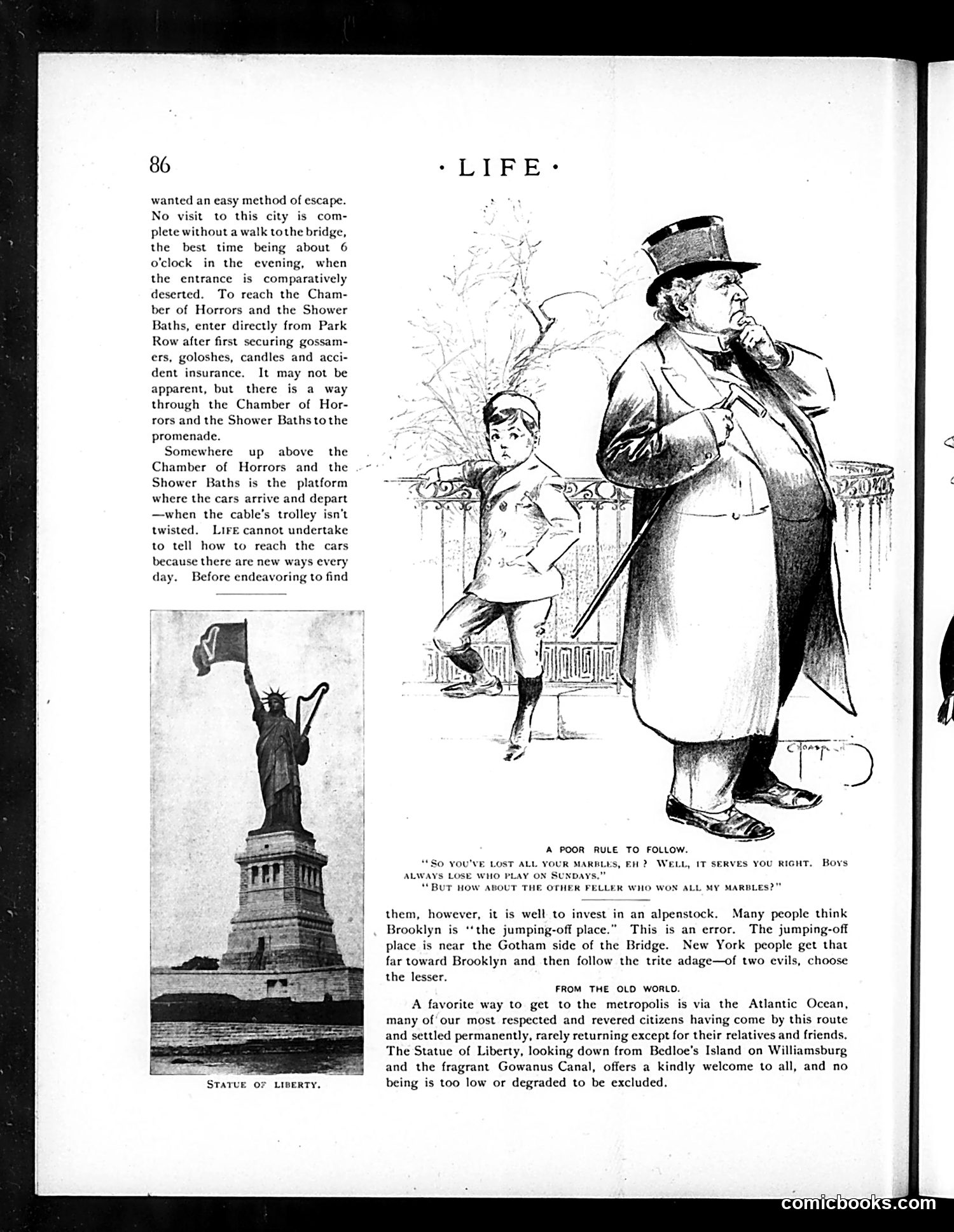
This page satirizes New York City's infrastructure and immigration, using dark humor typical of early Life magazine. **Main Cartoon:** An elegantly dressed man and young boy stand on what appears to be the Brooklyn Bridge. The caption "A Poor Rule to Follow" presents a dialogue about losing marbles on Sundays—surface-level moralizing that ignores hypocrisy (the boy who won them isn't condemned). This likely critiques selective moral judgment. **Text Satire:** The article mocks NYC's chaotic transportation systems, particularly the Brooklyn Bridge and cable cars, describing them as bewildering and poorly maintained ("new ways every day," "cable's trolley isn't twisted"). **Immigration Theme:** The final section sarcastically welcomes immigrants via the Statue of Liberty and Atlantic passage, with biting irony about "no being too low or degraded to be excluded"—reflecting period anti-immigrant sentiment masked as hospitality. The reference to "Gowanus Canal" (notoriously polluted) reinforces the condescension. Overall, the page blends infrastructure incompetence with xenophobic commentary typical of early 20th-century American satire.
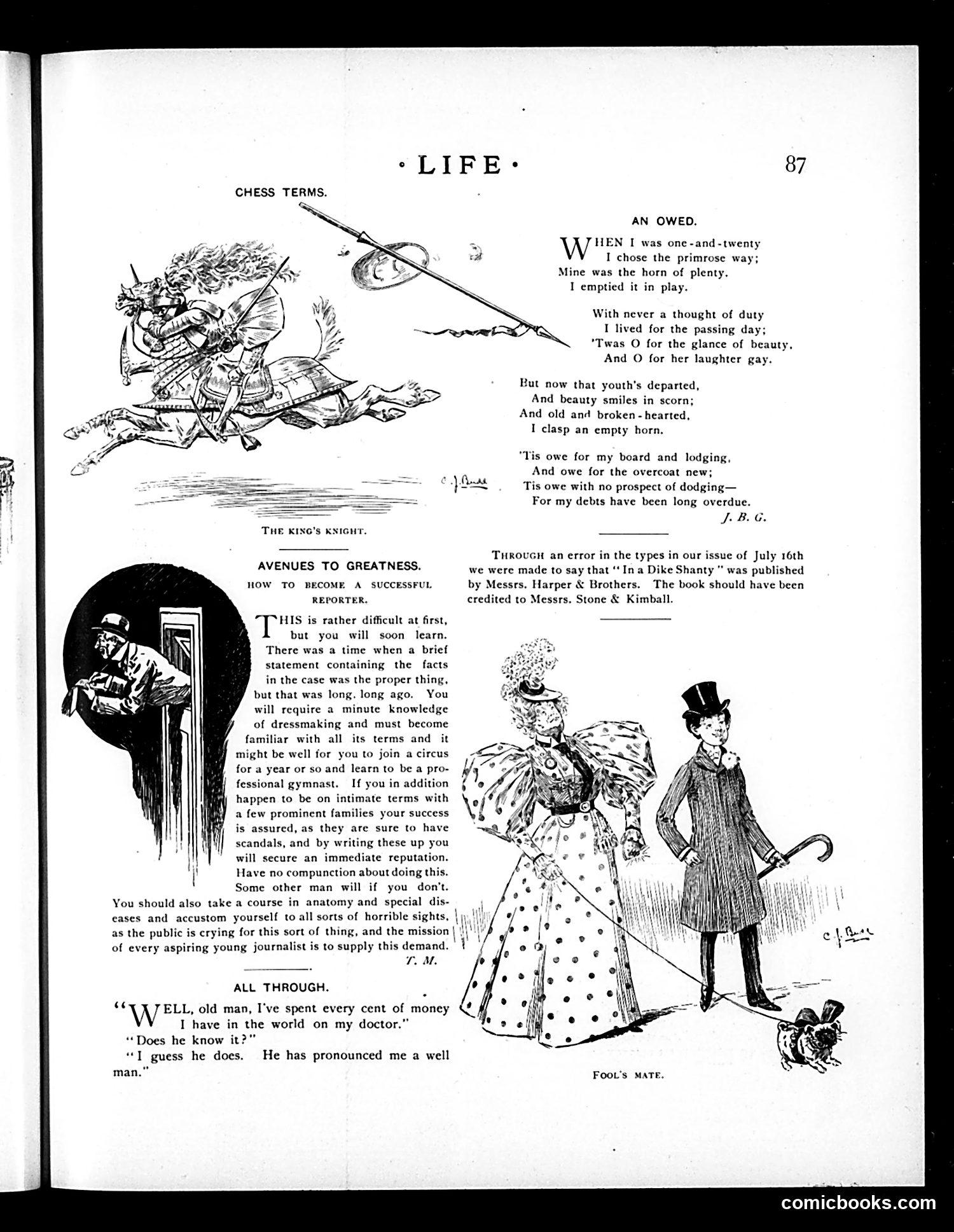
This page contains three satirical pieces typical of turn-of-century American humor: **"The King's Knight"** (top left): An illustration labeled "Chess Terms" shows armored knights in chaotic combat—a visual pun playing on chess terminology applied literally. **"Avenues to Greatness"** (center-left): A cynical guide mocking aspiring journalists. The satire suggests that successful reporting requires not integrity but scandal-mongering connections to wealthy families, knowledge of fashion and circus acrobatics, and willingness to exploit gruesome details. The author (T.M.) attacks sensationalism in journalism—the very thing Life itself practiced. **"An Owed"** (top right): A poem about youthful excess followed by impoverishment and debt, moralizing about wasted youth. **"All Through"** (bottom): A brief joke about a doctor exploiting a patient's complete financial ruin. **"Fool's Mate"** (bottom right): An illustration of fashionable figures, likely satirizing society pretension. The page exemplifies Life's satirical voice: mocking journalism ethics, financial irresponsibility, and social climbing through humor and caricature.
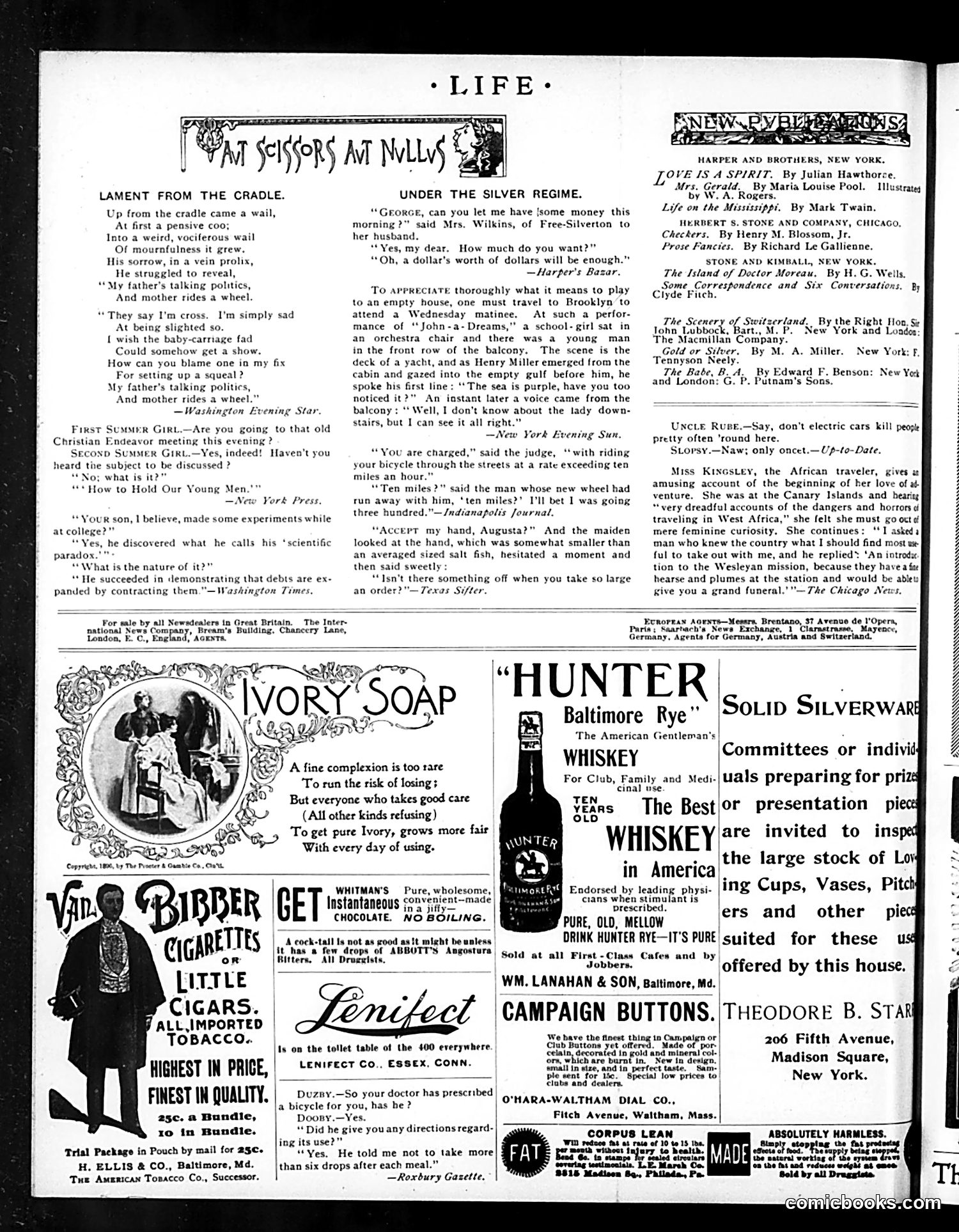
This page from *Life* magazine contains several humorous sketches satirizing contemporary social trends of the 1890s: **"Lament from the Cradle"** mocks the "New Woman" movement—specifically women's cycling enthusiasm and men's obsession with political debate. The infant complains his parents neglect him: his father won't stop discussing politics, and his mother is consumed with the bicycle craze, leaving no attention for the baby carriage. **"Under the Silver Regime"** jokes about currency debates of the era. A wife asks for "a dollar's worth of dollars," playing on contemporary confusion about monetary policy (likely referencing free silver political arguments). **The "Empty House" and "Bicycle Speed" sketches** use ironic humor about theater attendance and bicycle accidents—reflecting emerging anxieties about new transportation technology. **The hand-proposal joke** relies on crude physical humor about a suitor's undersized hand. Overall, the page satirizes period anxieties: women's independence, political divisiveness, technological change, and economic uncertainty during the 1890s.
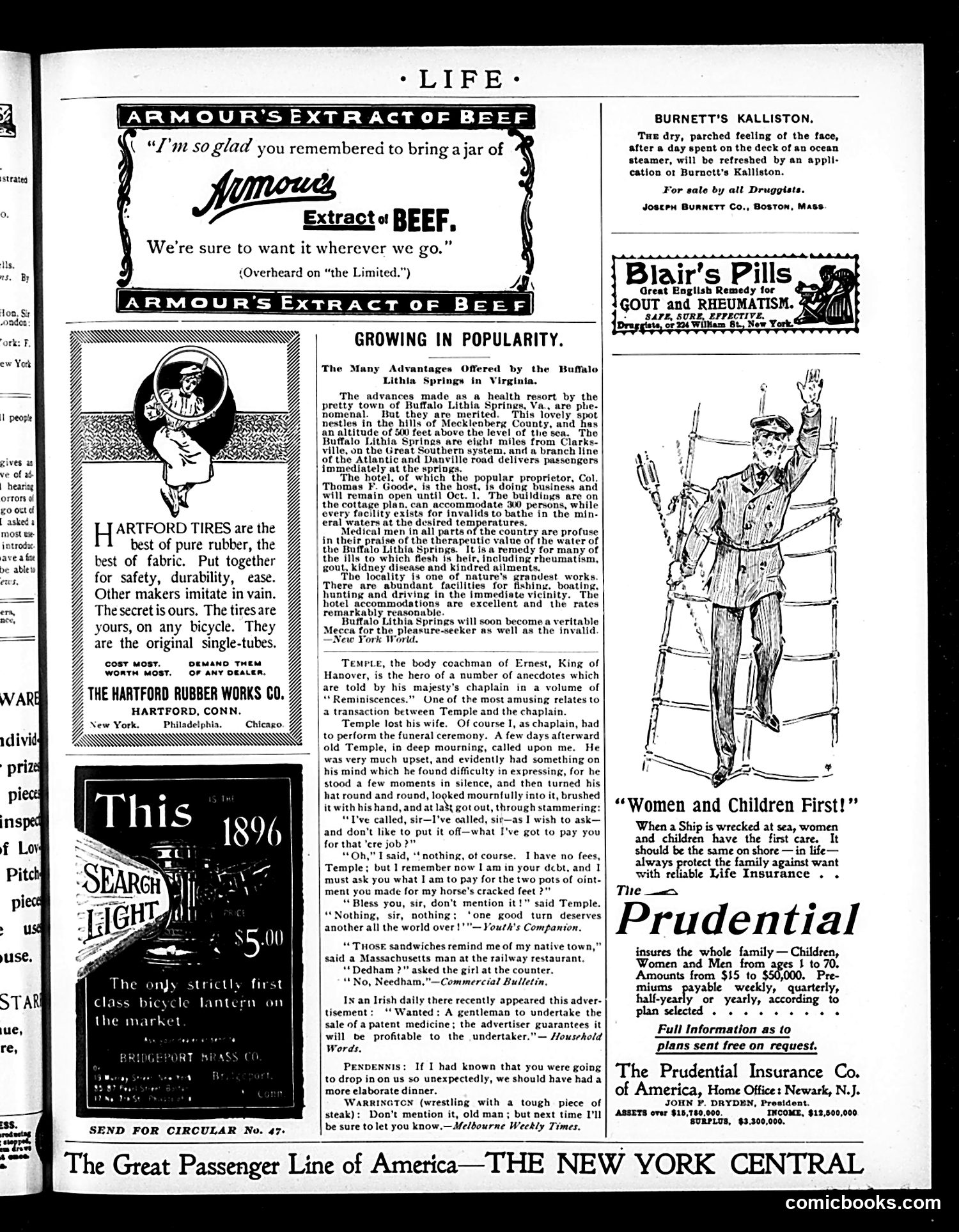
This page is primarily **advertising** rather than editorial content or political satire. It features multiple product advertisements from the 1890s, including Armour's Extract of Beef, Hartford Tires, and Prudential Insurance. The only narrative content with satirical elements appears in the anecdotes section. One story describes **Temple, a Hanoverian coachman**, who approaches his employer's chaplain awkwardly seeking payment for a funeral service. The humor derives from Temple's working-class discomfort with social interaction and his attempt to reciprocate by referencing past favors (ointment for a horse). The joke satirizes **class differences and social awkwardness** rather than political issues. The brief humorous items below mock rural simplicity and Irish advertisements, typical of *Life*'s light humor style. No identifiable political figures or events appear on this page.
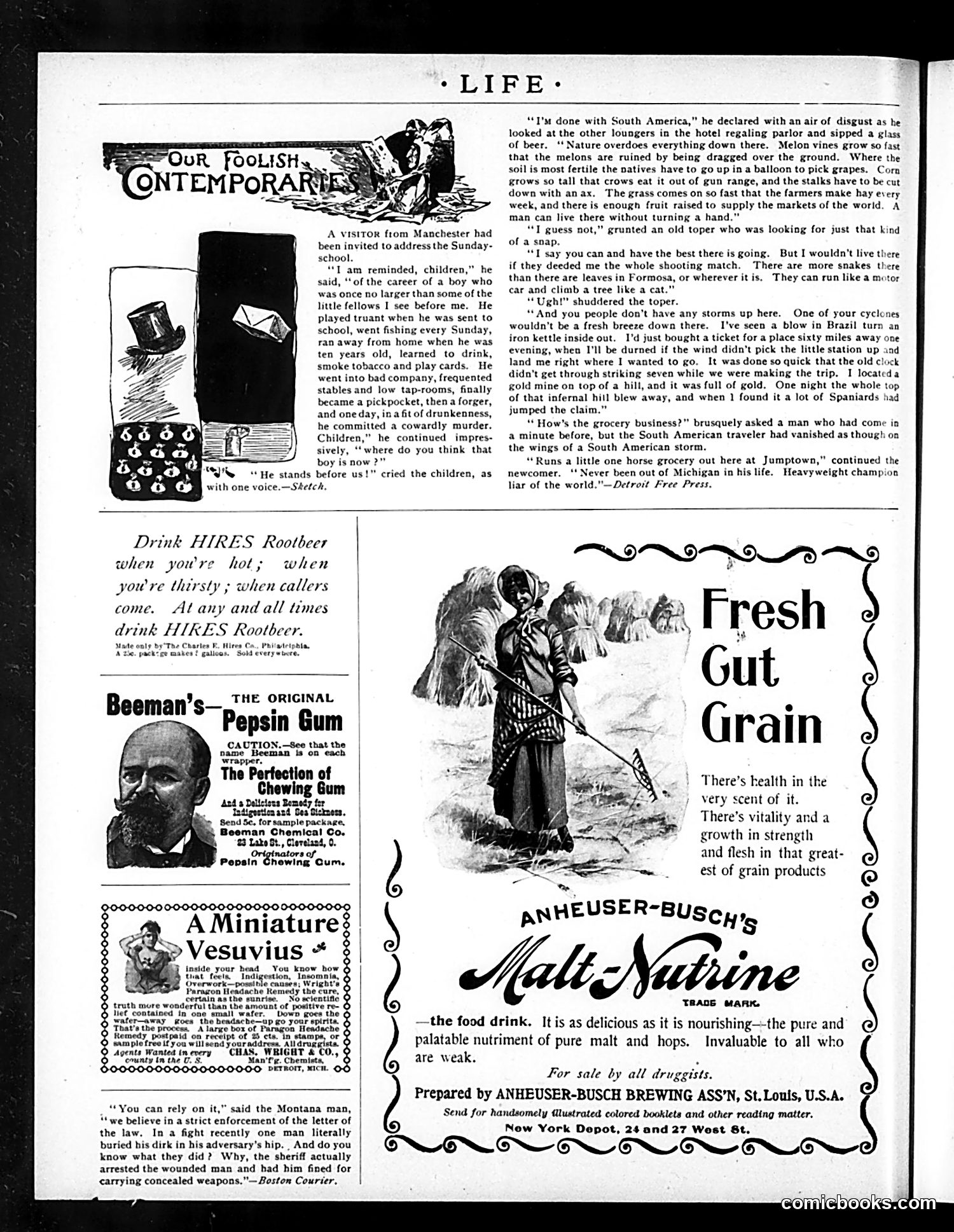
This page contains two satirical pieces and period advertisements. **"Our Foolish Contemporaries" cartoon (top left):** A Sunday school teacher from Manchester tells children about a delinquent boy—truant, smoker, gambler, criminal—asking where he is now. The children respond: "He stands before us!" The joke: the teacher has inadvertently confessed to his own criminal past through his own story. It's a classic Victorian-era joke about ironic self-revelation. **"South America" anecdote (center/right):** A traveler boasts absurdly about South America's exaggerations—melons ruined by growth, corn so tall crows need guns, storms that move buildings. A newcomer reveals the truth: the man runs a small-town Michigan grocery and has never left the state. The satire mocks tall-tale liars and travelers' exaggerations, with the punchline that he's a "heavyweight champion liar." **Advertisements:** Period products (Hires Rootbeer, Beeman's Pepsin Gum, Anheuser-Busch Malt-Nutrine) fill the lower half—typical early 20th-century magazine content.
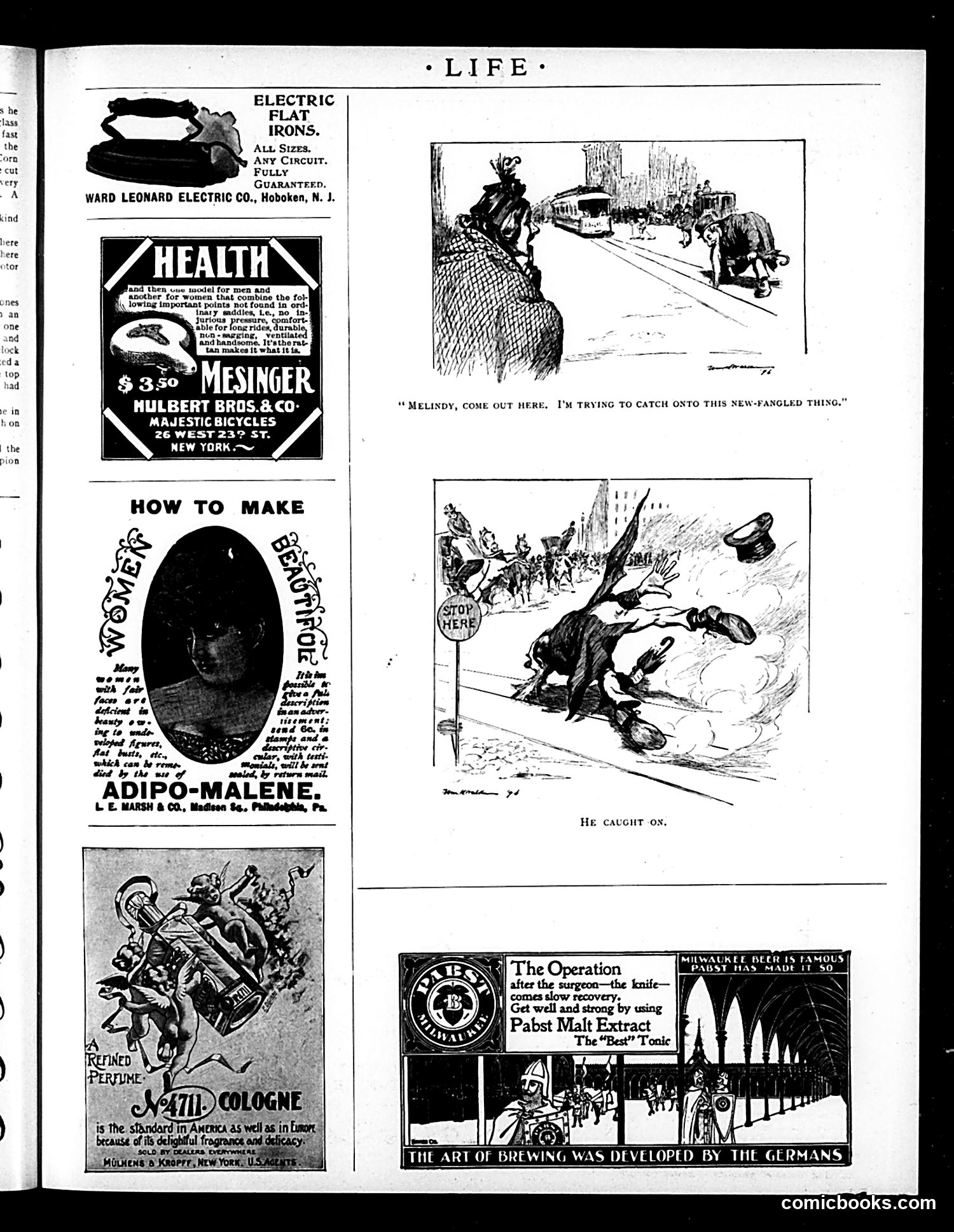
This page combines two narrative cartoons with period advertisements. The main cartoons depict an African American man (labeled "Melindy") attempting to use a new motorized vehicle or mechanical device—likely an early automobile or motorcycle. In the first panel, he calls to someone to help him "catch onto this new-fangled thing." The second panel shows him crashed or tangled with the machine at a "STOP HERE" sign, captioned "HE CAUGHT ON." The humor relies on a racist stereotype: portraying Black Americans as unfamiliar with modern technology and clumsy in adapting to it. The pun "caught on" (understood/learned vs. physically caught/entangled) reinforces the joke at his expense. The surrounding ads—for electric irons, bicycles, cologne, and malt extract—represent typical early 1900s consumer goods. The page reflects Life's satirical approach, though one deeply rooted in the racial attitudes of its era.
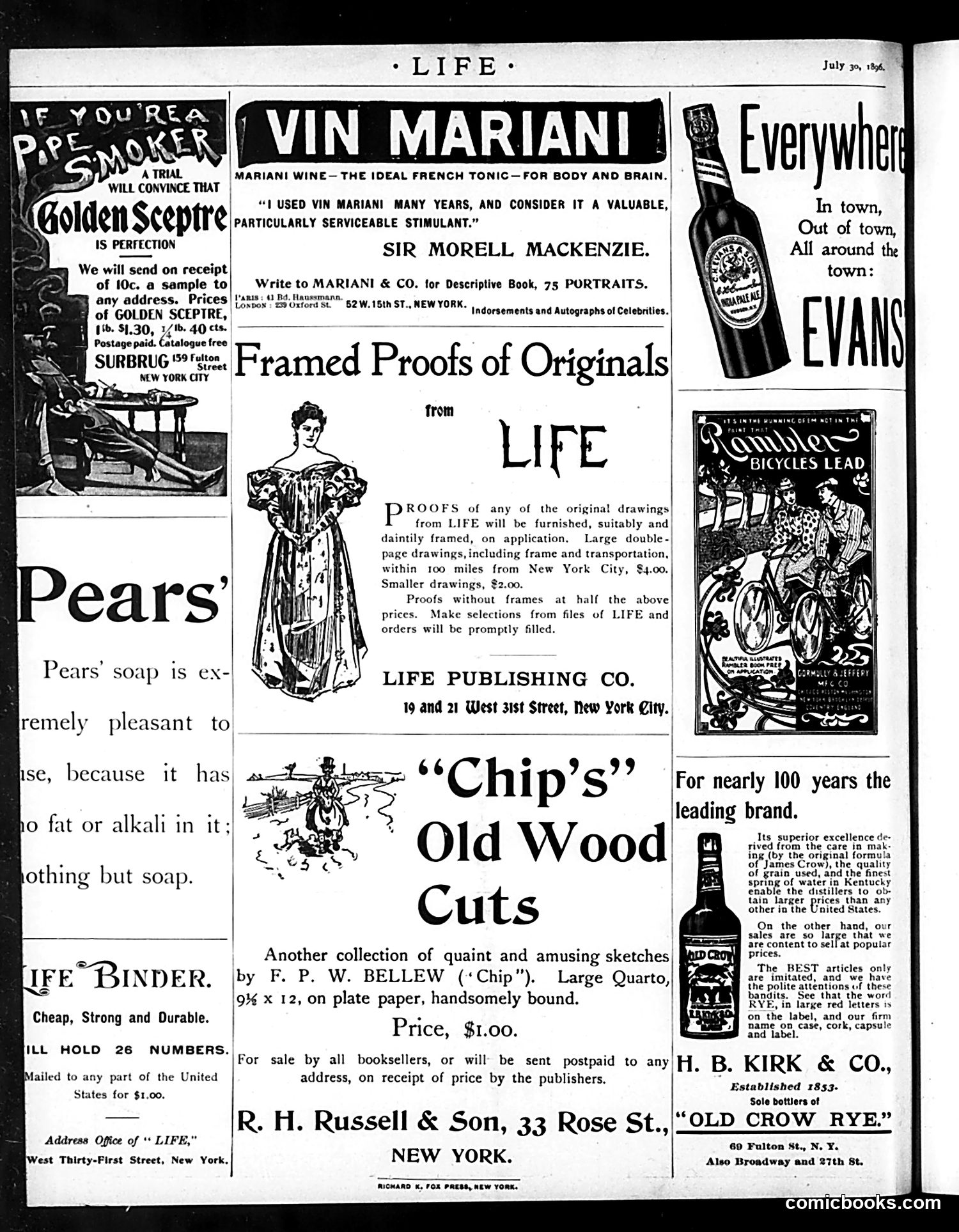
This is primarily an **advertising page** with no political cartoons. The content consists of period product advertisements and publisher announcements. **Key advertisements:** - **Vin Mariani**: A French wine tonic marketed as a "stimulant" for body and brain, endorsed by celebrity Sir Morell Mackenzie. (This was a legitimate product of the era, though such tonics often contained questionable ingredients.) - **Pears' soap**: Marketed as pure soap without harmful additives - **Life Publishing Co.**: Offers framed reproductions of original drawings from Life magazine - **"Chip's Old Wood Cuts"**: A book of sketches by F.P.W. Bellew - **Evans bicycles** and **Old Crow Rye whiskey**: Standard product promotions The page reflects late 19th-century advertising conventions, including celebrity endorsements and health claims that would be heavily regulated today. No satire or political commentary is evident—this is straightforward commercial promotion.