
Life, 1896-07-30 · page 4 of 18
Life — July 30, 1896 — page 4: what you’re looking at
What you’re looking at
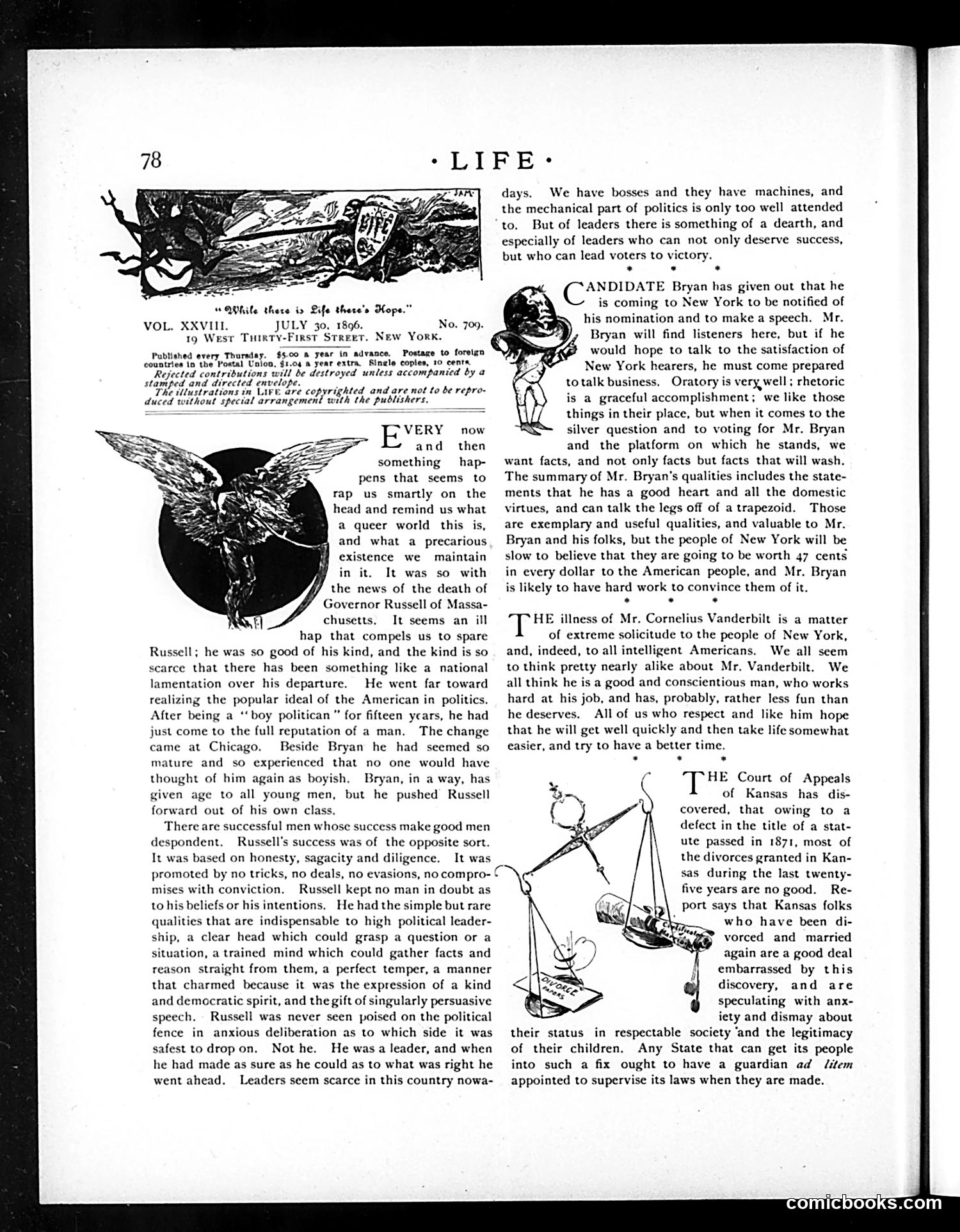
This page contains three distinct political commentaries: 1. **The dead bird illustration** mourns Russell of Massachusetts—likely a political figure whose death is compared to losing "something like a national lamentation." The text praises his integrity and independence in politics. 2. **The Bryan cartoon** (top right) addresses William Jennings Bryan's upcoming New York speech regarding his presidential nomination. The satire suggests New York voters won't be easily convinced by Bryan's oratory, implying his platform lacks substantive appeal beyond rhetoric. 3. **The scales of justice cartoon** (bottom) critiques a Kansas Court ruling that invalidated divorces granted under an 1871 statute, leaving divorced-and-remarried individuals in legal limbo and social embarrassment. All three pieces mock political and legal failures of leadership.
📄 Transcribed text from this page (OCR, searchable)
Machine-transcribed from the original scan — historical spelling and the odd misread are preserved.
> LIFE: “QNhile there is Life there's Hope.” VOL. XXVIII. JULY 30. 1896. No. 709. 19 West Tiiety-First Street. New York. Published every Thuraday. $5.00 a year in advance. Postage to foreign countries in the Postal Union, $1.04 a year extra, Single coples, 10 cents, Rejected contributions will be destroyed unless accompanied by a stamped and directed envelope. The illustrations in LiFt are copyrighted and are not to be repro- duced without special arrangement with the publishers, BYvery and then something hap- pens that seems to rap us smartly on the head and remind us what a queer world this is, and what a precarious existence we maintain in it. It was so with #/ the news of the death of 7 Governor Russell of Massa- chusetts. It s an ill hap that compels us to spare Russell; he was so good of his kind, and the kind is so scarce that there has been something like a national lamentation over his departure. He went far toward realizing the popular ideal of the American in politics. After being a ‘‘ boy politican ” for fifteen years, he had just come to the full reputation of a man. The change came at Chicago. Beside Bryan he had seemed so mature and so experienced that no one would have thought of him again as boyish, Bryan, in a way, has given age to all young men, but he pushed’ Russell forward out of his own class. There are successful men whose success make good men despondent. Russell's success was of the opposite sort. It was based on honesty, sagacity and diligence. It was promoted by no tricks, no deals, no evasions, no compro- mises with conviction. Russell kept no man in doubt as to his beliefs or his intentions. He had the simple but rare qualities that are indispensable to high political leader- ship, a clear head which could grasp a question or a situation ained mind which could gather facts and reason straight from them, a perfect temper, a manner that charmed because it was the expression of a kind and democratic spirit, and the gift of singularly persuasive speech. Russell was never seen poised on the political fence in anxious deliberation as to which side it was safest to dropon. Not he. He was a leader, and when he had made as sure as he could as to what was right he went ahead. Leaders seem scarce in this country nowa- now days. We have bosses and they have machines, and the mechanical part of politics is only too well attended to, But of leaders there is something of a dearth, and especially of leaders who can not only deserve success, but who can lead voters to victory. . . . (Gear Bryan has given out that he is coming to New York to be notified of — 5) his nomination and to make a speech. Mr. Pz Bryan will find listeners here, but if he g would hope to talk to the satisfaction of New York hearers, he must come prepared totalk business. Oratory is very well ; rhetoric is a graceful accomplishment; we like those things in their place, but when it comes to the silver question and to voting for Mr. Bryan and the platform on which he stands, we want facts, and not only facts but facts that will wash. The summary of Mr. Bryan's qualities includes the state- ments that he has a good heart and all the domestic virtues, and can talk the legs off of a trapezoid. Those are exemplary and useful qualities, and valuable to Mr. Bryan and his folks, but the people of New York will be slow to believe that they are going to be worth 47 cents in every dollar to the American people, and Mr. Bryan is likely to have hard work to convince them of it. . . . HE illness of Mr. Cornelius Vanderbilt is a matter of extreme solicitude to the people of New York, and, indeed, to all intelligent Americans. We all seem to think pretty nearly alike about Mr. Vanderbilt. We all think he is a good and conscientious man, who works hard at his job, and has, probably, rather less fun than he deserv All of us who respect and like him hope that he will get well quickly and then take life somewhat easier, and try to have a better time. . / HE Court of Appeals of Kan: has dis- covered, that owing to a defect in the title of a stat- ute passed in 1871, most of the divorces granted in Kan- sas during the last twenty- five years are no good. Re- port says that Kansas folks . who have been di- vorced and married again are a good deal embarrassed by this discovery, and are speculating with anx- iety and dismay about their status in respectable socicty ‘and the legitimacy of their children. Any State that can get its people into such a fix ought to have a guardian ad ditem appointed to supervise its laws when they are made. a f ee