
Life, 1896-07-30 · page 6 of 18
Life — July 30, 1896 — page 6: what you’re looking at
What you’re looking at
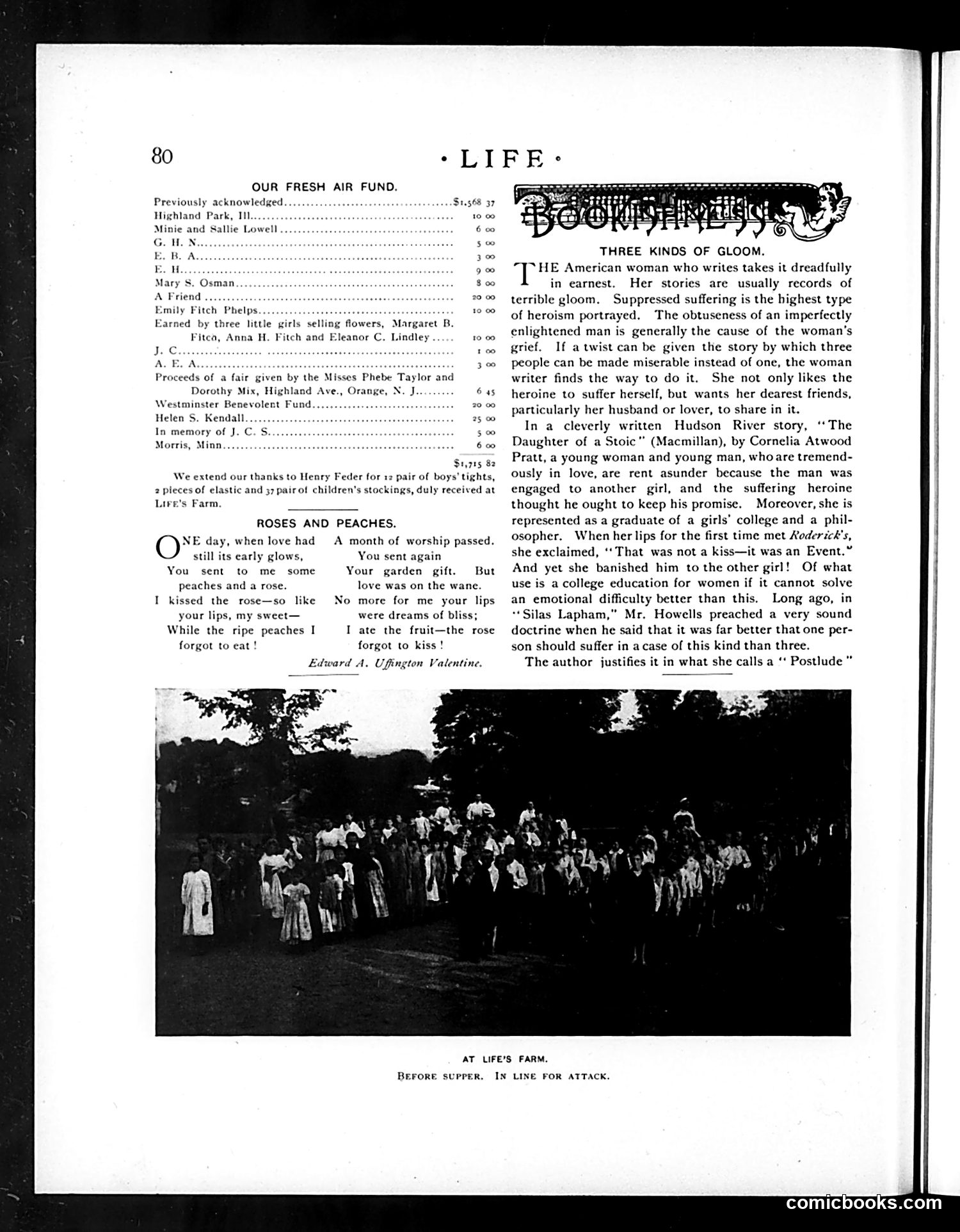
This page contains **no political cartoon**, but rather literary and philanthropic content. The top section lists donors to "Our Fresh Air Fund," a charitable initiative providing outdoor recreation for underprivileged children. Names and donation amounts suggest a community fundraising effort. Below is a short poem titled "Roses and Peaches" by Edward A. Uflington Valentine, a sentimental piece about love and romance using floral imagery. The main feature is an article titled "Three Kinds of Gloom" discussing how American women writers depict suffering in literature. It references Hudson River school stories and mentions specific works like "The Daughter of a Stoic" and "Silas Lapham," analyzing how female authors handle emotional difficulties in their narratives. The photograph shows a crowd gathering at "Life's Farm" before supper, "in line for attack"—likely a humorous caption for what appears to be a community event.
📄 Transcribed text from this page (OCR, searchable)
Machine-transcribed from the original scan — historical spelling and the odd misread are preserved.
80 OUR FRESH Previously acknowledged... Highland Park, I1.. Minie and Sallie Lowell G. HN. EB. AL E. H. . Mary S. Osman A Friend .. . Emily Fitch Phelps... Earned by three little girls selling flowers, AIR FUND. seeNgEeaee $1,568 37 6 co 5 3 900 8 20 Margaret B. Fitea, Anna H. Fitch and Eleanor C, Lindley .. A A Proceeds of a fair given by the Misses Phebe Taylor and Dorothy Mix, Highland Ave., Orange, Westminster Benevolent Fund Helen S. Kendall In memory of J. C Morris, Minn...... XN. J. 6 00 $1,715 82 We extend our thanks to Henry Feder for 12 pair of boys’ tights, 2 pleces of elastic and 37 pairot children’s stockings, duly received at Lire's Farm. ROSES AND PEACHES. NE day, when love had still its early glows, sent to me peaches and a rose. I kissed the rose—so like your lips, my sweet— While the ripe peaches I forgot to eat! You some A month of worship passed. You sent again Your garden gift. But love was on the wane. No more for me your lips were dreams of bliss; I ate the fruit—the rose forgot to kiss! rd A. Uffington Valentine. THREE KINDS OF GLOOM. TE American woman who writes takes it dreadfully in earnest. Her stories are usually records of terrible gloom. Suppressed suffering is the highest type of heroism portrayed. The obtuseness of an imperfectly enlightened man is generally the cause of the woman's grief. If a twist can be given the story by which three people can be made miserable instead of one, the woman writer finds the way to do it. She not only likes the heroine to suffer herself, but wants her dearest friends, particularly her husband or lover, to share in it. In a cleverly written Hudson River story, ‘‘ The Daughter of a Stoic” (Macmillan), by Cornelia Atwood Pratt, a young woman and young man, whoare tremend- ously in love, are rent asunder because the man was engaged to another girl, and the suffering heroine thought he ought to keep his promise. Moreover, she is represented as a graduate of a girls’ college and a phil- osopher. When her lips for the first time met Xoderick's, she exclaimed, ‘That was not a kiss—it was an Event.” And yet she banished him to the other girl! Of what use is a college education for women if it cannot solve an emotional difficulty better than this. Long ago, in “Silas Lapham," Mr. Howells preached a very sound doctrine when he said that it was far better that one per- son should suffer in a case of this kind than three. The author jus in what she calls a ‘‘ Postlude ” AT LIFE’S FARM. BEFore suprPer, IN LINE FOR ATTACK. comicbooks.com