
A complete issue · 18 pages · 1896
Life — July 23, 1896
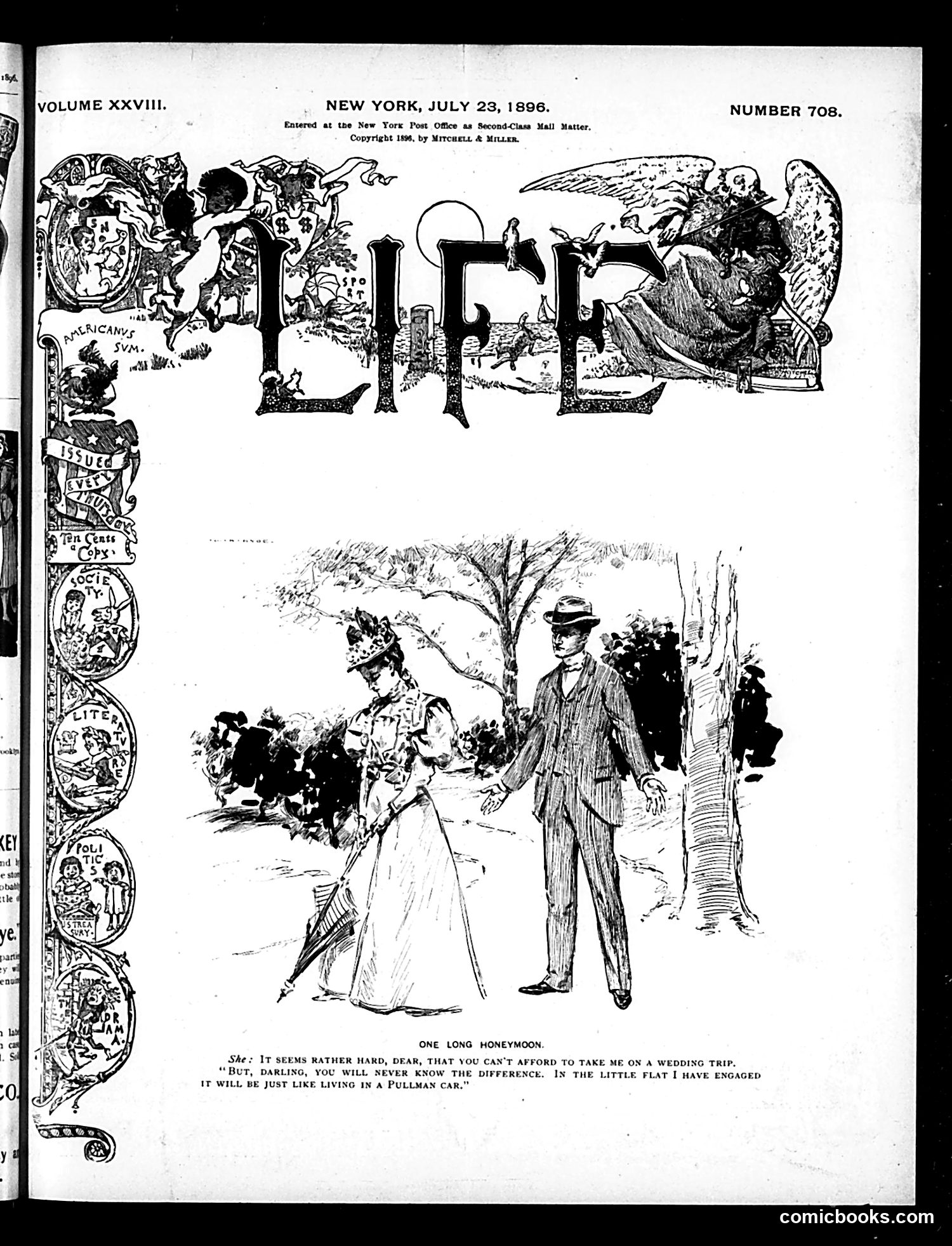
This page features a satirical cartoon titled "One Long Honeymoon" about newlyweds and train travel. The woman expresses concern about taking a wedding trip, saying she can't afford it. The man reassures her it will be fine—they'll simply live in a Pullman car (a luxury railroad sleeping car). The satire targets the late-Victorian practice of newlyweds taking extended honeymoon train journeys. The joke plays on the absurdity of suggesting permanent residence in a Pullman car as a money-saving solution, mocking both the expense of honeymoons and the era's fascination with rail travel as a romantic getaway. The illustration style is typical of 1890s Life magazine's genteel humor.
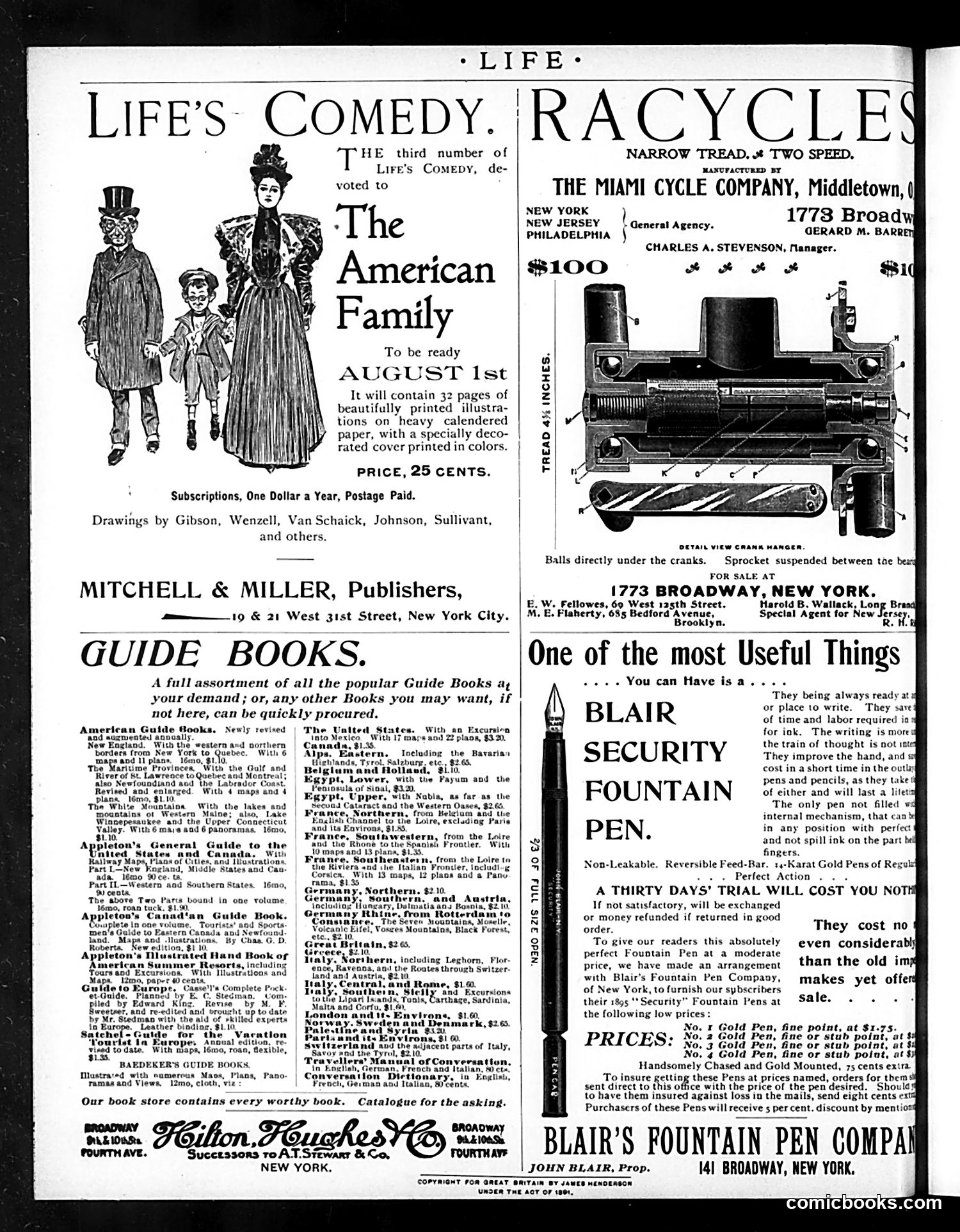
This page is **primarily advertising** rather than satirical content. The left side advertises *Life's Comedy*, specifically "The American Family" issue (due August 1st), featuring illustrations by Gibson, Wentzell, Van Schaick, and others—prominent cartoonists of the era. Below that are listings for guide books and a bookstore advertisement. The right side contains **commercial advertisements** for Miami Cycle Company racycles ($100-$10 depending on model) and Blair Security Fountain Pens, emphasizing their reliability and moderate pricing. There is **no political cartoon or satire visible** on this page. It represents typical early 1900s magazine advertising and promotional content rather than the satirical commentary *Life* magazine was known for.
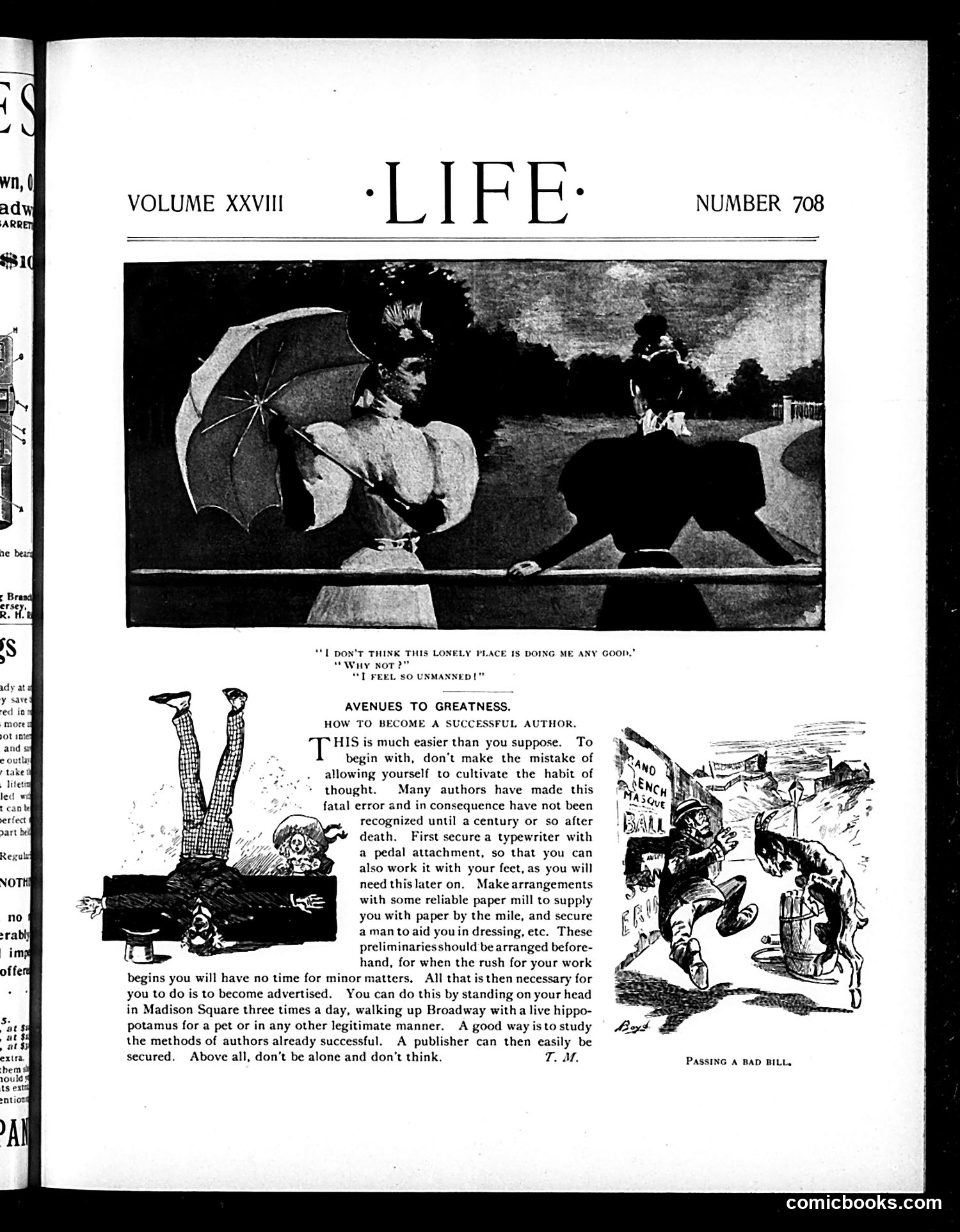
**Top Illustration:** Shows a woman with an umbrella at what appears to be a park or public space, with dialogue suggesting social discomfort ("I don't think this lonely place is doing me any good"). This appears to be a satirical commentary on courtship or romantic encounters, possibly critiquing a woman's anxiety in unsupervised settings—reflecting early 20th-century social conventions about propriety. **"Avenues to Greatness" Article:** Satirizes aspiring authors' methods for success. The illustration labeled "Passing a Bad Bill" depicts writers engaged in various promotional activities. The article mocks the notion that one can become a famous author through publicity stunts—standing in Madison Square with hippopotamuses, walking Broadway with live animals—rather than through genuine literary talent. The satire suggests that contemporary publishing valued sensationalism and self-promotion over actual literary merit.
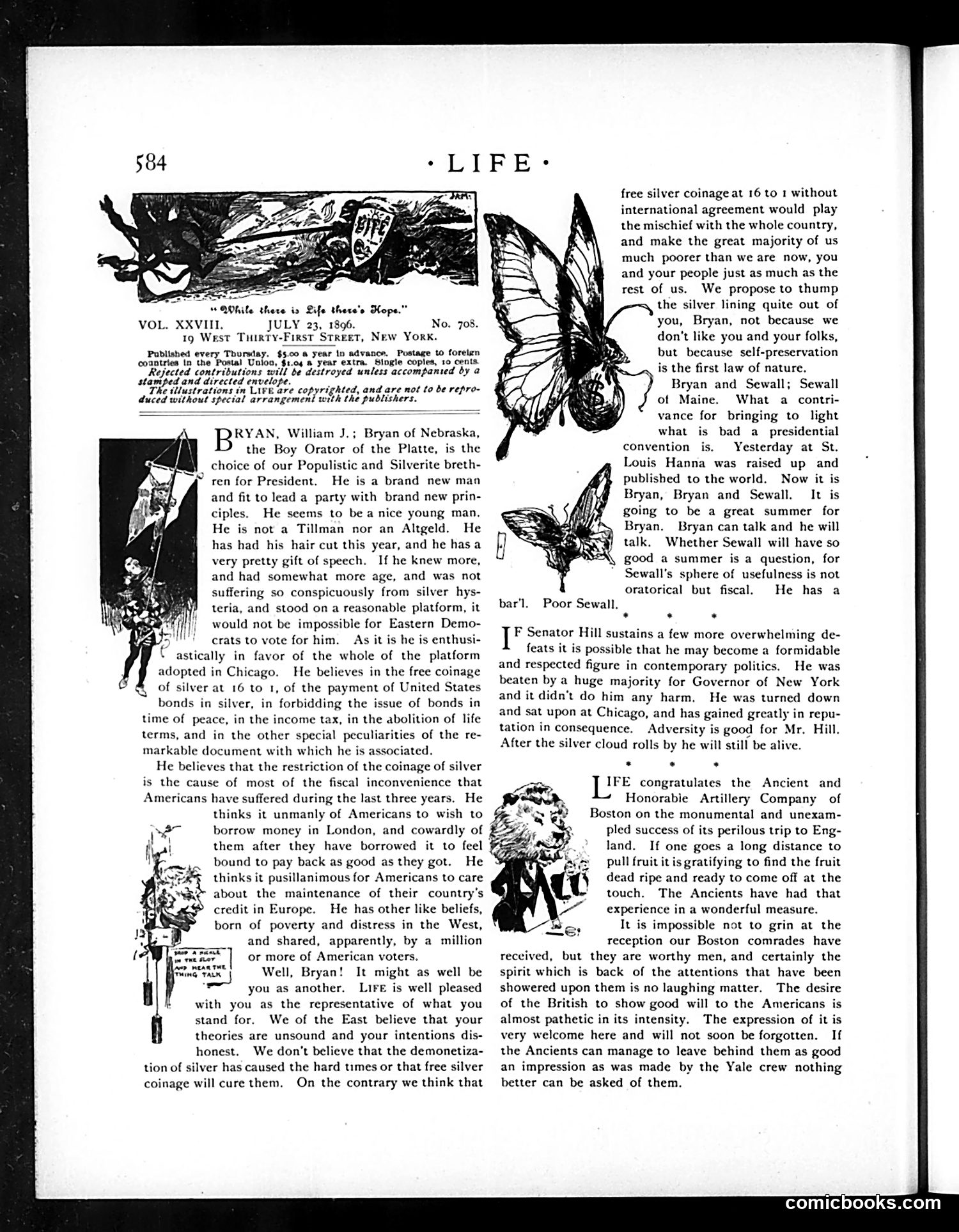
This page contains satirical editorial commentary on William Jennings Bryan, the Democratic presidential nominee ("Boy Orator of the Platte"). Life's editors mock Bryan's support for free silver coinage at 16-to-1 ratio, calling it economically unsound and warning it would impoverish America. The text uses dismissive language—calling Bryan a "nice young man" but criticizing his "silver hysteria" and lack of depth beyond oratory. The editors contrast Bryan unfavorably with Senator Hill, suggesting Hill's defeat was actually beneficial. The butterfly and bird illustrations appear decorative rather than satirical. Life represents Eastern, sound-money Republican interests opposing Bryan's agrarian, inflationist platform. The piece exemplifies how the magazine ridiculed populist economic proposals during the contentious 1896 election.
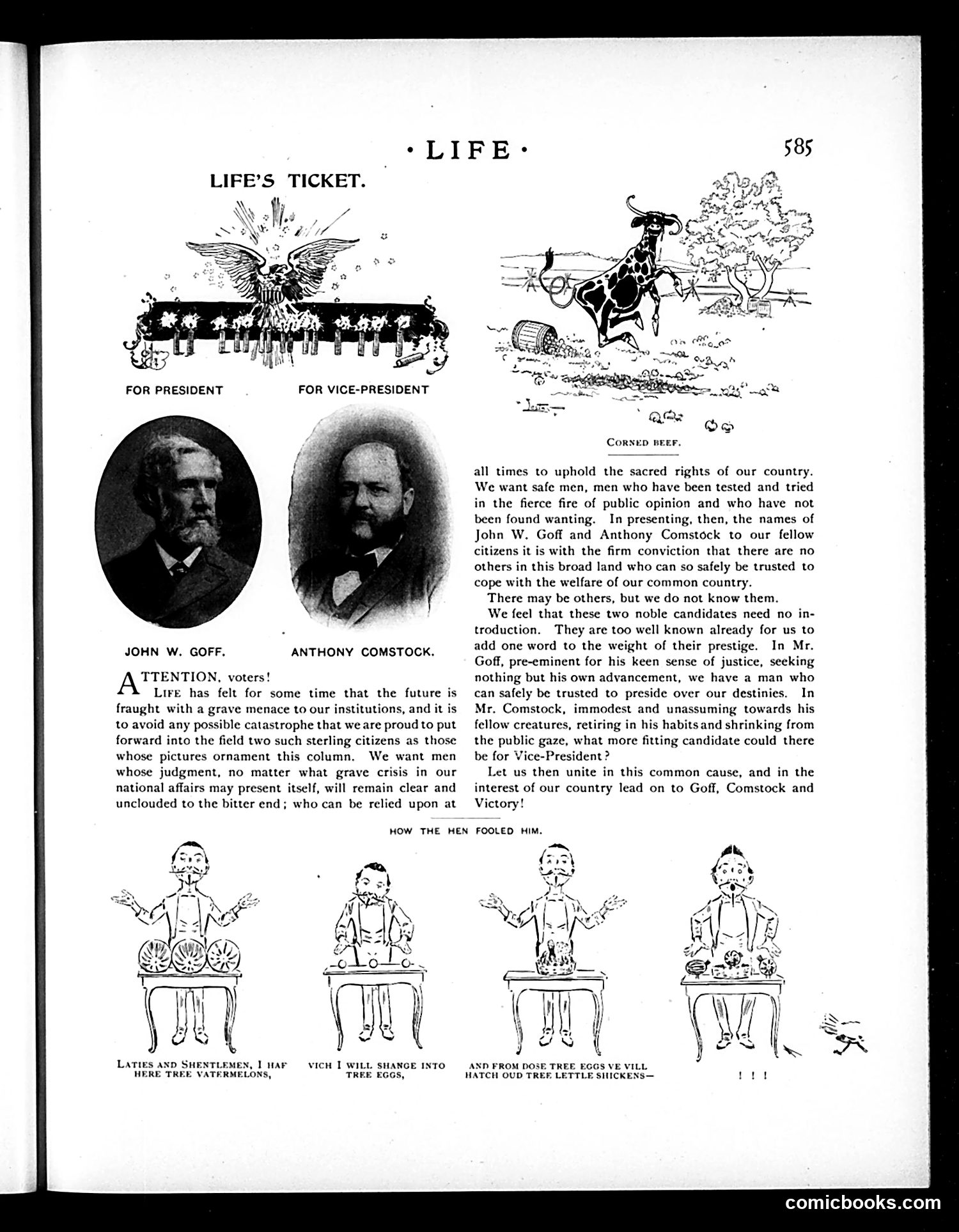
This page promotes **John W. Goff for President and Anthony Comstock for Vice-President** in what appears to be a satirical endorsement. The text claims these are "safe men" tested in public opinion, though it ironically admits "there may be others, but we do not know them." The bottom comic strip, "How the Hen Fooled Him," uses wordplay about eggs transforming into different things—a clever visual pun suggesting deception or trickery. This likely mocks one or both candidates as gullible or easily deceived. **Anthony Comstock** was a real historical figure known for anti-obscenity crusades. The satire appears to mock both candidates' fitness for high office while simultaneously punning on farm imagery (corned beef, the goat illustration), suggesting rural simplicity or naïveté.
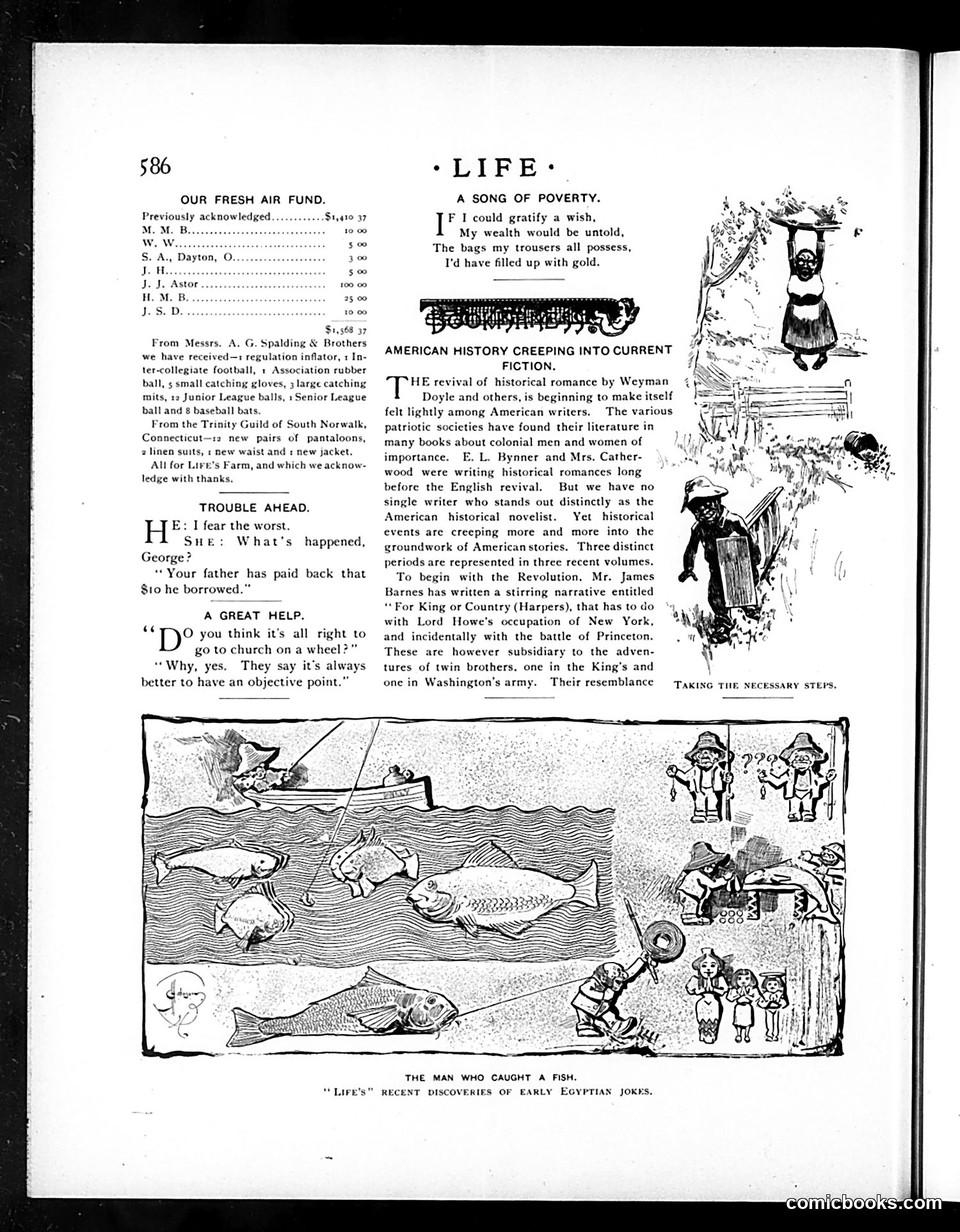
This page from *Life* magazine contains an article titled "American History Creeping Into Current Fiction," discussing the revival of historical romance novels set during the American Revolution. The text mentions James Barnes's narrative "For King or Country," which involves Lord Howe's occupation of New York and the Battle of Princeton, centering on twin brothers—one serving the King, one Washington. The cartoon below, captioned "Life's Recent Discoveries of Early Egyptian Jokes," is unrelated satire depicting ancient Egyptian fishing and domestic scenes rendered comedically. The juxtaposition suggests *Life* was mocking both contemporary historical fiction trends and presumed "discoveries" of ancient humor—likely parodying sensationalized archaeological claims popular in the early 1900s.
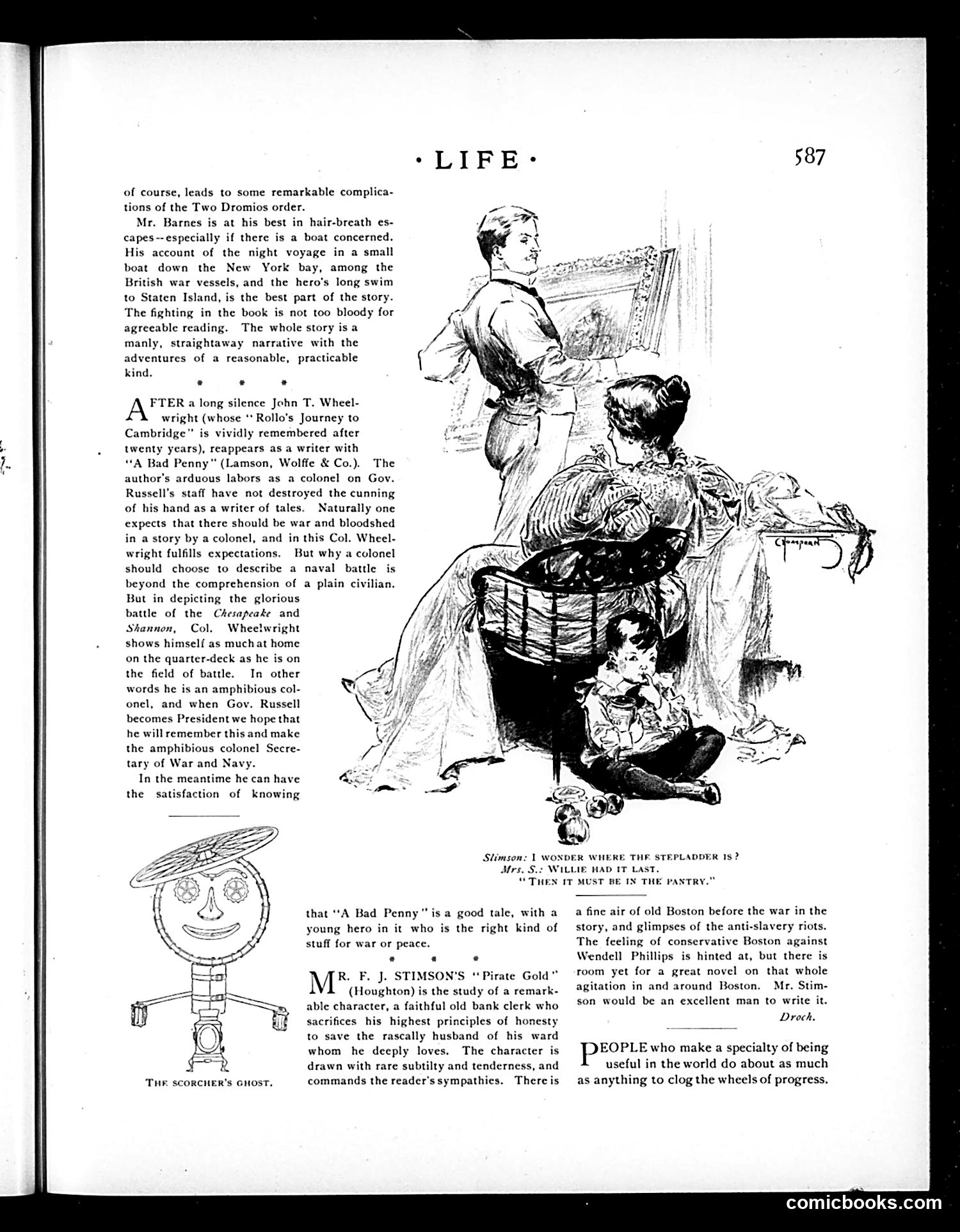
This page contains literary criticism and reviews, primarily discussing Colonel John T. Wheelwright's reappearance as a writer. The main illustration shows two figures—a man standing and a woman seated—in what appears to be a domestic scene, captioned with dialogue about a "stepladder" and pantry, suggesting domestic comedy. The small cartoon at bottom left, titled "The Scorcher's Ghost," depicts a face-like figure on a wheeled stand, though its satirical meaning is unclear from the visible text. The page reviews several books including "A Bad Penny" and "Mr. Stimson's 'Private Gold,'" offering literary commentary rather than political satire. The content focuses on character development and narrative quality in contemporary fiction rather than topical social commentary.
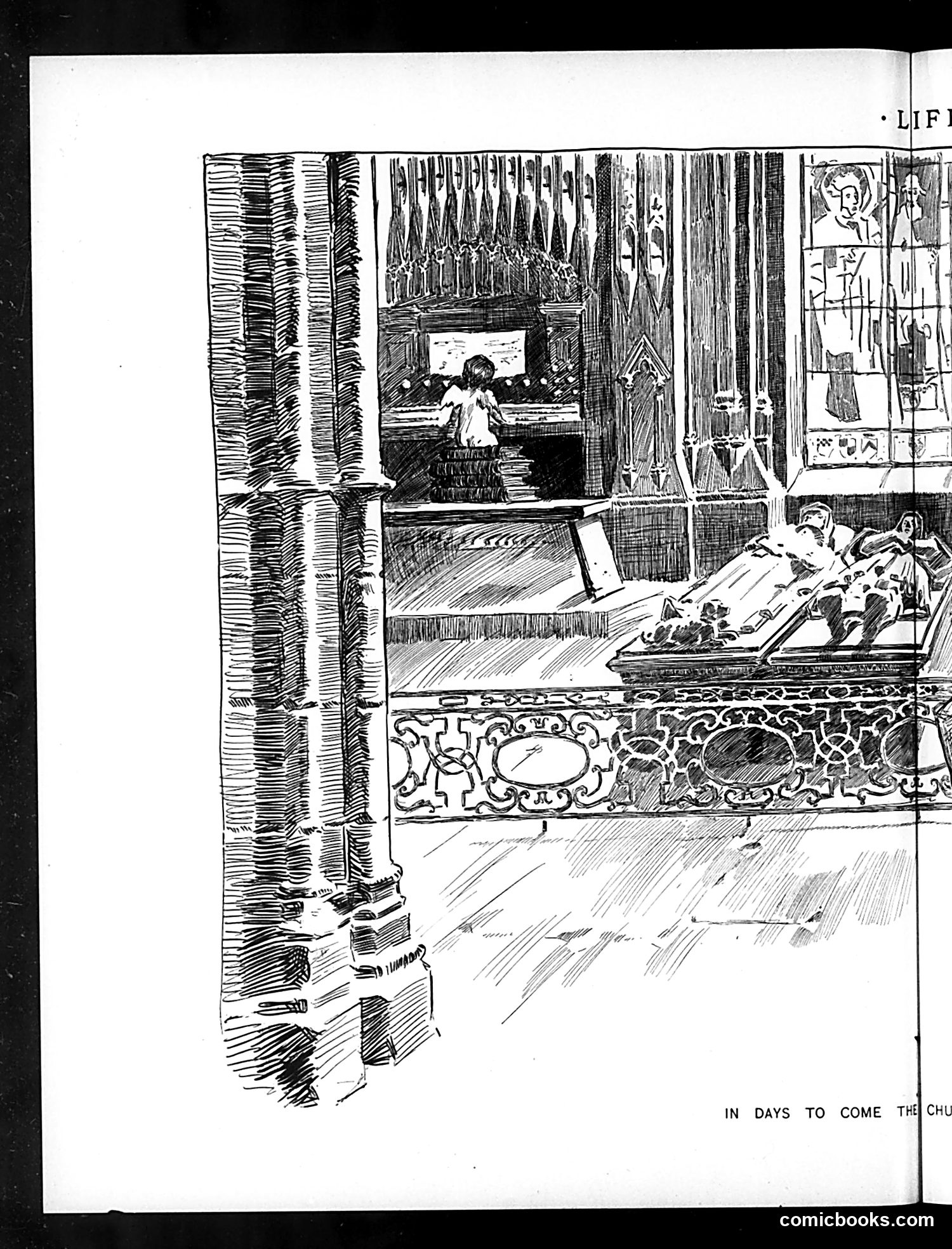
This is a black and white illustration showing an interior church scene. A figure sits at a grand piano in the foreground while others occupy pews in the background. Tall Gothic-style windows and architectural details frame the scene. The partial text at bottom reads "IN DAYS TO COME THE CHU[RCH]" (cut off), suggesting this is commentary about the future of churches. The satire likely critiques the role of music or entertainment in religious spaces—the prominent piano and seated pianist suggest that secular musical performance is becoming central to church life, rather than traditional worship. This reflects early 20th-century concerns about modernization affecting religious institutions and the shift from purely spiritual focus to entertainment-oriented services. However, without the complete caption or publication date, the specific reference remains unclear.
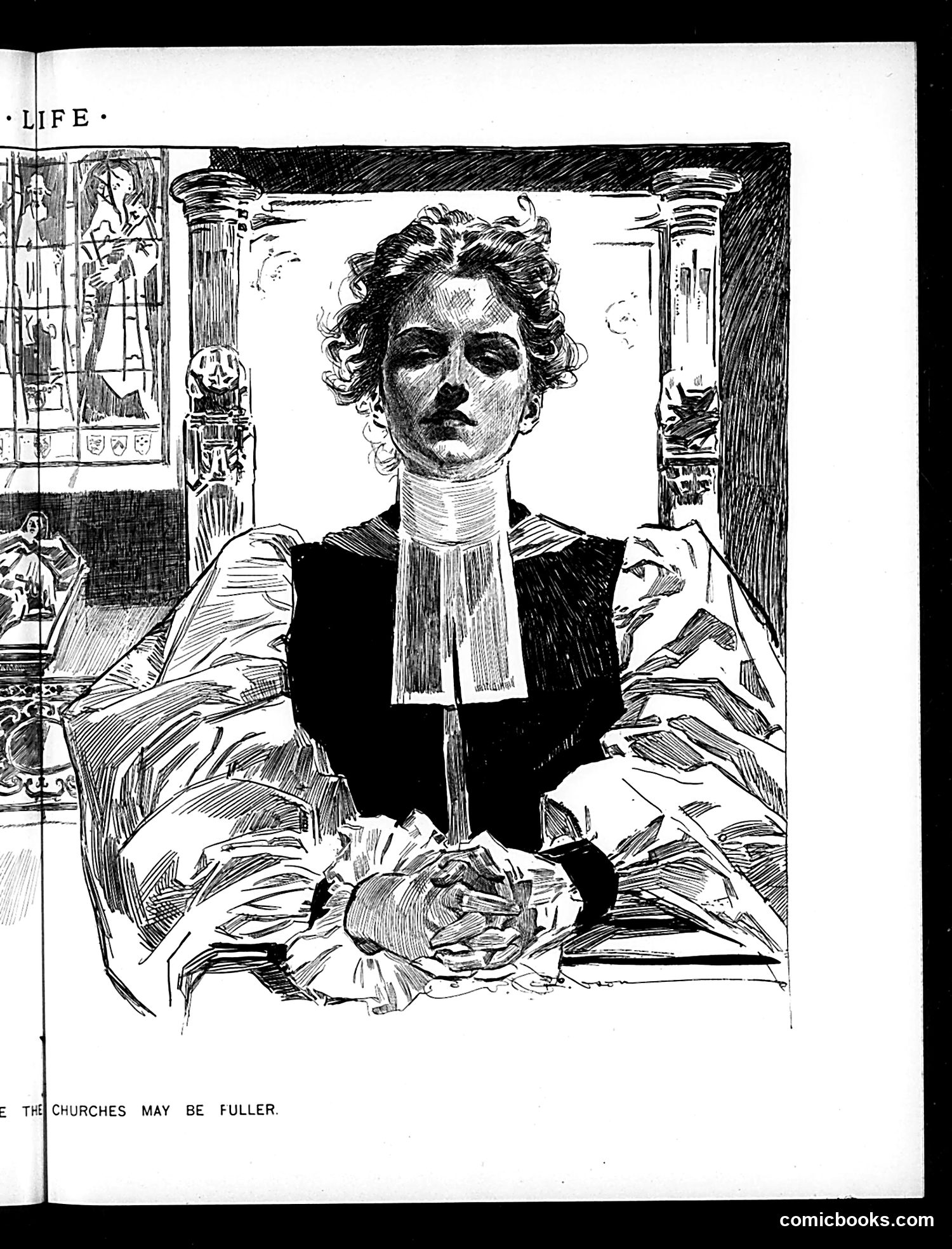
This page features a pen-and-ink portrait of a woman in professional or formal attire, wearing what appears to be a white collar or jabot against dark clothing. The architectural details visible in the background suggest an institutional or official setting. The partial caption at bottom reads "THE CHURCHES MAY BE FULLER," though the complete context is cut off. This suggests the cartoon comments on religious attendance or church participation, likely making a social or political point about women's roles, professionalism, or institutional life during the period Life magazine was active. Without the complete caption or additional context, the specific satire target remains unclear, though it appears to address gender, professional status, and religious or social institutions.
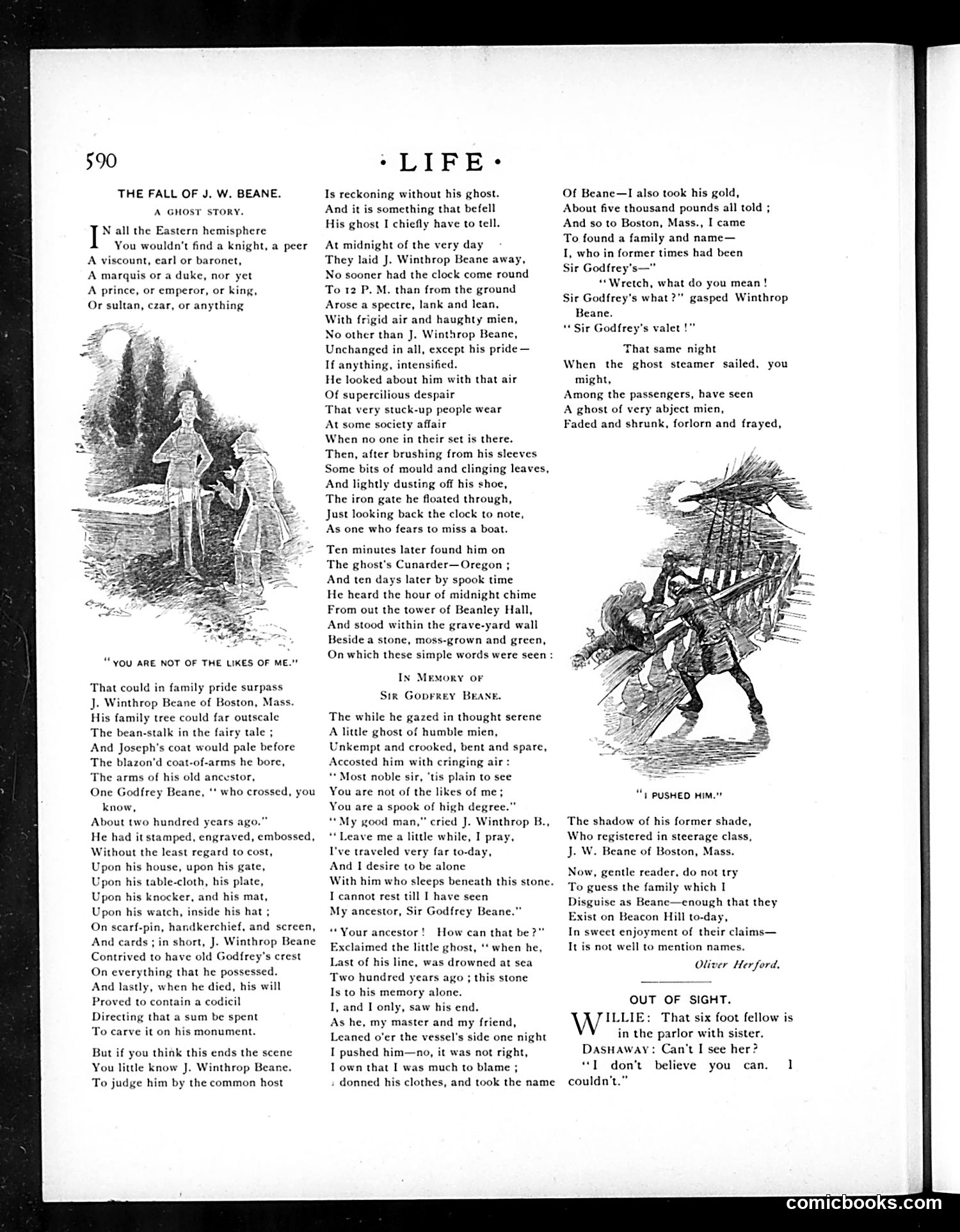
This page contains literary content rather than political cartoons. "The Fall of J. W. Beane: A Ghost Story" is a narrative poem illustrated with two engravings. The story concerns J. Winthrop Beane of Boston, Massachusetts, a proud aristocrat whose ghost appears after his death to haunt his descendants. The narrative satirizes family pride and social pretension—Beane's ghost is described as "stuck-up" and maintains his snobbish dignity even in death, appearing to humble relatives to remind them "You are not of the likes of me." The illustrations show the ghost encounter and a dramatic scene involving the supernatural visitation. The satire targets class consciousness and inherited social superiority among Boston's elite families during the period. Oliver Herford is credited at the end.
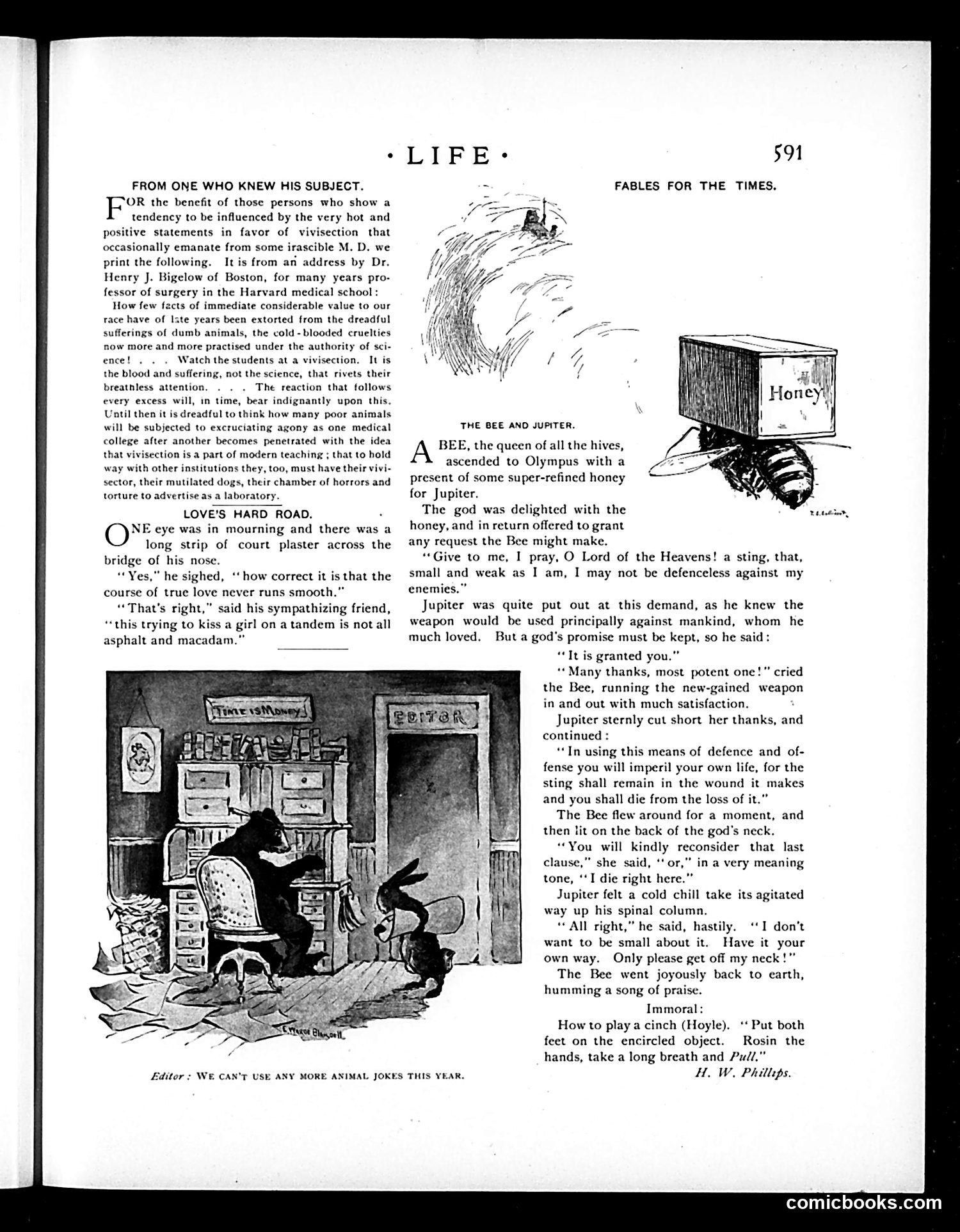
This page contains three distinct pieces: 1. **"From One Who Knew His Subject"** - An anti-vivisection statement quoting Dr. Henry J. Bigelow of Harvard Medical School, arguing that animal experimentation causes unnecessary suffering and that vivisection's use in medical education is unjustifiable. 2. **"Love's Hard Road"** - A brief romantic anecdote about a couple's disagreement over smooth love, illustrated by a cartoon showing two figures at what appears to be a desk or counter. 3. **"The Bee and Jupiter"** - A fable where a bee requests a weapon from Jupiter to defend against enemies. Jupiter grants a sting but warns the bee will die if it uses it. The moral critiques playing cinch (a card game). The editor's note indicates they've discontinued animal jokes, likely reflecting contemporary animal welfare concerns.
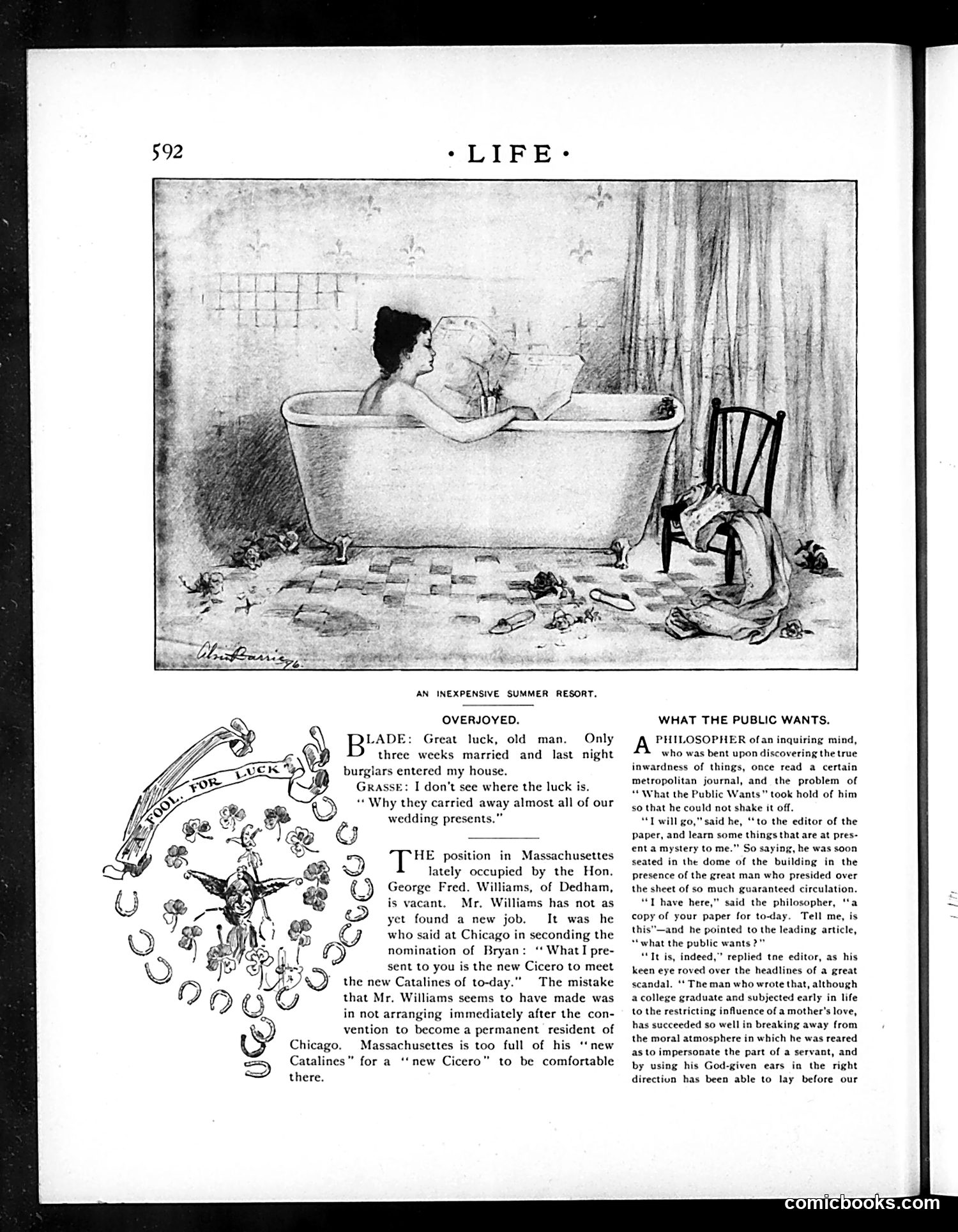
This Life magazine page contains three separate satirical pieces: **"An Inexpensive Summer Resort"** (top): A cartoon mocking newlyweds whose house was burgled. The "joke" is that losing wedding gifts is good luck—dark humor about unwanted presents. **"Overjoyed"** (bottom left): Political satire about George Fred. Williams, a Massachusetts politician who'd nominated William Jennings Bryan for president using grandiose rhetoric (comparing Bryan to Cicero opposing "new Catilines"). The piece mocks Williams's failure to secure a job after the convention, suggesting his flowery speech didn't translate to practical success. Massachusetts, it quips, already has enough of his "new Cicero" talk. **"What the Public Wants"** (bottom right): A philosophical dialogue satirizing newspaper editors. A philosopher asks whether sensational scandal coverage truly reflects public demand, or whether editors simply *claim* it does while pursuing salacious stories regardless of actual reader interest—a critique of journalistic justifications for yellow journalism. All three target pretension, hypocrisy, and the gap between stated ideals and actual behavior.
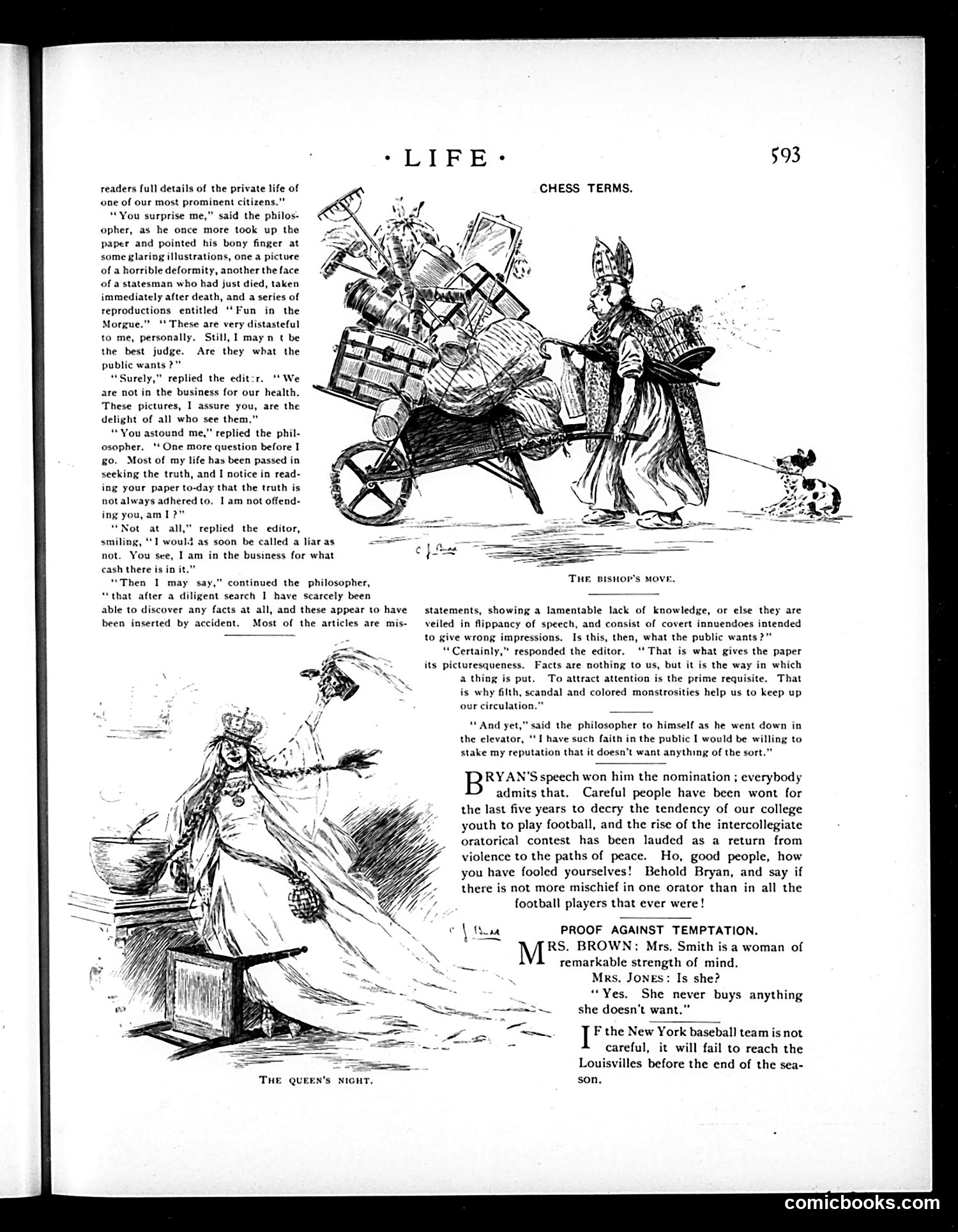
This page contains a dialogue between a philosopher and a newspaper editor, satirizing early 20th-century American journalism ethics. The philosopher critiques the editor's use of sensationalism—grotesque illustrations, morgue photos, and scandal—to boost circulation. The editor brazenly admits that facts are irrelevant; what matters is "picturesqueness" and attracting attention through "filth, scandal and colored monstrosities." The accompanying chess and queen illustrations likely comment metaphorically on the strategic manipulation of public taste. The satire's point: newspapers deliberately feed readers sensationalism rather than truth, corrupting public discourse for profit—and the editor openly acknowledges this cynical business model. The page also includes brief commentary on political oratory (Ryan's nomination speech) and a social observation about consumer restraint, but these are minor.
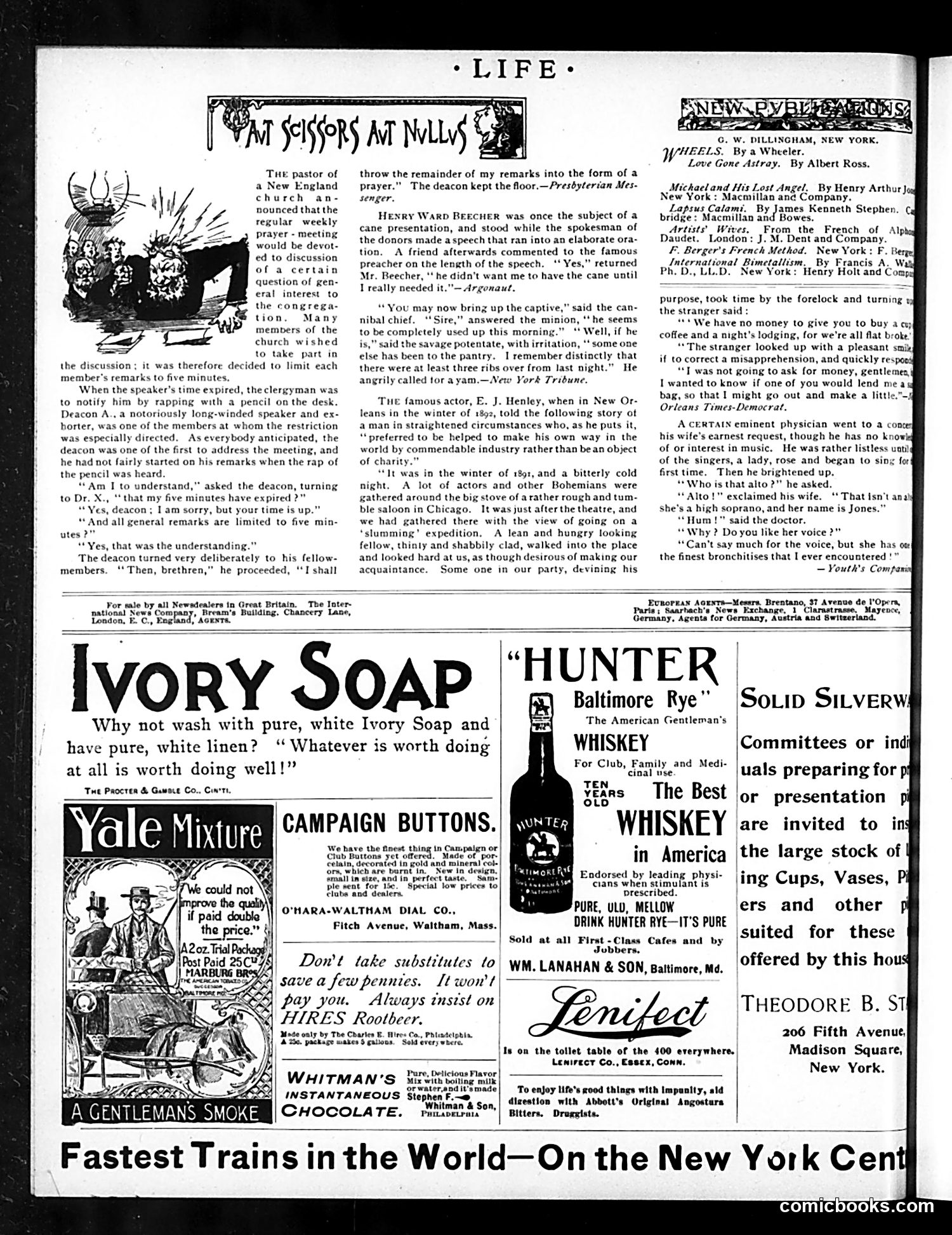
This page contains three humorous anecdotes satirizing verbose speakers and self-righteous behavior: **"Seiggors at Nully"** (main cartoon): A New England church implements a five-minute speaking limit for prayer meetings. Deacon A., notorious for long-windedness, circumvents this by converting his remaining remarks into a prayer—exploiting a loophole since prayers weren't restricted. The satire targets pompous preachers who exploit technicalities and those who hide self-importance behind religious practice. **Other anecdotes** include: - Henry Ward Beecher's quip about receiving a cane after an interminable presentation speech - A cannibal chief's complaint about missing ribs from a captive (dark humor) - An actor's story about a poor but dignified man who refuses charity, asking only to borrow a bag—implying he'll earn money honestly **Point**: The page mocks hypocrisy, pretension, and those who game systems (religious or social) to serve selfish ends while maintaining respectability.
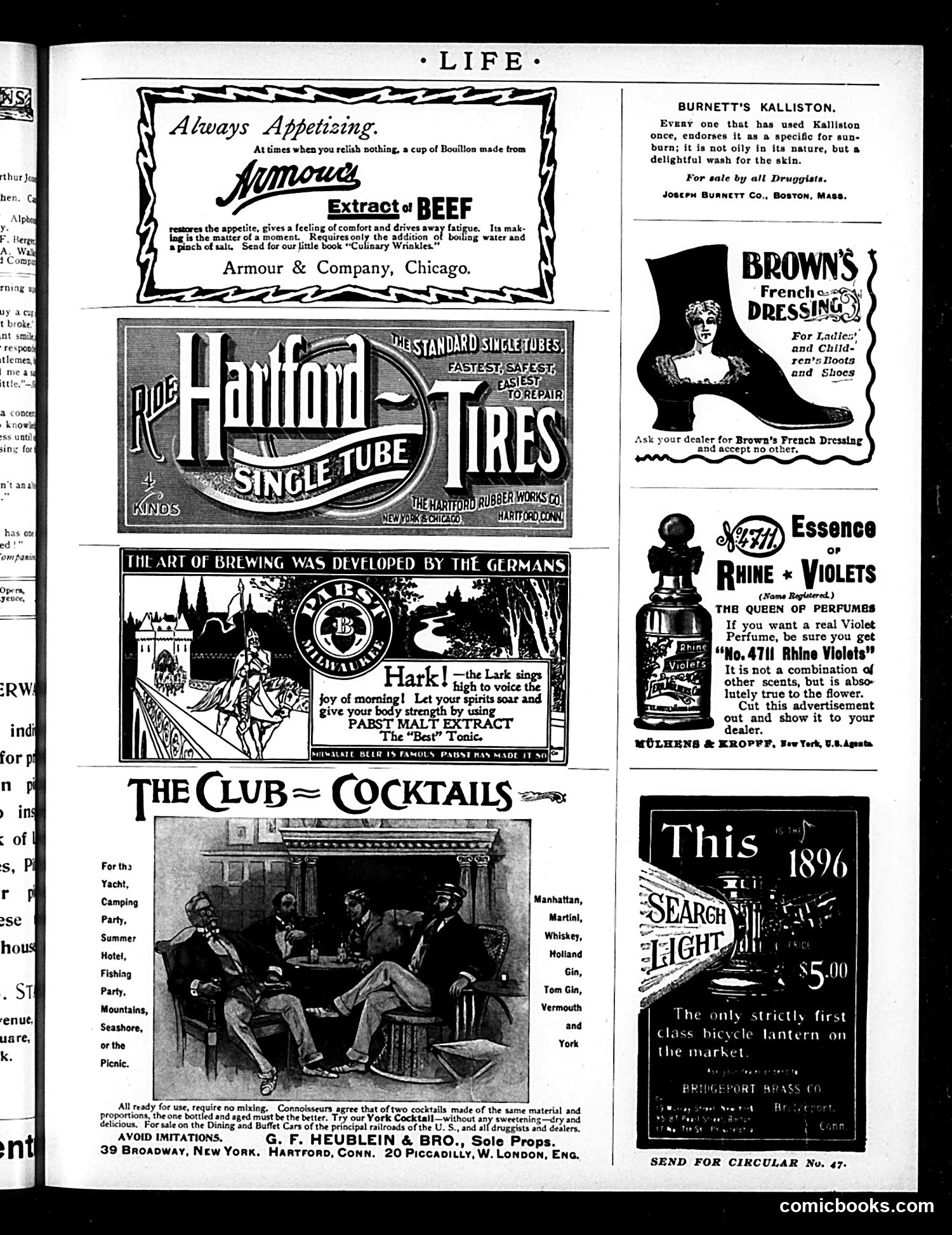
This page is primarily **advertising**, not political satire. It contains multiple product advertisements typical of late 19th-century American magazines: **Notable ads include:** - Armour's Beef Extract (restorative bouillon) - Hartford Single Tube Tires (bicycle repair) - Pabst Milwaukee Beer (with German brewing heritage imagery) - Brown's French Dressing (shoe polish) - Rhine Violets perfume - **The Club Cocktails** (pre-mixed drinks for social occasions—yacht parties, camping, hotels) - A bicycle lantern ($5.00) The only image with narrative content is "The Club Cocktails," which depicts gentlemen in formal dress socializing. This reflects Gilded Age leisure culture—ready-made cocktails marketed as convenience products for the affluent. The page reflects turn-of-the-century consumer culture and emerging branded products, rather than political commentary or satire. The German beer reference may subtly reference immigration debates, but this isn't developed into satire here.
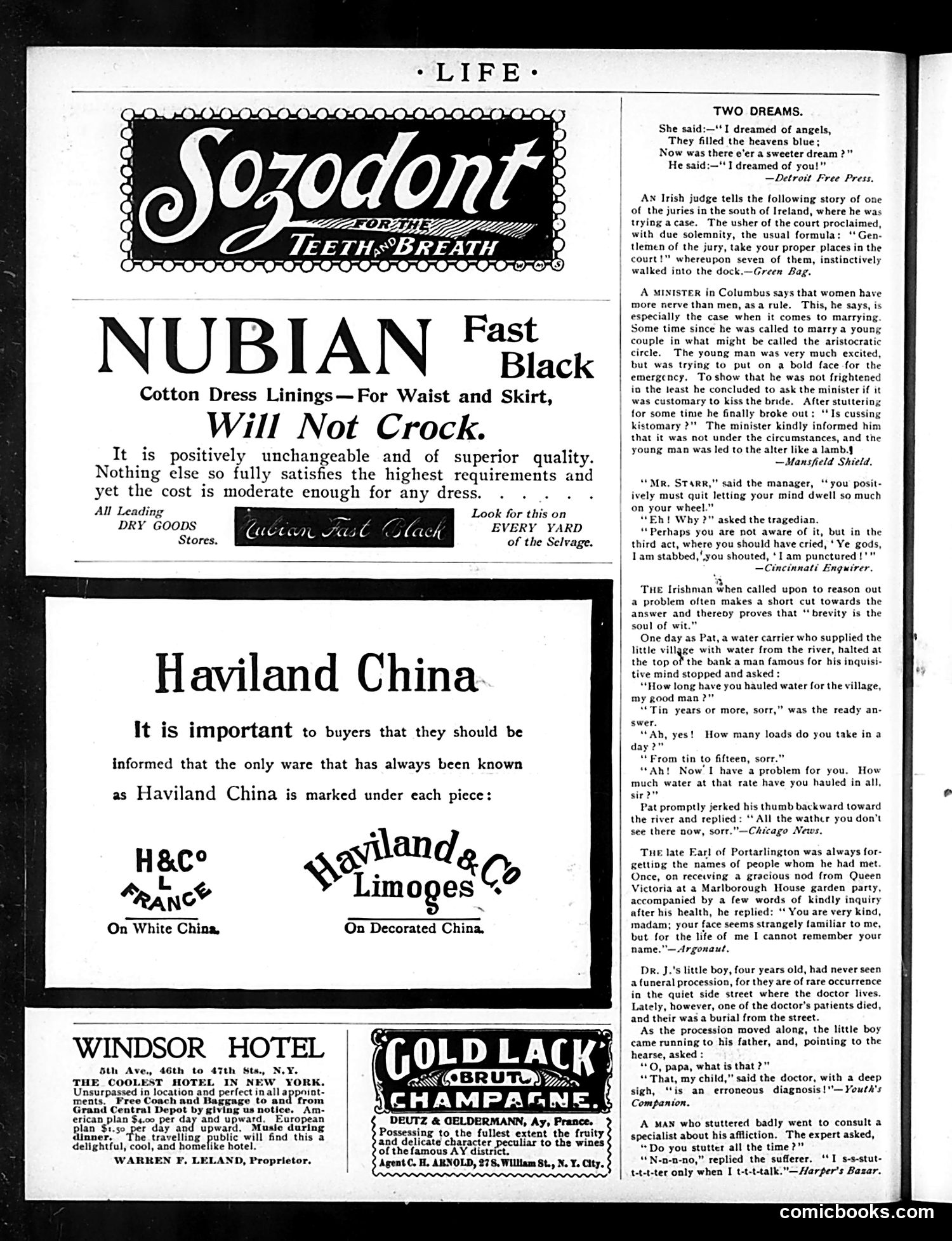
This page is primarily **advertising with humorous anecdotes**, not political satire. The upper half showcases product ads for Sozodont toothpaste, Nubian fabric linings, and Haviland China—typical late 19th/early 20th-century *Life* magazine content. The right column contains **light comic stories** poking fun at Irish stereotypes (slow reasoning, literal-mindedness), matrimonial nervousness, and absentmindedness among the British upper class. These are genteel, period-appropriate humor pieces rather than sharp satire. The "Two Dreams" poem is sentimental Victorian romance. The **Gold Lack Champagne** ad (lower right) advertises a French luxury product. Overall, this represents *Life*'s mixed editorial-advertising format of the era—not a platform for political commentary, but rather society humor, romantic sentiment, and consumer goods marketing targeting affluent readers.
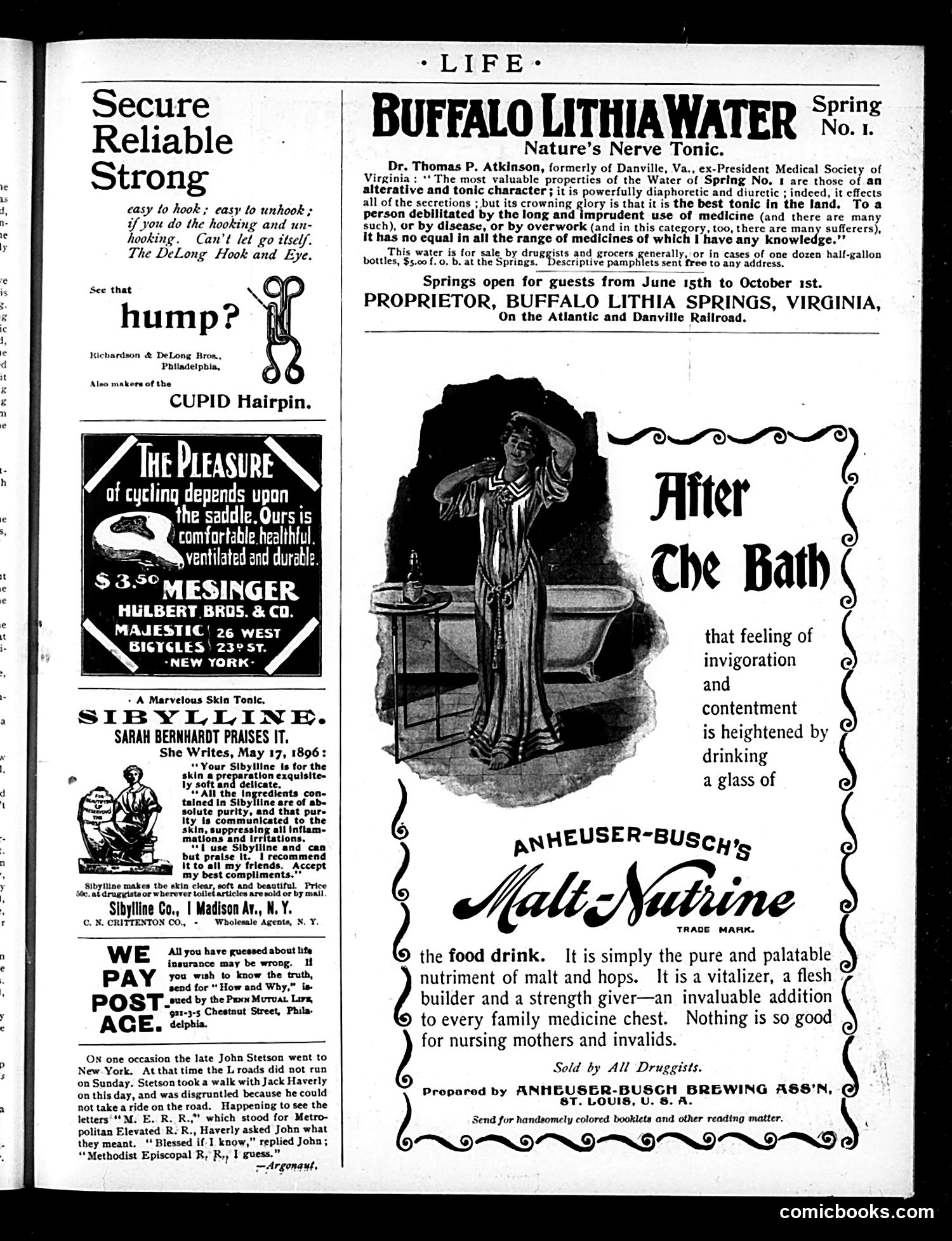
This is primarily an **advertising page** from Life magazine's Spring issue, not a political cartoon. The page contains multiple product advertisements typical of the era (late 1800s), including: - **DeLong Hook and Eye** and Cupid Hairpin (fasteners) - **Mesinger bicycle saddle** - **Sibylline skin tonic** (endorsed by a testimonial letter) - **Buffalo Lithia Water** — marketed as a "nerve tonic" with a medical endorsement claiming benefits for debility and overwork - **Anheuser-Busch Malt Nutrine** — beer marketed as a medicinal "food drink" for nursing mothers and invalids The only humorous element is a brief **anecdote** at the bottom about John Stetson misinterpreting "M.E.R.R." (Metropolitan Elevated Railroad) as "Methodist Episcopal R.R."—a mild joke playing on his confusion. The advertisements reflect contemporary patent-medicine culture, where alcohol and dubious tonics were marketed as health remedies.
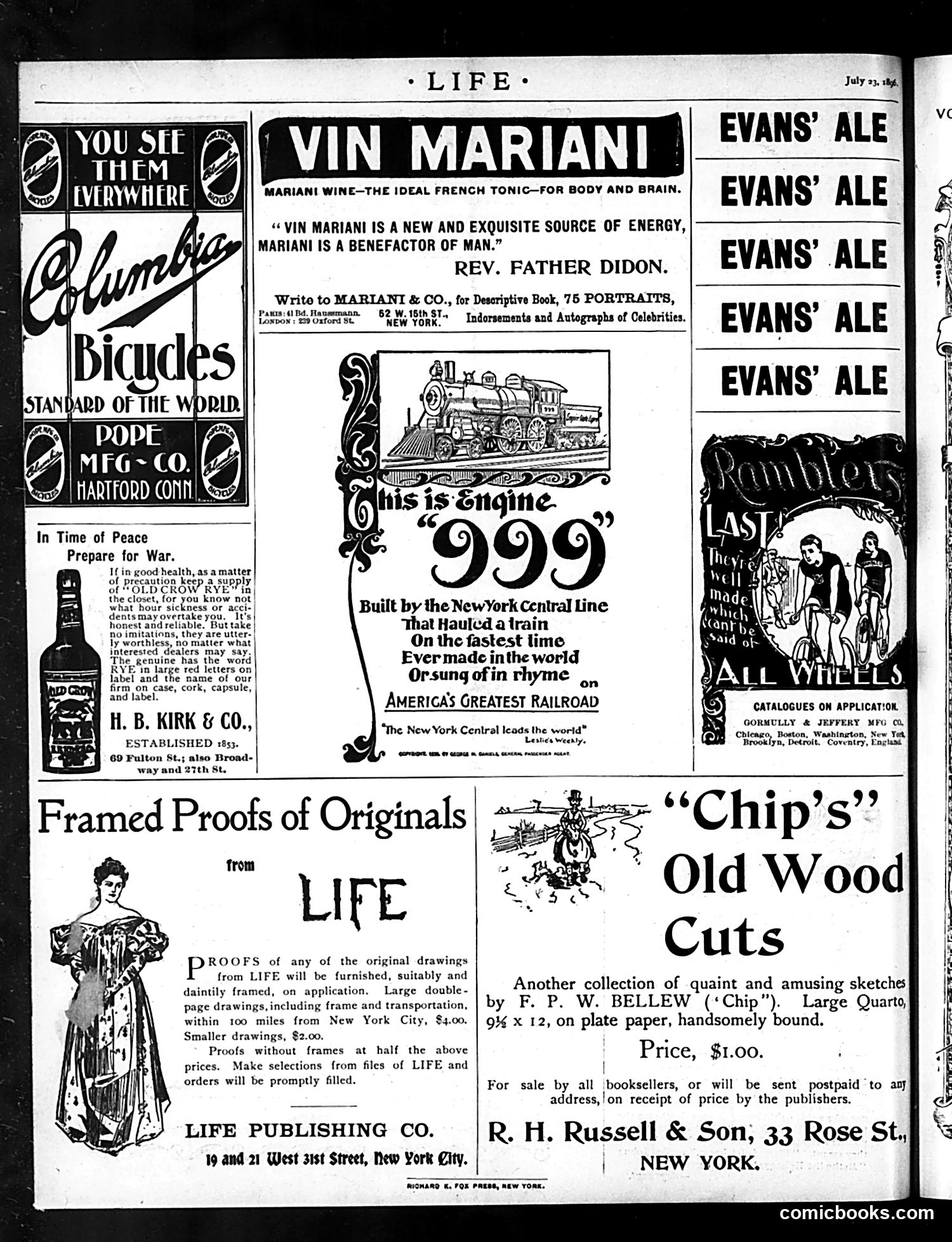
This page is primarily **advertising**, not editorial content or satire. It contains multiple product advertisements typical of early-1900s magazines: **Key ads include:** - Columbia Bicycles ("Standard of the World") - Old Crow Rye whiskey, marketed with a militaristic tagline "In Time of Peace Prepare for War"—likely referencing contemporary anxieties about military preparedness - Vin Mariani wine, endorsed by "Rev. Father Didon," a real French priest known for promoting this cocaine-containing tonic - Evans' Ale (repeated vertically) - New York Central Railroad, celebrating "Engine 999," a famous locomotive - Rambler bicycles and other products The page also advertises **Life Publishing Company's own products**: framed proofs of original drawings from the magazine and "Chip's" Old Wood Cuts (F.P.W. Bellew's sketches). This reflects the era's advertising practices and consumer products, with no discernible political cartoon or satire present on this particular page.