
Life, 1896-07-23 · page 12 of 18
Life — July 23, 1896 — page 12: what you’re looking at
What you’re looking at
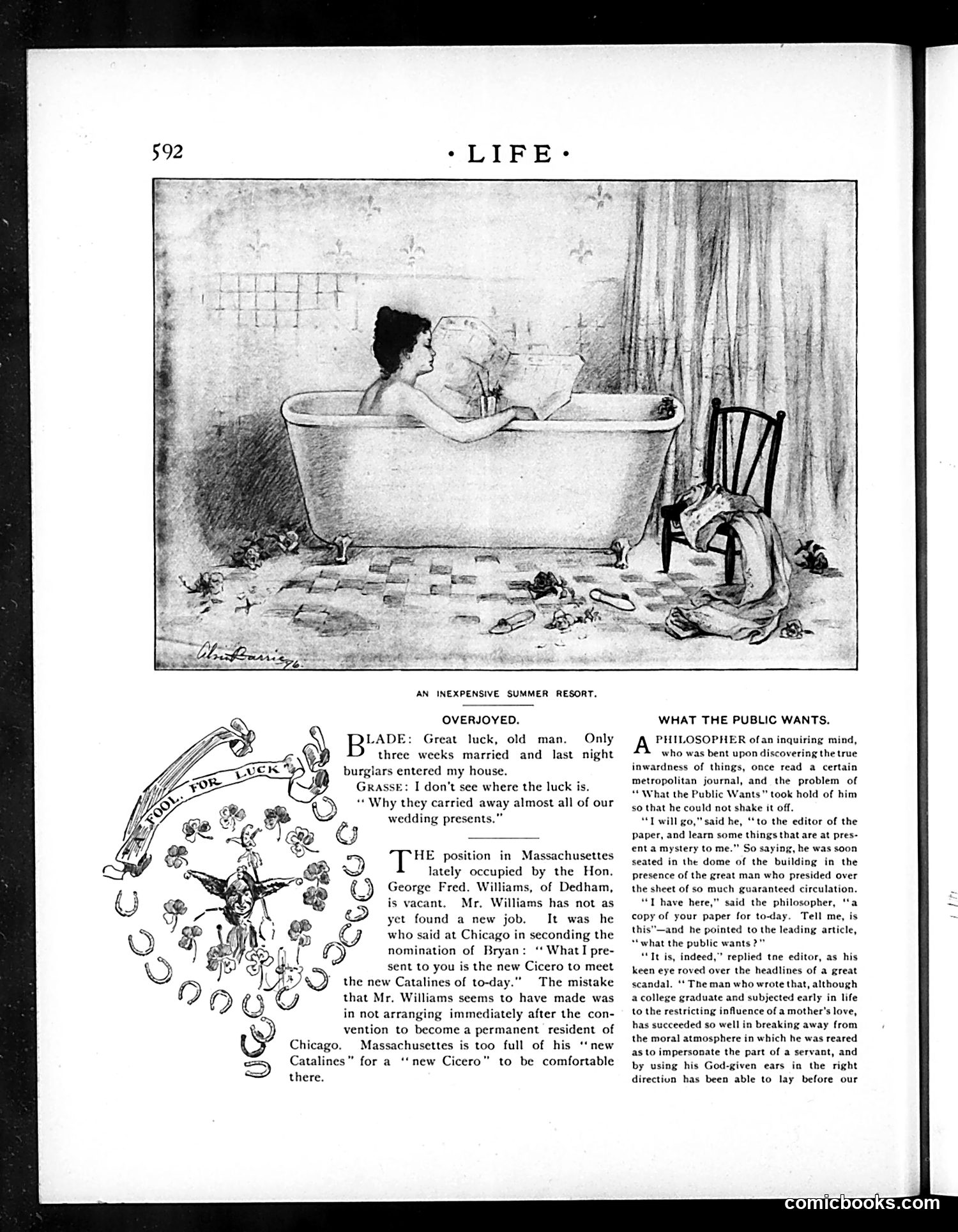
This Life magazine page contains three separate satirical pieces: **"An Inexpensive Summer Resort"** (top): A cartoon mocking newlyweds whose house was burgled. The "joke" is that losing wedding gifts is good luck—dark humor about unwanted presents. **"Overjoyed"** (bottom left): Political satire about George Fred. Williams, a Massachusetts politician who'd nominated William Jennings Bryan for president using grandiose rhetoric (comparing Bryan to Cicero opposing "new Catilines"). The piece mocks Williams's failure to secure a job after the convention, suggesting his flowery speech didn't translate to practical success. Massachusetts, it quips, already has enough of his "new Cicero" talk. **"What the Public Wants"** (bottom right): A philosophical dialogue satirizing newspaper editors. A philosopher asks whether sensational scandal coverage truly reflects public demand, or whether editors simply *claim* it does while pursuing salacious stories regardless of actual reader interest—a critique of journalistic justifications for yellow journalism. All three target pretension, hypocrisy, and the gap between stated ideals and actual behavior.
📄 Transcribed text from this page (OCR, searchable)
Machine-transcribed from the original scan — historical spelling and the odd misread are preserved.
AN INEXPENSIVE SUMMER RESORT. OVERJOYED. AD Great luck, old man. Only three weeks married and last night burglars entered my house. Grasse: I don’t see where the luck is. ‘Why they carried away almost all of our wedding presents. “TBE position in Massachusettes lately occupied by the Hon. George Fred. Williams, of Dedham, is vacant. Mr. Williams has not as yet found a new job. It was he who said at Chicago in seconding the nomination of Bryan: ‘* WhatI pre- sent to you is the new Cicero to meet the new Catalines of to-day.” The mistake that Mr. Williams seems to have made was in not arranging immediately after the con- vention to become a permanent resident of Massachusettes is too full of his ‘new “‘new Cicero” to be comfortable Chicago. Catalines” for a there. WHAT THE PUBLIC WANTS. PHILOSOPHER ofan inquiring mind, who was bent upon discovering the true inwardness of things, once read a certain metropolitan journal, and the problem of “What the Public Wants” took hold of him so that he could not shake it off. “Twill go," said he, “to the editor of the paper, and learn some things that are at pres- ent a mystery to me.” So saying, he was soon seated in the dome of the building in the presence of the great man who presided over the sheet of so much guaranteed circulation. “TL have here,” said the philosopher, ‘a copy of your paper for to-day. Tell me, is this"—and he pointed to the leading article, “what the public wants ?” “It is, indeed,” replied tne editor, as his keen eye roved over the headlines of a great scandal. The man who wrote that, although a college graduate and subjected early in life to the restricting influence of a mother's love, has succeeded so well in breaking away from the moral atmosphere in which he was reared as to impersonate the part of a servant, and by using his God-given ears in the right direction has been able to lay before our