
A complete issue · 18 pages · 1895
Life — October 31, 1895
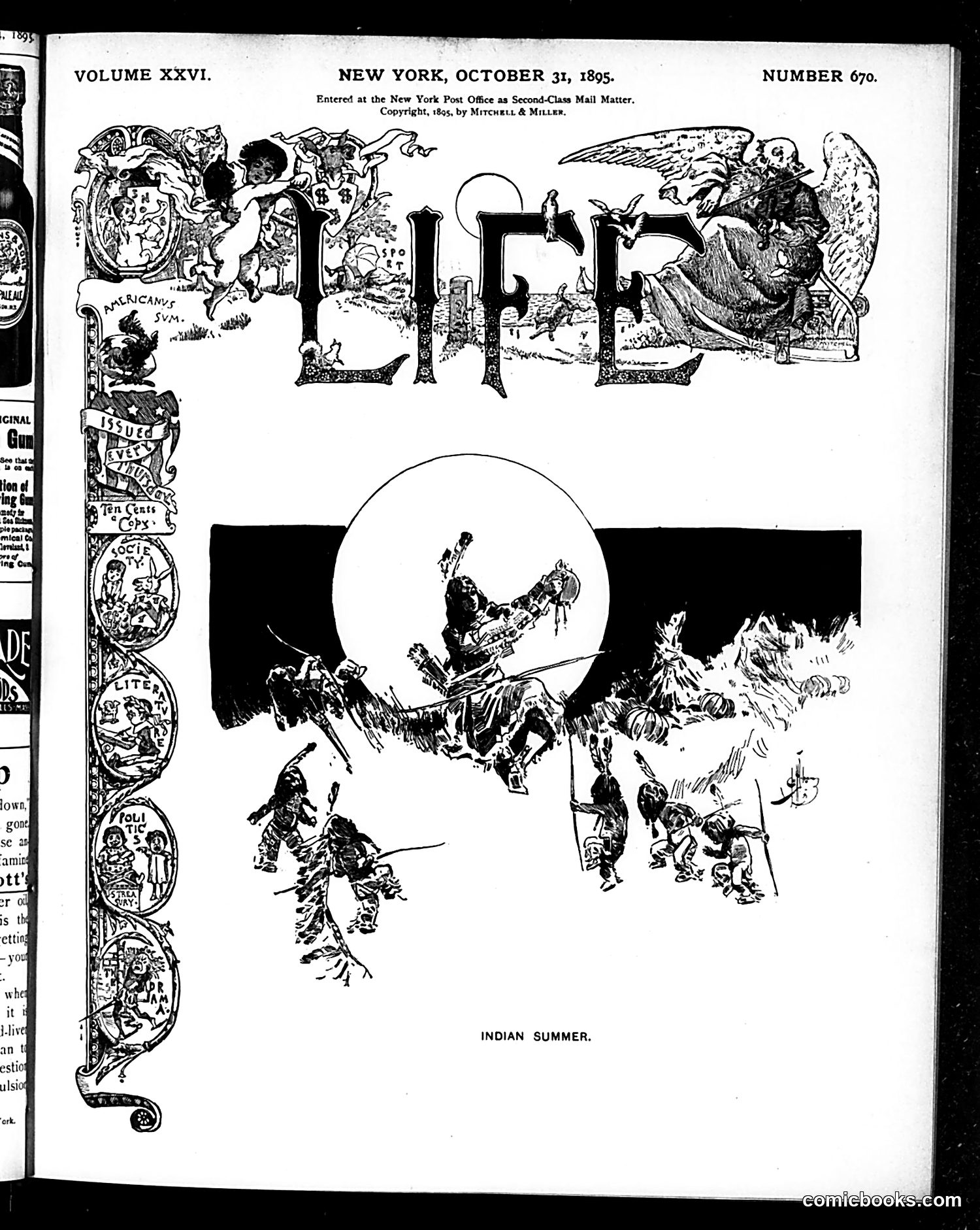
This illustration depicts whimsical, fantastical figures frolicking against a large moon. The caption "INDIAN SUMMER" suggests a playful treatment of the seasonal phenomenon—a period of warm, pleasant weather in autumn traditionally attributed to Native American origins of the term. The figures appear to be mythological or supernatural beings (possibly fairies, spirits, or allegorical characters) engaged in carefree activity. The elaborate decorative border on the left contains various vignettes and emblems typical of Life's ornamental style. Without additional context from surrounding articles, the specific political or social satire remains unclear. The image may simply represent a lighthearted, seasonal theme rather than commentary on a particular event or figure.
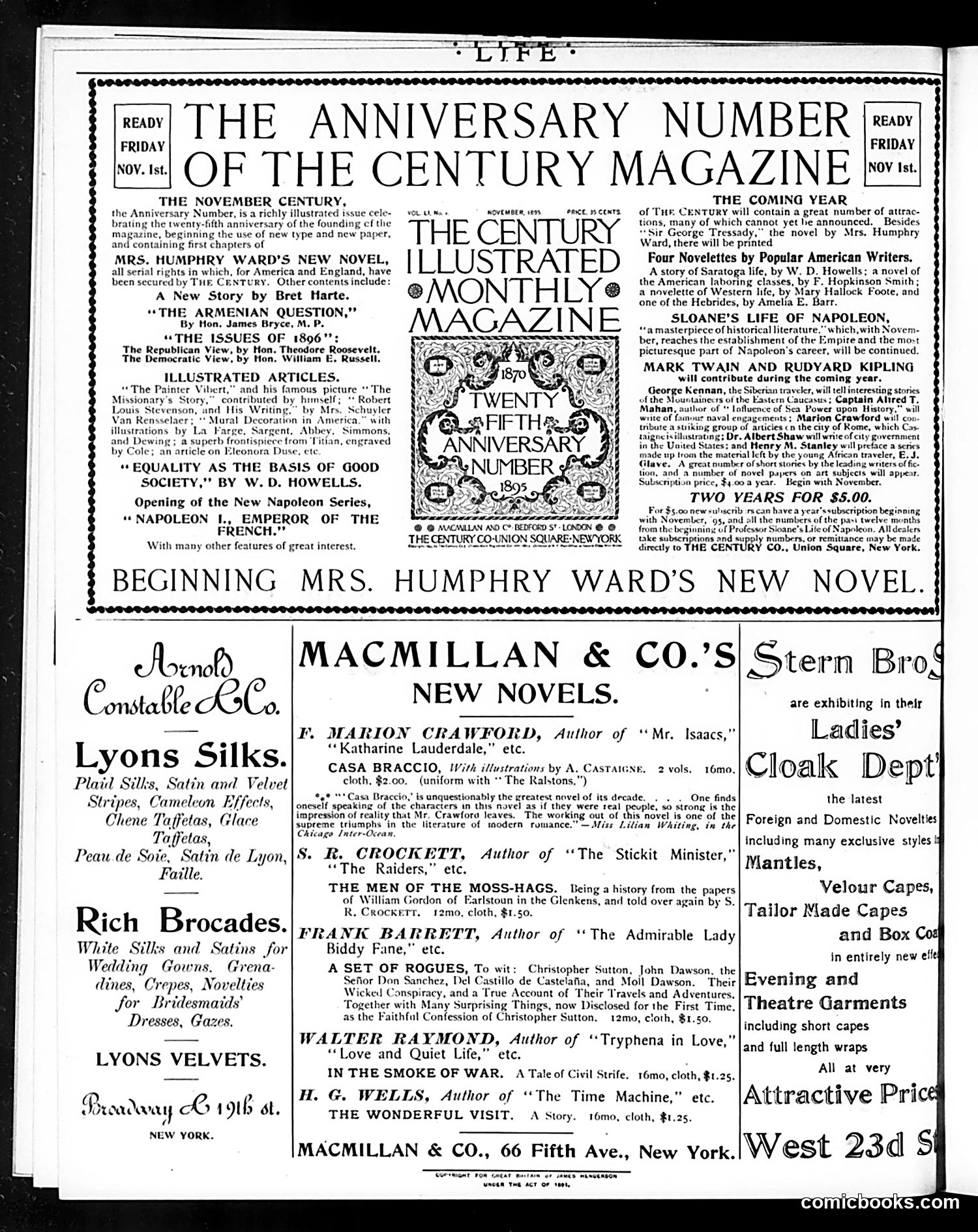
This page is primarily **advertising and promotional content** for *The Century Illustrated Monthly Magazine's* 25th anniversary issue (November 1895). The central image is an ornate masthead celebrating the magazine's milestone. The page announces upcoming serialized fiction and articles, including work by Mrs. Humphry Ward and references to Napoleon-related content. Publishers MacMillan & Co. and Stern Bros. advertise new novels and ladies' clothing respectively. **No significant political cartoons or satire appear on this page.** It functions as a magazine cover/announcement page promoting literary and consumer goods. The historical interest lies in period advertising (silk fabrics, cloaks, theater garments) and the prominent American and British authors being marketed to affluent readers in the 1890s.
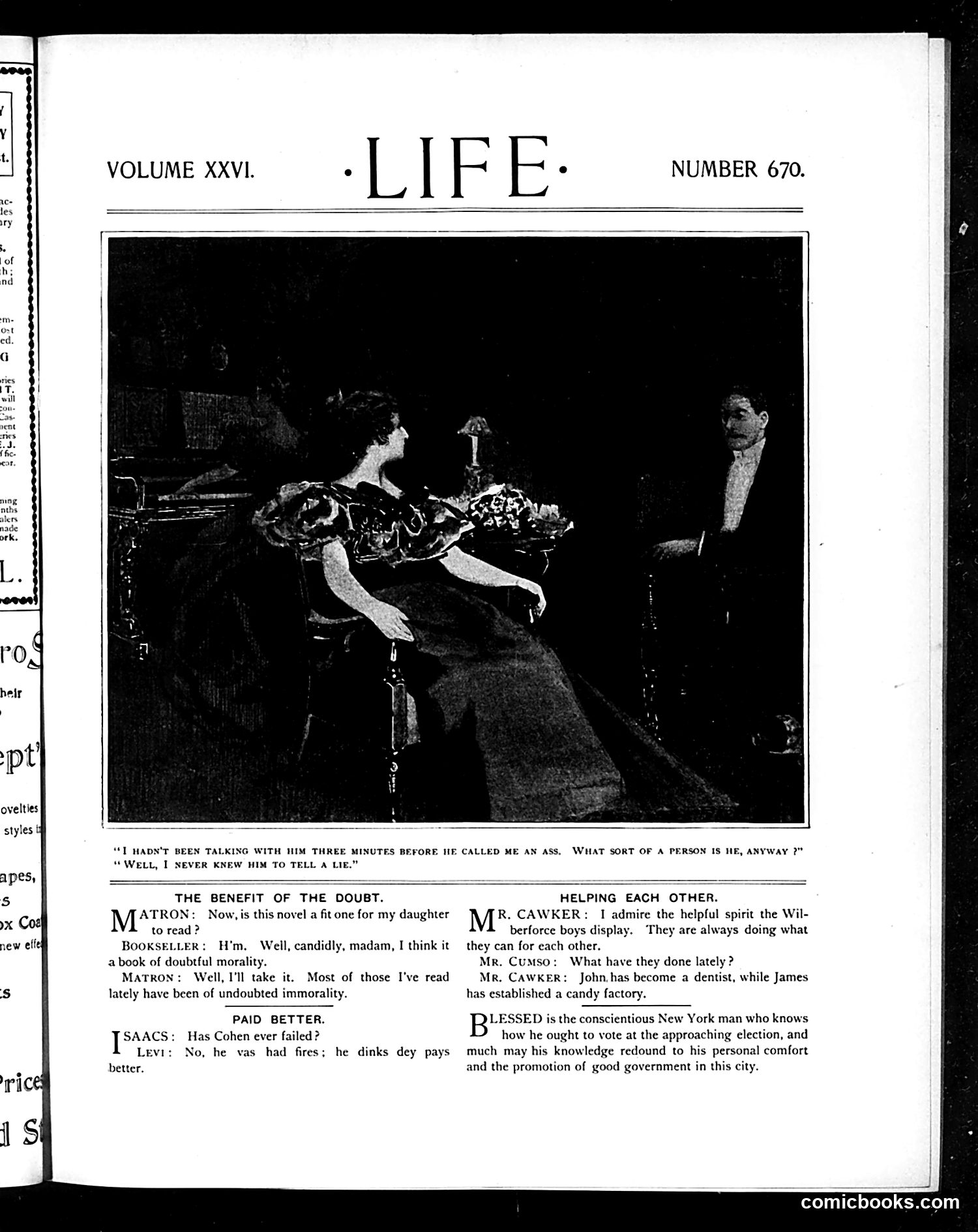
The main illustration shows a dramatic scene between a woman and man, with the caption referencing someone calling another "an ass" and the response "I never knew him to tell a lie." Below are three brief satirical sections: **"The Benefit of the Doubt"** - A matron asks a bookseller about a book of "doubtful morality"; he recommends it anyway, noting most doubtful books he's read were actually of undoubted quality (satirizing how "forbidden" books often prove worthwhile). **"Paid Better"** - A joke about Cohen never failing—he drinks "dey pays better" (playing on ethnic dialect humor common to period satire). **"Helping Each Other"** - Social commentary praising a conscientious New York voter, while noting two boys (John became a dentist, James runs a candy factory) who "help each other" by doing what benefits them. The humor relies on period stereotypes and class-based social observation.
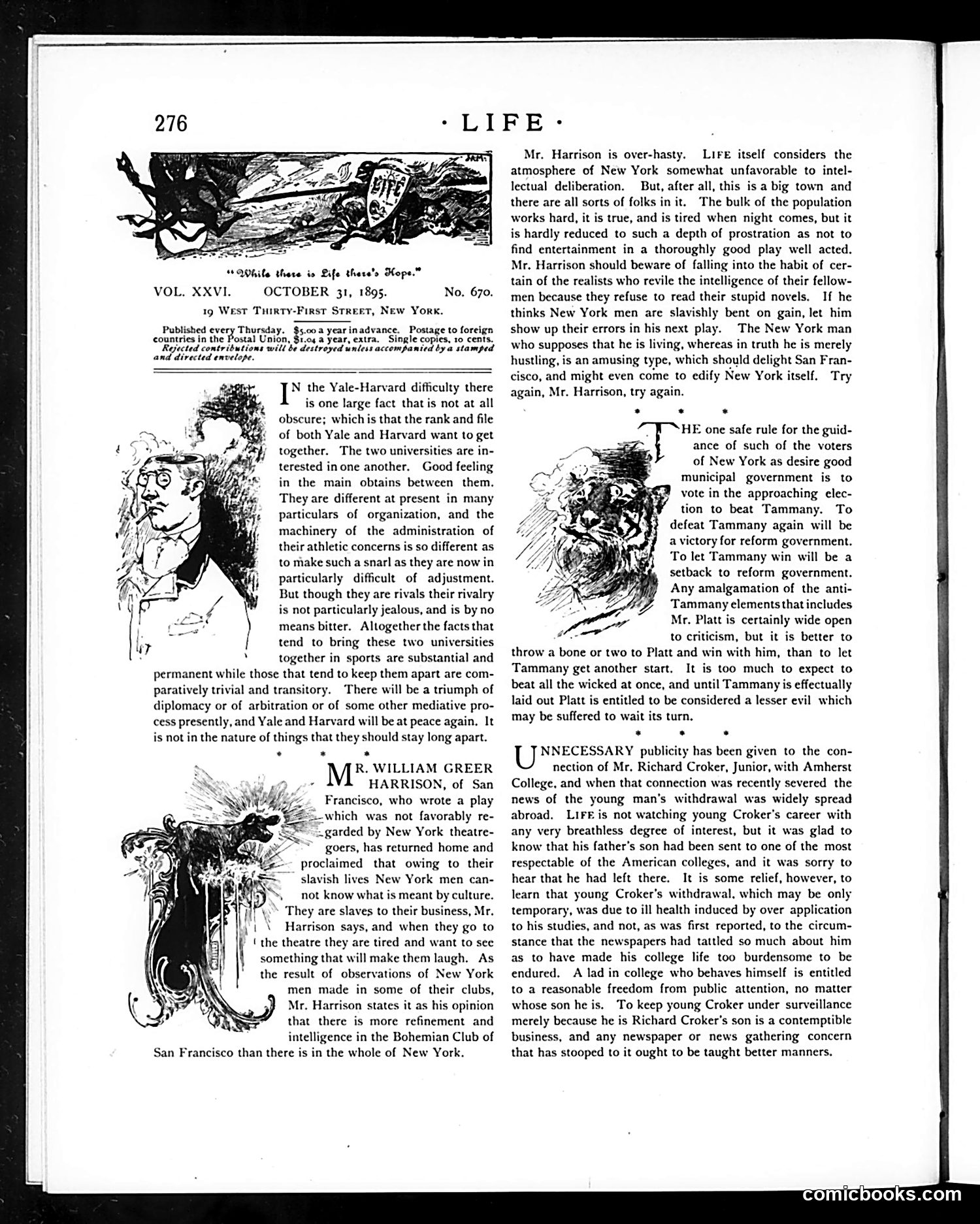
This page contains three editorial cartoons with accompanying commentary on contemporary issues. The **first cartoon** (top) criticizes Mr. William Greer Harrison, a San Francisco playwright whose work was poorly received by New York theater critics. The satire mocks Harrison's claim that New Yorkers lack culture and refinement, arguing instead that New York audiences are simply discerning and tired—they work hard and deserve quality entertainment, not "slavish" productions. The **second and third cartoons** address Yale-Harvard university rivalry and New York municipal politics. The text discusses reform efforts against Tammany Hall's political machine, arguing that defeating Tammany represents genuine reform progress. The page also reports on Richard Croker Jr.'s withdrawal from Amherst College, defending his privacy against newspaper intrusion.
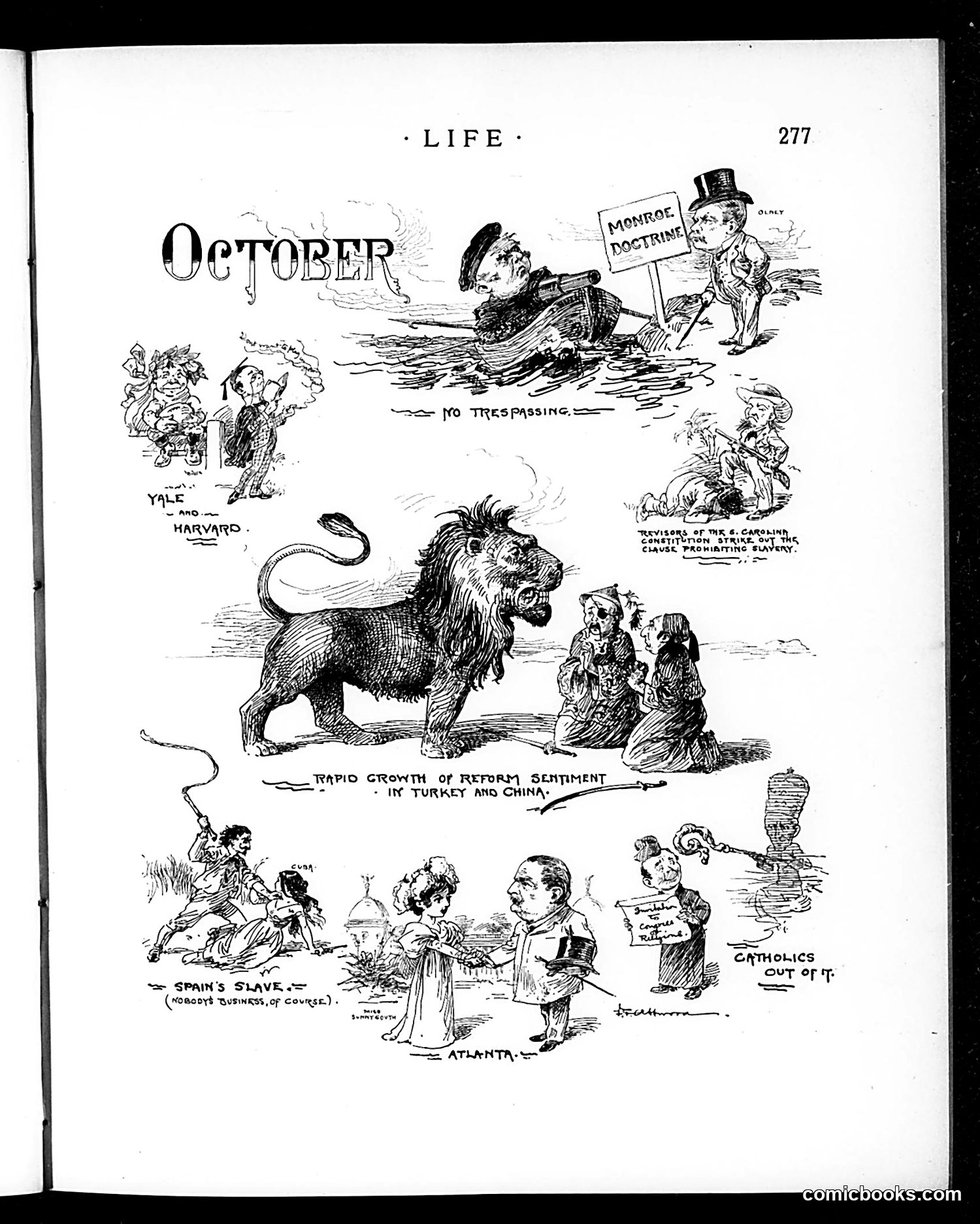
This page from *Life* magazine presents satirical commentary on early 20th-century political issues: **Monroe Doctrine** (top): A figure representing American policy blocks another nation from crossing, illustrating U.S. resistance to foreign intervention in the Americas. **Yale and Harvard** (left): Appears to mock these elite universities, though context is unclear. **Reform Sentiment in Turkey and China** (center): A large lion represents aggressive expansionism; smaller figures suggest reform movements struggling against this force. **Spain's Slave** (bottom left): Likely references Spain's colonial or labor policies, depicted as enslavement. **Atlanta** and **Catholics Cut of It** (right): Suggest local or sectarian political tensions, though specific references are unclear without additional historical context. The overall theme critiques American foreign policy, imperialism, and domestic inequality.
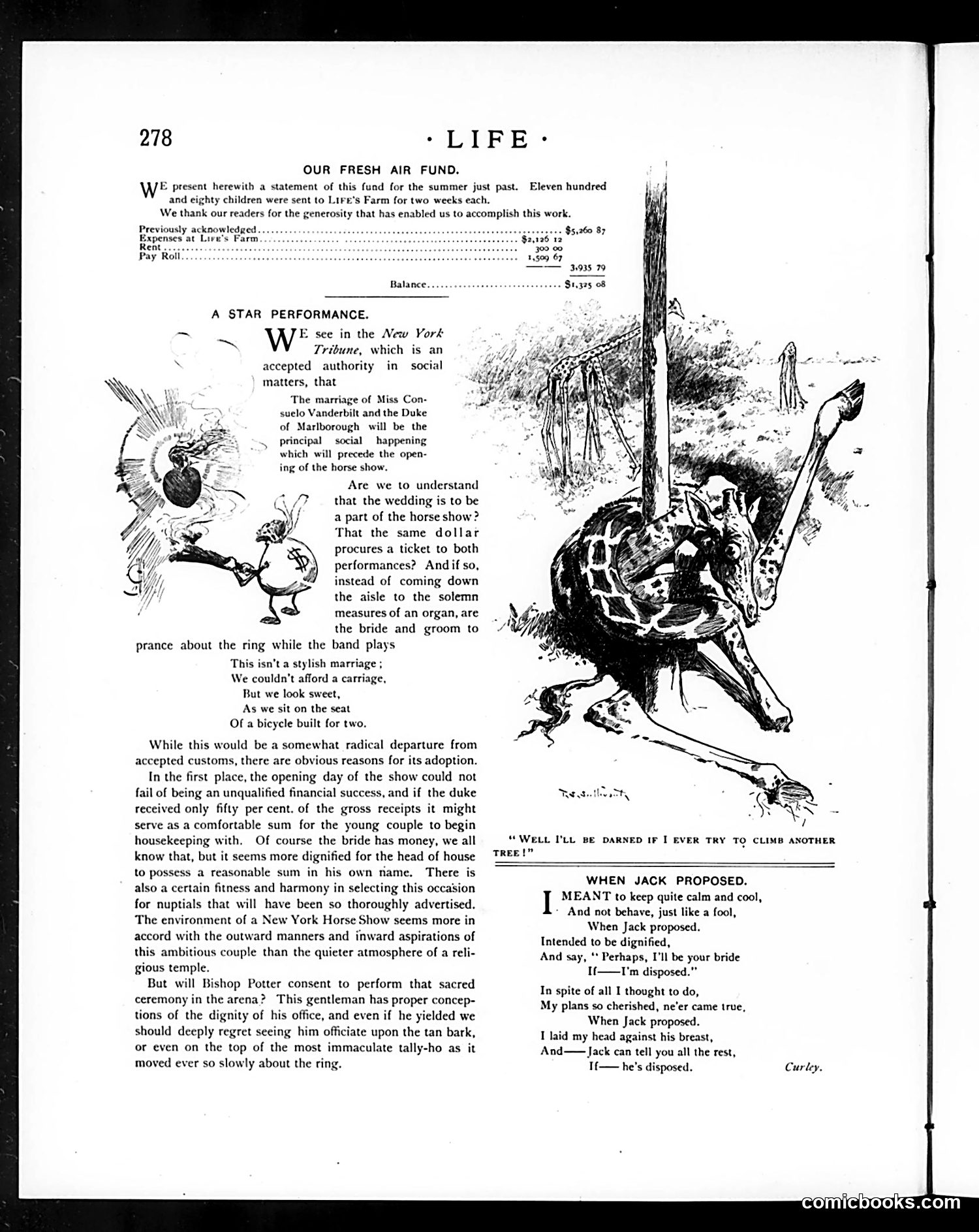
This page contains two satirical pieces: **"A Star Performance"** critiques a high-society wedding between Miss Consuelo Vanderbilt and the Marlborough duke. The satire mocks the commercialization of their union—suggesting the couple treats their wedding like a circus performance, where the same ticket admits spectators to both the horse show and the ceremony. The cartoon illustrations depict absurd wedding scenarios. The piece questions whether such an expensive, spectacle-driven event is appropriate when the bride and groom could more modestly begin housekeeping. It criticizes the social pretension and financial excess surrounding aristocratic marriages. **"When Jack Proposed"** is a lighthearted poem about a marriage proposal, contrasting the narrator's attempts at composure with their emotional response to Jack's proposal.
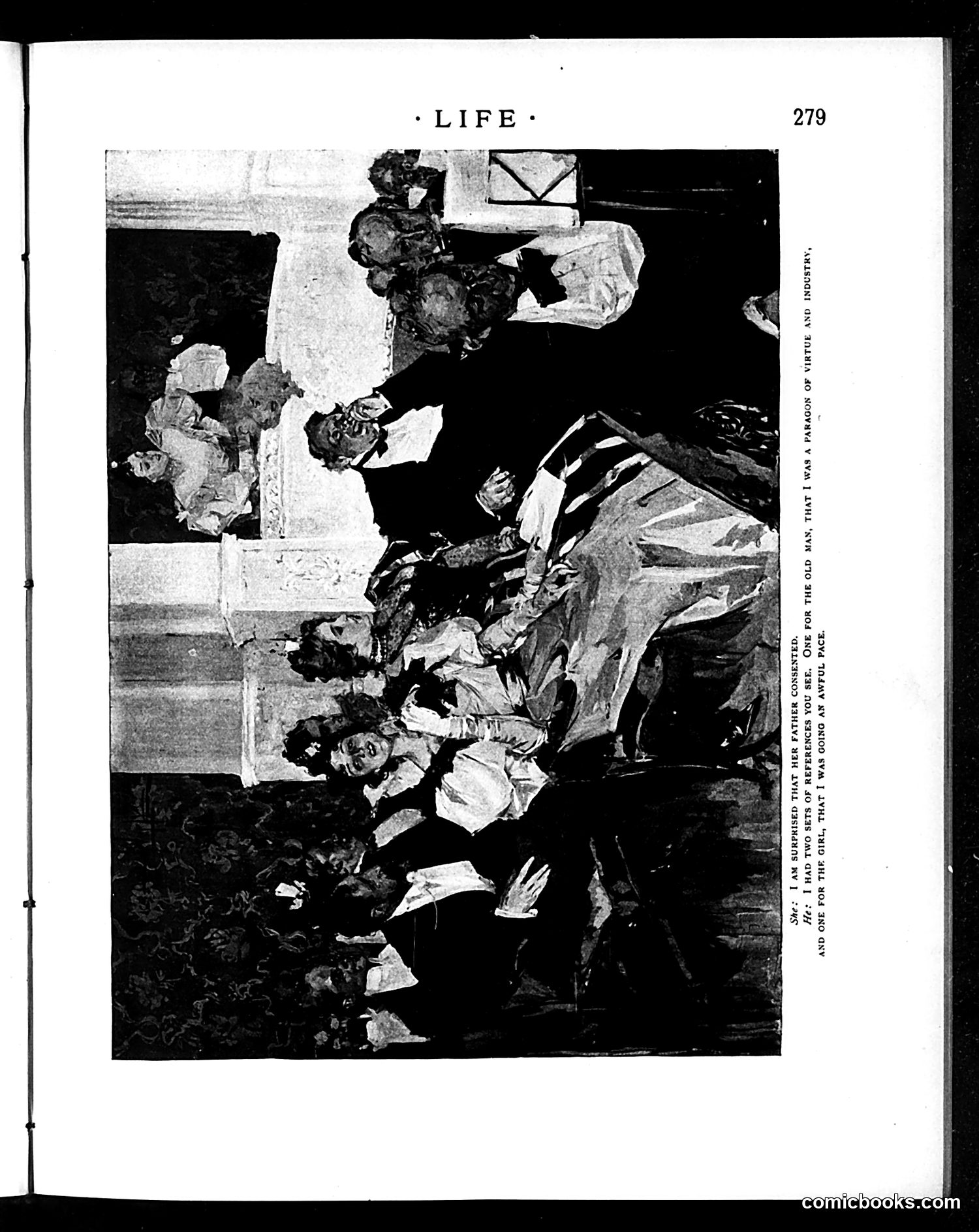
This appears to be page 279 from *Life* magazine, featuring a black and white photograph rather than a cartoon. The image shows what appears to be an interior domestic scene with multiple figures in period dress (possibly late 19th or early 20th century based on clothing styles). The caption references "a first congress" and mentions "two sets of references" and "the girl" being "caged in dwell," though the OCR text is difficult to parse clearly. Without being able to read the caption text reliably or identify the specific figures in the photograph with certainty, I cannot confidently explain the satirical or political point of this particular image. The photograph itself appears documentary rather than obviously comedic, which was sometimes *Life*'s approach to satire—using captioning to create ironic commentary on straightforward images.
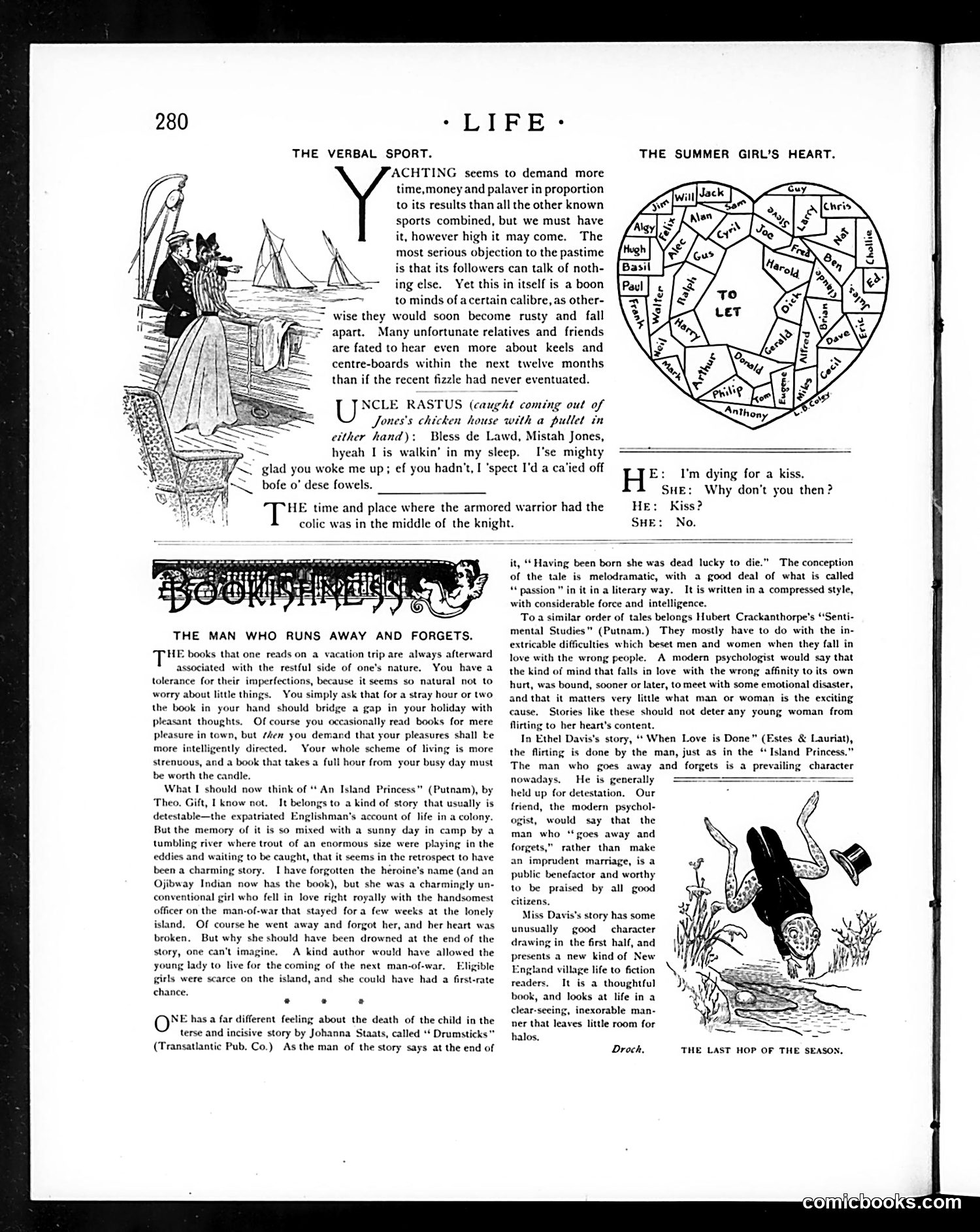
This page contains three distinct literary/satirical pieces rather than political cartoons: 1. **"The Verbal Sport"** critiques yachting as an expensive hobby whose enthusiasts bore others with technical details about "keels and centre-boards." 2. **"The Summer Girl's Heart"** is a humorous diagram showing a young woman's romantic interests—various male names (Jack, Guy, Paul, etc.) arranged in sections with "TO LET" at the center, satirizing the fickleness of summer romance. 3. **"The Man Who Runs Away and Forgets"** reviews several literary works, including discussions of character psychology and storytelling conventions. The accompanying illustrations show a man fleeing and a figure in nature. The page is primarily literary commentary and book reviews with light satirical humor about social behaviors and romantic life, rather than political commentary.
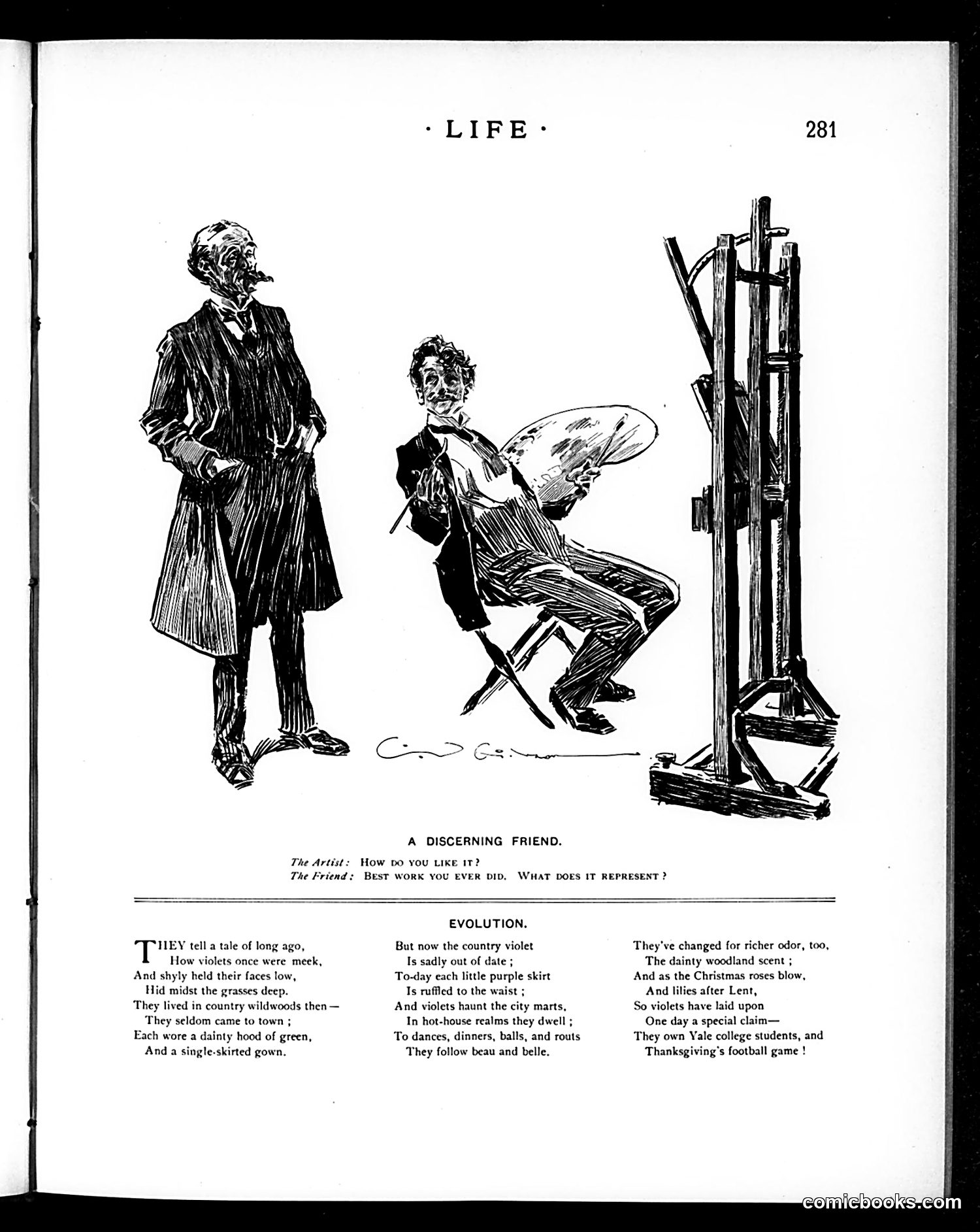
The top cartoon shows an artist displaying his work to a critical friend. The friend praises it as "best work you ever did" while asking what it represents—a joke about abstract or modernist art that's so non-representational the viewer cannot identify its subject. Below, the poem "Evolution" satirizes changing fashion and social norms regarding violets (flowers). It contrasts Victorian-era violets—modest wildflowers worn simply by country women—with contemporary urban violets: now dyed in vivid colors, worn at fashionable events and dances, and even adopted as symbols by Vassar college students. The satire mocks how modernity transforms innocent natural things into markers of commercialized, urban sophistication.
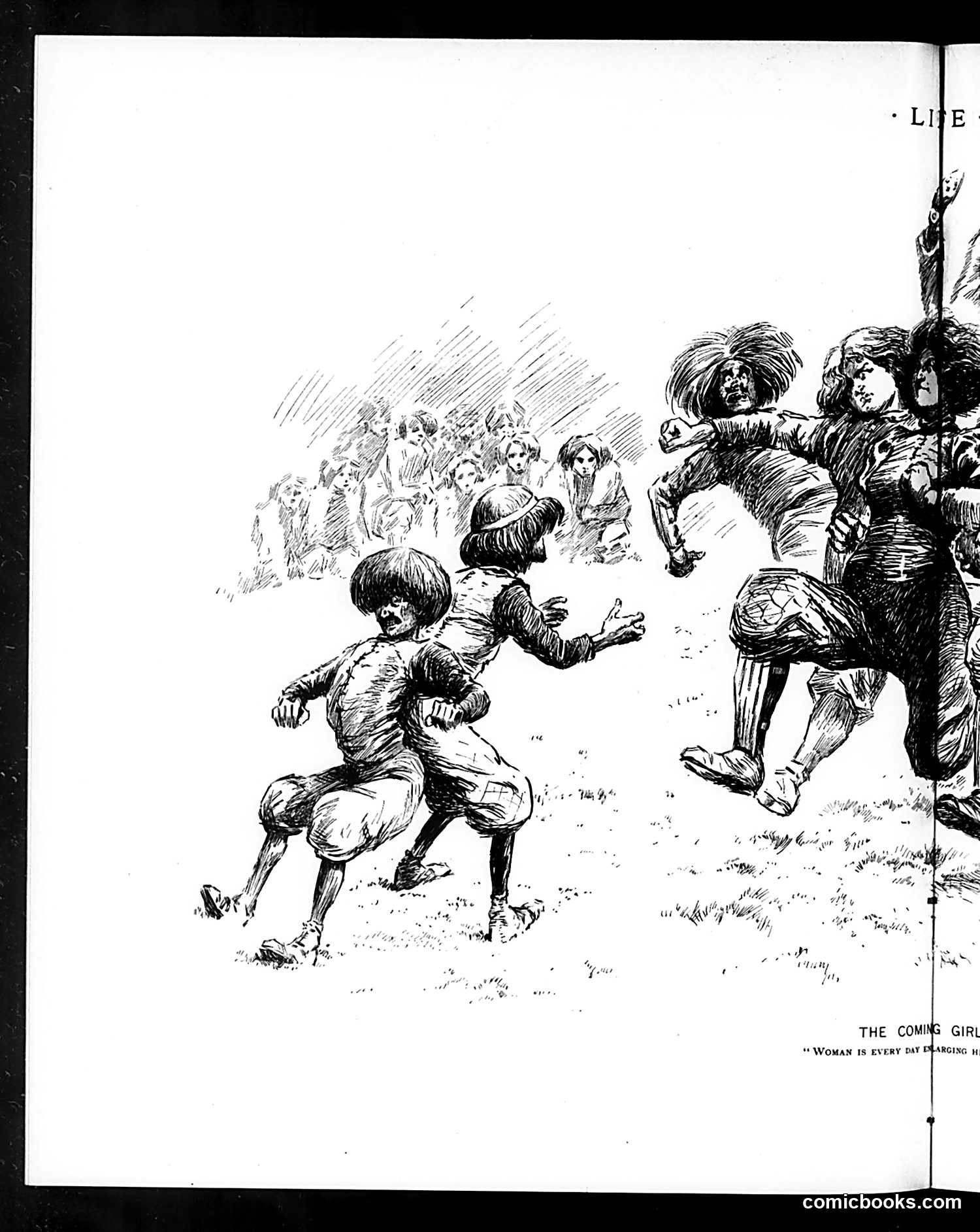
This Life magazine illustration depicts a young girl energetically running toward a group of adult women. The caption reads: "Woman is every day marching in..." The cartoon satirizes the early feminist movement and women's suffrage activism of the early 20th century. The "coming girl" represents the next generation of women who will advance women's rights, shown literally "marching" forward with determination. The established women on the right appear to be leading this movement or representing current female activism. The satire likely mocks contemporary anxieties about changing gender roles and women's increasing public political involvement—particularly the suffrage movement, which was gaining momentum during Life's publication era. The exaggerated energy of the child figure may be satirizing both the vigor of the movement and conservative concerns about its radical implications.
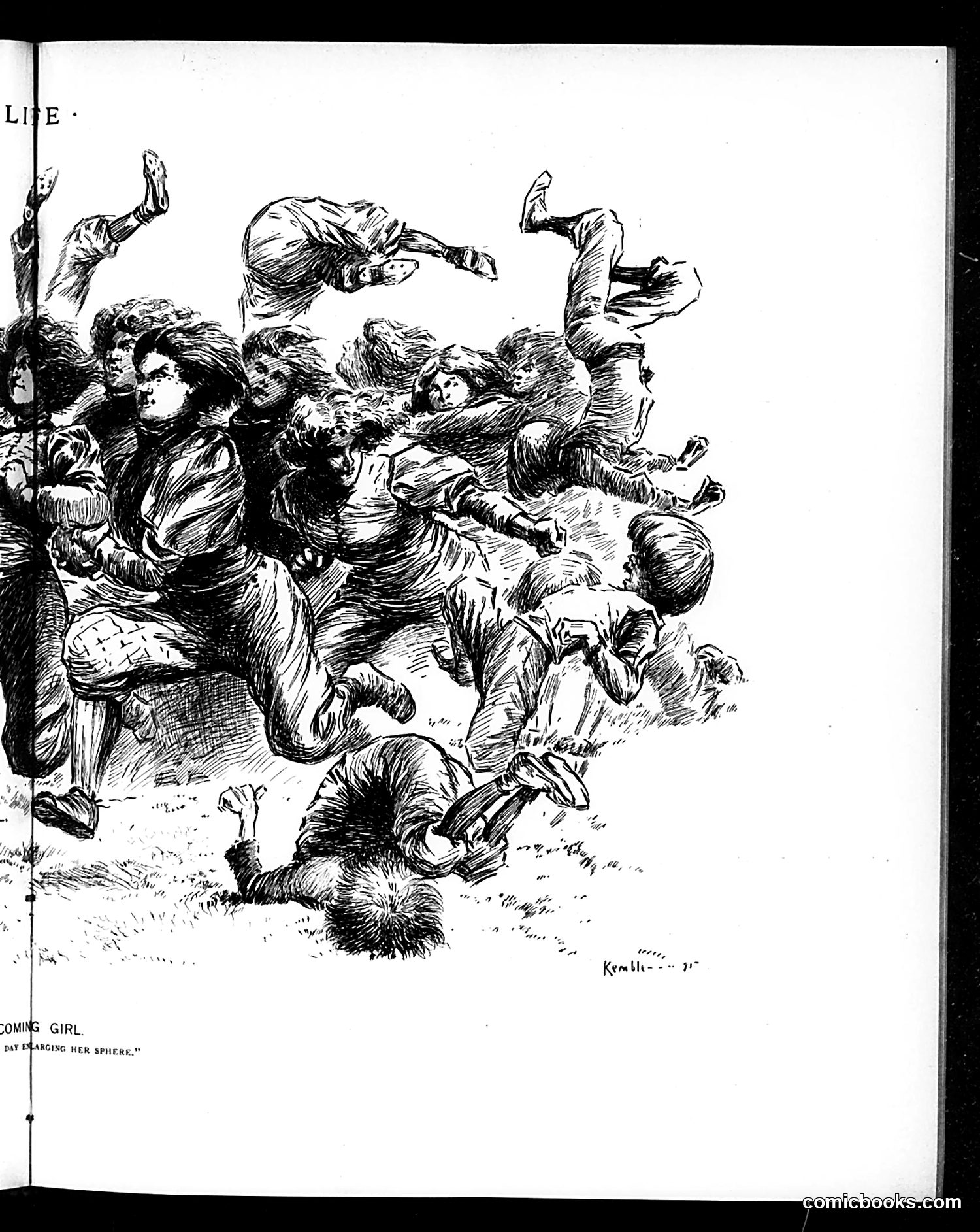
This page shows a chaotic sketch depicting a group of people in apparent distress or conflict. The partial caption visible reads "COMING GIRL" and references "DRAWING HER SPHERE," suggesting commentary on women's roles or the women's suffrage movement—a major political debate in early 20th-century America. The crowded, frenzied composition with figures tumbling and gesturing wildly likely satirizes opposition to expanding women's rights. The title "Coming Girl" appears to mock predictions about how society would change if women gained more freedoms or political power. The artist's signature reads "Kemble." Without the complete caption and full context from Life magazine's publication date, the exact targets of this satire remain somewhat unclear, though it clearly engages with contemporary debates about gender and social change.
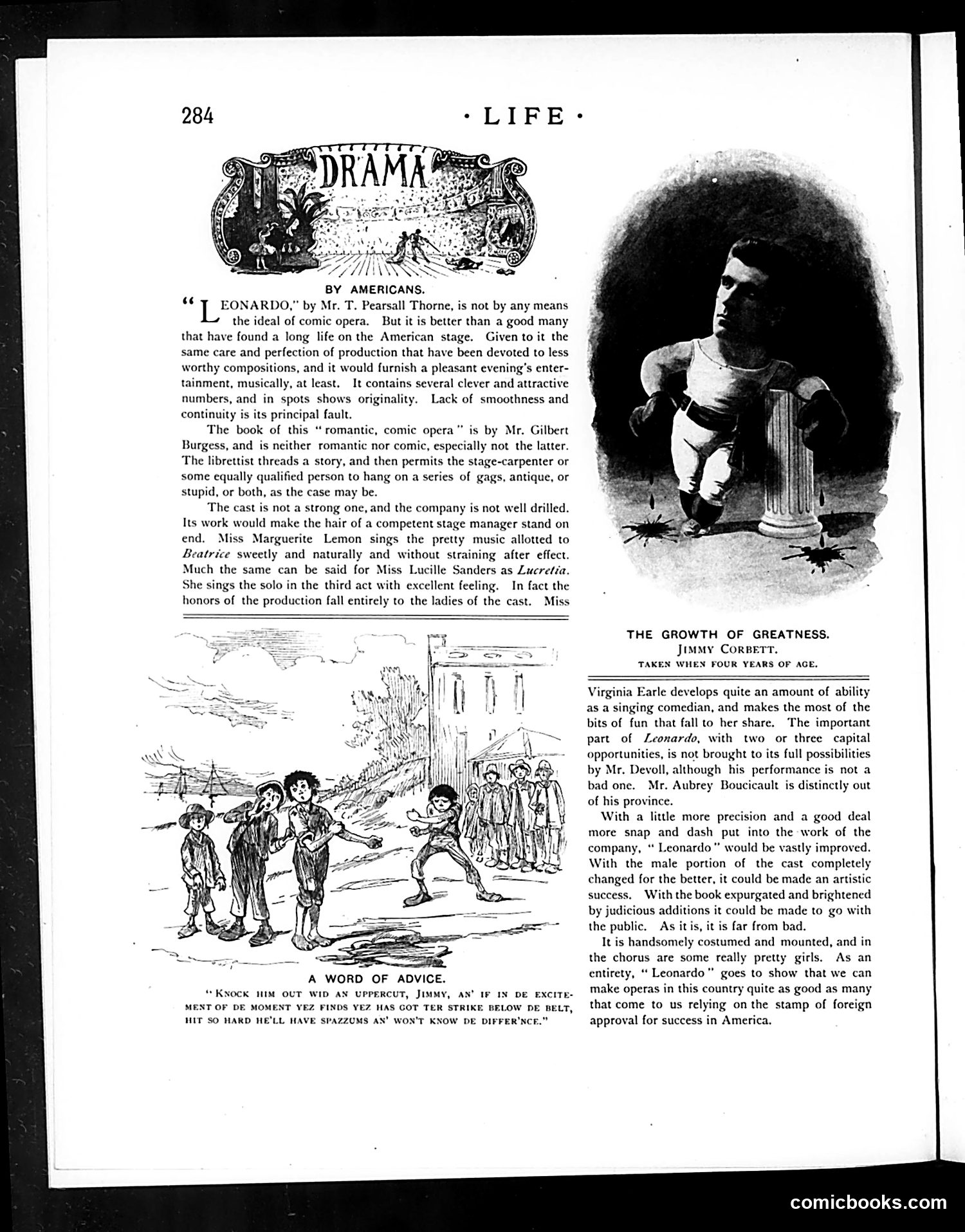
This page reviews the comic opera "Leonardo" by T. Pearsall Thorne, with book by Gilbert Burgess. The critic gives a mixed assessment: the music is pleasant but the libretto is weak, relying on disconnected gags rather than coherent storytelling. The cast is underrehearsed and poorly drilled. **The performers praised:** Miss Marguerite Lemon (as Beatrice) and Miss Lucille Sanders (as Lucretia) sing well. Virginia Earle (shown in the portrait as "Jimmy Corbett, Taken When Four Years of Age") performs competently as a singing comedian. **Those criticized:** Mr. Devoll and especially Mr. Aubrey Boucicault fail to deliver on their roles' potential. The cartoon "A Word of Advice" (lower left) depicts street boxing slang, advising hitting an opponent hard enough to cause disorientation. Overall, the reviewer concludes "Leonardo" could succeed with better male casting, tighter choreography, and script revision—suggesting American opera could match foreign imports.
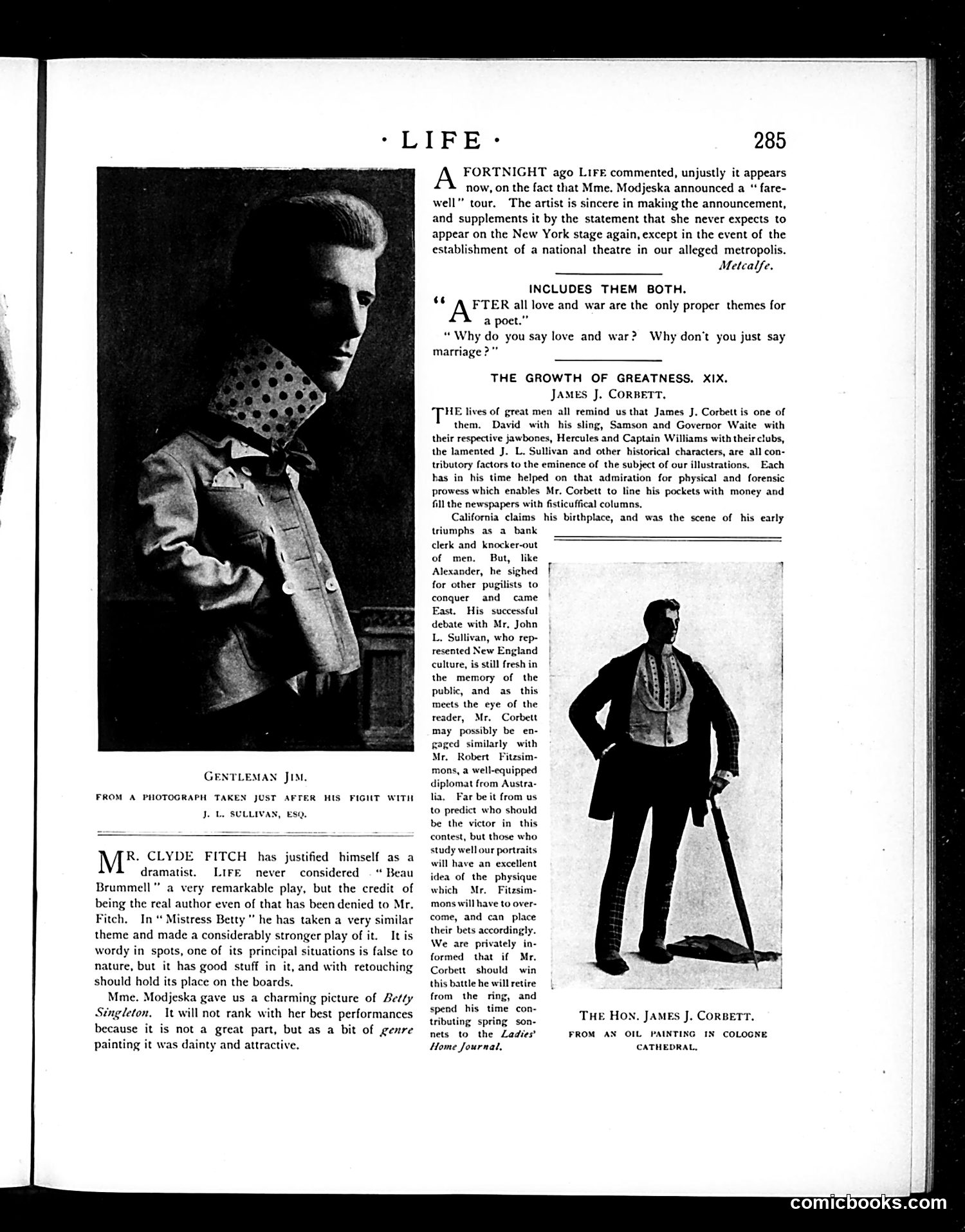
This page satirizes boxer **James J. Corbett**, then a major celebrity. The heading "Gentleman Jim" references Corbett's famous nickname. The satire works on multiple levels: **The Main Joke**: Life mockingly elevates Corbett to historical greatness by comparing him to biblical and classical figures (David, Samson, Hercules, Captain Williams) and historical boxers like J.L. Sullivan—all known for physical prowess. This is mock-heroic inflation of a prizefighter. **The Implicit Criticism**: The piece suggests Corbett profits handsomely from boxing while filling newspapers with "fisticuffical columns" (sports coverage), implying both vanity and commercialism. **The Punch Line**: The final joke suggests that if Corbett wins his upcoming fight against Robert Fitzsimmons, he'll retire to write "spring sonnets" for *Ladies' Home Journal*—absurdly transforming a brutal pugilist into a sentimental poet. The formal oil painting portrait treatment reinforces the satire by treating a boxer with mock-serious artistic dignity.
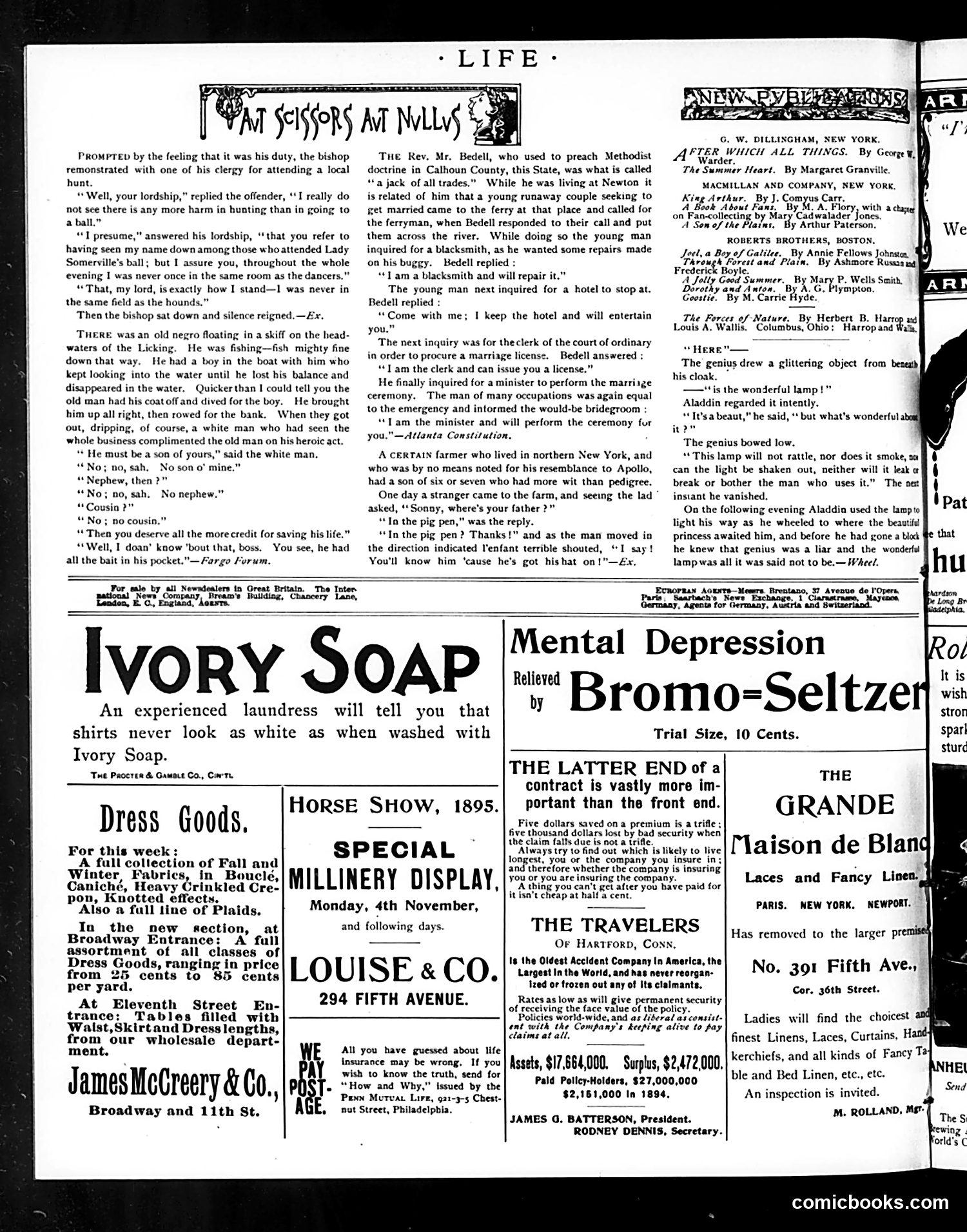
This page consists primarily of **humorous anecdotes and advertisements** rather than political cartoons. The main content includes four comedic stories: 1. **A bishop's hypocrisy**: A clergyman defends attending a hunt by comparing it to the bishop attending a ball—then reveals he stayed out of the ballroom, just as he stayed out of the hunting field. The joke mocks the bishop's moral contradiction. 2. **A Black man's heroism**: A freedman rescues a drowning boy. When praised for saving a relative, he clarifies the boy isn't kin—he saved him because the boy had the bait. The humor relies on a stereotype of Black people as motivated by self-interest. 3. **Rev. Bedell's versatility**: A minister serves simultaneously as ferryman, blacksmith, hotel-keeper, court clerk, and minister—a satire on rural clergy's multiple roles. 4. **A farmer's witty son**: A child jokes that his slovenly father can be identified by his hat in the pigpen. The advertisements (Ivory Soap, dress goods, Bromo-Seltzer) are standard period marketing with no satirical content visible.
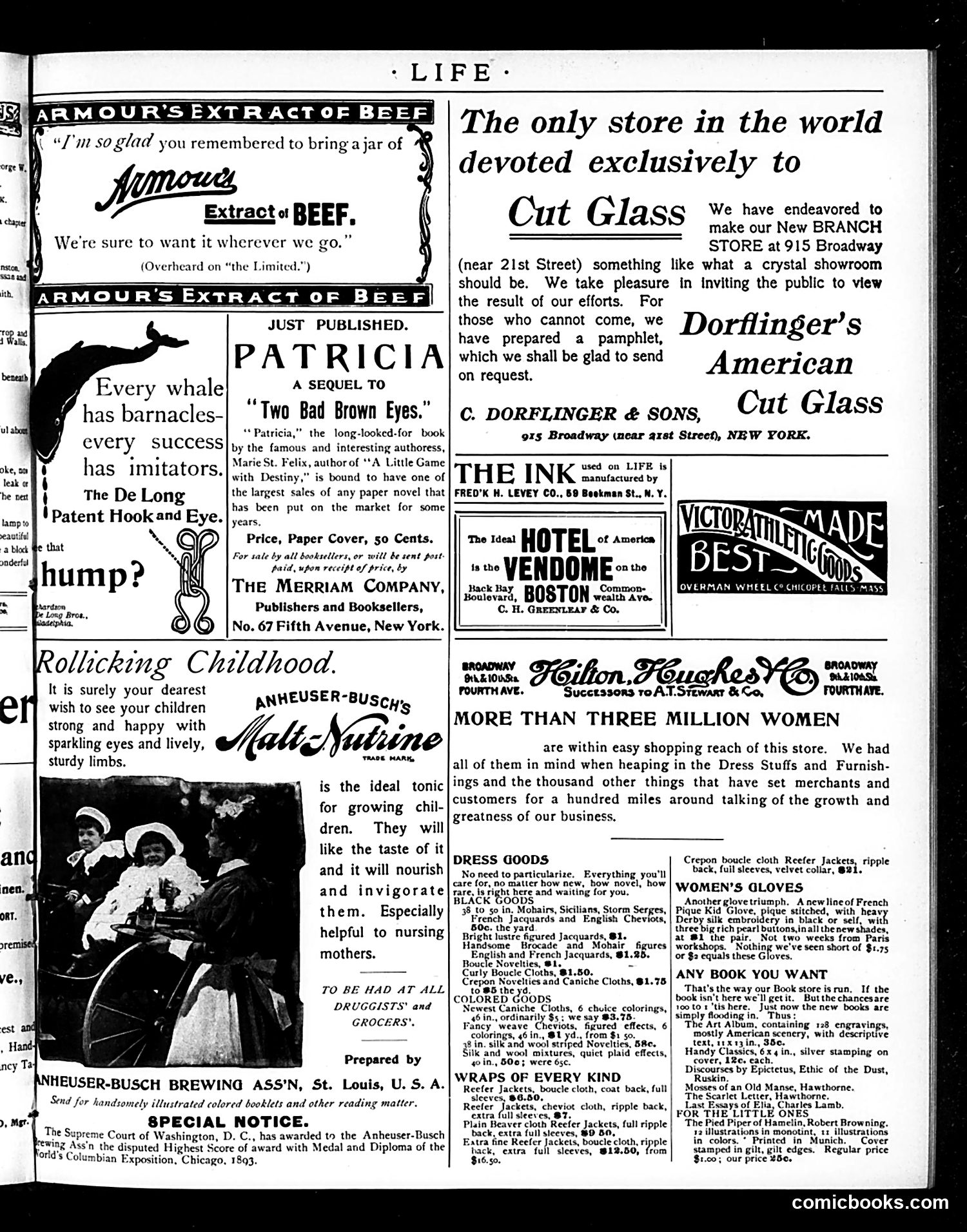
This page is primarily **advertising**, not satire or political cartoons. It contains multiple commercial advertisements typical of early American magazines: **Key advertisements include:** - **Armour's Extract of Beef**: A meat product humorously quoted as something travelers want "wherever we go" - **Patricia novel**: A book sequel promoted as having sold well - **De Long Patent Hook and Eye**: A fastening device; the whale/barnacle imagery suggests imitation competitors - **Anheuser-Busch Malt Nutrine**: A tonic marketed for children and nursing mothers (alcohol content unclear from visible text) - **Dorflinger Cut Glass**: A luxury glassware store claiming to be "the only store in the world devoted exclusively to Cut Glass" - **Holton, Hughes & Co.**: A major department store advertising dress goods and women's clothing The only mild visual satire appears in the whale/barnacles segment, suggesting successful products spawn imitators. Otherwise, this represents straightforward turn-of-century product marketing within a satirical magazine's pages.
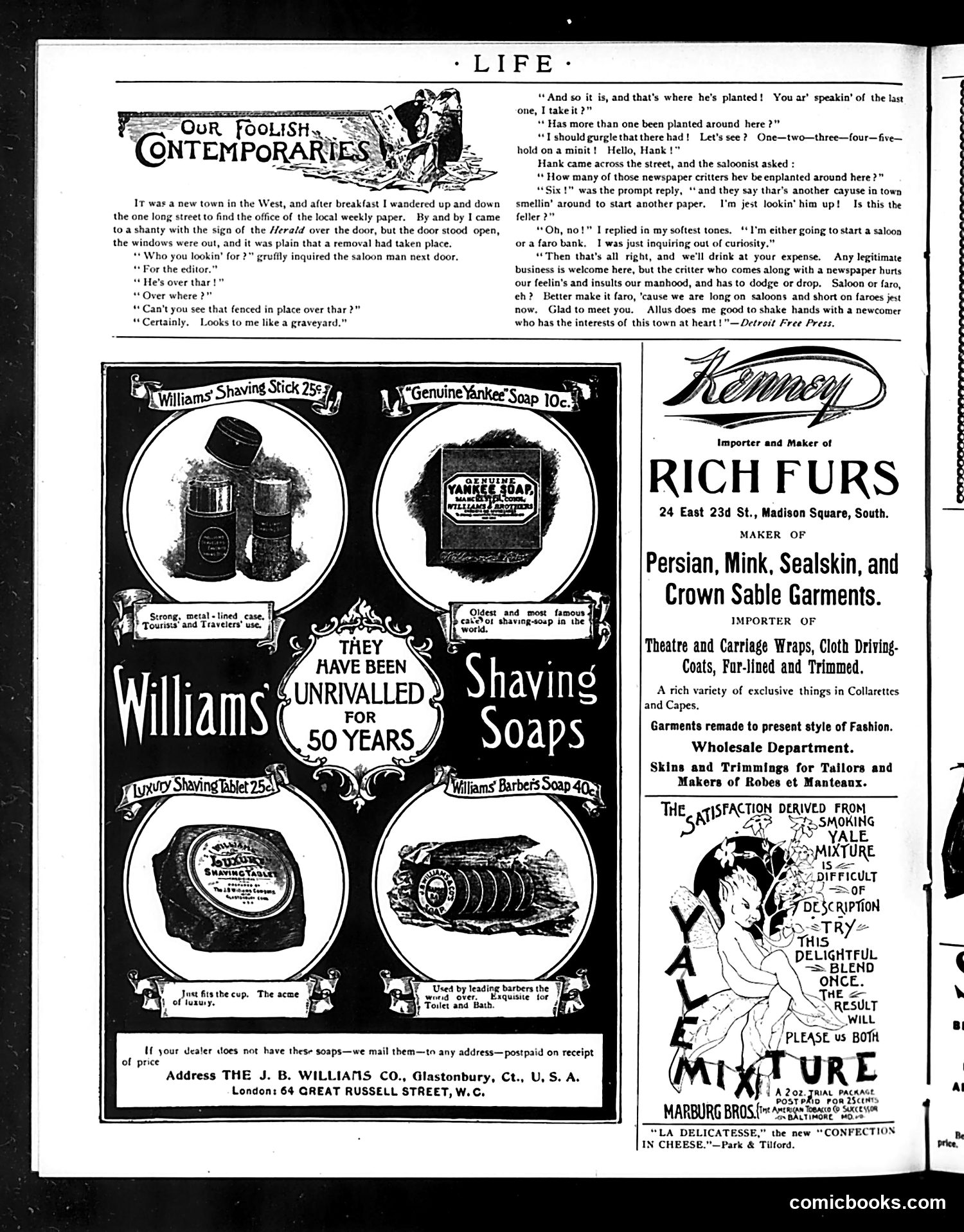
This cartoon satirizes frontier antagonism toward journalists. The narrative depicts a Western town where newspaper editors have been literally killed ("planted" in a graveyard). Six editors have died; a seventh is rumored arriving. The saloon keeper and his associate explicitly threaten any new newspaper editor with death, declaring newspapers "hurt our feelin's and insults our manhood." They welcome the narrator only after he claims he'll start a saloon or gambling operation instead. The satire targets two audiences: (1) Western frontier culture portrayed as violently anti-press and pro-vice; and (2) contemporary newspaper editors who might face such hostility. The joke's dark humor rests on depicting murder as casual frontier justice against an unwelcome profession. This reflects real tensions in 19th-century American journalism, where editors faced genuine physical danger in certain regions for their reporting.
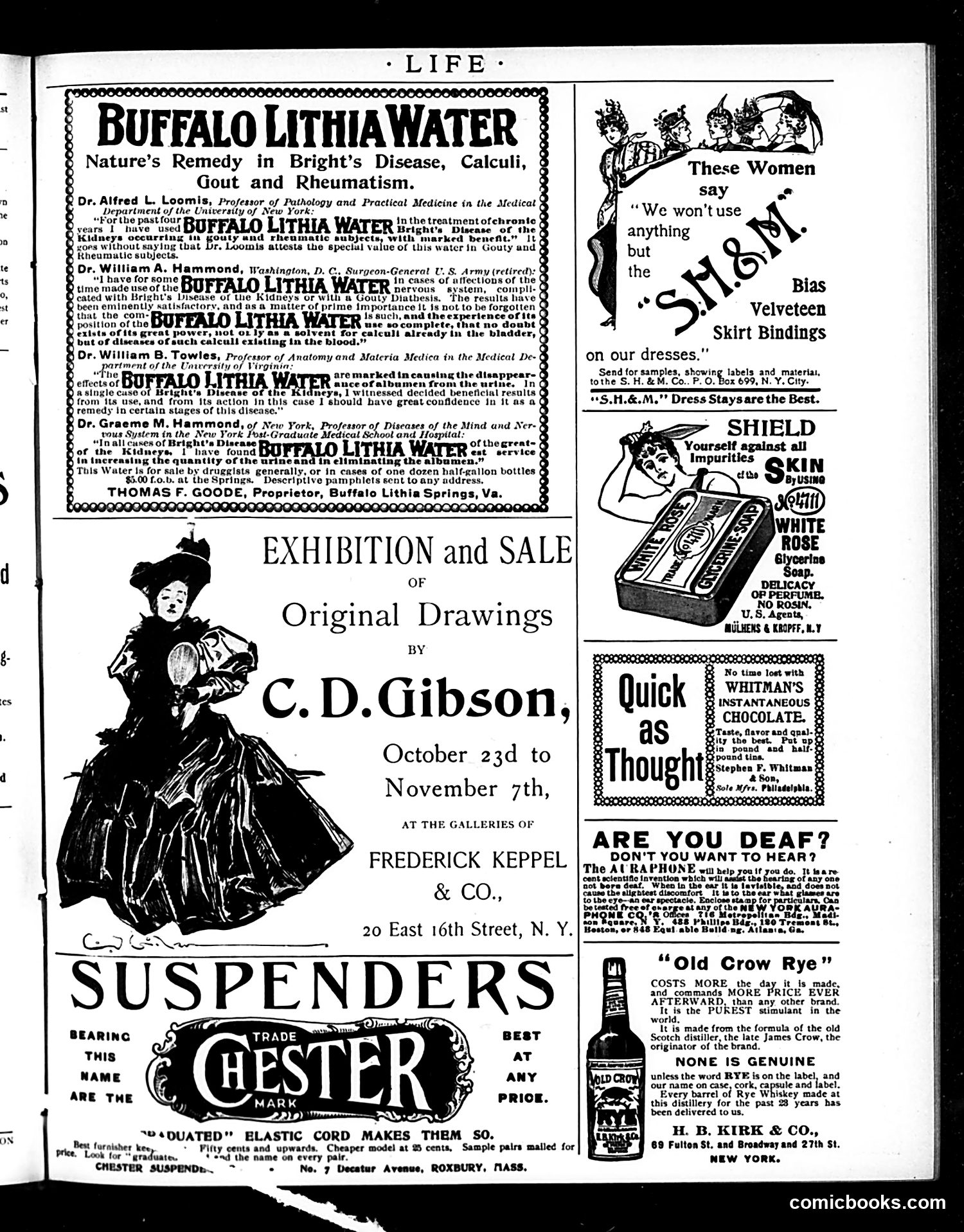
This page is primarily **advertising**, not political satire or editorial cartooning. It contains multiple product advertisements typical of early 20th-century magazines: **Major Advertisements:** 1. **Buffalo Lithia Water** — A patent medicine claiming to cure Bright's Disease, gout, and rheumatism, endorsed by medical professors (a common marketing tactic of the era before FDA regulation). 2. **C.D. Gibson Drawing Exhibition** — An art gallery show featuring the famous illustrator C.D. Gibson (creator of the "Gibson Girl"). 3. **Chester Suspenders** — Elastic-cord suspenders marketed as superior quality. 4. **Miscellaneous products** — Skirt bindings, soap, chocolate, a hearing device ("Auraphone"), and Old Crow Rye whiskey. **Historical Context:** This reflects an era when patent medicines made extravagant health claims without scientific evidence, and magazines relied heavily on advertising revenue. The Gibson advertisement is the only culturally significant item, promoting a popular illustrator of the period. There is no political satire on this page.
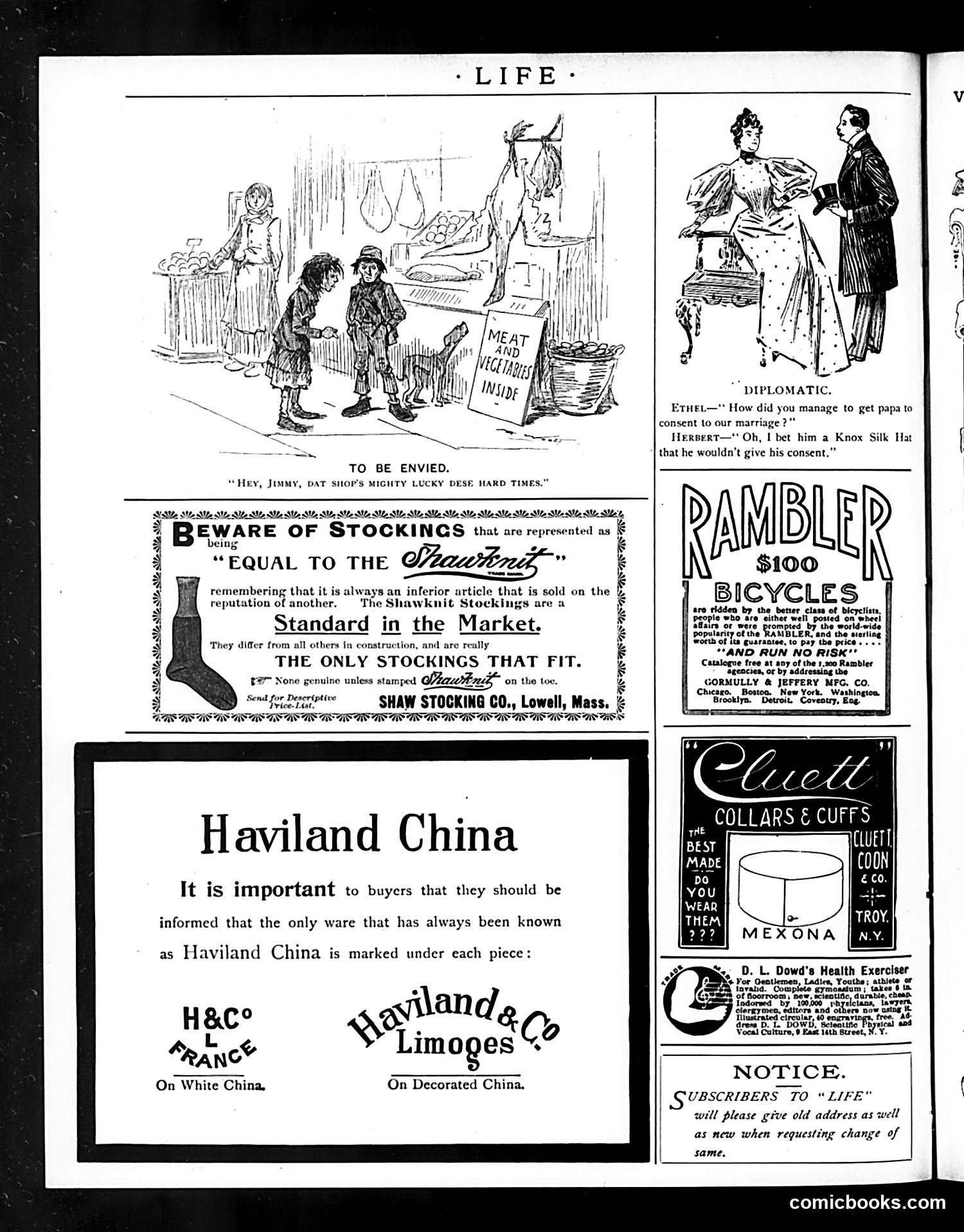
This page contains satirical cartoons and period advertisements from early 20th-century Life magazine. **"Diplomatic" cartoon (top right):** A young woman (Ethel) asks her fiancé (Herbert) how he convinced her father to approve their marriage. Herbert reveals he won a bet with her father involving a Knox Silk Hat—implying he wagered the hat against the father's consent, and the father lost. The satire mocks upper-class courtship rituals where material goods and gambling determine serious life decisions. **"To Be Envied" cartoon (top left):** Two poor children peer at a butcher shop during economic hardship ("hard times"), envying its apparent good fortune despite the struggling economy. **Advertisements:** The page features standard period ads for Shaw stockings, Rambler bicycles, Haviland china, Cluett collars and cuffs, and health products—typical commercial content mixed with editorial material in early Life magazine. The overall page reflects turn-of-the-century American social commentary on class distinctions, consumerism, and economic conditions.