
Life, 1895-10-31 · page 8 of 18
Life — October 31, 1895 — page 8: what you’re looking at
What you’re looking at
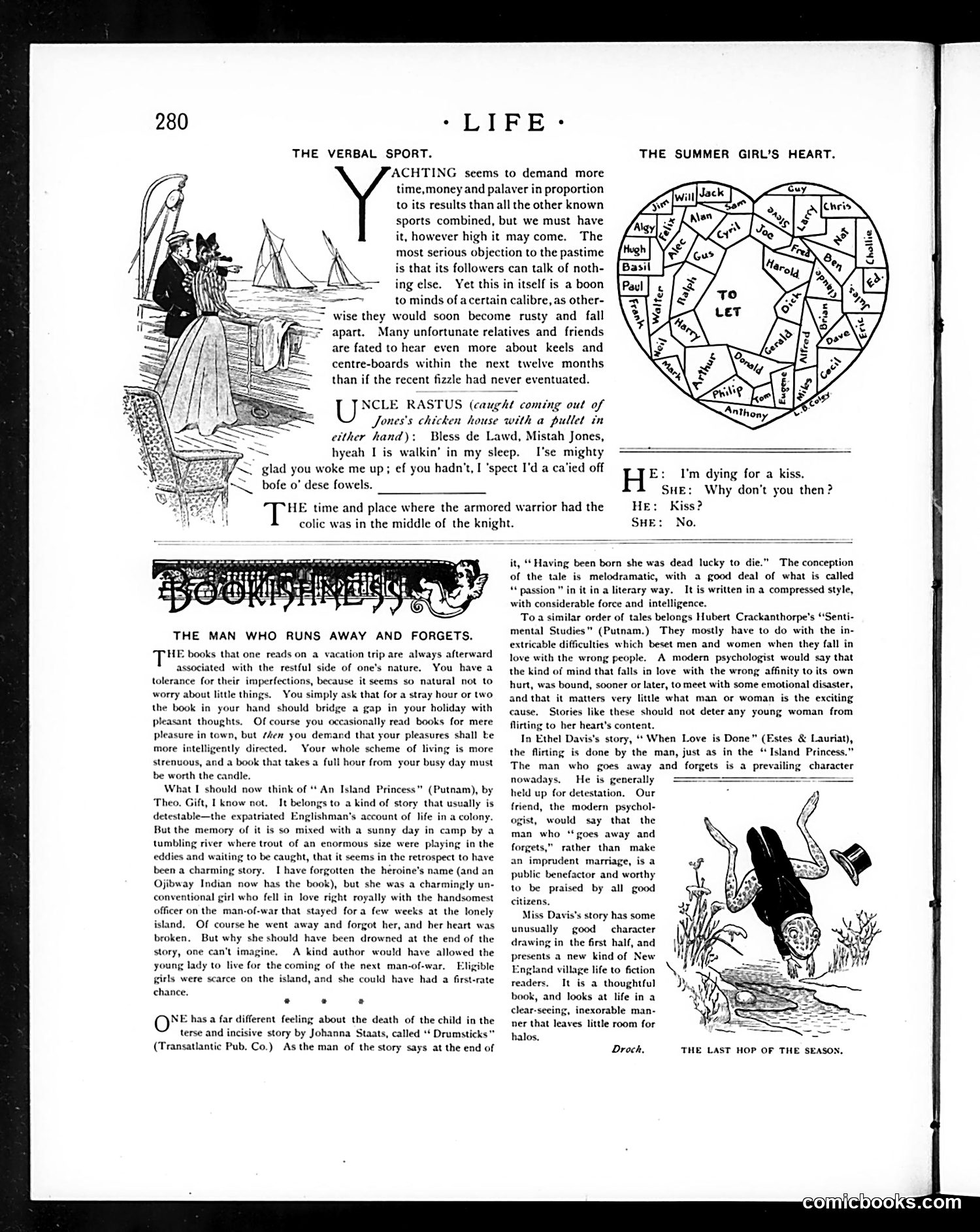
This page contains three distinct literary/satirical pieces rather than political cartoons: 1. **"The Verbal Sport"** critiques yachting as an expensive hobby whose enthusiasts bore others with technical details about "keels and centre-boards." 2. **"The Summer Girl's Heart"** is a humorous diagram showing a young woman's romantic interests—various male names (Jack, Guy, Paul, etc.) arranged in sections with "TO LET" at the center, satirizing the fickleness of summer romance. 3. **"The Man Who Runs Away and Forgets"** reviews several literary works, including discussions of character psychology and storytelling conventions. The accompanying illustrations show a man fleeing and a figure in nature. The page is primarily literary commentary and book reviews with light satirical humor about social behaviors and romantic life, rather than political commentary.
📄 Transcribed text from this page (OCR, searchable)
Machine-transcribed from the original scan — historical spelling and the odd misread are preserved.
*LIFE: THE VERBAL SPORT. THE SUMMER GIRL’S HEART. 'ACHTING seems to demand more time,money and palaver in proportion to its results than all the other known sports combined, but we must have it, however high it may come. The most serious objection to the pastime is that its followers can talk of noth- ing else. Yet this in itself is a boon to minds of acertain calibre, as other- apart. wise they would soon become rusty and fall Many unfortunate relatives and friends are fated to hear even more about keels and centre-boards within the next twelve months than if the recent fizzle had never eventuated. NCLE RASTUS (caught coming out of Jones's chicken house with a pullet in etther hand): HE time and place where the armored warrior had the Bless de Lawd, Mistah Jones, hyeah I is walkin’ in my sleep. I'se mighty I'm dying for a kiss. SHE: Why don’t you then? HE: Kis colic was in the middle of the knight. THE MAN WHO RUNS AWAY AND FORGETS. THE books that one reads on a vacation trip are always afterward associated with the restful side of one's nature. You have a tolerance for their imperfections, because it seems so natural not to worry about little things. You simply ask that for a stray hour or two the book in your hand should bridge a gap in your holiday with pleasant thoughts. Ofcourse you occasionally read books for mere pleasure in town, but ¢#en you demand that your pleasures shall te more intelligently directed. Your whole scheme of living is more strenuous, and a book that takes a full hour from your busy day must be worth the candle, What I should now think of * An Island Princess” (Putnam), by Theo. Gift, I know not. It belongs to a kind of story that usually is detestable—the expatriated Englishman's account of life in a colony. But the memory of it is so mixed with a sunny day in camp by a tumbling river where trout of an enormous size were playing in the eddies and waiting to be caught, that it seems in the retrospect to have been a charming story. I have forgotten the héroine’s name (and an Ojibway Indian now has the book), but she was a charmingly un- conventional girl who fell in love right royally with the handsomest officer on the man-of-war that stayed fora few weeks at the lonely island, Of course he went away and forgot her, and her heart was broken. But why she should have been drowned at the end of the story, one can't imagine, A kind author would have allowed the young lady to live for the coming of the next man-of-war. Eligible girls were scarce on the island, and she could have had a first-rate chance. ° . * CSE has a far different feeling about the death of the child in the terse and incisive story by Johanna Staats, called “ Drumsticks” (Transatlantic Pub. Co.) As the man of the story says at the end of it, “ Having been born she was dead lucky to die.” The conception of the tale is melodramatic, with a good deal of what is called “ passion ” in it in a literary way. It is written in a compressed style, with considerable force and intelligence. Toa similar order of tales belongs Hubert Crackanthorpe's “Senti- mental Studies” (Putnam.) They mostly have to do with the in- extricable difficulties which beset men and women when they fall in love with the wrong people. A modern psychologist would say that the kind of mind that falls in love with the wrong affinity to its own hurt, was bound, sooner or later, to meet with some emotional disaster, and that it matters very little what man or woman is the exciting cause, Stories like these should not deter any young woman from flirting to her heart's content. In Ethel Davis's story, “ When Love is Done” (Estes & Lauriat), the flirting is done by the man, just as in the “ Island Princess.” The man who goes away and forgets is a prevailing character nowadays. He is generally held up for detestation. Our friend, the modern psychol- ogist, would say that the man who “goes away and forgets,” rather than make an imprudent marriage, is a public benefactor and worthy to be praised by all good citizens, Miss Davis's story has some unusually good character drawing in the first half, and presents a new kind of New England village life to fiction readers, It is a thoughtful book, and looks at life in a clear-seeing, inexorable man- her that leaves little room for halos. Droch, THE LAST HOP OF THE SEASON,