
Life, 1895-10-31 · page 4 of 18
Life — October 31, 1895 — page 4: what you’re looking at
What you’re looking at
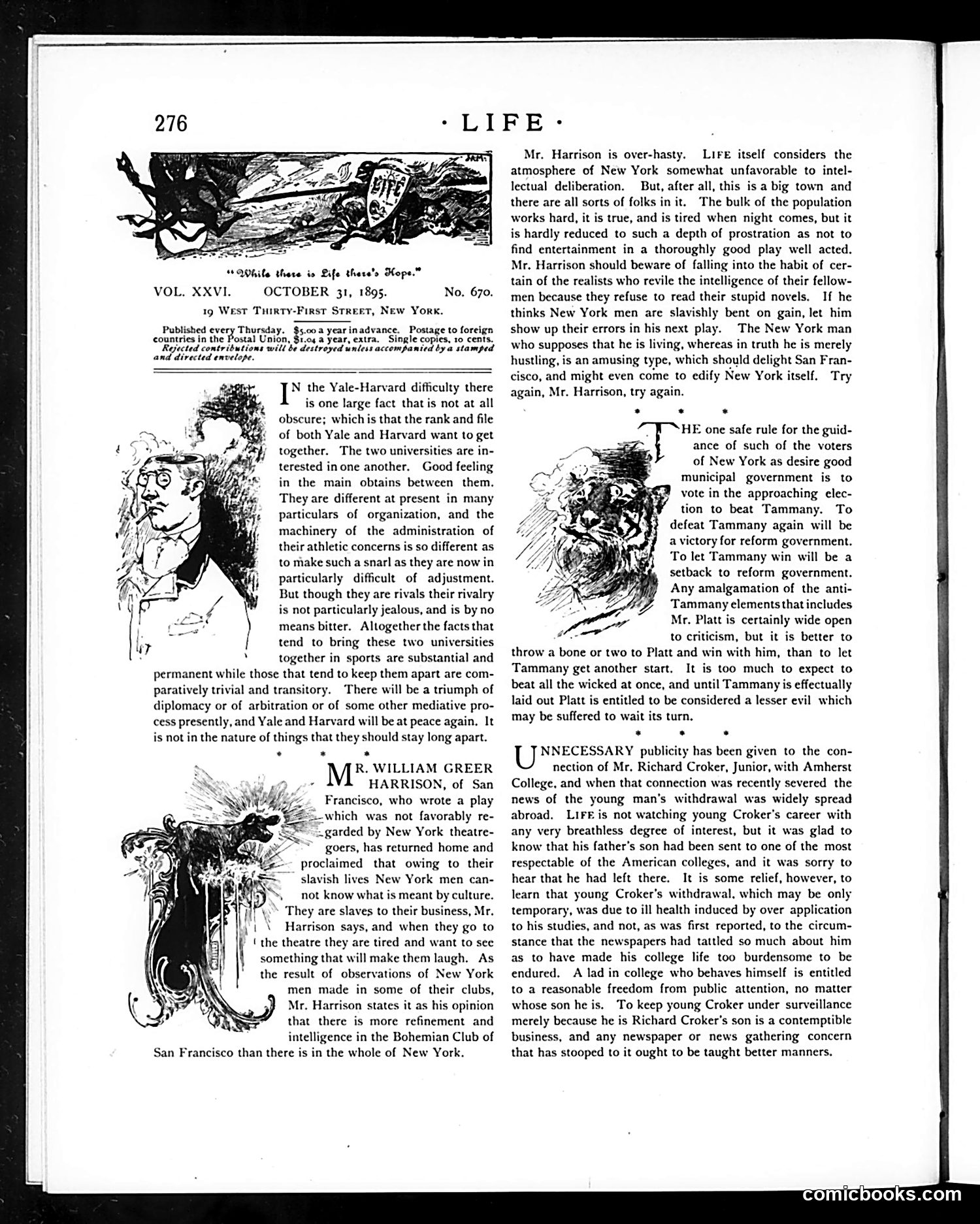
This page contains three editorial cartoons with accompanying commentary on contemporary issues. The **first cartoon** (top) criticizes Mr. William Greer Harrison, a San Francisco playwright whose work was poorly received by New York theater critics. The satire mocks Harrison's claim that New Yorkers lack culture and refinement, arguing instead that New York audiences are simply discerning and tired—they work hard and deserve quality entertainment, not "slavish" productions. The **second and third cartoons** address Yale-Harvard university rivalry and New York municipal politics. The text discusses reform efforts against Tammany Hall's political machine, arguing that defeating Tammany represents genuine reform progress. The page also reports on Richard Croker Jr.'s withdrawal from Amherst College, defending his privacy against newspaper intrusion.
📄 Transcribed text from this page (OCR, searchable)
Machine-transcribed from the original scan — historical spelling and the odd misread are preserved.
LIFE “QWhile there is Life there's Tope.” VOL. XXVI. OCTOBER 31, 1895. 19 West THiRty-First STREET, No, 670. New York. Published every Thursday. 5.00 year inadvance. countries in the Rejected contributio and directed envelope. Postage to foreign 104 a Year, extra. Single copies, 10 cents. ill be destroyed anless accompanied bya stamped I the Yale-Harvard difficulty there is one large fact that is not at all obscure; which is that the rank and file of both Yale and Harvard want to get together. The two universities are in- terested inone another. Good feeling in the main obtains between them. They are different at present in many particulars of organization, and the machinery of the administration of their athletic concerns is so different as to make such a snarl as they are now in particularly difficult of adjustment. But though they are rivals their rivalry is not particularly jealous, and is by no means bitter. Altogether the facts that tend to bring these two universities together in sports are substantial and permanent while those that tend to keep them apart are com- paratively trivial and transitory. There will be a triumph of diplomacy or of arbitration or of some other mediative pro- cess presently, and Yale and Harvard will be at peace again, It is not in the nature of things that they should stay long apart. . * R. WILLIAM GREER HARRISON, of San Francisco, who wrote a play =-which was not favorably re- ~garded by New York theatre- goers, has returned home and proclaimed that owing to their slavish lives New York men can- not know what is meant by culture. They are slaves to their business, Mr. Harrison says, and when they go to something that will make them laugh. As the result of observations of New York men made in some of their clubs, Mr. Harrison states it as his opinion that there is more refinement and intelligence in the Bohemian Club of San Francisco than there is in the whole of New York. Mr. Harrison is over-hasty. LIFE itself considers the atmosphere of New York somewhat unfavorable to intel- lectual deliberation. But, after all, this is a big town and there are all sorts of folks in it. The bulk of the population works hard, it is true, and is tired when night comes, but it is hardly reduced to such a depth of prostration as not to find entertainment in a thoroughly good play well acted. Mr. Harrison should beware of falling into the habit of cer- tain of the realists who revile the intelligence of their fellow- men because they refuse to read their stupid novels. If he thinks New York men are slavishly bent on gain, let him show up their errors in his next play. The New York man who supposes that he is living, whereas in truth he is merely hustling, is an amusing type, which should delight San Fran- cisco, and might even come to edify New York itself. Try again, Mr. Harrison, try again. . * * HE one safe rule for the guid- ance of such of the voters of New York as desire good municipal government is to vote in the approaching elec- tion to beat Tammany. To defeat Tammany again will be a victory for reform government, To let Tammany win will be a setback to reform government. Any amalgamation of the anti- Tammany elements that includes Mr. Platt is certainly wide open to criticism, but it is better to throw a bone or two to Platt and win with him, than to let Tammany get another start. It is too much to expect to beat all the wicked at once, and until Tammany is effectually laid out Platt is entitled to be considered a lesser evil which may be suffered to wait its turn. . . . NNECESSARY publicity has been given to the con- nection of Mr. Richard Croker, Junior, with Amherst College, and when that connection was recently severed the news of the young man’s withdrawal was widely spread abroad. LIFE is not watching young Croker’s career with any very breathless degree of interest, but it was glad to know that his father’s son had been sent to one of the most respectable of the American colleges, and it was sorry to hear that he had left there. It is some relief, however, to learn that young Croker’s withdrawal. which may be only temporary, was due to ill health induced by over application to his studies, and not, as was first reported, to the circum- stance that the newspapers had tattled so much about him as to have made his college life too burdensome to be endured. A lad in college who behaves himself is entitled to a reasonable freedom from public attention, no matter whose son he is. To keep young Croker under surveillance merely because he is Richard Croker’s son is a contemptible business, and any newspaper or news gathering concern that has stooped to it ought to be taught better manners. Comicbooks.com