
A complete issue · 20 pages · 1895
Life — October 17, 1895
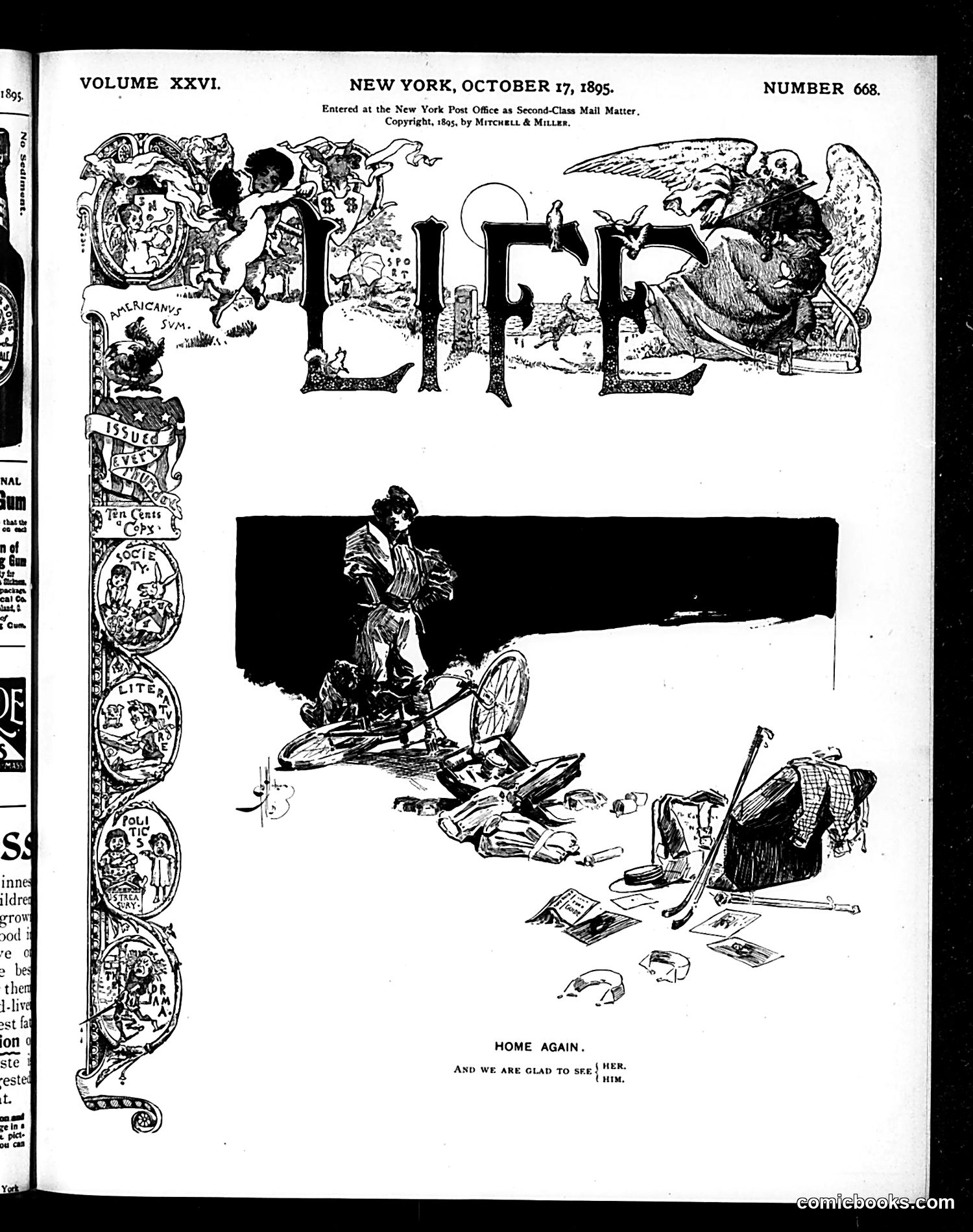
The main illustration titled "Home Again" depicts a triumphant figure standing over scattered military equipment and supplies. Based on the caption "And we are glad to see her" / "him," this appears to reference the return of American military forces from a recent conflict. The elaborate decorative border on the left contains multiple vignettes, suggesting this is celebrating an American victory or successful military campaign. Without clearer identification of specific figures or knowledge of which 1895 military engagement this references, I cannot definitively identify the exact historical event. However, the satirical tone suggests the cartoon comments on the reception and celebration of returning soldiers or military leadership, likely celebrating American martial success during this period.
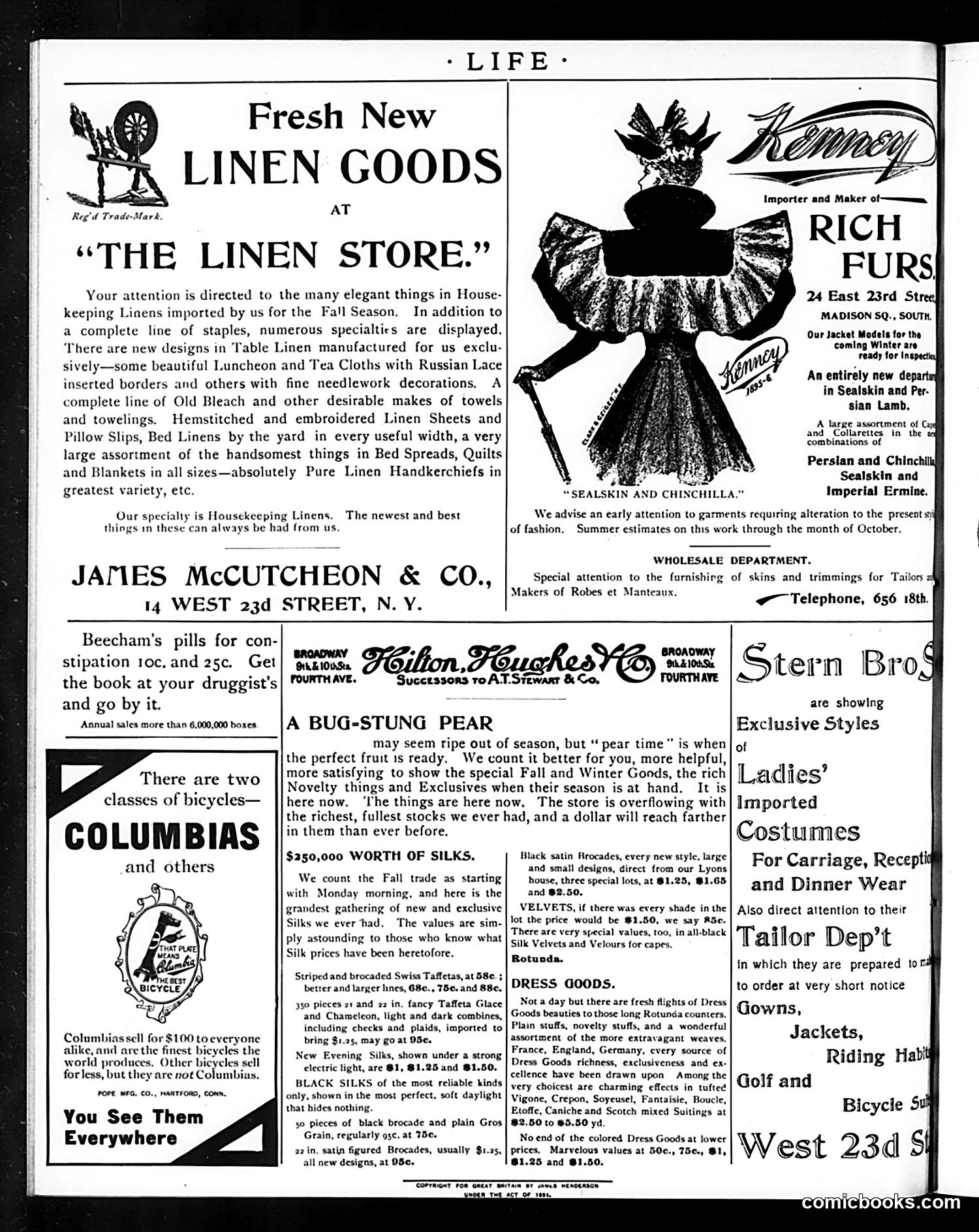
This page is **primarily advertising**, not satirical content. It contains five vintage advertisements from what appears to be an early 20th-century Life magazine: 1. **The Linen Store** (James McCutcheon & Co.) — promoting imported linens and household goods 2. **Kenney Furs** — advertising sealskin and chinchilla garments 3. **Halton Hawkes** — silk goods and dress fabrics 4. **Columbias bicycles** — emphasizing their superior quality and affordability 5. **Stern Bros** — showcasing ladies' imported costumes and tailoring services There is **no political cartoon or satirical content** visible. The page reflects period consumer culture, with emphasis on luxury imported goods (linens, furs, silks) and emerging technology (bicycles) marketed to affluent urban customers in New York.
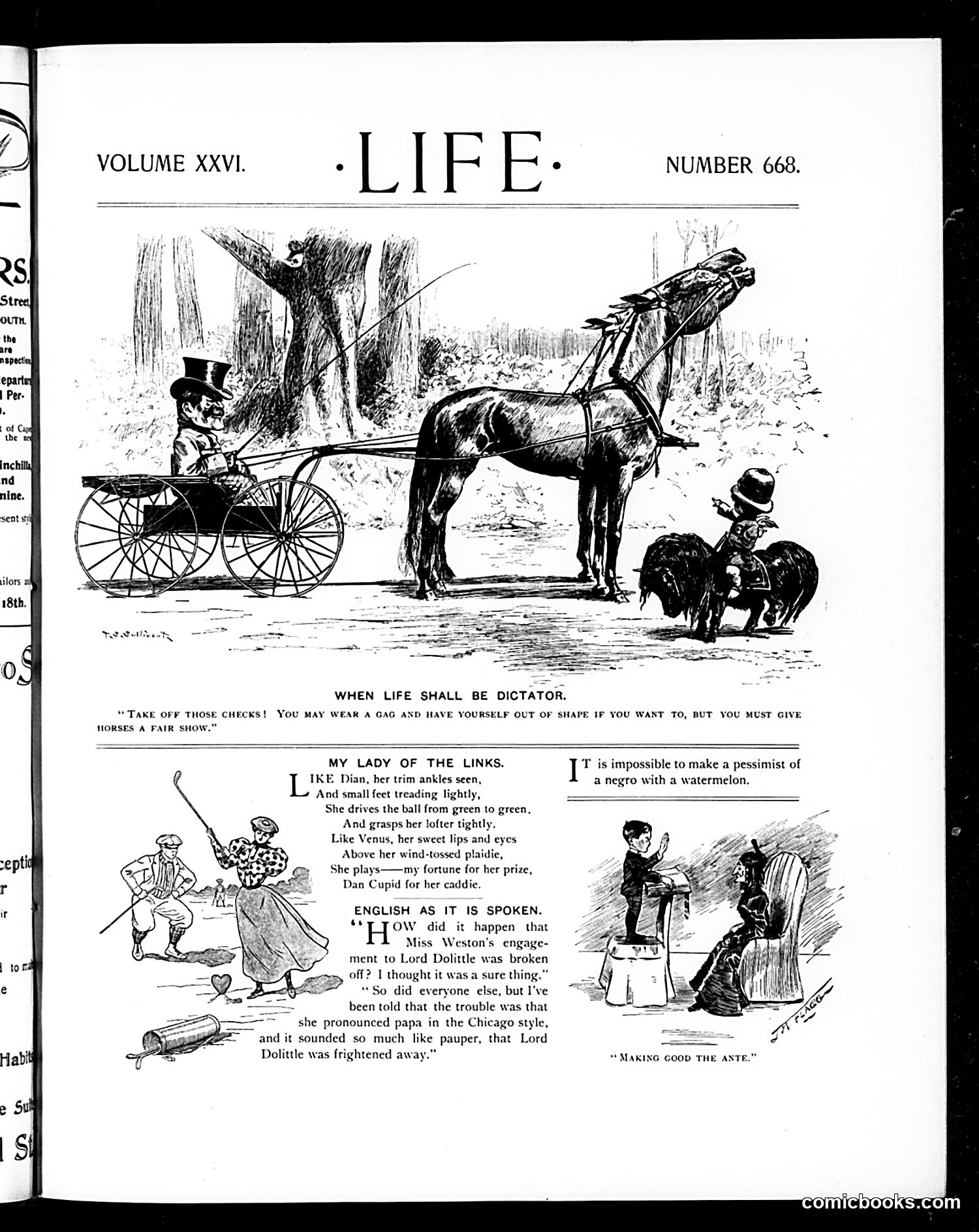
The main cartoon, "When Life Shall Be Dictator," depicts a wealthy man in a carriage drawn by an exhausted horse, while a figure on the right controls dogs. The caption criticizes dress codes and personal freedoms: "Take off those checks! You may wear a gag and have yourself out of shape if you want to, but you must give horses a fair show." This satirizes hypocrisy—mocking restrictive fashion rules while advocating animal welfare. The other sections include a golf poem ("My Lady of the Links") and a dialogue titled "English As It Is Spoken" about a broken engagement, with the punchline "Making Good the Ante," likely a card-game metaphor for reconciliation. The content reflects turn-of-the-century satirical humor about social conventions and propriety.
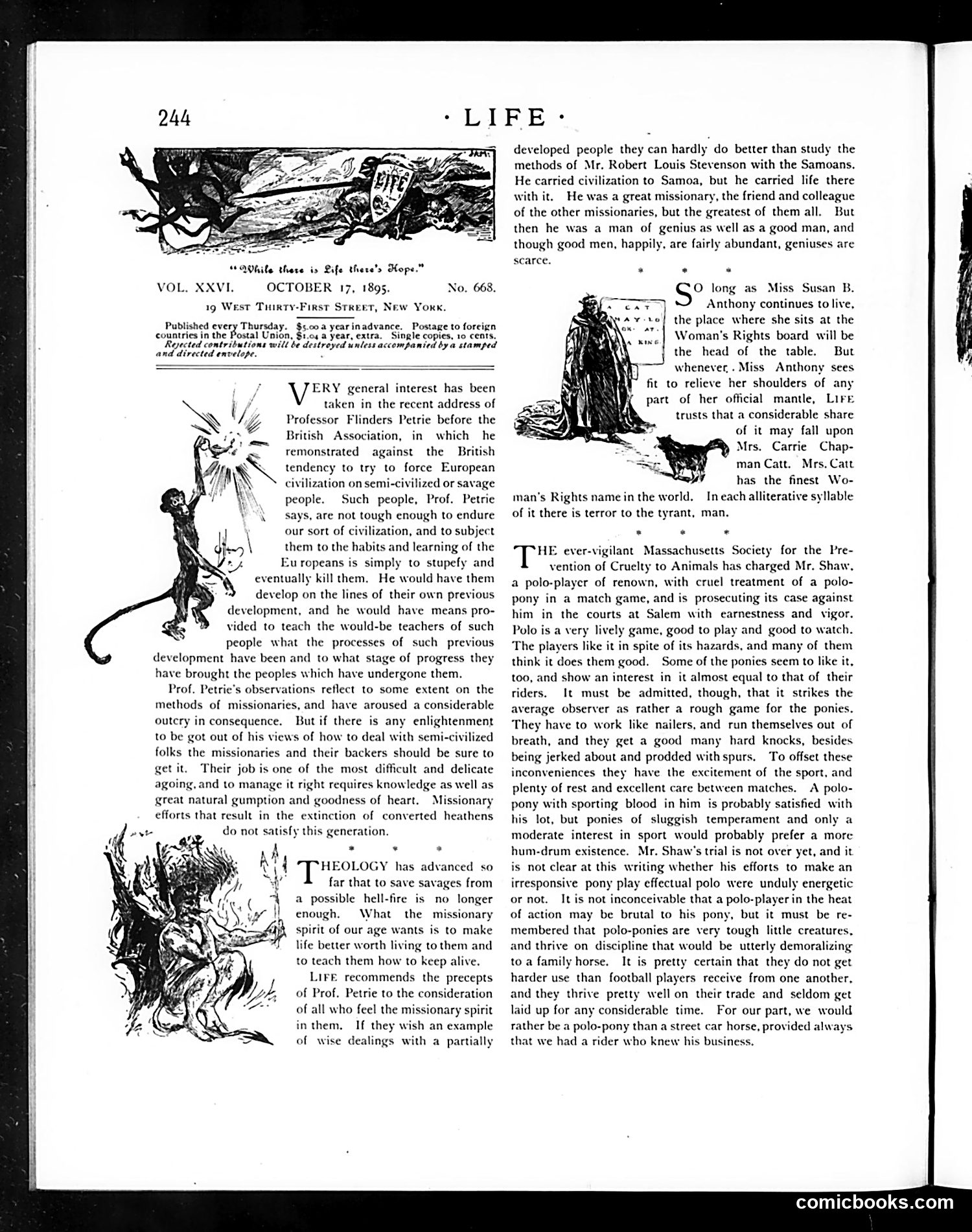
This page contains three distinct editorial sections with accompanying illustrations: 1. **Top cartoon** (unclear subject): Features a figure being struck by light or energy, likely satirizing a contemporary event or person, though specifics are not identifiable from the image alone. 2. **Main text** discusses Professor Flinders Petrie's address opposing British efforts to impose European civilization on "semi-civilized or savage people," arguing such efforts are misguided. The accompanying illustration shows figures in apparent conflict or struggle. 3. **Bottom section** criticizes the Massachusetts Society for the Prevention of Cruelty to Animals for prosecuting a polo player named Shaw over treatment of his pony, arguing polo ponies are tough animals suited to the sport and receive adequate care. The page reflects late-Victorian debates about colonialism, animal welfare, and social reform.
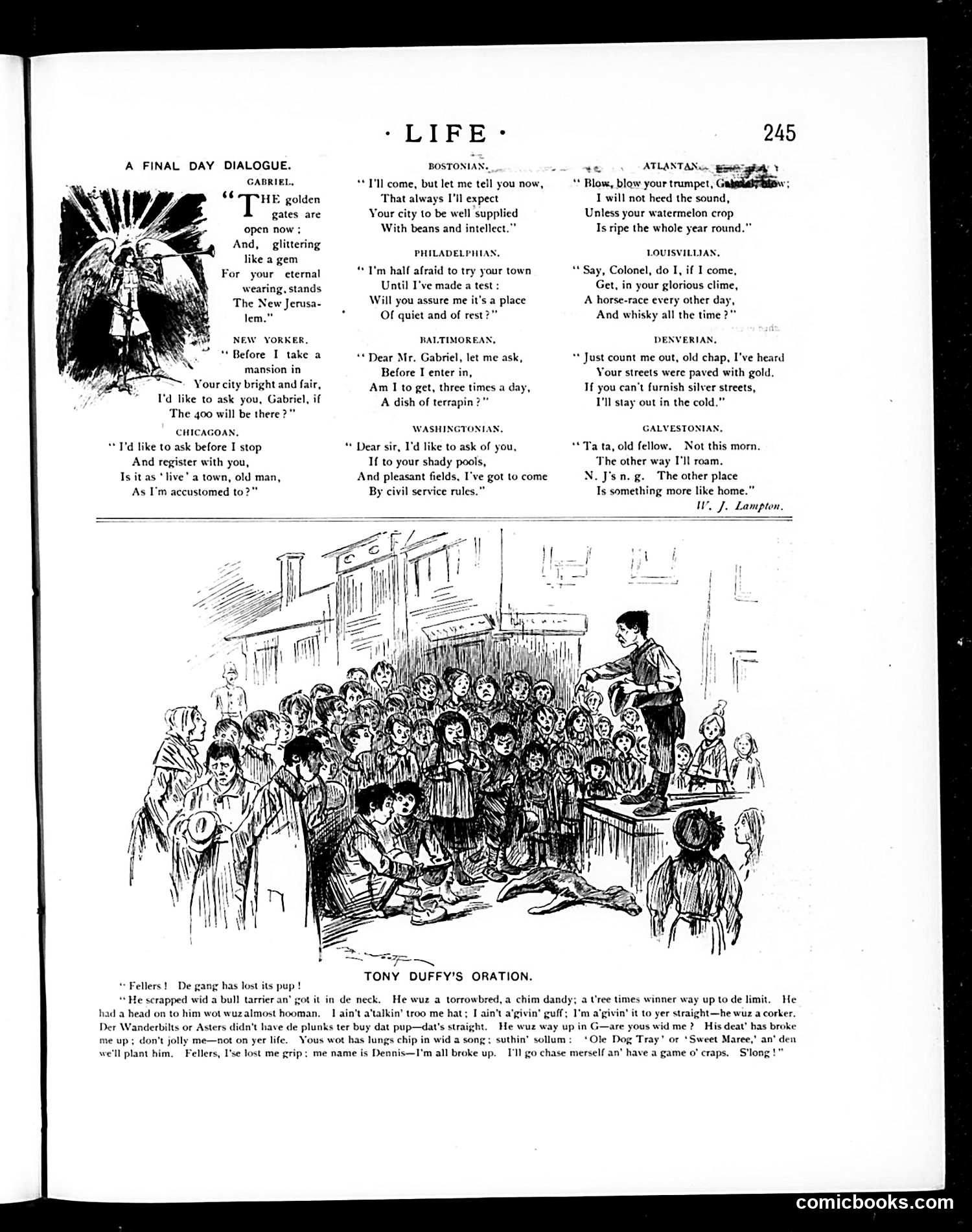
This page presents "A Final Day Dialogue," a satirical piece mocking various American cities and their characteristics through stereotypical voices. Each section features a different city—Boston, Philadelphia, New York, Chicago, Washington, Baltimore, Atlanta, Louisville, Denver, and Galveston—with representatives pitching their town to an arriving immigrant named Gabriel. The humor relies on exaggerated regional stereotypes: Boston's intellectual pretension, Philadelphia's quietness, New York's brightness, Chicago's roughness, and so forth. The lower illustration shows "Tony Duffy's Oration," depicting street-level working-class dialect and immigrant culture. The satire critiques both urban boosterism (cities competing to attract settlers) and American regional stereotypes popular in this era. The crude dialect transcriptions reflect period attitudes toward working-class and immigrant speech patterns.
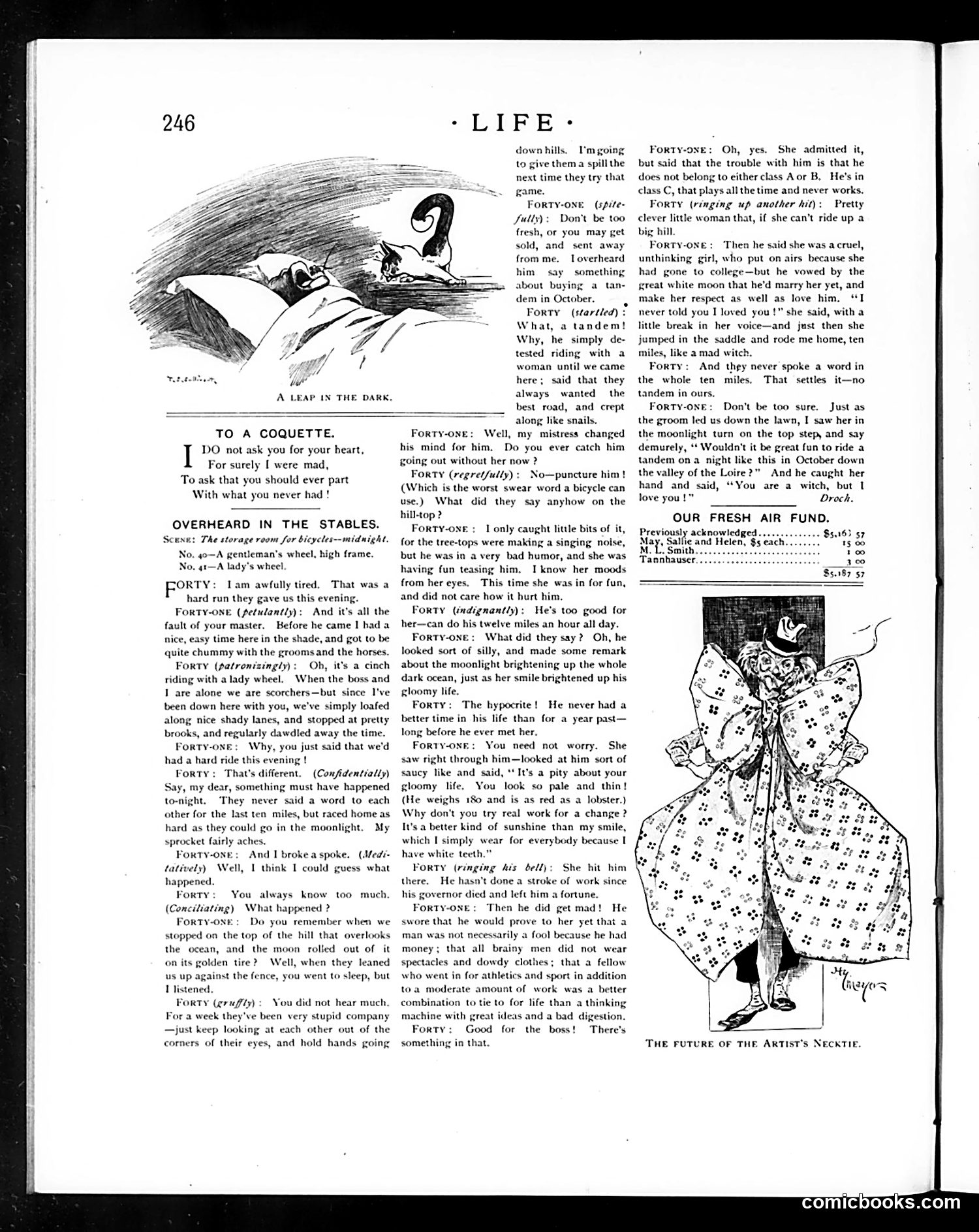
This page contains three distinct elements: 1. **"A Leap in the Dark"** (top left sketch): A horse and rider in mid-jump over dark terrain—a generic illustration without clear political reference. 2. **"To a Coquette"** and **"Overheard in the Stables"** (center dialogues): Humorous conversations between characters named Forty and Forty-one about romantic relationships and work. The "stables" setting suggests these are horse-racing or equestrian contexts. The dialogue mocks a woman for her mercenary nature and dishonesty. 3. **"The Future of the Artist's Necktie"** (right): A fashion illustration showing an ornate necktie design. **"Our Fresh Air Fund"** box lists charitable donations. The page appears primarily entertainment-focused rather than overtly political satire, with typical early-20th-century social humor about romance and gender relations.
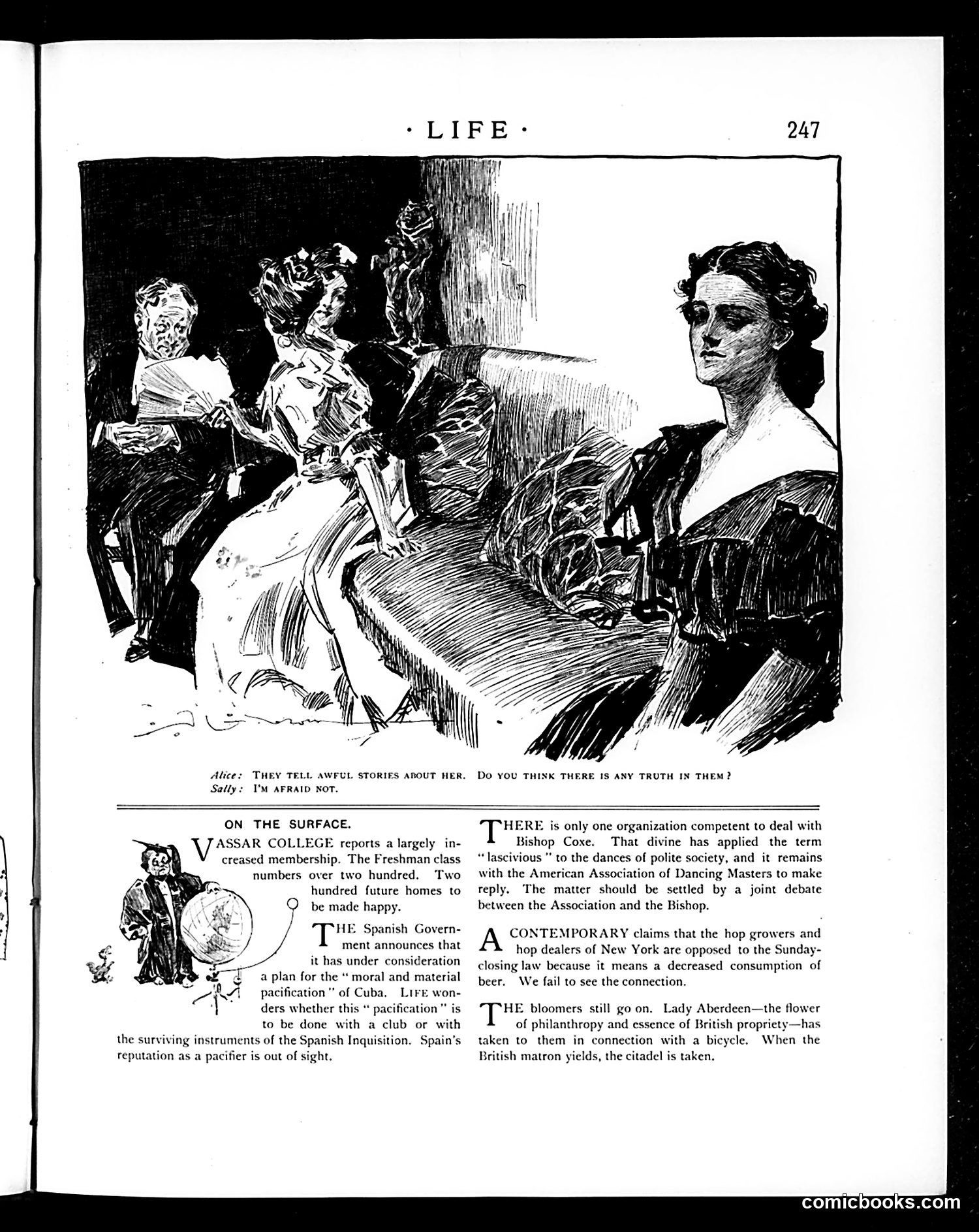
The main illustration depicts a social scene with two women and a man in formal dress. The dialogue between "Alice" and "Sally" addresses gossip: Alice says "They tell awful stories about her. Do you think there is any truth in them?" Sally replies "I'm afraid not."—a joke about how rumors lose their salacious appeal when they're actually true. Below, the "On the Surface" section contains brief satirical commentary on contemporary issues: Vassar College enrollment, Spanish colonial policy in Cuba, Bishop Coxe's criticism of "police society" dances, hop growers opposing Sunday-closing laws, and Lady Aberdeen's philanthropic activities. These are disconnected social observations typical of Life's weekly satirical format, mocking various institutions and public figures of the period.
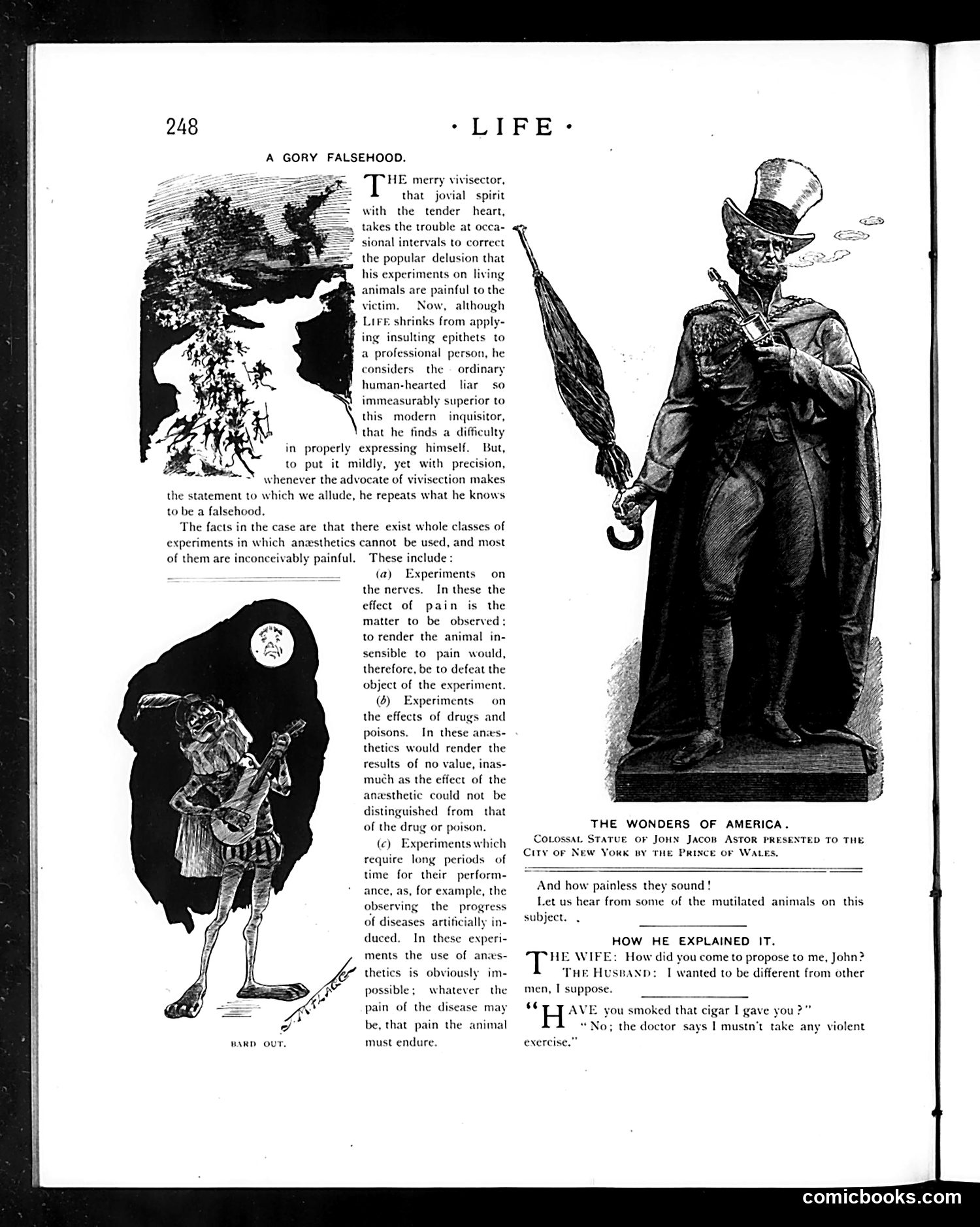
This satirical page attacks defenders of animal vivisection (experimentation on living animals). The article "A Gory Falsehood" argues that vivisectionists falsely claim their experiments cause minimal pain, when certain categories of research—particularly nerve experiments and long-term disease studies—are necessarily painful and cannot use anesthetics effectively. The political cartoon on the right depicts "The Wonders of America": a colossal statue of John Jacob Astor (the wealthy industrialist) presented to New York by the Prince of Wales. The caption "And how painless they sound!" sarcastically links Astor's monument to the vivisection debate, likely criticizing American materialism and callousness toward suffering. The bottom humor section offers domestic satire unrelated to the main topic.
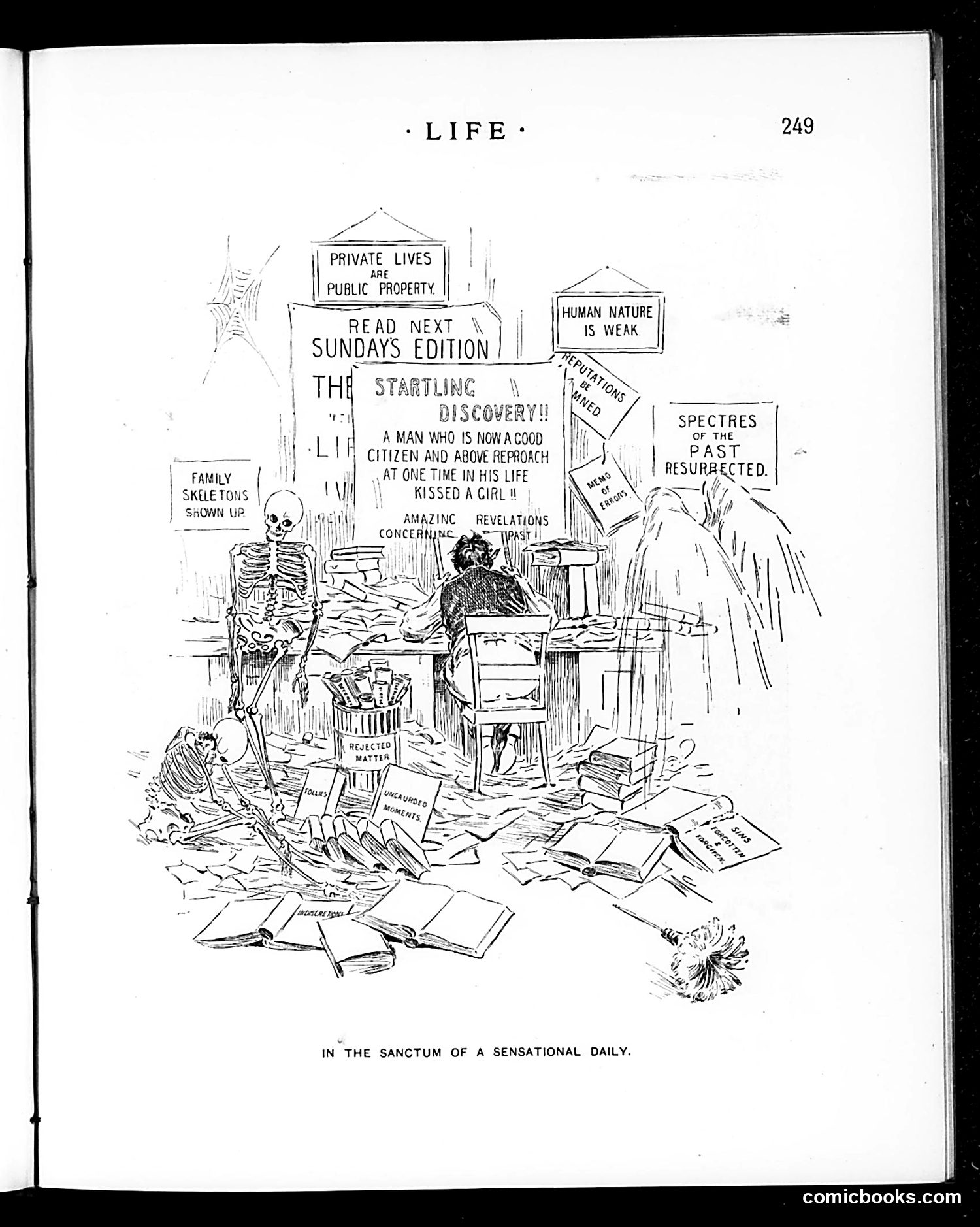
This is a satirical cartoon critiquing sensationalist newspaper journalism. The scene depicts the editorial office of a tabloid newspaper ("In the Sanctum of a Sensational Daily"), where skeletal figures representing death, decay, and moral corruption surround a busy editor or publisher at a desk. The various signs and labels mock typical tabloid content: "Private Lives Are Public Property," "Human Nature Is Weak," "Spectres of the Past Resurrected," and a prominent headline about "A Man Who Is Now a Good Citizen" kissing a girl—presented as scandalous "news." Books labeled "Rejected Matter" and scattered papers suggest the newspaper prioritizes sensationalism over substantive journalism. The skeletal imagery implies such publications are spiritually and morally dead, feeding on society's worst impulses while claiming to serve the public interest.
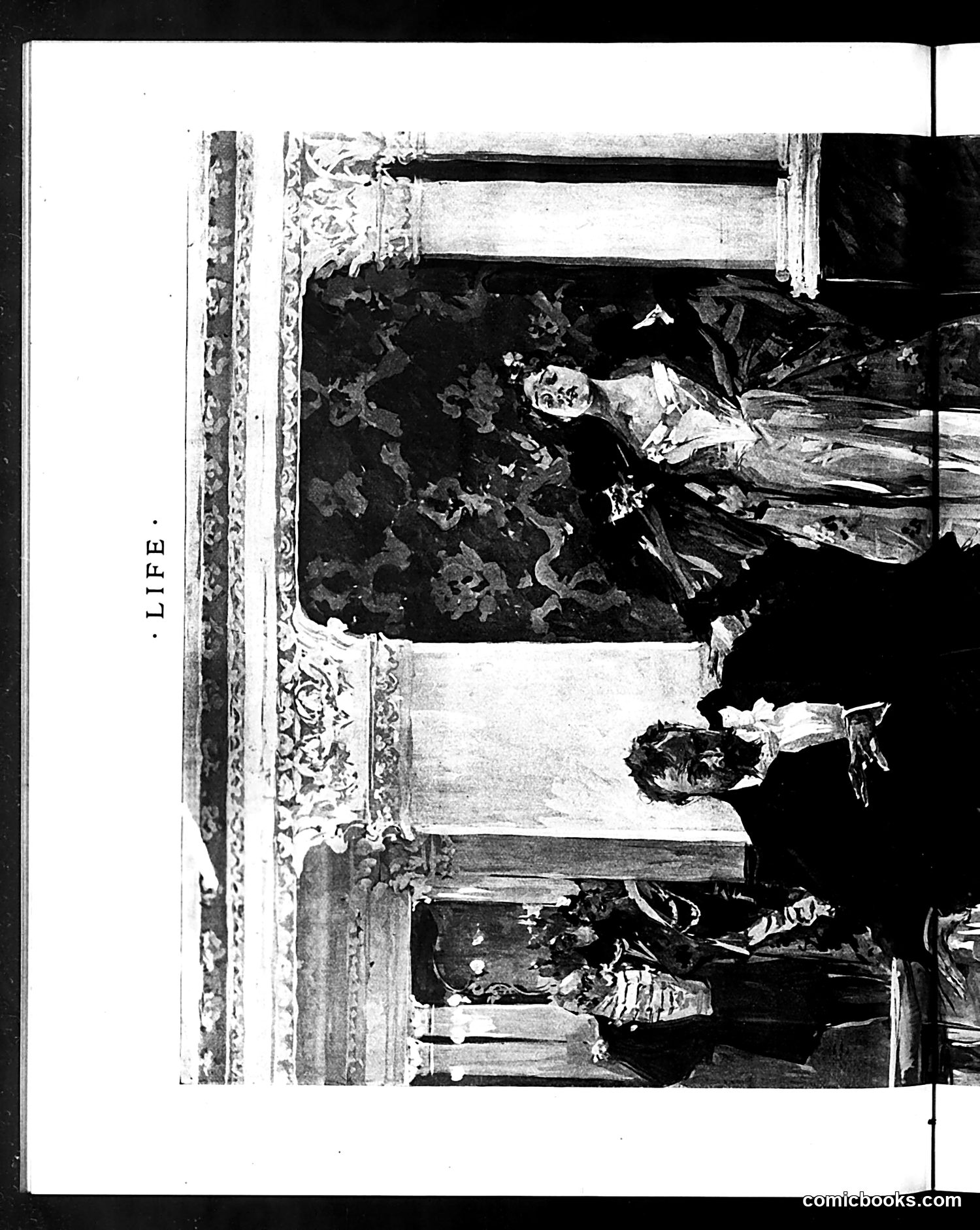
I can see this is a page from *Life* magazine marked "LIFE" on the left margin. The image appears to be a black and white photograph or illustration rotated sideways, showing what looks like an interior domestic scene with ornate furnishings (decorative border/trim visible) and figures in period clothing. However, the OCR text provided contains no actual readable content—only the word "LIFE"—so I cannot determine what specific political, social, or satirical point this image makes. Without accompanying caption text, article content, or visible text within the illustration itself, I cannot reliably identify the figures, the historical context, or the intended satire for a modern reader. To properly explain this cartoon's meaning, I would need legible text or caption information from the original page.
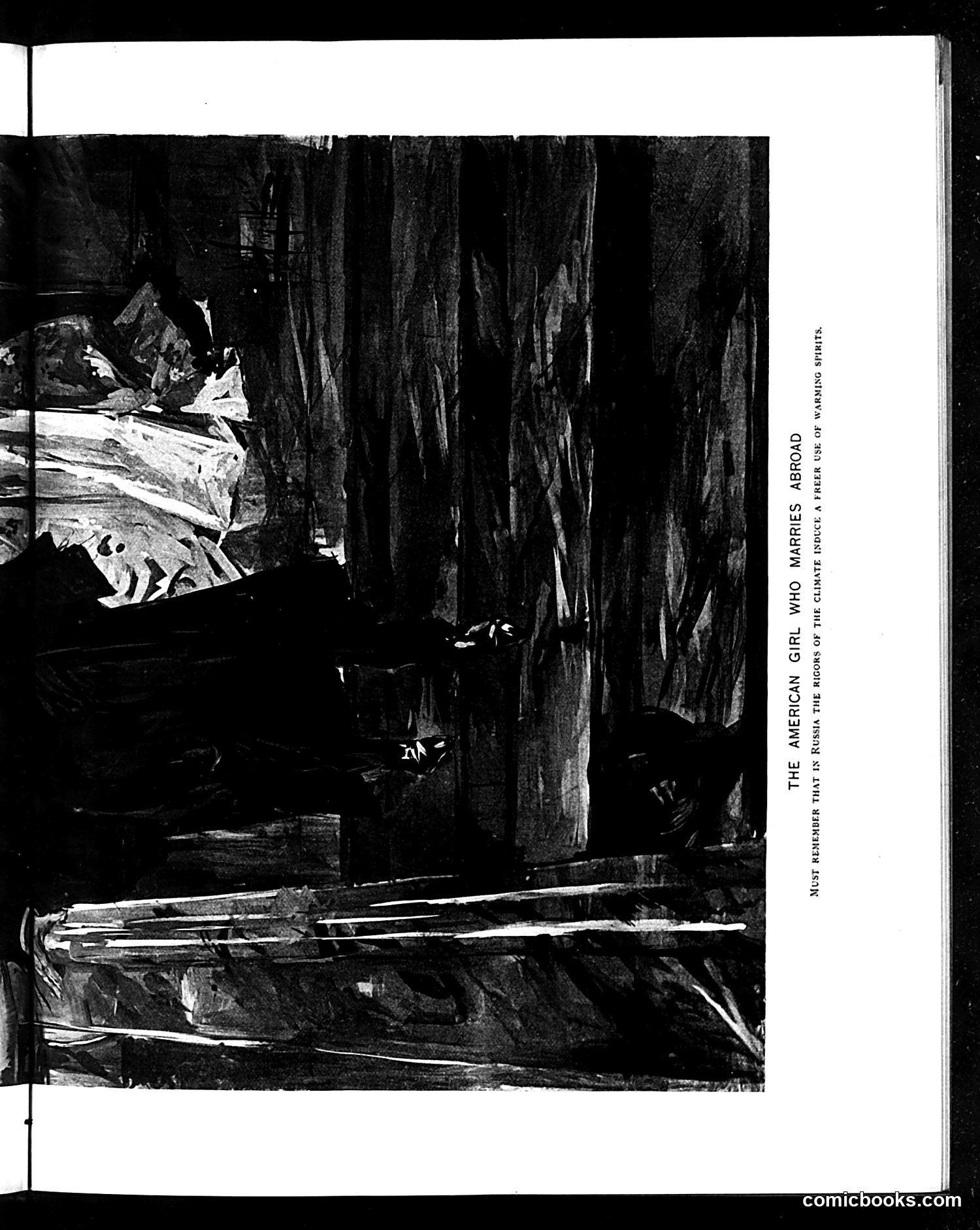
This appears to be an illustration from Life magazine's satirical commentary on American women marrying foreign men. The caption indicates the piece concerns "the brooks of the client house" and marrying abroad. The dark, dramatic illustration shows what appears to be a woman in an ornate interior setting with tall wooden posts or columns—possibly meant to evoke a European aristocratic mansion or castle. The satire likely mocked the phenomenon of wealthy American heiresses marrying titled but impoverished European noblemen during the Gilded Age, a common social practice where American money secured foreign nobility status. The Gothic, shadowy aesthetic may be sarcastically commenting on the perceived dangers, foreign strangeness, or romantic delusions involved in such cross-Atlantic marriages.
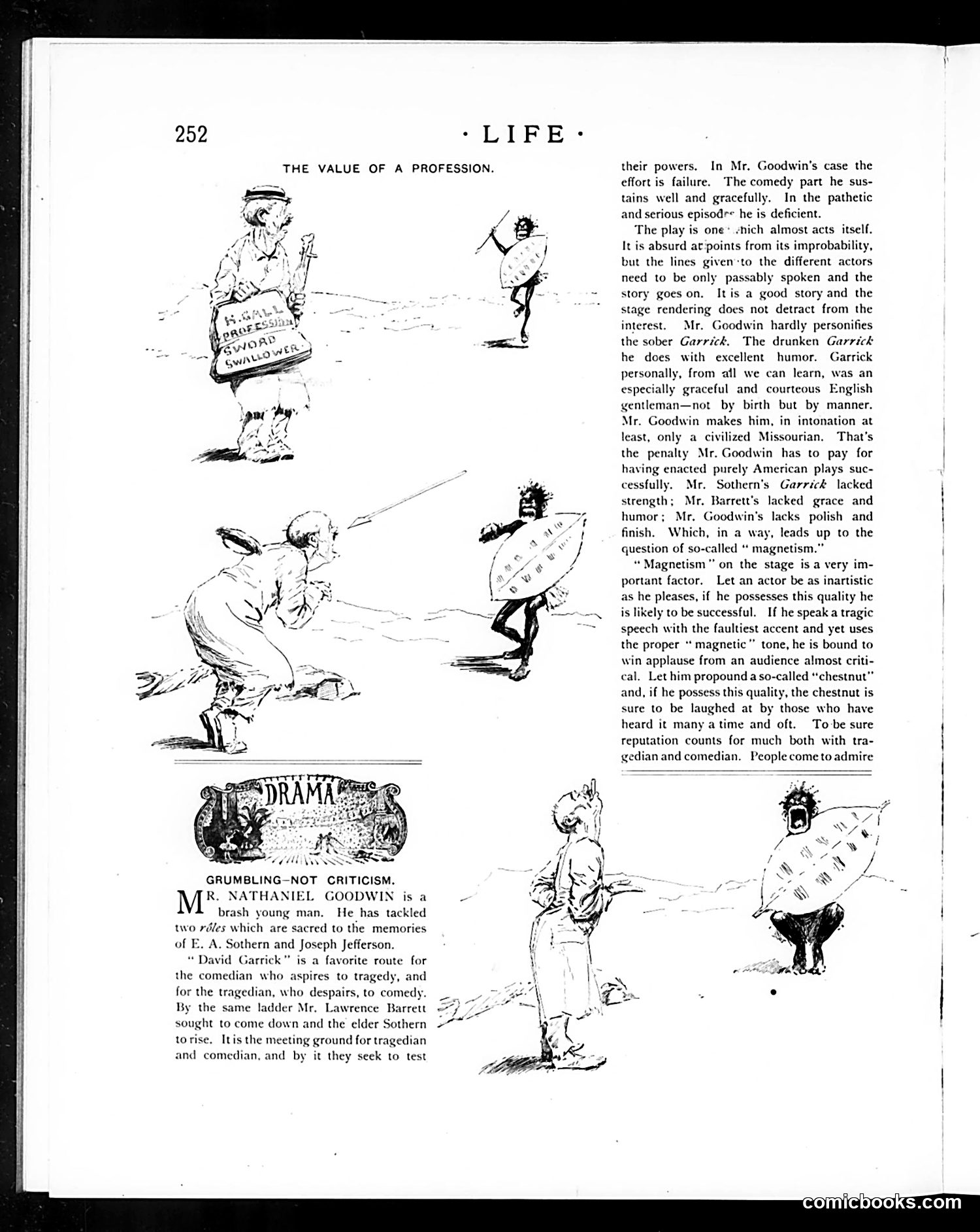
This page critiques actor Nathaniel Goodwin's performance in "David Garrick," a play previously associated with celebrated actors E.A. Sothern and Joseph Jefferson. The sketches illustrate various theatrical poses and character types. **The satire's point:** Goodwin excels at comedy but fails at pathos and serious moments. The critic argues he lacks the "magnetism"—stage presence and polish—that made earlier performers succeed. His weakness stems from specializing in American comedies, leaving him unable to embody the refined English gentleman that Garrick requires. While Sothern lacked strength and Barrett lacked grace, Goodwin's deficiency is polish and finish. The accompanying cartoons (likely by a staff illustrator) humorously depict theatrical character types and exaggerated dramatic poses, reinforcing the theme that professional acting requires mastery across multiple registers—comedy alone is insufficient.
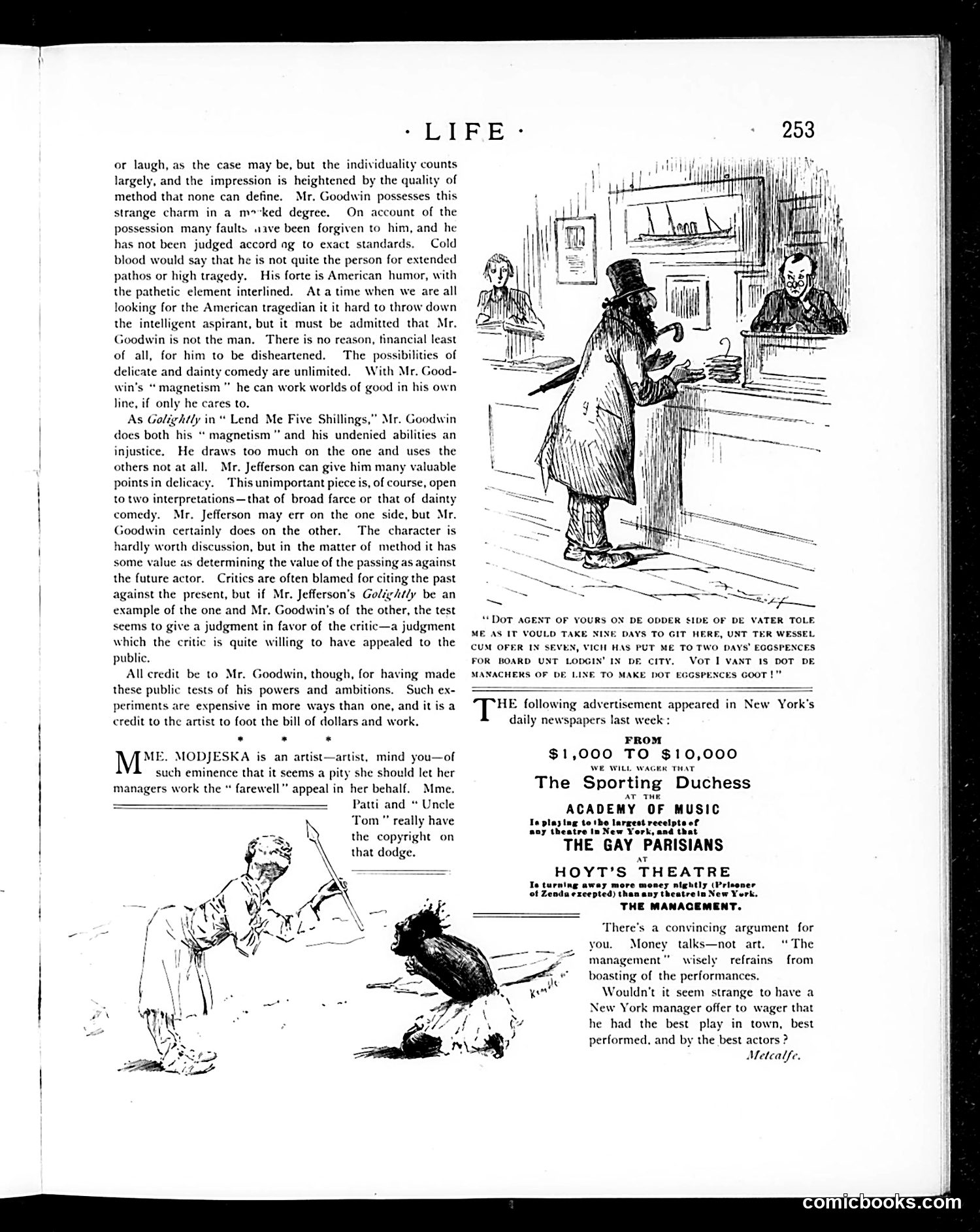
This page contains theater criticism and satirical commentary on performances and theatrical advertising. **Main Content:** The text critiques actor Mr. Goodwin's performance in "Lend Me Five Shillings," comparing him unfavorably to Mr. Jefferson in the same role. The critic argues Goodwin relies too heavily on "magnetism" while neglecting nuanced acting technique—he's better suited to broad comedy than pathos or tragedy. **Cartoon Satire (lower left):** A sketch of Mme. Modjeska with a crow, mocking how she allows her managers to exploit her "farewell" appeal for publicity. The joke references that farewell tours were a theatrical cliché—Patti and "Uncle Tom" (likely referring to established farewell-tour traditions) had already exhausted this marketing strategy. **Advertisement Commentary:** The page ridicules a theater advertisement claiming "The Sporting Duchess" draws more money nightly than any other New York show. The critic sarcastically notes the management conspicuously avoids claiming artistic merit—only financial success—suggesting the play's quality is irrelevant to its box-office appeal.
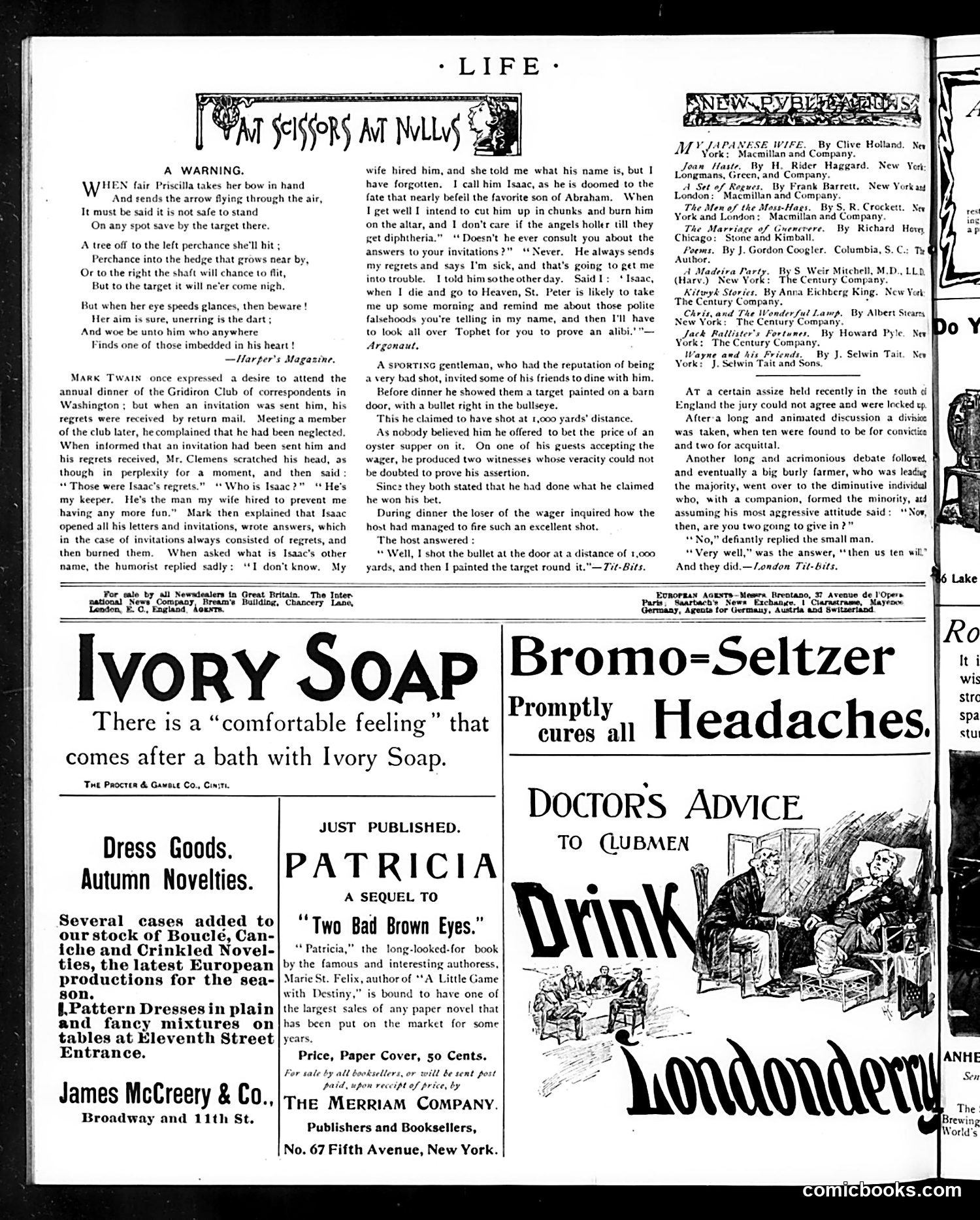
This page is primarily **advertisements and book reviews** rather than political cartoons. The main content consists of three humorous anecdotes: 1. **"A Warning"** — A poem about "fair Priscilla" and archery, suggesting her romantic appeal is more dangerous than her actual arrows. 2. **Mark Twain story** — A satirical anecdote mocking overly-controlling wives. Twain complains his wife hired a man named "Isaac" to intercept all invitations and automatically decline them, preventing Twain from having fun. The joke is that wives use such servants as instruments of marital control. 3. **The Bad Shot story** — A hunting anecdote where a notoriously poor marksman claims a long-distance bullseye. Revealed as fraud: he shot first, then painted the target around the bullet hole. These are **social humor pieces** typical of the era—poking fun at marriage dynamics, masculine pride, and dishonesty—rather than political satire. The page also advertises books, soap, and dress goods.
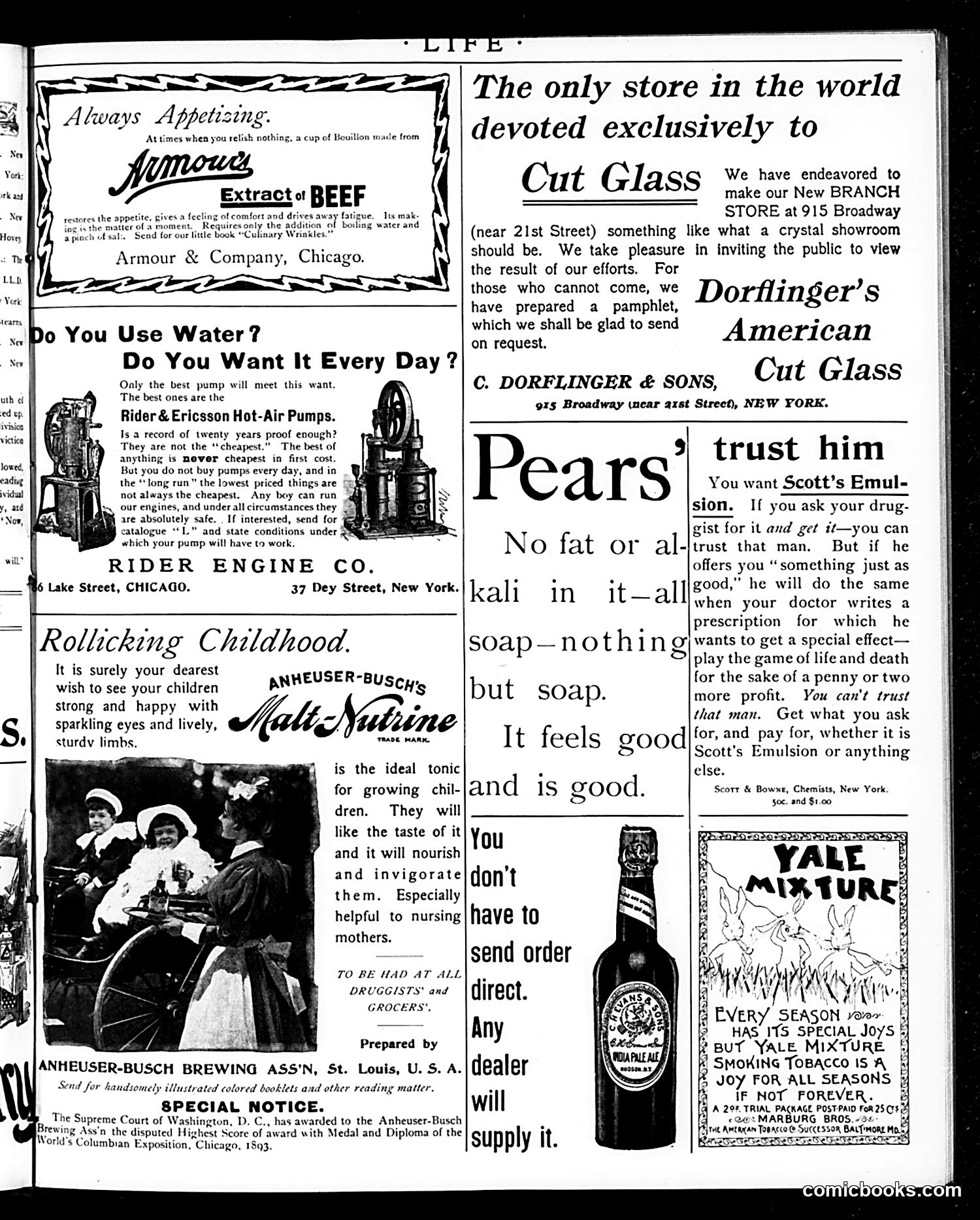
This is primarily a **commercial advertising page** from an early Life magazine (circa 1893, based on the Columbian Exposition reference). There are no political cartoons or satire here. The page features period product advertisements including: - **Armour's Extract of Beef** - a digestive tonic - **Rider & Ericsson Hot-Air Pumps** - industrial equipment - **Anheuser-Busch Malt Nutrine** - a "tonic for growing children" (notably, a malt beverage marketed to families and nursing mothers, reflecting pre-Prohibition attitudes toward alcohol) - **Dorflinger Cut Glass** - luxury glassware - **Pears' Soap** - emphasizing purity and trustworthiness - **Scott's Emulsion** - a medicinal product - **Yale Mixture Tobacco** The ads reflect late Victorian consumer culture and contain claims that would be illegal today (medicinal alcohol for infants, unregulated pharmaceutical marketing). The *only* potentially satirical element is the implicit humor in marketing malt liquor as wholesome children's nutrition.
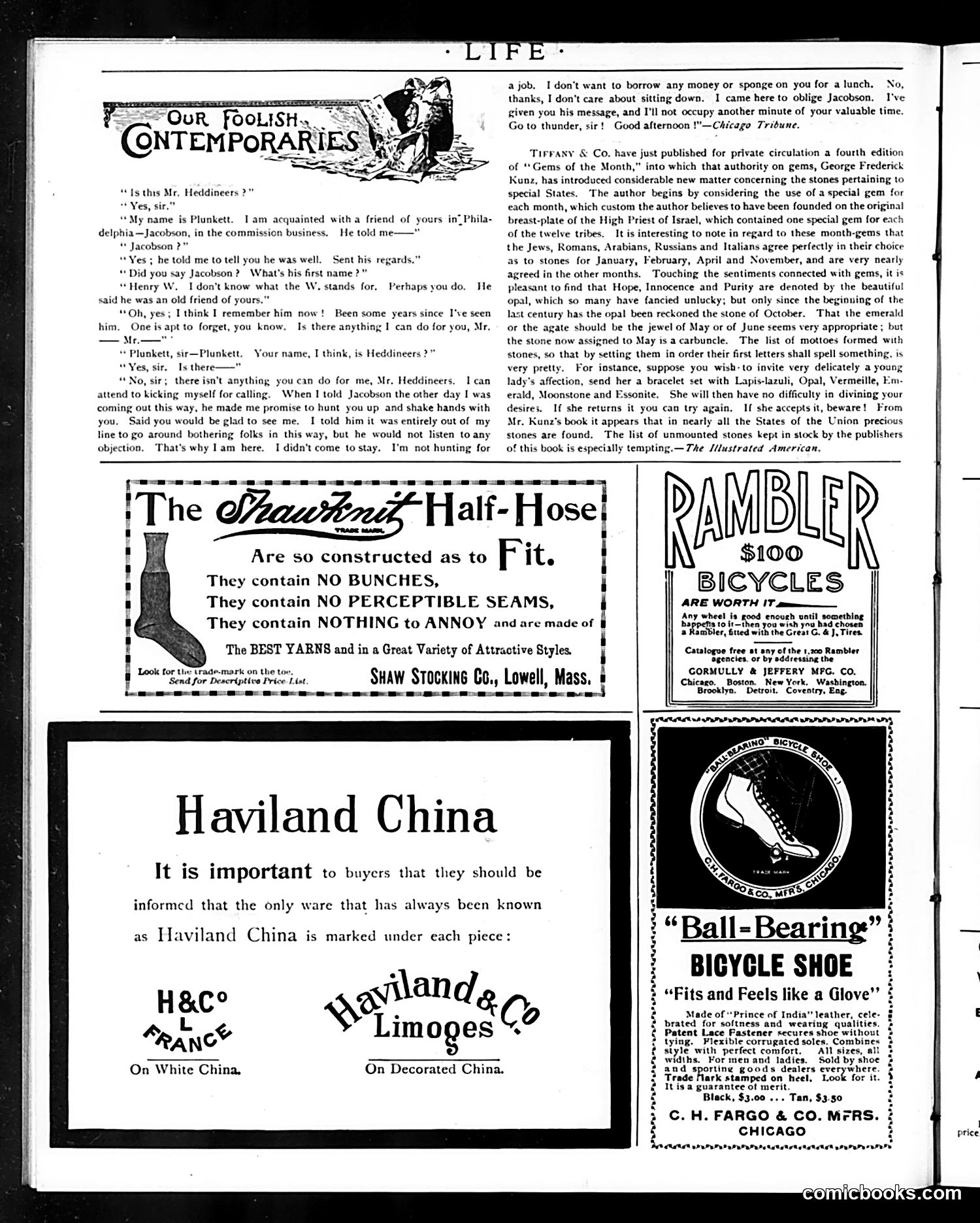
This satirical dialogue mocks the social awkwardness of unwanted visits. A man named Plunkett visits Mr. Heddineers, claiming a mutual friend (Jacobson) insisted he call. Throughout the interaction, Plunkett repeatedly reassures his reluctant host that he wants nothing—not a job, money, lunch, or to stay long—while simultaneously wasting his time with the visit itself. The humor lies in the contradiction: Plunkett protests he's not imposing while actively imposing. He's overly deferential yet oblivious to how unwelcome he is. The cartoon satirizes people who make obligatory social calls out of misplaced politeness, creating discomfort for everyone involved. The punchline—"Go to thunder, sir!"—shows Heddineers's exasperation finally breaking through. This was a common annoyance in early 20th-century social life before modern communication made unexpected visits less frequent.
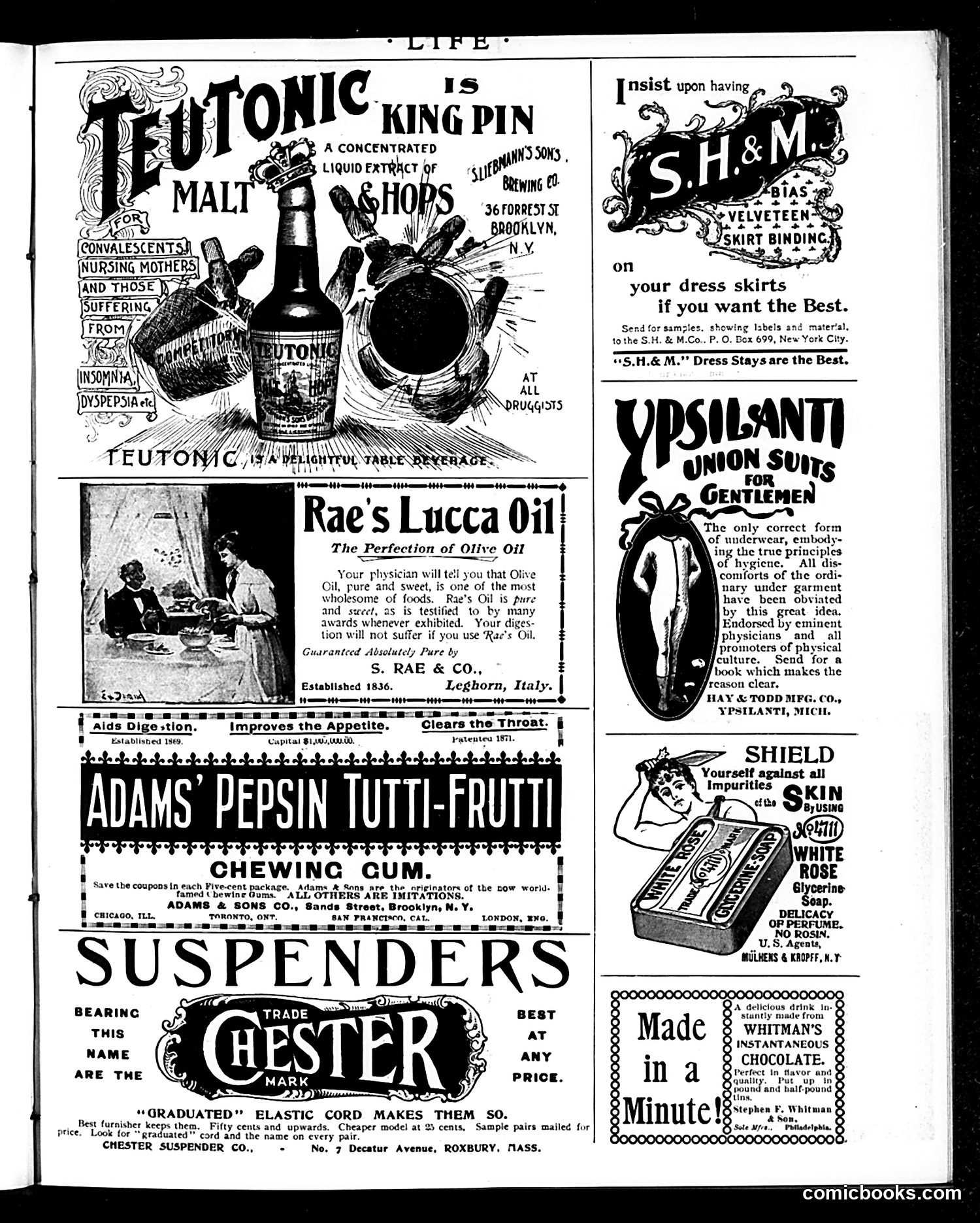
This is primarily an **advertisement page**, not a satirical cartoon section. It features various commercial products marketed to early 20th-century consumers: **Key Advertisements:** - **Teutonic Malt & Hops** (top): A "tonic" beverage marketed to "convalescents, nursing mothers" and those suffering from insomnia and dyspepsia—typical medicinal claims for patent medicines of this era - **Rae's Lucca Oil**: Italian olive oil guaranteed pure - **Adams' Pepsin Tutti-Frutti**: Chewing gum claiming digestive benefits - **Chester Suspenders**: Men's clothing hardware - **S.H. & M. Dress Stays**: Women's undergarment support wear - **Upsilanti Union Suits**: Men's underwear marketed with health/hygiene claims - **Shield Skin Soap**: Cosmetic product - **Whitman's Instantaneous Chocolate**: Instant drink mix The page reflects **patent medicine era advertising** (pre-FDA regulation), where products made exaggerated health claims. Modern readers would recognize these as dubious by today's standards—particularly the medicinal tonics claiming to cure various ailments.
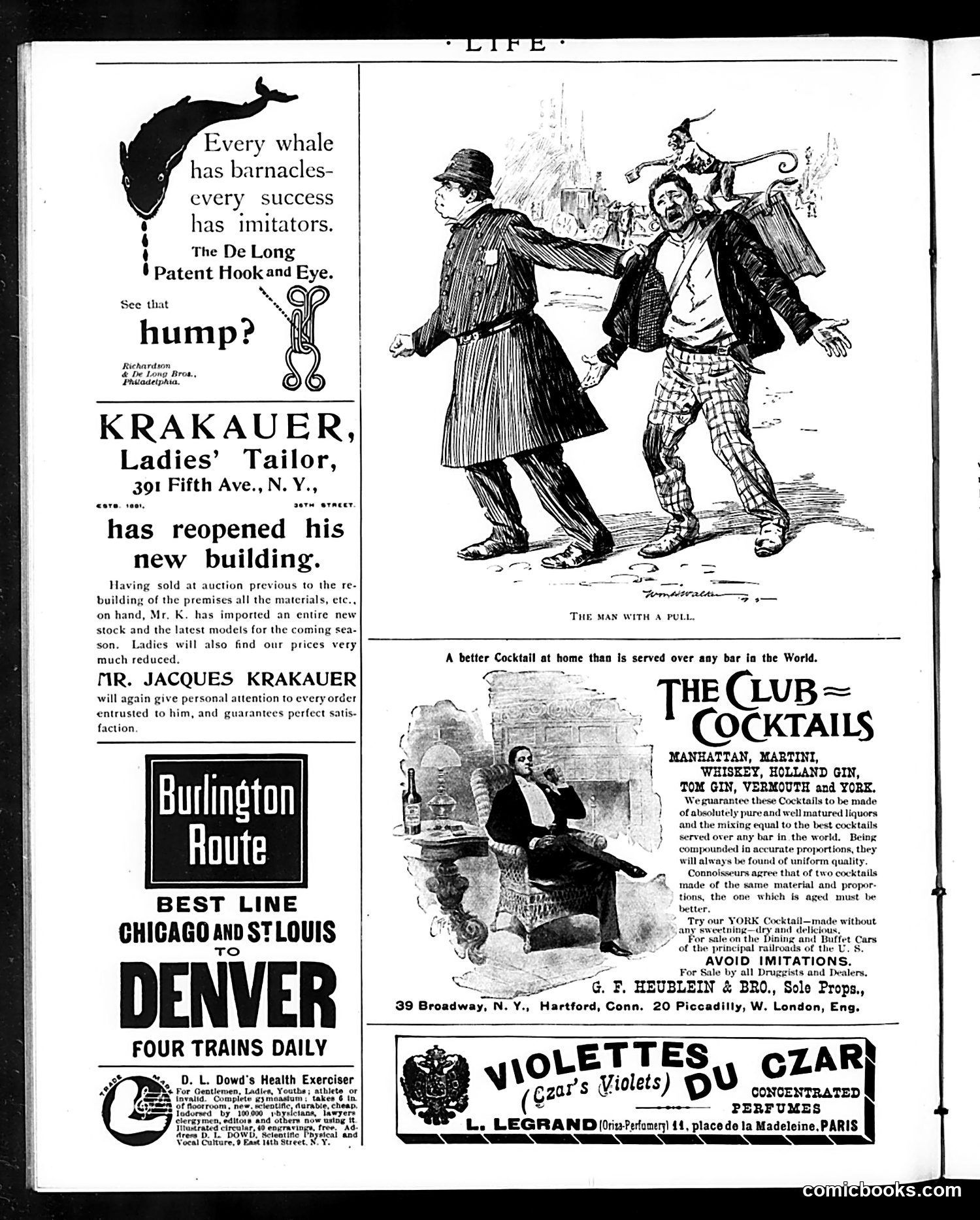
This page is primarily **advertisements** with one political cartoon. **"The Man with a Pull"** cartoon depicts a common turn-of-the-century satirical theme: a well-dressed man with political or social connections (indicated by the figure in a jester's cap pointing from above) manipulating or assisting another man. "Having a pull" meant having influence or connections to obtain favors. The cartoon illustrates how success or advancement often depends on personal connections rather than merit—a frequent target of Progressive Era satire mocking corruption and cronyism in American business and politics. The page otherwise contains period advertisements: a ladies' tailor reopening in a new Fifth Avenue building, railroad service to Denver, a patent hook-and-eye fastener (comparing success to barnacles on whales), a home cocktail set, health exercise equipment, and French perfume. The ads reflect early 1900s consumer culture and luxury goods marketing.
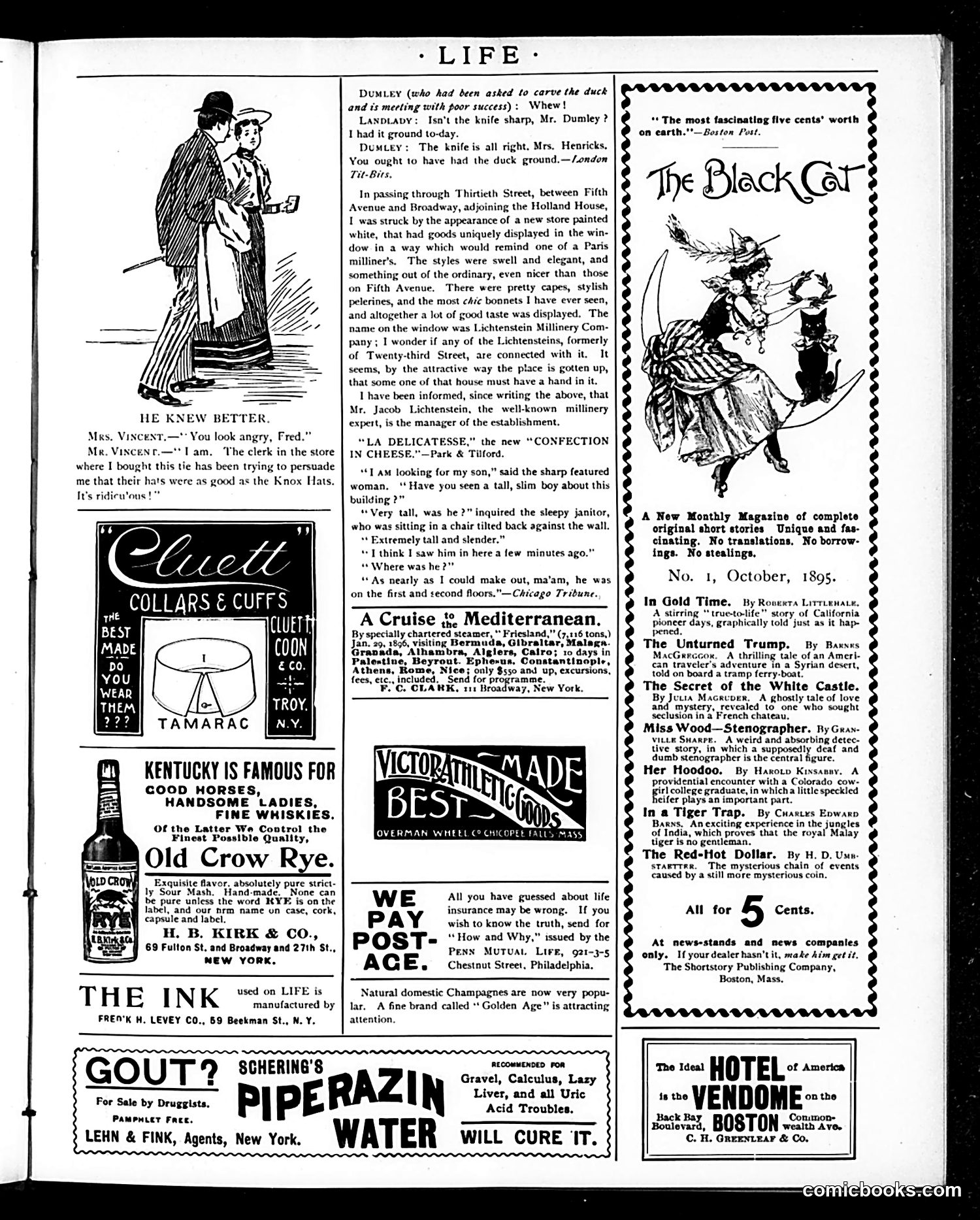
The top cartoon, "He Knew Better," satirizes brand loyalty and advertising claims. Mr. Vincent is annoyed that a store clerk tried to convince him their hats matched Knox Hats' quality—Vincent recognizes Knox as the superior, established brand and resents the deception. Below, a second joke shows a woman searching for her tall, thin son in a building. The janitor, apparently dim-witted, reports seeing him "on the first and second floors"—a deliberately unhelpful answer that misses the obvious: the son is probably *between* those floors, or the janitor simply wasn't paying attention. The remainder is primarily **advertising and announcements**: luxury goods (Old Crow whiskey, Knox Hats, Cluett collars), travel (Mediterranean cruises), patent medicines (Piperazin for gout), and the inaugural issue of *The Black Cat* magazine (5 cents). This reflects Life's role as both humor publication and advertising vehicle for upper-middle-class consumers.
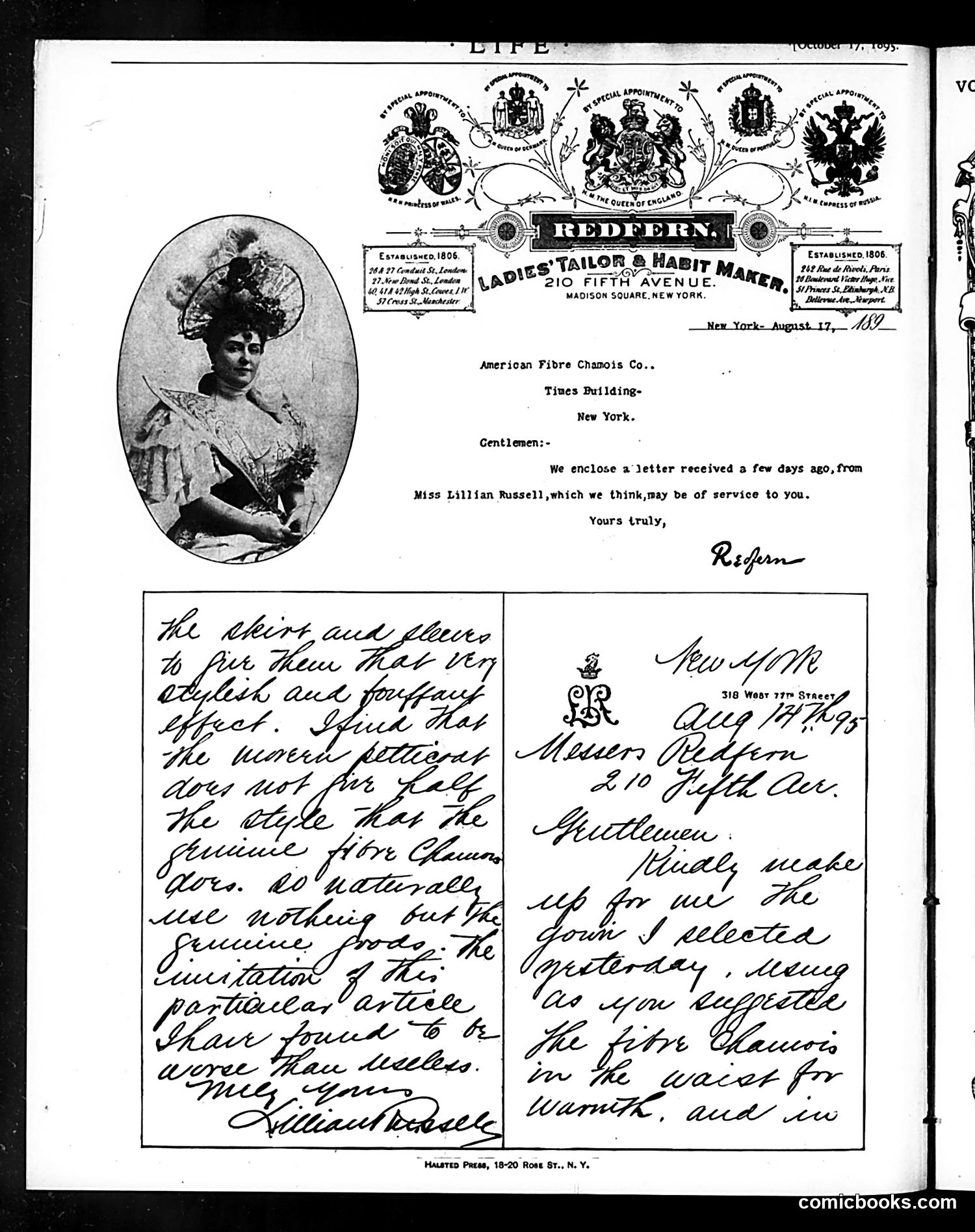
This is primarily **business correspondence and advertising**, not political satire. The page features: **Main Content:** A letter from Redfern (an established tailor/dressmaker at 210 Fifth Avenue, Madison Square, New York) forwarding correspondence from **Lillian Russell**, a famous American actress and performer of the era, to the American Fibre Chamois Company. **The Photo:** A glamorous portrait of a woman in Edwardian dress dominates the left side—likely Russell herself, given the context. **The Actual Letter:** Two handwritten notes appear below, discussing clothing construction—specifically about "skirts and sleeves" and "the style" of a garment, mentioning "genuine horn clasp" and concerns about durability. **Purpose:** This appears to be a **testimonial advertisement** using Russell's celebrity endorsement to promote quality tailoring and materials (particularly chamois fiber). Russell's status as a well-known public figure lent credibility to the dressmaker's work. This reflects early 1900s marketing: leveraging celebrity endorsement for luxury clothing goods.