
Life, 1895-10-17 · page 13 of 20
Life — October 17, 1895 — page 13: what you’re looking at
What you’re looking at
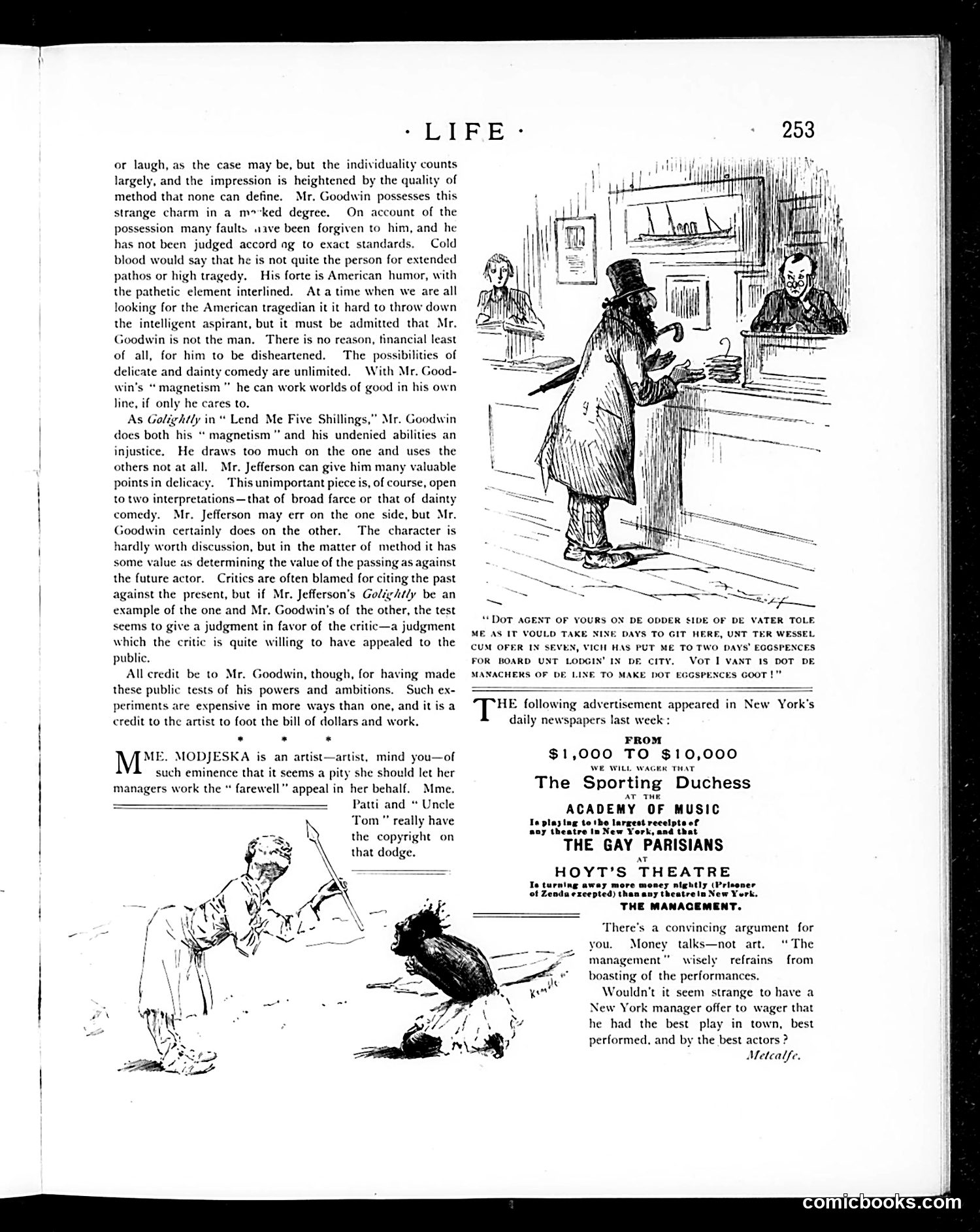
This page contains theater criticism and satirical commentary on performances and theatrical advertising. **Main Content:** The text critiques actor Mr. Goodwin's performance in "Lend Me Five Shillings," comparing him unfavorably to Mr. Jefferson in the same role. The critic argues Goodwin relies too heavily on "magnetism" while neglecting nuanced acting technique—he's better suited to broad comedy than pathos or tragedy. **Cartoon Satire (lower left):** A sketch of Mme. Modjeska with a crow, mocking how she allows her managers to exploit her "farewell" appeal for publicity. The joke references that farewell tours were a theatrical cliché—Patti and "Uncle Tom" (likely referring to established farewell-tour traditions) had already exhausted this marketing strategy. **Advertisement Commentary:** The page ridicules a theater advertisement claiming "The Sporting Duchess" draws more money nightly than any other New York show. The critic sarcastically notes the management conspicuously avoids claiming artistic merit—only financial success—suggesting the play's quality is irrelevant to its box-office appeal.
📄 Transcribed text from this page (OCR, searchable)
Machine-transcribed from the original scan — historical spelling and the odd misread are preserved.
pat a) (Jer) or laugh, as the case may be, but the individuality counts largely, and the impression is heightened by the quality of method that none can define. Mr. Goodwin possesses this strange charm in a m-ked degree. On account of the possession many faults wave been forgiven to him, and he has not been judged accord ag to exact standards. Cold blood would say that he is not quite the person for extended pathos or high tragedy. His forte is American humor, with the pathetic element interlined. Ata time when we are all looking for the American tragedian it it hard to throw down the intelligent aspirant, but it must be admitted that Mr. Goodwin is not the man. There is no reason, financial least of all, for him to be disheartened. The possibilities of delicate and dainty comedy are unlimited. With Mr. Good- “ magnetism " he can work worlds of good in his own win’ line, if only he cares to. As Golightly in“ Lend Me Five Shillings,” Mr. Goodwin does both his “ magnetism" and his undenied abilities an injustice. He draws too much on the one and uses the others not at all, Mr. Jefferson can give him many valuable pointsin delicacy. This unimportant piece is, of course, open to two interpretations—that of broad farce or that of dainty comedy. Mr. Jefferson may err on the one side, but Mr. Goodwin certainly does on the other. The character is hardly worth discussion, but in the matter of method it has some value as determining the value of the passing as against the future actor. Critics are often blamed for citing the past against the present, but if Mr. Jefferson's Golightly be an example of the one and Mr. Goodwin's of the other, the test scems to give a judgment in favor of the critic—a judgment which the critic is quite willing to have appealed to the public. All credit be to Mr. Goodwin, though, for having made these public tests of his powers and ambitions. Such ex- periments are expensive in more ways than one, and it is a credit to the artist to foot the bill of dollars and work, . . « . MODJESKA is an artist—artist, mind you—of ch eminence that it seems a pity she should let her ers work the “ farewell” appeal in her behalf. Mme. = Patti and “ Uncle Tom" really have the copyright on that dodge. “DOT AGENT OF YOURS ON DE ODDER SIDE OF DE VATER TOLE ME AS IT VOULD TAKE NINE DAYS TO GIT HERE, UNT TER WESSEL CUM OFER IN SEVE FOR BOARD UNT LODG MANACHERS OF DE 1 IN DE city. E TO MAKE DoT HE following advertisement appeared in New York's daily newspapers last week : FROM $1,000 TO $10,000 WE WILL WAGER THAT The Sporting Duchess AT THE ACADEMY OF MUSIC THE GA’ HOYT’S THEATRE Ie turning away more money nightly (Prisoner of Zenda excepted) t y theatre in New York. ‘THE MANACEMENT. ‘There's a convincing argument for you. Money talks—not art, “The management" wisely refrains from boasting of the performances. Wouldn't it seem strange to have a New York manager offer to wager that he had the best play in town, best performed, and by the best actors ? Metcalfe. comicbooks.com