
Life, 1895-10-17 · page 12 of 20
Life — October 17, 1895 — page 12: what you’re looking at
What you’re looking at
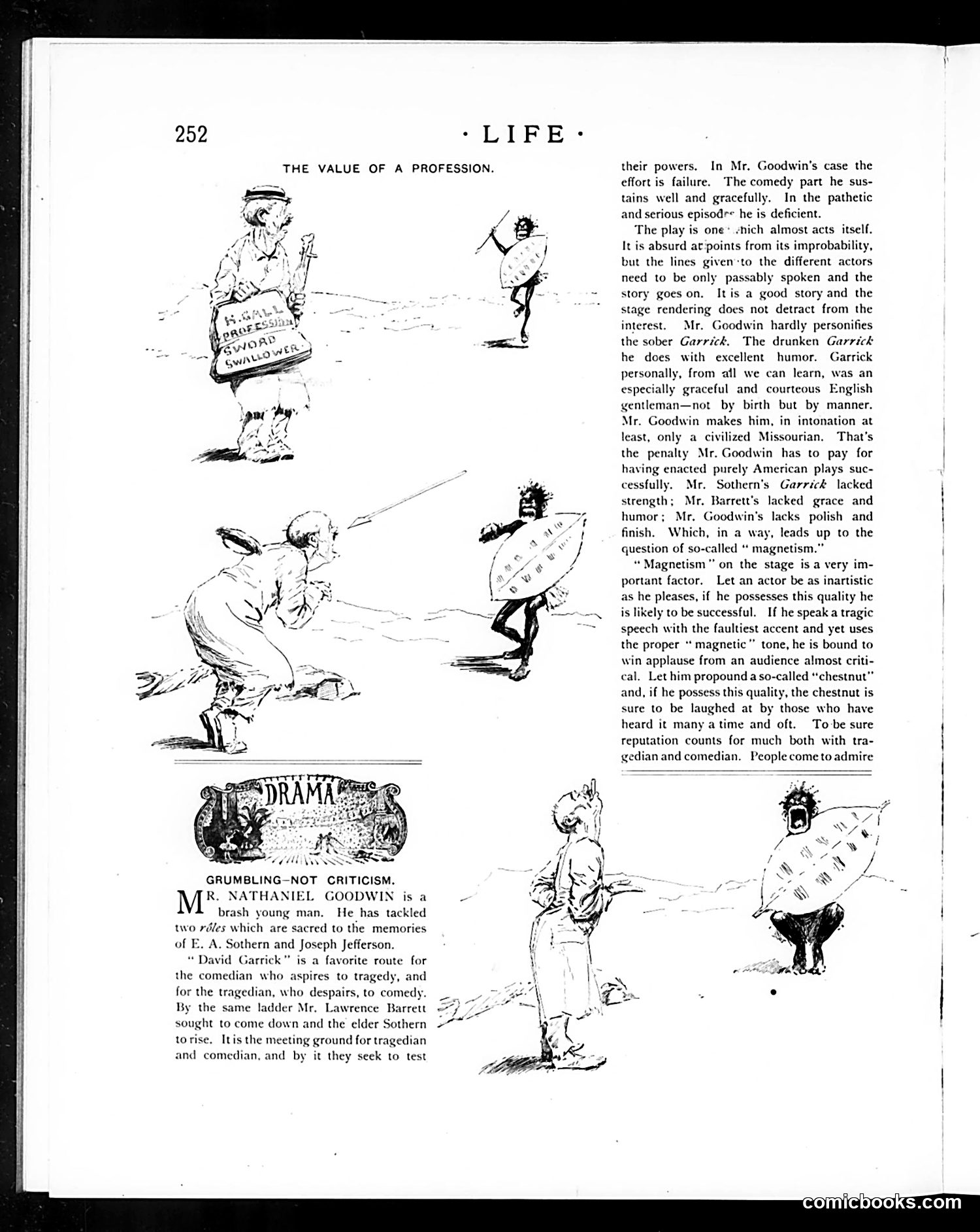
This page critiques actor Nathaniel Goodwin's performance in "David Garrick," a play previously associated with celebrated actors E.A. Sothern and Joseph Jefferson. The sketches illustrate various theatrical poses and character types. **The satire's point:** Goodwin excels at comedy but fails at pathos and serious moments. The critic argues he lacks the "magnetism"—stage presence and polish—that made earlier performers succeed. His weakness stems from specializing in American comedies, leaving him unable to embody the refined English gentleman that Garrick requires. While Sothern lacked strength and Barrett lacked grace, Goodwin's deficiency is polish and finish. The accompanying cartoons (likely by a staff illustrator) humorously depict theatrical character types and exaggerated dramatic poses, reinforcing the theme that professional acting requires mastery across multiple registers—comedy alone is insufficient.
📄 Transcribed text from this page (OCR, searchable)
Machine-transcribed from the original scan — historical spelling and the odd misread are preserved.
- LIFE: THE VALUE OF A PROFESSION. GRUMBLING-NOT CRITICISM. R. NATHANIEL GOODWIN is a - brash young man. He has tackled two rdles which are sacred to the memories of E. A. Sothern and Joseph Jefferson. “ David Garrick” is a favorite route for the comedian who aspires to tragedy, and for the tragedian, who despairs, to comedy. By the same ladder Mr. Lawrence Barrett sought to come down and the elder Sothern to ris Itis the meeting ground for tragedian and comedian, and by it they seek to test their powers. In Mr. Goodwin's case the effort is failure. The comedy part he sus- tains well and gracefully, In the pathetic and serious episodrs he is deficient. The play is one’ snich almost acts itself. It is absurd at‘points from its improbability, but the lines given:to the different actors need to be only passably spoken and the story goes on. Itis a good story and the stage rendering does not detract from the terest. Mr. Goodwin hardly personifies the sober Garrick. The drunken Garrick he does with excellent humor. Garrick personally, from afl we can learn, was an especially graceful and courteous English gentleman—not by birth but by manner. Mr. Goodwin makes him, in intonation at least, only a civilized Missourian, That's the penalty Mr. Goodwin has to pay for having enacted purely American plays suc- cessfully. Mr. Sothern’s Garrick lacked strength; Mr. Barrett's lacked grace and humor; Mr, Goodwin's lacks polish and finish. Which, in a way, leads up to the question of so-called “ magnetism.” “Magnetism” on the stage is a very im- portant factor. Let an actor be as inartistic as he pleases, if he possesses this quality he is likely to be successful. If he speak a tragic speech with the faultiest accent and yet uses the proper “ magnetic” tone, he is bound to win applause from an audience almost criti- cal. Let him propound a so-called “chestnut and, if he possess this quality, the chestnut is sure to be laughed at by those who have heard it many atime and oft. To-be sure reputation counts for much both with tra- gedian and comedian. People come to admire