
A complete issue · 26 pages · 1895
Life — October 3, 1895
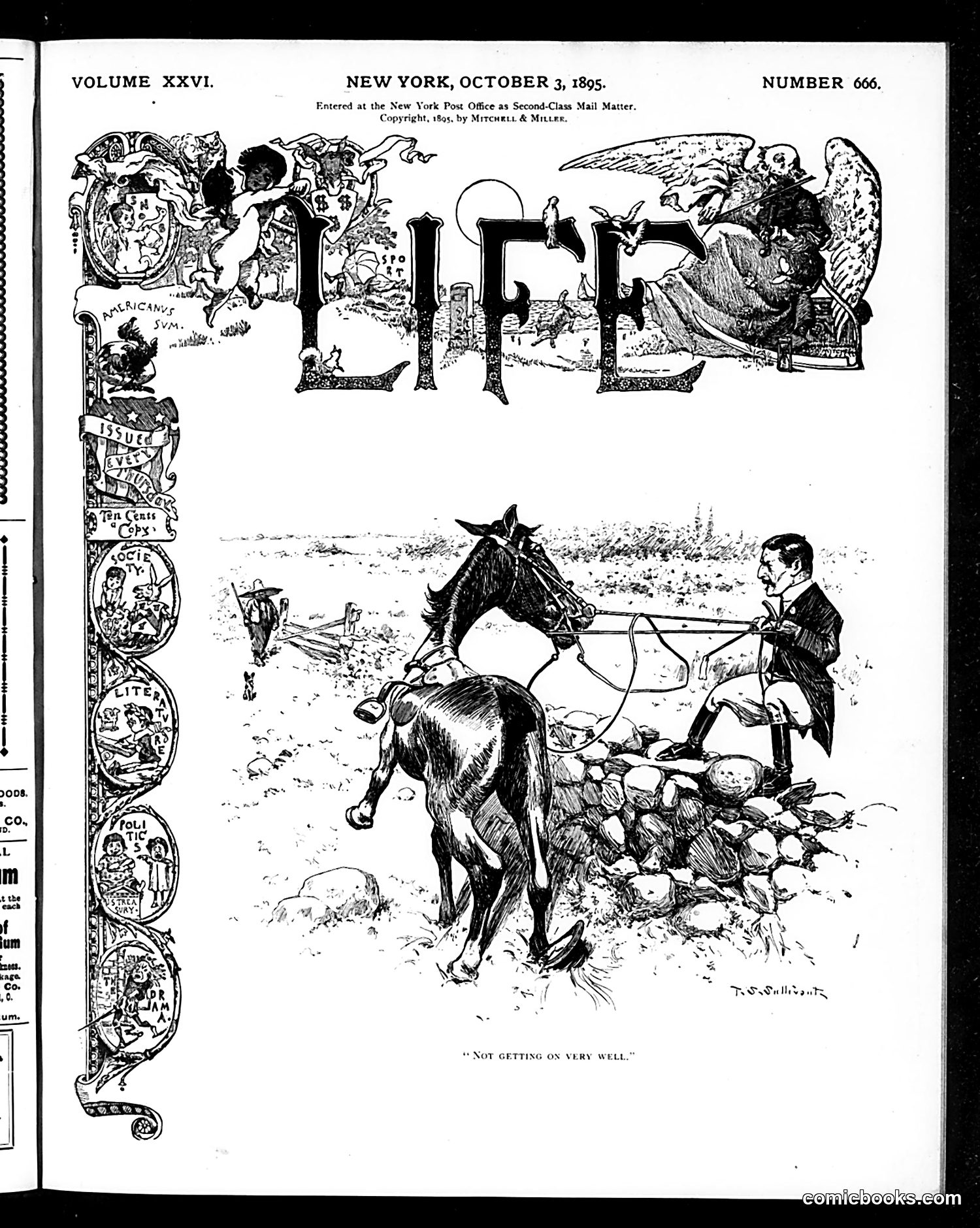
This page features a satirical cartoon titled "Not Getting on Very Well." The illustration depicts a man struggling to control a stubborn horse that refuses to move forward, despite his efforts pulling on the reins while standing among rocks. The cartoon likely comments on a contemporary political or social situation where someone in power faces unexpected resistance or inability to achieve their goals—the horse representing an obstinate force or institution resisting the man's direction. Without identifying the specific figure, the image suggests frustration with stalled progress or failed leadership during this period. The elaborate decorative border on the left side is typical of Life magazine's ornate design aesthetic from the 1890s.
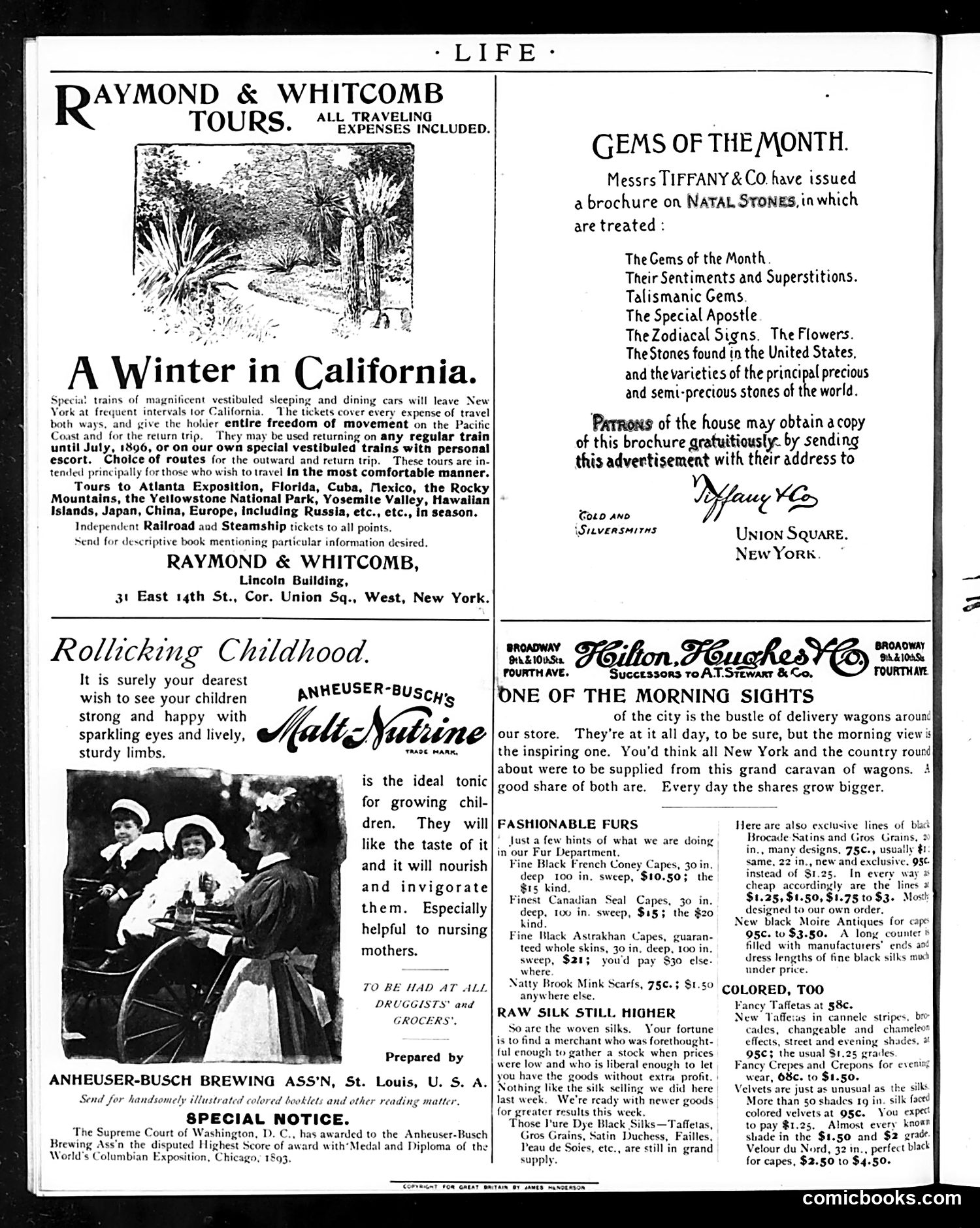
This page is **primarily advertising** rather than political satire. It contains three major advertisements: 1. **Raymond & Whitcomb Tours** — promoting luxury travel packages to California and various destinations 2. **Anheuser-Busch's Malt Nutrine** — a tonic beverage marketed to mothers and children, featuring a photograph of well-dressed children 3. **Hilton, Honoikes & Co.** — a department store advertising furs and silk fabrics The Anheuser-Busch ad includes a special notice about the Supreme Court awarding the company a medal at the 1893 Chicago Exposition, suggesting this page dates to the 1890s era. There is no discernible political cartoon or satire on this page—it represents typical late-19th-century magazine advertising combining commercial products with aspirational imagery of health, refinement, and leisure travel.
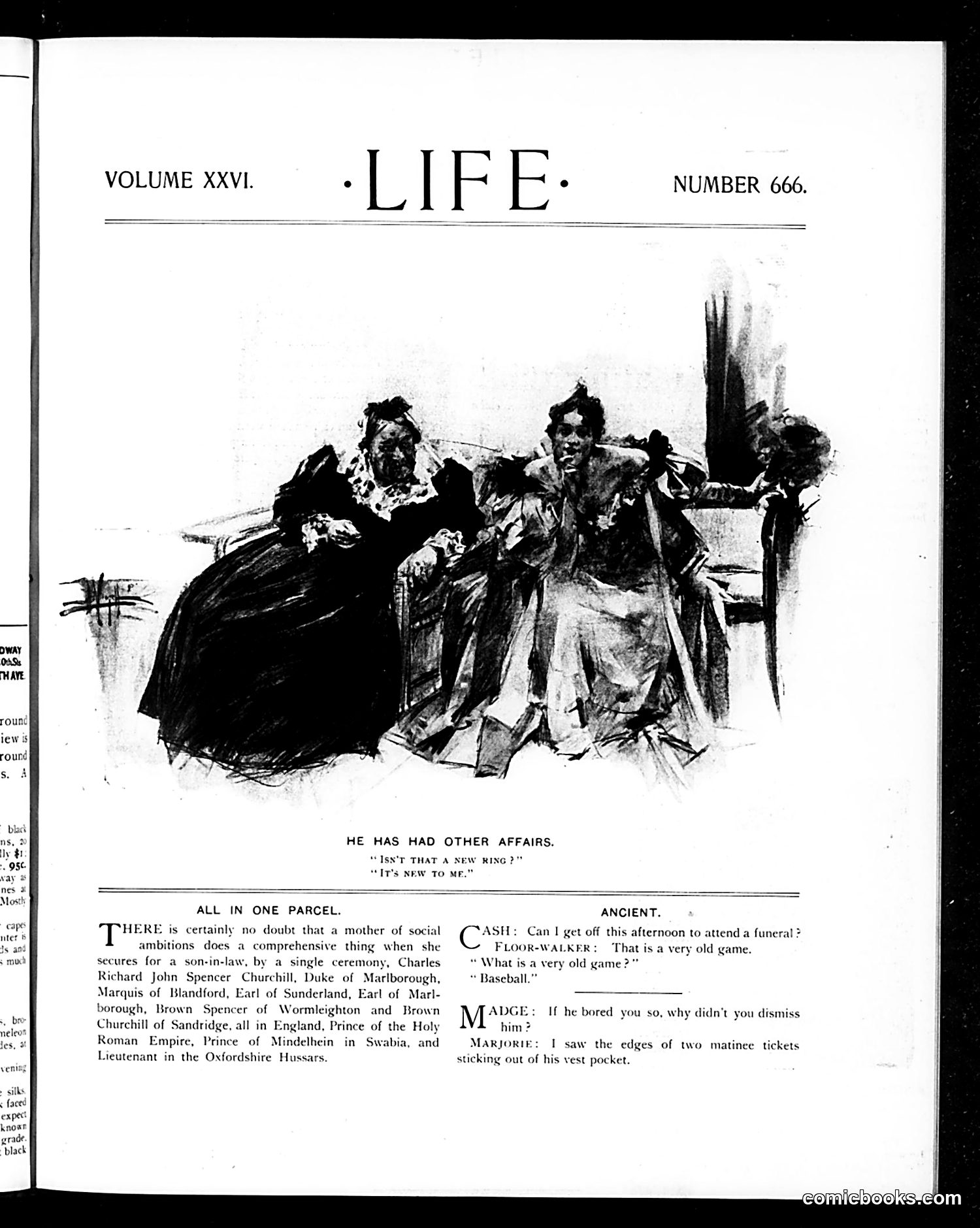
The main cartoon depicts three figures in period dress with the caption "HE HAS HAD OTHER AFFAIRS" — apparently satirizing someone's romantic history. The dialogue ("Isn't that a new ring?" / "It's new to me") suggests infidelity or romantic deception. The text below references "a mother of social ambitions" securing a "soft-in-law" through a single ceremony, then lists numerous titled British and colonial figures (Duke of Marlborough, Earl of Sunderland, etc.), suggesting this is about advantageous aristocratic marriages. The secondary joke sections labeled "ALL IN ONE PARCEL" and "ANCIENT" involve short comedic dialogues about dismissing someone who attended funerals and matinee tickets. Without the specific issue date, I cannot identify the particular scandal referenced, but the page satirizes upper-class marriage customs and infidelity.
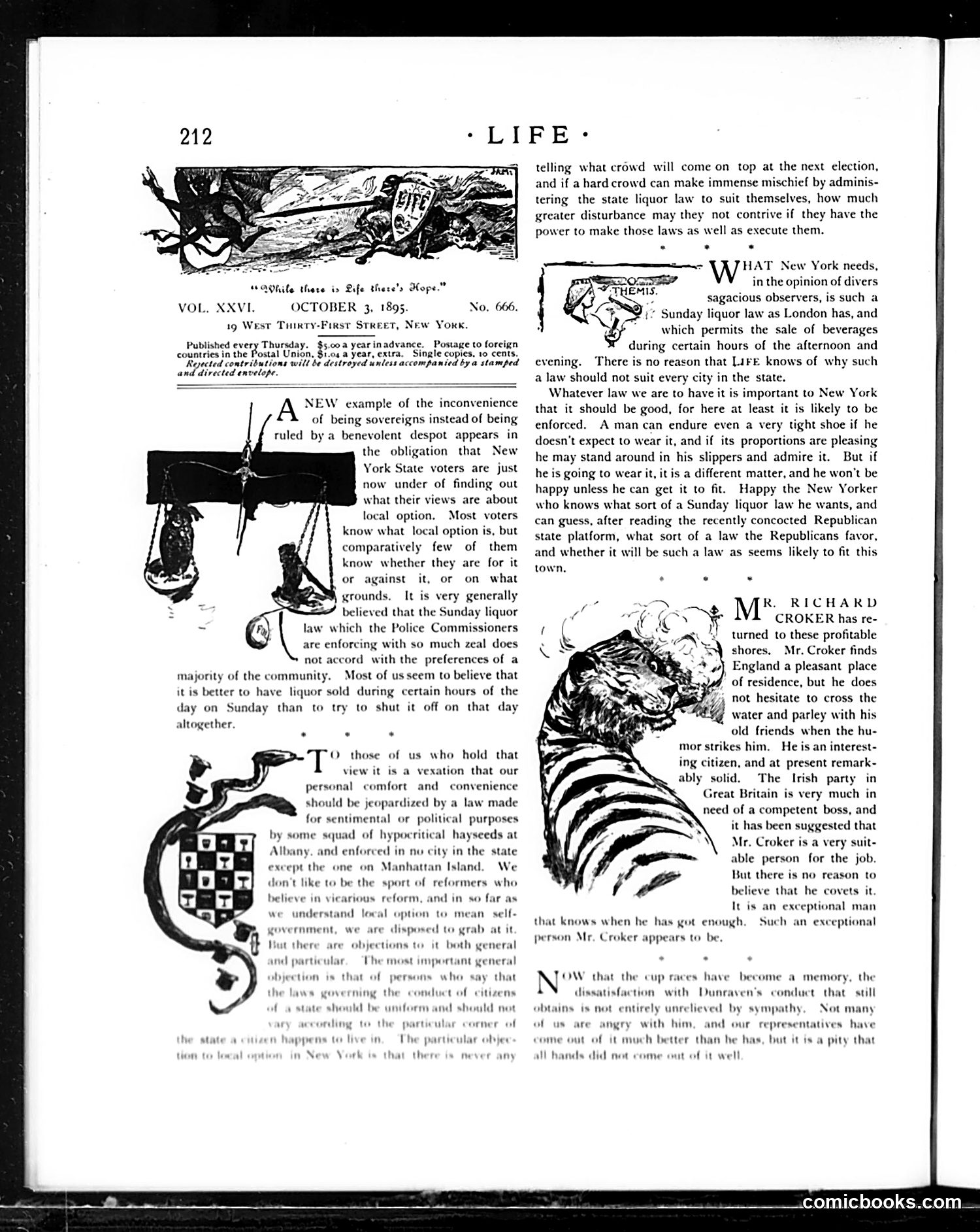
This page contains editorial commentary on New York state politics, particularly regarding Sunday liquor laws. The text debates whether New York should adopt a Sunday closing law for alcohol sales, similar to London's restrictions. The main satirical point concerns the tension between personal liberty and government regulation. The author critiques voters' uncertainty about local political positions and the disconnect between what politicians claim to support and what laws they actually pass. A secondary commentary discusses Richard Croker, the notorious Tammany Hall political boss, who has returned from England. The text suggests Croker may become involved in Irish politics, with some irony about his suitability for leadership despite his questionable character. The cartoons appear to illustrate the absurdity of conflicting laws and political hypocrisy, though specific figure identification is unclear from the image alone.
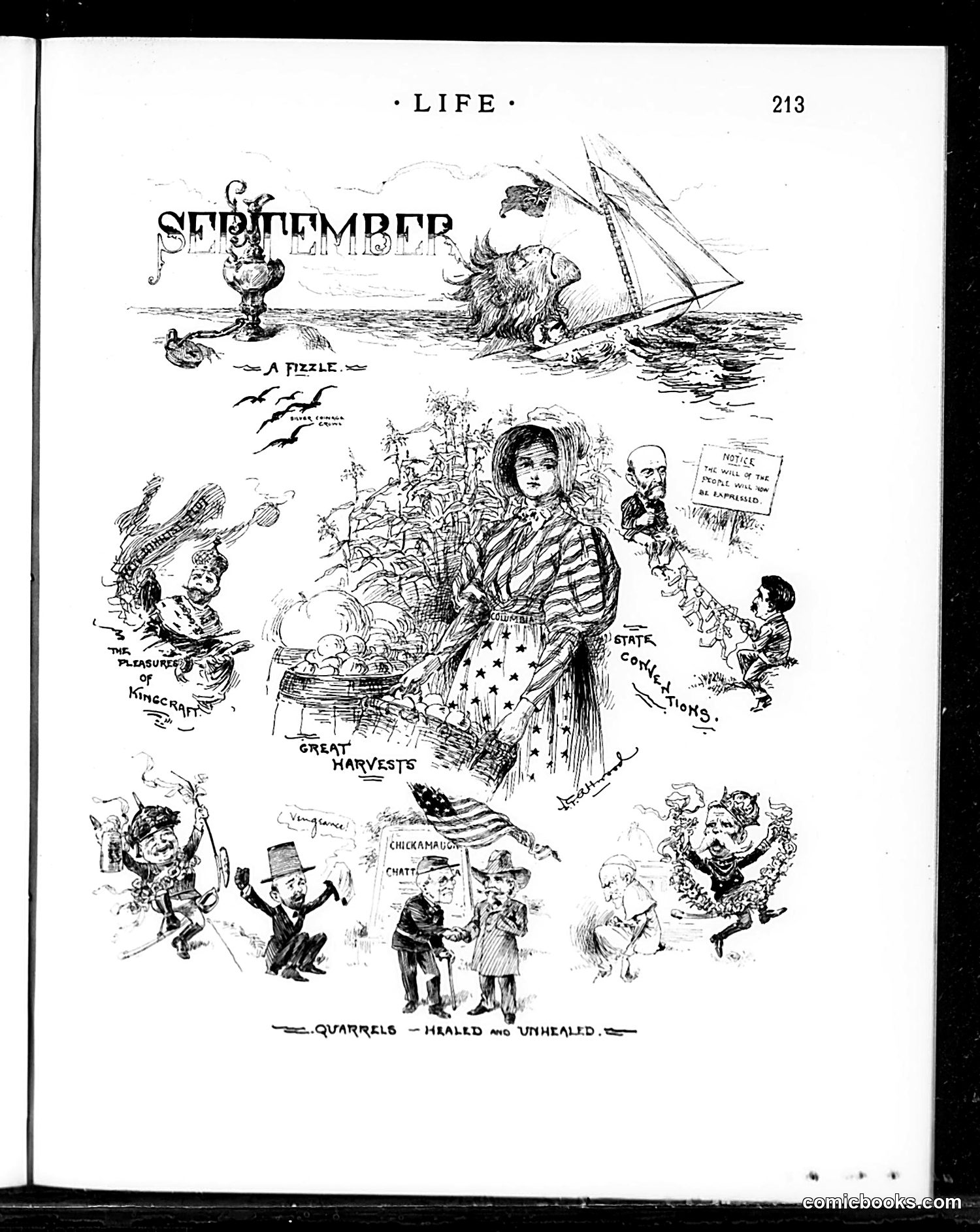
This page presents September-themed political cartoons. The central figure is Lady Columbia (personification of America), surrounded by vignettes labeled "Great Harvests," "Reconciliations," and other topics. The top shows "A Puzzle" featuring what appears to be a bearded figure (possibly representing a political or historical personage) with a sailing vessel. The bottom section titled "Quarrels—Healed and Unhealed" depicts various political disputes, including references to "Chickamauga" and "Chatt[anooga]"—likely Civil War battlefields—suggesting reconciliation efforts between North and South. The overall composition frames September as a month of national harvest, healing from conflicts, and resolving quarrels, though some disputes remain unresolved. The specific identities of some figures remain unclear without additional historical context.
I can see this is a page from Life magazine with decorative ornamental borders visible on the right edge, but the main content area is almost entirely black or blank. The OCR text provided is empty, containing only the word "VOL" at the top and "comicbooks.com" at the bottom. Without legible cartoon imagery or accompanying text, I cannot identify specific figures, political references, or satirical content. This appears to be either a blank page, a scanning/image quality issue, or possibly a separator page from the publication. To provide accurate historical analysis, I would need a clearer image showing the actual cartoon or article content.
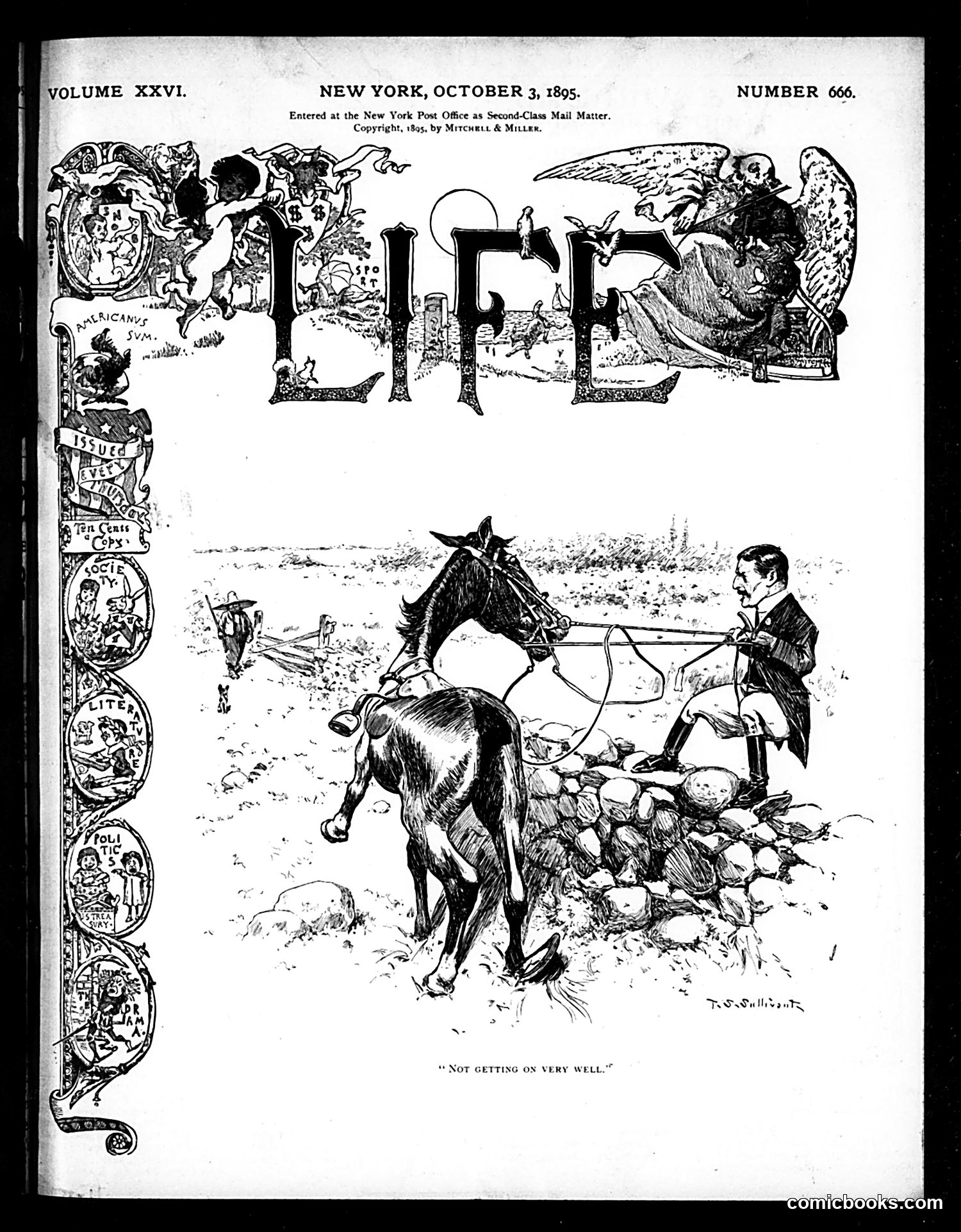
This is the cover of *Life* magazine from October 3, 1895. The main illustration, captioned "Not Getting On Very Well," depicts a man in formal attire struggling to control a horse that is rearing up and refusing to move forward, with a pile of rocks blocking its path. The image appears to be political satire, though without additional context about 1895 events, the specific figures or situation being referenced remain unclear. The struggling horseman likely represents a political figure or policy facing obstruction, with the horse's resistance symbolizing public opposition or practical difficulties. The rocks appear to represent literal or metaphorical obstacles preventing progress. The decorative border contains various illustrated vignettes typical of *Life*'s aesthetic from this period.
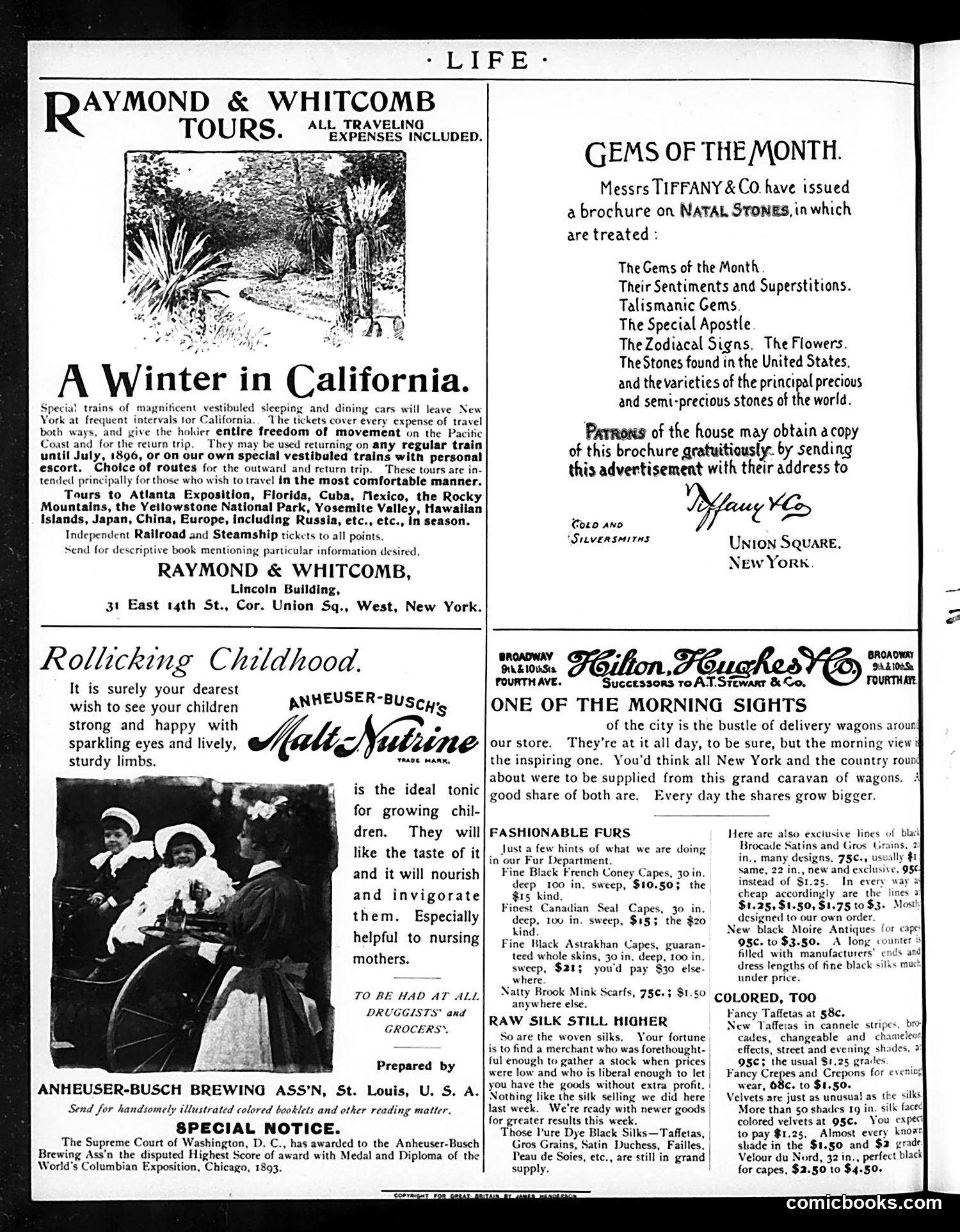
This page is primarily **advertising**, not satire or political commentary. It contains: 1. **Raymond & Whitcomb Tours** — promoting luxury winter travel to California with vestibulted trains, offering trips to natural attractions (Yellowstone, Yosemite, Hawaiian Islands, etc.) 2. **Anheuser-Busch's Malt-Nutrine** — a tonic advertised for children's health, featuring a photograph of children in a carriage. The ad emphasizes it's beneficial for "growing children" and "nursing mothers." 3. **Hilton Hawke & Co.** — a furrier advertising fashionable furs and silk fabrics with detailed product descriptions and pricing. 4. **Gems of the Month** — Tiffany & Co. promoting a brochure on natal stones. The page reflects late 19th/early 20th-century consumer culture targeting affluent readers, with no political satire evident.
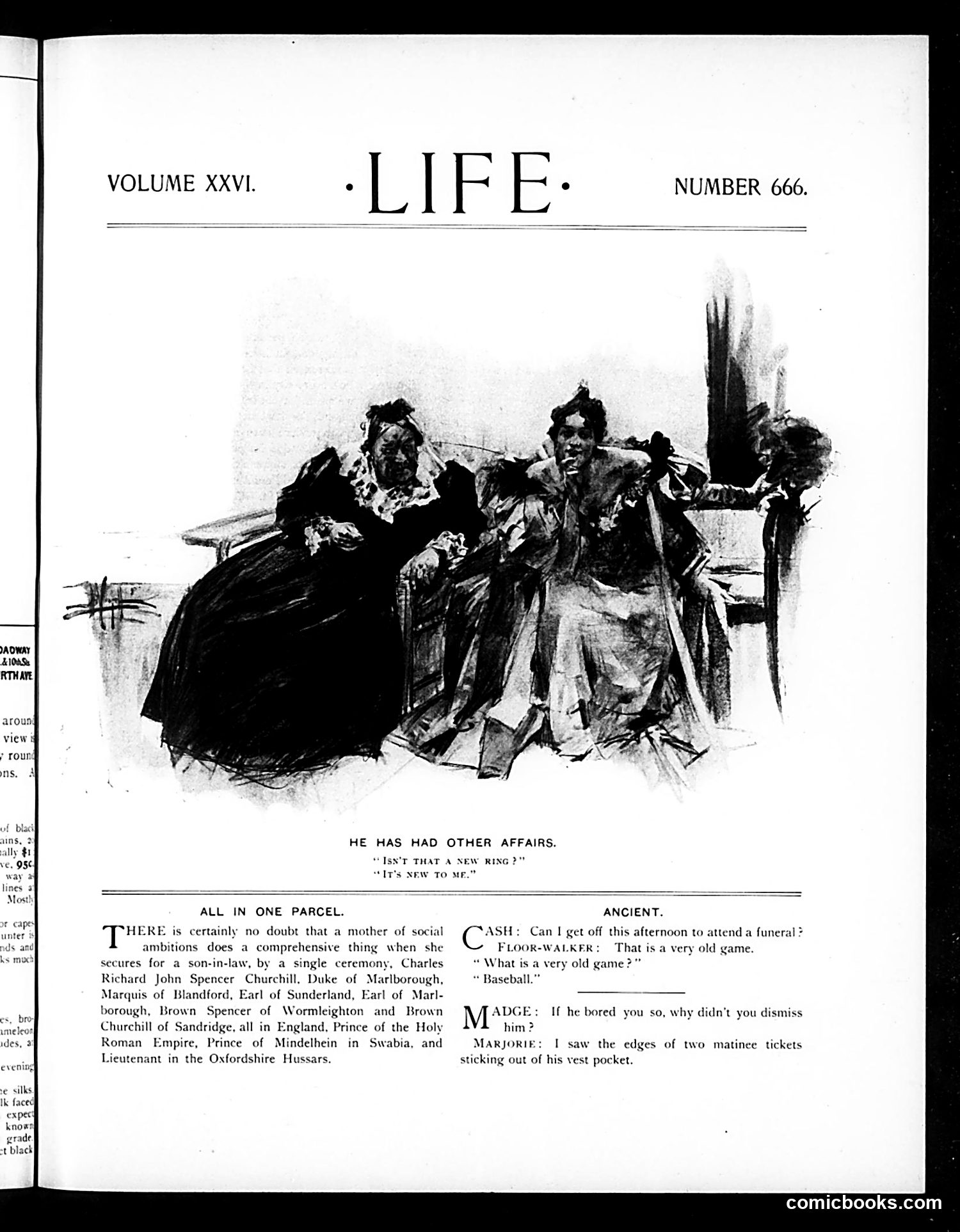
The main illustration depicts two women in conversation, captioned "HE HAS HAD OTHER AFFAIRS" with dialogue "ISN'T THAT A NEW RING?" / "IT'S NEW TO ME." This appears to be satirizing infidelity and gift-giving in relationships—the joke being that a man has given his mistress a ring, which she claims is "new to her," implying either the ring is secondhand or the affair itself is new, while suggesting the man's pattern of affairs. Below are two brief comic exchanges: **"ALL IN ONE PARCEL"** mentions a mother securing a son-in-law through a comprehensive ceremony, listing various historical English nobility and titles. **"ANCIENT"** is a dialogue about attending a funeral and watching a baseball game—likely mocking what constitutes entertainment or leisure priorities.
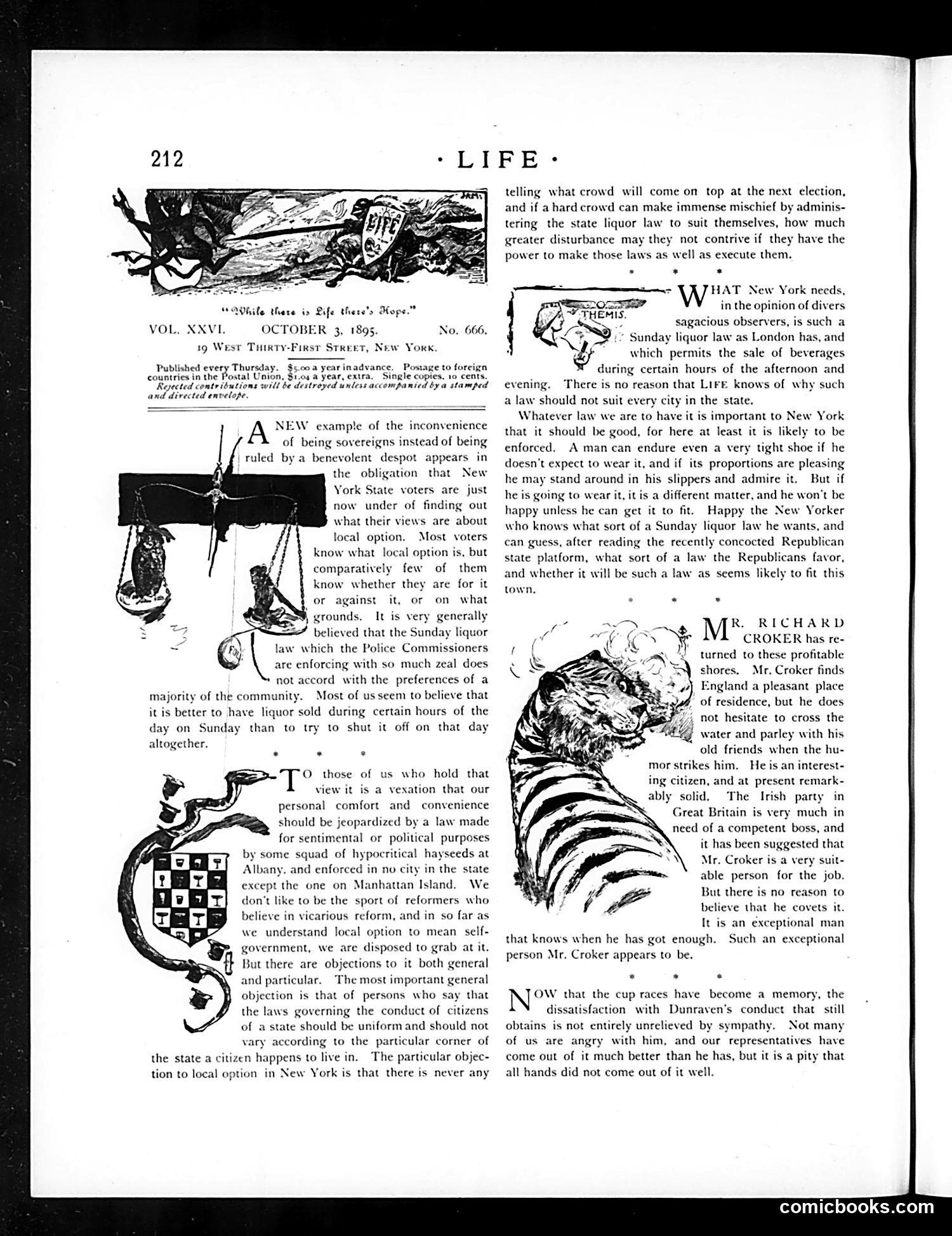
This page discusses New York State's Sunday liquor laws through political commentary and illustrations. The main cartoon depicts a scale of justice, satirizing the debate over whether liquor sales should be permitted on Sundays during specific afternoon hours. The text argues that New York needs a Sunday liquor law similar to London's—practical and enforceable rather than attempting total prohibition, which the author suggests is unrealistic. The piece criticizes both reformers pushing strict temperance and politicians who ignore local opinion. A second item discusses Mr. Richard Croker, an Irish political figure in Great Britain, praising him as a capable leader while noting his controversial status. The final paragraph mentions horse racing ("cup races") and criticism of someone named Dunraven's conduct. The satire targets inconsistent liquor regulation and hypocritical reform movements.
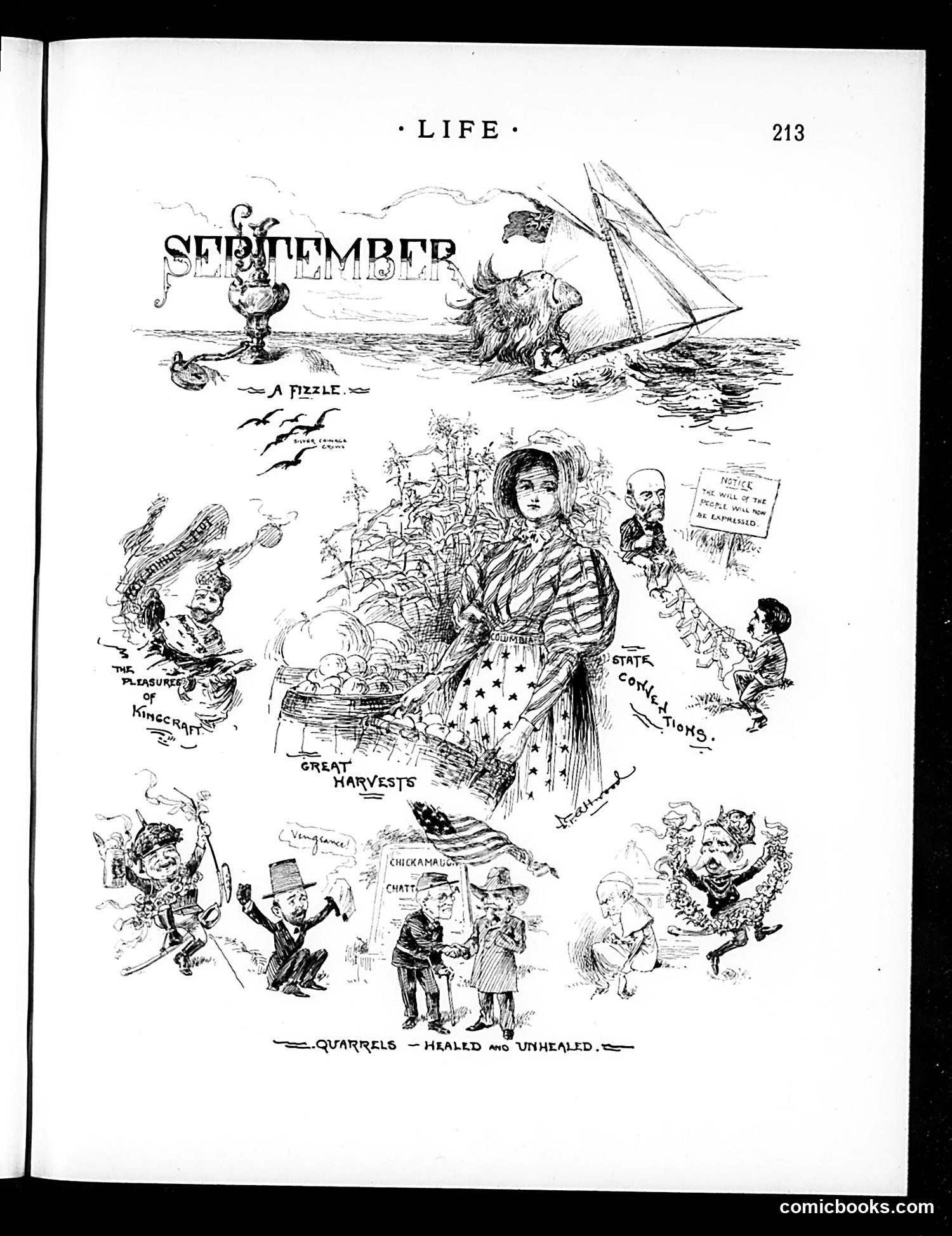
This is a **September-themed political cartoon** titled "A Puzzle" with the subtitle "Quarrels—Healed and Unhealed." The central figure is a woman (likely representing America or a state) surrounded by various symbolic elements and caricatured figures. The imagery includes references to: - **"Great Harvests"** and agricultural abundance - **"State Complications"** and political disputes - Small figures appearing to quarrel or negotiate - Maritime symbols (sailboat, sea creatures) suggesting commerce - Various labeled disputes or controversies being addressed or ignored The cartoon satirizes how America manages internal political conflicts—some apparently resolved ("healed") while others remain unresolved ("unhealed"). The specific political disputes referenced are unclear without additional historical context, but the overall message concerns managing national discord amid prosperity.
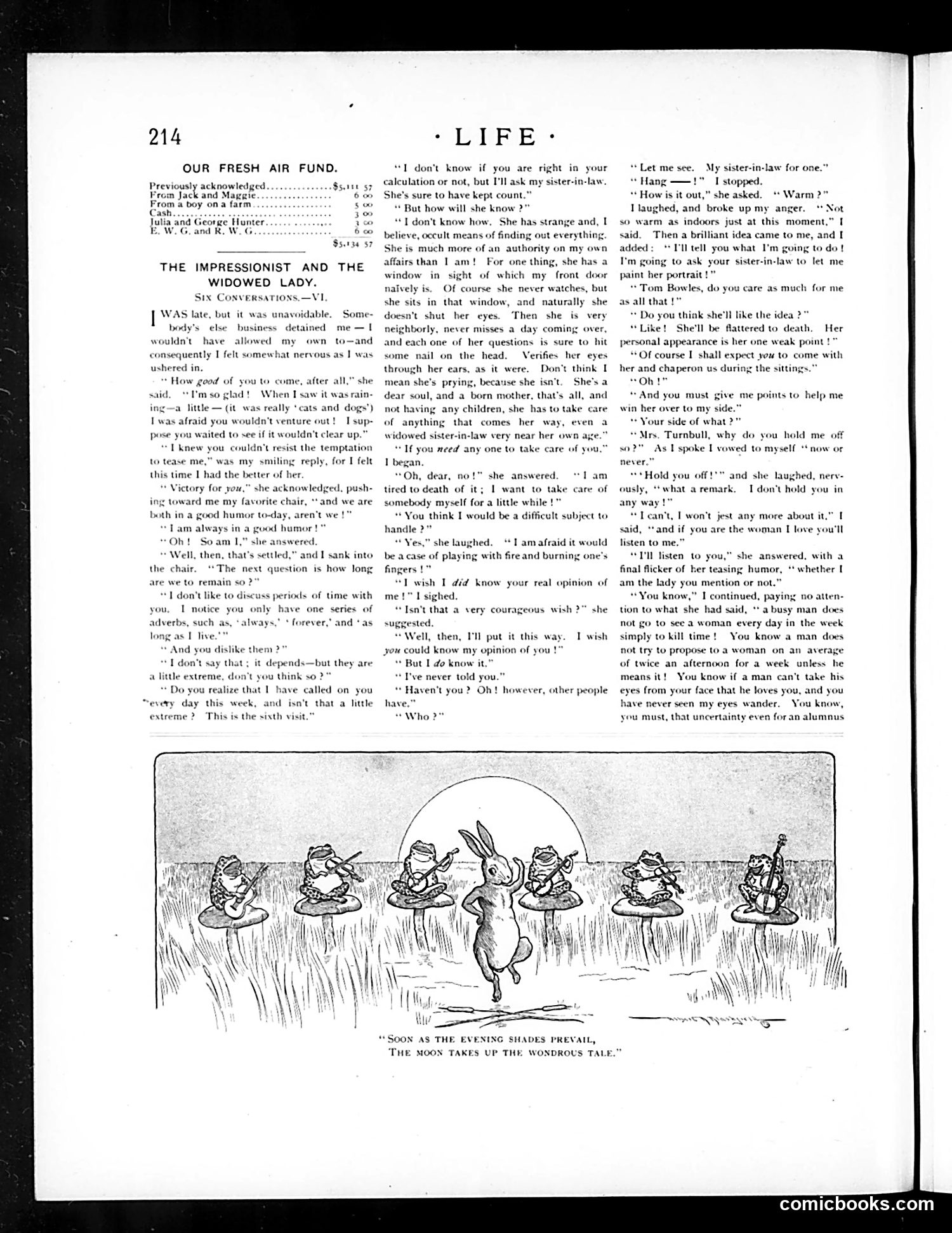
This page contains two distinct elements: **Upper Section:** "Our Fresh Air Fund" lists small monetary donations ($6-$5.034.57 total) to a charitable cause—likely a turn-of-century program providing outdoor recreation for poor urban children. **Main Content:** "The Impressionist and the Widowed Lady" is a serialized romantic comedy dialogue (installment VI). A male caller (Tom Bowles) visits a witty widow repeatedly. Their banter centers on her intrusive sister-in-law who monitors the widow's social life from a window overlooking her door—suggesting potential impropriety in unmarried visits. When Tom proposes painting the widow's portrait, he's essentially suggesting a courtship, which delights her (her "one weak point" being vanity). The widow agrees on condition her sister-in-law chaperone—protecting both their reputations. **The cartoon below** depicts anthropomorphic rabbits and a hare dancing at moonrise, illustrating the romantic/whimsical tone. The satire gently mocks Victorian social conventions restricting women's independence and requiring chaperones.
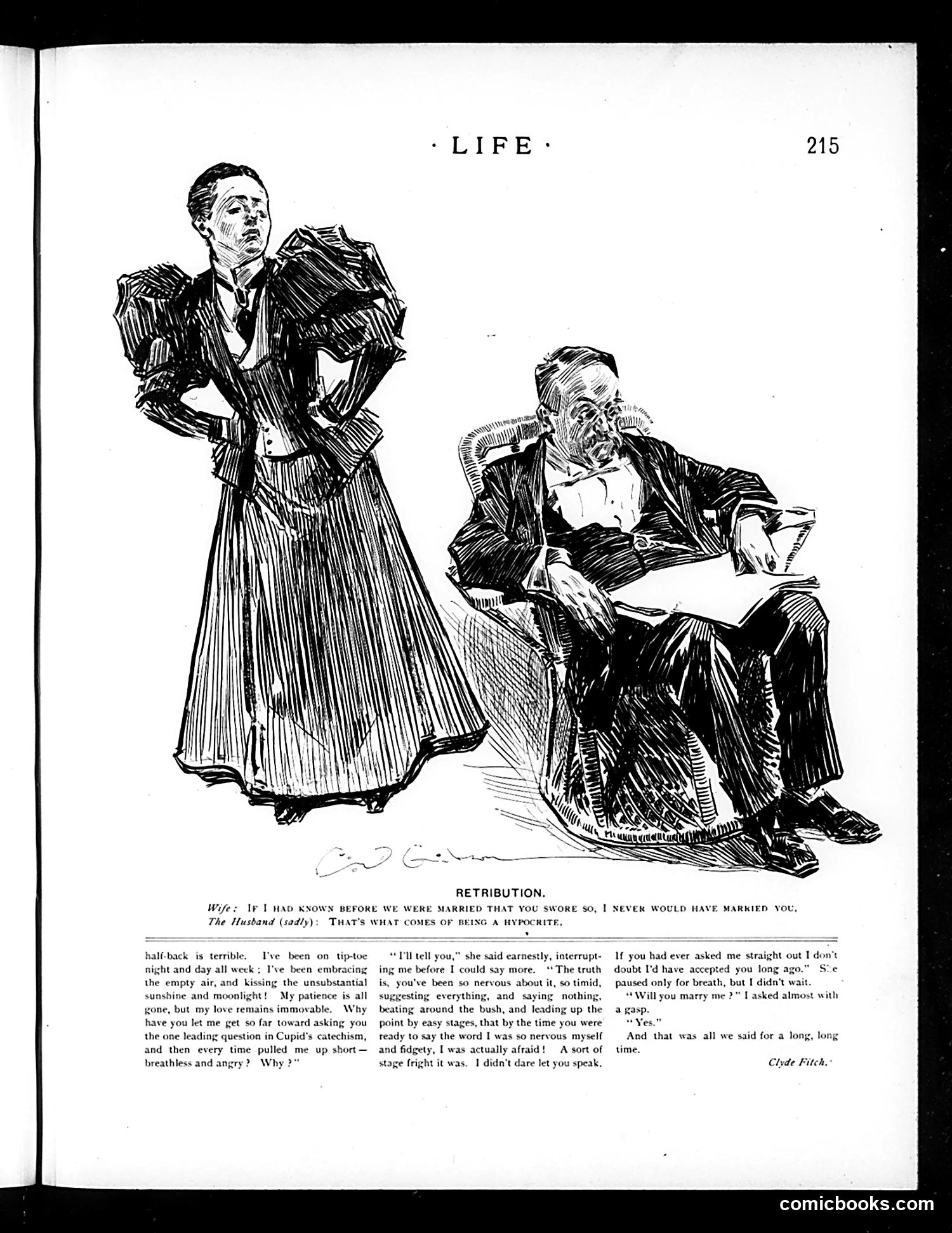
This is a satirical humor piece about marital hypocrisy and courtship anxieties. A husband reproaches his wife, claiming he never would have married her had he known she swore (used profanity) before their wedding. She responds that *he's* the real hypocrite—and explains why. The joke's twist: The wife reveals the husband was so nervously indirect in proposing (hinting, beating around the bush) that *she* got nervous and kept cutting him off, fearing she'd lose her nerve. Only when he finally asked directly did she accept. His accusation about her swearing becomes absurd when confronted with his own cowardly, roundabout approach to proposing. The "retribution" is that his indirectness caused the very hesitation he's now blaming on her character flaws. It's a gender-dynamics piece mocking both nervous suitors and the pretense of moral superiority in marriage. By Clyde Fitch, a known American playwright of the era.
I can see this is a black and white image from *Life* magazine with "LIFE" printed vertically on the left margin. However, the image quality and contrast make it difficult to discern specific details clearly. The photograph appears to show figures in what looks like a dramatic or theatrical scene with strong shadows and contrast, possibly depicting a political or social commentary typical of *Life*'s satirical content. Without being able to read any accompanying text or identify specific individuals with confidence, I cannot accurately explain the cartoon's meaning, political references, or satirical intent to a modern reader. The image's quality and orientation would require clearer reproduction or additional context to provide the detailed historical analysis you've requested.
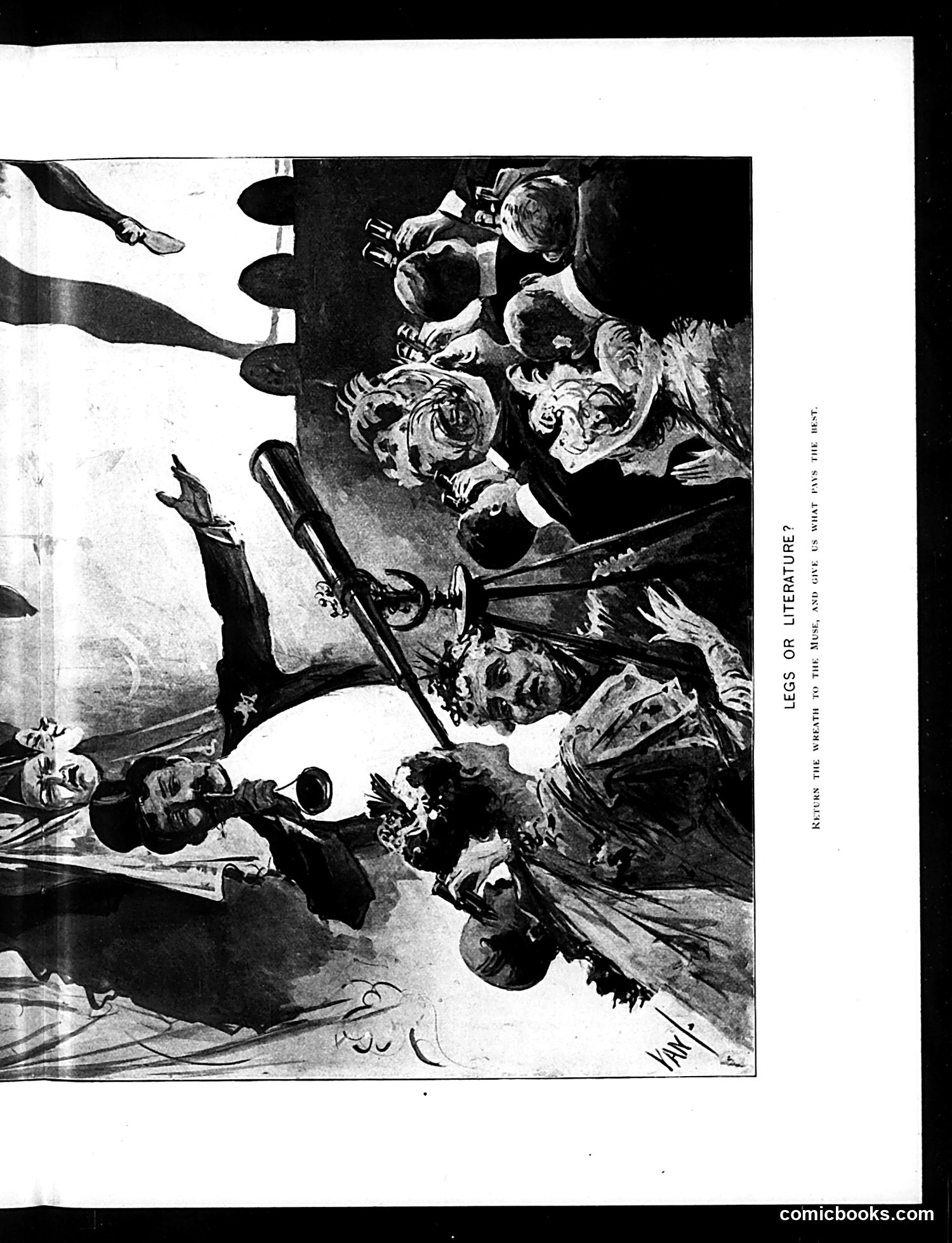
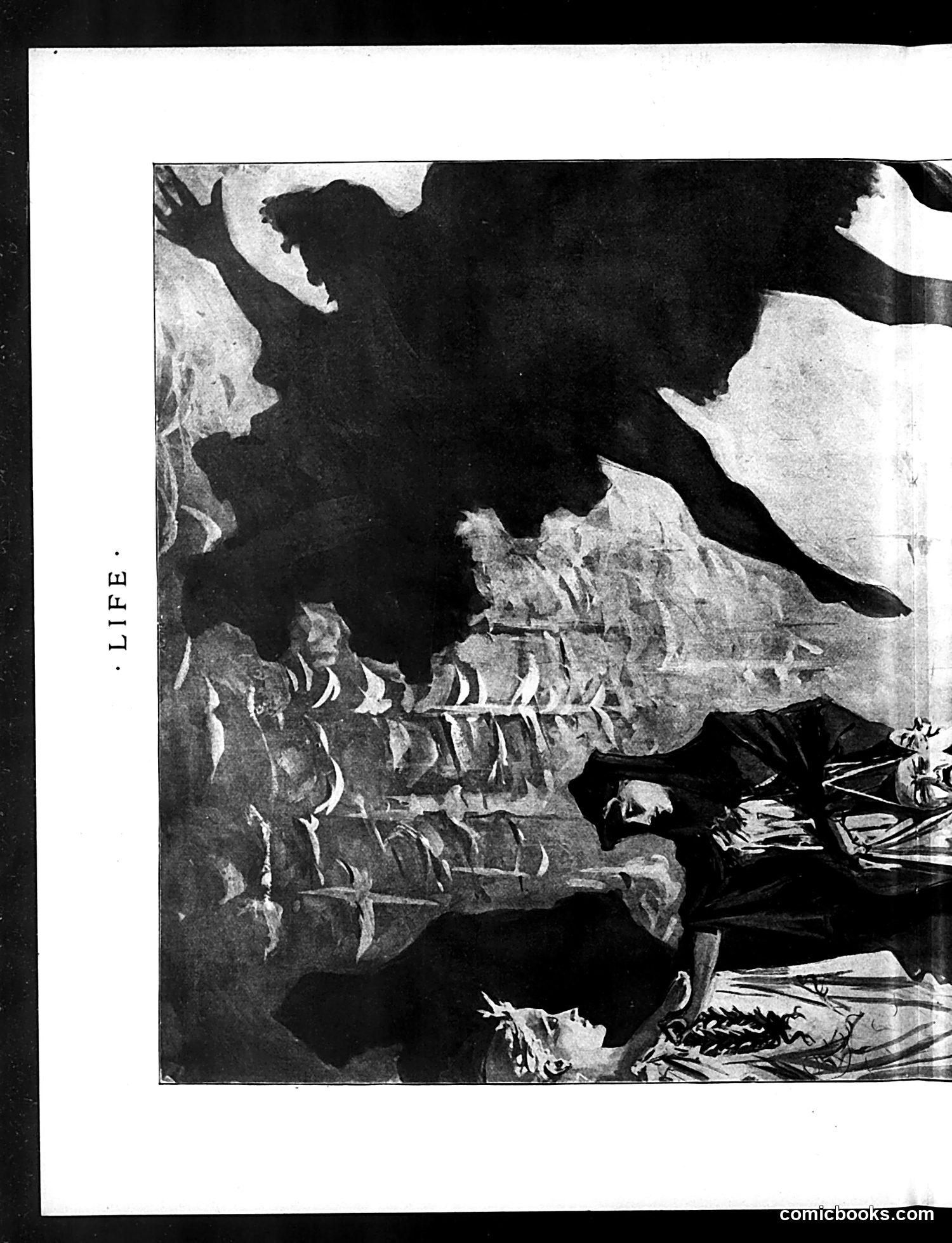
The OCR text is too corrupted to read clearly. However, the image shows a satirical illustration titled "LEGS OF LITERATURE" (visible on the right margin). The cartoon depicts several figures in period dress examining or gesturing toward a prone figure's legs. The style and composition suggest this is social or literary satire, possibly mocking pretentious literary criticism or the objectification of women in literature/society. Without legible text explaining the specific context, I cannot confidently identify which literary figures or works are being satirized, or what particular 1920s-30s cultural moment prompted this cartoon. The artistic execution suggests it's commentary on literary criticism or taste, but the exact target remains unclear.
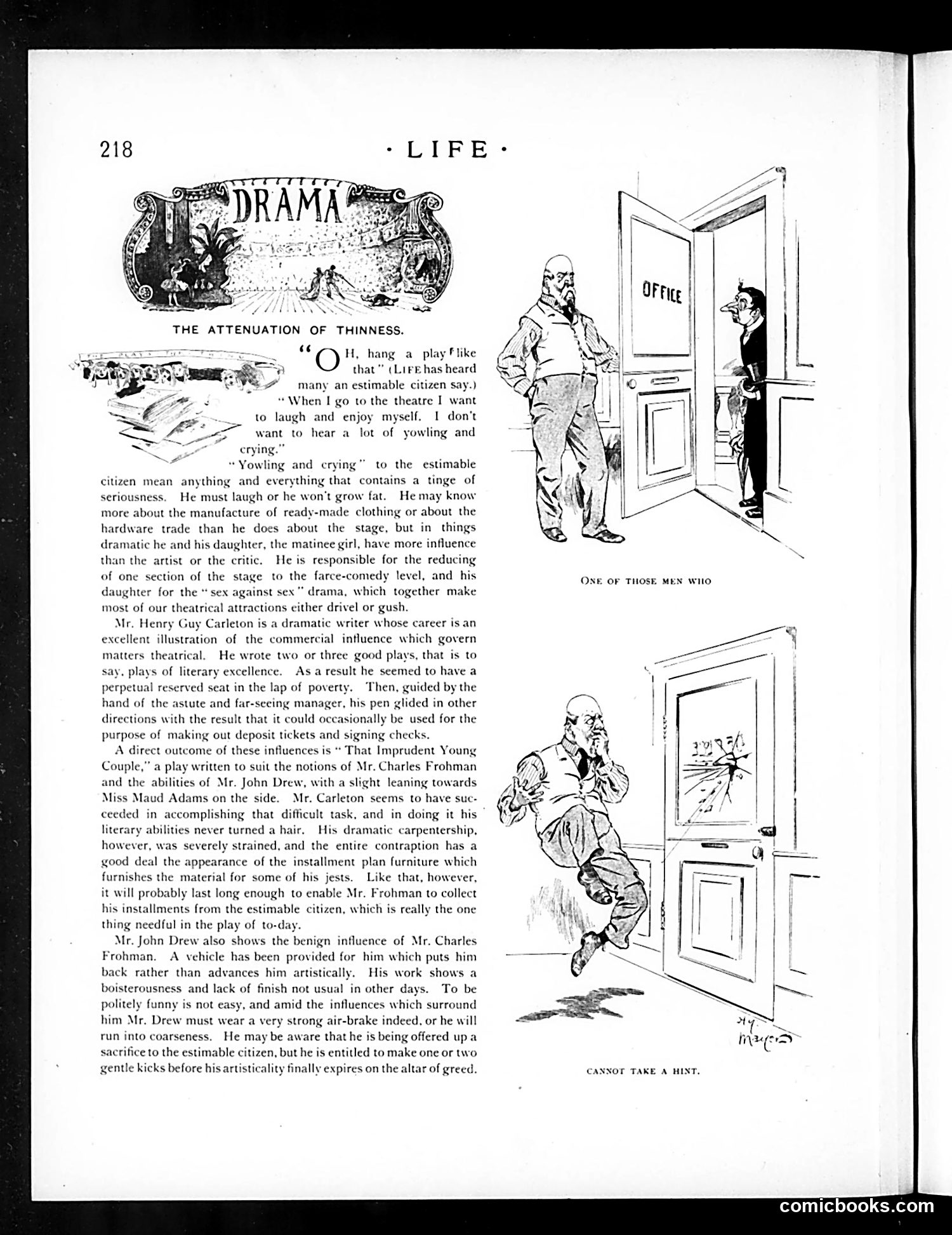
This page critiques commercial theater's degradation by mass-market taste. The title refers to how serious drama is being diluted ("attenuated"). The article attacks the "estimable citizen"—the average theatergoer who demands only light farce and refuses "yowling and crying" (serious emotion). This audience member and his daughter, the "matinee girl," exert disproportionate influence, forcing playwrights toward mindless entertainment. The essay uses Henry Guy Carleton as a case study: a talented dramatist forced by producer Charles Frohman to abandon literary excellence for commercial drivel like "That Imprudent Young Couple." Actor John Drew suffers similarly—given roles requiring "boisterousness" rather than his true talent for "polite" comedy. The two cartoons illustrate the message: office scenes showing men "who cannot take a hint"—visual metaphors for artists compromised by commercial pressure, unable to resist the market's coarse demands. The satire mourns theater's descent into profitable mediocrity.
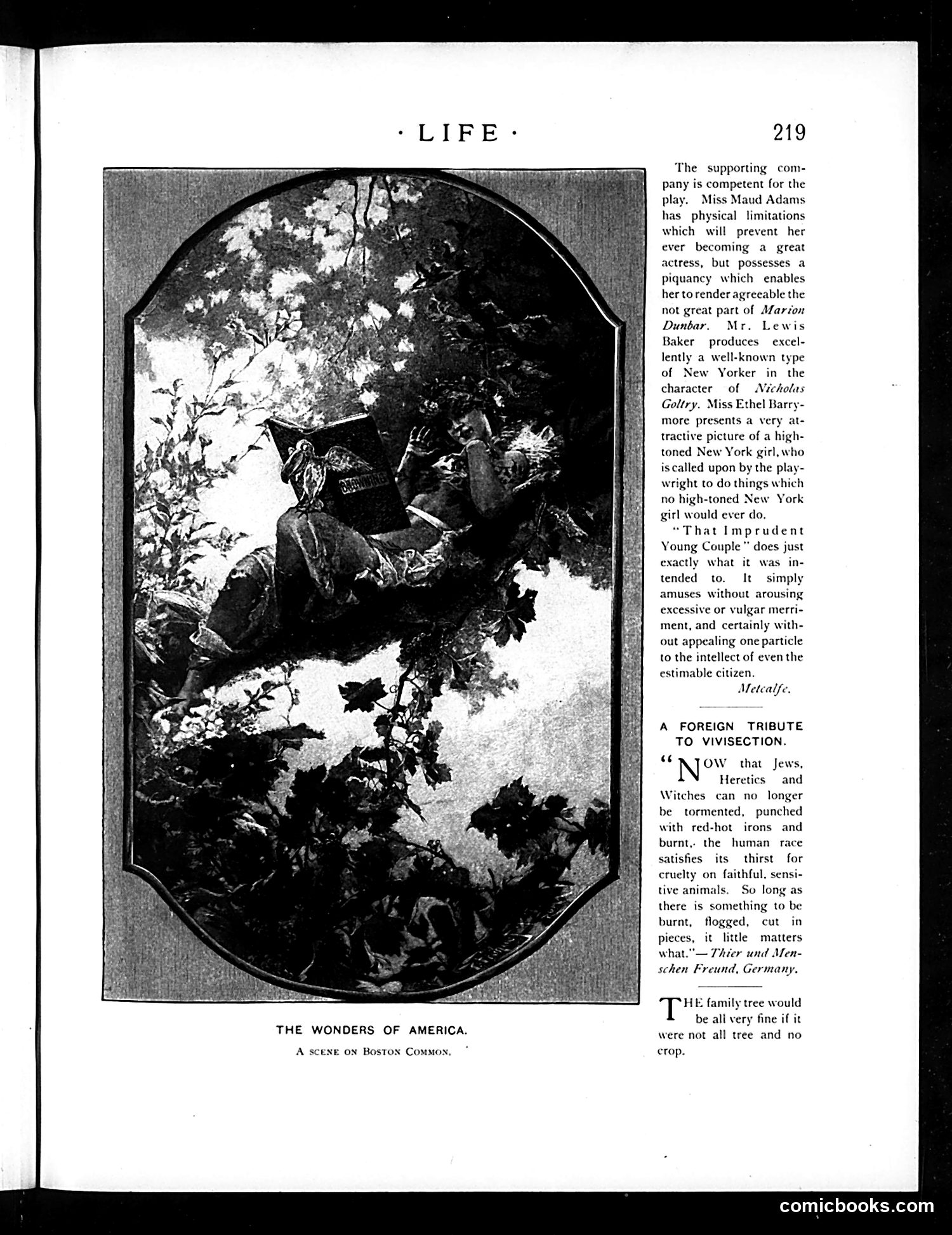
This page contains **theater criticism** and **satirical commentary**, not political cartoons. The left image, titled "The Wonders of America: A Scene on Boston Common," appears to be an illustration accompanying the "Foreign Tribute to Vivisection" section—a biting critique of animal cruelty. The German quote suggests that since persecuting Jews, heretics, and witches is no longer socially acceptable, society has redirected its cruelty toward animals through vivisection (live animal experimentation). The satire implies Western civilization claims moral progress while merely shifting its brutality to defenseless creatures. The theater review critiques "That Imprudent Young Couple," finding it amusing but intellectually hollow—entertainment for "estimable citizens" with no substance. The final quip about family trees being "all tree and no crop" is a pun mocking genealogy's popularity without practical value.
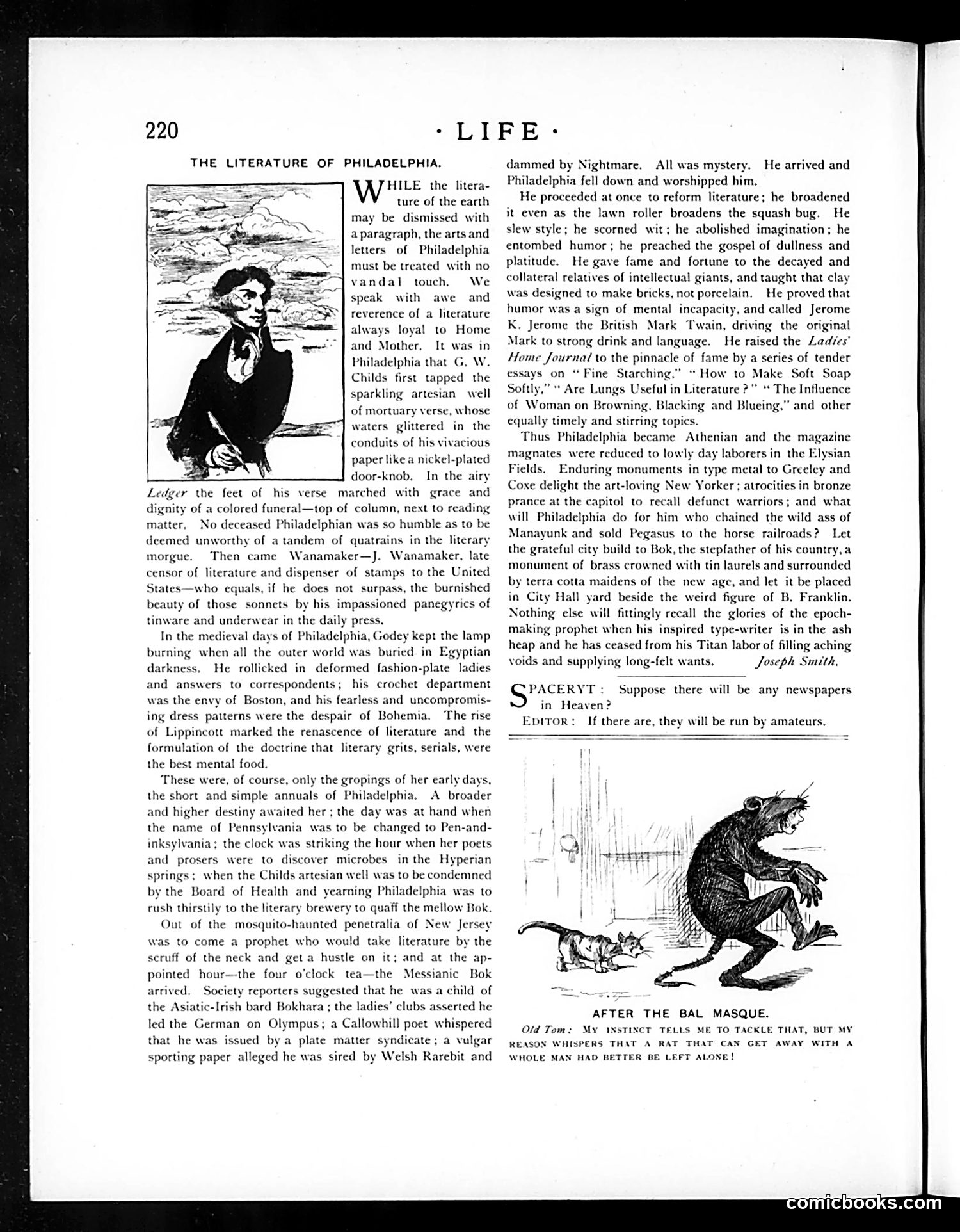
This article mocks Philadelphia's literary pretensions, particularly targeting **Edward Bok**, editor of *Ladies' Home Journal*. The text sarcastically traces Philadelphia's literary history from G.W. Childs (known for ornate funeral verses in his newspaper) through J. Wanamaker to Bok, who is portrayed as a mysterious, almost messianic figure arriving to "reform" literature. The satire's core joke: Bok supposedly "improved" *Ladies' Home Journal* by eliminating style, wit, imagination, and humor—replacing them with tedious domestic advice ("Fine Starching," "How to Make Soft Soap"). The author absurdly claims this dullness made the magazine wildly successful, reducing other magazine editors to "lowly day laborers." The cartoon below, "After the Bal Masque," appears unrelated—showing a figure confronting a rat, with Old Tom's quip about tackling rats. Its connection to the Bok satire is unclear from this page alone.
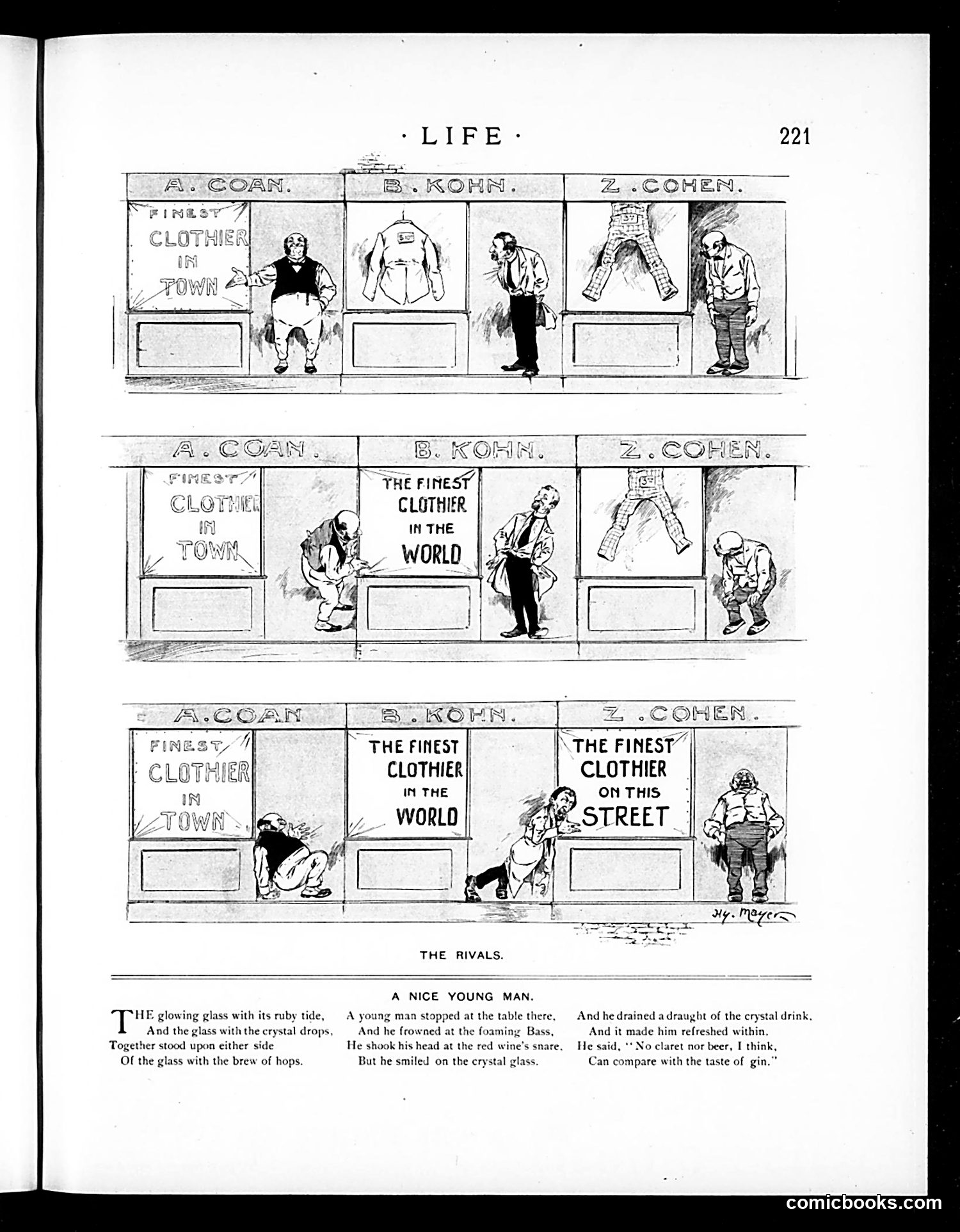
**"The Rivals"** is a three-panel comic strip satirizing competition between clothing merchants. Three clothiers—A. Coan, B. Kohn, and Z. Cohen—each claim superiority through increasingly grandiose storefront signs: "Finest Clothier in Town," then "in the World," then "on this Street." The humor escalates absurdly as each merchant's claim expands then contracts, mocking the exaggerated advertising and boastful competition common in retail. **"A Nice Young Man"** is a humorous poem about a man choosing gin over beer and wine. He rejects ale ("foaming Bass") and wine ("red wine's snare") but smiles approvingly at gin, declaring it superior to all other drinks. The satire appears to mock both excessive drinking culture and the smugly confident young man who fancies himself a connoisseur while indulging in alcohol. Both pieces use gentle humor to critique contemporary social behaviors—commercial vanity and drinking habits.
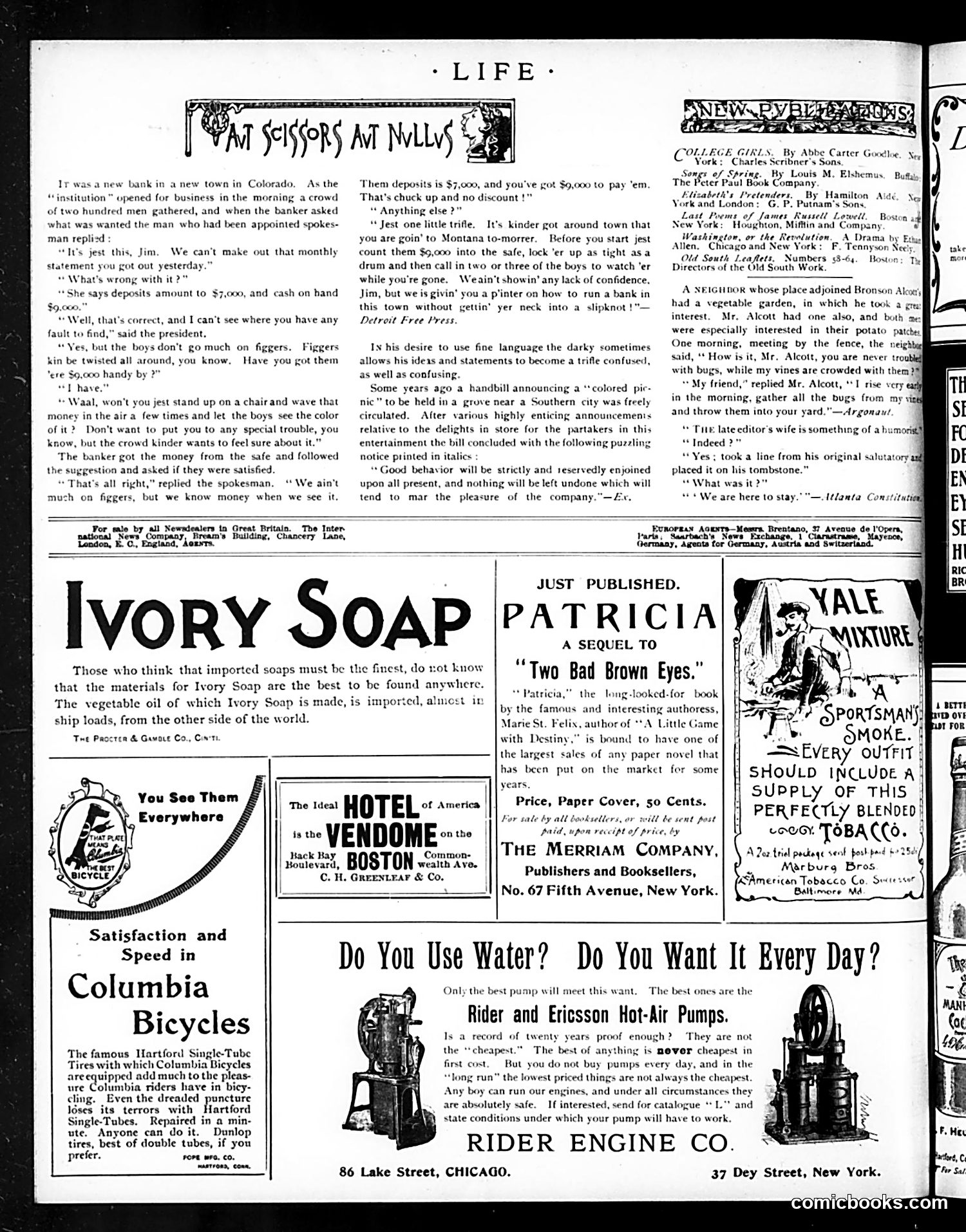
This page contains two distinct satirical pieces: **Main Cartoon ("Scissors at Nulls"):** The joke mocks frontier banking practices and financial illiteracy. Newly established Colorado bank depositors distrust written statements ("figgers can be twisted"), so they demand the banker physically display their cash to verify it exists. The punchline: they understand money visually but not numerically—the banker shows them $9,000 when deposits are only $7,000, yet they're satisfied because they "know money when we see it." The satire targets both naive settlers and suggests loose frontier banking standards where appearance matters more than actual accounting. **Secondary humor** includes period racial stereotypes about Black speakers ("the darky") misusing formal language, and a practical joke involving vegetable gardens. The remaining content is advertisements and book announcements typical of *Life* magazine's format—no political content.
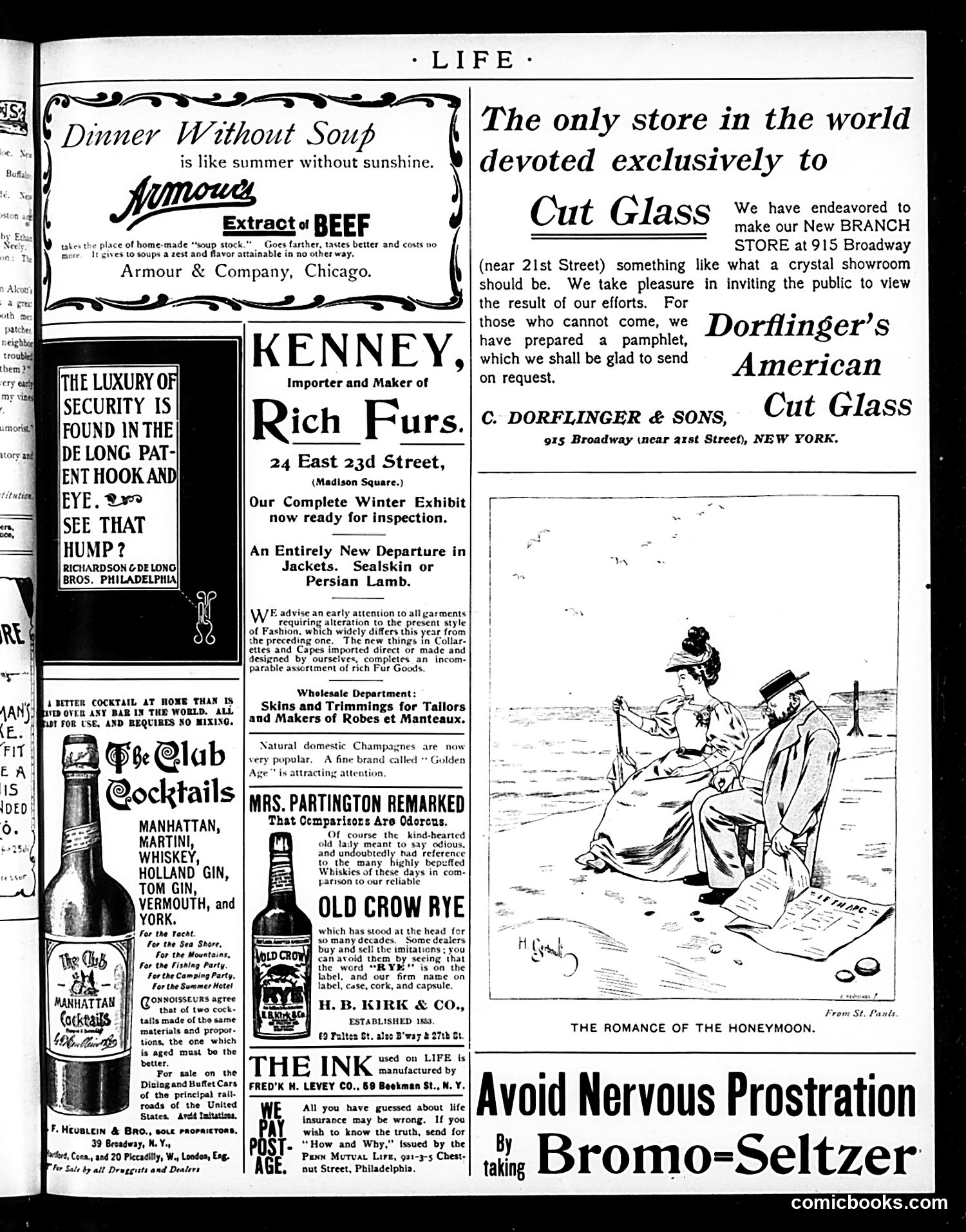
This is primarily an **advertising page** from an early Life magazine (likely early 1900s based on style). The content consists of product advertisements rather than editorial cartoons or satire. The one illustration—"The Romance of the Honeymoon"—depicts a couple on a beach, likely illustrating the leisurely pleasures advertised by various products on the page. The advertisements reflect period concerns and products: Armour's beef extract (soup base), fur coats, cocktail mixers, cut glass, and notably **Bromo-Seltzer** for "nervous prostration"—a catch-all Victorian diagnosis for anxiety and fatigue. The Old Crow Rye whiskey ad includes a Mrs. Partington reference, apparently a period personality known for malapropisms. Rather than satire, this page captures **early-20th-century consumer culture**: marketed solutions to modern life's stresses, luxury goods positioning, and the era's medical-commercial overlap. The Bromo-Seltzer ad is particularly revealing—it treats everyday nervousness as a medical condition requiring patent medicine, a common contemporary marketing practice.
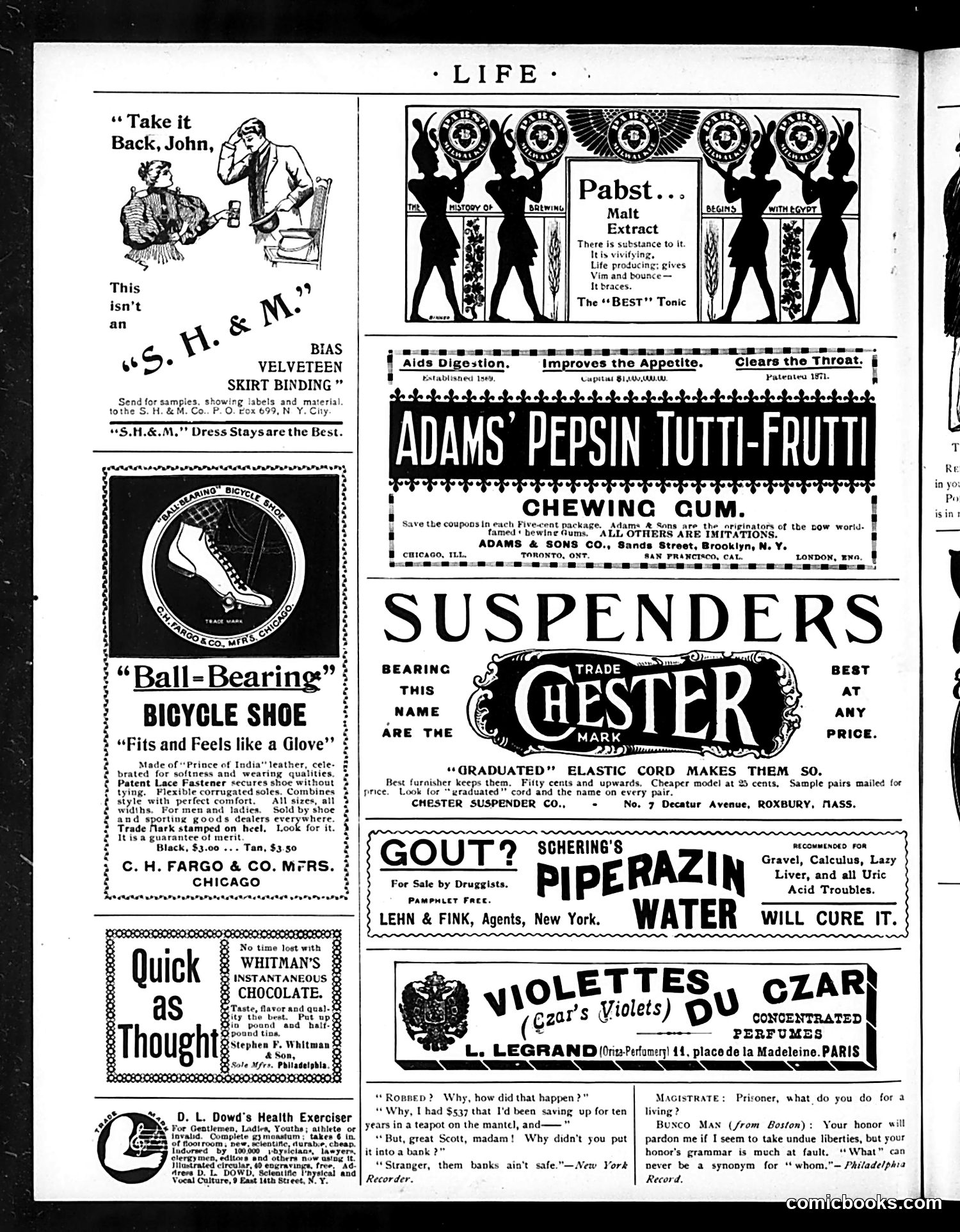
This page is primarily **advertising**, typical of early 20th-century American magazines. The bulk consists of product advertisements with minimal satirical content. The only clear cartoon appears at top left: a domestic scene captioned "Take it Back, John"—likely depicting a wife rejecting her husband's purchase or behavior, playing on the common "nagging wife" trope of the era. Below that are two brief joke-format pieces: one about a woman who kept savings in a teapot rather than a bank (mocking rural financial distrust), and another about a Boston man correcting a magistrate's grammar (poking fun at regional pretentiousness). The advertisements themselves reveal period concerns: digestive tonics (Pabst Malt Extract, Adams' Pepsin Tutti-Frutti), patent medicines for gout and "uric acid troubles," corsets, bicycle shoes, and suspenders. These ads suggest anxieties about digestion, health, and bodily comfort typical of the era. No identifiable political figures or major satirical commentary is present on this page.
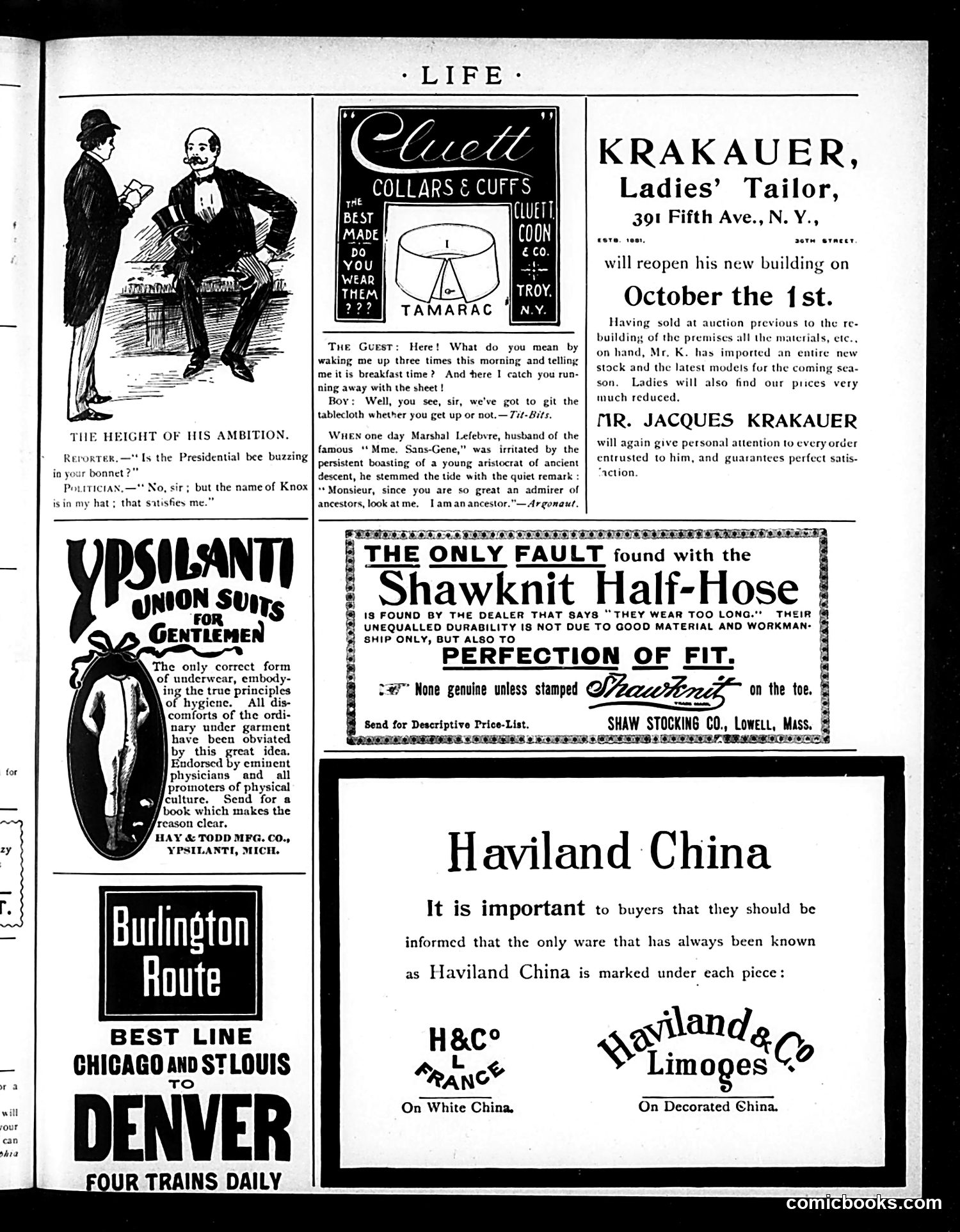
The page's main cartoon, "The Height of His Ambition," satirizes American political ambition circa 1910s. A reporter questions a politician about presidential aspirations, but the politician dismissively replies that merely having "Knox" in his hat satisfies him—a pun on Secretary of State Philander C. Knox. The joke mocks how politicians settle for minor accomplishments rather than pursue greater office, reducing ambition to wordplay. The page is otherwise dominated by **advertisements**: Cluett collars, Ursilanti union suits, Haviland China, and the Burlington Route railroad. These represent typical early-1900s consumer goods marketed to middle-class readers. A ladies' tailor announces a reopening, while humorous anecdotes fill space between ads—including a joke about a servant stealing tablecloths and a French marshal's witty retort about ancestry. The satirical content is minimal; this is primarily an advertising-heavy magazine page typical of *Life*'s era.
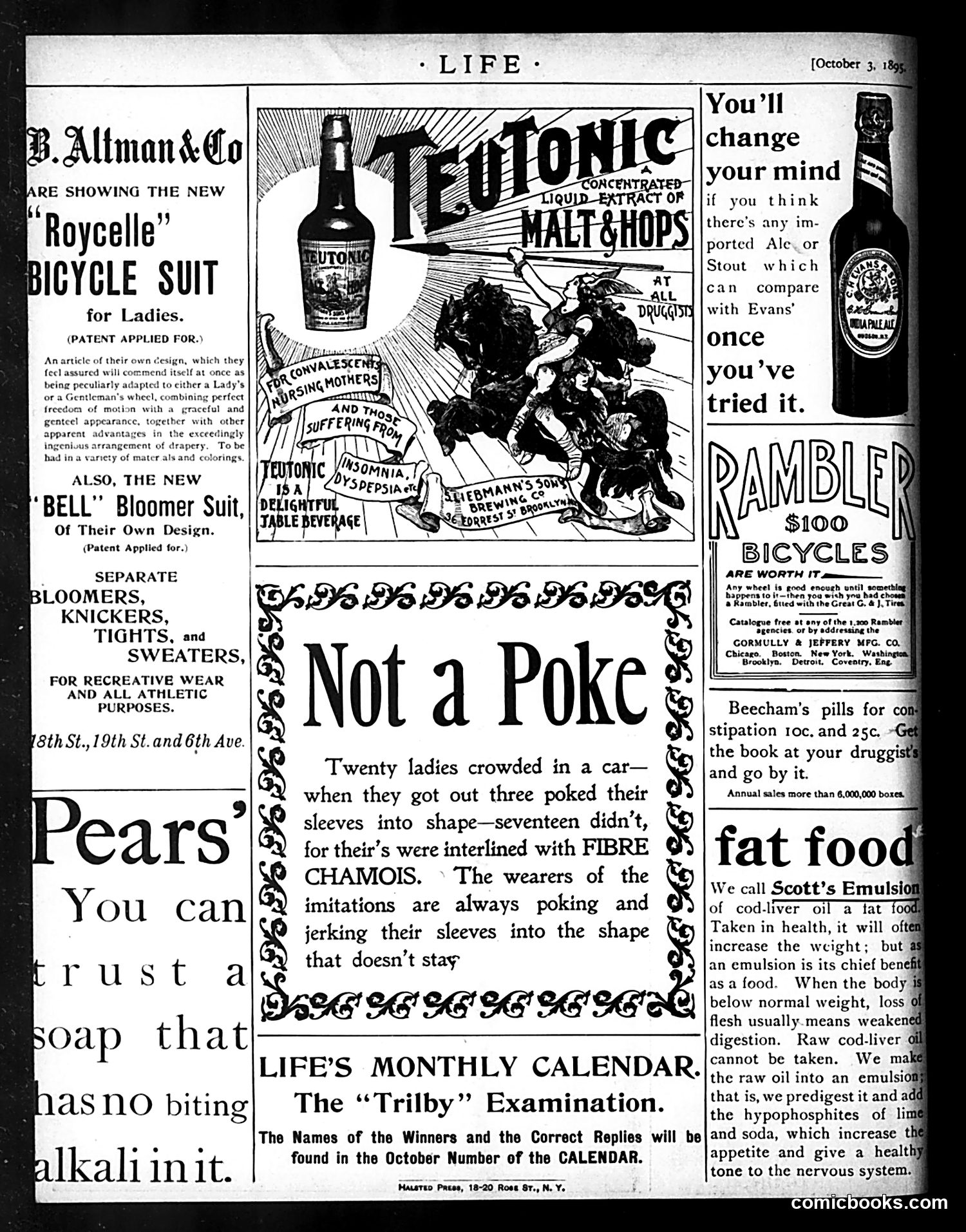
This page is primarily **advertisements and miscellaneous content** rather than political satire. The central cartoon, titled **"Not a Poke,"** is a humorous social commentary on women's fashion. It mocks the impracticality of sleeves lined with "fibre chamois"—a material that doesn't hold its shape. The joke: twenty ladies exited a carriage; three poked their sleeves back into form, but seventeen couldn't because their sleeves were lined with this inferior material. The cartoon satirizes both the absurdity of the fashion itself and the false advertizing claims of imitation products. The surrounding ads promote contemporary products: women's bicycle suits (reflecting the "New Woman" era), Teutonic malt and hops extract, Rambler bicycles, Pears' soap, Beecham's pills, and Scott's Emulsion cod-liver oil. The "Trilby Examination" references a popular 1895 novel, offering a contest with answers to appear in Life's calendar issue.
I can see this is a page from Life magazine, but the image is almost entirely black with only a thin strip of text visible along the left margin. The OCR text is minimal and uninformative ("comicbooks.com" appears to be a watermark). From the faint left-margin text, I can make out partial phrases mentioning "Food," discussion of "oil," and references to "vision" and "benefit," but the content is too fragmentary to identify specific figures, cartoons, or satirical points with confidence. To properly analyze the political or social satire on this page, I would need a clearer, more legible image showing the actual cartoon(s) or editorial content.
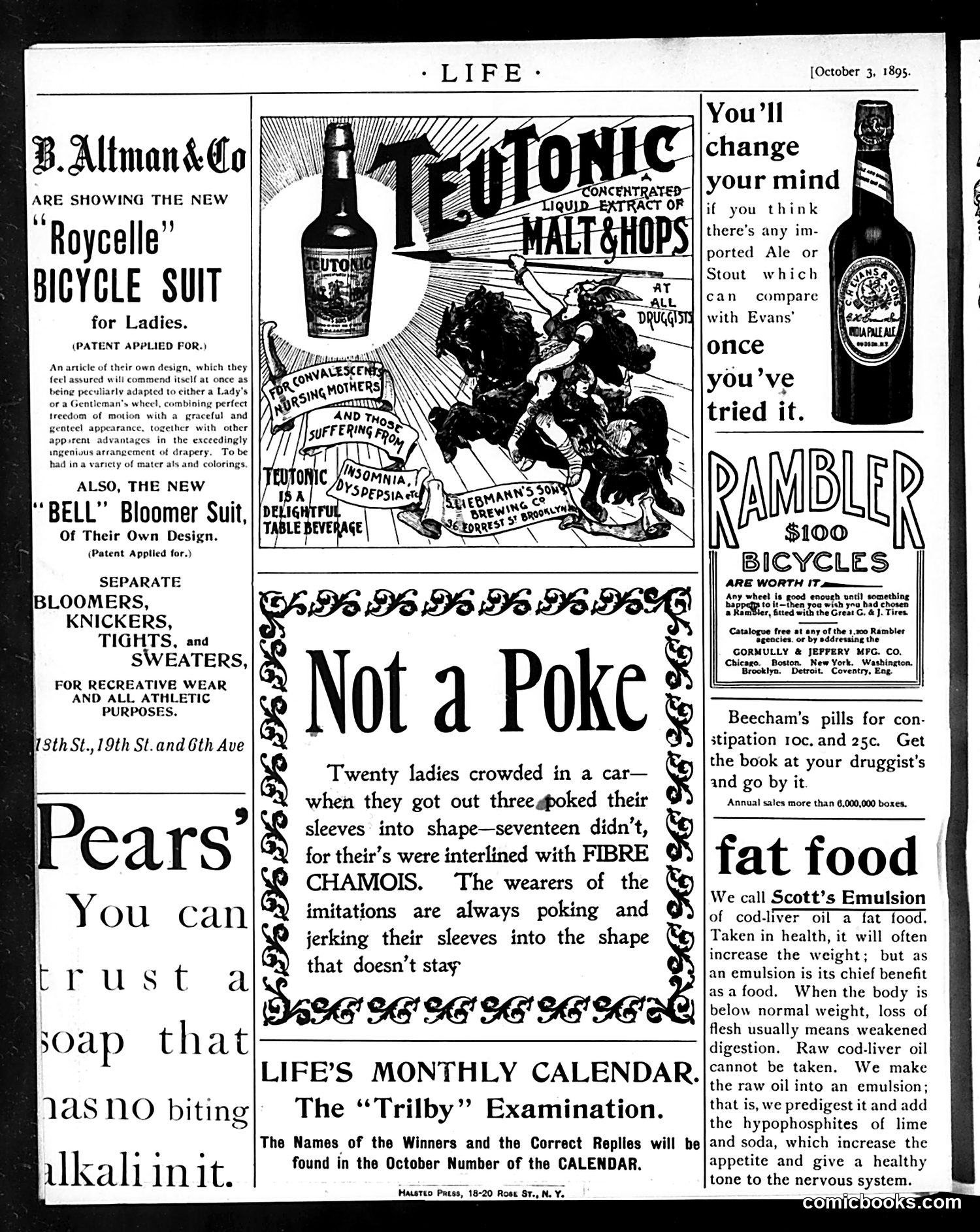
This cartoon satirizes the new "bloomer suit" craze for women—athletic wear featuring loose pants instead of restrictive skirts. The joke targets imitation bloomers made with "fibre chamois" (a cheap fabric substitute). The satire: Twenty ladies crowded into a carriage found their cheap imitation bloomers wouldn't hold their shape. Because the fabric wasn't properly constructed, the wearers constantly had to poke and jerk their sleeves to keep them from collapsing—defeating the purpose of practical athletic wear. The punchline is the title: despite bloomers' supposed freedom of movement, wearers of poor-quality imitations were perpetually "poking" at their clothing to maintain appearances, making them no more practical than traditional restrictive garments. The surrounding advertisements (for B. Altman & Co.'s quality bloomer suits and bicycles) underscore the satire: proper bloomers were fashionable for the new bicycle-riding woman, but cheap knockoffs were worthless.