
Life, 1895-10-03 · page 10 of 26
Life — October 3, 1895 — page 10: what you’re looking at
What you’re looking at
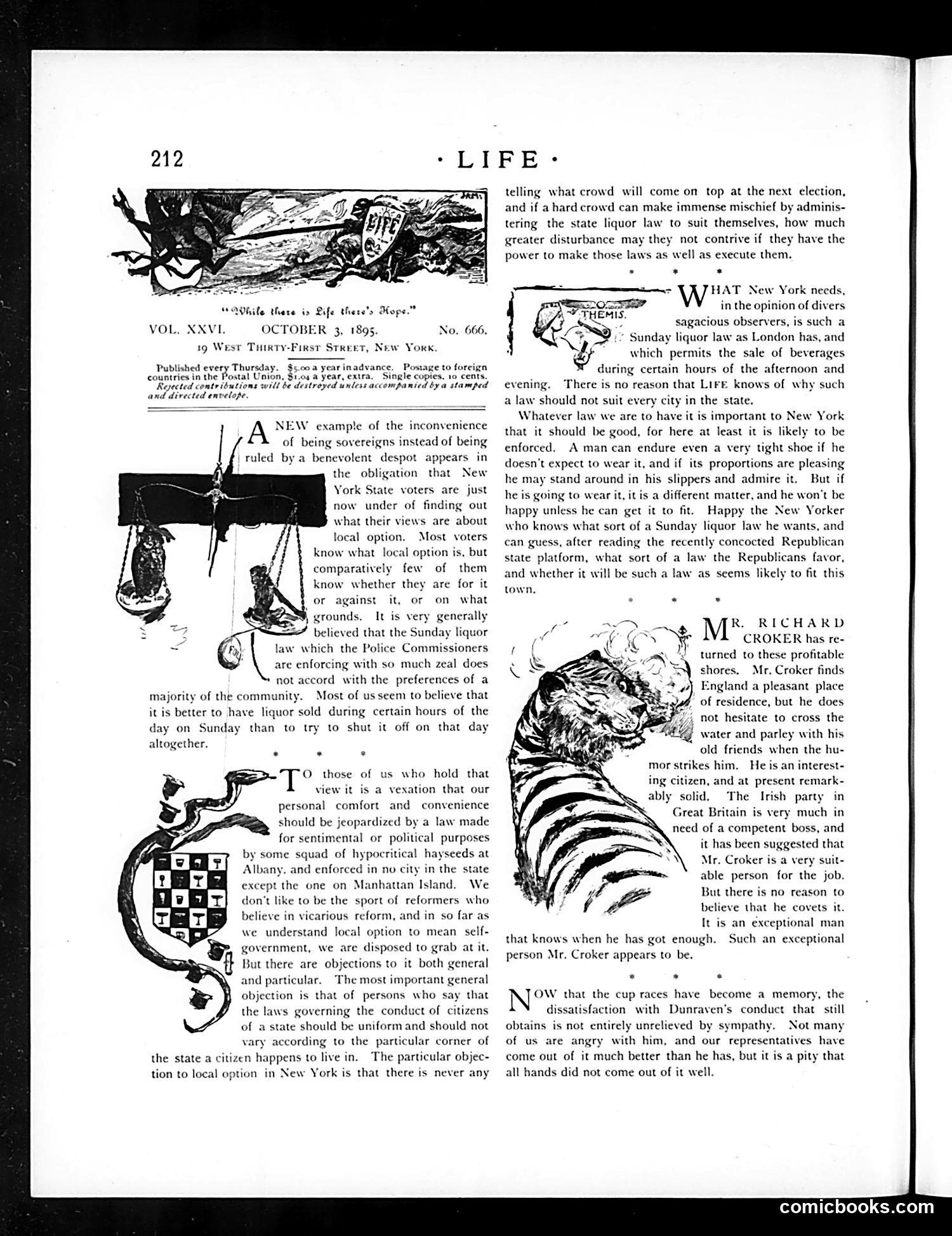
This page discusses New York State's Sunday liquor laws through political commentary and illustrations. The main cartoon depicts a scale of justice, satirizing the debate over whether liquor sales should be permitted on Sundays during specific afternoon hours. The text argues that New York needs a Sunday liquor law similar to London's—practical and enforceable rather than attempting total prohibition, which the author suggests is unrealistic. The piece criticizes both reformers pushing strict temperance and politicians who ignore local opinion. A second item discusses Mr. Richard Croker, an Irish political figure in Great Britain, praising him as a capable leader while noting his controversial status. The final paragraph mentions horse racing ("cup races") and criticism of someone named Dunraven's conduct. The satire targets inconsistent liquor regulation and hypocritical reform movements.
📄 Transcribed text from this page (OCR, searchable)
Machine-transcribed from the original scan — historical spelling and the odd misread are preserved.
- LIFE: “QWVhile there io Life there’s Hope.” VOL. XXVL OCTOBER 3, 1895. 1g West Tuirty-First Street, New York. No, 666, Published every Thursday, $5.00a year inadvance. Postage to foreign countries in the Postal Union, $1.04 a year, extra, Single copies, 10 cents, Reyected contributions will be destroyed untess accompanied bya stamped and directed envelope NEW example of the inconvenience of being sovereigns instead of being ruled by a benevolent despot appears in the obli; that New York State voters are just now under of finding out what their views are about local option, Most voters know what local option is, but comparatively few of them ation know whether they are for it what It is very generally or against it, or on rounds. believed that the Sunday liquor law which the Police Commissioners are enforcing with so much zeal does not accord with the preferences of a majority of the community. Most of us seem to believe that itis better to have liquor sold during certain hours of the day on Sunday than to try to shut it off on that day altogether. . . us who hold that ation that our personal comfort and convenience those of view it is a ve should be jeopardized by a law made for sentimental or politi by some squad of hypocritical hayseeds at Albany. and enforced in no city in the state he one on Manhattan Island. We don’t like to be the sport of reformers who believe in vicarious reform, and in so far as al purposes we understand local option to mean self- government, we are disposed to grab at it. But there are objections to it both general and particular. The most important general objection is that of persons who say that the laws governing the conduct of citizens of a state should be uniform and should not vary according to the particular corner of the state a citizen happens to live in. The particular objec- tion to local option in New York is that there is never any telling what crowd will come on top at the next election, and if a hard crowd can make immense mischief by adminis- tering the state liquor law to suit themselves, how much greater disturbance may they not contrive if they have the power to make those law well as execute them. * . HAT New York needs, in the opinion of divers a sagacious observers, is such a < * Sunday liquor law as London has, and by which permits the sale of beverages during certain hours of the afternoon and evening. There is no reason that LiFe knows of why such a law should not suit every city in the state. Whatever law we are to have it is important to New York that it should be good, for here at least it is likely to be A man can endure even a very tight shoe if he doesn’t expect to wear it, and if its proportions are pleasing he may stand around in his slippers and admire it. But if he is going to wear it, itis a different matter, and he won't be happy unless he can get it to fit. Happy the New Yorker who knows what sort of a Sunday liquor law he wants, and can guess, after reading the recently concocted Republican state platform, what sort of a law the Republicans favor, and whether it will be such a law as seems likely to fit this town, enforced. R. RICHARD CROKER has re- turned to these profitable shores. Mr. Croker finds England a pleasant place of residence, but he does not hesitate to cross the j water and parley with his old friends when the hu- mor strikes him. He is an interest- ing citizen, and at present remark: ably solid. The Irish party in Great Britain is very much in need of a competent boss, and it has been suggested that Mr. Croker is a very suit- able person for the job. But there is no reason to believe that he covets it. It is an exceptional man that knows when he has got enough. person Mr. Croker appears to be. Such an exceptional * . * OW that the cup races have become a memory, the dissatisfaction with Dunraven’s conduct that. still obtains is not entirely unrelieved by sympathy. Not many of us are angry with him, and our representatives have come out of it much better than he has, but it is a pity that all hands did not come out of it well. comicbooks.com