
A complete issue · 14 pages · 1895
Life — August 15, 1895
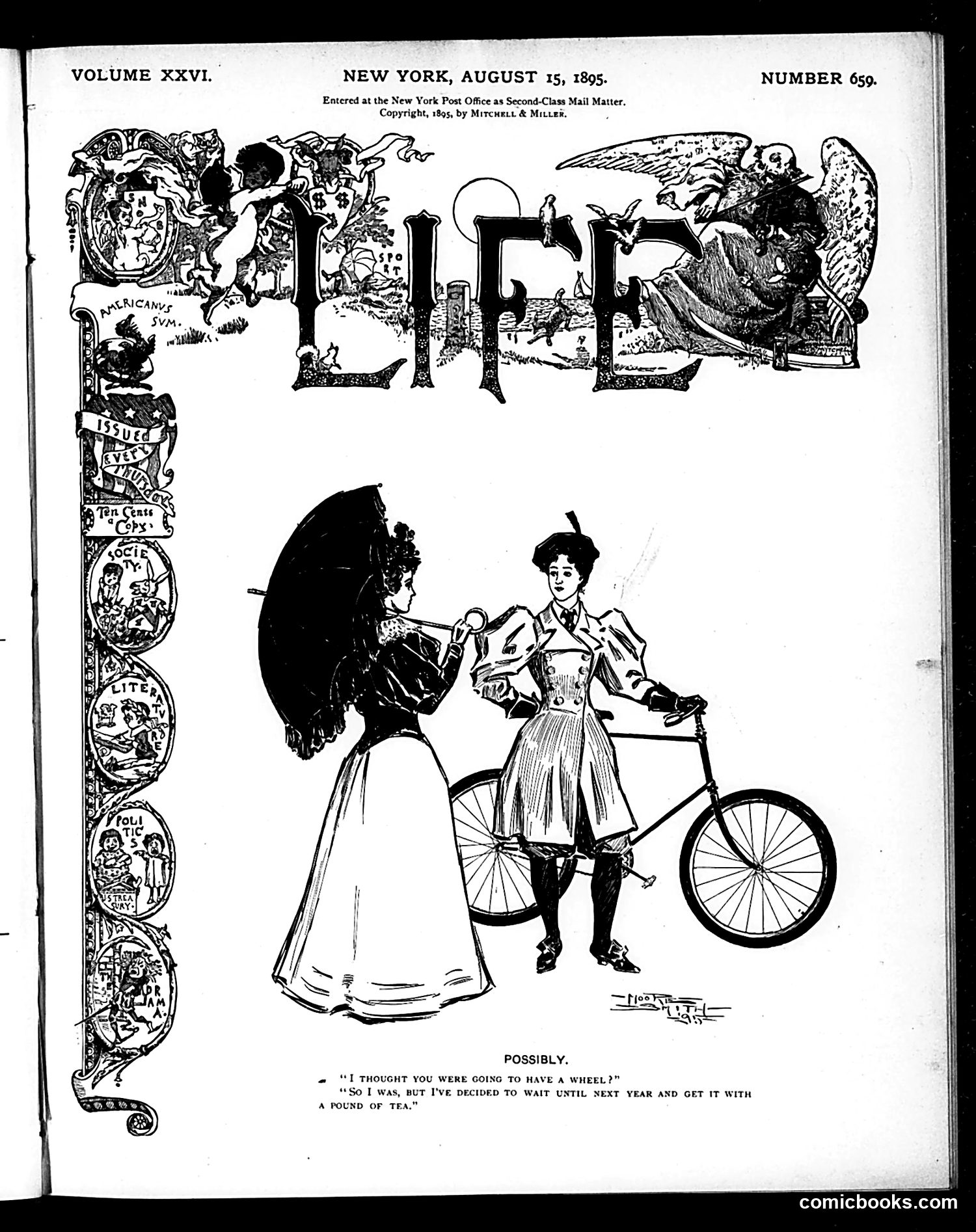
This page contains a single cartoon titled "Possibly." Two women are depicted: one holding an umbrella (shown from behind in a long coat), and another standing with a bicycle, wearing a jacket and hat. The dialogue reads: "I thought you were going to have a wheel?" / "So I was, but I've decided to wait until next year and get it with a pound of tea." This satirizes the cycling craze of the 1890s. Bicycles were expensive luxury items. The joke suggests that rather than purchase a costly bicycle outright, the woman plans to accumulate it gradually through tea purchases—likely referencing promotional offers where grocers bundled products. It mocks both the bicycle's high cost and the era's marketing tactics.
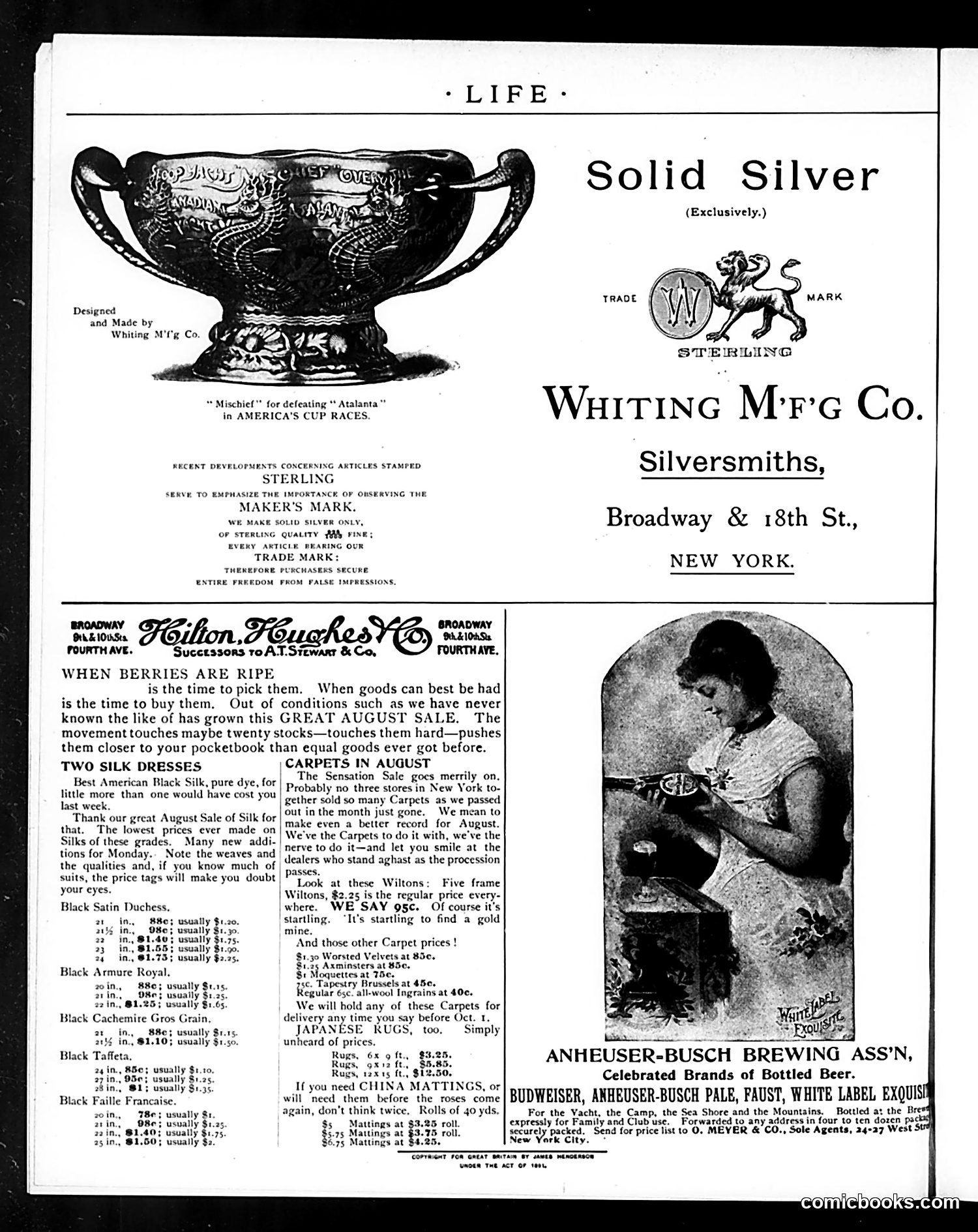
This page is primarily **commercial advertising** rather than political satire. The top features a **Whiting Manufacturing Company advertisement** for sterling silver goods, specifically a decorative bowl labeled "Mischief" that defeated "Atlanta" in America's Cup races—a reference to the actual yacht competition. The lower half contains **retail advertisements** from Hilton, Houk & Co. and Anheuser-Busch, promoting sales on silk dresses, carpets, and bottled beer. There is **no political cartoon or satire visible**. The page reflects Life magazine's mixed content model: combining product advertisements with editorial material. The Anheuser-Busch ad notably emphasizes distribution to "Family and Club use," reflecting late 19th/early 20th-century marketing practices before Prohibition.
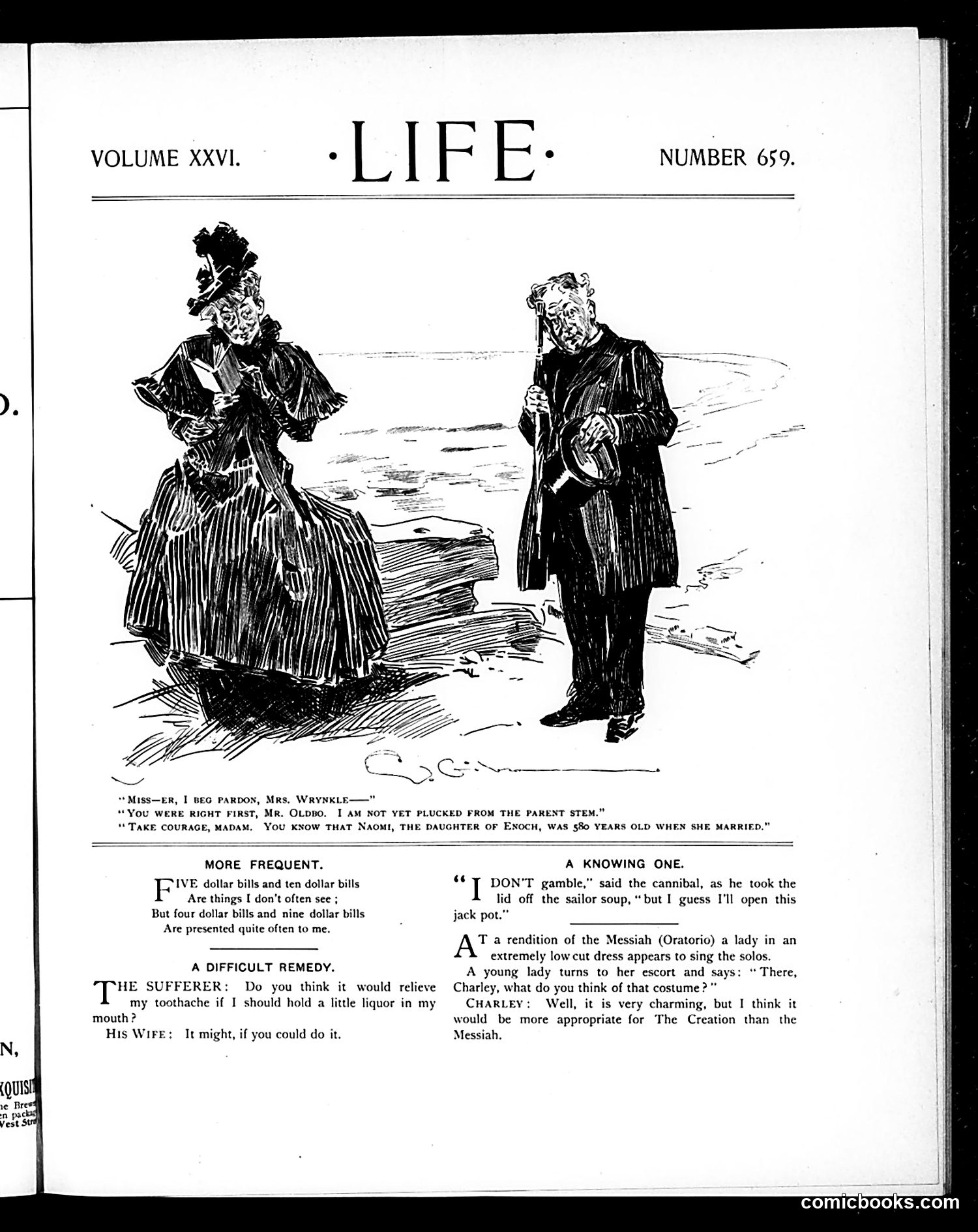
The main cartoon depicts two figures in conversation, with the caption indicating a debate about lineage and worthiness. The woman (left) appears to be Mrs. Wrinkle, and the man (right) is Mr. Oloro. The exchange concerns whether she possesses noble ancestry—specifically referencing Naomi, daughter of Enoch, from biblical genealogy. This satirizes social pretension about family lineage and aristocratic claims. The joke hinges on the contrast between claiming descent from ancient biblical figures versus contemporary social standing. The exaggerated facial caricatures emphasize the mockery of such genealogical vanity. Below are three brief humorous anecdotes: "More Frequent" about dollar bills, "A Difficult Remedy" about toothache treatment, and "A Knowing One" about operatic costume appropriateness—typical period humor pieces.
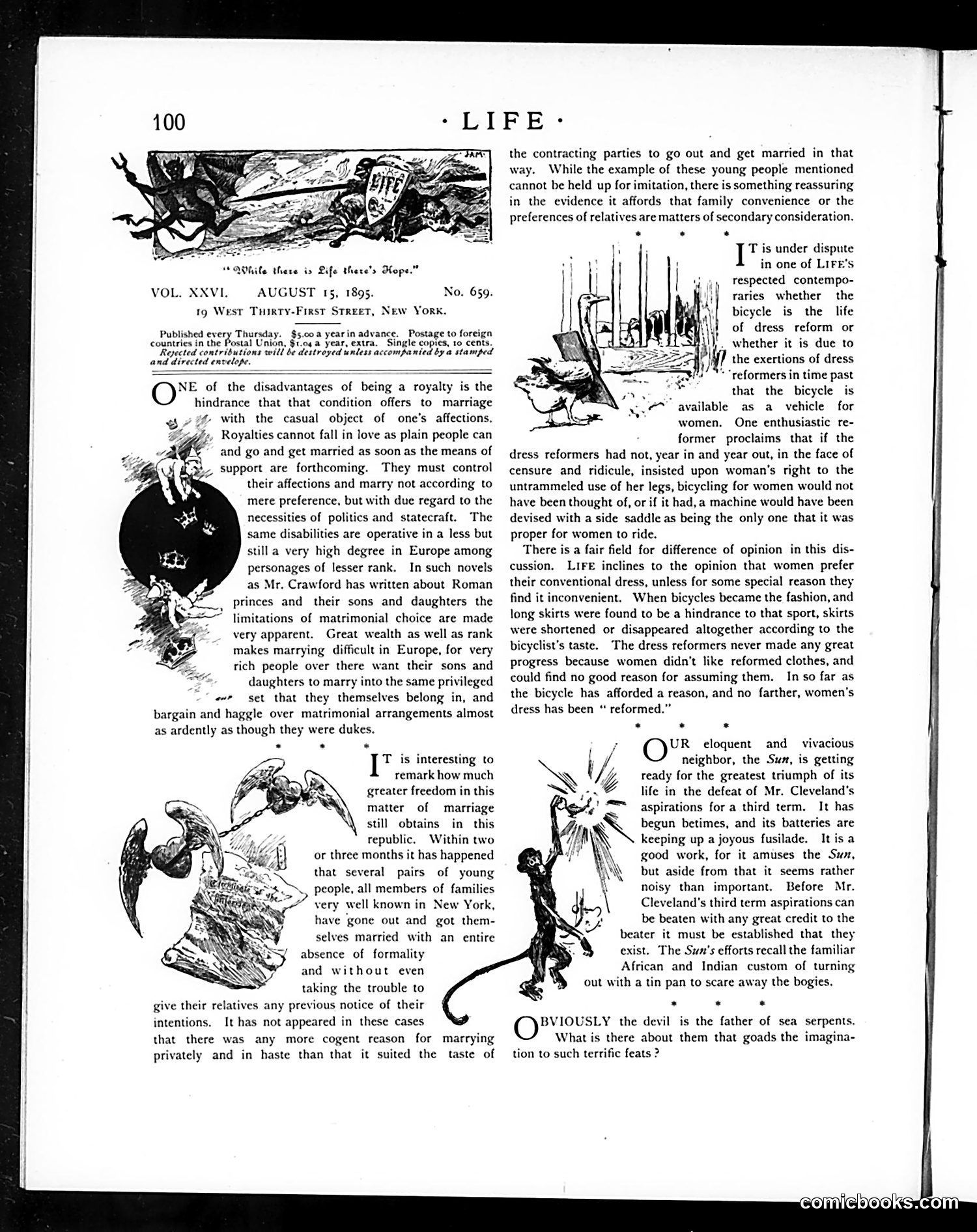
This page discusses marriage customs and dress reform, particularly regarding women's bicycle use. The text debates whether bicycles represent dress reform or are merely practical vehicles, referencing contemporary controversy over shortened skirts worn for cycling. The cartoons satirize this debate: one illustration shows a demon or devil figure (likely representing opposition to reform), while another depicts what appears to be a imp or mischievous creature disturbing a formal gathering—symbolizing how bicycle culture and dress reform disrupted Victorian social conventions. The article notes that dress reformers hadn't achieved much progress because women themselves resisted changes, but bicycles forced practical clothing adaptations. The final paragraph shifts to mocking Cleveland's political prospects, treating it as equally absurd to the reform debate. The overall satire targets Victorian anxieties about women's changing roles and freedoms.
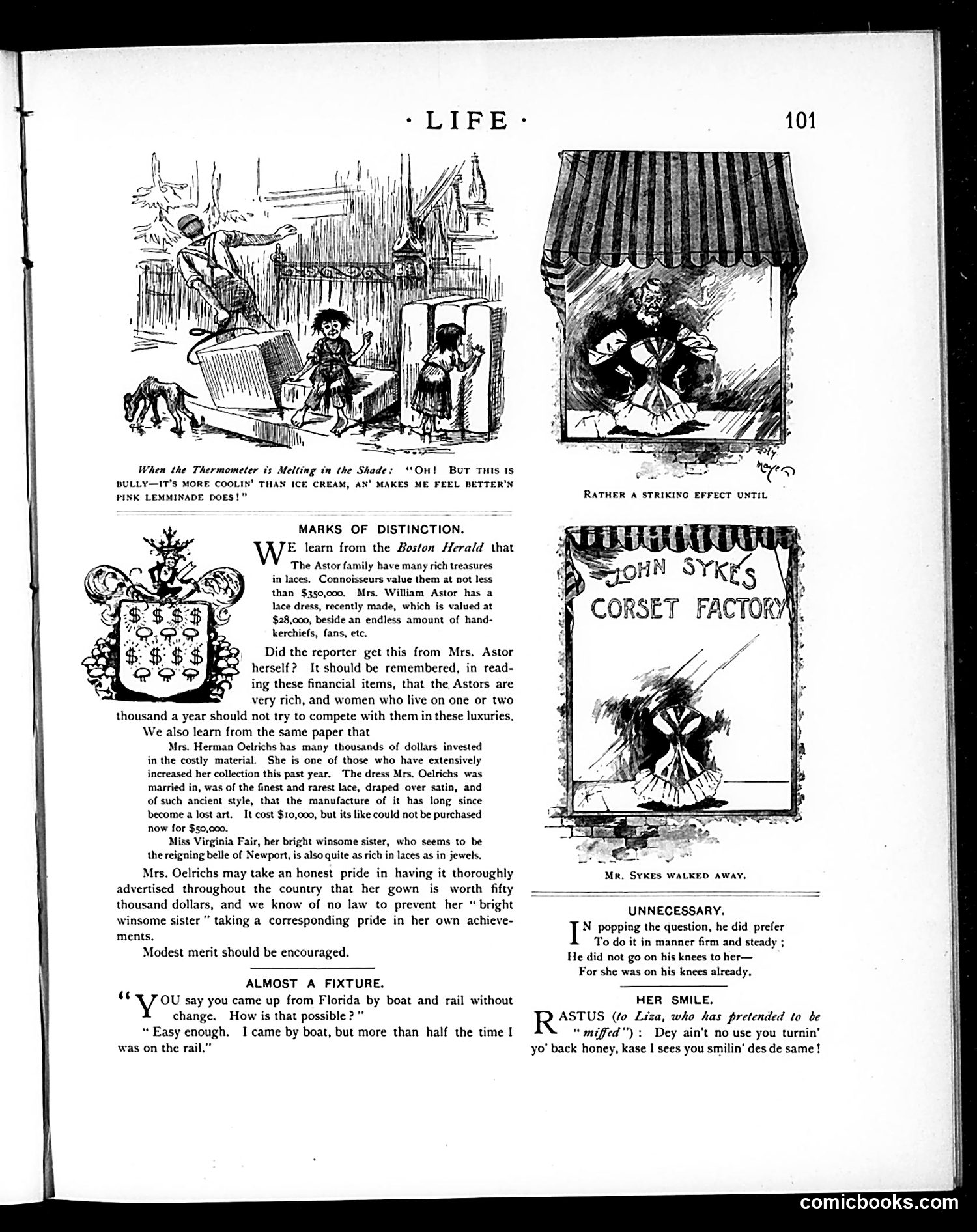
This page contains several humorous vignettes and social commentary typical of early 20th-century Life magazine satire. The top cartoon mocks children's exaggerated claims about summer heat and treats. The "Marks of Distinction" section satirizes wealthy families' ostentatious displays of luxury—specifically targeting the Astor and Oelrichs families, known for their extravagant lace collections and expensive wardrobes. The piece gently critiques how wealth is publicly advertised and the impossibility for ordinary people to compete. The "John Sykes Corset Factory" illustration appears to be a satirical advertisement or social commentary piece, though its specific target remains unclear from context. The remaining poems and short pieces offer gentle romantic and social humor typical of the magazine's content, with no clearly identifiable political figures or specific dated references.
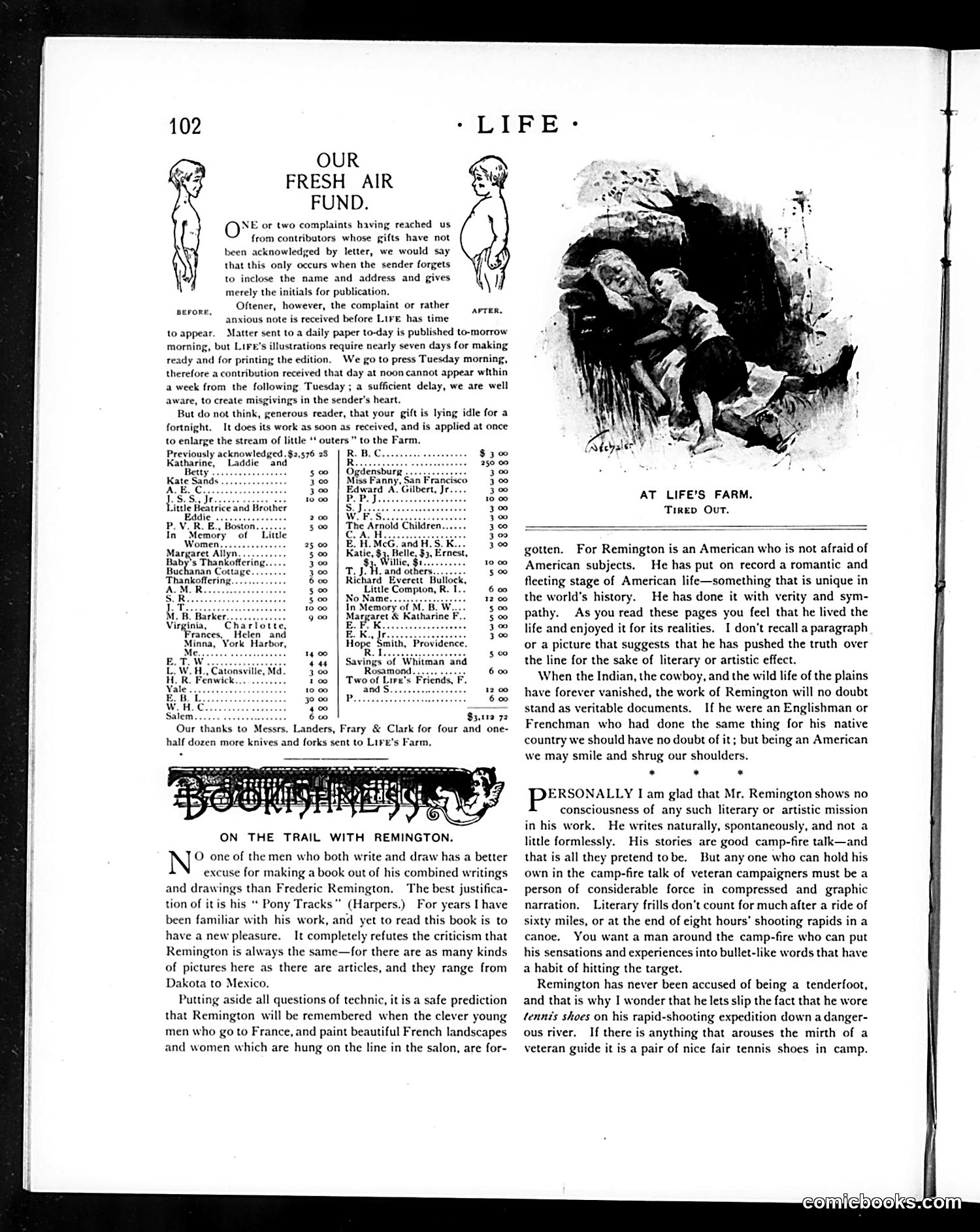
**Top Section - "Our Fresh Air Fund":** This satirizes Life magazine's charitable acknowledgment delays. The "before" and "after" drawings show a thin figure transforming into a robust one, humorously suggesting the magazine's Fresh Air Fund (a program sending urban children to countryside) produces dramatic physical improvement. The text explains that contributions received Monday cannot appear in Tuesday's edition due to printing schedules, addressing reader complaints about unacknowledged gifts. It's gentle self-mockery about administrative lag. **Bottom Section - "On the Trail with Remington":** This discusses Frederic Remington, the famous American artist-writer known for Western and frontier subjects. The author praises Remington's authenticity and natural storytelling style, defending him against charges of prioritizing artistic mission over accuracy. The passage emphasizes Remington's credibility as a recorder of American frontier life, noting his refusal to embellish despite artistic opportunity.
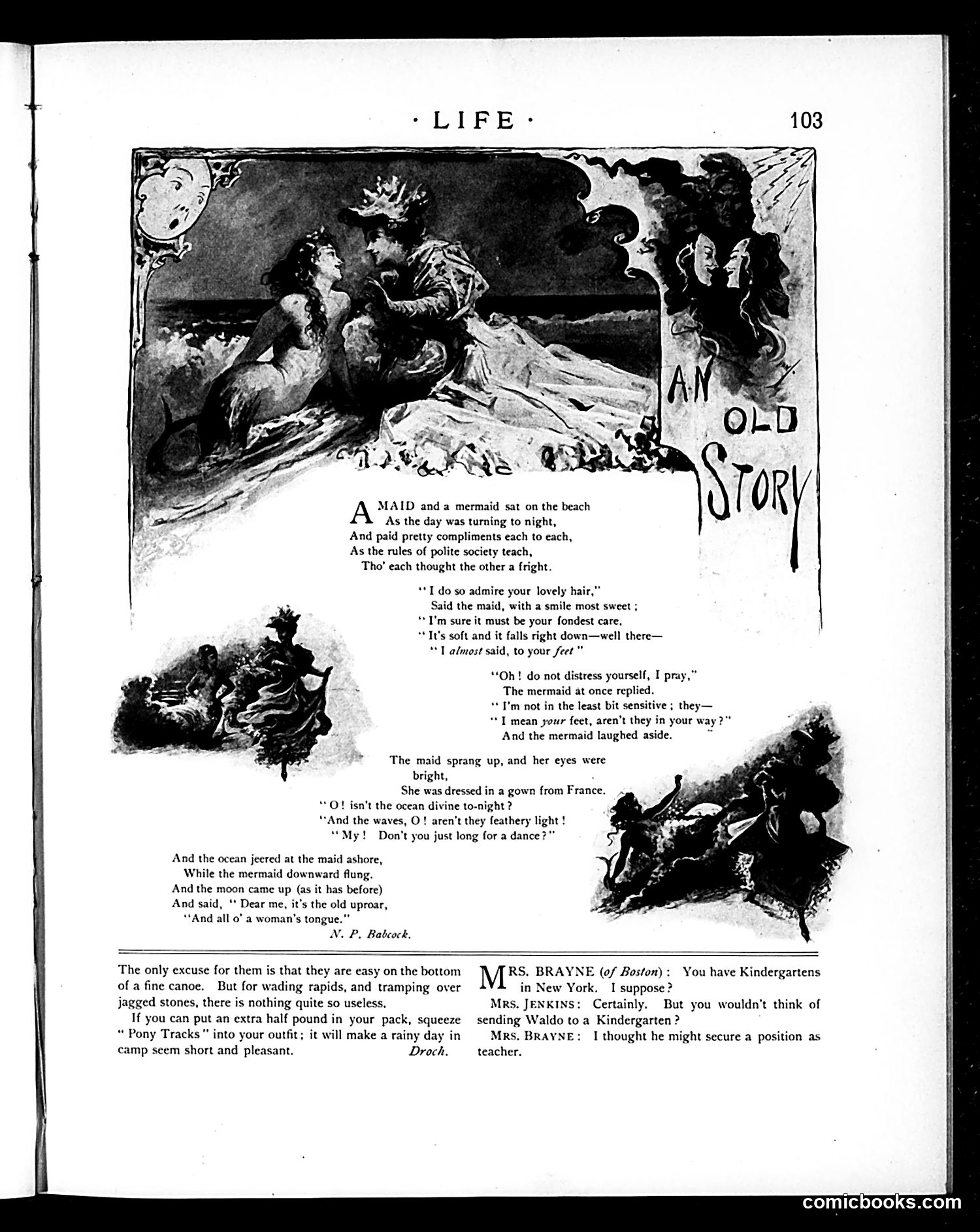
This page contains **"An Old Story,"** a romantic poem illustrated with classical engravings. The narrative depicts a maid and mermaid on a beach exchanging compliments—the maid praising the mermaid's hair, the mermaid responding that the maid's feet are unremarkable. The poem concludes with the moon personified as an old gossip, commenting on "a woman's tongue." The satire targets **polite society courtship rituals** of the era, mocking the insincere flattery and social pretense exchanged between suitors. By setting the scene with a mermaid (supernatural) and having celestial bodies judge their behavior, the author ridicules how artificial and performative romantic interactions had become among the genteel classes. Below is an unrelated practical advice column about camping.
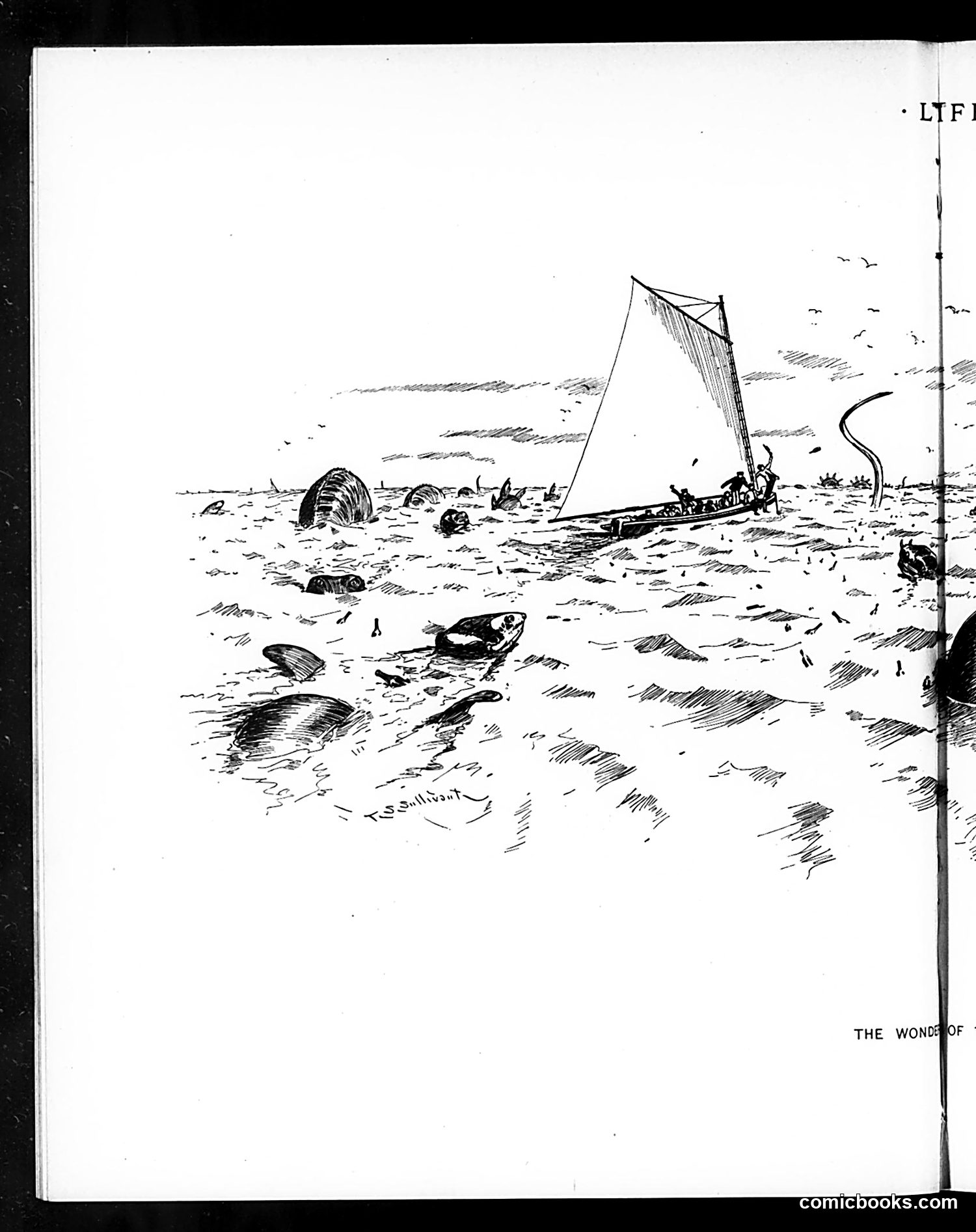
This page contains a pen-and-ink sketch of a beach scene with several boats and figures scattered across sand. The image shows what appears to be a sailing vessel with a large sail, smaller rowboats, and various people on a shoreline. The style is characteristic of early 20th-century illustration. The visible text reads "THE WONDE OF" at the bottom right, which appears to be a partial caption or title (likely "WONDER OF" with text cut off). **However, without the complete caption or surrounding context, I cannot definitively identify what specific political or social satire this cartoon references.** The sketch itself depicts a mundane beach scene, but the satirical meaning—if any—depends on the missing text and context from *Life* magazine's editorial framework at the time of publication.
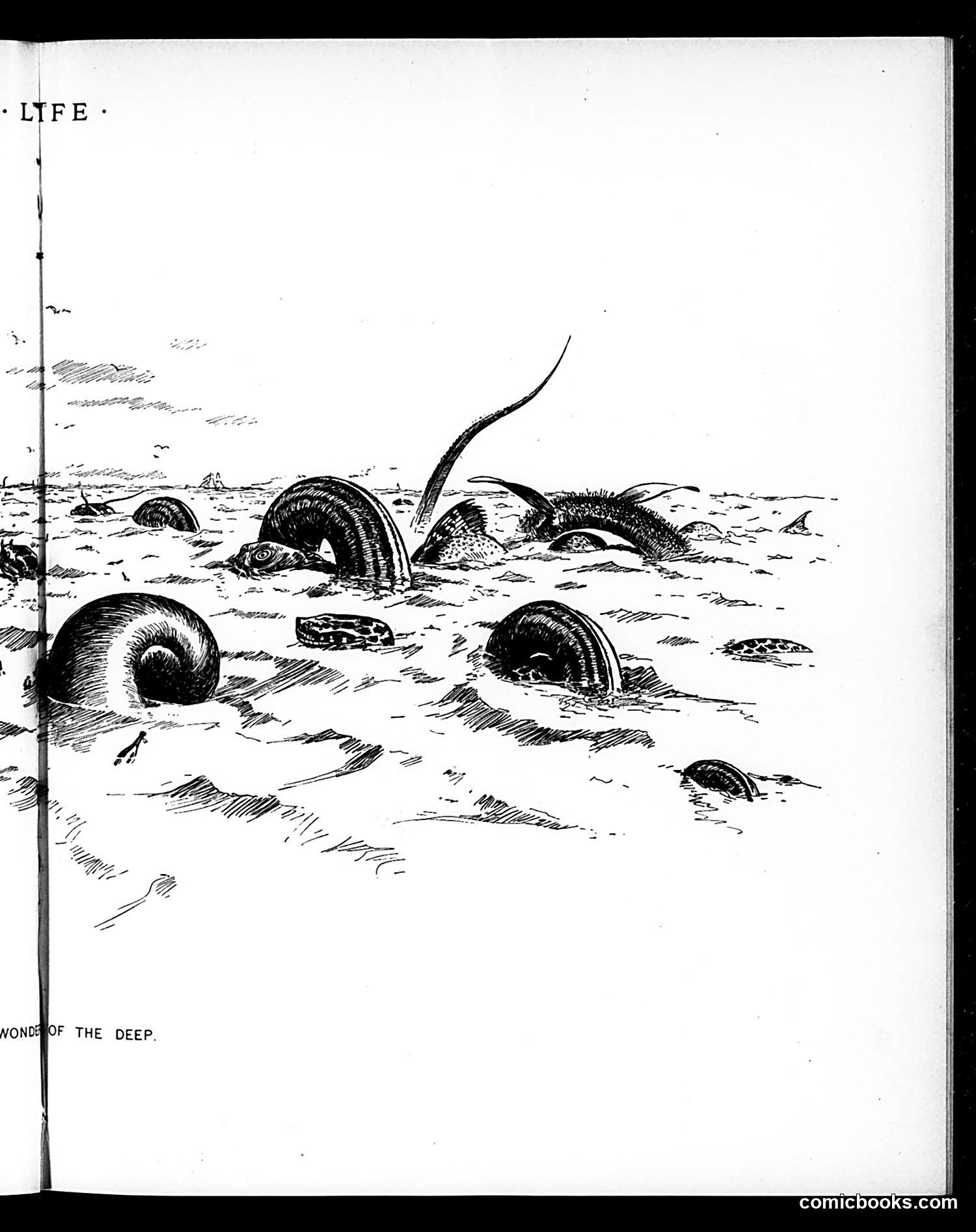
This page from *Life* magazine shows an illustration titled "Wonders of the Deep" depicting various sea creatures on the ocean floor. The image features several spiral-shelled ammonites or nautiluses of different sizes, along with other marine organisms and what appears to be a small fish. The piece appears to be a straightforward natural history or scientific illustration rather than political satire. It showcases the exotic and fantastical appearance of deep-sea life, which would have fascinated contemporary readers unfamiliar with marine biology. The detailed cross-hatching technique emphasizes the alien nature of these creatures to land-dwellers, presenting them as curiosities worthy of wonder and study.
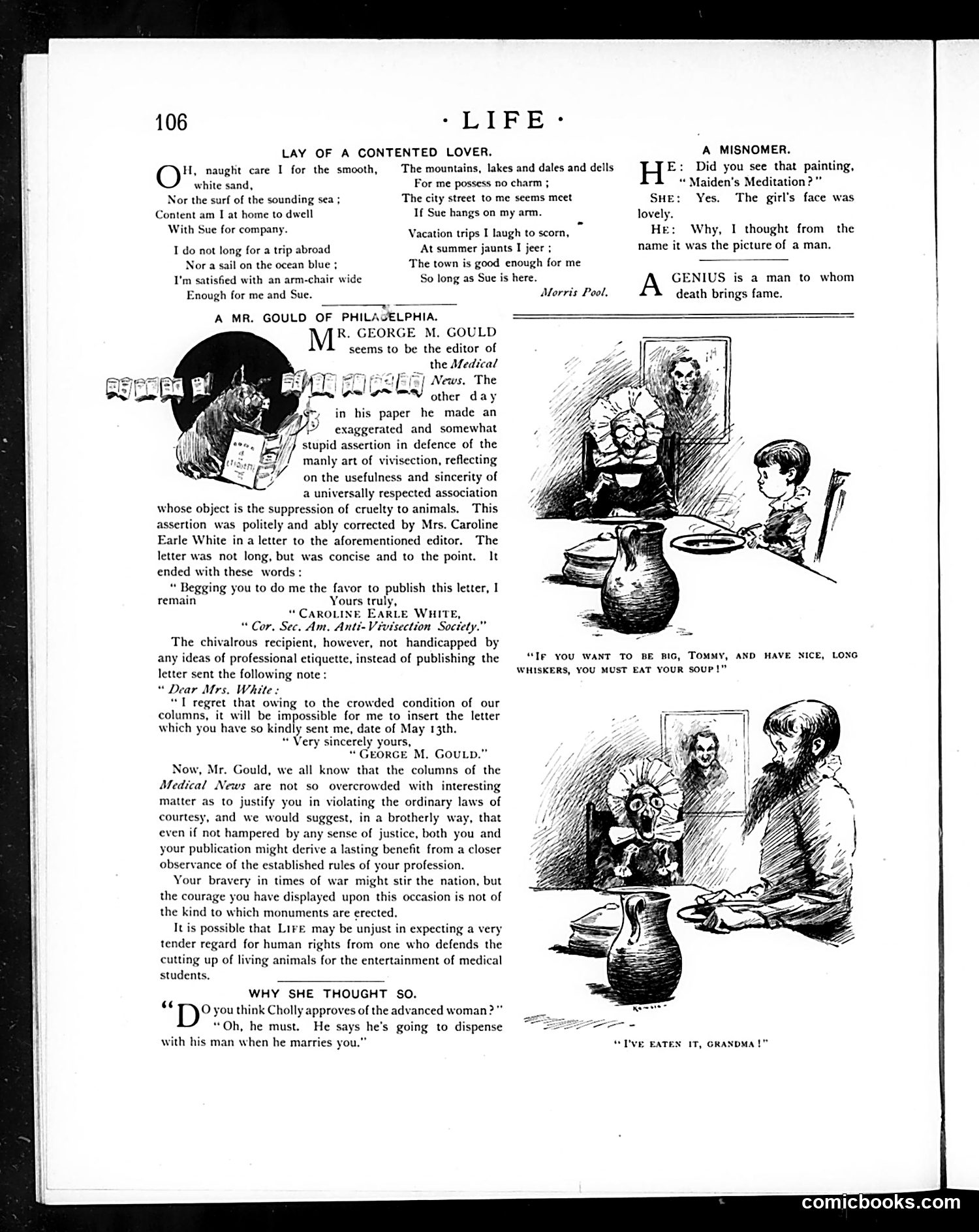
This page contains several short satirical pieces and illustrations: **"A Mr. Gould of Philadelphia"** features a caricatured man reading newspapers, satirizing Mr. George M. Gould's defense of vivisection (animal dissection for medical education) in the *Medical News*. The text criticizes his "exaggerated and somewhat stupid assertion," noting that Caroline Earle White of the Anti-Vivisection Society corrected him. The satire mocks both Gould's position and the editor's refusal to publish White's rebuttal due to "crowded conditions." **The two cartoons on the right** show a child and grandmother at mealtime. A skeletal Death figure looms in a portrait above. The captions play on encouraging children to eat soup ("eat your soup") to grow healthy, with dark irony about mortality—"I've eaten it, grandma!" These pieces collectively satirize medical practices and mortality through humor.
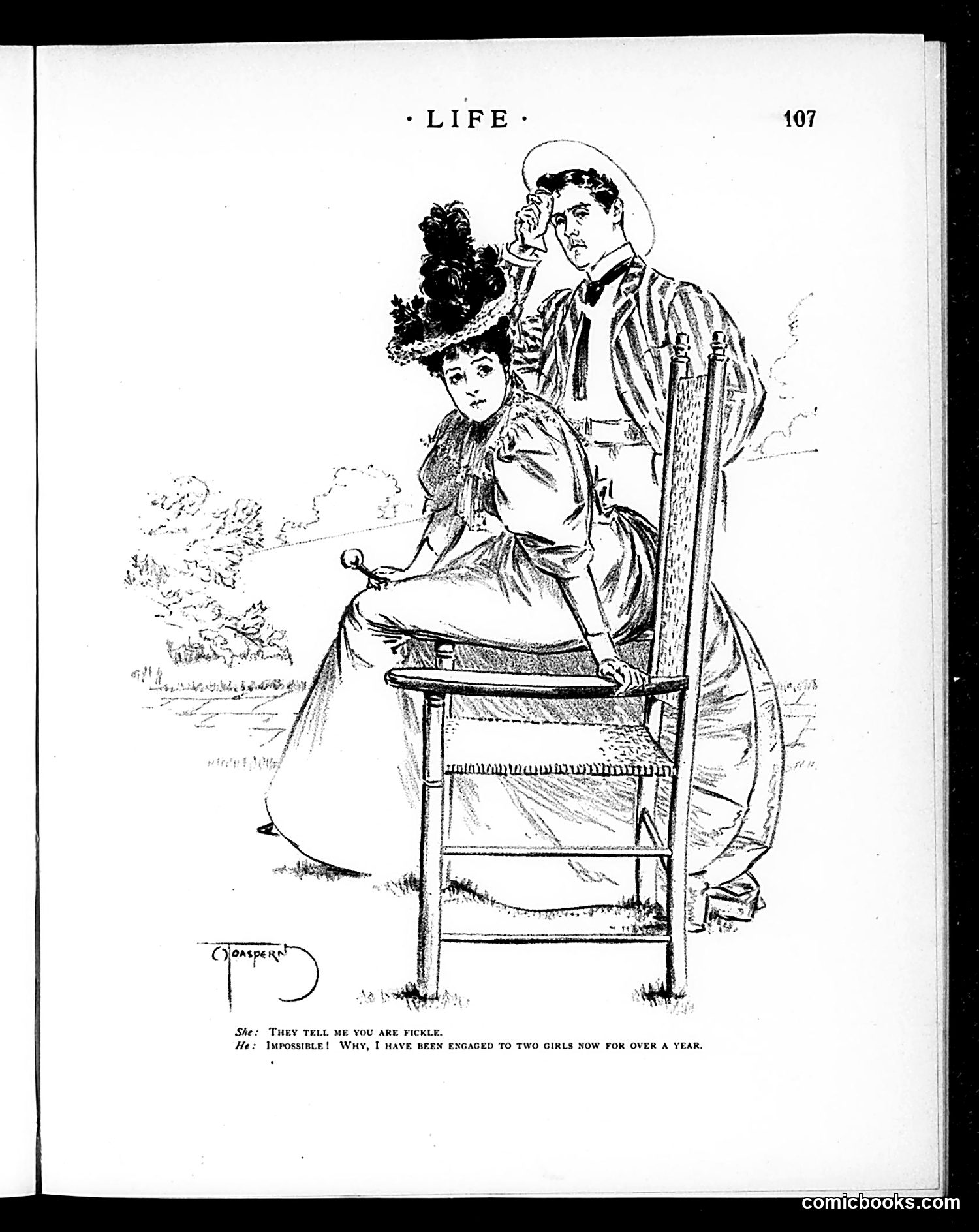
This is a single-panel cartoon satirizing male romantic fickleness. The drawing shows a man on a ladder with a woman seated below, looking up at him skeptically. The caption reads: "She: They tell me you are fickle. / He: Impossible! Why, I have been engaged to two girls now for over a year." The joke relies on the contradiction between denying fickleness while simultaneously admitting to being simultaneously engaged to two different women for an extended period—the definition of fickle behavior. The ladder positioning may suggest he's literally trying to escape or elevate himself from an awkward social situation. The satire targets male hypocrisy and the social acceptance of men maintaining multiple romantic commitments during this era.
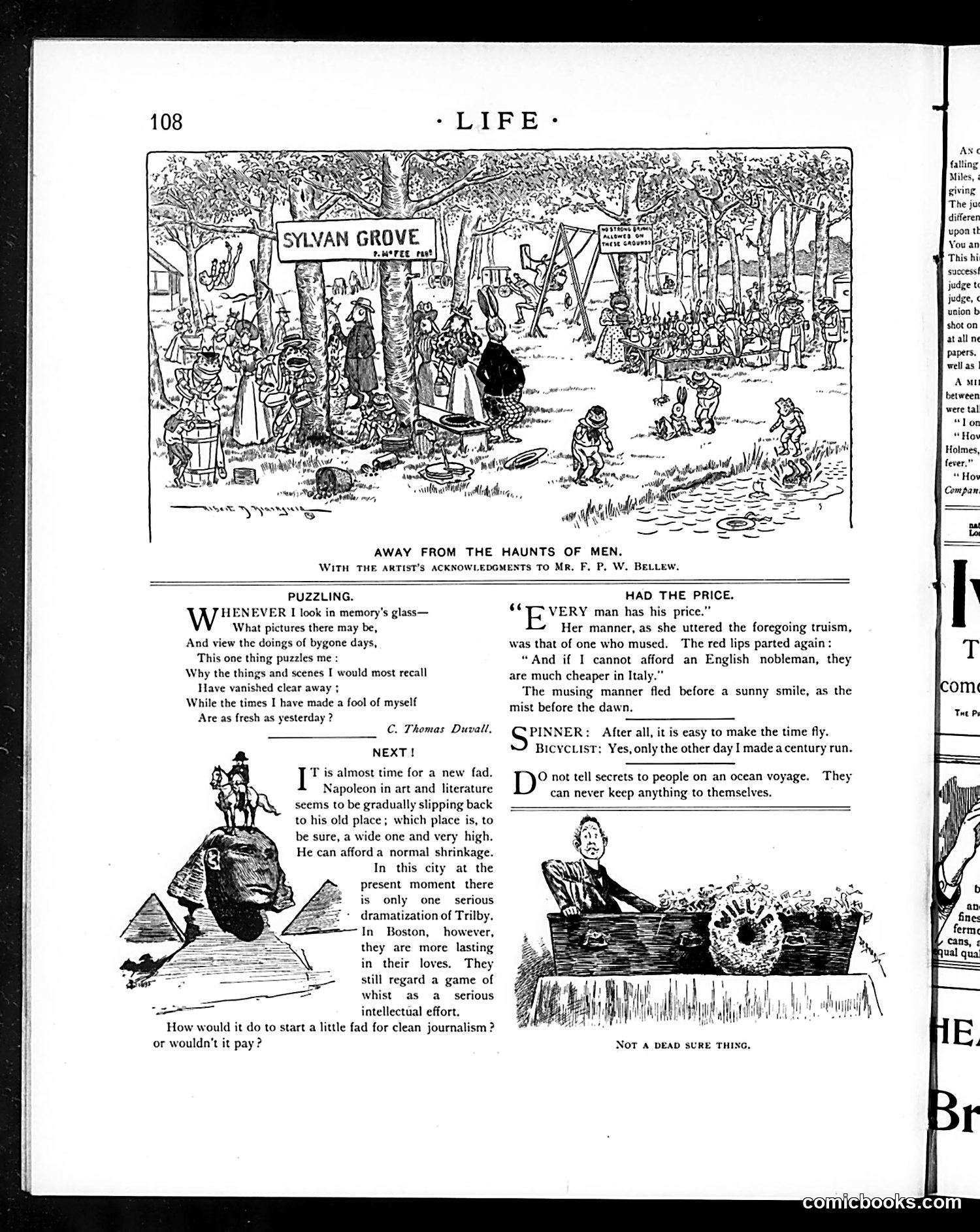
This page from *Life* magazine contains several brief satirical pieces: **Top cartoon**: "Sylvan Grove" depicts a picnic or outdoor gathering, captioned "Away from the Haunts of Men"—likely satirizing the popular Romantic ideal of escaping urban life for nature. **"Puzzling"**: A humorous poem about human memory—we forget important things but vividly remember our embarrassing moments. **"Next!"**: Social satire mocking the fickleness of cultural trends. It notes that Napoleon obsession is fading in New York but persists in Boston, where people treat whist (a card game) as serious intellectual work. The closing jab proposes starting a "fad for clean journalism"—suggesting contemporary newspapers lack honesty. **"Had the Price"**: A cynical exchange where a woman discusses acquiring romantic companionship, suggesting English noblemen are expensive but Italian men cheaper. **Bottom cartoons**: Brief comic exchanges about bicycling and ocean voyage gossip, presenting conventional witticisms. The overall tone reflects turn-of-century American magazine humor: satirizing social pretension, romantic excess, and journalistic ethics.
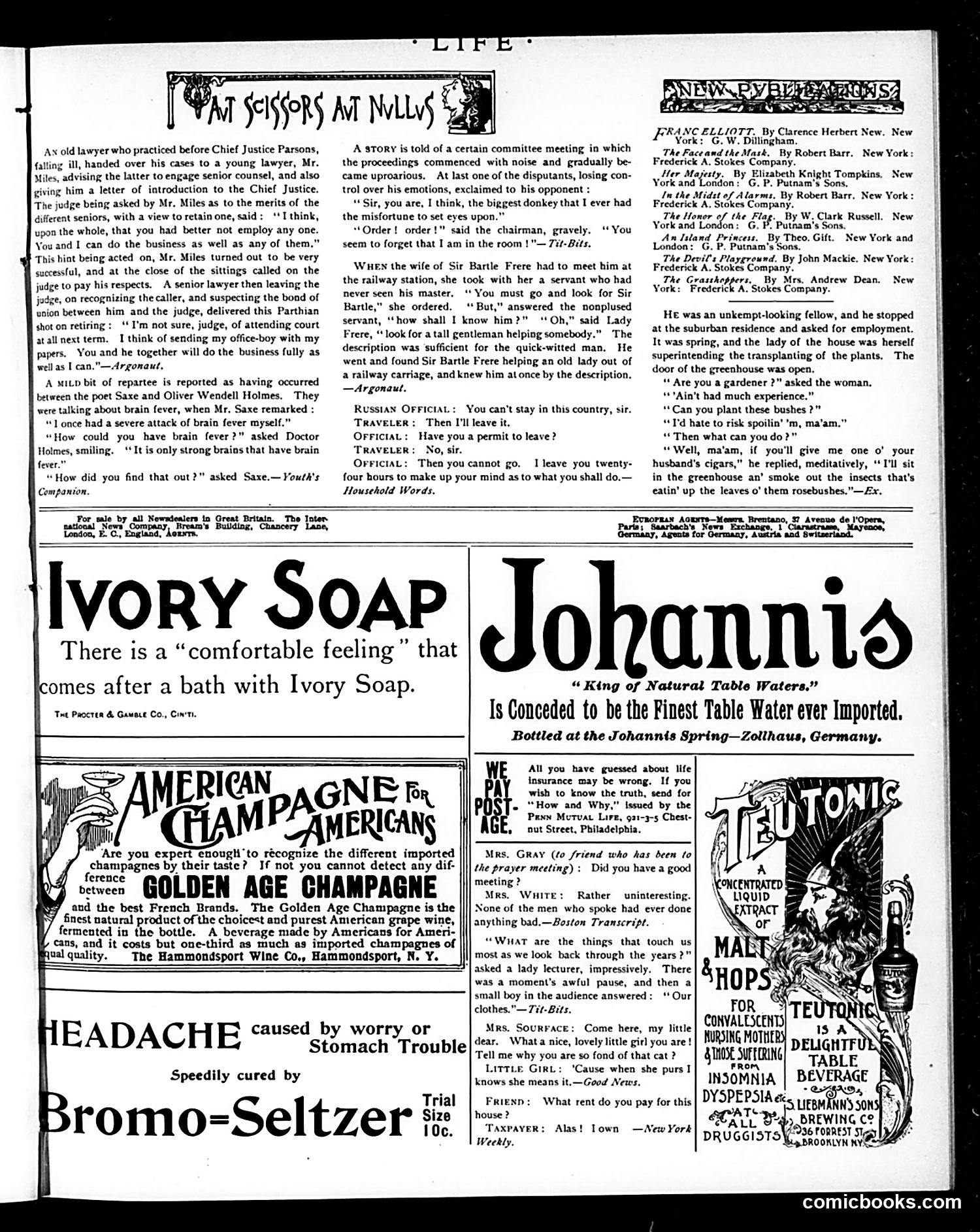
This page consists primarily of **short humorous anecdotes and advertisements** rather than political cartoons. The text pieces are light comedic stories: one about a lawyer and Chief Justice Parsons, another about a noisy committee meeting where the chairman forgets his own rule about order, and anecdotes involving poets Saxe and Oliver Wendell Holmes joking about brain fever. The only satirical content appears to be a brief dialogue labeled "Russian Official" depicting a Russian bureaucrat refusing to let a traveler leave the country without proper permits—a likely jab at Russian autocracy and restrictive governance, though details are sparse. The page is dominated by **period advertisements** for Ivory Soap, Johannis table water, Golden Age Champagne, Bromo-Seltzer, and Teutonic malt beverage—typical of Life's revenue model. Without clearer visual cartoons or more explicit political references, the page functions primarily as entertainment and advertising rather than serious social commentary.
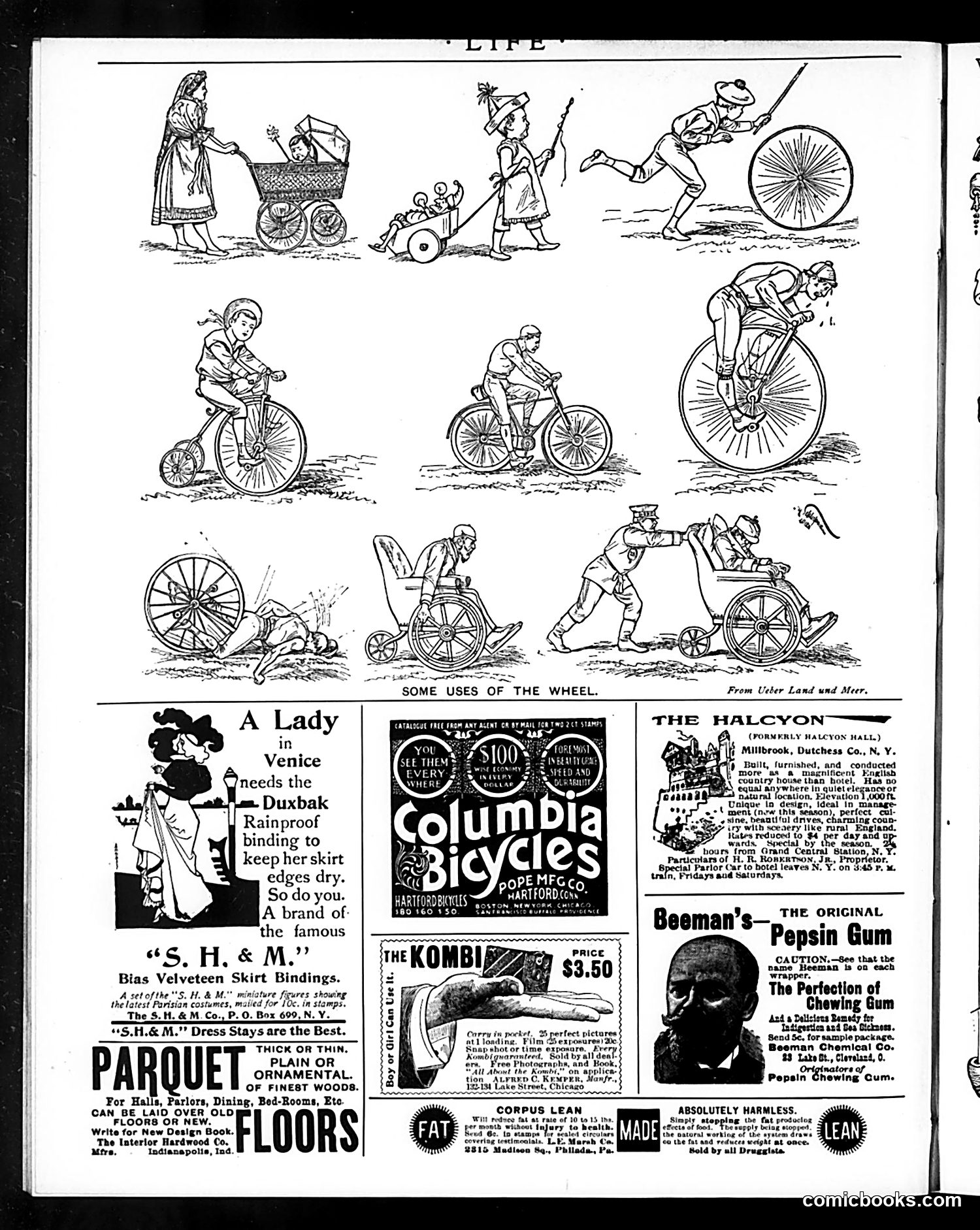
This satirical illustration, reprinted from the German publication *Ueber Land und Meer*, mocks the bicycle craze of the late 19th century. The eight panels show increasingly absurd applications of wheels to everyday life: women pushing prams, children in wheeled carriages, adults performing acrobatic tricks on bicycles, and someone attempting to ride a bicycle while sitting backwards. The joke targets the contemporary obsession with bicycles as a solution to modern transportation. By depicting ridiculous scenarios—including what appears to be someone launching themselves off a wheel—the cartoonist satirizes how enthusiastically people had embraced this new technology, treating it as a universal answer to mobility problems. The page is otherwise filled with period advertisements for bicycle manufacturers, rainproof skirt bindings, parquet floors, and Beeman's Pepsin Gum, typical of *Life* magazine's commercial content from this era.